REVIEW 62 references
A spectral-vanishing-viscosity stabilization of a higher-order consistent splitting scheme for the Navier-Stokes equations
T0 review · reviewed 2026-07-30 · grok-4.5
Pith's one-line read A spectral vanishing viscosity term keeps a high-order Navier–Stokes splitting scheme stable at high Reynolds number without losing its design accuracy.
desk verdict Clean fix of a real high-Re failure in Huang–Shen splitting; theory is honest but does not explain the Re=10^4 runs. read the letter →
The pith
A machine-rendered reading of the paper's core claim, the machinery that carries it, and where it could break.
The reading
What carries the argument
The directional SVV operator S_N = −ε_N div(Q_N ∇) built from the Maday–Kaber–Tadmor kernel applied separately in each coordinate; it is diagonal in the simultaneous-diagonalization eigenbasis, positive-semidefinite, free on resolved modes, and supplies the ν-independent high-mode coercivity in the energy and error estimates.
What would settle it
Run the stabilized scheme and the bare scheme on the manufactured solution or Kelvin–Helmholtz problem at Re=10^4 with the same spectral resolution: if the stabilized run loses design order or still blows up while matching the reference diagnostics fails, the central claim is false.
Extended reading notes
Core claim
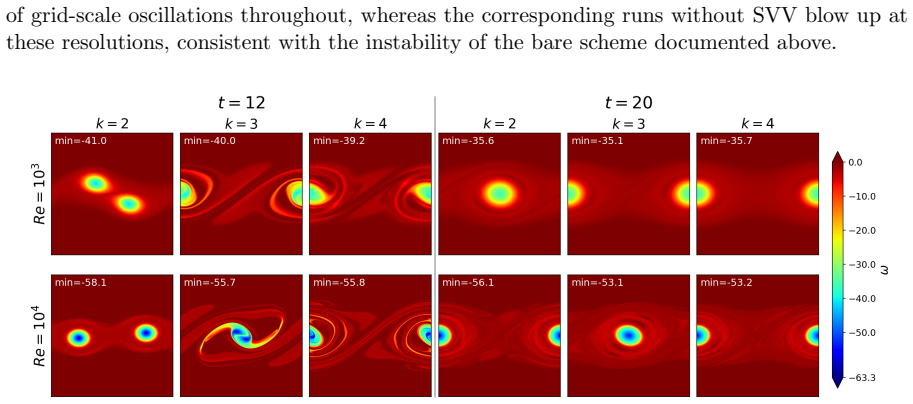
Augmenting the Huang–Shen BDF–IMEX consistent splitting scheme with a directional Maday–Kaber–Tadmor spectral vanishing viscosity operator yields a scheme that remains stable and optimally accurate at high Reynolds number: SVV contributes a viscosity-independent coercive term on the high modes in the energy identity, the design temporal orders k=2,3,4 are retained, and the bare scheme’s breakdown at Re=10^4 is eliminated in manufactured, Kovasznay, and Kelvin–Helmholtz tests.
Load-bearing premise
The analysis assumes a strong solution with high temporal regularity on a smooth domain, which is not guaranteed for the high-Reynolds flows that motivate the method.
Editorial extensions
If this is right
- High-order fully decoupled BDF–IMEX splitting becomes a practical option for under-resolved high-Re spectral computations without changing the per-step cost.
- The same directional SVV correction carries over unchanged to every order k=2,3,4 and to Fourier–cosine/sine as well as Legendre–Galerkin bases.
- Error constants still carry inverse powers of viscosity; SVV controls only high modes, so low-mode convection absorption remains ν-tied.
- Three standard 2-D benchmarks (manufactured solution, perturbed Kovasznay, Kelvin–Helmholtz) become reliable testbeds for the stabilized family.
Reading between the lines
- A quantitative low/high-mode split of the trilinear term could remove the remaining ν^{-5} factor and close the gap between the proved bound and the observed robustness.
- The same diagonal SVV correction should extend immediately to three space dimensions once a tensor eigenbasis is available.
- Adaptive or defect-corrected choices of ε_N and the cut-off m_N could lift the mild accuracy floor seen for k=3,4 without sacrificing stability.
Editorial analysis
A structured set of objections, weighed in public.
Circularity Check
No significant circularity: energy/error analysis is a standard a-priori estimate with an added PSD operator; numerics are checked against external or manufactured references.
full rationale
The load-bearing claim is Theorem 3.1 (stability and error bound (17) for the SVV-stabilized scheme (9)+(3b)). Its proof is a classical energy estimate: take the inner product of the discrete momentum equation with −δt ΔC_k(·), invoke G-stability of the shifted BDF (Lemma 3.5, from Huang–Shen [30], non-overlapping authors), B_k–C_k coercivity (Lemma 3.6), the new SVV coercivity (Lemma 3.7, obtained mode-by-mode by multiplying the same algebraic inequality by bQ_ij ≥ 0), Young absorption of convection/Stokes-pressure with ν-tied weights, and discrete Gronwall. The SVV operator S_N = −ε_N Q_N Δ is an independently defined symmetric positive-semidefinite spectral multiplier (Definition 2.2, Maday–Kaber–Tadmor kernel applied directionally); it is not fitted to the target error nor defined from the quantity being bounded. D_svv is a consistency remainder controlled by the exact solution, not a fitted prediction. Numerical claims are falsifiable against a manufactured solution, the classical Kovasznay base flow, and the external Kelvin–Helmholtz integral diagnostics of Schroeder et al. [47]. Self-citations ([1], [2]) supply background comparisons only and are not used to force uniqueness or close the main estimate. The acknowledged gap that the ν^{-5} Gronwall factor makes the theorem non-informative at Re = 10^4 is a usefulness/correctness issue, not circularity: the derivation does not reduce to its inputs by construction.
Assumptions & free parameters
free parameters (3)
- C_svv (SVV amplitude) =
1 (production)
- m_N (SVV cut-off) =
⌈√M⌉
- β_k (Taylor-shift parameters) =
3,6,9
assumptions (6)
- domain assumption Assumption 2.1: strong solution with high temporal regularity on a C³ domain (u ∈ L^∞(H²∩H0¹), ∂_t^k u ∈ L^∞(H²), etc.)
- standard math G-stability of the shifted BDF multipliers (Lemma 3.5, from Huang–Shen / Dahlquist)
- standard math B_k–C_k coercivity with η_k = 0.71 (Lemma 3.6, from Huang–Shen)
- standard math Stokes-pressure estimate (Lemma 3.3, Liu–Liu–Pego)
- standard math Trilinear estimates of Lemma 3.4 / (20) for H² ∩ H0¹ vector fields
- domain assumption Directional Maday–Kaber–Tadmor kernel with ε_N ∼ 1/M, m_N ∼ √M yields a self-adjoint positive-semidefinite operator that vanishes on low modes
invented entities (1)
-
SVV-stabilized Huang–Shen scheme (eq. 9)
independent evidence
Cite this review
Pith. "Pith review of A spectral-vanishing-viscosity stabilization of a higher-order consistent splitting scheme for the Navier-Stokes equations." pith.science (2026). https://pith.science/paper/LAY5JIMV
@misc{pith2026260723720,
  author       = {Pith},
  title        = {Pith review of: A spectral-vanishing-viscosity stabilization of a higher-order consistent splitting scheme for the Navier-Stokes equations},
  year         = {2026},
  howpublished = {\url{https://pith.science/paper/LAY5JIMV}},
  note         = {Machine review of arXiv:2607.23720}
}
read the original abstract
Huang and Shen developed a novel class of high-order BDF-IMEX consistent-splitting schemes for the incompressible Navier-Stokes equations, giving the first rigorous stability and error analysis for a fully decoupled splitting scheme of temporal order higher than two. Extending their analysis from unit viscosity to arbitrary viscosity, this work reveals that the error upper bound coefficient contains inverse powers of the viscosity. Our numerical experiments show that the scheme can break down at high Reynolds number. To save the scheme from this failure, we stabilize it by adding to the velocity update a symmetric positive-semidefinite spectral vanishing viscosity operator, built from the directionally applied Maday-Kaber-Tadmor kernel, which selectively damps the high, under-resolved modes at no additional asymptotic cost and leaves the structure of the error analysis intact. We establish stability and error estimates for the stabilized scheme in which the spectral vanishing viscosity provides viscosity-independent coercive control of the high modes. Three two-dimensional tests demonstrate the robustness and accuracy of the stabilized scheme. For a manufactured solution, the stabilized scheme retains its design order for k=2,3,4, whereas the unstabilized scheme diverges. For a perturbed Kovasznay flow, it accurately resolves the boundary layer at Re=10^4 and drives the perturbation back to the steady state, while the unstabilized scheme blows up. For the Kelvin-Helmholtz instability problem, it reproduces the reference integral diagnostics throughout the reliable regime, whereas the unstabilized scheme produces spurious solutions or blows up.
Figures


Figures from the paper (8 more)



Reference graph
Works this paper leans on
-
[1]
Nader Alhomsi, Jiahong Wu, and Xiaoming Zheng
M. Nader Alhomsi, Jiahong Wu, and Xiaoming Zheng. Viscosity in error upper bound for a consistent splitting scheme of the Navier–Stokes equations.Journal of Computational and Applied Mathematics, page 117965, 2026. ISSN 0377-0427. doi: 10.1016/j.cam.2026.117965. 28
arXiv 2026
-
[2]
Nader Alhomsi, Jiahong Wu, and Xiaoming Zheng
M. Nader Alhomsi, Jiahong Wu, and Xiaoming Zheng. A consistent-splitting generalized scalar auxiliary variable scheme for the perturbed Boussinesq system.https://arxiv. org/abs/2606.31152, 2026. Submitted for publication
arXiv 2026
-
[3]
Ø. Andreassen, I. Lie, and C. E. Wasberg. The spectral viscosity method applied to simulation of waves in a stratified atmosphere.J. Comput. Phys., 110(2):257–273, 1994. doi: 10.1006/jcph.1994.1023
arXiv 1994
-
[4]
Brezzi and M
F. Brezzi and M. Fortin.Mixed and Hybrid Finite Element Methods, volume 15 ofSpringer Series in Computational Mathematics. Springer-Verlag, New York, 1991. doi: 10.1007/ 978-1-4612-3172-1
1991
-
[5]
Canuto, M
C. Canuto, M. Y. Hussaini, A. Quarteroni, and T. A. Zang.Spectral Methods: Fundamen- tals in Single Domains. Springer, Berlin, 2006
2006
-
[6]
G.-Q. Chen, Q. Du, and E. Tadmor. Spectral viscosity approximations to multidimensional scalar conservation laws.Math. Comp., 61(204):629–643, 1993. doi: 10.2307/2153244
-
[7]
L. Chen, R. Pasquetti, and C. Xu. Efficient SVV stabilized triangular spectral element methods for incompressible flows of high Reynolds numbers.Adv. Aerodyn., 3:27, 2021. doi: 10.1186/s42774-021-00090-x
-
[8]
A. J. Chorin. Numerical solution of the Navier–Stokes equations.Math. Comp., 22(104): 745–762, 1968. doi: 10.1090/S0025-5718-1968-0242392-2
Show all 62 references
-
[9]
Dahlquist
G. Dahlquist. G-stability is equivalent to A-stability.BIT, 18(4):384–401, 1978. doi: 10.1007/BF01932018
1978 doi
-
[10]
de Frutos, B
J. de Frutos, B. Garc ´ ıa-Archilla, V. John, and J. Novo. Grad-div stabilization for the evolutionary Oseen problem with inf-sup stable finite elements.J. Sci. Comput., 66(3): 991–1024, 2016. doi: 10.1007/s10915-015-0052-1
2016 doi
-
[11]
Deuflhard
P. Deuflhard. Recent progress in extrapolation methods for ordinary differential equations. SIAM Review, 27(4):505–535, 1985
1985
-
[12]
E and J.-G
W. E and J.-G. Liu. Projection method. I. Convergence and numerical boundary layers. SIAM J. Numer. Anal., 32(4):1017–1057, 1995. doi: 10.1137/0732047
1995 doi
-
[13]
E and J.-G
W. E and J.-G. Liu. Gauge method for viscous incompressible flows.Commun. Math. Sci., 1(2):317–332, 2003. doi: 10.4310/cms.2003.v1.n2.a6
2003 doi
-
[14]
H. C. Elman, D. J. Silvester, and A. J. Wathen.Finite Elements and Fast Iterative Solvers: With Applications in Incompressible Fluid Dynamics. Oxford Univ. Press, Oxford, 2nd edition, 2014. doi: 10.1093/acprof:oso/9780199678792.001.0001
2014
-
[15]
Garc ´ ıa-Archilla, V
B. Garc ´ ıa-Archilla, V. John, and J. Novo. On the convergence order of the finite element er- ror in the kinetic energy for high Reynolds number incompressible flows.Comput. Methods Appl. Mech. Engrg., 385:114032, 2021. doi: 10.1016/j.cma.2021.114032
2021
- [16]
-
[17]
Girault and P.-A
V. Girault and P.-A. Raviart.Finite Element Approximation of the Navier–Stokes Equa- tions, volume 749 ofLecture Notes in Mathematics. Springer-Verlag, Berlin, 1979. 29
1979
-
[18]
Guermond and A
J.-L. Guermond and A. J. Salgado. Error analysis of a fractional time-stepping technique for incompressible flows with variable density.SIAM J. Numer. Anal., 49(3):917–944, 2011. doi: 10.1137/090768758
2011 doi
-
[19]
J. L. Guermond and J. Shen. A new class of truly consistent splitting schemes for incom- pressible flows.J. Comput. Phys., 192(1):262–276, 2003. doi: 10.1016/j.jcp.2003.07.009
2003 doi
-
[20]
J. L. Guermond and J. Shen. Velocity-correction projection methods for incompressible flows.SIAM J. Numer. Anal., 41(1):112–134, 2003. doi: 10.1137/S0036142901395400
2003 doi
-
[21]
J. L. Guermond and J. Shen. On the error estimates for the rotational pressure- correction projection methods.Math. Comp., 73(248):1719–1737, 2004. doi: 10.1090/ S0025-5718-03-01621-1
2004
-
[22]
J. L. Guermond, P. Minev, and J. Shen. An overview of projection methods for incom- pressible flows.Comput. Methods Appl. Mech. Engrg., 195(44-47):6011–6045, 2006. doi: 10.1016/j.cma.2005.10.010
2006 doi
-
[23]
Guermond, P
J.-L. Guermond, P. D. Minev, and A. J. Salgado. Convergence analysis of a class of massively parallel direction splitting algorithms for the Navier–Stokes equations in simple domains.Math. Comp., 81(280):1951–1977, 2012. doi: 10.1090/S0025-5718-2012-02588-9
1951 doi
-
[24]
Guo, H.-P
B.-Y. Guo, H.-P. Ma, and E. Tadmor. Spectral vanishing viscosity method for nonlin- ear conservation laws.SIAM J. Numer. Anal., 39(4):1254–1268, 2001. doi: 10.1137/ S0036142900374233
2001
-
[25]
Hairer and G
E. Hairer and G. Wanner.Solving Ordinary Differential Equations II: Stiff and Differential- Algebraic Problems, volume 14 ofSpringer Series in Computational Mathematics. Springer- Verlag, Berlin, 2nd edition, 1996
1996
-
[26]
Hairer, S
E. Hairer, S. P. Nørsett, and G. Wanner.Solving Ordinary Differential Equations I: Nonstiff Problems, volume 8 ofSpringer Series in Computational Mathematics. Springer-Verlag, Berlin, 2nd edition, 1993
1993
-
[27]
R. A. Horn and C. R. Johnson.Matrix Analysis. Cambridge University Press, Cambridge, 2nd edition, 2013
2013
-
[28]
Huang and J
F. Huang and J. Shen. Stability and error analysis of a second-order consistent splitting scheme for the Navier–Stokes equations.SIAM J. Numer. Anal., 61(5):2408–2433, 2023. doi: 10.1137/23M1556022
2023 doi
-
[29]
Huang and J
F. Huang and J. Shen. On a new class of BDF and IMEX schemes for parabolic type equations.SIAM J. Numer. Anal., 62(4):1609–1637, 2024. doi: 10.1137/23M1612986
2024 doi
-
[30]
Huang and J
F. Huang and J. Shen. Stability and error analysis of a new class of higher-order consistent splitting schemes for the navier-stokes equations.Math. Comp., 2025. doi: https://doi. org/10.1090/mcom/4132
2025 doi
-
[31]
Johnston and J.-G
H. Johnston and J.-G. Liu. Accurate, stable and efficient Navier–Stokes solvers based on explicit treatment of the pressure term.J. Comput. Phys., 199(1):221–259, 2004. doi: 10.1016/j.jcp.2004.02.009
2004 doi
-
[32]
Karamanos and G
G.-S. Karamanos and G. E. Karniadakis. A spectral vanishing viscosity method for large- eddy simulations.J. Comput. Phys., 163(1):22–50, 2000. doi: 10.1006/jcph.2000.6552
-
[33]
G. E. Karniadakis, M. Israeli, and S. A. Orszag. High-order splitting methods for the incompressible Navier–Stokes equations.J. Comput. Phys., 97(2):414–443, 1991. doi: 10.1016/0021-9991(91)90007-8. 30
1991 doi
-
[34]
R. M. Kirby and S. J. Sherwin. Stabilisation of spectral/hp element methods through spectral vanishing viscosity: Application to fluid mechanics modelling.Comput. Methods Appl. Mech. Engrg., 195(23-24):3128–3144, 2006. doi: 10.1016/j.cma.2004.09.019
2006 doi
-
[35]
L. I. G. Kovasznay. Laminar flow behind a two-dimensional grid.Math. Proc. Cambridge Philos. Soc., 44(1):58–62, 1948. doi: 10.1017/S0305004100023999
1948 doi
-
[36]
J.-G. Liu, J. Liu, and R. L. Pego. Stable and accurate pressure approximation for unsteady incompressible viscous flow.Comm. Pure Appl. Math., 60(10):1443–1487, 2007. doi: 10. 1002/cpa.20178
2007
-
[37]
Maday, S
Y. Maday, S. M. Ould Kaber, and E. Tadmor. Legendre pseudospectral viscosity method for nonlinear conservation laws.SIAM J. Numer. Anal., 30(2):321–342, 1993. doi: 10. 1137/0730016
1993
-
[38]
Ahmed body
M. Minguez, R. Pasquetti, and E. Serre. High-order large-eddy simulation of flow over the “Ahmed body” car model.Phys. Fluids, 20(9):095101, 2008. doi: 10.1063/1.2952595
2008 doi
-
[39]
R. C. Moura, S. J. Sherwin, and J. Peir´ o. Eigensolution analysis of spectral/hp continuous Galerkin approximations to advection–diffusion problems: Insights into spectral vanishing viscosity.J. Comput. Phys., 307:401–422, 2016. doi: 10.1016/j.jcp.2015.12.009
2016 doi
-
[40]
R. H. Nochetto and J.-H. Pyo. Error estimates for semi-discrete gauge methods for the Navier–Stokes equations.Math. Comp., 74(250):521–542, 2005. doi: 10.1090/ S0025-5718-04-01687-4
2005
-
[41]
M. A. Olshanskii and L. G. Rebholz. Longer time accuracy for incompressible Navier– Stokes simulations with the EMAC formulation.Computer Methods in Applied Mechanics and Engineering, 372:113369, 2020. doi: 10.1016/j.cma.2020.113369
2020
-
[42]
S. A. Orszag, M. Israeli, and M. O. Deville. Boundary conditions for incompressible flows. J. Sci. Comput., 1(1):75–111, 1986
1986
-
[43]
Pasquetti
R. Pasquetti. Spectral vanishing viscosity method for large-eddy simulation of turbulent flows.J. Sci. Comput., 27(1-3):365–375, 2006. doi: 10.1007/s10915-005-9029-9
2006 doi
-
[44]
Pasquetti and C
R. Pasquetti and C. J. Xu. High-order algorithms for large-eddy simulation of incompress- ible flows.J. Sci. Comput., 17(1-4):273–284, 2002. doi: 10.1023/A:1015113017729
2002 doi
-
[45]
Prohl.Projection and Quasi-compressibility Methods for Solving the Incompressible Navier–Stokes Equations
A. Prohl.Projection and Quasi-compressibility Methods for Solving the Incompressible Navier–Stokes Equations. Advances in Numerical Mathematics. B. G. Teubner, Stuttgart,
-
[46]
Z. J. Rong and C. J. Xu. Spectral vanishing viscosity for large-eddy simulations by spectral element methods.Chinese J. Theor. Appl. Mech., 41(6):155–161, 2009
2009
-
[47]
P. W. Schroeder, V. John, P. L. Lederer, C. Lehrenfeld, G. Lube, and J. Sch¨ oberl. On ref- erence solutions and the sensitivity of the 2D Kelvin–Helmholtz instability problem.Com- puters & Mathematics with Applications, 77(4):1010–1028, 2019. doi: 10.1016/j.camwa. 2018.10.030
2019 doi
-
[48]
S´ ev´ erac and E
´E. S´ ev´ erac and E. Serre. A spectral vanishing viscosity LES model for the simulation of turbulent flows within rotating cavities.J. Comput. Phys., 226(2):1234–1255, 2007. doi: 10.1016/j.jcp.2007.05.023
2007 doi
-
[49]
J. Shen. On error estimates of projection methods for Navier–Stokes equations: first-order schemes.SIAM J. Numer. Anal., 29(1):57–77, 1992. doi: 10.1137/0729004. 31
1992 doi
-
[50]
J. Shen. Efficient spectral-Galerkin method. I. Direct solvers of second- and fourth-order equations using Legendre polynomials.SIAM J. Sci. Comput., 15(6):1489–1505, 1994. doi: 10.1137/0915089
1994 doi
-
[51]
J. Shen. Modeling and numerical approximation of two-phase incompressible flows by a phase-field approach. InMultiscale Modeling and Analysis for Materials Simulation, volume 22 ofLect. Notes Ser. Inst. Math. Sci. Natl. Univ. Singap., pages 147–195. World Sci. Publ., Hackensac...
2012
-
[52]
Shen and X
J. Shen and X. Yang. Error estimates for finite element approximations of consistent splitting schemes for incompressible flows.Discrete Contin. Dyn. Syst. Ser. B, 8(3):663– 676, 2007. doi: 10.3934/dcdsb.2007.8.663
2007 doi
-
[53]
E. Tadmor. Convergence of spectral methods for nonlinear conservation laws.SIAM J. Numer. Anal., 26(1):30–44, 1989. doi: 10.1137/0726003
1989 doi
-
[54]
E. Tadmor. Approximate solutions of nonlinear conservation laws.Lecture Notes in Math., 1697:1–149, 1998. doi: 10.1007/BFb0096351. Advanced Numerical Approximation of Non- linear Hyperbolic Equations (Cetraro, 1997), Springer
1998 doi
-
[55]
Temam.Navier–Stokes Equations: Theory and Numerical Analysis
R. Temam.Navier–Stokes Equations: Theory and Numerical Analysis. North-Holland, Amsterdam, 3rd edition, 1984
1984
-
[56]
L. J. P. Timmermans, P. D. Minev, and F. N. van de Vosse. An approximate projection scheme for incompressible flow using spectral elements.Internat. J. Numer. Methods Fluids, 22(7):673–688, 1996
1996
-
[57]
Wang and J.-G
C. Wang and J.-G. Liu. Convergence of gauge method for incompressible flow.Math. Comp., 69(232):1385–1407, 2000. doi: 10.1090/S0025-5718-00-01248-5
2000 doi
-
[58]
J. A. C. Weideman and L. N. Trefethen. The eigenvalues of second-order spectral dif- ferentiation matrices.SIAM Journal on Numerical Analysis, 25(6):1279–1298, 1988. doi: 10.1137/0725072
1988 doi
-
[59]
K. Wu, F. Huang, and J. Shen. A new class of higher-order decoupled schemes for the incompressible Navier–Stokes equations and applications to rotating dynamics.J. Comput. Phys., 458:111097, 2022. doi: 10.1016/j.jcp.2022.111097
2022
-
[60]
Xu and R
C. Xu and R. Pasquetti. Stabilized spectral element computations of high Reynolds number incompressible flows.J. Comput. Phys., 196(2):680–704, 2004. doi: 10.1016/j.jcp.2003.11. 009
2004 doi
-
[61]
C. J. Xu. Stabilization methods for spectral element computations of incompressible flows. J. Sci. Comput., 27(1-3):495–505, 2006. doi: 10.1007/s10915-005-9059-3. 32
2006 doi
-
[1997]
doi: 10.1007/978-3-663-11171-9
Reviewed July 30, 2026 · model on record in the stance chip above.
Discussion (0). Continue with ORCID to comment.