REVIEW 1 major objections 1 minor 1 cited by
A consistent-splitting generalized scalar auxiliary variable scheme for the perturbed Boussinesq system
T0 review · 1 major / 1 minor · reviewed 2026-07-01 · grok-4.3
Pith's one-line read A consistent-splitting GSAV scheme for the perturbed Boussinesq system is unconditionally weakly stable and yields optimal second-order error estimates.
desk verdict Routine extension of GSAV-BDF2 to perturbed Boussinesq gives unconditional weak stability and second-order errors, but the error constants have quadruply-nested exponential blow-up in 1/ν and 1/κ. read the letter →
The pith
A machine-rendered reading of the paper's core claim, the machinery that carries it, and where it could break.
The reading
What carries the argument
The consistent-splitting generalized BDF2 framework combined with the generalized scalar auxiliary variable (GSAV) approach, which reformulates the equations around an auxiliary scalar to permit explicit treatment of nonlinear terms while retaining stability.
What would settle it
A computation with fixed large time step and successively smaller viscosity (or thermal diffusivity) values that checks whether the discrete solutions remain bounded and converge at the claimed second-order rate or instead grow unbounded.
Extended reading notes
Core claim
We propose and analyze a second-order consistent-splitting scheme based on the generalized scalar auxiliary variable approach for the two-dimensional perturbed Boussinesq system. The system is obtained by subtracting a stable, linearly stratified hydrostatic equilibrium from the standard Boussinesq system. The time discretization extends the consistent-splitting generalized BDF2 framework, treating the nonlinear convection and advection together with the linear buoyancy and stratification couplings explicitly, so that each time step reduces to a small number of decoupled linear systems. We prove an unconditional weak stability theorem for the GSAV scheme and derive optimal second-order error
Load-bearing premise
The nonlinear convection and advection can be treated explicitly together with the linear buoyancy and stratification couplings without destroying unconditional stability or second-order accuracy.
Editorial extensions
If this is right
- Each time step reduces to a small number of decoupled linear systems.
- Unconditional weak stability holds independently of the time-step size.
- Optimal second-order error estimates are obtained for velocity, pressure, and temperature.
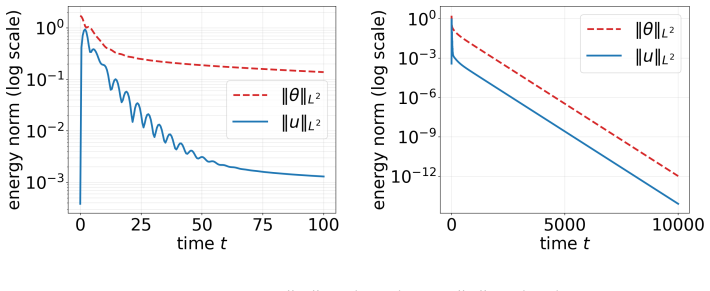
- The scheme reproduces internal-wave dynamics and exponential relaxation to hydrostatic balance in long-time stratified-flow simulations.
Reading between the lines
- The explicit treatment of convection may become impractical for very small viscosity, suggesting that selective implicit treatment could be needed for robustness at high Reynolds numbers.
- The quadruply-nested exponential dependence in the error constant indicates that practical accuracy degrades rapidly as either viscosity or thermal diffusivity approaches zero.
- The decoupling property may extend naturally to related systems such as the Navier-Stokes equations with temperature-dependent buoyancy.
Editorial analysis
A structured set of objections, weighed in public.
Referee Report
Summary. The manuscript proposes and analyzes a second-order consistent-splitting generalized scalar auxiliary variable (GSAV) scheme for the two-dimensional perturbed Boussinesq system. Nonlinear convection and advection terms, together with linear buoyancy and stratification couplings, are treated explicitly, reducing each time step to decoupled linear systems. The paper proves an unconditional weak stability result and derives optimal second-order error estimates for velocity, pressure, and temperature; a careful tracing of the constants shows quadruply-nested exponential dependence on the reciprocals of viscosity and thermal diffusivity. Numerical experiments confirm second-order convergence and reproduce expected long-time stratified-flow dynamics.
Significance. If the stability and error results hold, the scheme offers an efficient, unconditionally stable discretization with decoupled solves for a physically relevant stratified-flow model. The explicit disclosure of the non-uniform error-constant dependence is a strength in transparency. The contribution extends prior consistent-splitting GSAV work on Navier-Stokes equations to the perturbed Boussinesq setting.
major comments (1)
- [Error analysis section (the theorem establishing the second-order estimates)] Error analysis section (the theorem establishing the second-order estimates): the claimed optimality is formally correct, yet the quadruply-nested exponential dependence of the constant on 1/ν and 1/κ (explicitly traced and stated in the abstract) renders the estimates non-uniform. This dependence is load-bearing for the practical content of the error result in the perturbed Boussinesq regime, where small viscosity and diffusivity are relevant; the manuscript should add a dedicated paragraph discussing the implications for robustness relative to fully implicit schemes.
minor comments (1)
- [Introduction] The abstract states the scheme is for the 'two-dimensional' system but does not repeat this in the introduction; adding a brief sentence on the 2D setting would improve clarity.
Simulated Author's Rebuttal
We thank the referee for the detailed and constructive report. We address the single major comment below and will incorporate the suggested addition in the revised manuscript.
read point-by-point responses
-
Referee: Error analysis section (the theorem establishing the second-order estimates): the claimed optimality is formally correct, yet the quadruply-nested exponential dependence of the constant on 1/ν and 1/κ (explicitly traced and stated in the abstract) renders the estimates non-uniform. This dependence is load-bearing for the practical content of the error result in the perturbed Boussinesq regime, where small viscosity and diffusivity are relevant; the manuscript should add a dedicated paragraph discussing the implications for robustness relative to fully implicit schemes.
Authors: We agree that the non-uniformity of the error constants, already disclosed in the abstract, merits explicit discussion of its practical implications. In the revised manuscript we will insert a dedicated paragraph (likely in Section 4 or the concluding remarks) that contrasts the robustness of the present explicit-treatment GSAV scheme with that of fully implicit discretizations. The paragraph will note that the exponential dependence on 1/ν and 1/κ arises from the explicit handling of the buoyancy and nonlinear terms, which enables the decoupled linear solves and unconditional weak stability, while fully implicit schemes typically produce more uniform constants at the expense of solving coupled nonlinear systems at each step. revision: yes
Circularity Check
No circularity: stability and error proofs are independent mathematical derivations
full rationale
The paper defines a GSAV-based time discretization extending the external framework of Huang and Shen [17], then states unconditional weak stability and second-order error estimates as theorems proved within the manuscript. These steps rely on standard energy estimates and consistency analysis applied to the scheme's explicit treatment of nonlinear terms; no equation reduces by construction to a fitted parameter, self-defined quantity, or load-bearing self-citation. The quadruply-nested exponential dependence on 1/ν and 1/κ is a property of the derived constants, not evidence that the result is tautological. The derivation chain is therefore self-contained against external benchmarks.
Assumptions & free parameters
assumptions (1)
- domain assumption Standard assumptions on domain, initial data, and regularity for the Boussinesq system that allow the error analysis to proceed.
Cite this review
Pith. "Pith review of A consistent-splitting generalized scalar auxiliary variable scheme for the perturbed Boussinesq system." pith.science (2026). https://pith.science/paper/EY7RYXEN
@misc{pith2026260631152,
  author       = {Pith},
  title        = {Pith review of: A consistent-splitting generalized scalar auxiliary variable scheme for the perturbed Boussinesq system},
  year         = {2026},
  howpublished = {\url{https://pith.science/paper/EY7RYXEN}},
  note         = {Machine review of arXiv:2606.31152}
}
read the original abstract
We propose and analyze a second-order consistent-splitting scheme, based on the generalized scalar auxiliary variable (GSAV) approach, for the two-dimensional perturbed Boussinesq system. The system is obtained by subtracting a stable, linearly stratified hydrostatic equilibrium from the standard Boussinesq system. The time discretization extends the consistent-splitting generalized BDF2 framework of Huang and Shen [17] for the Navier-Stokes equations, treating the nonlinear convection and advection together with the linear buoyancy and stratification couplings explicitly, so that each time step reduces to a small number of decoupled linear systems. We prove an unconditional weak stability theorem for the GSAV scheme and derive optimal second-order error estimates for the velocity, pressure, and temperature. A careful tracing reveals that the error constant depends on the inverse viscosity and inverse thermal diffusivity through a quadruply-nested exponential, so the scheme is not robust as either tends to zero. Numerical experiments confirm the second-order convergence and reproduce the expected internal-wave dynamics and exponential relaxation toward hydrostatic balance in a long-time stratified-flow simulation.
Figures


Forward citations
Cited by 1 Pith paper
-
A spectral-vanishing-viscosity stabilization of a higher-order consistent splitting scheme for the Navier-Stokes equations
Directional Maday–Kaber–Tadmor SVV stabilizes Huang–Shen high-order BDF–IMEX consistent splitting for Navier–Stokes at high Re, with stability/error estimates and 2D validation.
Reference graph
Works this paper leans on
-
[1]
Dhanapati Adhikari, Chongsheng Cao, and Jiahong Wu. The 2D Boussinesq equations with vertical viscosity and vertical diffusivity.Journal of Differential Equations, 249(5):1078–1088, 2010
work page 2010
-
[2]
Dhanapati Adhikari, Chongsheng Cao, and Jiahong Wu. Global regularity results for the 2D Boussinesq equations with vertical dissipation.Journal of Differential Equations, 251(6):1637– 1655, 2011
work page 2011
-
[3]
Viscosity in error upper bound for a consistent splitting scheme of the Navier-Stokes equations
M. Nader Alhomsi, Jiahong Wu, and Xiaoming Zheng. Viscosity in error upper bound for a consistent splitting scheme of the navier–stokes equations.arXiv preprint arXiv:2606.28800, 2026
work page Pith review arXiv 2026
-
[4]
Edom Belayneh, Xiaobai Chen, Ruthwik Nadam, Jiahong Wu, and Xiaoming Zheng. Impact of Reynolds number and slip/no-slip boundary condition on stratification in a two-dimensional Boussinesq system.Computational and Applied Mathematics, 45(4):Paper No. 181, 2026
work page 2026
-
[5]
Chongsheng Cao and Jiahong Wu. Global regularity for the two-dimensional anisotropic Boussinesq equations with vertical dissipation.Archive for Rational Mechanics and Analysis, 208(3):985–1004, 2013. 38
work page 2013
-
[6]
´Angel Castro, Diego C´ ordoba, and Daniel Lear. On the asymptotic stability of stratified solutions for the 2D Boussinesq equations with a velocity damping term.Mathematical Models and Methods in Applied Sciences, 29(7):1227–1277, 2019
work page 2019
-
[7]
Global regularity for the 2D Boussinesq equations with partial viscosity terms
Dongho Chae. Global regularity for the 2D Boussinesq equations with partial viscosity terms. Advances in Mathematics, 203(2):497–513, 2006
work page 2006
-
[8]
A. J. Chorin. Numerical solution of the Navier–Stokes equations.Mathematics of Computation, 22(104):745–762, 1968
work page 1968
Show all 39 references
-
[9]
Global existence results for the anisotropic Boussinesq system in dimension two.Mathematical Models and Methods in Applied Sciences, 21(3):421–457, 2011
Rapha¨ el Danchin and Marius Paicu. Global existence results for the anisotropic Boussinesq system in dimension two.Mathematical Models and Methods in Applied Sciences, 21(3):421–457, 2011
2011
-
[10]
C. R. Doering, J. Wu, K. Zhao, and X. Zheng. Long time behavior of the two-dimensional Boussinesq equations without buoyancy diffusion.Physica D, 376–377:144–159, 2018
2018
-
[11]
Stability and exponential decay for the 2D anisotropic Boussinesq equations with horizontal dissipation.Calculus of Variations and Partial Differential Equations, 60(3):Paper No
Boqing Dong, Jiahong Wu, Xiaojing Xu, and Ning Zhu. Stability and exponential decay for the 2D anisotropic Boussinesq equations with horizontal dissipation.Calculus of Variations and Partial Differential Equations, 60(3):Paper No. 116, 2021
2021
-
[12]
Garcia-Archilla, V
B. Garcia-Archilla, V. John, and J. Novo. On the convergence order of the finite element error in the kinetic energy for high reynolds number incompressible flows.Computer Methods in Applied Mechanics and Engineering, 385:114032, 2021
2021
-
[13]
A. E. Gill.Atmosphere–Ocean Dynamics, volume 30 ofInternational Geophysics Series. Academic Press, New York, 1982
1982
-
[14]
J. L. Guermond, P. Minev, and J. Shen. An overview of projection methods for incompressible flows.Computer Methods in Applied Mechanics and Engineering, 195(44–47):6011–6045, 2006
2006
-
[15]
Guermond and J
J.L. Guermond and J. Shen. A new class of truly consistent splitting schemes for incompressible flows.Journal of computational physics, 192(1):262–276, 2003
2003
-
[16]
Hou and Congming Li
Thomas Y. Hou and Congming Li. Global well-posedness of the viscous Boussinesq equations. Discrete and Continuous Dynamical Systems, 12(1):1–12, 2005
2005
-
[17]
Huang and J
F. Huang and J. Shen. Stability and error analysis of a second-order consistent splitting scheme for the navier–stokes equations.SIAM Journal on Numerical Analysis, 61(5):2408–2433, 2023
2023
-
[18]
Huang and J
F. Huang and J. Shen. Stability and error analysis of a new class of higher-order consistent splitting schemes for the navier–stokes equations.Mathematics of Computation, 2025
2025
-
[19]
A new class of implicit–explicit bdfk sav schemes for general dissipative systems and their error analysis.Computer Methods in Applied Mechanics and Engineering, 392:114718, 2022
Fukeng Huang and Jie Shen. A new class of implicit–explicit bdfk sav schemes for general dissipative systems and their error analysis.Computer Methods in Applied Mechanics and Engineering, 392:114718, 2022
2022
-
[20]
Stability of hydrostatic equilibrium to the 2D Boussinesq systems with partial dissipation.Applied Mathematics Letters, 98:392–397, 2019
Ruihong Ji, Dan Li, Yuanyuan Wei, and Jiahong Wu. Stability of hydrostatic equilibrium to the 2D Boussinesq systems with partial dissipation.Applied Mathematics Letters, 98:392–397, 2019
2019
-
[21]
Optimal decay for the 3D anisotropic Boussinesq equations near the hydrostatic balance.Calculus of Variations and Partial Differential Equations, 61(6):Paper No
Ruihong Ji, Lin Yan, and Jiahong Wu. Optimal decay for the 3D anisotropic Boussinesq equations near the hydrostatic balance.Calculus of Variations and Partial Differential Equations, 61(6):Paper No. 222, 2022. 39
2022
-
[22]
Unconditionally stable, second order, decoupled ensemble schemes for computing evolutionary Boussinesq equations.Applied Numerical Mathematics, 192:241–260, 2023
Nan Jiang and Huanhuan Yang. Unconditionally stable, second order, decoupled ensemble schemes for computing evolutionary Boussinesq equations.Applied Numerical Mathematics, 192:241–260, 2023
2023
-
[23]
Accurate, stable and efficient Navier–Stokes solvers based on explicit treatment of the pressure term.Journal of Computational Physics, 199(1):221–259, 2004
Hans Johnston and Jian-Guo Liu. Accurate, stable and efficient Navier–Stokes solvers based on explicit treatment of the pressure term.Journal of Computational Physics, 199(1):221–259, 2004
2004
-
[24]
P. K. Kundu, I. M. Cohen, and D. R. Dowling.Fluid Mechanics. Academic Press, Oxford, 6 edition, 2015
2015
-
[25]
Error analysis of BDF2 scheme for the Boussinesq system based on exponential scalar auxiliary variable.Computational Methods in Applied Mathematics, 26(1):89–107, 2026
Huanhuan Li, Meng Li, and Xianbing Luo. Error analysis of BDF2 scheme for the Boussinesq system based on exponential scalar auxiliary variable.Computational Methods in Applied Mathematics, 26(1):89–107, 2026
2026
-
[26]
J.-G. Liu, J. Liu, and R.L. Pego. Stability and convergence of efficient Navier–Stokes solvers via a commutator estimate.Communications on Pure and Applied Mathematics, 60(10):1443–1487, 2007
2007
-
[27]
Pedlosky.Geophysical Fluid Dynamics
J. Pedlosky.Geophysical Fluid Dynamics. Springer, New York, 2 edition, 1987
1987
-
[28]
Springer Science & Business Media, 2011
Jie Shen, Tao Tang, and Li-Lian Wang.Spectral methods: algorithms, analysis and applications, volume 41. Springer Science & Business Media, 2011
2011
-
[29]
The scalar auxiliary variable (SAV) approach for gradient flows.Journal of Computational Physics, 353:407–416, 2018
Jie Shen, Jie Xu, and Jiang Yang. The scalar auxiliary variable (SAV) approach for gradient flows.Journal of Computational Physics, 353:407–416, 2018
2018
-
[30]
A new class of efficient and robust energy stable schemes for gradient flows.SIAM Review, 61(3):474–506, 2019
Jie Shen, Jie Xu, and Jiang Yang. A new class of efficient and robust energy stable schemes for gradient flows.SIAM Review, 61(3):474–506, 2019
2019
-
[31]
Error estimates for finite element approximations of consistent splitting schemes for incompressible flows.DISCRETE AND CONTINUOUS DYNAMICAL SYSTEMS SERIES B, 8(3):663, 2007
Jie Shen and Xiaofeng Yang. Error estimates for finite element approximations of consistent splitting schemes for incompressible flows.DISCRETE AND CONTINUOUS DYNAMICAL SYSTEMS SERIES B, 8(3):663, 2007
2007
-
[32]
B. R. Sutherland.Internal Gravity Waves. Cambridge University Press, Cambridge, 2010
2010
-
[33]
Stability near hydrostatic equilibrium to the 2D Boussinesq equations without thermal diffusion.Archive for Rational Mechanics and Analysis, 237(2):585–630, 2020
Lizheng Tao, Jiahong Wu, Kun Zhao, and Xiaoming Zheng. Stability near hydrostatic equilibrium to the 2D Boussinesq equations without thermal diffusion.Archive for Rational Mechanics and Analysis, 237(2):585–630, 2020
2020
-
[34]
R. Temam. Une m´ ethode d’approximation de la solution des ´ equations de Navier-Stokes. Bulletin de la Soci´ et´ e Math´ ematique de France, 96:115–152, 1968
1968
-
[35]
G. K. Vallis.Atmospheric and Oceanic Fluid Dynamics: Fundamentals and Large-Scale Circulation. Cambridge University Press, Cambridge, 2 edition, 2017
2017
-
[36]
The generalized scalar auxiliary variable applied to the incompressible Boussinesq equation.Journal of Scientific Computing, 2026
Andreas Wagner, Barbara Wohlmuth, and Jan Zawallich. The generalized scalar auxiliary variable applied to the incompressible Boussinesq equation.Journal of Scientific Computing, 2026
2026
-
[37]
Gauge method for viscous incompressible flows.Communications in Mathematical Sciences, 1(2):317–332, 2003
E Weinan and Jian-Guo Liu. Gauge method for viscous incompressible flows.Communications in Mathematical Sciences, 1(2):317–332, 2003. 40
2003
-
[38]
Zhang, L
J. Zhang, L. Yuan, and H. Chen. Error estimate of a fully decoupled numerical scheme based on the scalar auxiliary variable (SAV) method for the Boussinesq system.Communications in Nonlinear Science and Numerical Simulation, 136:108102, 2024
2024
-
[39]
An iterative projection method for unsteady navier–stokes equations with high reynolds numbers.Advances in Computational Mathematics, 51(5):44, 2025
Xiaoming Zheng, Kun Zhao, Jiahong Wu, Weiwei Hu, and Dapeng Du. An iterative projection method for unsteady navier–stokes equations with high reynolds numbers.Advances in Computational Mathematics, 51(5):44, 2025. 41
2025
Reviewed July 1, 2026 · model on record in the stance chip above.
Discussion (0). Continue with ORCID to comment.