REVIEW 3 major objections 6 minor 184 references
White-dwarf–compact-object binaries make unique gravitational-wave signals with a sharp high-frequency cutoff that future decihertz detectors will see in large numbers, while LISA and terrestrial detectors will not.
Reviewed by Pith at T0; open to challenge. T0 means a machine referee read the full paper against a public rubric. the ladder, T0–T4 →
T0 review · grok-4.5
2026-07-31 05:04 UTC pith:Q4NTSDSO
load-bearing objection Solid waveform morphology and a clean impostor exclusion; the DECIGO “millions” rate is the soft number, not the physics of f_max. the 3 major comments →
Gravitational Wave Modeling of White-Dwarf--Compact-Object Binaries and Observational Outlook
The pith
A machine-rendered reading of the paper's core claim, the machinery that carries it, and where it could break.
Core claim
Circular white-dwarf–compact-object binaries evolve through a radiation-reaction-dominated inspiral followed by a mass-transfer-dominated outspiral; their gravitational waveforms therefore accumulate signal near a sharp maximum cutoff frequency f_max fixed by the turnaround, and these end stages will be abundant sources for decihertz detectors (DECIGO, LGWA) while remaining undetectable extragalactically by LISA or terrestrial interferometers and incapable of mimicking sub-solar-mass compact-object signals.
What carries the argument
A semi-analytic integrator that evolves circular orbits under simultaneous Roche-lobe mass transfer (polytropic white-dwarf profile, Eddington-limited accretion, angular-momentum-loss parameter γ) and 2.5PN quadrupole radiation reaction, then constructs characteristic-strain tracks via the stationary-phase approximation.
Load-bearing premise
The angular momentum carried away by ejected mass is fixed to one of two simple analytic extremes (Jeans mode or isotropic re-emission), even though the true geometry almost certainly requires full fluid simulations.
What would settle it
A hydrodynamic simulation of super-Eddington mass transfer in a white-dwarf–neutron-star binary that measures the actual specific angular momentum of the outflow (effective γ) and shows whether the system still reaches the predicted f_max turnaround or instead merges or forms a long-lived ultracompact X-ray binary.
If this is right
- LGWA should detect roughly tens of white-dwarf–neutron-star final inspirals each year, comparable to current black-hole–black-hole rates in LIGO.
- DECIGO will see millions of overlapping white-dwarf–compact-object inspirals plus thousands of outspirals per year, requiring advanced global-fit and peeling techniques so they do not swamp cosmological signals.
- LISA’s horizon for these end stages is only tens of megaparsecs, so it is not expected to catch an extragalactic event in its nominal lifetime.
- White-dwarf–compact-object waveforms cannot reach the high-frequency band or chirp-mass range needed to impersonate sub-solar-mass compact-object candidates in LIGO/Virgo/KAGRA.
- Whether a given mass pair ends in a common envelope, a dark plunge, or a stable ultracompact X-ray binary flips with the assumed mass-loss angular-momentum mode.
Where Pith is reading between the lines
- If decihertz detectors fly, the measured distribution of f_max peaks will directly map the white-dwarf mass function in close binaries, independent of electromagnetic selection.
- The same integrator could be extended to spinning or eccentric systems; even modest eccentricity would likely smear the sharp f_max pile-up and change the SNR forecasts.
- A confirmed Galactic ultracompact X-ray binary with a carbon-oxygen donor and orbital frequency near 10 mHz would favor the isotropic-re-emission channel over Jeans-mode loss.
- Because outspiral strains are orders of magnitude weaker than inspiral strains near f_max, search pipelines optimized only for rising chirps will systematically miss half the detectable signal.
Editorial analysis
A structured set of objections, weighed in public.
Referee Report
Summary. The authors present a semi-analytic integrator for circular white-dwarf–compact-object (WD–CO) binaries that couples a polytropic Roche-lobe-overflow mass-transfer prescription (Eggleton Roche radius, Nauenberg mass–radius relation, Eddington-limited accretion) to 2.5PN quadrupole radiation reaction, with automatic differentiation used to obtain the time derivatives of the quadrupole moment. They evolve a grid of 16 WD masses × 13 CO masses, characterize the resulting waveforms (notably a characteristic-strain peak at the inspiral-to-outspiral turnaround frequency f_max), compute SNRs for LISA, DECIGO, LGWA, and ET, and derive order-of-magnitude detection rates: tens of WD–NS inspirals per year for LGWA, and ≳10^6 inspirals plus ~2×10^3 outspirals per year for DECIGO. They further map system fates (common envelope, merger/TDE, UCXB, no contact) as a function of the assumed angular-momentum-loss mode (Jeans vs. isotropic re-emission), and show that the highest attainable f_max (~10–20 Hz) precludes WD–CO systems from mimicking sub-solar-mass compact-object signals in terrestrial detectors.
Significance. If the results hold, this is a useful and timely contribution to the science case for decihertz detectors (DECIGO, LGWA), which currently lack detailed end-stage WD–CO waveform forecasts. Strengths: the waveform construction is computed forward from stated physics with no fitting to observations; the mass grid is broad and the trends in f_max and integrated power are cleanly mapped; the interference-envelope argument for treating inspiral/outspiral SNR separately (Eq. 20) is a nice, correct simplification; the SSM-impostor exclusion (§IV C) is a concrete, falsifiable statement relevant to S251112cm-like events; and the code is promised public upon publication. The rate forecasts are explicitly labeled order-of-magnitude, but the headline DECIGO number ("millions of inspirals") is the paper's most quotable claim and, as detailed below, rests on a Euclidean, zero-redshift extrapolation that the authors' own horizon estimates place in the cosmological regime — so the significance of that specific number is not yet established. The qualitative conclusion (DECIGO/LGWA are the relevant instruments; LISA and terrestrial detectors are not) appears robust.
major comments (3)
- [§IV A, Eqs. (22)–(25), Table II] The DECIGO detection rates (the abstract's 'millions of inspirals') are computed as R × V_eff with (i) a constant comoving rate density R derived from the present Galactic merger rate via the present-day matter density (Eq. 22), (ii) a Euclidean effective volume V_eff ∝ r_horizon^3 (Eq. 23), and (iii) a horizon obtained by linearly scaling a zero-redshift, 1 Mpc face-on SNR (r_horizon = SNR_1Mpc/8 Mpc). The paper itself states DECIGO 'will be able to detect massive WD–CO binaries at cosmological distances'; for r_horizon ≳ 1 Gpc this procedure neglects (a) the cosmic merger-rate history, (b) source-frame rate dilation by (1+z), (c) comoving vs. Euclidean volume, and (d) redshifting of f_max and the waveform through DECIGO's band — which is doubly relevant here because detectability is gated on f_max falling in band (§Fig. 6 caption), and f_max/(1+z) can leave the band entirely for the hi
- [§II A.1, §IV A, Table II; cf. §IV B] All rate estimates use Jeans-mode angular momentum loss, while §IV B demonstrates that the binary fate — and hence whether a given (M_WD, M_C) system produces an inspiral-turnaround-plus-outspiral event at all versus a prompt common-envelope merger — flips between the Jeans and isotropic-re-emission prescriptions (Figs. 7a vs. 7b). Since V_eff(M_WD, M_C) is only nonzero for systems that actually reach the turnaround in band, the mass-distribution integral in Eq. (25) is implicitly weighted by a Jeans-mode fate map. The paper states (§II A.1) that observational consequences are not strongly affected, but no quantitative support is given for the rate table specifically. Please provide Table II (or at least the DECIGO and LGWA inspiral rows) computed under isotropic re-emission as well, or show explicitly that the integrand of Eq. (25) is dominated by mass bins whose fates are mode-independ
- [§II C, Eq. (19); §III B Feature B] The stationary-phase expression h̃(f) ∝ |ḟ|^{-1/2} diverges at the turnaround where ḟ → 0, yet the f_max peak is the paper's central waveform feature (the ≲50× h_c buildup, the Feature-B points in Fig. 5, and the SNR integrands of Fig. 6 all depend on it). The divergence is integrable, so integrated SNRs are formally finite, but the manuscript does not describe how the ḟ → 0 region is handled numerically: is Eq. (19) used arbitrarily close to the turning point, is there a uniform (Airy-type) approximation, or is the Fourier transform done directly (Eq. 18) in a window around t(f_max)? Because the claimed buildup factor and the precise value of h_c(f_max) enter the horizon estimates, a brief description (and a convergence check against direct FFT of the time series for one representative system) should be added.
minor comments (6)
- [Abstract / §IV C / Fig. 9] The abstract quotes '10–20 Hz' for the highest f_max, while §IV C and Fig. 9 give f_max ≈ 15 Hz for the most extreme case. Please make these consistent or state the range's origin.
- [Table II] Entries such as '>10^6' sit oddly with the 'order-of-magnitude' framing; consider quoting a single significant figure with an explicit uncertainty statement, and clarify whether the WD-BH DECIGO inspiral rate being comparable to WD-NS despite R_BH-WD ~ 50× smaller is purely a horizon-volume effect.
- [Fig. 9] The legend label '= 1 M_⊙' appears garbled (presumably script-M chirp mass); also state which template approximant from [173] is used and at what distance the M = 1 M_⊙ comparison curves are placed.
- [§IV A] The 75% duty cycle is described as applied to LISA and then 'to it, LGWA, and DECIGO'; please clarify how the duty cycle enters the SNR (scaling of integration time?) and justify applying a LISA-specific duty cycle to LGWA and DECIGO.
- [§II C, pipeline steps 1–3] Freezing R_WD = R_WD,0 during steps 1–3 while M_WD decreases is justified by Δt ≫ τ_dyn, but near the turnaround Δt shrinks toward the dynamical time; a sentence quantifying how well the switch to the full Eq. (5) evolution in step 4 converges would help.
- [General] Recurring typographical artifact 'LGW A' (space inside the acronym) throughout; Eq. (21) would benefit from units on the numerical coefficients; Fig. 6's colorbar thresholds for SNR display should be stated numerically in the caption; the promise that code 'will be made publicly available upon publication' would be stronger as an arXiv-linked repository now.
Circularity Check
No circularity: waveforms, f_max, fates, and rate forecasts are forward outputs of stated physics and external rates, not fits or self-definitional closures.
full rationale
The load-bearing chain is self-contained and non-circular. System evolution follows from explicit inputs: Eggleton Roche lobe (Eq. 1), n=1.5 polytropic overflow (Eq. 3), Nauenberg mass–radius (Eq. 4), Eddington-capped conservative/non-conservative transfer (Eqs. 6–10) with γ fixed to standard Jeans or isotropic-re-emission extremes, and 2.5PN quadrupole radiation reaction (Eqs. 12–16). f_max is the computed root of ȧ_MT + ȧ_RR = 0, not a fitted or redefined observable. Characteristic strains use the quadrupole formula and SPA (Eqs. 17–19) on those tracks. Detection-rate estimates multiply external Galactic WD–NS/BH rates from Nelemans et al. by a local matter-density conversion (Eq. 22) and Euclidean V_eff from face-on SNR grids (Eqs. 23–25); those rates are not tuned to produce the DECIGO/LGWA numbers. Angular-momentum-mode dependence of final fates is explored as a sensitivity study, not smuggled uniqueness. A=10 is a conventional O(10) literature choice with an explicit Appendix B error budget, not a fit-to-data prediction. No self-citation uniqueness theorem, ansatz-via-own-prior, or definitional identity underwrites the central claims. Methodological limits (Euclidean cosmological volumes, uncertain γ) are correctness issues, not circularity.
Axiom & Free-Parameter Ledger
free parameters (4)
- A (mass-transfer rate coefficient) =
10
- γ (specific angular momentum of ejected material) =
Jeans or isotropic-re-emission extremes
- η_acc (accretion efficiency) =
0.1
- M_WD,min stopping mass =
0.05 M_⊙
axioms (6)
- domain assumption Orbits remain circular (isotropic mass loss and GW emission; e = 0 enforced).
- domain assumption n = 1.5 polytropic density profile for the white-dwarf mass exterior to the Roche lobe.
- domain assumption Nauenberg (1972) zero-temperature mass–radius relation (Eq. 4) with μ_e = 2.
- domain assumption 2.5PN quadrupole radiation reaction (Eqs. 14–15) is adequate through the turnaround.
- domain assumption Mass transfer is conservative until the Eddington limit, then excess is ejected with the chosen γ.
- domain assumption Galactic WD–NS and WD–BH merger rates from Nelemans et al. (2001) scaled by local matter density give the volumetric end-stage rate.
read the original abstract
We investigate the end stages of circular white-dwarf--compact-object binaries by developing a novel integrator implementing mass transfer and 2.5-order Post-Newtonian kinematics. White-dwarf--compact-object binaries are subject to two phases: a slow inspiral during which binary evolution is dominated by weak-gravity radiation reaction and a quicker ``outspiral" dominated by mass transfer. These systems have unique gravitational waveforms with several characteristic features including an accumulation of signal near the maximum cutoff frequency set by the transition between in- and outspiral. We investigate trends in gravitational wave parameters based on component masses. In particular, maximum cutoff frequency depends strongly on white dwarf mass and compactness. It is unlikely that extragalactic binaries will be measured by LISA or current or future terrestrial detectors. However, white-dwarf--compact-object binary end stages will be an important source for future decihertz detectors such as DECIGO and LGWA: The final inspiral of tens of white-dwarf--neutron-star binaries will be detected annually by LGWA, and millions of inspirals along with thousands of outspirals will be detected by DECIGO. The ultimate fates of these binaries are diverse and dependent upon the intricacies of angular momentum loss. In particular, we show that white dwarfs with partners of sufficiently low/high mass can end their lives in common envelopes/mergers, while white dwarfs do not enter contact with partners of intermediate mass. The highest frequencies produced by white-dwarf--compact-object binaries in our tests are 10--20 Hz---incapable of mimicking sub-solar-mass compact object signals in terrestrial detectors or explaining S251112cm-like signals.
Figures



Reference graph
Works this paper leans on
-
[1]
Fast” and “Slow
Angular Momentum Loss Modes In general, it is necessary to model a system with fluid dynamics to determine precisely how angular momentum is lost [73]. Under certain simplifying assumptions, how- ever, it is possible to calculate analytically the angular momentum lost and to provide a simple closed-form so- lution forγ. Two such assumptions are Jeans Mode...
2000
-
[2]
dark” merger without any electromagnetic counterpart (e.g., [138–142]). We assume non-spinning Schwarzschild BHs to cal- culate the “Merger + TDE
Mergers and Common Envelopes A merger detected by L VK is characterized by an in- spiral due to radiation reaction followed by a final plunge with separation approaching zero under the effects of strong gravity (e.g., [131–133]). There are two classes of events that we may consider analogous to mergers in the case of WD-CO binaries. In the first such clas...
-
[3]
turnaround
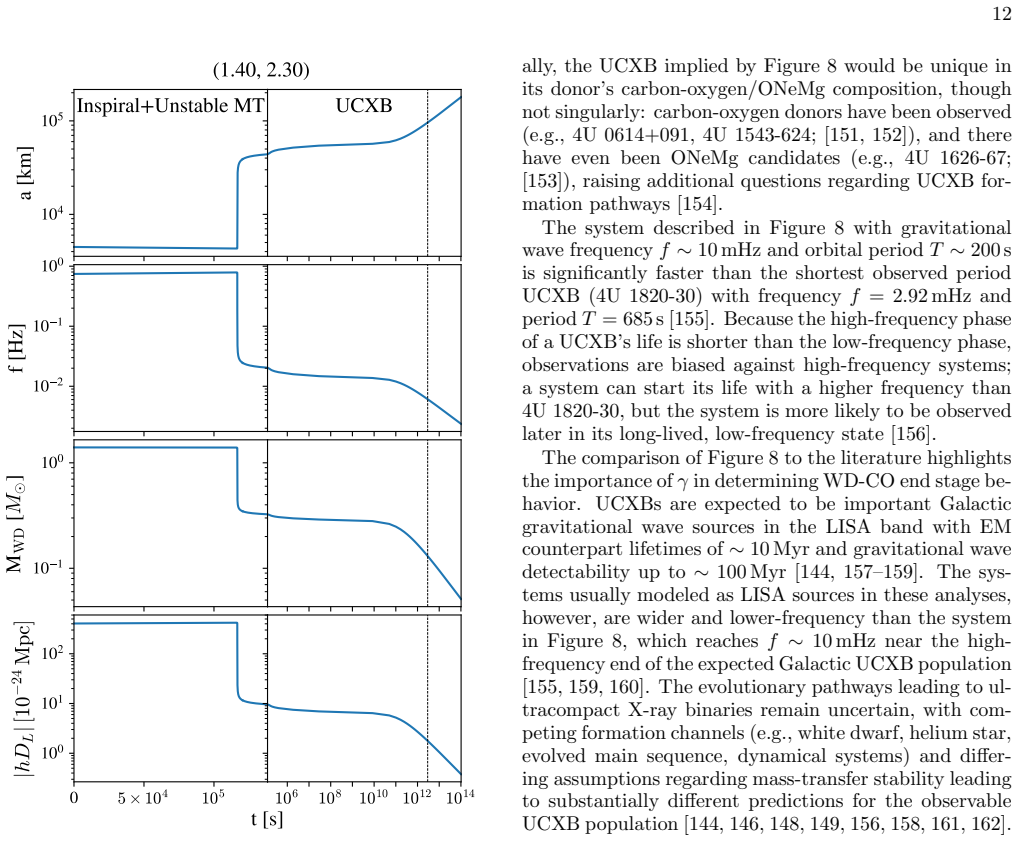
UCXB In Figure 8, we show the evolution after initial Roche Lobe overflow for a system with masses (M WD, MC) = (1.40,2.30)M ⊙ and Isotropic Re-emission angular mo- mentum loss. As in the representative cases shown in Figure 1, this system experiences initial hardening due to radiation reaction and then undergoes a short period of rapid mass loss. The sys...
-
[4]
B. P. Abbottet al.(LIGO Scientific Collaboration and Virgo Collaboration), Phys. Rev. Lett.116, 061102 (2016), arXiv:1602.03837 [gr-qc]
Pith/arXiv arXiv 2016
-
[5]
Aasiet al.(LIGO Scientific Collabora- tion), Class
J. Aasiet al.(LIGO Scientific Collabora- tion), Class. Quantum Grav.32, 074001 (2015), arXiv:1411.4547 [gr-qc]
Pith/arXiv arXiv 2015
-
[6]
Abbottet al.(LIGO Scientific Collaboration and Virgo Collaboration and KAGRA Collaboration), Phys
R. Abbottet al.(LIGO Scientific Collaboration and Virgo Collaboration and KAGRA Collaboration), Phys. Rev. X13, 041039 (2023), arXiv:2111.03606 [gr- qc]
Pith/arXiv arXiv 2023
-
[7]
S. Adhicary, P. Baral, A. Baylor, B. Ewing, Y.-J. Huang, R. Huxford, P. Joshi, J. Kennington, R. Magee, C. Messick,et al., arXiv e-prints , arXiv:2605.19153 (2026), arXiv:2605.19153 [gr-qc]
Pith/arXiv arXiv 2026
-
[8]
The LIGO Scientific Collaboration, the Virgo Collabo- ration, and the KAGRA Collaboration, arXiv e-prints , arXiv:2605.27225 (2026), arXiv:2605.27225 [gr-qc]
Pith/arXiv arXiv 2026
-
[9]
The LIGO Scientific Collaboration, the Virgo Collabo- ration, and the KAGRA Collaboration, arXiv e-prints , arXiv:2605.27226 (2026), arXiv:2605.27226 [astro- ph.HE]
Pith/arXiv arXiv 2026
-
[10]
S. Biscoveanu, P. Landry, and S. Vitale, Mon. Not. R. Astron. Soc.518, 5298 (2023), arXiv:2207.01568 [astro-ph.HE]
Pith/arXiv arXiv 2023
-
[11]
Abbottet al.(LIGO Scientific Collaboration and Virgo Collaboration and KAGRA Collaboration), Phys
R. Abbottet al.(LIGO Scientific Collaboration and Virgo Collaboration and KAGRA Collaboration), Phys. Rev. X13, 011048 (2023), arXiv:2111.03634 [astro-ph.HE]
Pith/arXiv arXiv 2023
-
[12]
O. S. Salafia, Astron. Astrophys.702, A54 (2025), arXiv:2507.00588 [gr-qc]
arXiv 2025
-
[13]
M. Fishbach, A. P. Ji, W.-f. Fong, T. Y. Wu, J. C. Rastinejad, A. Vijaykumar, and H.-Y. Chen, arXiv e-prints , arXiv:2604.05059 (2026), arXiv:2604.05059 [astro-ph.HE]
Pith/arXiv arXiv 2026
-
[14]
I. Mandel and F. S. Broekgaarden, Living Reviews in Relativity25, 1 (2022), arXiv:2107.14239 [astro-ph.HE]
Pith/arXiv arXiv 2022
-
[15]
B. P. Abbottet al.(LIGO Scientific Collaboration and Virgo Collaboration), Phys. Rev. Lett.119, 161101 (2017), arXiv:1710.05832 [gr-qc]
Pith/arXiv arXiv 2017
-
[16]
F. Acernese, M. Agathos, K. Agatsuma, D. Aisa, N. Allemandou, A. Allocca, J. Amarni, P. Astone, G. Balestri, G. Ballardin,et al., Class. Quantum Grav. 32, 024001 (2015), arXiv:1408.3978 [gr-qc]
Pith/arXiv arXiv 2015
- [17]
-
[18]
LIGO Scientific Collaboration, Virgo Collaboration, and KAGRA Collaboration,The LSC-Virgo-KAGRA Observational Science White Paper (2022-2023 edition), Tech. Rep. LIGO-T2200382-v2 (LIGO Lab, 2022)
2022
-
[19]
Punturo, M
M. Punturo, M. Abernathy, F. Acernese, B. Allen, N. Andersson, K. Arun, F. Barone, B. Barr, M. Barsug- lia, M. Beker,et al., Class. Quantum Grav.27, 194002 (2010)
2010
-
[20]
M. Evans, A. Corsi, C. Afle, A. Ananyeva, K. G. Arun, S. Ballmer, A. Bandopadhyay, L. Barsotti, M. Baryakhtar, E. Berger,et al., arXiv e-prints , arXiv:2306.13745 (2023), arXiv:2306.13745 [astro- ph.IM]
Pith/arXiv arXiv 2023
-
[21]
Agazieet al.(NANOGrav Collaboration), Astro- phys
G. Agazieet al.(NANOGrav Collaboration), Astro- phys. J. Lett.951, L8 (2023), arXiv:2306.16213 [astro- ph.HE]
Pith/arXiv arXiv 2023
-
[22]
M. A. McLaughlin, Class. Quantum Grav.30, 224008 (2013), arXiv:1310.0758 [astro-ph.IM]
Pith/arXiv arXiv 2013
-
[23]
R. N. Manchester and IPTA, Class. Quantum Grav.30, 224010 (2013), arXiv:1309.7392 [astro-ph.IM]
Pith/arXiv arXiv 2013
-
[24]
B. B. P. Perera, M. E. DeCesar, P. B. Demor- est, M. Kerr, L. Lentati, D. J. Nice, S. Os lowski, S. M. Ransom, M. J. Keith, Z. Arzoumanian, et al., Mon. Not. R. Astron. Soc.490, 4666 (2019), arXiv:1909.04534 [astro-ph.HE]
Pith/arXiv arXiv 2019
-
[25]
P. Amaro-Seoane, H. Audley, S. Babak, J. Baker, E. Ba- rausse, P. Bender, E. Berti, P. Binetruy, M. Born, D. Bortoluzzi,et al., arXiv e-prints , arXiv:1702.00786 (2017), arXiv:1702.00786 [astro-ph.IM]
Pith/arXiv arXiv 2017
-
[26]
A. Sesana, F. Haardt, P. Madau, and M. Volonteri, Astrophys. J.623, 23 (2005), arXiv:astro-ph/0409255 [astro-ph]
Pith/arXiv arXiv 2005
-
[27]
A. Klein, E. Barausse, A. Sesana, A. Petiteau, E. Berti, S. Babak, J. Gair, S. Aoudia, I. Hinder, F. Ohme, and B. Wardell, Phys. Rev. D93, 024003 (2016), arXiv:1511.05581 [gr-qc]
Pith/arXiv arXiv 2016
-
[28]
P. Amaro-Seoane, J. R. Gair, M. Freitag, M. C. Miller, I. Mandel, C. J. Cutler, and S. Babak, Class. Quan- tum Grav.24, R113 (2007), arXiv:astro-ph/0703495 16 [astro-ph]
Pith/arXiv arXiv 2007
-
[29]
G. Nelemans, L. R. Yungelson, S. F. Portegies Zwart, and F. Verbunt, Astron. Astrophys.365, 491 (2001), arXiv:astro-ph/0010457 [astro-ph]
Pith/arXiv arXiv 2001
-
[30]
T. Kupfer, V. Korol, S. Shah, G. Nelemans, T. R. Marsh, G. Ramsay, P. J. Groot, D. T. H. Steeghs, and E. M. Rossi, Mon. Not. R. Astron. Soc.480, 302 (2018), arXiv:1805.00482 [astro-ph.SR]
Pith/arXiv arXiv 2018
-
[31]
K. B. Burdge, M. W. Coughlin, J. Fuller, T. Kupfer, E. C. Bellm, L. Bildsten, M. J. Graham, D. L. Kaplan, J. v. Roestel, R. G. Dekany,et al., Nature (London) 571, 528 (2019), arXiv:1907.11291 [astro-ph.SR]
Pith/arXiv arXiv 2019
-
[32]
E. Finch, G. Bartolucci, D. Chucherko, B. G. Patterson, V. Korol, A. Klein, D. Bandopadhyay, H. Middleton, C. J. Moore, and A. Vecchio, Mon. Not. R. Astron. Soc. 522, 5358 (2023), arXiv:2210.10812 [astro-ph.SR]
Pith/arXiv arXiv 2023
-
[33]
T. Kupfer, V. Korol, T. B. Littenberg, S. Shah, E. Savalle, P. J. Groot, T. R. Marsh, M. Le Jeune, G. Nelemans, A. F. Pala,et al., Astrophys. J.963, 100 (2024), arXiv:2302.12719 [astro-ph.SR]
Pith/arXiv arXiv 2024
-
[34]
A. J. Farmer and E. S. Phinney, Mon. Not. R. As- tron. Soc.346, 1197 (2003), arXiv:astro-ph/0304393 [astro-ph]
Pith/arXiv arXiv 2003
-
[35]
D. Falta, R. Fisher, and G. Khanna, Phys. Rev. Lett. 106, 201103 (2011), arXiv:1011.6387 [astro-ph.HE]
Pith/arXiv arXiv 2011
-
[36]
V. Korol, R. Buscicchio, R. Pakmor, J. Mor´ an-Fraile, C. J. Moore, and S. E. de Mink, Astron. Astrophys. 691, A44 (2024), arXiv:2407.03935 [astro-ph.HE]
Pith/arXiv arXiv 2024
-
[37]
S. Kawamura, M. Ando, N. Seto, S. Sato, M. Musha, I. Kawano, J. Yokoyama, T. Tanaka, K. Ioka, T. Akutsu,et al., Progress of Theoretical and Experi- mental Physics2021, 05A105 (2021), arXiv:2006.13545 [gr-qc]
Pith/arXiv arXiv 2021
- [38]
-
[39]
P. C. Peters, Phys. Rev.136, 1224 (1964)
1964
-
[40]
Blanchet, Living Reviews in Relativity17, 2 (2014), arXiv:1310.1528 [gr-qc]
L. Blanchet, Living Reviews in Relativity17, 2 (2014), arXiv:1310.1528 [gr-qc]
Pith/arXiv arXiv 2014
-
[41]
Poisson and C
E. Poisson and C. M. Will,Gravity(Cambridge Univer- sity Press, 2014)
2014
-
[42]
LIGO Scientific Collaboration, Virgo Collabo- ration, and KAGRA Collaboration, GCN No- tice: LIGO/Virgo/KAGRA Trigger S250818k, https://gcn.nasa.gov/circulars/events/ ligovirgokagra-s250818k(2025), GCN Circular
2025
-
[43]
LIGO Scientific Collaboration, Virgo Collabora- tion, and KAGRA Collaboration, GraceDB Su- perevent S251112cm,https://gracedb.ligo.org/ superevents/S251112cm/view/(2025), accessed: 2025-12-05
2025
-
[44]
B. P. Abbottet al.(LIGO Scientific Collaboration and Virgo Collaboration), Phys. Rev. X9, 031040 (2019), arXiv:1811.12907 [astro-ph.HE]
Pith/arXiv arXiv 2019
-
[45]
A. H. Nitz and Y.-F. Wang, Phys. Rev. Lett.127, 151101 (2021)
2021
-
[46]
Abbottet al.(LIGO Scientific Collaboration and Virgo Collaboration and KAGRA Collaboration), Phys
R. Abbottet al.(LIGO Scientific Collaboration and Virgo Collaboration and KAGRA Collaboration), Phys. Rev. Lett.129, 061104 (2022), arXiv:2109.12197 [astro- ph.CO]
Pith/arXiv arXiv 2022
-
[47]
L VK Collaboration, Mon. Not. R. Astron. Soc.524, 5984 (2023)
2023
-
[48]
A. L. Miller, arXiv e-prints , arXiv:2404.11601 (2024), arXiv:2404.11601 [gr-qc]
Pith/arXiv arXiv 2024
-
[49]
Prunier, G
M. Prunier, G. Morr´ as, J. F. N. Siles, S. Clesse, J. Garc ´ ıa-Bellido, and E. R. Morales, Physics of the Dark Universe46, 101582 (2024)
2024
-
[50]
M. Riajul Haque, F. Iocco, and L. Visinelli, arXiv e-prints , arXiv:2603.25795 (2026), arXiv:2603.25795 [astro-ph.CO]
arXiv 2026
-
[51]
N. Vieira, N. Franz, B. Subrayan, C. D. Kilpatrick, D. J. Sand, W.-f. Fong, G. Hosseinzadeh, K. D. Alexan- der, K. A. Bostroem, J. Rastinejad,et al., arXiv e-prints , arXiv:2603.17009 (2026), arXiv:2603.17009 [astro-ph.HE]
Pith/arXiv arXiv 2026
-
[52]
S. O. Kepler, S. J. Kleinman, A. Nitta, D. Koester, B. G. Castanheira, O. Giovannini, A. F. M. Costa, and L. Althaus, Mon. Not. R. Astron. Soc.375, 1315 (2007), arXiv:astro-ph/0612277 [astro-ph]
Pith/arXiv arXiv 2007
-
[53]
P.-E. Tremblay, J. Cummings, J. S. Kalirai, B. T. G¨ ansicke, N. Gentile-Fusillo, and R. Raddi, Mon. Not. R. Astron. Soc.461, 2100 (2016), arXiv:1606.05292 [astro-ph.SR]
Pith/arXiv arXiv 2016
-
[54]
L. Lehner, Class. Quantum Grav.18, R25 (2001), arXiv:gr-qc/0106072 [gr-qc]
Pith/arXiv arXiv 2001
-
[55]
T. W. Baumgarte and S. L. Shapiro,Numerical Rel- ativity: Solving Einstein ’s Equations on the Computer (Cambridge University Press, 2010)
2010
-
[56]
L. Lehner and F. Pretorius, Annu. Rev. Astron. Astro- phys.52, 661 (2014), arXiv:1405.4840 [astro-ph.HE]
Pith/arXiv arXiv 2014
-
[57]
J.-P. Chen, R.-F. Shen, and J.-H. Chen, arXiv e-prints , arXiv:2510.27399 (2025), arXiv:2510.27399 [astro- ph.HE]
Pith/arXiv arXiv 2025
-
[58]
K. Kremer, K. Breivik, S. L. Larson, and V. Kalogera, Astrophys. J.846, 95 (2017), arXiv:1707.01104 [astro- ph.HE]
Pith/arXiv arXiv 2017
-
[59]
G. Sala, C. Brandenstein, S. Baum, and P. W. Graham, arXiv e-prints , arXiv:2510.19913 (2025), arXiv:2510.19913 [gr-qc]
Pith/arXiv arXiv 2025
-
[60]
Paschalidis, M
V. Paschalidis, M. MacLeod, T. W. Baumgarte, and S. L. Shapiro, Phys. Rev. D80, 024006 (2009)
2009
-
[61]
T. M. Tauris, Phys. Rev. Lett.121, 131105 (2018), arXiv:1809.03504 [astro-ph.SR]
Pith/arXiv arXiv 2018
-
[62]
S. Yu, Y. Lu, C. S. Jeffery, Z. Han, D. Liu, J. Yang, X. Fan, B. Peng, and J. Li, Mon. Not. R. Astron. Soc. 545, staf2077 (2026), arXiv:2511.20970 [astro-ph.HE]
arXiv 2026
-
[63]
P. P. Eggleton, Astrophys. J.268, 368 (1983)
1983
-
[64]
Ritter, Astron
H. Ritter, Astron. Astrophys.202, 93 (1988)
1988
-
[65]
Kolb and H
U. Kolb and H. Ritter, Astron. Astrophys.236, 385 (1990)
1990
-
[66]
T. Ryu, R. Sari, S. E. de Mink, O. David, R. Valli, J.-Z. Ma, S. Justham, R. Pakmor, and H. Ritter, As- tron. Astrophys.702, A61 (2025), arXiv:2505.18255 [astro-ph.SR]
arXiv 2025
-
[67]
Hamada and E
T. Hamada and E. E. Salpeter, Astrophys. J.134, 683 (1961)
1961
-
[68]
Nauenberg, Astrophys
M. Nauenberg, Astrophys. J.175, 417 (1972)
1972
-
[69]
Chandrasekhar, Astrophys
S. Chandrasekhar, Astrophys. J.74, 81 (1931)
1931
-
[70]
Verbunt and S
F. Verbunt and S. Rappaport, Astrophys. J.332, 193 (1988)
1988
-
[71]
A. S. Eddington,The Internal Constitution of the Stars (Cambridge University Press, 1926)
1926
-
[72]
Frank, A
J. Frank, A. R. King, and D. J. Raine,Accretion power in astrophysics(Cambridge University Press, 1985)
1985
-
[73]
N. A. Inogamov and R. A. Sunyaev, Astronomy Letters 25, 269 (1999), arXiv:astro-ph/9904333 [astro-ph]. 17
Pith/arXiv arXiv 1999
-
[74]
N. R. Sibgatullin and R. A. Sunyaev, Astronomy Letters 26, 699 (2000), arXiv:astro-ph/0011253 [astro-ph]
Pith/arXiv arXiv 2000
-
[75]
A. Chashkina, P. Abolmasov, and J. Poutanen, Mon. Not. R. Astron. Soc.470, 2799 (2017), arXiv:1703.07005 [astro-ph.HE]
Pith/arXiv arXiv 2017
-
[76]
G. E. Soberman, E. S. Phinney, and E. P. J. van den Heuvel, Astron. Astrophys.327, 620 (1997), arXiv:astro-ph/9703016 [astro-ph]
Pith/arXiv arXiv 1997
-
[77]
O. R. Pols, Binary stars,https://www.astro.ru.nl/ ~onnop/education/binaries_utrecht_notes/(2014), Utrecht University lecture notes
2014
-
[78]
T. M. Tauris and E. P. J. van den Heuvel, inCompact stellar X-ray sources, Vol. 39, edited by W. H. G. Lewin and M. van der Klis (Cambridge University Press, 2006) pp. 623–665
2006
-
[79]
M. I. Saladino, O. R. Pols, E. van der Helm, I. Pelu- pessy, and S. Portegies Zwart, Astron. Astrophys.618, A50 (2018), arXiv:1805.03208 [astro-ph.SR]
Pith/arXiv arXiv 2018
-
[80]
S. L. Schrøder, M. MacLeod, E. Ramirez-Ruiz, I. Man- del, T. Fragos, A. Loeb, and R. W. Everson, arXiv e-prints , arXiv:2107.09675 (2021), arXiv:2107.09675 [astro-ph.HE]
Pith/arXiv arXiv 2021
discussion (0)
Sign in with ORCID, Apple, or X to comment. Anyone can read and Pith papers without signing in.