REVIEW 2 major objections 8 minor 115 references
A neural surrogate matches NRSur7dq4 precessing black-hole waveforms at NR-faithful accuracy while running fully differentiable and ~140× faster in batch on GPU.
Reviewed by Pith at T0; open to challenge. T0 means a machine referee read the full paper against a public rubric. the ladder, T0–T4 →
T0 review · grok-4.5
2026-07-31 04:53 UTC pith:YPTTASOO
load-bearing objection Solid, usable infrastructure: first NR-faithful precessing NN surrogate with a real differentiable GPU likelihood, validated hard enough that the remaining soft spots are scoped, not load-bearing. the 2 major comments →
Fast, accurate, and differentiable: a neural-network surrogate for NRSur7dq4 precessing binary black hole waveforms
The pith
A machine-rendered reading of the paper's core claim, the machinery that carries it, and where it could break.
Core claim
The authors show that a bank of independent multilayer perceptrons, each predicting one constituent of the NRSur7dq4 decomposition directly on the native time grid, reproduces the full precessing waveform to NR-faithful accuracy while making the whole waveform-to-likelihood pipeline differentiable and GPU-native. Median sky-averaged mismatches against NRSur7dq4 lie an order of magnitude below typical indistinguishability thresholds for loud events, and batch throughput on an L40S reaches ~140× the LALSimulation baseline.
What carries the argument
Piecewise neural surrogate: twenty-five independent networks (a time-conditioned residual MLP for orbital frequency, wide MLPs for the co-precessing quaternion and spins, smaller MLPs for co-orbital modes) whose outputs are reassembled by precomputed phase integration, quaternion normalization, and batched Wigner-D rotation—all as pure tensor operations in JAX.
Load-bearing premise
Smoothing the post-merger orbital-frequency training target does not inject systematics that matter for inference, and the learned spin trajectories are accurate enough whenever spins must be specified at a reference frequency.
What would settle it
Re-run the ten-thousand-waveform sky-averaged mismatch campaign and the strong-precession injection recovery with the raw (unsmoothed) orbital-frequency target and with the neural spin networks forced to perform the f_ref inversion; any jump of the 95th-percentile mismatch above ~10⁻³ or a clear bias in recovered χ_p would falsify the claim.
If this is right
- Low-latency and large-scale PE for precessing binaries can move from multi-day CPU runs toward sub-hour GPU analyses without sacrificing NRSur7dq4 fidelity.
- Exact automatic-differentiation Jacobians enable stable Fisher-matrix grids and gradient-based MCMC/nested sampling for generic precessing systems.
- Batched differentiable likelihoods make importance sampling of nested-sampling or simulation-based-inference posteriors cheap enough to reweight millions of samples in seconds.
- The same piecewise, error-budget-driven recipe can be applied to other NRSurrogate or EOB models and to longer hybrid waveforms.
Where Pith is reading between the lines
- Because orbital-frequency error already dominates ~70 % of the mismatch budget, any future gain in long-inspiral accuracy will have to come from residual-to-PN/EOB baselines rather than simply wider networks.
- The demonstrated conditioning mismatch between time-domain and frequency-domain LAL pipelines is comparable to the neural–NRSur7dq4 difference, so PE comparisons will need matched conditioning before claiming model systematics.
- Once spin-trajectory networks reach the same fidelity as the quaternion, native f_ref sampling inside the likelihood loop becomes practical and removes the post-hoc remap step entirely.
Editorial analysis
A structured set of objections, weighed in public.
Referee Report
Summary. The manuscript presents a neural-network surrogate that emulates the NRSur7dq4 precessing binary-black-hole waveform model over its full calibration domain (1 <= q <= 4, |chi_i| <= 0.8). The construction mirrors NRSur7dq4's own decomposition: 25 independent networks predict the orbital frequency (via a time-conditioned MLP with Fourier features and spin conditioning), the co-precessing quaternion, the co-precessing spin trajectories, and the 21 co-orbital modes with l <= 4, and the waveform is reassembled through the same phase-integration, quaternion-normalization, Wigner-D rotation, and mode-summation pipeline as the parent model. Network capacities are allocated by an explicit error budget: leave-one-out and Monte Carlo perturbation analyses identify Omega and the quaternion as the dominant error channels, and a greedy knapsack optimization distributes a 50M-parameter budget accordingly. Validation on 10,000 held-out waveforms gives median sky-averaged frequency-domain mismatches of 8.0e-5 to 1.7e-4 (95th percentiles below 1e-3) at total masses of 60-300 M_sun. The JAX/PyTorch implementation evaluates a waveform in ~1 ms on an L40S GPU (~10x the lalsimulation C implementation) with ~140x throughput at batch size 64, and the full waveform-to-likelihood pipeline is differentiable. Parameter-estimation demonstrations on GW150914 and a strongly precessing injection recover posteriors consistent with LALSuite NRSur7dq4 pipelines to within the conditioning systematic that alread
Significance. If the numbers hold, this is a practically important contribution: it converts the community's standard precessing NR surrogate into a millisecond-latency, batch-scalable, end-to-end differentiable model, which is exactly the ingredient needed for GPU-accelerated nested sampling (e.g., blackjax-ns), gradient-based samplers (flowMC), and cheap importance-sampling reweighting in SBI pipelines (Dingo). Particular strengths worth naming: (i) the validation is large and conventionally rigorous (10^4 held-out waveforms, SXS-style sky-averaged FD mismatches at three masses, 27 sky points, optimization over time/polarization/phase), with the surrogate error shown to be subdominant to NRSur7dq4's own error against NR; (ii) the error-attribution machinery (leave-one-out patching plus Monte Carlo sensitivity weights feeding a greedy parameter-budget allocation) is a reusable methodological contribution beyond this specific model; (iii) the post-merger smoothing systematic is bounded directly (median TD mismatch 3.6e-8, ~3 orders of magnitude below the surrogate error) and, by construction, all end-to-end mismatches are computed against raw NRSur7dq4 waveforms so any conditioning bias is insid
major comments (2)
- [§IV.B–IV.C, Figs. 4 and 8] Internal inconsistency in the quoted time-domain mismatch statistics. Sec. IV B and Fig. 4 report a full-surrogate TD mismatch over the 10,000 validation waveforms with median 1.91e-6 and p95 6.85e-6 (and Sec. IV B repeats '~2e-6 TD median' when comparing to the NRSur7dq4-vs-NR error). Sec. IV C and Fig. 8 then state that replacing the predicted Omega with ground truth 'reduces the median TD mismatch from 9.4e-7 to 3.0e-7' with p95 falling 'from 4.4e-6 to 1.1e-6' — i.e. the full-surrogate distribution underlying Fig. 8 has median 9.4e-7, a factor of two below Fig. 4, for what appears to be the same diagnostic (face-on TD mismatch on the same 10k waveforms, with ground-truth spins fed to the Omega network in both cases; the TD mismatch is stated to be mass-independent in the Fig. 4 caption, so a mass difference cannot explain it). If Fig. 8 was produced with the error-budget-sized bank of
- [§IV.H, Table VI, §V.B, §VI.C–D] Scoping of the f_ref spin-specification feature. Sec. IV H and Sec. VI C advertise native spin specification at a reference frequency as a capability of the model ('removing a conversion step that downstream pipelines would otherwise have to supply'), but the paper's own tests show this channel degrades sharply in the strong-precession corner: Table VI reports a maximum self-consistency mismatch of 1.5e-2 for chi_p in [0.5, 0.8), ~1% of draws (median chi_p = 0.63) fail to converge and are excluded from the quoted indistinguishability fractions, and Sec. V B concedes that the NN spin trajectories are not accurate enough to perform even the forward t0->f_ref remap for the chi_p = 0.61 injection without falling back to gwsurrogate ODEs. The paper does disclose each of these points individually, and the production PE workaround (sample at t0, remap post hoc with gwsurrogate) is sound. What i
minor comments (8)
- [Table III, Table V, §IV.A] Architecture inconsistencies between text and tables. Sec. IV A states the co-orbital modes use 'H=256, D=4 for l>=3; H=1024, D=6 for the dominant l=2 modes', but Table III lists l=2 modes at 512x6 and l=3 modes at 512x6 (only l=4 is 256x4). Similarly, Table V assigns the spin networks 512x6 while the production bank in Table III uses 1024x6 for chi_A and chi_B. Please make Table III, Table V, and the text mutually consistent about which configurations constitute the production bank.
- [Table III, Table V, §IV.A] Quaternion validation MSE is quoted as 1.04e-6 in Table III, 1.02e-6 in the Sec. IV A text, and 1.0e-6 in Table V. Minor, but these should agree or be explicitly tied to different training runs.
- [§V.A, Table VII discussion] The ~6e-4 'effective mismatch' invoked to explain the ~1-nat evidence deficit of the NN run is asserted without derivation. Given that the Table IV sky-averaged medians at 60-120 M_sun are 0.8-1.3e-4, the reader cannot verify that an effective mismatch of 6e-4 is the right scale for the GW150914 configuration (or what the implied relation, e.g. Delta ln B ~ rho^2 M, predicts). A short derivation or a direct computation of the NN-vs-NRSur7dq4 mismatch at the recovered posterior would close this gap.
- [§V.B, Table VIII] Mass-ratio convention: Eq. (1) defines q = m1/m2 >= 1, but Sec. V B and Table VIII quote the injection at q = 0.4 with prior q >= 1/4. Please note explicitly that the PE runs use the inverse convention to avoid confusion with the model parameter space.
- Typos and grammar: 'while for larger batches its the average cost' (§IV.F); 'We leave imporoves to the spin networks as future work' (§V.B); 'natively parameterize' should be 'parameterizes' (§IV.H); 'The weights w_i therefore depends' (§III.I.2).
- [Abstract, Fig. 14, §IV.G] The GPU-vs-single-threaded-CPU speed comparison (Fig. 14) is standard in this literature, but since the CPU JAX evaluation at batch 1 is actually 40% slower than lalsimulation, the abstract's '~10x faster' claim is hardware-conditioned; consider stating 'on an L40S GPU' in the abstract itself rather than only in the body. Relatedly, the batched timings use TF32 while the accuracy numbers use true single precision; the cross-check in Sec. IV G is reassuring, but a one-line pointer from Fig. 14 to that discussion would help.
- [Abstract, §I] The 'first' claim in the abstract is defensible given that Whittall & Pratten [60] emulate an EOB model and Ref. [62] is unpublished, but since [60] is concurrent and public, a half-sentence in the abstract or introduction clarifying the precise sense of 'first' (precessing NR-trained surrogate, all 21 l<=4 modes, differentiable likelihood) would pre-empt confusion.
- [§VI.B] Sec. VI B's tail comparison with Ref. [60] ('a difference of this size in the tail is unlikely to be accounted for by the differing sky- and polarization-averaging conventions alone') is plausible but not demonstrated, given that the parent models, durations, and parameter domains also differ; consider softening or adding a caveat.
Circularity Check
No significant circularity: the NN is trained and validated against an external parent model (NRSur7dq4), with PE checks against independent LAL pipelines.
full rationale
The paper’s load-bearing claims are empirical emulation fidelity, GPU speed, differentiability, and PE consistency. Training targets and validation mismatches are taken from NRSur7dq4/gwsurrogate on held-out draws; end-to-end FD mismatches (Table IV) are computed against raw parent waveforms, not against quantities defined from the NN fit. PE on GW150914 and a strong-precession injection compares the NN likelihood to independent LAL-TD/LAL-FD NRSur7dq4 pipelines. Self-citations are to the parent surrogate and standard tooling, not to a prior result that already asserted this network’s accuracy. Post-merger Ω smoothing and error-budget sizing are design choices with measured impact, not self-definitional predictions. No step reduces a claimed derivation to its own inputs by construction.
Axiom & Free-Parameter Ledger
free parameters (5)
- Post-merger Ω smoothing window (t_start≈40M, t_end≈90M) and constant-derivative clamp =
t in [40,90]M smooth; t>90M constant dφ/dt
- Network widths/depths and 50M parameter budget allocation =
Production bank ~47.6M params (Table III/V)
- Quaternion unit-norm penalty λ_norm =
0.01
- TCMLP Fourier feature count F and residual depth =
F=16, D=16, H=384 with spin conditioning
- Training set size and spin sampling (rescale |χ|>0.8 onto sphere) =
5e6 train / 1e5 val
axioms (5)
- domain assumption NRSur7dq4 is a sufficiently accurate parent over q∈[1,4], |χ|≤0.8 that matching it to ~1e-4 FD mismatch yields NR-faithful waveforms for current PE.
- domain assumption Noise-weighted FD mismatch with aLIGOLateHighSensitivity PSD and SXS-style sky average is the right figure of merit for PE relevance.
- domain assumption Piecewise co-orbital / quaternion / Ω decomposition plus Wigner-D assembly preserves the parent waveform family when pieces are accurate.
- ad hoc to paper Standard MLP/TCMLP universal-approximation regression with MSE on standardized targets suffices; no physics-informed residual PDE constraints required.
- domain assumption Automatic differentiation through the JAX pipeline yields gradients accurate enough for Fisher matrices and gradient-based samplers.
invented entities (2)
-
PieceMLP / TCMLP+SC production model bank for NRSur7dq4 data pieces
independent evidence
-
Neural f_ref→t0 spin inverse (Newton on network spin trajectories)
independent evidence
read the original abstract
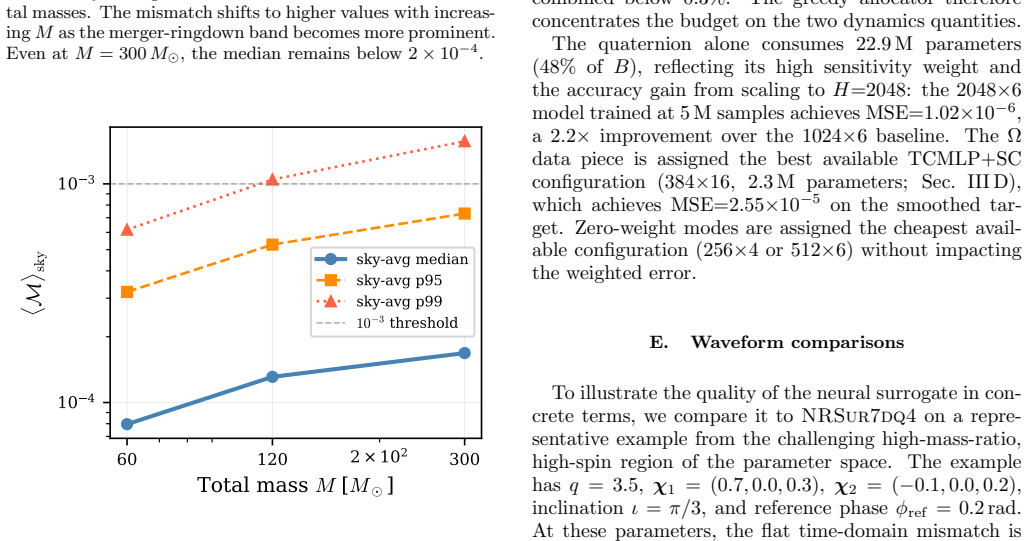
We present a neural network surrogate model that emulates the NRSur7dq4 gravitational waveform model for precessing binary black hole mergers. The surrogate decomposes the waveform into constituent quantities and trains an independent multilayer perceptron (MLP) for each. We validate the surrogate against NRSur7dq4 on 10,000 waveforms spanning its full parameter space ($1 \leq q \leq 4$, $|\chi_{A,B}| \leq 0.8$). For representative total masses between 60 and 300 $M_\odot$, median sky-averaged frequency-domain mismatches range from $8.0 \times 10^{-5}$ to $1.7 \times 10^{-4}$, with 95th percentiles below $10^{-3}$. On an NVIDIA L40S GPU the JAX surrogate evaluates a single waveform in about 1 ms end-to-end, roughly 10 times faster than the LALSimulation C implementation of NRSur7dq4, and sustains about 140 times the LALSimulation throughput at batch size 64, making it well suited for both low-latency parameter-estimation samplers and large-scale waveform generation. The full NRSur7dq4 NN waveform-to-likelihood pipeline is implemented in JAX and is differentiable. This is the first neural-network surrogate of a precessing numerical-relativity waveform model to combine validated NR-faithful accuracy with a fully differentiable, GPU-accelerated inference pipeline, enabling gradient-based inference approaches via automatic differentiation including Fisher information matrices, GPU-accelerated nested sampling, gradient-based MCMC and importance sampling.
Figures




Reference graph
Works this paper leans on
-
[1]
B. P. Abbottet al.(LIGO Scientific, Virgo), Obser- vation of Gravitational Waves from a Binary Black Hole Merger, Phys. Rev. Lett.116, 061102 (2016), arXiv:1602.03837 [gr-qc]
Pith/arXiv arXiv 2016
-
[2]
Aasiet al.(LIGO Scientific), Advanced LIGO, Class
J. Aasiet al.(LIGO Scientific), Advanced LIGO, Class. Quant. Grav.32, 074001 (2015), arXiv:1411.4547 [gr- qc]
Pith/arXiv arXiv 2015
-
[3]
F. Acerneseet al.(VIRGO), Advanced Virgo: a second- generation interferometric gravitational wave detector, Class. Quant. Grav.32, 024001 (2015), arXiv:1408.3978 [gr-qc]
Pith/arXiv arXiv 2015
-
[4]
T. Akutsuet al.(KAGRA), First cryogenic test opera- tion of underground km-scale gravitational-wave obser- vatory KAGRA, Class. Quant. Grav.36, 165008 (2019), arXiv:1901.03569 [astro-ph.IM]
arXiv 2019
-
[5]
A. G. Abacet al.(LIGO Scientific, VIRGO, KA- GRA), GWTC-5.0: An Introduction to Version 5.0 of the Gravitational-Wave Transient Catalog, (2026), arXiv:2605.27223 [gr-qc]
Pith/arXiv arXiv 2026
-
[6]
A. G. Abacet al.(LIGO Scientific, VIRGO, KA- GRA), GWTC-5.0: Methods for Identifying and Characterizing Gravitational-wave Transients, (2026), arXiv:2605.27224 [gr-qc]
Pith/arXiv arXiv 2026
-
[7]
A. G. Abacet al.(LIGO Scientific, VIRGO, KAGRA), GWTC-5.0: Observations from the Second Part of the Fourth LIGO-Virgo-KAGRA Observing Run and Updates to the Gravitational-Wave Transient Catalog, (2026), arXiv:2605.27225 [gr-qc]. 34
Pith/arXiv arXiv 2026
-
[8]
M. A. Scheelet al., The SXS collaboration’s third cata- log of binary black hole simulations, Class. Quant. Grav. 42, 195017 (2025), arXiv:2505.13378 [gr-qc]
arXiv 2025
-
[9]
Pretorius, Evolution of binary black hole space- times, Phys
F. Pretorius, Evolution of binary black hole space- times, Phys. Rev. Lett.95, 121101 (2005), arXiv:gr- qc/0507014
arXiv 2005
-
[10]
M. Campanelli, C. O. Lousto, P. Marronetti, and Y. Zlo- chower, Accurate evolutions of orbiting black-hole bi- naries without excision, Phys. Rev. Lett.96, 111101 (2006), arXiv:gr-qc/0511048
Pith/arXiv arXiv 2006
-
[11]
J. G. Baker, J. Centrella, D.-I. Choi, M. Koppitz, and J. van Meter, Gravitational wave extraction from an inspiraling configuration of merging black holes, Phys. Rev. Lett.96, 111102 (2006), arXiv:gr-qc/0511103
Pith/arXiv arXiv 2006
-
[12]
C. Garc ´ ıa-Quir´ os, M. Colleoni, S. Husa, H. Estell´ es, G. Pratten, A. Ramos-Buades, M. Mateu-Lucena, and R. Jaume, Multimode frequency-domain model for the gravitational wave signal from nonprecessing black-hole binaries, Phys. Rev. D102, 064002 (2020), arXiv:2001.10914 [gr-qc]
Pith/arXiv arXiv 2020
-
[13]
P. Ajithet al., Inspiral-merger-ringdown waveforms for black-hole binaries with non-precessing spins, Phys. Rev. Lett.106, 241101 (2011), arXiv:0909.2867 [gr-qc]
Pith/arXiv arXiv 2011
-
[14]
S. Khan, S. Husa, M. Hannam, F. Ohme, M. P¨ urrer, X. Jim´ enez Forteza, and A. Boh´ e, Frequency-domain gravitational waves from nonprecessing black-hole bi- naries. II. A phenomenological model for the ad- vanced detector era, Phys. Rev. D93, 044007 (2016), arXiv:1508.07253 [gr-qc]
Pith/arXiv arXiv 2016
-
[15]
G. Prattenet al., Computationally efficient models for the dominant and subdominant harmonic modes of pre- cessing binary black holes, Phys. Rev. D103, 104056 (2021), arXiv:2004.06503 [gr-qc]
Pith/arXiv arXiv 2021
-
[16]
A. Ramos-Buades, A. Buonanno, H. Estell´ es, M. Khalil, D. P. Mihaylov, S. Ossokine, L. Pompili, and M. Shiferaw, Next generation of accurate and ef- ficient multipolar precessing-spin effective-one-body waveforms for binary black holes, Phys. Rev. D108, 124037 (2023), arXiv:2303.18046 [gr-qc]
Pith/arXiv arXiv 2023
-
[17]
A. Buonanno and T. Damour, Effective one-body ap- proach to general relativistic two-body dynamics, Phys. Rev. D59, 084006 (1999), arXiv:gr-qc/9811091
Pith/arXiv arXiv 1999
-
[18]
S. Ossokineet al., Multipolar Effective-One-Body Wave- forms for Precessing Binary Black Holes: Construc- tion and Validation, Phys. Rev. D102, 044055 (2020), arXiv:2004.09442 [gr-qc]
Pith/arXiv arXiv 2020
-
[19]
S. Albanesi, R. Gamba, S. Bernuzzi, J. Fontbut´ e, A. Gonzalez, and A. Nagar, Effective-one-body mod- eling for generic compact binaries with arbitrary orbits, Phys. Rev. D112, L121503 (2025), arXiv:2503.14580 [gr-qc]
Pith/arXiv arXiv 2025
-
[20]
S. E. Field, C. R. Galley, F. Herrmann, J. S. Hes- thaven, E. Ochsner, and M. Tiglio, Reduced basis cata- logs for gravitational wave templates, Phys. Rev. Lett. 106, 221102 (2011), arXiv:1101.3765 [gr-qc]
Pith/arXiv arXiv 2011
-
[21]
S. E. Field, C. R. Galley, J. S. Hesthaven, J. Kaye, and M. Tiglio, Fast prediction and evaluation of gravi- tational waveforms using surrogate models, Phys. Rev. X4, 031006 (2014), arXiv:1308.3565 [gr-qc]
Pith/arXiv arXiv 2014
-
[22]
M. P¨ urrer, Frequency domain reduced order models for gravitational waves from aligned-spin compact binaries, Class. Quant. Grav.31, 195010 (2014), arXiv:1402.4146 [gr-qc]
Pith/arXiv arXiv 2014
-
[23]
M. P¨ urrer, Frequency domain reduced order model of aligned-spin effective-one-body waveforms with generic mass-ratios and spins, Phys. Rev. D93, 064041 (2016), arXiv:1512.02248 [gr-qc]
Pith/arXiv arXiv 2016
-
[24]
J. Blackman, S. E. Field, C. R. Galley, B. Szil´ agyi, M. A. Scheel, M. Tiglio, and D. A. Hemberger, Fast and Accurate Prediction of Numerical Relativity Wave- forms from Binary Black Hole Coalescences Using Sur- rogate Models, Phys. Rev. Lett.115, 121102 (2015), arXiv:1502.07758 [gr-qc]
Pith/arXiv arXiv 2015
-
[25]
J. Blackman, S. E. Field, M. A. Scheel, C. R. Galley, C. D. Ott, M. Boyle, L. E. Kidder, H. P. Pfeiffer, and B. Szil´ agyi, Numerical relativity waveform surrogate model for generically precessing binary black hole merg- ers, Phys. Rev. D96, 024058 (2017), arXiv:1705.07089 [gr-qc]
Pith/arXiv arXiv 2017
-
[26]
R. Cotesta, S. Marsat, and M. P¨ urrer, Frequency do- main reduced order model of aligned-spin effective-one- body waveforms with higher-order modes, Phys. Rev. D 101, 124040 (2020), arXiv:2003.12079 [gr-qc]
Pith/arXiv arXiv 2020
-
[27]
V. Varma, S. E. Field, M. A. Scheel, J. Black- man, L. E. Kidder, and H. P. Pfeiffer, Surrogate model of hybridized numerical relativity binary black hole waveforms, Phys. Rev. D99, 064045 (2019), arXiv:1812.07865 [gr-qc]
Pith/arXiv arXiv 2019
-
[28]
V. Varma, S. E. Field, M. A. Scheel, J. Blackman, D. Gerosa, L. C. Stein, L. E. Kidder, and H. P. Pfeiffer, Surrogate models for precessing binary black hole sim- ulations with unequal masses, Phys. Rev. Research1, 033015 (2019), arXiv:1905.09300 [gr-qc]
Pith/arXiv arXiv 2019
-
[29]
Punturoet al., The Einstein Telescope: A third-generation gravitational wave observatory, Class
M. Punturoet al., The Einstein Telescope: A third-generation gravitational wave observatory, Class. Quant. Grav.27, 194002 (2010)
2010
-
[30]
M. Branchesiet al., Science with the Einstein Tele- scope: a comparison of different designs, JCAP07, 068, arXiv:2303.15923 [gr-qc]
-
[31]
Abacet al.(ET), The Science of the Einstein Tele- scope, JCAP03, 081, arXiv:2503.12263 [gr-qc]
A. Abacet al.(ET), The Science of the Einstein Tele- scope, JCAP03, 081, arXiv:2503.12263 [gr-qc]
-
[32]
Reitzeet al., Cosmic Explorer: The U.S
D. Reitzeet al., Cosmic Explorer: The U.S. Contribu- tion to Gravitational-Wave Astronomy beyond LIGO, Bull. Am. Astron. Soc.51, 035 (2019), arXiv:1907.04833 [astro-ph.IM]
Pith/arXiv arXiv 2019
-
[33]
M. Evanset al., Cosmic Explorer: A Submission to the NSF MPSAC ngGW Subcommittee, (2023), arXiv:2306.13745 [astro-ph.IM]
Pith/arXiv arXiv 2023
-
[34]
L. Lindblom, B. J. Owen, and D. A. Brown, Model Waveform Accuracy Standards for Gravitational Wave Data Analysis, Phys. Rev. D78, 124020 (2008), arXiv:0809.3844 [gr-qc]
Pith/arXiv arXiv 2008
-
[35]
M. P¨ urrer and C.-J. Haster, Gravitational waveform ac- curacy requirements for future ground-based detectors, Phys. Rev. Res.2, 023151 (2020), arXiv:1912.10055 [gr- qc]
Pith/arXiv arXiv 2020
-
[36]
Q. Hu and J. Veitch, Assessing the model waveform ac- curacy of gravitational waves, Phys. Rev. D106, 044042 (2022), arXiv:2205.08448 [gr-qc]
Pith/arXiv arXiv 2022
-
[37]
J. S. Read, Waveform uncertainty quantification and interpretation for gravitational-wave astronomy, Class. Quant. Grav.40, 135002 (2023), arXiv:2301.06630 [gr- qc]
Pith/arXiv arXiv 2023
-
[38]
C. B. Owen, C.-J. Haster, S. Perkins, N. J. Cornish, and N. Yunes, Waveform accuracy and systematic un- certainties in current gravitational wave observations, Phys. Rev. D108, 044018 (2023), arXiv:2301.11941 [gr- qc]. 35
Pith/arXiv arXiv 2023
-
[39]
V. Kapil, L. Reali, R. Cotesta, and E. Berti, Systematic bias from waveform modeling for binary black hole pop- ulations in next-generation gravitational wave detectors, Phys. Rev. D109, 104043 (2024), arXiv:2404.00090 [gr- qc]
Pith/arXiv arXiv 2024
- [40]
-
[41]
N. J. Cornish, Fast Fisher Matrices and Lazy Likeli- hoods, (2010), arXiv:1007.4820 [gr-qc]
Pith/arXiv arXiv 2010
-
[42]
B. Zackay, L. Dai, and T. Venumadhav, Relative Bin- ning and Fast Likelihood Evaluation for Gravitational Wave Parameter Estimation, (2018), arXiv:1806.08792 [astro-ph.IM]
Pith/arXiv arXiv 2018
-
[43]
N. J. Cornish, Heterodyned likelihood for rapid gravi- tational wave parameter inference, Phys. Rev. D104, 104054 (2021), arXiv:2109.02728 [gr-qc]
Pith/arXiv arXiv 2021
-
[44]
N. Leslie, L. Dai, and G. Pratten, Mode-by-mode rel- ative binning: Fast likelihood estimation for gravita- tional waveforms with spin-orbit precession and mul- tiple harmonics, Phys. Rev. D104, 123030 (2021), arXiv:2109.09872 [astro-ph.IM]
Pith/arXiv arXiv 2021
-
[45]
S. Vinciguerra, J. Veitch, and I. Mandel, Accelerat- ing gravitational wave parameter estimation with multi- band template interpolation, Class. Quant. Grav.34, 115006 (2017), arXiv:1703.02062 [gr-qc]
Pith/arXiv arXiv 2017
-
[46]
S. Morisaki, Accelerating parameter estimation of grav- itational waves from compact binary coalescence us- ing adaptive frequency resolutions, Phys. Rev. D104, 044062 (2021), arXiv:2104.07813 [gr-qc]
Pith/arXiv arXiv 2021
-
[47]
P. Canizares, S. E. Field, J. R. Gair, and M. Tiglio, Gravitational wave parameter estimation with com- pressed likelihood evaluations, Phys. Rev. D87, 124005 (2013), arXiv:1304.0462 [gr-qc]
Pith/arXiv arXiv 2013
-
[48]
P. Canizares, S. E. Field, J. Gair, V. Raymond, R. Smith, and M. Tiglio, Accelerated gravitational-wave parameter estimation with reduced order modeling, Phys. Rev. Lett.114, 071104 (2015), arXiv:1404.6284 [gr-qc]
Pith/arXiv arXiv 2015
-
[49]
R. Smith, S. E. Field, K. Blackburn, C.-J. Haster, M. P¨ urrer, V. Raymond, and P. Schmidt, Fast and ac- curate inference on gravitational waves from precess- ing compact binaries, Phys. Rev. D94, 044031 (2016), arXiv:1604.08253 [gr-qc]
Pith/arXiv arXiv 2016
-
[50]
J. Tissino, G. Carullo, M. Breschi, R. Gamba, S. Schmidt, and S. Bernuzzi, Combining effective-one- body accuracy and reduced-order-quadrature speed for binary neutron star merger parameter estimation with machine learning, Phys. Rev. D107, 084037 (2023), arXiv:2210.15684 [gr-qc]
Pith/arXiv arXiv 2023
-
[51]
A. J. K. Chua and M. Vallisneri, Learning Bayesian posteriors with neural networks for gravitational- wave inference, Phys. Rev. Lett.124, 041102 (2020), arXiv:1909.05966 [gr-qc]
Pith/arXiv arXiv 2020
-
[52]
M. Dax, S. R. Green, J. Gair, J. H. Macke, A. Buo- nanno, and B. Sch¨ olkopf, Real-Time Gravitational Wave Science with Neural Posterior Estimation, Phys. Rev. Lett.127, 241103 (2021), arXiv:2106.12594 [gr-qc]
Pith/arXiv arXiv 2021
-
[53]
M. Dax, S. R. Green, J. Gair, M. P¨ urrer, J. Wild- berger, J. H. Macke, A. Buonanno, and B. Sch¨ olkopf, Neural Importance Sampling for Rapid and Reliable Gravitational-Wave Inference, Phys. Rev. Lett.130, 171403 (2023), arXiv:2210.05686 [gr-qc]
Pith/arXiv arXiv 2023
-
[54]
M. Dax, S. R. Green, J. Gair, N. Gupte, M. P¨ urrer, V. Raymond, J. Wildberger, J. H. Macke, A. Buonanno, and B. Sch¨ olkopf, Real-time inference for binary neutron star mergers using machine learning, Nature639, 49 (2025), arXiv:2407.09602 [gr-qc]
Pith/arXiv arXiv 2025
-
[55]
Q. Hu, J. Irwin, Q. Sun, C. Messenger, L. Suleiman, I. S. Heng, and J. Veitch, Decoding Long-duration Gravitational Waves from Binary Neutron Stars with Machine Learning: Parameter Estimation and Equa- tions of State, Astrophys. J. Lett.987, L17 (2025), arXiv:2412.03454 [gr-qc]
Pith/arXiv arXiv 2025
-
[56]
S. Khan and R. Green, Gravitational-wave surrogate models powered by artificial neural networks, Phys. Rev. D103, 064015 (2021), arXiv:2008.12932 [gr-qc]
Pith/arXiv arXiv 2021
-
[57]
S. Thomaset al., Accelerating multimodal gravitational waveforms from precessing compact binaries with artifi- cial neural networks, Phys. Rev. D106, 104029 (2022), arXiv:2205.14066 [gr-qc]
Pith/arXiv arXiv 2022
-
[58]
O. Gramaxo Freitas, A. Theodoropoulos, N. Villanueva, T. Fernandes, S. Nunes, J. A. Font, A. Onofre, A. Torres-Forn´ e, and J. D. Martin-Guerrero, Deep learning powered numerical relativity surrogate for bi- nary black hole waveforms, Phys. Rev. D112, 043026 (2025), arXiv:2412.06946 [gr-qc]
arXiv 2025
-
[59]
L. M. Thomas, K. Chatziioannou, V. Varma, and S. E. Field, Optimizing neural network surrogate models: Ap- plication to black hole merger remnants, Phys. Rev. D 111, 104029 (2025), arXiv:2501.16462 [gr-qc]
Pith/arXiv arXiv 2025
-
[60]
C. Whittall and G. Pratten, Fast neural network sur- rogate for multimodal effective-one-body gravitational waveforms from generically precessing compact binaries, (2026), arXiv:2604.14270 [gr-qc]
Pith/arXiv arXiv 2026
-
[61]
Barrault, Y
M. Barrault, Y. Maday, N. C. Nguyen, and A. T. Pa- tera, An ‘empirical interpolation’ method: application to efficient reduced-basis discretization of partial differ- ential equations, Comptes Rendus Math´ ematique339, 667 (2004)
2004
-
[62]
K. W. K. Wong and GW-JAX Team, JAXNRSur: A JAX implementation of numerical relativity surrogate models,https://github.com/GW-JAX-Team/JAXNRSur (2025), originally developed athttps://github.com/ kazewong/JaxNRSur
2025
-
[63]
G. Lovelace, R. Owen, H. P. Pfeiffer, and T. Chu, Binary-black-hole initial data with nearly-extremal spins, Phys. Rev.D78, 084017 (2008), arXiv:0805.4192 [gr-qc]
Pith/arXiv arXiv 2008
-
[64]
L. Lindblom, M. A. Scheel, L. E. Kidder, R. Owen, and O. Rinne, A New generalized harmonic evolution system, Class. Quant. Grav.23, S447 (2006), arXiv:gr- qc/0512093 [gr-qc]
arXiv 2006
-
[65]
B. Szilagyi, L. Lindblom, and M. A. Scheel, Simulations of Binary Black Hole Mergers Using Spectral Methods, Phys. Rev.D80, 124010 (2009), arXiv:0909.3557 [gr- qc]
Pith/arXiv arXiv 2009
-
[66]
M. A. Scheel, M. Boyle, T. Chu, L. E. Kidder, K. D. Matthews, and H. P. Pfeiffer, High-accuracy waveforms for binary black hole inspiral, merger, and ringdown, Phys. Rev.D79, 024003 (2009), arXiv:0810.1767 [gr- qc]
Pith/arXiv arXiv 2009
-
[67]
LIGO Scientific Collaboration, LAL: LIGO algorithm library,https://doi.org/10.7935/GT1W-FZ16(2018)
-
[68]
Ravishankaret al., NRSur7dq4v2: A multi-domain 36 precessing surrogate model with improved accuracy, (2026), to appear on arXiv
A. Ravishankaret al., NRSur7dq4v2: A multi-domain 36 precessing surrogate model with improved accuracy, (2026), to appear on arXiv
2026
-
[69]
S. E. Field, V. Varma, J. Blackman, B. Gadre, C. R. Galley, T. Islam, K. Mitman, M. P¨ urrer, A. Ravichan- dran, M. A. Scheel, L. C. Stein, and J. Yoo, GWSur- rogate: A Python package for gravitational wave sur- rogate models, J. Open Source Softw.10, 7073 (2025), arXiv:2504.08839 [astro-ph.IM]
Pith/arXiv arXiv 2025
-
[70]
B. P. Abbottet al.(KAGRA, LIGO Scientific, Virgo), Prospects for observing and localizing gravitational- wave transients with Advanced LIGO, Advanced Virgo and KAGRA, Living Rev. Rel.19, 1 (2016), arXiv:1304.0670 [gr-qc]
Pith/arXiv arXiv 2016
-
[71]
Rahaman, A
N. Rahaman, A. Baratin, D. Arpit, F. Draxler, M. Lin, F. Hamprecht, Y. Bengio, and A. Courville, On the spectral bias of neural networks, inProceedings of the 36th International Conference on Machine Learning, Proceedings of Machine Learning Research, Vol. 97, edited by K. Chaudhuri and R. Salakhutdinov (PMLR,
-
[72]
M. Tancik, P. P. Srinivasan, B. Mildenhall, S. Fridovich- Keil, N. Raghavan, U. Singhal, R. Ramamoorthi, J. T. Barron, and R. Ng, Fourier features let networks learn high frequency functions in low dimensional domains, inAdvances in Neural Information Processing Systems, Vol. 33 (2020) arXiv:2006.10739 [cs.CV]
Pith/arXiv arXiv 2020
-
[73]
I. Loshchilov and F. Hutter, Decoupled weight decay regularization, inInternational Conference on Learning Representations(2019) arXiv:1711.05101
Pith/arXiv arXiv 2019
-
[74]
M. Boyle, Angular velocity of gravitational radiation from precessing binaries and the corotating frame, Phys. Rev. D87, 104006 (2013), arXiv:1302.2919 [gr-qc]
Pith/arXiv arXiv 2013
-
[75]
Bradbury, R
J. Bradbury, R. Frostig, P. Hawkins, M. J. Johnson, C. Leary, D. Maclaurin, G. Necula, A. Paszke, J. Van- derPlas, S. Wanderman-Milne, and Q. Zhang, JAX: composable transformations of Python+NumPy pro- grams,http://github.com/jax-ml/jax(2018)
2018
-
[76]
A. Paszke, S. Gross, F. Massa, A. Lerer, J. Bradbury, G. Chanan, T. Killeen, Z. Lin, N. Gimelshein, L. Antiga, A. Desmaison, A. K¨ opf, E. Yang, Z. DeVito, M. Rai- son, A. Tejani, S. Chilamkurthy, B. Steiner, L. Fang, J. Bai, and S. Chintala, PyTorch: An imperative style, high-performance deep learning library, inAdvances in Neural Information Processing ...
Pith/arXiv arXiv 2019
-
[77]
Ansel, E
J. Ansel, E. Yang, H. He, N. Gimelshein, A. Jain, M. Voznesensky, B. Bao, P. Bell, D. Berard, E. Burovski, G. Chauhan, A. Chourdia, W. Constable, A. Desmaison, Z. DeVito, E. Ellison, W. Feng, J. Gong, M. Gschwind, B. Hirsh, S. Huang, K. Kalambarkar, L. Kirsch, M. Lazos, M. Lezcano, Y. Liang, J. Liang, Y. Lu, C. K. Luk, B. Maher, Y. Pan, C. Puhrsch, M. Res...
2024
-
[78]
Kellerer, U
H. Kellerer, U. Pferschy, and D. Pisinger,Knapsack Problems(Springer, Berlin, 2004)
2004
-
[79]
The XLA Authors, XLA: Optimizing compiler for ma- chine learning,https://openxla.org/xla(2017)
2017
-
[80]
P. Kidger and C. Garcia, Equinox: neural networks in JAX via callable PyTrees and filtered transforma- tions, Differentiable Programming workshop at Neu- ral Information Processing Systems 2021 (2021), arXiv:2111.00254 [cs.LG]
Pith/arXiv arXiv 2021
discussion (0)
Sign in with ORCID, Apple, or X to comment. Anyone can read and Pith papers without signing in.