REVIEW 2 major objections 6 minor 249 references
V407 Vul is the first gravitational-wave 'verification triple': an AM CVn double white dwarf and a G-type star, bound ~120 AU apart, that LISA should detect at signal-to-noise ~27.
Reviewed by Pith at T0; open to challenge. T0 means a machine referee read the full paper against a public rubric. the ladder, T0–T4 →
T0 review · deepseek-v4-flash
2026-08-01 02:04 UTC pith:O3WUUAOV
load-bearing objection Strong evidence that V407 Vul is a LISA-detectable triple, but a missing plate scale in the astrometry section undermines the headline 3.2-sigma binding argument. the 2 major comments →
V407 Vul: a triple star system with an AM CVn detectable by gravitational wave observatories
The pith
A machine-rendered reading of the paper's core claim, the machinery that carries it, and where it could break.
Core claim
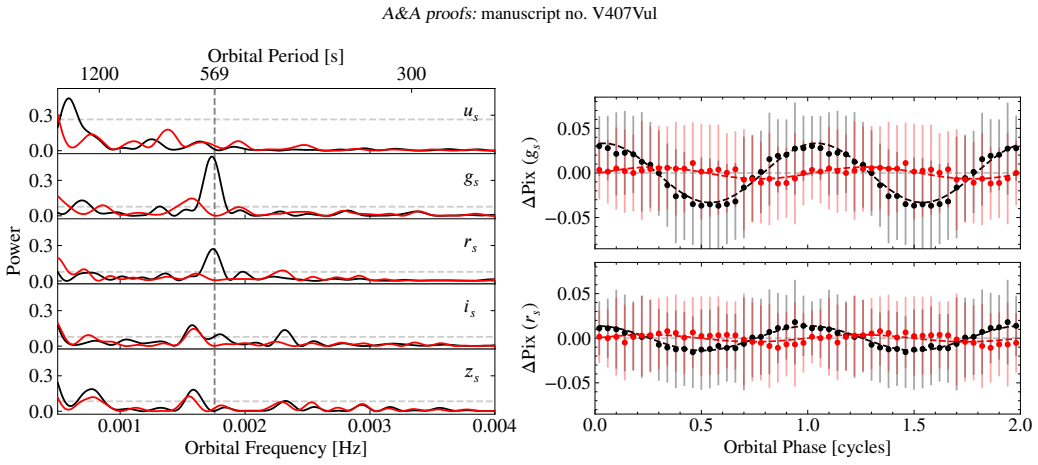
V407 Vul is a gravitationally bound triple star system: a 569-second AM CVn double-white-dwarf binary plus a ~0.9-solar-mass G-type main-sequence star. One night of high-speed HiPERCAM astrometry shows the photocentre wobbling at the binary's period — 0.0340±0.0018 pixels in g_s, 0.0144±0.0014 in r_s — which, combined with the binary's per-band flux fraction, gives an angular separation of 0.0346±0.0018 arcseconds (~120 AU at 3510 pc). The authors argue the pair is bound rather than a chance alignment, and that 23 years of timing pin the orbital decay to 1%. They predict LISA will detect the binary at signal-to-noise 27.4±9.1 in four years, making V407 Vul the first 'verification triple.'
What carries the argument
The photocentre-wobble astrometry, tied to the light curve by the identity A = [V/(V+1)] f_MS,min d, where A is the measured centroid oscillation in a passband, V the binary's fractional flux variation there, f_MS,min the G star's fractional flux at minimum, and d the true angular separation. This relation carries the triple claim: because the wobble amplitude scales with the binary's flux fraction (about 2× in g_s vs r_s, matching the light curves), the oscillation reads as a shifting centre of light rather than intrinsic flicker. Supporting machinery: 23 years of O−C timing across high-speed cameras giving the orbital decay; MCMC spectro-photometric fits of stellar-atmosphere models to HST
Load-bearing premise
The claim stands on the interpretation of the 0.034-pixel centroid oscillation measured in a single night of HiPERCAM data as a physical displacement of the photocentre on the 569-second period, after subtracting a linear differential-refraction trend; if the wobble instead reflects an unrecognized systematic — such as seeing or colour variations coupled to the binary phase — the triple separation and the 'verification triple' claim weaken.
What would settle it
Re-observe V407 Vul with the same high-speed imager on a second night at different airmass and with several comparison stars. A physical wobble must (1) re-appear at the 569-second period locked to the photometric ephemeris, and (2) reproduce the amplitude predicted by the flux-fraction scaling across bands (equation 4), whereas a refraction or seeing artifact would drift in phase with airmass and fail the scaling test. Independent confirmation would come from LISA: the measured chirp mass must be consistent with the 0.1545-solar-mass lower bound once mass-transfer corrections are applied.
If this is right
- V407 Vul becomes the first 'verification triple': a millihertz gravitational-wave calibration source inside a hierarchical triple, with LISA predicted to detect it at signal-to-noise 27.4±9.1 in a four-year mission (43.6±14.1 in ten years), keeping it among the brightest verification binaries.
- The orbital decay, now measured to 1% precision (f_dot = (1.291±0.015)×10⁻¹⁷ Hz/s), confines the chirp mass to a minimum of 0.1545±0.0106 M_sun and opens a test of whether the binary survives a period minimum or coalesces; continued timing could reveal a second frequency derivative.
- The outer orbit (~10³ years, ~120 AU) is too wide to imprint a gravitational-wave Doppler shift on LISA's signal, so the inner AM CVn evolves in near-isolation; the tertiary is too distant to drive Kozai–Lidov dynamics or common-envelope interaction.
- The revised distance of 3510 pc and the ≈58,000-K accretor temperature imply a present-day mass-transfer rate near 10⁻⁸ to 10⁻⁷·⁵ M_sun/yr and lower the optimistic LISA signal estimates that earlier, looser distances had produced.
- Whether the inner binary outspirals, merges into a rejuvenated star, or detonates as a sub-Chandrasekhar type Ia supernova, the tertiary is essentially a spectator: its Roche lobe is far too large for interaction, so the two parts of the system evolve independently.
Where Pith is reading between the lines
- If the wobble is genuinely orbital, the same single-night, high-speed astrometric method should find other companion-dominated ultra-compact binaries; the absence of triples among known verification binaries would then be a selection effect of optical surveys blinded by bright main-sequence stars, not a real scarcity.
- The distance revision to ~3.5 kpc — near the top of previously quoted ranges — suggests systematic uncertainty in distances, and hence in LISA signal-to-noise predictions, for other AM CVn verification binaries; a uniform UV-based distance campaign for the class would test this.
- With an outer period near 10³ years, the wobble amplitude and direction should drift slowly as the projected separation changes; re-measuring the photocentre wobble over coming decades could constrain the outer orbit's eccentricity and inclination, which a single epoch cannot.
- The authors' note that the most recent timing points deviate slightly from a constant period derivative is a concrete prediction: if the deviation persists, V407 Vul would be nearing its period minimum, sharpening the expected merger-vs-outspiral outcome and the timing of any turn-around signature.
Editorial analysis
A structured set of objections, weighed in public.
Referee Report
Summary. The paper presents a multi-wavelength study of V407 Vul, an ultra-compact binary with a 569 s orbital period that has long been suspected to be an AM CVn double white dwarf. Using 23 years of high-speed photometry the authors measure a precise orbital decay, ˙f0 = (1.291±0.015)×10^-17 Hz/s, and infer a minimum chirp mass. New HiPERCAM astrometry shows a 569-s photocentre wobble in the g_s and r_s bands, which the authors interpret as the signature of a spatially separated, gravitationally bound outer tertiary star. Combining HST, LBT, and Keck data with an SED model, they derive a distance of 3510^{+140}_{-110} pc, a hot ~58,000 K accreting white dwarf, and a main-sequence tertiary; from the wobble amplitude they derive an angular separation of 0.03–0.04 arcsec and claim V407 Vul is a bound triple. They further predict a LISA SNR of 27.4±9.1 in 4 years, making it the first 'verification triple' in the millihertz gravitational-wave band.
Significance. If the triple interpretation holds, this would be the first confirmed AM CVn system in a hierarchical triple among the LISA verification binaries, with direct implications for the formation and evolution of ultra-compact binaries and for the expected number of LISA sources in multi-star systems. The paper contains a valuable long-baseline timing dataset, new UV observations that isolate the accreting component, and a high-S/N astrometric detection in two bands. The timing result and the SED analysis are carefully presented, and the LISA SNR prediction is a concrete, falsifiable forecast. However, the headline quantitative separation — and with it one of the two tests for gravitational binding — is not reproducible as written, and the astrometric detection that anchors the triple claim rests on a single epoch. These issues need to be resolved before the central claims can be accepted.
major comments (2)
- [Section 6.2, Eq. (4), Table 3] Eq. (4) and Table 3 are dimensionally inconsistent, and the quoted d values do not follow from the stated inputs. A is measured in pixels (§4: 0.0340±0.0018 px in g_s and 0.0144±0.0014 px in r_s), while d is quoted in arcseconds; no plate scale (0.162″/px) appears in Eq. (4). Evaluating d = A_px × 0.162″/px / [(V/(V+1)) f_MS,min] gives d_g ≈ 0.073″ and d_r ≈ 0.054″, not 0.0406″ and 0.0285″. The mean separation would be ≈0.064″ rather than 0.0346″. The inconsistency cannot be resolved by assuming the Table-3 A values are already in arcsec, since then d would be ≈0.45″ and ≈0.33″. This matters directly for the proper-motion test in the same section: with d_2021≈0.0346″ and d_2005≈0.022″, the maximum possible separation change (≈0.056″) is smaller than the Gaia displacement 0.076″; with d_2021≈0.073″ the maximum possible change (≈0.095″) is compatible with a stationary background, so the cl
- [Section 4, Fig. 2] The new astrometric wobble detection is based on a single HiPERCAM night (2021 June 16) after subtracting a linear differential-refraction trend. Comparison stars are mentioned, but no comparison-star periodograms or injection-recovery tests are shown. Since the triple separation, the binding test, and the 'verification triple' claim all depend on this ~0.005–0.006″ signal, the authors should demonstrate that the signal is not a seeing–colour systematic. For example, they could show null results for comparison-star centroids at 569 s, or recover an injected synthetic wobble of the same amplitude and frequency. Without such a test, the statement 'clear confirmation of the triple star nature' overstates the evidence from the single epoch.
minor comments (6)
- [Abstract vs. Section 6.3] The abstract quotes a LISA SNR of 28.4±9.2, while Section 6.3 and the conclusion quote 27.4±9.1. Reconcile these values.
- [Section 4] The text says 'the night of 16 June 2026', but Table A.1 and context indicate 2021 June 16. Correct the date.
- [Eq. (5)] The characteristic-strain formula is typeset ambiguously: 2(GM)^5/3/c^4 d should be written as 2(GM)^{5/3}/(c^4 d). Also check the numerical factor against Shah et al. (2012).
- [Table 2] The second fit line is labelled 'LBT/LRIS' but should be 'LBT/MODS'.
- [Table 3 and Eq. (4)] Please state explicitly whether A in Eq. (4) is the pixel amplitude or an angular amplitude, and define V consistently as a fraction or a percentage. The current text switches between 'pixel amplitude' and percent units without making the conversion explicit.
- [Section 6.3] The phrase '43.6±14.1 yr' should be '43.6±14.1' (the unit yr belongs to the mission time, not the uncertainty).
Circularity Check
No load-bearing circularity: the astrometric-wobble detection, separation estimate, and LISA SNR are independent forward calculations; the reported unit inconsistency is a correctness risk, not a circular step.
full rationale
The paper's central chain—measured 569 s astrometric wobble (Section 4), conversion to angular separation via Eq. (4), and forward LISA SNR (Eq. 5, Section 6.3)—contains no step in which a target result is used as an input. The pixel amplitudes are measured independently of the SED fit; f_MS,min is derived from the SED model plus the photometric amplitude, and d is solved for rather than fitted. The proper-motion and chance-alignment arguments (Section 6.2) are external consistency checks using Gaia and TRILEGAL. The orbital-decay chirp mass (Eq. 3) is a direct conversion of the fitted f0 and fdot. Self-citations (e.g., Munday et al. 2023 for timing methodology, Wong & Bildsten 2021 for evolutionary tracks) are not load-bearing for the triple claim. The paper explicitly flags its own limitations: reddening degeneracy (Section 5.1), 'Formal errors are given... and the true uncertainties would be much larger' (Section 6.1), outer-orbit period intended only as order-of-magnitude (Section 6.2), and past distance uncertainty affecting the SNR comparison (Section 6.3). The unit mismatch between A[pix] and d[arcsec] in Eq. (4)/Table 3 is a reproducibility/correctness defect, not a circular reduction: no fitted parameter is renamed as a prediction. Score 0.
Axiom & Free-Parameter Ledger
free parameters (5)
- Inclination (i) =
60° (assumed)
- Inner binary masses =
M_acc=0.6±0.2 M☉, M_don=0.25±0.05 M☉
- Donor WD temperature =
8000 K (fixed)
- Donor WD radius =
0.035 R☉ (fixed)
- E(B−V) =
0.43–0.44 mag
axioms (4)
- domain assumption The 569-s photometric modulation is the orbital period of the inner DWD binary
- standard math Kepler's third law and the standard GW strain formula apply
- domain assumption The G-type star and the AM CVn are at the same distance
- ad hoc to paper Reddening E(B−V)=0.43–0.44 mag from Lallement et al. (2022) maps
read the original abstract
The AM CVn class includes mass transferring, ultra-compact double white dwarf binaries with orbital periods on the timescale of minutes. A long-standing puzzle is that none of the roughly fifty ultra-compact, "verification binaries" which are easily detectable in the millihertz gravitational wave regime reside in a triple star configuration. Much evidence has hinted at V407 Vul being an inspiraling, double white dwarf AM CVn with an orbital period of 569s. Yet, a decisive confirmation has proved challenging since a main sequence star dominates its visible spectrum. We present a clear confirmation of the triple star nature of the source by detecting a significant astrometric wobble of the photocentre on the 569s orbital period of the binary. The AM CVn and the main sequence components are gravitationally bound with a spatial separation of roughly 0.03-0.04'', equating to an orbital separation of approximately 120AU. A total of 23 years of orbital timing constrained the orbital decay of the AM CVn as being precise to the 1% level, critical in understanding if this class of binary survives through a period minimum or coalesce. New Hubble Space Telescope ultra-violet imaging and spectroscopic data allowed the isolated detection of the AM CVn at shorter wavelengths, revealing an approximately 58000 K accretor white dwarf, while placing a firm distance constraint of 3510+140-110 pc. At this distance, we predict that the Laser Interferometer Space Antenna (LISA) will detect V407 Vul with a 28.4+-9.2 signal-to-noise ratio in a 4yr mission time, making it the first verification binary with an outer tertiary, or "verification triple", detectable for millihertz gravitational wave observatories.
Figures



Reference graph
Works this paper leans on
-
[1]
2020, , 249, 3
Ahumada , R., Allende Prieto , C., Almeida , A., et al. 2020, , 249, 3
2020
-
[2]
H., & van Paradijs , J
Augusteijn , T., van Kerkwijk , M. H., & van Paradijs , J. 1993, , 267, L55
1993
-
[3]
Barros , S. C. C., Marsh , T. R., Dhillon , V. S., et al. 2007, , 374, 1334
2007
-
[4]
Barros , S. C. C., Marsh , T. R., Groot , P., et al. 2005, , 357, 1306
2005
-
[5]
2020, , 901, 93
B \'e dard , A., Bergeron , P., Brassard , P., & Fontaine , G. 2020, , 901, 93
2020
-
[6]
M., Deloye , C
Bildsten , L., Townsley , D. M., Deloye , C. J., & Nelemans , G. 2006, , 640, 466
2006
-
[7]
B., Prince , T
Burdge , K. B., Prince , T. A., Fuller , J., et al. 2020, , 905, 32
2020
-
[8]
B., Rappaport , S
Chakraborty , J., Burdge , K. B., Rappaport , S. A., et al. 2024, , 977, 262
2024
-
[9]
& Pan-STARRS Team
Chambers , K. & Pan-STARRS Team . 2018, in American Astronomical Society Meeting Abstracts, Vol. 231, American Astronomical Society Meeting Abstracts \#231, 102.01
2018
-
[10]
C., Geballe , T
Clayton , G. C., Geballe , T. R., Herwig , F., Fryer , C., & Asplund , M. 2007, , 662, 1220
2007
-
[11]
K., Mason , K
Cropper , M., Harrop-Allin , M. K., Mason , K. O., et al. 1998, , 293, L57
1998
-
[12]
Croxall , K. V. & Pogge , R. W. 2019, rwpogge/modsIDL: modsIDL Binocular Release , Zenodo
2019
-
[13]
2021, , 501, 5274
Cukanovaite , E., Tremblay , P.-E., Bergeron , P., et al. 2021, , 501, 5274
2021
-
[14]
L., & Stella , L
Dall'Osso , S., Israel , G. L., & Stella , L. 2007, , 464, 417
2007
-
[15]
2018, , 852, 19
de Miguel , E., Patterson , J., Kemp , J., et al. 2018, , 852, 19
2018
-
[16]
Deloye , C. J. & Taam , R. E. 2006, , 649, L99
2006
-
[17]
J., Taam , R
Deloye , C. J., Taam , R. E., Winisdoerffer , C., & Chabrier , G. 2007, , 381, 525
2007
-
[18]
S., Bezawada , N., Black , M., et al
Dhillon , V. S., Bezawada , N., Black , M., et al. 2021, , 507, 350
2021
-
[19]
S., Marsh , T
Dhillon , V. S., Marsh , T. R., Atkinson , D. C., et al. 2014, , 444, 4009
2014
-
[20]
S., Marsh , T
Dhillon , V. S., Marsh , T. R., Bezawada , N., et al. 2016, in Society of Photo-Optical Instrumentation Engineers (SPIE) Conference Series, Vol. 9908, Ground-based and Airborne Instrumentation for Astronomy VI, ed. C. J. Evans , L. Simard , & H. Takami , 99080Y
2016
-
[21]
S., Marsh , T
Dhillon , V. S., Marsh , T. R., Stevenson , M. J., et al. 2007, , 378, 825
2007
-
[22]
Dupuy , T. J. & Liu , M. C. 2011, , 733, 122
2011
-
[23]
2018, , 479, 5491
Eker , Z., Bak s , V., Bilir , S., et al. 2018, , 479, 5491
2018
-
[24]
2024, , 98, 101694
El-Badry , K. 2024, , 98, 101694
2024
-
[25]
& Rix , H.-W
El-Badry , K. & Rix , H.-W. 2018, , 480, 4884
2018
-
[26]
El-Badry , K., Rix , H.-W., Quataert , E., Kupfer , T., & Shen , K. J. 2021, , 508, 4106
2021
-
[27]
2026, , 706, A152
Filiz , S., Reindl , N., Jones , D., et al. 2026, , 706, A152
2026
-
[28]
2023, , 522, 5358
Finch , E., Bartolucci , G., Chucherko , D., et al. 2023, , 522, 5358
2023
-
[29]
W., Lang , D., & Goodman , J
Foreman-Mackey , D., Hogg , D. W., Lang , D., & Goodman , J. 2013, , 125, 306
2013
-
[30]
2025, , 543, 4003
Frank , J., Straub , A., Shiber , S., et al. 2025, , 543, 4003
2025
-
[31]
Gaia Collaboration , Prusti , T., de Bruijne , J. H. J., et al. 2016, , 595, A1
2016
-
[32]
Girardi , L., Groenewegen , M. A. T., Hatziminaoglou , E., & da Costa , L. 2005, , 436, 895
2005
-
[33]
M., Schlafly , E., Zucker , C., Speagle , J
Green , G. M., Schlafly , E., Zucker , C., Speagle , J. S., & Finkbeiner , D. 2019, , 887, 93
2019
-
[34]
J., Marsh , T
Green , M. J., Marsh , T. R., Carter , P. J., et al. 2020, , 496, 1243
2020
-
[35]
& Motch , C
Haberl , F. & Motch , C. 1995, , 297, L37
1995
-
[36]
& H g , E
Hobbs , D. & H g , E. 2018, in IAU Symposium, Vol. 330, Astrometry and Astrophysics in the Gaia Sky, ed. A. Recio-Blanco , P. de Laverny , A. G. A. Brown , & T. Prusti , 67--70
2018
-
[37]
O., Wende-von Berg , S., Dreizler , S., et al
Husser , T. O., Wende-von Berg , S., Dreizler , S., et al. 2013, , 553, A6
2013
-
[38]
& Tutukov , A
Iben , Jr., I. & Tutukov , A. V. 1984, , 54, 335
1984
-
[39]
& Tutukov , A
Iben , Jr., I. & Tutukov , A. V. 1987, , 313, 727
1987
-
[40]
L., Hummel , W., Covino , S., et al
Israel , G. L., Hummel , W., Covino , S., et al. 2002, , 386, L13
2002
-
[41]
L., Bildsten , L., & Steinfadt , J
Kaplan , D. L., Bildsten , L., & Steinfadt , J. D. R. 2012, , 758, 64
2012
-
[42]
1962, , 67, 591
Kozai , Y. 1962, , 67, 591
1962
-
[43]
Kulkarni , S. R., Harrison , F. A., Grefenstette , B. W., et al. 2021, arXiv e-prints, arXiv:2111.15608
Pith/arXiv arXiv 2021
-
[44]
B., et al
Kupfer , T., Korol , V., Littenberg , T. B., et al. 2024, , 963, 100
2024
-
[45]
2018, , 480, 302
Kupfer , T., Korol , V., Shah , S., et al. 2018, , 480, 302
2018
-
[46]
L., Babusiaux , C., & Cox , N
Lallement , R., Vergely , J. L., Babusiaux , C., & Cox , N. L. J. 2022, , 661, A147
2022
-
[47]
Lidov , M. L. 1962, , 9, 719
1962
-
[48]
Lu , C. X. & Naoz , S. 2019, , 484, 1506
2019
-
[49]
Marsh , T. R. & Steeghs , D. 2002, , 331, L7
2002
-
[50]
O., Breeveld , A., Much , R., et al
Mason , K. O., Breeveld , A., Much , R., et al. 2001, , 365, L36
2001
-
[51]
& Di Stefano , R
Moe , M. & Di Stefano , R. 2017, , 230, 15
2017
-
[52]
J., Cole , R
Moore , C. J., Cole , R. H., & Berry , C. P. L. 2015, Classical and Quantum Gravity, 32, 015014
2015
-
[53]
1996, , 307, 459
Motch , C., Haberl , F., Guillout , P., et al. 1996, , 307, 459
1996
-
[54]
2025 a , arXiv e-prints, arXiv:2512.12075
Munday , J., Korol , V., Danielski , C., et al. 2025 a , arXiv e-prints, arXiv:2512.12075
arXiv 2025
-
[55]
R., Hollands , M., et al
Munday , J., Marsh , T. R., Hollands , M., et al. 2023, , 518, 5123
2023
-
[56]
2025 b , Nature Astronomy, 9, 872
Munday , J., Pakmor , R., Pelisoli , I., et al. 2025 b , Nature Astronomy, 9, 872
2025
-
[57]
1998, , 296, 339
Naylor , T. 1998, , 296, 339
1998
-
[58]
F., Verbunt , F., & Yungelson , L
Nelemans , G., Portegies Zwart , S. F., Verbunt , F., & Yungelson , L. R. 2001, , 368, 939
2001
-
[59]
J., Haswell , C
Norton , A. J., Haswell , C. A., & Wynn , G. A. 2004, , 419, 1025
2004
-
[60]
1967, , 17, 287
Paczy \'n ski , B. 1967, , 17, 287
1967
-
[61]
R., Ashley , R
Pelisoli , I., Marsh , T. R., Ashley , R. P., et al. 2021, , 507, 6132
2021
-
[62]
Perley , D. A. 2019, , 131, 084503
2019
-
[63]
T., Caputo , D
Pijloo , J. T., Caputo , D. P., & Portegies Zwart , S. F. 2012, , 424, 2914
2012
-
[64]
2003, , 340, 1214
Podsiadlowski , P., Han , Z., & Rappaport , S. 2003, , 340, 1214
2003
-
[65]
2019, rwpogge/modsCCDRed: v2.0.1 , Zenodo
Pogge , R. 2019, rwpogge/modsCCDRed: v2.0.1 , Zenodo
2019
-
[66]
W., Atwood , B., Brewer , D
Pogge , R. W., Atwood , B., Brewer , D. F., et al. 2010, in Society of Photo-Optical Instrumentation Engineers (SPIE) Conference Series, Vol. 7735, Ground-based and Airborne Instrumentation for Astronomy III, ed. I. S. McLean , S. K. Ramsay , & H. Takami , 77350A
2010
-
[67]
P., Vigna-G \'o mez , A., Rajamuthukumar , A
Preece , H. P., Vigna-G \'o mez , A., Rajamuthukumar , A. S., Vynatheya , P., & Klencki , J. 2024, arXiv e-prints, arXiv:2412.14022
Pith/arXiv arXiv 2024
-
[68]
S., Korol , V., Stegmann , J., et al
Rajamuthukumar , A. S., Korol , V., Stegmann , J., et al. 2025, , 704, A156
2025
-
[69]
2008, , 384, 687
Ramsay , G. 2008, , 384, 687
2008
-
[70]
2006, , 367, L62
Ramsay , G., Cropper , M., & Hakala , P. 2006, , 367, L62
2006
-
[71]
O., & Hakala , P
Ramsay , G., Cropper , M., Wu , K., Mason , K. O., & Hakala , P. 2000, , 311, 75
2000
-
[72]
2002 a , , 332, L7
Ramsay , G., Hakala , P., & Cropper , M. 2002 a , , 332, L7
2002
-
[73]
2005, , 357, 49
Ramsay , G., Hakala , P., Wu , K., et al. 2005, , 357, 49
2005
-
[74]
2002 b , , 333, 575
Ramsay , G., Wu , K., Cropper , M., et al. 2002 b , , 333, 575
2002
-
[75]
K., Lambert , D
Rao , N. K., Lambert , D. L., Garc \' a-Hern \'a ndez , D. A., et al. 2012, , 760, L3
2012
-
[76]
J., Tamanini , N., & Toonen , S
Robson , T., Cornish , N. J., Tamanini , N., & Toonen , S. 2018, , 98, 064012
2018
-
[77]
Rodriguez , A. C. 2024, , 136, 054201
2024
-
[78]
C., El-Badry , K., Suleimanov , V., et al
Rodriguez , A. C., El-Badry , K., Suleimanov , V., et al. 2025, , 137, 014201
2025
-
[79]
Roelofs , G. H. A., Rau , A., Marsh , T. R., et al. 2010, , 711, L138
2010
-
[80]
J., de Kool , M., & van den Heuvel , E
Savonije , G. J., de Kool , M., & van den Heuvel , E. P. J. 1986, , 155, 51
1986
discussion (0)
Sign in with ORCID, Apple, or X to comment. Anyone can read and Pith papers without signing in.