REVIEW 3 major objections 4 minor 270 references
A self-adaptive learning controller tracks unknown, switching target dynamics with expected regret O(T^{3/4}), so average regret vanishes.
Reviewed by Pith at T0; open to challenge. T0 means a machine referee read the full paper against a public rubric. the ladder, T0–T4 →
T0 review · deepseek-v4-flash
2026-08-01 17:15 UTC pith:UOXZK7JX
load-bearing objection The algorithm and experiments are worthwhile, but the central no-regret theorem has a broken step in its proof, so the theoretical claim as written does not stand. the 3 major comments →
Self-Adaptive Learning and Model Predictive Control for Tracking Unknown Dynamics with No Regret
The pith
A machine-rendered reading of the paper's core claim, the machinery that carries it, and where it could break.
Core claim
On the paper's own terms: the method achieves expected dynamic regret bounded by O(T^{3/4}) under four assumptions — bounded robot and target states, Lipschitzness of the value function, an MPC perturbation bound, and representability of the target dynamics by one of the finite random-Fourier-feature predictors. Since average regret is Regret_T / T, this goes to zero, so in expectation the self-adaptive learner asymptotically matches a non-causal controller that knows the target's future. With nonzero approximation error ε_t, the bound becomes O(T^{3/4} + sqrt(T Σ_t ||ε_t||^2)); with κ switches of the best predictor, it becomes O(κ^{1/4}T^{3/4} + sqrt(T Σ_t ||ε_t||^2) + Õ(sqrt(κT))). The pro
What carries the argument
The central mechanism is a composition of three modules: (i) isolated online learning (ISO), which maintains P independent predictors of the target's N-step-ahead motion, each a finite random-Fourier-feature representation updated by efficient online gradient descent; (ii) adaptive selection (AS), which scores each predictor by its recent prediction error over a sliding window and keeps an exponentially weighted (Hedge) probability distribution over predictors, with a forgetting factor to handle switching; and (iii) model predictive control (MPC), which simulates the robot and the selected predictor over a horizon to produce control inputs. The proof's load-bearing inequality is A^⋆_t(u_t; x
Load-bearing premise
The no-regret theorem assumes that the target's true dynamics are exactly expressible by one of the finite random-Fourier-feature predictors with bounded weights; if representability fails, the guarantee becomes an additive term proportional to the total prediction error and average regret vanishes only as that error goes to zero.
What would settle it
Simulate a non-switching target whose dynamics h is exactly representable by one of the RFF predictors, run the algorithm over a long horizon, and measure average regret; if Regret_T / T does not decay roughly as T^{-1/4} — or total regret grows faster than O(T^{3/4}) — the claimed bound is contradicted.
If this is right
- For exactly representable, non-switching targets, average tracking cost converges to that of the optimal non-causal controller at rate O(T^{-1/4}), so long missions incur no asymptotic penalty for learning online.
- When the learned model has bounded error ε_max, the algorithm's average regret stays within O(ε_max) of the clairvoyant controller, so even imperfect predictors give near-optimal tracking.
- Under switching dynamics, the regret bound grows as κ^{1/4}T^{3/4} plus Õ(sqrt(κT)); in the worst case κ = O(T), the average regret remains bounded up to logarithmic factors, so the method need not be re-tuned when the target's behavior changes.
- The full pipeline runs at 50 Hz with about 9 ms per step for four predictors, making the scheme usable in real-time drone tracking.
- The architecture — a portfolio of cheap online predictors plus a bandit selector — generalizes the earlier single-predictor RFF-MPC approach to non-stationary targets and removes the need to know which predictor will work best in advance.
Where Pith is reading between the lines
- Editorial inference: the literal no-regret statement holds only for targets inside the chosen random-Fourier-feature class; outside that class, the operative guarantee is the additive error term, so practitioners should read the advertised 'no regret' as 'regret proportional to representability.'
- Editorial inference: the architecture is a general recipe — a portfolio of cheap predictors plus a bandit selector — and the same proof structure should transfer to other function classes, such as online deep learners or Gaussian processes, provided each learner has a per-step regret bound.
- Editorial inference: the forgetting factor γ in the selector defines a time scale for switching; a natural extension is to make γ itself adaptive to observed switch frequency, which the paper leaves as a fixed hyperparameter.
- Editorial inference: the hardware experiments include downwash disturbances on the target that are outside the modeled dynamics; the method's success there hints that the guarantees may tolerate unmodeled bounded disturbances, but the paper does not prove this.
Editorial analysis
A structured set of objections, weighed in public.
Referee Report
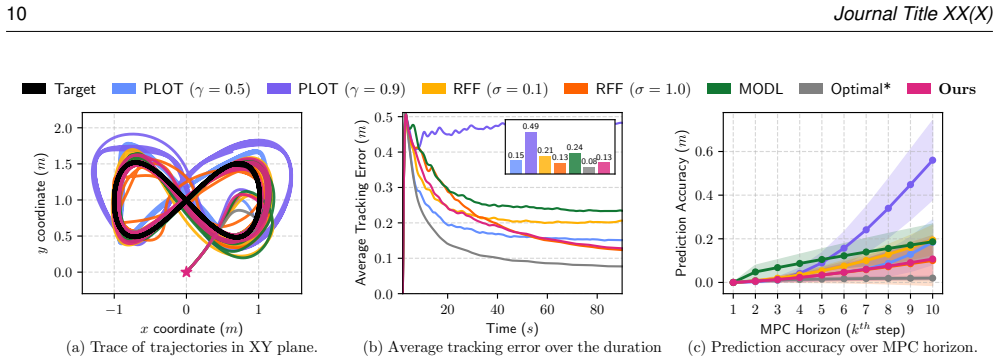
Summary. The paper proposes a self-adaptive online learning + MPC method for tracking a target whose dynamics are unknown and may switch between structured, random, and adversarial behaviors. The ISO module trains several independent RFF-based predictors online via OGD, the AS module selects among them with Hedge, and the MPC module plans with the selected predictor. The central theoretical claim is Theorem 1: under Assumptions 1-4, the expected dynamic regret with respect to a non-causal target-aware MPC is O(T^{3/4}), with corollaries for nonzero prediction error and switching. The paper also reports simulations and Crazyflie hardware experiments comparing against PLOT, RFF-MPC, and MODL on lemniscate, sinusoidal, star, random-walk, adversarial, and switching trajectories, plus ablations isolating the ISO and AS modules.
Significance. The algorithmic architecture is plausible and the experimental component is a real strength: the Crazyflie hardware tests with switching targets and the ISO/AS ablations credibly demonstrate that a fixed predictor configuration is insufficient and that Hedge-based selection improves robustness. If the theoretical result were established, the paper would make a useful contribution toward online learning MPC with expert selection for non-stationary tracking. However, the advertised no-regret guarantee is not presently supported: the proof of Theorem 1 contains a trajectory-conflation error in the performance-difference lemma step, and the OGD regret bound is applied to a loss sequence that is not the one appearing in the MPC prediction error. In addition, Assumption 4 restricts the main theorem to exact finite-dimensional representability, which does not cover the random/adversarial targets emphasized in the experiments.
major comments (3)
- [Appendix 10.1, Eqs. (18)-(26) and Definition 1] The proof of Theorem 1 conflates the comparator's own trajectory with the one-step continuation from the algorithm's current state. In Eq. (20), the second term should be Q*_t(x_t, u*_t) = ||e_t||^2_Q + ||u*_t||^2_R + V*_{t+1}(f(x_t)+g(x_t)u*_t - y_{t+1}). Instead, the proof writes V*_{t+1}(e*_{t+1}) with e*_{t+1}=x*_{t+1}-y_{t+1}. Under Definition 1, x*_{t+1}=f(x*_t)+g(x*_t)u*_t, so Eq. (25), x_{t+1}-x*_{t+1}=g(x_t)(u_t-u*_t), is false unless x_t=x*_t. The PDL decomposition in Eq. (18) is therefore not justified as written. The authors need to define the comparator as a policy and use u*_t = pi*(x_t) consistently throughout, or provide a correct dynamic-regret decomposition for nonlinear dynamics. This is load-bearing for Theorem 1.
- [Appendix 10.1, Eq. (34) and Section 5.3 / Algorithm 1] The proof identifies the MPC prediction errors ||y_{t+1+j} - hat{y}^p_{t+1+j}||^2 with the OGD training losses l^{j,p}_t(alpha^{j,p}_t). But Algorithm 1 defines l^{j,p}_t = ||y_t - hat{h}^p_j(y_{t-1-tau-j:t-1-j}; alpha^{j,p}_t)||^2. The MPC prediction made at time t for y_{t+j+1} uses feature window y_{t-tau:t} and parameter alpha^{j,p}_t, whereas the same training loss with that feature and target is only observed at time t+j+1 and is evaluated with alpha^{j,p}_{t+j+1}. Proposition 2 bounds the cumulative online losses, not the delayed sequence appearing in the regret. A delayed-feedback regret analysis (or a redefinition of the training loss) is needed before Eq. (34) and the O(T^{3/4}) rate follow.
- [Assumption 4 vs. Sections 7-8] The no-regret Theorem 1 requires exact representability of the unknown target dynamics by a finite-dimensional RFF predictor with a fixed parameter alpha_* (Assumption 4). Random-walk and randomized adversarial targets in the experiments are not exactly representable in this class. Corollary 1 adds sqrt(T sum_t ||epsilon_t||^2), which can be linear in T if the approximation error is bounded away from zero, so the abstract's claim of no regret for adversarial/random target dynamics is not supported by the theory. The paper should either soften the claim or add a quantitative bound under a learnability assumption with explicit dependence on the number of random features M.
minor comments (4)
- [Algorithm 2, line 9] The denominator should be sum_p exp(lambda S^p_t), not sum_p exp(lambda S^p_{t-1}); the text in Section 6.2 has the correct expression.
- [Algorithm 1, lines 4-7] The loop observes y_{t+1} but the loss is defined with y_t. This indexing mismatch should be fixed for clarity, and it matters for the interpretation of Proposition 2.
- [Theorem 2 and Section 7] The statement 'with a high probability, the expectation of the regret' is imprecise; the standard Hedge regret bound for bounded losses is deterministic in expectation. Also, the loose sentence after Corollary 2 that the worst-case average regret becomes O-tilde(1) should be rechecked: for kappa=O(T), the kappa^{1/4}T^{3/4} term is O(T), which is O(1) average only after division by T.
- [Section 5.3 / Eq. (7)] The notation for the RFF approximation and the projection step is dense; a short worked example or a table of dimension/indices (t, j, p, M) would help readers follow the delay structure in the proof.
Circularity Check
No significant circularity; the no-regret claim is conditional on explicit assumptions and standard external learning bounds.
full rationale
I walked the derivation chain: Regret is decomposed via the performance difference lemma, then bounded through Assumptions 1-3, Hedge (Theorem 2), and OGD (Proposition 2). No step reduces a prediction to a fitted input or defines X in terms of Y. Assumption 4 assumes exact RFF representability of the target, but it is an explicit hypothesis, not a consequence smuggled into the proof; the theorem would be conditional even if the assumption is strong. The self-citation to Zhou and Tzoumas (2024) is used as an algorithmic subroutine and comparison baseline, but the regret bound for the online least-squares estimator is attributed to Hazan (2016), and the Hedge bound to Cesa-Bianchi and Lugosi (2006), so the self-citation is not load-bearing in the proof. I also examined the apparent proof gap in Appendix 10.1, eqs. (24)-(25): the proof replaces the Definition 2 continuation f(x_t)+g(x_t)u*_t-y_{t+1} with x*_{t+1}-y_{t+1}, which is not an identity unless x_t=x*_t. That is a correctness/rigor concern, not a circularity: it does not make the theorem an input by construction, nor does it rename a fitted parameter as a prediction. Assumption 1 similarly assumes bounded tracking errors rather than proving them, but boundedness alone does not force the O(T^{3/4}) regret rate, so the derivation retains independent content. Overall, the central claim is a conditional bound assembled from stated assumptions and standard external results, with no circular reduction identified.
Axiom & Free-Parameter Ledger
free parameters (6)
- Kernel width σ for each predictor (P1-P4) =
0.1, 1.0, 0.1, 1.5
- OGD learning rate η for each predictor =
0.25, 0.1, 0.15, 0.1
- Feature history horizon τ =
10
- Hedge forgetting factor γ =
0.98
- Hedge learning rate λ =
0.2
- Reward shaping constant a =
4
axioms (6)
- domain assumption Assumption 1: The MPC policies in eq. (3) and eq. (6) render the tracking errors e*_t and e_t uniformly bounded.
- domain assumption Assumption 2: The optimal value function V*_t(e) is Lipschitz in the tracking error e.
- domain assumption Assumption 3: A perturbation bound on the MPC policy holds, relating control-input differences to target-prediction errors with summable coefficients.
- ad hoc to paper Assumption 4: There exists a predictor p whose RFF approximation error is zero: y_{t+j} = \hat{h}^p_j(\tilde{z}_j; α^{j,p}_*) for α^{j,p}_* ∈ D_j.
- standard math Proposition 1 (RFF uniform approximation, from Boffi et al. 2022): functions in a bounded RKHS can be approximated uniformly by M random features with error O(1/√M).
- standard math Hedge switching regret bound (Matsuoka et al. 2021): in a switching environment, the regret of Hedge with a proper learning rate is Õ(√(κT)).
read the original abstract
We propose a self-adaptive online learning for control method for tracking unknown target dynamics. The target dynamics can exhibit switching behavior, particularly, a mixture of structured, random, and/or adversarial motion. Such challenging target tracking scenarios arise in applications of dynamic mapping, traffic control, and pursuit evasion, where robots need to track, pursue, or avoid collision with moving landmarks, objects, humans, etc., whose dynamics are unknown. Our method simultaneously learns multiple predictors from scratch, via self-supervised, one-shot, and computationally efficient learning, and adaptively selects the best one to match the observed target behavior. The method enjoys finite-time near-optimality guarantees in expectation, characterized as a function of the learning error of the target dynamics and the frequency that the target dynamics switch. In the absence of both error and switching, the method asymptotically matches the optimal non-causal control policy that knows a priori the target dynamics, i.e., the method enjoys no regret in expectation. In the presence of learning errors and switching, the method degrades gracefully, \eg when there are errors and no switching, the average regret is proportional to the average learning error and switching times. To prove these guarantees, a novel technical approach is required compared to the existing works that employ RFF-based online learning. We validate our method in Crazyflie simulations and hardware experiments, across target trajectories that vary from structured to random to adversarial, in comparison to non-stochastic, kernel-based, and neural-network-based methods for online learning.
Figures




Reference graph
Works this paper leans on
-
[1]
IEEE Communications Surveys & Tutorials , volume=
Autonomous cars: Research results, issues, and future challenges , author=. IEEE Communications Surveys & Tutorials , volume=. 2018 , publisher=
2018
-
[2]
IEEE Transactions on Robotics , volume=
Cinempc: A fully autonomous drone cinematography system incorporating zoom, focus, pose, and scene composition , author=. IEEE Transactions on Robotics , volume=. 2024 , publisher=
2024
-
[3]
IEEE Access , volume=
Long Short-Term Memory-Based Neural Networks for Missile Maneuvers Trajectories Prediction , author=. IEEE Access , volume=. 2023 , publisher=
2023
-
[4]
2024 IEEE International Conference on Robotics and Automation (ICRA) , pages=
Crazysim: A software-in-the-loop simulator for the crazyflie nano quadrotor , author=. 2024 IEEE International Conference on Robotics and Automation (ICRA) , pages=. 2024 , organization=
2024
-
[5]
Mathematical Programming Computation , Year =
acados -- a modular open-source framework for fast embedded optimal control , Author =. Mathematical Programming Computation , Year =
-
[6]
Mathematical Programming Computation , volume =
Joel A E Andersson and Joris Gillis and Greg Horn and James B Rawlings and Moritz Diehl , title =. Mathematical Programming Computation , volume =. 2019 , publisher =
2019
-
[7]
2022 IEEE 61st Conference on Decision and Control (CDC) , pages=
Online learning for predictive control with provable regret guarantees , author=. 2022 IEEE 61st Conference on Decision and Control (CDC) , pages=. 2022 , organization=
2022
-
[8]
arXiv preprint arXiv:2404.02023 , year=
On the Regret of Recursive Methods for Discrete-Time Adaptive Control with Matched Uncertainty , author=. arXiv preprint arXiv:2404.02023 , year=
-
[9]
2021 60th IEEE Conference on Decision and Control (CDC) , pages=
Model learning predictive control in nonlinear dynamical systems , author=. 2021 60th IEEE Conference on Decision and Control (CDC) , pages=. 2021 , organization=
2021
-
[10]
Foundations and Trends in Optimization , volume=
Introduction to online convex optimization , author=. Foundations and Trends in Optimization , volume=. 2016 , publisher=
2016
-
[11]
Foundations and Trends
Online learning and online convex optimization , author=. Foundations and Trends. 2012 , publisher=
2012
-
[12]
2006 , publisher=
Prediction, learning, and games , author=. 2006 , publisher=
2006
-
[13]
Online convex programming and generalized infinitesimal gradient ascent , author=. Interna. Conf. on Machine Learning (ICML) , pages=
-
[14]
SIAM Journal on Optimization , volume=
Convergence analysis of a proximal-like minimization algorithm using Bregman functions , author=. SIAM Journal on Optimization , volume=. 1993 , publisher=
1993
-
[15]
Conference on Learning Theory (COLT) , volume=
Composite objective mirror descent , author=. Conference on Learning Theory (COLT) , volume=. 2010 , organization=
2010
-
[16]
IEEE Transactions on Information Theory (TIT) , volume=
On delayed prediction of individual sequences , author=. IEEE Transactions on Information Theory (TIT) , volume=. 2002 , publisher=
2002
-
[17]
ACM Transactions on Intelligent Systems and Technology (TIST) , volume=
Understand dynamic regret with switching cost for online decision making , author=. ACM Transactions on Intelligent Systems and Technology (TIST) , volume=. 2020 , publisher=
2020
-
[18]
2004 , publisher=
Convex optimization , author=. 2004 , publisher=
2004
-
[19]
2021 , publisher=
Algorithms for convex optimization , author=. 2021 , publisher=
2021
-
[20]
2009 , publisher=
Robust optimization , author=. 2009 , publisher=
2009
-
[21]
Advanced Robotics , volume=
Deep learning in robotics: a review of recent research , author=. Advanced Robotics , volume=. 2017 , publisher=
2017
-
[22]
2018 , publisher=
Foundations of machine learning , author=. 2018 , publisher=
2018
-
[23]
2012 , publisher=
Learning from data , author=. 2012 , publisher=
2012
-
[24]
The International Journal of Robotics Research , volume=
Autonomous helicopter aerobatics through apprenticeship learning , author=. The International Journal of Robotics Research , volume=. 2010 , publisher=
2010
-
[25]
Journal of Guidance, Control, and Dynamics , volume=
Real-time optimal control via deep neural networks: study on landing problems , author=. Journal of Guidance, Control, and Dynamics , volume=. 2018 , publisher=
2018
-
[26]
IEEE Robotics and Automation Letters , volume=
Data-driven model predictive control for trajectory tracking with a robotic arm , author=. IEEE Robotics and Automation Letters , volume=. 2019 , publisher=
2019
-
[27]
arXiv preprint arXiv:1906.01728 , year=
Bayessim: adaptive domain randomization via probabilistic inference for robotics simulators , author=. arXiv preprint arXiv:1906.01728 , year=
Pith/arXiv arXiv 1906
-
[28]
2017 IEEE/RSJ international conference on intelligent robots and systems (IROS) , pages=
Domain randomization for transferring deep neural networks from simulation to the real world , author=. 2017 IEEE/RSJ international conference on intelligent robots and systems (IROS) , pages=. 2017 , organization=
2017
-
[29]
Science robotics , volume=
Learning quadrupedal locomotion over challenging terrain , author=. Science robotics , volume=. 2020 , publisher=
2020
-
[30]
Information theoretic
Williams, Grady and Wagener, Nolan and Goldfain, Brian and Drews, Paul and Rehg, James M and Boots, Byron and Theodorou, Evangelos A , booktitle=. Information theoretic. 2017 , organization=
2017
-
[31]
IEEE Robotics and Automation Letters , volume=
Model-based meta-reinforcement learning for flight with suspended payloads , author=. IEEE Robotics and Automation Letters , volume=. 2021 , publisher=
2021
-
[32]
IEEE Transactions on Robotics , year=
Active learning of discrete-time dynamics for uncertainty-aware model predictive control , author=. IEEE Transactions on Robotics , year=
-
[33]
1996 , publisher=
Robust adaptive control , author=. 1996 , publisher=
1996
-
[34]
PRENTICE-HALL google schola , volume=
Applied Nonlinear Control , author=. PRENTICE-HALL google schola , volume=
-
[35]
1995 , publisher=
Nonlinear and adaptive control design , author=. 1995 , publisher=
1995
-
[36]
Science Robotics , volume=
Neural-fly enables rapid learning for agile flight in strong winds , author=. Science Robotics , volume=. 2022 , publisher=
2022
-
[37]
2019 International Conference on Robotics and Automation (ICRA) , pages=
Neural lander: Stable drone landing control using learned dynamics , author=. 2019 International Conference on Robotics and Automation (ICRA) , pages=. 2019 , organization=
2019
-
[38]
Learning for Dynamics and Control , pages=
Regret bounds for adaptive nonlinear control , author=. Learning for Dynamics and Control , pages=. 2021 , organization=
2021
-
[39]
Journal of Machine Learning Research , volume=
Nonparametric adaptive control and prediction: Theory and randomized algorithms , author=. Journal of Machine Learning Research , volume=
-
[40]
L1 Quad:
Wu, Zhuohuan and Cheng, Sheng and Zhao, Pan and Gahlawat, Aditya and Ackerman, Kasey A and Lakshmanan, Arun and Yang, Chengyu and Yu, Jiahao and Hovakimyan, Naira , journal=. L1 Quad:
-
[41]
2016 American Control Conference (ACC) , pages=
A tutorial and overview of retrospective cost adaptive control , author=. 2016 American Control Conference (ACC) , pages=. 2016 , organization=
2016
-
[42]
arXiv preprint arXiv:2401.01881 , year=
Robust Control Barrier Functions using Uncertainty Estimation with Application to Mobile Robots , author=. arXiv preprint arXiv:2401.01881 , year=
-
[43]
IEEE Transactions on Robotics , year=
EVOLVER: Online Learning and Prediction of Disturbances for Robot Control , author=. IEEE Transactions on Robotics , year=
-
[44]
2012 IEEE International Conference on Robotics and Automation , pages=
Learning-based model predictive control on a quadrotor: Onboard implementation and experimental results , author=. 2012 IEEE International Conference on Robotics and Automation , pages=. 2012 , organization=
2012
-
[45]
2012 American Control Conference (ACC) , pages=
Extensions of learning-based model predictive control for real-time application to a quadrotor helicopter , author=. 2012 American Control Conference (ACC) , pages=. 2012 , organization=
2012
-
[46]
arXiv preprint arXiv:2211.09619 , year=
Introduction to online nonstochastic control , author=. arXiv preprint arXiv:2211.09619 , year=
-
[47]
International Conference on Machine Learning (ICML) , pages=
Online control with adversarial disturbances , author=. International Conference on Machine Learning (ICML) , pages=
-
[48]
Algorithmic Learning Theory (ALT) , pages=
The nonstochastic control problem , author=. Algorithmic Learning Theory (ALT) , pages=
-
[49]
Learning for Dynamics and Control Conference , pages=
Adaptive regret for control of time-varying dynamics , author=. Learning for Dynamics and Control Conference , pages=. 2023 , organization=
2023
-
[50]
Conference on Learning Theory (COLT) , pages=
Improper learning for non-stochastic control , author=. Conference on Learning Theory (COLT) , pages=
-
[51]
International Conference on Machine Learning , pages=
Logarithmic regret for adversarial online control , author=. International Conference on Machine Learning , pages=. 2020 , organization=
2020
-
[52]
AAAI Conference on Artificial Intelligence (AAAI) , volume=
Online optimal control with affine constraints , author=. AAAI Conference on Artificial Intelligence (AAAI) , volume=
-
[53]
International Conference on Artificial Intelligence and Statistics (AISTATS) , pages=
Non-stationary online learning with memory and non-stochastic control , author=. International Conference on Artificial Intelligence and Statistics (AISTATS) , pages=. 2022 , organization=
2022
-
[54]
2023 62nd IEEE Conference on Decision and Control (CDC) , pages=
Efficient online learning with memory via frank-wolfe optimization: Algorithms with bounded dynamic regret and applications to control , author=. 2023 62nd IEEE Conference on Decision and Control (CDC) , pages=. 2023 , organization=
2023
-
[55]
2023 62nd IEEE Conference on Decision and Control (CDC) , pages=
Safe non-stochastic control of linear dynamical systems , author=. 2023 62nd IEEE Conference on Decision and Control (CDC) , pages=. 2023 , organization=
2023
-
[56]
IEEE Robotics and Automation Letters , year=
Safe non-stochastic control of control-affine systems: An online convex optimization approach , author=. IEEE Robotics and Automation Letters , year=
-
[57]
arXiv preprint arXiv:2407.04143 , year=
Simultaneous System Identification and Model Predictive Control with No Dynamic Regret , author=. arXiv preprint arXiv:2407.04143 , year=
-
[58]
arXiv preprint arXiv:2510.15626 , year=
Adaptive Legged Locomotion via Online Learning for Model Predictive Control , author=. arXiv preprint arXiv:2510.15626 , year=
-
[59]
International Conference on Machine Learning , pages=
Tracking adversarial targets , author=. International Conference on Machine Learning , pages=. 2014 , organization=
2014
-
[60]
International Conference on Artificial Intelligence and Statistics (AISTATS) , pages=
Adversarial tracking control via strongly adaptive online learning with memory , author=. International Conference on Artificial Intelligence and Statistics (AISTATS) , pages=. 2022 , organization=
2022
-
[61]
Transactions on Machine Learning Research , number=
Online Optimal Tracking of Linear Systems with Adversarial Disturbances , author=. Transactions on Machine Learning Research , number=
-
[62]
IEEE Control Systems Letters , year=
Online linear quadratic tracking with regret guarantees , author=. IEEE Control Systems Letters , year=
-
[63]
Proceedings of the 41st International Conference on Machine Learning , pages=
Predictive linear online tracking for unknown targets , author=. Proceedings of the 41st International Conference on Machine Learning , pages=
-
[64]
2022 IEEE 61st Conference on Decision and Control (CDC) , pages=
The power of linear controllers in LQR control , author=. 2022 IEEE 61st Conference on Decision and Control (CDC) , pages=. 2022 , organization=
2022
-
[65]
arXiv preprint arXiv:2412.00922 , year=
Online convex optimization for constrained control of nonlinear systems , author=. arXiv preprint arXiv:2412.00922 , year=
-
[66]
International Conference on Artificial Intelligence and Statistics , pages=
Tracking regret bounds for online submodular optimization , author=. International Conference on Artificial Intelligence and Statistics , pages=. 2021 , organization=
2021
-
[67]
1999 , publisher=
Differential games: a mathematical theory with applications to warfare and pursuit, control and optimization , author=. 1999 , publisher=
1999
-
[68]
2020 American Control Conference (ACC) , pages=
An introduction to pursuit-evasion differential games , author=. 2020 American Control Conference (ACC) , pages=. 2020 , organization=
2020
-
[69]
Indiana University mathematics journal , volume=
Differential games and representation formulas for solutions of Hamilton-Jacobi-Isaacs equations , author=. Indiana University mathematics journal , volume=. 1984 , publisher=
1984
-
[70]
IEEE Transactions on Automatic Control , volume=
Differential games and optimal pursuit-evasion strategies , author=. IEEE Transactions on Automatic Control , volume=. 1965 , publisher=
1965
-
[71]
IEEE Transactions on automatic control , volume=
Hamilton--Jacobi formulation for reach--avoid differential games , author=. IEEE Transactions on automatic control , volume=. 2011 , publisher=
2011
-
[72]
SIAM Journal on Control and Optimization , volume=
Reachability and minimal times for state constrained nonlinear problems without any controllability assumption , author=. SIAM Journal on Control and Optimization , volume=. 2010 , publisher=
2010
-
[73]
IFAC Proceedings Volumes , volume=
Minimal time problems with moving targets and obstacles , author=. IFAC Proceedings Volumes , volume=. 2011 , publisher=
2011
-
[74]
Proceedings of the 18th international conference on hybrid systems: computation and control , pages=
Reach-avoid problems with time-varying dynamics, targets and constraints , author=. Proceedings of the 18th international conference on hybrid systems: computation and control , pages=
-
[75]
2015 54th IEEE conference on decision and control (CDC) , pages=
The pursuit-evasion-defense differential game in dynamic constrained environments , author=. 2015 54th IEEE conference on decision and control (CDC) , pages=. 2015 , organization=
2015
-
[76]
IEEE Robotics and Automation Letters , volume=
Autonomous flight for detection, localization, and tracking of moving targets with a small quadrotor , author=. IEEE Robotics and Automation Letters , volume=. 2017 , publisher=
2017
-
[77]
Journal of Intelligent & Robotic Systems , volume=
Vision based autonomous landing of multirotor UAV on moving platform , author=. Journal of Intelligent & Robotic Systems , volume=. 2017 , publisher=
2017
-
[78]
IEEE Transactions on Control Systems Technology , volume=
Robust visual servoing control for ground target tracking of quadrotors , author=. IEEE Transactions on Control Systems Technology , volume=. 2019 , publisher=
2019
-
[79]
2014 IEEE international conference on robotics and automation (ICRA) , pages=
Toward image based visual servoing for aerial grasping and perching , author=. 2014 IEEE international conference on robotics and automation (ICRA) , pages=. 2014 , organization=
2014
-
[80]
Automatica , volume=
Image-based tracking control of VTOL unmanned aerial vehicles , author=. Automatica , volume=. 2015 , publisher=
2015
discussion (0)
Sign in with ORCID, Apple, or X to comment. Anyone can read and Pith papers without signing in.