REVIEW 3 major objections 5 minor 46 references
PhoPS builds epoch-propagated Gaia reference indexes on the fly and a radial detector zero-point model, claiming 15% better astrometry and stable light curves.
Reviewed by Pith at T0; open to challenge. T0 means a machine referee read the full paper against a public rubric. the ladder, T0–T4 →
T0 review · deepseek-v4-flash
2026-08-01 07:43 UTC pith:FC22VX6X
load-bearing objection Useful open-source pipeline, but the headline astrometric gain isn't proven: the two conditions are measured against different epoch references, so the 15% number conflates reference-frame consistency with real accuracy. the 3 major comments →
PhoPS: An automated photometric pipeline for survey-era astronomy
The pith
A machine-rendered reading of the paper's core claim, the machinery that carries it, and where it could break.
Core claim
The authors introduce PhoPS, an open-source Python pipeline for fully automated photometric reduction with integrated astrometric calibration of point sources. Instead of relying on a pre-installed collection of static astrometric indexes, PhoPS queries Gaia DR3 for each field, propagates source positions from the catalogue epoch J2016.0 to the observation epoch using proper motions and parallaxes, and builds local astrometric indexes on the fly. This epoch-consistent reference, they argue, is what makes the astrometric improvement possible; the propagated solution beats the non-propagated one in every magnitude bin, with a clipped N-weighted total RMS residual of 0.241 arcsec versus 0.284 a
What carries the argument
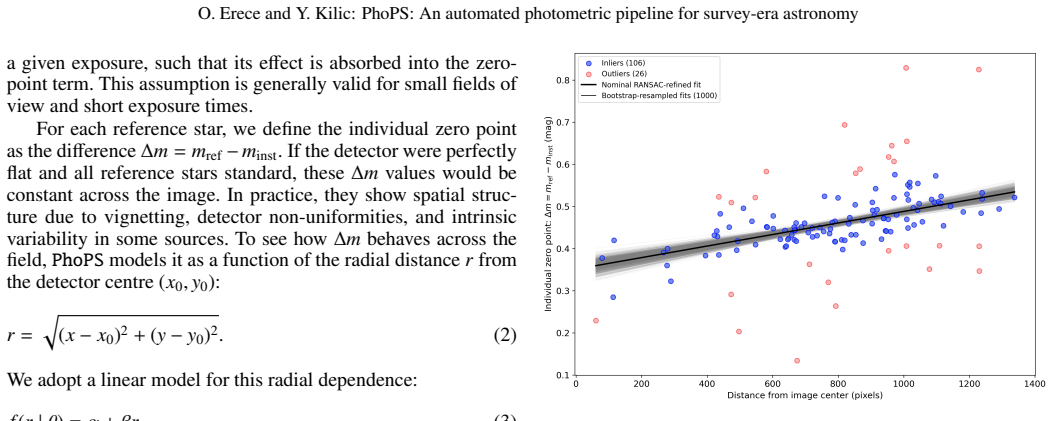
Two mechanisms carry the argument. First, dynamic Gaia DR3 index generation: the pipeline queries the Gaia archive for each field, propagates proper motions and parallaxes to the observation epoch, and creates temporary local astrometric indexes, so the reference frame matches the moment of observation rather than the catalogue epoch. Second, the field-dependent zero-point model f(r)=α+βr, a radial linear model fitted with RANSAC over matched reference stars; the resulting zero point is evaluated at each target's radial position, and bootstrap resampling of the RANSAC inliers quantifies the zero-point uncertainty that is added in quadrature to the formal photometric error.
Load-bearing premise
The load-bearing premise is that the photometric zero point varies linearly with radial distance from the detector centre; if a real detector shows asymmetric or higher-order spatial structure, calibrated magnitudes inherit spatial systematics that the quoted uncertainties do not capture.
What would settle it
Take a wide-field image with strong asymmetric vignetting and a dense set of Gaia reference stars; fit the PhoPS radial linear model and a full two-dimensional zero-point map, and compare the spatial structure of the residuals. If the radial-model residuals show coherent two-dimensional patterns beyond the bootstrap uncertainty, the assumption fails. Similarly, collect more than nine bright reference stars (10≤G<13) and check whether sigma_z remains near 2; if it does, the bright-star uncertainty model is genuinely mis-scaled.
If this is right
- Adopting epoch-propagated Gaia references lowers astrometric RMS in all brightness bins, with the largest relative gain (22.2%) at intermediate magnitudes.
- The pipeline can produce asteroid light curves and stellar time series from the same frames without manual reference-star selection; a reference field star is recovered at its catalogued magnitude to within one millimagnitude.
- Because zero-point variations across frames do not appear as coherent features in calibrated light curves, the radial RANSAC model is sufficient to absorb short-term systematics like vignetting and tracking degradation.
- Reported photometric uncertainties are not uniformly scaled: users should treat bright-star errors as underestimated and faint-star errors as conservative, and the paper argues against interpreting the full-sample variance as a single global error model.
- No permanent astrometric index collection is required, and indexes are reused for repeated observations of the same field, supporting survey-scale time-series reductions.
Where Pith is reading between the lines
- The 15% astrometric gain was measured on data with a limited time baseline from the Gaia epoch; a dataset collected several years further from J2016.0, or in a high-proper-motion field, should show a larger relative gain, making the dynamic-index strategy increasingly valuable for long-term surveys.
- If the radial linear zero-point assumption is the bottleneck, replacing it with a two-dimensional polynomial or a pixel-grid model should reduce spatially structured residuals on wide-field images; this is directly testable with the same reference-star sample.
- The magnitude-dependent sigma_z pattern suggests an extension in which the reported uncertainty includes a brightness-dependent term fitted from the validation residuals; a dedicated bright-star sample with more than nine stars would decide whether the bright-end under-estimate is real.
- Because the pipeline leaves residual elongation in the astrometric error distribution unmodelled, combining the epoch-propagated indexes with an instrument-specific distortion correction could close part of the remaining 0.241 arcsec floor.
Editorial analysis
A structured set of objections, weighed in public.
Referee Report
Summary. PhoPS is an open-source Python pipeline for automated astrometric calibration and photometric reduction of point sources. Its two distinctive features are (i) dynamic on-the-fly generation of local Gaia DR3 astrometric index files propagated to the epoch of observation, avoiding pre-installed index collections, and (ii) a field-dependent photometric zero-point model based on RANSAC linear regression in radial distance from the detector centre. The paper validates these features using 840 TUG100 images of (201) Penelope: the propagated astrometric index is reported to reduce the clipped N-weighted total RMS residual from 0.284 arcsec to 0.241 arcsec (15.0%), and a population-level photometric uncertainty validation using 203 reference stars and 92,980 measurements yields normalized residuals with magnitude-dependent widths (sigma_z = 2.069, 1.129, 0.698 for the 10-13, 13-16, 16-18 G-mag bins). The authors conclude that PhoPS is a portable, robust tool suitable for asteroid light-curve analysis and stellar variability studies.
Significance. If the results hold, PhoPS provides a genuinely useful engineering contribution: dynamic, epoch-propagated index generation is a practical improvement over static Astrometry.net index collections, and the RANSAC-based radial zero-point model is a sensible lightweight alternative to per-star differential photometry. The astrometric comparison in §3.2 is a controlled A/B test that keeps all pipeline components identical except for epoch propagation, which is exactly the right experimental design for isolating that effect. The photometric validation is commendably honest about the magnitude-dependent behaviour of the reported uncertainties. However, two methodological issues in the validation are load-bearing: the astrometric residuals are computed against different reference epochs for the two solutions, and the photometric uncertainty validation applies a post-hoc stability filter that can bias the residual distributions. These issues do not necessarily invalidate the claims, but they must be addressed before the central results can be accepted as quantitative evidence.
major comments (3)
- [§3.2, Table 2] The propagated and non-propagated residuals are measured against different reference quantities: the propagated solution is compared against epoch-of-observation Gaia positions, while the non-propagated solution is compared against native J2016.0 positions. Because proper motion separates these frames, the reported 15.0% improvement conflates calibration-reference consistency with astrometric accuracy. To support the claim of an accuracy gain, both WCS solutions should be evaluated against the same reference set (e.g., the propagated Gaia positions). Please recompute the non-propagated residuals against the propagated catalog, or otherwise perform a common-truth comparison.
- [§3.1, §3.3, Table 3] The photometric uncertainty validation applies a 'stability filter' that removes stars with outlying ratios of robust scatter to mean reported uncertainty, evaluated separately within each magnitude bin. This filter is post-hoc and the threshold is not specified. Because the goal is to validate the uncertainty model, removing the most discrepant stars can bias the normalized residual widths toward unity and suppress evidence of underestimation. Report the exact filter criterion, and show the residual statistics with and without the filter, or with a pre-specified fixed threshold. This is especially important for the bright bin (N*=9), where sigma_z = 2.069 is already statistically fragile.
- [§3.3, §4] The validation is restricted to RANSAC calibration inliers. Since the zero-point model is fitted to those same inliers, the validation is partly circular: the reported uncertainties reflect the scatter of stars that the model already deemed consistent. The paper should state how many stars/measurements were excluded by the inlier criterion and the stability filter, and discuss how the residual distributions would change if a held-out set of Gaia-matched stars (not used in calibration) were used. This would strengthen the claim that the uncertainty model is representative.
minor comments (5)
- [§3.2, Table 2] The definition of 'N-weighted total RMS' is not given. Please define the weighting scheme (presumably number of measurements per bin) or state that the overall value is simply the RMS over all matched measurements after clipping.
- [§3.2] The SIP polynomial order (2-6) was tested on the same dataset and order 5 was adopted because it minimized scatter. This introduces a selection on the validation data and may slightly inflate the apparent astrometric quality. Please state this clearly as a tunable parameter or provide a cross-validation or independent confirmation.
- [§3.1] The stability filter description would benefit from a precise definition of 'outlying ratios' (e.g., median absolute deviation cut or percentile). Currently it is not reproducible from the text.
- [Abstract] The abstract states 'Epoch propagation reduced the clipped N-weighted total RMS residual from 0.284 arcsec to 0.241 arcsec, a 15.0% improvement.' Given the reference-frame issue, the wording should be qualified as 'relative to the respective reference catalogue epochs' until a common-truth comparison is provided.
- [§4] The paper correctly acknowledges that the linear radial zero-point model may not capture asymmetric or higher-order structure. It would be useful to quantify the magnitude of the residual spatial pattern (e.g., the standard deviation of per-star residuals as a function of position) to indicate how much of the observed sigma_z could be due to model inadequacy.
Circularity Check
No load-bearing circularity: central claims are controlled empirical comparisons; minor in-sample validation caveats and non-load-bearing self-citations.
full rationale
The paper's central claims are empirical comparisons rather than derivations. The headline astrometric result compares two versions of the same pipeline (epoch-propagated vs non-propagated Gaia DR3 index files) on the same matched sources with the same plate-solving engine and index-generation procedure, so it is not an equation-level reduction of a prediction to its inputs. The residuals are measured against the Gaia DR3 catalogue that also serves as the calibration reference, which makes the validation in-sample, and the two arms nominally use different reference epochs; this is a benchmark/correctness caveat rather than a definitional circularity, and the paper presents the result explicitly as a residual comparison. The photometric uncertainty validation is also an internal consistency check using calibration-inlier reference stars, and the paper openly reports magnitude-dependent behavior rather than claiming a globally validated error model. The self-citations to prior PhoPS applications (Erece et al. 2023; Kilic et al. 2026) are supporting examples, not load-bearing evidence for the present validation. No specific step could be exhibited where a fitted quantity is renamed as a prediction or where an equation is defined in terms of its own output, so the appropriate finding is no significant circularity; score 2 reflects the minor in-sample validation design and non-load-bearing self-citations, not a demonstration of circularity.
Axiom & Free-Parameter Ledger
free parameters (3)
- SIP polynomial order =
5
- RANSAC residual threshold =
auto (knee criterion)
- Aperture radius / FWHM factor =
user-configurable
axioms (6)
- domain assumption Gaia DR3 positions and magnitudes are accurate to the level required for the claimed astrometric and photometric calibration.
- domain assumption The colour transformation coefficients of Carrasco & Bellazzini (2022) are applicable to the observed passbands and stellar populations.
- domain assumption Atmospheric extinction is constant across the field and absorbed into the zero-point term.
- ad hoc to paper The photometric zero point varies linearly with radial distance from the detector centre.
- domain assumption Proper-motion and parallax propagation without radial velocity is sufficient for epoch propagation.
- domain assumption DAOStarFinder detection plus positional crossmatching yields an unbiased set of reference stars after quality filters.
read the original abstract
Modern astronomical surveys produce large volumes of imaging data together with highly accurate astrometric and photometric reference catalogues, creating a need for automated, robust, and instrument-independent reduction pipelines. We present PhoPS (Photometry and Astrometry of Point Sources), an open-source Python pipeline for fully automated astrometric calibration and photometric reduction of stellar and moving Solar System targets. PhoPS dynamically generates local Gaia DR3 astrometric index files propagated to the observation epoch, eliminating the need for pre-installed index collections while improving astrometric accuracy. Photometric calibration uses a field-dependent zero-point model based on Random Sample Consensus (RANSAC) linear regression to account for spatial systematics such as vignetting and detector non-uniformities. Astrometric performance was evaluated using 141672 matched measurements from 840 images obtained with the 1 m TUG100 telescope. Epoch propagation reduced the clipped N-weighted total RMS residual from 0.284 arcsec to 0.241 arcsec, a 15.0% improvement. The photometric uncertainty model was validated using 203 reference stars and 92980 measurements. Normalized residuals are centered near zero, but their widths are magnitude dependent, with sigma values of 2.069 for bright stars (10 <= G < 13), 1.129 for intermediate-brightness stars (13 <= G < 16), and 0.698 for faint stars (16 <= G < 18), indicating underestimated uncertainties for the brightest stars and conservative uncertainties for the faintest stars. PhoPS provides a lightweight, cross-platform solution for automated astronomical image reduction and is well suited to asteroid light-curve analysis, stellar variability studies, and the diagnosis of observational systematics.
Figures




Reference graph
Works this paper leans on
-
[1]
M. Assafin , keywords =. Astrometry with PRAIA , journal =. 2023 , issn =. doi:https://doi.org/10.1016/j.pss.2023.105801 , url =
arXiv 2023
-
[2]
Astrometry and Astrophysics in the Gaia Sky , year = 2018, editor =
Astrometry with A-Track Using Gaia DR1 Catalogue. Astrometry and Astrophysics in the Gaia Sky , year = 2018, editor =. doi:10.1017/S174392131700552X , adsurl =
-
[3]
Summary of the contents and survey properties
Gaia Data Release 2. Summary of the contents and survey properties. , keywords =. doi:10.1051/0004-6361/201833051 , archivePrefix =. 1804.09365 , primaryClass =
-
[4]
Summary of the astrometric, photometric, and survey properties
Gaia Data Release 1. Summary of the astrometric, photometric, and survey properties. , keywords =. doi:10.1051/0004-6361/201629512 , archivePrefix =. 1609.04172 , primaryClass =
-
[5]
The Gaia mission. , keywords =. doi:10.1051/0004-6361/201629272 , archivePrefix =. 1609.04153 , primaryClass =
-
[6]
Summary of the content and survey properties
Gaia Data Release 3. Summary of the content and survey properties. , keywords =. doi:10.1051/0004-6361/202243940 , archivePrefix =. 2208.00211 , primaryClass =
-
[7]
The Two Micron All Sky Survey (2MASS). , keywords =. doi:10.1086/498708 , adsurl =
-
[8]
The Sloan Digital Sky Survey: Technical Summary. , keywords =. doi:10.1086/301513 , archivePrefix =. astro-ph/0006396 , primaryClass =
-
[9]
LSST: From Science Drivers to Reference Design and Anticipated Data Products. , keywords =. doi:10.3847/1538-4357/ab042c , archivePrefix =. 0805.2366 , primaryClass =
-
[10]
Astrometric and photometric star catalogues derived from the ESA HIPPARCOS Space Astrometry Mission
The HIPPARCOS and TYCHO catalogues. Astrometric and photometric star catalogues derived from the ESA HIPPARCOS Space Astrometry Mission. ESA Special Publication , year = 1997, editor =
1997
-
[11]
arXiv , Author =:1307.6212 , Journal =
doi:10.1051/0004-6361/201322068 , Eid =. arXiv , Author =:1307.6212 , Journal =
-
[12]
The Astropy Project: Building an Open-science Project and Status of the v2.0 Core Package. , keywords =. doi:10.3847/1538-3881/aabc4f , archivePrefix =. 1801.02634 , primaryClass =
-
[13]
The Astropy Project: Sustaining and Growing a Community-oriented Open-source Project and the Latest Major Release (v5.0) of the Core Package. , keywords =. doi:10.3847/1538-4357/ac7c74 , archivePrefix =. 2206.14220 , primaryClass =
-
[14]
and Hogg, D
Lang, D. and Hogg, D. W. and Mierle, K. and Blanton, M. and Roweis, S. , title =. The Astronomical Journal , volume =. 2010 , doi =
2010
-
[15]
astropy/photutils: 2.2.0 , month = feb, year = 2025, journal =
Larry Bradley and Brigitta Sip. astropy/photutils: 2.2.0 , month = feb, year = 2025, journal =. doi:10.5281/zenodo.14889440 , url =
-
[16]
, archivePrefix = "arXiv", eprint =
astroquery: An Astronomical Web-querying Package in Python. , archivePrefix = "arXiv", eprint =. doi:10.3847/1538-3881/aafc33 , adsurl =
-
[17]
SExtractor: Software for source extraction , DOI= "10.1051/aas:1996164", url= "https://doi.org/10.1051/aas:1996164", journal =
-
[18]
, keywords =
The Tycho-2 catalogue of the 2.5 million brightest stars. , keywords =
-
[19]
Relationships with other photometric systems , year =
-
[20]
Communications of the ACM , volume=
Random sample consensus: a paradigm for model fitting with applications to image analysis and automated cartography , author=. Communications of the ACM , volume=. 1981 , publisher=
1981
-
[21]
Chambers, K. C. et al. , title =. arXiv e-prints , year =
-
[22]
Bellm, E. C. et al. , title =. Publications of the Astronomical Society of the Pacific , volume =. 2019 , doi =
2019
-
[23]
DAOPHOT: A Computer Program for Crowded-Field Stellar Photometry. , keywords =. doi:10.1086/131977 , adsurl =
-
[24]
Research in Astronomy and Astrophysics , year = 2009, month = nov, volume =
DZ Lyn: a contact binary with components in poor thermal contact. Research in Astronomy and Astrophysics , year = 2009, month = nov, volume =. doi:10.1088/1674-4527/9/11/009 , adsurl =
-
[25]
Asteroid Observations at Low Phase Angles. II. 5 Astraea, 75 Eurydike, 77 Frigga, 105 Artemis, 119 Althaea, 124 Alkeste, and 201 Penelope. , year = 2002, month = feb, volume =. doi:10.1006/icar.2001.6651 , adsurl =
arXiv 2002
-
[26]
Rotational Properties of the Maria Asteroid Family. , keywords =. doi:10.1088/0004-6256/147/3/56 , archivePrefix =. 1311.5318 , primaryClass =
-
[27]
Summary of the contents and survey properties
Gaia Early Data Release 3. Summary of the contents and survey properties. , keywords =. doi:10.1051/0004-6361/202039657 , archivePrefix =. 2012.01533 , primaryClass =
Pith/arXiv arXiv 2012
-
[28]
Gaia Early Data Release 3. The astrometric solution. , keywords =. doi:10.1051/0004-6361/202039709 , archivePrefix =. 2012.03380 , primaryClass =
Pith/arXiv arXiv 2012
-
[29]
The Physical Nature and Orbital Behavior of V523 Cassiopeiae. , keywords =. doi:10.1086/426357 , adsurl =
-
[30]
Period and light-curve study of the contact eclipsing binary V523 Cas. , keywords =. doi:10.1016/j.newast.2015.10.001 , adsurl =
-
[31]
Absolute dimensions of the close binary systems V453 Monocerotis and V523 Cassiopeiae. , keywords =. doi:10.1007/s10509-009-0048-0 , adsurl =
-
[32]
Adaptive data reduction workflows for astronomy: The ESO Data Processing System (EDPS). , keywords =. doi:10.1051/0004-6361/202347651 , archivePrefix =. 2311.03822 , primaryClass =
-
[33]
Automated data reduction workflows for astronomy. The ESO Reflex environment. , keywords =. doi:10.1051/0004-6361/201322494 , archivePrefix =. 1311.5411 , primaryClass =
-
[34]
Research Notes of the American Astronomical Society , keywords =
DRAGONS-A Quick Overview. Research Notes of the American Astronomical Society , keywords =. doi:10.3847/2515-5172/ad0044 , archivePrefix =. 2310.03048 , primaryClass =
-
[35]
doi:10.71929/RUBIN/2570545 , adsurl =
PSTN-019: The LSST Science Pipelines Software: Optical Survey Pipeline Reduction and Analysis Environment. doi:10.71929/RUBIN/2570545 , adsurl =
-
[36]
The Pan-STARRS Data-processing System. , keywords =. doi:10.3847/1538-4365/abb829 , archivePrefix =. 1612.05240 , primaryClass =
-
[37]
Instrumentation in astronomy VI , year = 1986, editor =
The IRAF Data Reduction and Analysis System. Instrumentation in astronomy VI , year = 1986, editor =. doi:10.1117/12.968154 , adsurl =
-
[38]
Astronomical Data Analysis Software and Systems II , year = 1993, editor =
IRAF in the Nineties. Astronomical Data Analysis Software and Systems II , year = 1993, editor =
1993
-
[39]
, year = 1981, month = jun, volume =
FITS - a Flexible Image Transport System. , year = 1981, month = jun, volume =
1981
-
[40]
Astronomical Data Analysis Software and Systems XI , year = 2002, editor =
HEALPix --- a Framework for High Resolution, Fast Analysis on the Sphere. Astronomical Data Analysis Software and Systems XI , year = 2002, editor =
2002
-
[41]
Physical properties of the slow-rotating near-Earth asteroid (2059) Baboquivari from one apparition. , keywords =. doi:10.1016/j.pss.2023.105698 , archivePrefix =. 2305.05217 , primaryClass =
arXiv 2059
-
[42]
Constraining the size, shape, and albedo of the large trans-Neptunian object (28978) Ixion with multi-chord stellar occultations. , keywords =. doi:10.1051/0004-6361/202557970 , adsurl =
-
[43]
Do fast stellar centroiding methods saturate the Cram \'e r-Rao lower bound?. arXiv e-prints , keywords =. doi:10.48550/arXiv.1610.05873 , archivePrefix =. 1610.05873 , primaryClass =
-
[44]
The Fourth US Naval Observatory CCD Astrograph Catalog (UCAC4). , keywords =. doi:10.1088/0004-6256/145/2/44 , archivePrefix =. 1212.6182 , primaryClass =
-
[45]
Astronomy and Computing , keywords =
PHOTOMETRYPIPELINE: An automated pipeline for calibrated photometry. Astronomy and Computing , keywords =. doi:10.1016/j.ascom.2016.11.002 , archivePrefix =. 1702.00834 , primaryClass =
Pith/arXiv arXiv 2016
-
[46]
STDPipe: Simple Transient Detection Pipeline
discussion (0)
Sign in with ORCID, Apple, or X to comment. Anyone can read and Pith papers without signing in.