REVIEW 3 major objections 4 minor 83 references
Nonlinear Fourier spectral signatures of rogue waves observed in Bose-Einstein condensates
T0 review · 3 major / 4 minor · reviewed 2026-08-01 · deepseek-v4-flash
Pith's one-line read This paper claims that rogue waves in Bose–Einstein condensates, including Gaussian-packet extreme events and experimentally observed Peregrine solitons, are not produced by a new instability mode but by the synchronized coherent focusing o
desk verdict A sound and mostly convincing nonlinear-spectral account of vanishing-background BEC rogue waves, with the experiment connection as the clear weak link. read the letter →
The pith
A machine-rendered reading of the paper's core claim, the machinery that carries it, and where it could break.
The reading
What carries the argument
The machinery is the nonlinear Fourier transform based on the Zakharov–Shabat scattering problem for the focusing nonlinear Schrödinger equation. The method splits any localized wave field into a discrete spectrum — complex eigenvalues λ_n with imaginary part giving soliton amplitude 2η_n and real part giving velocity, plus norming constants c_n that encode position and phase — and a continuous spectrum of radiation. The decisive simplification is that the eigenvalues are conserved while the norming constants evolve linearly, c_n(t)=c_n(0)e^{-2iλ_n^2 t}; the paper reads rogue-wave formation as the moment when these rotating phases line up. Darboux transformation then recursively builds the e
What would settle it
Run a full two-component Gross–Pitaevskii simulation that includes the axial harmonic trap and the sustained optical potential for the same experimental initial state, extract the Zakharov–Shabat discrete spectrum of the minority component, and check whether the pure-discrete Darboux reconstruction reproduces the Peregrine peak's amplitude and time of emergence. If the reconstruction misses the peak or its timing by a significant amount, the single-component spectral mechanism is not what governs the experiment; alternatively, a clean way to falsify the general spectral claim is to find a nume
Extended reading notes
Core claim
The central claim is that, for BEC systems satisfying vanishing boundary conditions, the core skeleton and rogue-wave dynamics are entirely encoded in the bound soliton modes of the discrete spectrum. The paper demonstrates this for two first-order rogue-wave classes: broad Gaussian initial states, whose discrete spectrum grows with width (one soliton, a two-soliton bound state, and a six-soliton Christmas-tree structure), and Peregrine-soliton events from a recent two-component BEC experiment, here reduced to an effective single-component focusing NLSE. In both cases, the discrete eigenvalues stay fixed while the norming constants rotate in phase; rogue-wave formation coincides with the syn
Load-bearing premise
The argument stands on the assumption that a single-component focusing nonlinear Schrödinger equation — derived by discarding the harmonic trap, the sustained optical potential, and the majority-component dynamics — faithfully represents the minority component of the two-component BEC experiment in which the Peregrine soliton was observed.
Editorial extensions
If this is right
- For Bose–Einstein condensates with vanishing boundary conditions, extreme localization events should be characterized by their discrete nonlinear spectrum, not only by real-space profiles.
- Continuous-spectrum radiation is not essential for rogue-wave formation: the discrete soliton skeleton alone reproduces the observed peaks, timing, and branch structure.
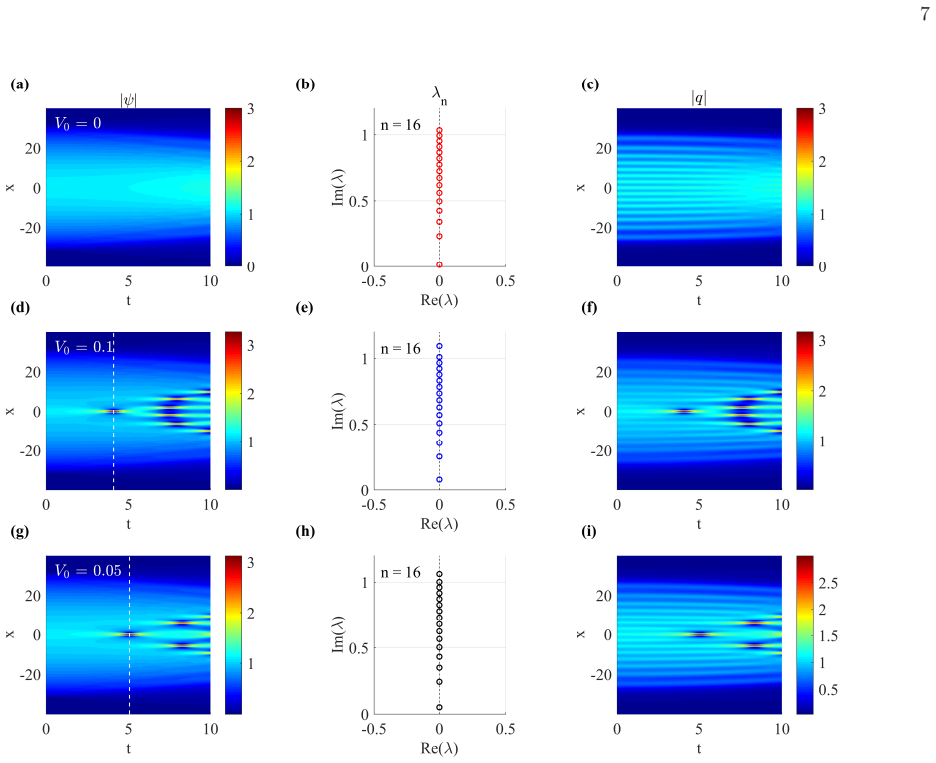
- The timing of experimentally observed Peregrine solitons is controlled by the perturbation strength, which alters the discrete-spectral configuration and thus how quickly the soliton modes reach phase synchrony.
- Higher-order rogue waves can be constructed on demand by choosing discrete eigenvalues and norming constants that enforce complete phase matching at a preset time; at that instant the peak amplitude is exactly the sum of the intrinsic amplitudes of the constituent solitons.
- The nonlinear-spectrum picture offers a constructive control tool — spectral engineering — not just a post-hoc explanation of rogue waves in BECs.
Reading between the lines
- Editorial inference: the paper's claim would be strengthened by a direct comparison with the full two-component Gross–Pitaevskii simulation and raw experimental data, because the effective single-component reduction used here neglects the harmonic trap, the sustained optical potential, and the majority component; without such a test, the extracted spectral signatures may describe the reduced model
- Editorial inference: the phase-matching construction suggests a general design principle for extreme events in any system approximated by the focusing NLSE — e.g., water waves or optical fibers with vanishing backgrounds — where one can prepare a multi-soliton bound state with prescribed eigenvalues to fire at a chosen time.
- Editorial inference: because the paper shows that the discrete spectrum alone suffices, a natural next question is whether the recently proposed topological monopole picture can be mapped exactly onto the Zakharov–Shabat scattering data; the paper leaves this mapping open.
- Editorial inference: the counterintuitive result that eight more energetic solitons produce a lower peak than eight less energetic ones implies that spectral phase configuration, not eigenvalue count or individual amplitudes, controls rogue-wave amplitude; this could be tested by deliberately detuning one eigenvalue phase and observing peak suppression.
Signed reviews
Editorial analysis
A structured set of objections, weighed in public.
Referee Report
Summary. The paper applies the nonlinear Fourier transform (Zakharov–Shabat spectral problem) to rogue-wave-like phenomena in BEC matter waves under vanishing boundary conditions. Two classes of first-order rogue waves are analyzed: (i) extreme localization events arising from Gaussian initial states in the focusing NLS equation, and (ii) Peregrine-type events from a recent two-component BEC experiment, modeled by an effective single-component focusing NLS. In both cases the authors extract discrete eigenvalues and norming constants via a forward NFT, then reconstruct pure-soliton fields by a Darboux transformation. They argue that discrete-spectrum soliton modes, through coherent phase synchronization, provide a unified spectral mechanism for these events. The paper also proposes an inverse spectral-engineering approach for higher-order rogue waves by choosing eigenvalues that enforce phase matching at a preset time, and compares the spectral picture with a recent topological description of rogue waves.
Significance. If fully established, the work would provide a unified nonlinear-spectral perspective on rogue wave formation in vanishing-background BEC systems, complementing modulation-instability analyses and offering a constructive tool for designing higher-order localized structures. The Gaussian-packet analysis is self-contained and demonstrates a concrete use of forward NFT plus Darboux reconstruction; the agreement between full numerics and pure-soliton reconstruction is visually compelling. The use of an open-source NFT library and standard integrable-system techniques is a strength. However, the experimental-connection claim rests on an unvalidated model reduction, and the phase-matching construction is largely tautological as a 'mechanism' explanation. The paper's significance is therefore conditional on additional validation of the experimental bridge and on clearer quantitative support for the dominance of the discrete spectrum.
major comments (3)
- [Sec. III.B (Eq. (13))] The central claim that experimentally observed Peregrine solitons are governed by discrete-spectrum bound soliton modes rests on an unvalidated effective single-component reduction. The paper explicitly states it 'invoke[s] a phenomenological effective single-component reduction' and neglects the harmonic trap, the sustained optical potential, and the majority-component dynamics during evolution. Validation is limited to 'perfect qualitative agreement with the statements in the real two-component experimental paper' — not with raw experimental data. If the neglected terms materially change the minority-component wavefunction, the extracted discrete eigenvalues and phases are not those of the actual experiment. The authors should either provide full two-component Gross–Pitaevskii numerics with the same parameters, or quantitatively compare the effective-model spectra/densities with the ex
- [Secs. III.A and III.B (Figs. 1, 2)] The paper repeatedly claims that the pure-discrete-spectrum Darboux reconstruction 'perfectly reproduces' or shows 'astonishing consistency' with the full numerical evolution, but no quantitative error metric is provided. Since the claim that 'the core skeleton and RW dynamics are entirely encoded in the bound soliton modes' is load-bearing, the authors should report, for each case, a quantitative error measure such as the relative L2 error between the full numerics and the DT reconstruction, the peak-amplitude error, and the error in the time of peak emergence. Without such a metric, the visual comparison is suggestive but does not rigorously support the assertion that continuous-spectrum radiation is negligible.
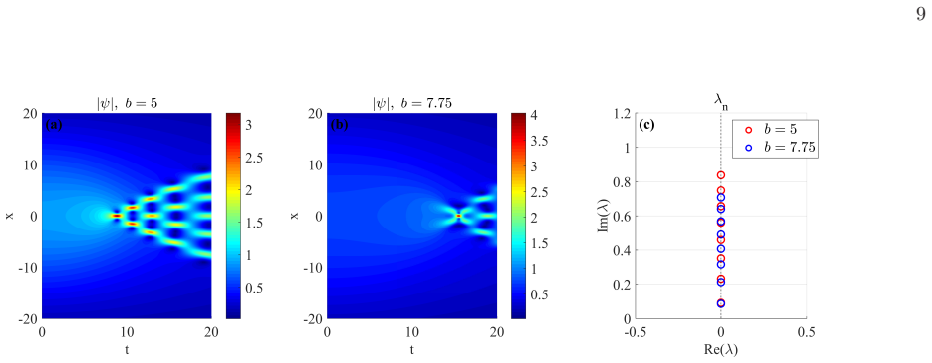
- [Sec. IV (Eqs. (15)–(16), Fig. 4)] The phase-matching construction is tautological as a demonstration of the mechanism. The eigenvalues η1, η2, η3 are chosen precisely so that the norming-constant phases satisfy Φn(T0)=0 mod 2π at T0=10; the resulting focusing at t=T0 is built into the input. This is a valid inverse-design strategy, but it does not independently 'reveal the spectral mechanism' of higher-order rogue waves. The b=7.75 case in Fig. 3 is likewise selected by 'searching for the optimal solution that maximizes the peak value,' so the subsequent spectral interpretation is not a falsifiable test. To support the mechanism, the authors should predict the peak time/amplitude for generic initial data and verify the prediction, or demonstrate that a different spectral configuration with the same number of eigenvalues and no phase matching does not focus.
minor comments (4)
- [Sec. II] The statement that 'the extracted discrete eigenvalues are strictly distributed on the imaginary axis' is asserted without numerical tolerance. For symmetric initial data it is expected, but numerical eigenvalues may have small real parts; reporting the accuracy (e.g., max |Re λ|) would strengthen the claim.
- [Sec. III.B] The definition of the characteristic length L_P = ℏ/√(1/(m|g_eff|P0)) appears to have a typo: the 1/ inside the square root gives the wrong physical dimensions. It should presumably be L_P = ℏ/√(m|g_eff|P0). Please correct.
- [Throughout] Several figure captions do not label panels (a)–(i), although the text refers to them (e.g., Fig. 1). This makes it difficult to map the discussion to the displayed panels. Please add panel labels.
- [Sec. III.B] The description 'perfect qualitative agreement with the statements in the real two-component experimental paper' is vague; specify which quantitative features (peak height, emergence time, background width) are compared and how the comparison was made.
Circularity Check
Higher-order RW 'phase-matching mechanism' is demonstrated by construction; forward NFT analysis remains independent
-
self definitional
[Sec. IV, inverse spectral engineering paragraph (Eq. 15 and Fig. 4)]
"If we require that these three soliton modes achieve complete in-phase synchronization (i.e., the phase differences between any two modes are integer multiples of 2π) at a preset time t=T0=10, we can finely design the imaginary parts of the individual discrete modes by inversely solving the phase-matching equations. For example, by setting the imaginary parts of the eigenvalues to satisfy η1=√(π/T0), η2=√(2π/T0), and η3=√(7π/(2T0)), the above synchronization criterion can be satisfied."
The eigenvalues are chosen so that the phases Φn(t)=2ηn²t (+π) coincide at T0 by Eq. (15). The subsequent 'peak at t=10' is the same alignment condition restated in real space via the DT. Thus the demonstration that phase matching produces a higher-order RW is not an independent test of the mechanism; the outcome is inserted as the phase-matching constraint. The paper itself says 'as theoretically expected,' confirming that the observed focusing time is built into the input spectral data.
-
fitted input called prediction
[Sec. IV, b=7.75 search-and-explain paragraph and Fig. 3]
"By searching for the optimal solution that maximizes the peak value during evolution, we aim to excite second-order RWs, and then extract and analyze the nonlinear spectral characteristics of the corresponding wave fields via the NFT method... the second-order RW observed in Fig. 3(b) is, in essence, not a simple mechanical collision of two independent first-order RWs in real space, but rather the result of these multisoliton bound states achieving consistent cooperative phase matching at a specific time due to the refined accumulation of nonlinear phases."
The control parameter b is fitted to maximize the real-space peak; the discrete spectrum and the 'phase matching' explanation are then read off from that same chosen field. The spectral signature is therefore selected by the outcome it is invoked to explain, rather than independently predicting the RW from the spectrum. This is the pattern of fitting to the target and then renaming the fit as the mechanism.
full rationale
The forward Gaussian analysis (Sec. III.A) is self-contained and non-circular: full NLSE simulations are compared with forward NFT discrete spectra and DT pure-soliton reconstructions, and the high visual fidelity of the reconstruction is an empirical statement about the smallness of continuous-spectrum contributions. The experimental section's effective single-component reduction and qualitative comparison to Ref. [17] is a model-fidelity / validation concern, not a circularity, and the external references are not self-citations. Self-citations [38,40] are not load-bearing because the relevant phenomena are re-derived in the present paper. The principal circularity is confined to the higher-order RW 'mechanism' claim: (i) the inverse spectral engineering case forces phase alignment at T0 by construction and then reports a peak at T0, and (ii) the b=7.75 case is tuned to maximize the peak before the spectral explanation is extracted. These steps reduce, at least in part, to the construction rather than an independent test. Because the first-order RW and Gaussian analyses have independent content, the overall circularity score is moderate rather than high.
Assumptions & free parameters
free parameters (5)
- Gaussian initial amplitude A0 =
0.5
- Gaussian widths σ =
3, 5, 15
- Perturbation parameters V0 and σ0 =
V0 = 0.1, 0.05; σ0 = 2
- Gaussian-packet offset b =
7.75
- Phase-matching eigenvalues ηn =
η1=√(π/10), η2=√(2π/10), η3=√(7π/20), η4=√(9π/20)
assumptions (5)
- standard math The focusing NLSE (Eq. 1) with vanishing boundary conditions is integrable, and the Zakharov-Shabat scattering problem provides a complete spectral decomposition of the field.
- standard math The N-th order Darboux transformation starting from the zero seed reconstructs the exact N-soliton solution corresponding to the discrete spectral data.
- domain assumption The effective single-component focusing NLSE faithfully models the minority component of the repulsive two-component BEC experiment.
- domain assumption The continuous-spectrum radiation contributes negligibly to the extreme events studied.
- standard math The discrete eigenvalues remain invariant over the simulated time windows.
Cite this review
Pith. "Pith review of Nonlinear Fourier spectral signatures of rogue waves observed in Bose-Einstein condensates." pith.science (2026). https://pith.science/paper/OFQ345DP
@misc{pith2026260727734,
  author       = {Pith},
  title        = {Pith review of: Nonlinear Fourier spectral signatures of rogue waves observed in Bose-Einstein condensates},
  year         = {2026},
  howpublished = {\url{https://pith.science/paper/OFQ345DP}},
  note         = {Machine review of arXiv:2607.27734}
}
read the original abstract
Modulation instability provides an important framework for understanding rogue wave (RW) formation on continuous backgrounds. However, the formation mechanism and nonlinear spectral structures of RWs in Bose-Einstein condensate (BEC) matter-wave systems with vanishing boundary conditions remain largely unexplored. Here, we employ the nonlinear Fourier transform (NFT), based on the integrable structure of the focusing nonlinear Schr\"odinger equation and the Zakharov-Shabat scattering problem, to investigate two representative classes of first-order RWs in BEC systems. Through nonlinear spectral analysis and Darboux reconstruction, we demonstrate that both Gaussian-wave-packet-induced extreme localization events and experimentally observed Peregrine solitons are governed by the coherent dynamics of discrete soliton modes encoded in the nonlinear spectrum. For Gaussian initial states, increasing the initial width leads to an increasing number of discrete eigenvalues, resulting in a transition from fundamental solitons and bound states to Christmas-tree-like RW structures. For experimentally observed Peregrine solitons, localized perturbations reshape the discrete spectral configuration and phase evolution, enabling coherent focusing of multiple bound soliton modes. Furthermore, we reveal the spectral mechanism of higher-order RWs and propose an inverse spectral-engineering approach based on discrete-spectrum phase matching. Our results provide a nonlinear spectral perspective for understanding and controlling RW formation in matter-wave systems with vanishing boundary conditions.
Figures

Figures from the paper (2 more)


Reference graph
Works this paper leans on
-
[17]
Bailung, S
H. Bailung, S. Sharma, and Y. Nakamura, Phys. Rev. Lett. 107, 255005 (2011)
2011
-
[1]
is employed di- rectly as the dynamical evolution equation [ 36]. On the other hand, to analyze the Peregrine solitons observed in recent experiments, we invoke a phenomenological effec- tive single-component reduction in one dimension for the minority component [ 17, 67]. In this paper, we focus on wave-field evolutions that satisfy the zero boundary condi...
-
[2]
For a given wave function ψ(x,t ) at any instant of time, the ZS linear scattering problem corresponding to Eq
can be solved exactly via the ZS scattering problem. For a given wave function ψ(x,t ) at any instant of time, the ZS linear scattering problem corresponding to Eq. (
-
[3]
can be formulated as the following matrix eigen- value problem [ 52, 68, 69]: d dx ( v1 v2 ) = ( −iλ ψ (x,t ) −ψ∗(x,t ) iλ ) ( v1 v2 ) , (3) where λ = ξ + iη is the complex spectral parameter, and v(x,λ ) = (v1,v 2)T is the auxiliary eigenfunction. In this scattering picture, the macroscopic wave function ψ(x,t ) acts as the scattering potential, while th...
-
[4]
The corre- sponding asymptotic eigenfunctions (Jost solutions) are respectively defined as φJ (x,λ ) → ( 1 0 ) e−iλx, (x → −∞), (4) and ψJ (x,λ ) → ( 0 1 ) eiλx, (x → +∞)
re- duces to a free linear system as x → ±∞ . The corre- sponding asymptotic eigenfunctions (Jost solutions) are respectively defined as φJ (x,λ ) → ( 1 0 ) e−iλx, (x → −∞), (4) and ψJ (x,λ ) → ( 0 1 ) eiλx, (x → +∞). (5) Owing to the linear nature of the ZS scattering equa- tion, on the real spectral axis λ ∈ R, any set of Jost solu- tions can be fully ch...
-
[5]
(9) Similarly, the continuous spectrum Qc(λ) also obeys a trivial linear evolution law
is given by cn(t) = cn(0)e−2iλ2 nt. (9) Similarly, the continuous spectrum Qc(λ) also obeys a trivial linear evolution law. Through the NFT, the com- plex nonlinear spatiotemporal evolution and soliton in- teractions in the time domain are completely mapped onto and simplified as linear phase shifts in the spec- tral space. This constitutes an important ph...
-
[6]
evolve as un(x,t ) = e−iλnx−iλ2 nt, vn(x,t ) = cn(0)eiλnx+iλ2 nt. (11) In the subsequent dynamical analysis, we shall employ the above Darboux reconstruction technique, retaining only the discrete-spectral parameters extracted from the forward NFT to reconstruct the pure-soliton wave field and compare it with the full-component numerical sim- ulation resul...
-
[7]
Christmas-tree
under vanishing boundary conditions, the spa- tiotemporal evolution of the wave function can be accu- rately mapped to nonlinear spectral space by solving the ZS scattering problem. In this framework, the discrete eigenvalues directly characterize the intrinsic bound soli- ton modes in the wave field. Therefore, by quantitatively dissecting the distributio...
Show all 83 references
-
[8]
Draper, Weather 21, 2-4 (1966)
L. Draper, Weather 21, 2-4 (1966)
1966
-
[9]
T. P. Nederkoorn and H. C. Seyffert, Ocean Eng. 251, 110955 (2022)
2022
-
[10]
H¨ afner, J
D. H¨ afner, J. Gemmrich, and M. Jochum, Sci. Rep. 11, 10084 (2021)
2021
-
[11]
J. Wang, H. Qin, W. Zhang, H. Zhang, and L. Mu, Ocean Eng. 297, 117167 (2024)
2024
-
[12]
Teutsch and R
I. Teutsch and R. Weisse, 13 J. Phys. Oceanogr. 53, 269-286 (2023)
2023
-
[13]
Toffoli, A
A. Toffoli, A. Alberello, H. Clarke, F. Nelli, A. Bene- tazzo, F. Bergamasco, N. B. N. Ntamba, M. Vichi, and M. Onorato, Phys. Rev. Lett. 132, 154101 (2024)
2024
-
[14]
Frisquet, A
B. Frisquet, A. Chabchoub, J. Fatome, C. Finot, B. Ki- bler, and G. Millot, Phys. Rev. A 89, 023821 (2014)
2014
-
[15]
A. N. Black, S. Choudhary, E. S. Arroyo- Rivera, H. Woodworth, and R. W. Boyd, Phys. Rev. Lett. 129, 133902 (2022)
2022
-
[16]
Y. O. Barmenkov, P. Muniz-C´ anovas, V. Aboites, J.-L. Cruz, and M. V. Andr´ es, Results Phys. 55, 107170 (2023)
2023
-
[18]
Chabchoub, N
A. Chabchoub, N. Hoffmann, and N. Akhmediev, Phys. Rev. Lett. 106, 204502 (2011)
2011
-
[19]
Chabchoub, N
A. Chabchoub, N. Hoffmann, M. Onorato, and N. Akhmediev, Phys. Rev. X 2, 011015 (2012)
2012
-
[20]
Tikan, F
A. Tikan, F. Bonnefoy, G. Roberti, G. El, A. Tovbis, G. Ducrozet, A. Cazaubiel, G. Prabhudesai, G. Michel, F. Copie, E. Falcon, S. Randoux, and P. Suret, Phys. Rev. Fluids 7, 054401 (2022)
2022
-
[21]
Loomba, H
S. Loomba, H. Kaur, R. Gupta, C. N. Kumar, and T. S. Raju, Phys. Rev. E 89, 052915 (2014)
2014
-
[22]
J. S. He, E. G. Charalampidis, P. G. Kevrekidis, and D. J. Frantzeskakis, Phys. Lett. A 378, 577-583 (2014)
2014
-
[23]
Kundu, S
N. Kundu, S. Ghosh, and U. Roy, Phys. Lett. A 449, 128335 (2022)
2022
-
[24]
Romero-Ros, G
A. Romero-Ros, G. C. Katsimiga, S. I. Mistakidis, S. Mossman, G. Biondini, P. Schmelcher, P. Engels, and P. G. Kevrekidis, Phys. Rev. Lett. 132, 033402 (2024)
2024
-
[25]
Y. V. Bludov, V. V. Konotop, and N. Akhmediev, Phys. Rev. A 80, 033610 (2009)
2009
-
[26]
D. H. Peregrine, J. Aust. Math. Soc., Ser. B 25, 16-43 (1983)
1983
-
[27]
Akhmediev, V
N. Akhmediev, V. M. Eleonskii, and N. E. Kulagin, Sov. Phys. JETP 62, 894 (1985)
1985
-
[28]
E. A. Kuznetsov, Dokl. Akad. Nauk SSSR 236, 575 (1977) [Sov. Phys. Dokl. 22, 507 (1978)]
1977
-
[29]
Y. C. Ma, Stud. Appl. Math. 60, 43-58 (1979)
1979
-
[30]
Akhmediev, A
N. Akhmediev, A. Ankiewicz, and M. Taki, Phys. Lett. A 373, 675-678 (2009)
2009
-
[31]
Akhmediev, A
N. Akhmediev, A. Ankiewicz, and J. M. Soto-Crespo, Phys. Rev. E 80, 026601 (2009)
2009
-
[32]
Ling, Discrete Contin
L. Ling, Discrete Contin. Dyn. Syst., Ser. S 9, 1975-1987 (2016)
1975
-
[33]
L. Ling, L. C. Zhao, Z. Y. Yang, and B. Guo, Phys. Rev. E 96, 022211 (2017)
2017
-
[34]
L. C. Zhao, G. G. Xin, and Z. Y. Yang, Phys. Rev. E 90, 022918 (2014)
2014
-
[35]
Ketterle, Rev
W. Ketterle, Rev. Mod. Phys. 74, 1131 (2002)
2002
-
[36]
C. Chin, R. Grimm, P. Julienne, and E. Tiesinga, Rev. Mod. Phys. 82, 1225 (2010)
2010
-
[37]
K¨ ohler, K
T. K¨ ohler, K. G´ oral, and P. S. Julienne, Rev. Mod. Phys. 78, 1311 (2006)
2006
-
[38]
Theis, G
M. Theis, G. Thalhammer, K. Winkler, M. Hell- wig, G. Ruff, R. Grimm, and J. H. Denschlag, Phys. Rev. Lett. 93, 123001 (2004)
2004
-
[39]
Denschlag, J
J. Denschlag, J. E. Simsarian, D. L. Feder, C. W. Clark, L. A. Collins, J. Cubizolles, L. Deng, E. W. Hagley, K. Helmerson, and W. P. Reinhardt, Science 287, 97-101 (2000)
2000
-
[40]
Fritsch, M
A. Fritsch, M. Lu, G. Reid, A. Pi˜ neiro, and I. Spielman, Phys. Rev. A 101, 053629 (2020)
2020
-
[41]
Kengne, B
E. Kengne, B. A. Malomed, and W. Liu, Commun. Nonlinear Sci. Numer. Simul. 103, 105983 (2021)
2021
-
[42]
Hoffmann, E
C. Hoffmann, E. Charalampidis, D. Frantzeskakis, and P. Kevrekidis, Phys. Lett. A 382, 42-43 (2018)
2018
-
[43]
E. G. Charalampidis, J. Cuevas-Maraver, D. J. Frantzeskakis, and P. G. Kevrekidis, Rom. Rep. Phys. 70, 504 (2018)
2018
-
[44]
Tan, X.-D
Y. Tan, X.-D. Bai, and T. Li, Phys. Rev. E 106, 014208 (2022)
2022
-
[45]
Zhang, S
Z. Zhang, S. Lin, L. Tan, X.-D. Bai, and J. Peng, Wave Motion 139, 103618 (2025)
2025
-
[46]
He, X.-D
F. He, X.-D. Bai, T. Li, and J.-C. Zhao, Chaos Solit. Fractals: X 13, 100120 (2024)
2024
-
[47]
Zhang, T
Z. Zhang, T. Li, X.-D. Bai, Y. Zhang, and D. Wang, Chaos Solit. Fractals 202, 117619 (2026)
2026
-
[48]
P. S. Vinayagam, R. Radha, and K. Porsezian, Phys. Rev. E 88, 042906 (2013)
2013
-
[49]
Akhmediev, J
N. Akhmediev, J. M. Soto-Crespo, and A. Ankiewicz, Phys. Lett. A 373, 2137-2140 (2009)
2009
-
[50]
S. Chen, L. Bu, C. Pan, C. Hou, F. Baronio, P. Grelu, and N. Akhmediev, Commun. Phys. 5, 297 (2022)
2022
-
[51]
Baronio, S
F. Baronio, S. Chen, P. Grelu, S. Wabnitz, and M. Con- forti, Phys. Rev. A 91, 033804 (2015)
2015
-
[52]
Zhao and L
L.-C. Zhao and L. Ling, J. Opt. Soc. Am. B 33, 850-856 (2016)
2016
-
[53]
J. M. Dudley, F. Dias, M. Erkintalo, and G. Genty, Nat. Photon. 8, 755-764 (2014)
2014
-
[54]
Baronio, M
F. Baronio, M. Conforti, A. Degasperis, S. Lombardo, M. Onorato, and S. Wabnitz, Phys. Rev. Lett. 113, 034101 (2014)
2014
-
[55]
Y. Lou, Y. Zhang, R. Ye, and M. Li, Wave Motion 106, 102795 (2021)
2021
-
[56]
Kharif and E
C. Kharif and E. Pelinovsky, Eur. J. Mech. B-Fluids 22, 603-634 (2003)
2003
-
[57]
Djelah, F
G. Djelah, F. II Ndzana, S. Abdoulkary, and A. Mo- hamadou, Chaos Solit. Fractals 167, 113087 (2023)
2023
-
[58]
He, H.-J
J.-T. He, H.-J. Li, J. Lin, and B. A. Malomed, New J. Phys. 26, 093020 (2024)
2024
-
[59]
V. E. Zakharov and A. B. Shabat, Sov. Phys. JETP 34, 62-69 (1972)
1972
-
[60]
M. J. Ablowitz, D. J. Kaup, A. C. Newell, and H. Segur, Stud. Appl. Math. 53, 249-315 (1974)
1974
-
[61]
Akhmediev, A
N. Akhmediev, A. Ankiewicz, J. M. Soto-Crespo, and J. M. Dudley, Phys. Lett. A 375, 541-544 (2011)
2011
-
[62]
S. K. Turitsyn, J. E. Prilepsky, S. T. Le, S. Wahls, L. L. Frumin, M. Kamalian, and S. A. Derevyanko, Optica 4, 307-322 (2017)
2017
-
[63]
Wahls and H
S. Wahls and H. V. Poor, 2013 IEEE International Conference on Acoustics, Speech an d Signal
2013
-
[64]
Wahls and H
S. Wahls and H. V. Poor, IEEE Trans. Inf. Theory 61, 6957-6974 (2015)
2015
-
[65]
Wahls and H
S. Wahls and H. V. Poor, 2015 IEEE International Symposium on Information Theory, 1 676-1680
2015
-
[66]
S. T. Le, J. E. Prilepsky, and S. K. Turitsyn, Opt. Express 22, 26720-26741 (2014)
2014
-
[67]
S. K. Turitsyn, 2017 European Conference on Optical Communication,
2017
-
[68]
J. Pan, T. Huang, Y. Wang, Z. Wu, J. Zhang, and L. Zhao, Phys. Rev. A 104, 043507 (2021)
2021
-
[69]
Y. Wang, S. Fu, C. Zhang, X. Tang, J. Kong, J. H. Lee, and L. Zhao, J. Lightwave Technol. 39, 2542-2546 (2021)
2021
-
[70]
Y. C. Lee, M. Br¨ uhl, D. J. Doong, and S. Wahls, PLOS ONE 19, e0301709 (2024)
2024
-
[71]
Feng, Z.-Y
Y.-J. Feng, Z.-Y. Sun, and X. Yu, Front. Phys. 10, 1092207 (2023)
2023
-
[72]
Randoux, P
S. Randoux, P. Suret, A. Chabchoub, B. Kibler, and G. 14 El, Phys. Rev. E 98, 022219 (2018)
2018
-
[73]
Zhao, L.-Z
L.-C. Zhao, L.-Z. Meng, Y.-H. Qin, Z.-Y. Yang, and J. Liu, Chin. Phys. Lett. 42, 110002 (2025)
2025
-
[74]
Romero-Ros, G
A. Romero-Ros, G. C. Katsimiga, S. I. Mistakidis, S. Mossman, G. Biondini, P. Schmelcher, P. Engels, and P. G. Kevrekidis, Supplemental Material of Phys. Rev. Lett. 132, 033402 (2024)
2024
-
[75]
P. D. Lax, Commun. Pure Appl. Math. 21, 467-490 (1968)
1968
-
[76]
Yang, Nonlinear Waves in Integrable and Noninte- grable Systems, (SIAM, Philadelphia, 2010)
J. Yang, Nonlinear Waves in Integrable and Noninte- grable Systems, (SIAM, Philadelphia, 2010)
2010
-
[77]
Y. Wang, S. Fu, J. Kong, A. Komarov, M. Klimczak, R. Buczy´ nski, X. Tang, M. Tang, Y. Qin, and L. Zhao, Photonics Res. 9, 1531-1539 (2021)
2021
-
[78]
Wahls, S
S. Wahls, S. Chimmalgi, and P. J. Prins, J. Open Source Softw. 3, 597 (2018)
2018
-
[79]
V. B. Matveev and M. A. Salle, Darboux Transformations and Solitons , (Springer-Verlag, Berlin, 1991)
1991
-
[80]
Al Khawaja and H
U. Al Khawaja and H. T. C. Stoof, New J. Phys. 13, 085003 (2011)
2011
-
[81]
Al Khawaja, Phys
U. Al Khawaja, Phys. Rev. E 81, 056603 (2010)
2010
-
[82]
Boudjemˆ aa and U
A. Boudjemˆ aa and U. Al Khawaja, Phys. Rev. A 88, 045801 (2013)
2013
-
[83]
G. Zhou, S. Fu, M. Xiang, A. P. T. Lau and Y. Qin, J. Lightwave Technol. 41, 5328-5339 (2023)
2023
Reviewed August 1, 2026 · model on record in the stance chip above.
Discussion (0). Continue with ORCID to comment.