REVIEW 5 major objections 5 minor 31 references
PARALLEL: A Prefrontal-Aligned Reinforcement inspired Approach for Language-Model Learning under Explicit Limits
T0 review · 5 major / 5 minor · reviewed 2026-08-03 · deepseek-v4-flash
Pith's one-line read PARALLEL claims that a controller trained on immediate utility–cost feedback can decide per sample whether and how strongly to update a LoRA adapter, retaining most of full-adaptation accuracy while using only 30% of the update budget.
desk verdict Useful idea—learned per-sample update intensity under a budget—but the headline retention numbers rest on single-seed runs, a budget chosen on the test benchmarks, and an unvalidated reward proxy. read the letter →
The pith
A machine-rendered reading of the paper's core claim, the machinery that carries it, and where it could break.
The reading
What carries the argument
The load-bearing object is the controller policy π(a_t | z_t), where z_t concatenates goal-related signal (target-token accuracy and exp(−loss)), uncertainty-related signal (choice entropy, token entropy, mean confidence, margin, variance), and the detached prompt representation. The controller's reward is the immediate utility–cost balance r_t = Δ_t − α_c w_t − α_b P_t, where Δ_t is the post-update minus pre-update loss and accuracy change on the same sample, w_t is the update weight, and P_t penalizes spending the budget too early. Action probabilities are masked whenever they would exceed the cumulative budget ρT, so the controller must decide how to allocate a fixed update mass across th
What would settle it
Measure, across several streams, whether the immediate post-update change Δ_t correlates with the change in held-out validation accuracy attributable to that update. If the correlation is near zero or negative, the reward signal is not optimizing what the paper claims.
Extended reading notes
Core claim
The paper's central claim is that sample-dependent update intensity, rather than uniform full-strength updates, can deliver most of the benefit of supervised adaptation at a fraction of the cost. PARALLEL builds a controller state from goal-related signals (how well the current model already predicts the target) and uncertainty-related signals (how confident the prediction is), concatenated with the current representation of the prompt. A lightweight policy trained with one-step REINFORCE samples one of three actions — Skip, Light, or Strong — and the adapter is updated with a learning rate scaled by the chosen weight. A cumulative update-mass constraint caps the total weight per stream. Exp
Load-bearing premise
The controller's reward assumes that a sample's immediate post-update loss drop predicts lasting accuracy gains, so if that link fails the efficiency numbers won't transfer.
Editorial extensions
If this is right
- If the claim holds, a deployment with limited compute or energy can adapt a model to a new task while spending only a fraction of the update budget and keeping most of the accuracy gain.
- The budget ratio ρ becomes a practical knob: operators can trade adaptation fidelity against cost by choosing ρ, e.g., 0.15, 0.30, or 0.50.
- The same controller architecture could be applied to other parameter-efficient adaptations beyond LoRA, wherever per-sample update magnitude can be scaled.
- Because PARALLEL processes the full stream but only updates on some samples, it offers a middle path between data selection (which chooses a subset) and full adaptation (which updates on everything).
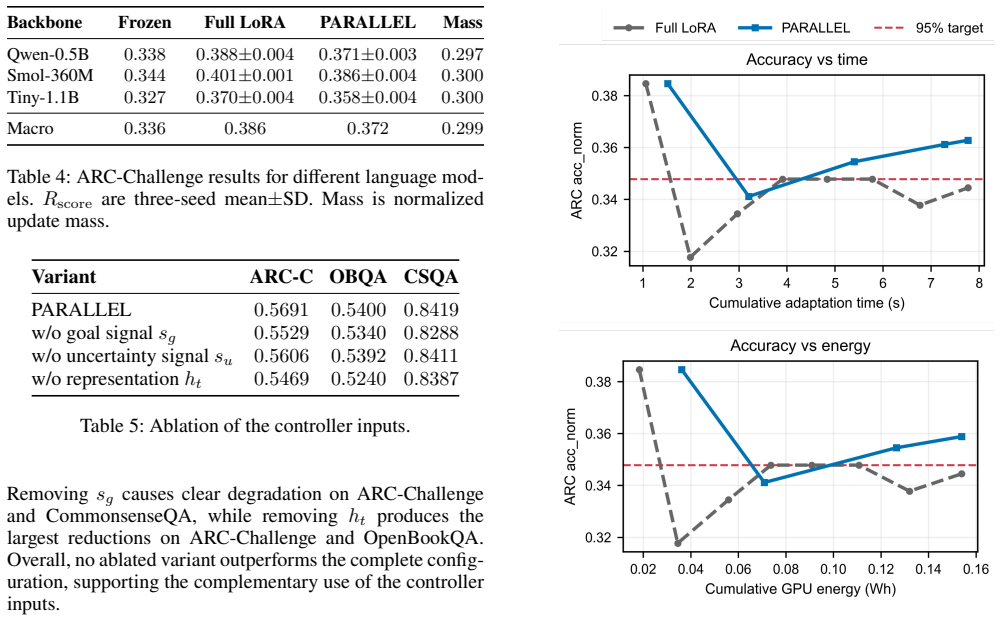
- The reported stability at matched time/energy suggests that avoiding unnecessary updates also reduces late-stage accuracy fluctuations during streaming.
Reading between the lines
- Beyond the paper: the immediate-loss-change reward could be tested for proxy validity by correlating Δ_t with held-out accuracy gains; the authors state this motivation but do not validate it.
- Beyond the paper: the controller might be transferable to continual learning or data curation, where one also wants to avoid wasteful updates; this is not tested here.
- Beyond the paper: the budget pressure term P_t may be unnecessary if the hard constraint already bounds total mass; an ablation removing only P_t would isolate its contribution.
- Beyond the paper: on generative tasks where loss is less directly tied to downstream quality, the reward definition may need adjustment; the paper only tests summarization with ROUGE.
Editorial analysis
A structured set of objections, weighed in public.
Referee Report
Summary. The paper proposes PARALLEL, an online controller that sequentially decides, for each labeled sample in an adaptation stream, whether to skip, lightly update, or strongly update a LoRA adapter, subject to a hard cumulative update-mass budget. The controller receives goal-related and uncertainty-related signals plus a prompt representation, and is trained with one-step REINFORCE on an immediate utility–cost reward defined as per-sample loss and token-accuracy improvement minus update-cost and budget-pressure penalties. Experiments on three reasoning benchmarks and two summarization datasets report that PARALLEL retains 94.1–99.2% of full-adaptation performance at a 30% update-mass budget, along with cross-backbone, ablation, and cumulative-time/GPU-energy comparisons.
Significance. If the results are robust, the paper makes a useful contribution to budget-constrained online adaptation: it introduces an explicit cumulative update-mass constraint, a lightweight controller with separate target-agreement and uncertainty signals, and a clear framework for non-uniform LoRA update intensity. The paper also reports cross-backbone results with three seeds, controller-input ablations, and measured time/energy trade-offs, which are strengths. However, the current evidence is not yet sufficient to establish the main claim: most headline tables are single-seed, the budget is selected on the same benchmarks as the main evaluation, and the reward proxy is never validated. The approach is plausible and the empirical work is extensive enough to merit a major revision rather than rejection.
major comments (5)
- [§4, Tables 1, 2, 3, 5] The central empirical claim (94.1–99.2% retention at 30% update mass) is supported only by single-seed point estimates on the five main benchmarks. Tables 1, 2, 3, and 5 report no variance or significance tests. Because many differences in Table 3 are tiny (e.g., XSum R-1: 0.3650 vs. 0.3652; CNN/DM R-2: 0.1694 vs. 0.1705), the reader cannot judge whether PARALLEL's apparent advantages are systematic or noise. Please report mean±SD over at least three seeds for all main tables and, where appropriate, significance tests.
- [§4.2, Table 2] The budget ρ=0.30 is selected using the same reasoning benchmarks that later appear in the main results (ARC-Challenge, OpenBookQA, CommonsenseQA). This makes the retention and gain-recovery percentages partly in-sample. Even if the search is described as selecting a 'practical operating point', the main claims are reported at that point. Please either use a held-out validation set for budget selection or report results across ρ values for the main benchmarks, so the qualitative conclusions are not contingent on this selection.
- [§3.2, Eqs. (14)–(17)] The controller is trained solely on the immediate per-sample improvement Δt = (ℓ⁻−ℓ⁺) + γ_acc(A⁺−A⁻), which measures improvement on the same training sample after a single update. The load-bearing premise that maximizing cumulative Δt leads to better final target-task accuracy is never tested. Please add (a) a correlation analysis between Δt and held-out accuracy, or (b) an ablation that replaces the reward signal with a constant or a random reward. Without this evidence, the mechanism's transferability remains unsupported.
- [§4.4, Figure 3] The accuracy-at-matched-cost comparison is based on a single 'representative' seed-42 trajectory on a 512-sample ARC-Challenge stream. This is anecdotal evidence for the claim that PARALLEL achieves higher accuracy at the same cumulative adaptation time or GPU energy. Please report multiple seeds with error bands, or at least average trajectories, so the reader can assess stability. If multi-seed results are too expensive, state this limitation explicitly and avoid generalizing from one run.
- [§4.3, Table 3 and Abstract] The abstract claims that PARALLEL 'uses available updates more efficiently than selective baselines', but Table 3 shows random selection achieving higher scores on several metrics: OpenBookQA (0.5440 vs. 0.5400), XSum R-1 (0.3652 vs. 0.3650), XSum R-2 (0.1414 vs. 0.1409), CNN/DM R-1 (0.3950 vs. 0.3937), and CNN/DM R-2 (0.1705 vs. 0.1694). The only consistent advantages are average gain recovery and ROUGE-L. Please qualify the efficiency claim and report per-metric variability and, if possible, significance tests for the differences.
minor comments (5)
- [§3.1, Eq. (13)] The budget constraint is written as a second equation for M_t, duplicating the definition in Eq. (12). Please simplify or clarify the notation so the constraint M_T/T ≤ ρ is not confused with the mass definition.
- [§4.1, Experimental Setup] The evaluation splits are not fully specified: the paper says training streams contain 90% of official training splits, but it does not state which split is used for final evaluation (validation vs. held-out test). Please clarify, especially for ARC-Challenge and OpenBookQA where lm-eval-harness defaults may be ambiguous.
- [§4.2, Budget Selection] The text says the budget search is on 'a subset of the benchmarks', but Table 2 lists all three reasoning benchmarks. Please specify which benchmarks and seeds were used for the search.
- [§3.2, Eq. (10)] The formula for the Light-scale target bλ_t is terse. Please add a short derivation or wording that explicitly identifies the terms as reward per unit update mass, to avoid confusion about the role of λ_t in the denominator.
- [§4, Tables 1–5] State explicitly in the experimental setup which tables report a single seed and which report multiple seeds. Table 4 reports three-seed mean±SD, but Tables 1–3 and 5 do not; readers should not have to infer this.
Circularity Check
No significant circularity; the reported results are measured outcomes, not derived from fitted inputs.
full rationale
The paper's core derivation chain is the controller state (Eq. 6), policy (Eq. 7), reward (Eq. 16) based on the immediate utility–cost signal Δt (Eq. 14), and one-step REINFORCE objective (Eq. 17). The benchmark results in Tables 1–4 are empirical measurements of running this policy; no equation reduces a reported retention or gain-recovery number to a fitted parameter or to the reward definition. The budget ρ is chosen via a preliminary search (Table 2), which is a hyperparameter-selection step and a potential selection-bias concern, but it is not a circular prediction because the evaluation then measures the resulting adapter on the same benchmarks. The only self-citation (Yoon et al. 2026) appears in the introduction as motivational context for why low-utility updates may waste resources; it is not load-bearing for the central empirical claim, which is established by comparisons to Frozen, Full LoRA, Random selection, and Active learning. The reviewer-identified weakness — that the immediate reward Δt is an unvalidated proxy for generalization — is a correctness and generalization risk, not a circularity: the paper never defines the target metric in terms of Δt. No self-definitional, fitted-input-called-prediction, self-citation-load-bearing, uniqueness-imported, ansatz-smuggled, or renaming pattern is present.
Assumptions & free parameters
free parameters (6)
- Budget ratio ρ =
0.30
- Controller reward coefficients =
γ_acc=0.30, α_c=0.14, α_b=0.40, α_ent=0.01
- Light-scale adaptation constants =
λ_1=0.5, β_λ=0.95, λ_min=0.05, λ_max=0.95
- Reward baseline decay =
β_b=0.95
- Adapter and controller learning rates =
2e-5 (adapter), 8e-4 (controller)
- LoRA configuration =
rank=16, scaling=32, dropout=0.05
assumptions (5)
- domain assumption Immediate post-update loss change Δt (Eq. 14) is a valid reward signal for improving final target-task accuracy.
- domain assumption Cumulative update mass M_T/T (Eq. 13) is an appropriate proxy for adaptation cost.
- domain assumption The goal/uncertainty/representation state z_t (Eq. 6) is sufficient to decide whether and how strongly to update a sample.
- standard math REINFORCE with a baseline and entropy regularization (Eq. 17) converges to a useful policy in this non-stationary online setting.
- ad hoc to paper The neuroimaging-inspired factorization of goal and uncertainty (Sung, Rigotti, and Lee 2025) motivates the separate control signals.
Cite this review
Pith. "Pith review of PARALLEL: A Prefrontal-Aligned Reinforcement inspired Approach for Language-Model Learning under Explicit Limits." pith.science (2026). https://pith.science/paper/C7N6GA4X
@misc{pith2026260728982,
  author       = {Pith},
  title        = {Pith review of: PARALLEL: A Prefrontal-Aligned Reinforcement inspired Approach for Language-Model Learning under Explicit Limits},
  year         = {2026},
  howpublished = {\url{https://pith.science/paper/C7N6GA4X}},
  note         = {Machine review of arXiv:2607.28982}
}
read the original abstract
Recent language models achieve strong performance across a variety of tasks, but conventional adaptation applies updates uniformly across training samples regardless of their local update benefit. We propose PARALLEL, a prefrontal-aligned reinforcement inspired approach for language-model learning. Inspired by the complementary roles of goal-related and uncertainty-related control, PARALLEL represents these forms of information as separate controller signals and combines them with the current model representation. A reinforcement-inspired controller assigns sample-dependent update intensity using immediate utility-cost feedback. PARALLEL therefore learns when and how strongly to adapt to each sample, prioritizing beneficial updates while limiting unnecessary parameter changes. PARALLEL uses available updates more efficiently than selective baselines while retaining 94.1--99.2\% of Full-adaptation performance. Beyond multiple-choice reasoning, experiments on XSum and CNN/DailyMail show that PARALLEL retains 96.9--98.6\% of the ROUGE-1 and ROUGE-2 scores achieved by Full adaptation and 98.8--98.9\% of the corresponding ROUGE-L scores. When compared at the same cumulative adaptation time or GPU energy, PARALLEL achieves higher ARC accuracy and exhibits a more stable late-stage adaptation trajectory than Full adaptation in the representative run. These results show that learning when and how strongly to update each sample supports stable and efficient post-deployment stream adaptation while avoiding unnecessary updates.
Figures


Reference graph
Works this paper leans on
-
[1]
Frontiers of Computer Science , volume=
A survey of large language models , author=. Frontiers of Computer Science , volume=. 2026 , publisher=
2026
-
[2]
ACM transactions on intelligent systems and technology , volume=
A survey on evaluation of large language models , author=. ACM transactions on intelligent systems and technology , volume=. 2024 , publisher=
2024
-
[3]
arXiv preprint arXiv:2503.12687 , year=
Ai agents: Evolution, architecture, and real-world applications , author=. arXiv preprint arXiv:2503.12687 , year=
-
[4]
Nature Communications , year=
Factorized embedding of goal and uncertainty in the lateral prefrontal cortex guides stably flexible learning , author=. Nature Communications , year=
-
[5]
2012 Symposium on Application Accelerators in High Performance Computing , pages=
Power aware computing on GPUs , author=. 2012 Symposium on Application Accelerators in High Performance Computing , pages=. 2012 , organization=
2012
-
[6]
Nature , volume=
Different voltage-dependent thresholds for inducing long-term depression and long-term potentiation in slices of rat visual cortex , author=. Nature , volume=. 1990 , publisher=
1990
-
[7]
Nature , volume=
Synaptic tagging and long-term potentiation , author=. Nature , volume=. 1997 , publisher=
1997
-
[8]
Nature reviews neuroscience , volume=
Making memories last: the synaptic tagging and capture hypothesis , author=. Nature reviews neuroscience , volume=. 2011 , publisher=
2011
Show all 31 references
-
[9]
International Conference on Learning Representations , year=
LoRA: Low-Rank Adaptation of Large Language Models , author=. International Conference on Learning Representations , year=
-
[10]
Active Learning Literature Survey , author=
-
[11]
Advances in Neural Information Processing Systems , volume=
Deep Learning on a Data Diet: Finding Important Examples Early in Training , author=. Advances in Neural Information Processing Systems , volume=
-
[12]
International Conference on Machine Learning , pages=
Prioritized Training on Points that are Learnable, Worth Learning, and Not Yet Learnt , author=. International Conference on Machine Learning , pages=. 2022 , organization=
2022
-
[13]
2019 , doi =
Devlin, Jacob and Chang, Ming-Wei and Lee, Kenton and Toutanova, Kristina , booktitle =. 2019 , doi =
2019
-
[14]
Advances in Neural Information Processing Systems , volume =
Batch Active Learning at Scale , author =. Advances in Neural Information Processing Systems , volume =. 2021 , url =
2021
-
[15]
1994 , doi =
A Sequential Algorithm for Training Text Classifiers , author =. 1994 , doi =
1994
-
[16]
Advances in Neural Information Processing Systems , volume =
Training Language Models to Follow Instructions with Human Feedback , author =. Advances in Neural Information Processing Systems , volume =. 2022 , url =
2022
-
[17]
Machine Learning , volume =
Simple Statistical Gradient-Following Algorithms for Connectionist Reinforcement Learning , author =. Machine Learning , volume =. 1992 , doi =
1992
-
[18]
International Conference on Learning Representations , year =
Decoupled Weight Decay Regularization , author =. International Conference on Learning Representations , year =
-
[19]
arXiv preprint arXiv:2502.02737 , year =
SmolLM2: When Smol Goes Big---Data-Centric Training of a Small Language Model , author =. arXiv preprint arXiv:2502.02737 , year =
-
[20]
arXiv preprint arXiv:1803.05457 , year=
Think you have solved question answering? try arc, the ai2 reasoning challenge , author=. arXiv preprint arXiv:1803.05457 , year=
-
[21]
Proceedings of the 2018 conference on empirical methods in natural language processing , pages=
Can a suit of armor conduct electricity? a new dataset for open book question answering , author=. Proceedings of the 2018 conference on empirical methods in natural language processing , pages=
2018
-
[22]
Commonsenseqa: A question answering challenge targeting commonsense knowledge , author=. Proceedings of the 2019 Conference of the North American Chapter of the Association for Computational Linguistics: Human Language Technologies, Volume 1 (Long and Short Papers) , pages=
2019
-
[23]
arXiv preprint arXiv:2401.02385 , year=
Tinyllama: An open-source small language model , author=. arXiv preprint arXiv:2401.02385 , year=
-
[24]
Neurocomputing , volume =
Online Learning: A Comprehensive Survey , author =. Neurocomputing , volume =. 2021 , doi =
2021
-
[25]
Proceedings of the 2022 Conference of the North American Chapter of the Association for Computational Linguistics: Human Language Technologies , pages =
Lifelong Pretraining: Continually Adapting Language Models to Emerging Corpora , author =. Proceedings of the 2022 Conference of the North American Chapter of the Association for Computational Linguistics: Human Language Technologies , pages =. 2022 , publisher =
2022
-
[26]
Chatterjee, Anwoy and Kowndinya Renduchintala, H. S. V. N. S. and Bhatia, Sumit and Chakraborty, Tanmoy , title =. Transactions of the Association for Computational Linguistics , volume =. 2025 , publisher =. doi:10.1162/tacl.a.42 , url =
2025 doi
-
[27]
arXiv preprint arXiv:2405.14782 , year=
Lessons from the trenches on reproducible evaluation of language models , author=. arXiv preprint arXiv:2405.14782 , year=
-
[28]
arXiv preprint arXiv:2602.16189 , year=
Beyond Learning: A Training-Free Alternative to Model Adaptation , author=. arXiv preprint arXiv:2602.16189 , year=
-
[29]
and Lapata, Mirella , booktitle =
Narayan, Shashi and Cohen, Shay B. and Lapata, Mirella , booktitle =. Don. 2018 , address =. doi:10.18653/v1/D18-1206 , url =
2018 doi
-
[30]
Advances in Neural Information Processing Systems , volume =
Teaching Machines to Read and Comprehend , author =. Advances in Neural Information Processing Systems , volume =. 2015 , publisher =
2015
-
[31]
Proceedings of the 55th Annual Meeting of the Association for Computational Linguistics (Volume 1: Long Papers) , pages =
Get To The Point: Summarization with Pointer-Generator Networks , author =. Proceedings of the 55th Annual Meeting of the Association for Computational Linguistics (Volume 1: Long Papers) , pages =. 2017 , address =. doi:10.18653/v1/P17-1099 , url =
2017 doi
Reviewed August 3, 2026 · model on record in the stance chip above.
Discussion (0). Continue with ORCID to comment.