REVIEW 5 major objections 5 minor 62 references
DynActiveGS: Active Gaussian Splatting for Dynamic Scene Reconstruction
T0 review · 5 major / 5 minor · reviewed 2026-08-06 · deepseek-v4-flash
Pith's one-line read DynActiveGS shows that a robot can keep building an accurate 3D Gaussian map while pedestrians move through the scene, by splitting uncertainty into structural and motion-induced components and planning around both.
desk verdict A convincing active-GS system for dynamic scenes, held back by an unvalidated uncertainty predictor and a missing supplementary. read the letter →
The pith
A machine-rendered reading of the paper's core claim, the machinery that carries it, and where it could break.
The reading
What carries the argument
The central object is the per-pixel uncertainty map $\beta_t$, produced by a lightweight network applied to pretrained DINOv3 features, together with its lift to two map-level fields over a 3D query set $\Omega$: structural uncertainty $U_s(\mathbf{x})$, built from effective observation count and rendering residual (Eq. 8), and motion-induced uncertainty $U_m(\mathbf{x})$, accumulated by projecting $\beta_t$ into 3D with an exponential moving average (Eqs. 9, 17). $\beta_t$ enters the optimization loss as a squared inverse weight: $\mathcal{L}_{\text{render}}=(\lambda_1\mathcal{L}_{\text{color}}+\lambda_2\mathcal{L}_{\text{depth}})/\beta_t^2+\lambda_3\mathcal{L}_{\text{iso}}$ (Eq. 6). The de
What would settle it
Use the simulator's ground truth: in Social-MP3D every virtual pedestrian's position is known, so render a true motion mask per frame and measure the agreement (e.g., AUROC) between $\beta_t$ and that mask; near-chance agreement would mean the reported gains do not come from motion detection. A second test: freeze all pedestrians in one scene. If DynActiveGS then fails to beat static baselines, or performs worse, the motion-aware modules are over-penalizing stable regions and the central claim fails.
Extended reading notes
Core claim
On the paper's own terms, the discovery is that the failure of active reconstruction in dynamic scenes is not insufficient view sampling but the absence of motion-aware decision-making. The system learns a per-pixel uncertainty map $\beta_t$ and uses it twice: as an inverse-squared weight in the Gaussian rendering loss (Eq. 6), so motion-corrupted pixels contribute little to map optimization, and as the accumulated field $U_m$ that penalizes risky viewpoints and traversal edges (Eqs. 11-15). Structural uncertainty $U_s$ stays separate, so the planner is still drawn to genuinely under-reconstructed static regions. With this decomposition, the paper reports the best geometric and photometric r
Load-bearing premise
The load-bearing premise is that the learned per-pixel unreliability map $\beta_t$ truly marks moving or transiently occluded pixels and does not confuse them with ordinary under-reconstructed static regions; if the two are confused, the same weight that suppresses a pedestrian also discards useful static observations, and the planner marks stable areas as risky.
Editorial extensions
If this is right
- If the claim holds, 3DGS-based active reconstruction can be deployed in inhabited spaces: motion-corrupted pixels no longer produce ghosted or duplicated geometry.
- The observation budget goes to stable, informative views; the paper reports faster PSNR and completion-ratio growth over 1000- and 2000-step horizons, so robustness does not sacrifice exploration efficiency.
- The uncertainty decomposition transfers across simulators: the same predictor works with Social-MP3D's native pedestrians and Gibson's externally injected humans, pointing to a dataset-independent mechanism.
- Cleaner Gaussian maps at held-out viewpoints (higher PSNR/SSIM, lower LPIPS) yield a scene model that is directly usable for simulation, planning, or visualization.
- Temporal accumulation of motion risk improves long-horizon planning, meaning persistently dynamic regions are avoided while transient disturbances do not derail the agent.
Reading between the lines
- My read: the two-channel uncertainty scheme is representation-agnostic, so the same up-weight/down-weight logic could be bolted onto TSDF or neural-implicit active mapping systems with minimal changes.
- The learned $\beta_t$ is effectively a motion-segmentation signal; a byproduct of this work could be a reusable dynamic-region prior for social navigation or object tracking in the same scenes.
- Because the predictor's supervision details are deferred to the supplementary, the cleanest stress test is to swap $\beta_t$ for the simulator's ground-truth motion mask: if the reported margins replicate under the oracle, the learned predictor is the true driver; if not, the gains may come from soft weighting acting as a regularizer.
- The paper states its own scope limit: evaluation is in simulation with controllable human dynamics; the natural next test is a real robot among unpredictable pedestrians, where the uncertainty predictor's transfer is the open question.
Editorial analysis
A structured set of objections, weighed in public.
Referee Report
Summary. The paper proposes DynActiveGS, a closed-loop active 3D reconstruction system based on 3D Gaussian Splatting for dynamic indoor scenes. The method predicts a per-pixel uncertainty map beta_t from DINOv3 features via a lightweight network P, uses beta_t to weight the reconstruction loss during Gaussian map optimization (Eq. 6), then lifts beta_t into map-level structural uncertainty U_s and motion-induced uncertainty U_m (Eqs. 8-9). These fields drive dynamic-aware local-global viewpoint selection (Eqs. 11-14) and motion-constrained path planning (Eqs. 15-16). Experiments on Social-MP3D and a self-constructed Dynamic Gibson protocol report consistent improvements over ActiveGAMER, ActiveSplat, ActiveGS, and NARUTO across geometric (Acc, Com, C.R.) and photometric (PSNR, SSIM, LPIPS) metrics, with ablations in Tables 3-5 supporting each component.
Significance. If the central claims hold, this paper would make a meaningful contribution by extending active reconstruction to scenes with human motion, a setting largely ignored by existing active 3DGS systems. The explicit decomposition of structural versus motion-induced uncertainty, and its use in both mapping and planning, is a natural and potentially effective design. The paper also ships a coherent formulation and internally consistent ablations, and the use of fixed scene splits and shared random seeds across methods is a reasonable control. However, the significance is currently tempered by three gaps: the training objective of the uncertainty predictor P is deferred to an absent supplementary, the learned uncertainty map is never directly validated against ground-truth dynamic regions, and no repeated-seed statistics or error bars are provided for the headline comparisons. These issues make the central mechanism difficult to reproduce or fully trust.
major comments (5)
- [§3.2.1, Eq. (5)–(6)] The uncertainty predictor P is the backbone of the method: beta_t from Eq. (5) directly weights the loss in Eq. (6) and accumulates into U_m in Eq. (9). Yet the training objective for P is not given; the text states 'the full objective is provided in the supplementary material,' but no supplementary is included. Without the objective and training protocol, the reader cannot know whether P is trained with dynamic-object labels, self-supervised appearance/depth consistency, or a pretrained network, and the central mechanism is not reproducible. Please include the complete loss, data, and training details.
- [§3.2.1, §4.3, Tables 3–5] No evidence shows that beta_t distinguishes motion-corrupted pixels from static under-reconstruction. If static under-observed regions also yield high beta_t, Eq. (6) down-weights the very observations needed to complete them, and Eq. (9) mislabels stable areas as dynamic, biasing the planner in Eqs. (11)–(15) toward already-explored regions. The ablations only toggle whole modules on/off and never evaluate beta_t itself. Add a direct evaluation of beta_t against ground-truth human masks (e.g., per-pixel AUC or precision-recall) and an ablation that replaces the learned beta_t with ground-truth dynamic masks to establish an upper bound. Also report beta_t behavior on static under-reconstruction vs. dynamic regions.
- [§4.1–4.2, Tables 1–2] All quantitative results are single values per scene. Human dynamics are randomized, and although seeds are shared across methods, a single trial cannot support the claim of 'consistent' improvements. Report mean ± std over at least three independent seeds, or per-seed distributions, and state whether the reported numbers come from one seed. Otherwise the consistent gains in Tables 1 and 2 could be a single favorable draw rather than a robust property of the method.
- [§3.2.2, Implementation Details] Eq. (6) is dimensionally ambiguous: L_color and L_depth are described as scalar losses while beta_t is a per-pixel map, so L_depth / beta_t^2 is not defined as written. Please specify the per-pixel weighting and the reduction (e.g., mean over pixels). Moreover, none of the hyperparameters in Eqs. (6), (8), (10), (11), (14), and (15) are reported: lambda_1, lambda_2, lambda_3, lambda_c, lambda_r, e_max, alpha, lambda_e, lambda_p, lambda_m, lambda_r, lambda_c, lambda_d, lambda_v, and the local score threshold. These values are necessary for reproducibility and to assess sensitivity.
- [§4.1 baselines] The paper states that some baselines (e.g., ActiveSplat, ActiveGAMER) employ free-flying 6DoF cameras, while DynActiveGS uses a ground robot with fixed camera height and discrete navigation actions. The baselines are run with their official implementations under 'identical observation budgets,' but the text does not explain how free-flying methods are constrained to the ground-robot embodiment or whether this places them at a disadvantage. Please describe the adaptation concretely, and if baselines are not run under the same action space, acknowledge this limitation or rerun a variant with the same constraints.
minor comments (5)
- [§3.4, Eq. (17)] Eq. (17) writes U_m^{(t)}(x) = (1-alpha) U_m^{(t-1)}(x) + alpha beta_t(x), but beta_t is defined on image pixels in Eq. (5), not on 3D query locations x. This should use the projection and visibility indicator as in Eq. (9), or be clarified as a different quantity.
- [§3.3.2] The 'local score threshold' used to iterate local candidate selection is never defined or quantified. Please specify how it is chosen.
- [§3.4, Algorithm 1] The text refers to 'Algorithm 1' in the supplementary material, but the supplementary is not provided. The closed-loop pseudocode should appear in the main text or the supplement must be submitted.
- [§3.2.1, references [36, 47]] The text calls the feature extractor 'DINOv3' and cites both DINOv2 [36] and DINOv3 [47]. Please make the naming and citation consistent, and specify which checkpoint is used.
- [Figure 2 caption] Several mathematical expressions in the caption are garbled (e.g., 'S(n) = ...' and 'c(e) = ...'). Please replace with readable LaTeX or text.
Circularity Check
No significant circularity: gains are measured against static ground-truth meshes and held-out views, and the uncertainty predictor is a learned module rather than a fitted constant that forces the headline metrics.
full rationale
We examined the load-bearing derivation chain: Eq. (6) weights the rendering loss by the predicted per-pixel uncertainty β_t; Eqs. (8)–(9) construct structural uncertainty U_s and motion uncertainty U_m; Eqs. (11)–(15) use U_s and U_m for viewpoint scoring and edge costs. None of these quantities is a re-packaging of the evaluation metrics. Reconstruction and rendering metrics are computed against static ground-truth meshes and held-out novel-view renderings, which are independent of β_t, U_s, and U_m; the planner’s choices are not scored by the uncertainty maps themselves. β_t is produced by a learned network from DINO features, with a supervision objective deferred to the supplementary; even though that objective is not included in the manuscript, the paper does not fit a scalar to the benchmark and then call it a prediction. The ablations toggle whole modules on/off, and the full model’s superiority is an empirical claim, not an identity. The only caveat is that Section 3.2.1 states “the full objective is provided in the supplementary material,” which is a missing-support / reproducibility concern and could in principle allow a degenerate solution if β_t were unregularized; but without the objective text we cannot exhibit a circular reduction. No self-citations are load-bearing, and no uniqueness theorem or ansatz is imported from the authors’ prior work. Therefore no significant circularity is demonstrated.
Assumptions & free parameters
free parameters (8)
- Loss weights lambda_1, lambda_2, lambda_3
- Structural uncertainty weights lambda_c, lambda_r and residual cap e_max
- Motion uncertainty update rate alpha
- Subregion distance weights lambda_e, lambda_p, lambda_m
- Viewpoint score weights lambda_r, lambda_c
- Global score weights lambda_r, lambda_d, lambda_v
- Path cost weight lambda_m
- Local score threshold
assumptions (5)
- standard math 3DGS rendering formulas (Eqs. 1-3) are correct and differentiable as stated
- domain assumption The learned uncertainty map beta_t identifies pixels corrupted by motion or transient occlusion
- ad hoc to paper The uncertainty predictor P can be trained from appearance and depth consistency without explicit dynamic-object labels
- domain assumption Dynamic humans are not part of the reconstruction target and corrupt observations only
- domain assumption The Habitat simulator's dynamic pedestrian models (ORCA, UPL++) are faithful enough to benchmark dynamic reconstruction
Cite this review
Pith. "Pith review of DynActiveGS: Active Gaussian Splatting for Dynamic Scene Reconstruction." pith.science (2026). https://pith.science/paper/L5ORVXQD
@misc{pith2026260801178,
  author       = {Pith},
  title        = {Pith review of: DynActiveGS: Active Gaussian Splatting for Dynamic Scene Reconstruction},
  year         = {2026},
  howpublished = {\url{https://pith.science/paper/L5ORVXQD}},
  note         = {Machine review of arXiv:2608.01178}
}
read the original abstract
We present DynActiveGS, a dynamic-aware active reconstruction framework based on 3D Gaussian Splatting (3DGS) for autonomous exploration in dynamic environments. The framework incrementally reconstructs a 3D Gaussian scene representation while suppressing motion-corrupted observations through online uncertainty prediction and uncertainty-weighted Gaussian optimization. A key component of DynActiveGS is the explicit decomposition of uncertainty into structural uncertainty and motion-induced uncertainty, which enables the system to distinguish under-reconstructed static regions from dynamically unreliable areas. Based on these uncertainty fields, DynActiveGS performs dynamic-aware viewpoint selection and dynamic-constrained path planning to favor informative yet stable observations during exploration. The resulting system forms a unified closed-loop pipeline for robust active reconstruction in dynamic scenes. Extensive experiments on challenging dynamic benchmarks demonstrate consistent improvements over existing active reconstruction baselines in reconstruction accuracy, completeness, rendering quality, and exploration efficiency.
Figures
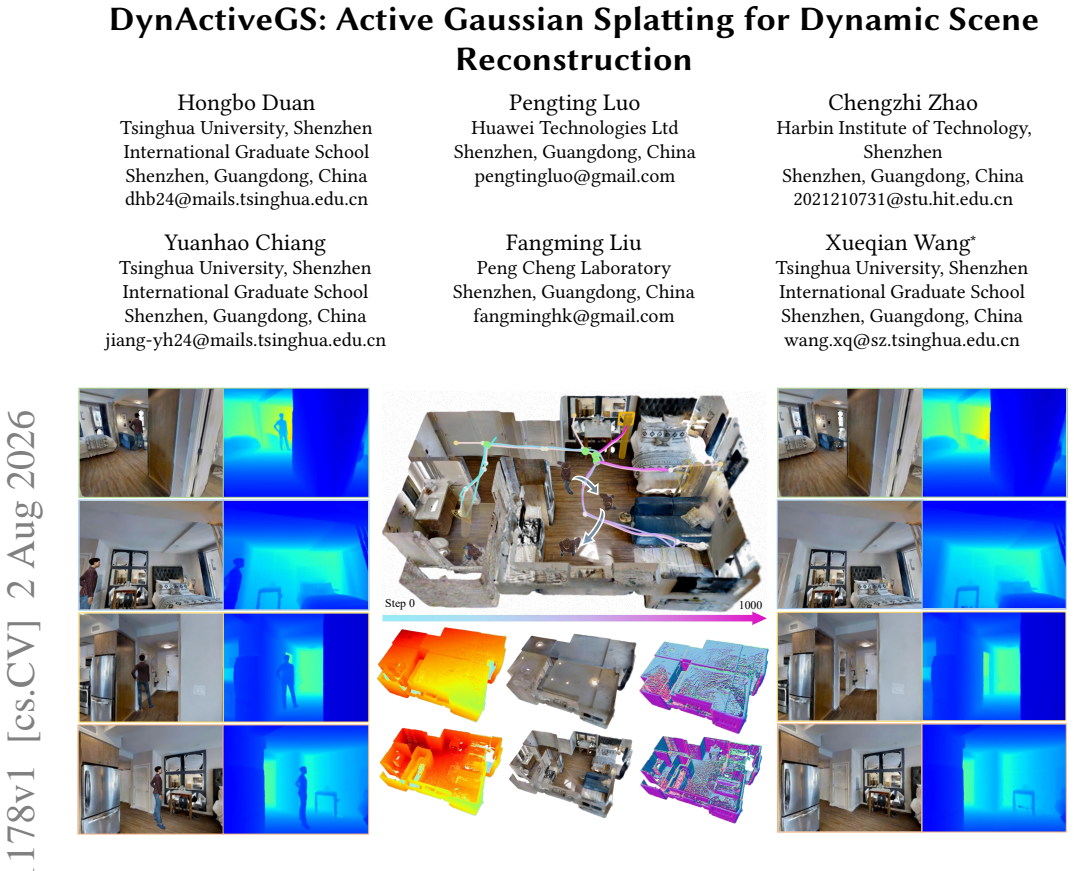


Figures from the paper (3 more)


Reference graph
Works this paper leans on
-
[1]
John Aloimonos, Isaac Weiss, and Amit Bandyopadhyay. 1988. Active vision. International journal of computer vision1, 4 (1988), 333–356
work page 1988
-
[2]
Jonathan T Barron, Ben Mildenhall, Dor Verbin, Pratul P Srinivasan, and Peter Hedman. 2022. Mip-nerf 360: Unbounded anti-aliased neural radiance fields. In Proceedings of the IEEE/CVF conference on computer vision and pattern recognition. 5470–5479
2022
-
[3]
Berta Bescos, José M Fácil, Javier Civera, and José Neira. 2018. DynaSLAM: Track- ing, mapping, and inpainting in dynamic scenes.IEEE robotics and automation letters3, 4 (2018), 4076–4083
work page 2018
-
[4]
Angel Chang, Angela Dai, Thomas Funkhouser, Maciej Halber, Matthias Niebner, Manolis Savva, Shuran Song, Andy Zeng, and Yinda Zhang. 2018. Matterport3D: Learning from RGB-D data in indoor environments. In7th IEEE International Conference on 3D Vision, 3DV 2017. 667–676
work page 2018
-
[5]
Anpei Chen, Zexiang Xu, Andreas Geiger, Jingyi Yu, and Hao Su. 2022. Tensorf: Tensorial radiance fields. InEuropean conference on computer vision. Springer, 333–350
2022
-
[6]
Liyan Chen, Huangying Zhan, Kevin Chen, Xiangyu Xu, Qingan Yan, Changjiang Cai, and Yi Xu. 2025. Activegamer: Active gaussian mapping through efficient rendering. InProceedings of the IEEE/CVF Conference on Computer Vision and Pattern Recognition. 16486–16497
work page 2025
-
[7]
Shengyong Chen, Youfu Li, and Ngai Ming Kwok. 2011. Active vision in robotic systems: A survey of recent developments.The International Journal of Robotics Research30, 11 (2011), 1343–1377
work page 2011
-
[8]
Xiao Chen, Quanyi Li, Tai Wang, Tianfan Xue, and Jiangmiao Pang. 2024. Gennbv: Generalizable next-best-view policy for active 3d reconstruction. InProceedings of the IEEE/CVF Conference on Computer Vision and Pattern Recognition. 16436– 16445
work page 2024
Show all 62 references
-
[9]
Shin-Fang Chng, Sameera Ramasinghe, Jamie Sherrah, and Simon Lucey. 2022. Gaussian activated neural radiance fields for high fidelity reconstruction and pose estimation. InEuropean Conference on Computer Vision. Springer, 264–280
2022
-
[10]
Angela Dai, Matthias Nießner, Michael Zollhöfer, Shahram Izadi, and Christian Theobalt. 2017. Bundlefusion: Real-time globally consistent 3d reconstruction using on-the-fly surface reintegration.ACM Transactions on Graphics (ToG)36, 4 (2017), 1
2017
-
[11]
Ziyue Feng, Huangying Zhan, Zheng Chen, Qingan Yan, Xiangyu Xu, Changjiang Cai, Bing Li, Qilun Zhu, and Yi Xu. 2024. Naruto: Neural active reconstruction from uncertain target observations. InProceedings of the IEEE/CVF Conference on Computer Vision and Pattern Recognition. 21...
2024
-
[12]
Zeying Gong, Tianshuai Hu, Ronghe Qiu, and Junwei Liang. 2025. From cognition to precognition: A future-aware framework for social navigation. In2025 IEEE International Conference on Robotics and Automation (ICRA). IEEE, 9122–9129
2025
-
[13]
Binbin Huang, Zehao Yu, Anpei Chen, Andreas Geiger, and Shenghua Gao
-
[14]
Stefan Isler, Reza Sabzevari, Jeffrey Delmerico, and Davide Scaramuzza. 2016. An information gain formulation for active volumetric 3D reconstruction. In2016 IEEE international conference on robotics and automation (ICRA). IEEE, 3477–3484
2016
-
[15]
Haochen Jiang, Yueming Xu, Kejie Li, Jianfeng Feng, and Li Zhang. 2024. Rodyn- slam: Robust dynamic dense rgb-d slam with neural radiance fields.IEEE Robotics and Automation Letters9, 9 (2024), 7509–7516
2024
-
[16]
Wen Jiang, Boshu Lei, and Kostas Daniilidis. 2024. Fisherrf: Active view selec- tion and mapping with radiance fields using fisher information. InEuropean Conference on Computer Vision. Springer, 422–440
2024
-
[17]
Liren Jin, Xingguang Zhong, Yue Pan, Jens Behley, Cyrill Stachniss, and Marija Popović. 2025. Activegs: Active scene reconstruction using gaussian splatting. IEEE Robotics and Automation Letters(2025)
2025
-
[18]
Rui Jin, Yuman Gao, Yingjian Wang, Yuze Wu, Haojian Lu, Chao Xu, and Fei Gao. 2024. Gs-planner: A gaussian-splatting-based planning framework for active high-fidelity reconstruction. In2024 IEEE/RSJ International Conference on Intelligent Robots and Systems (IROS). IEEE, 11202–11209
2024
-
[19]
Ioannis Karamouzas, Brian Skinner, and Stephen J Guy. 2014. Universal power law governing pedestrian interactions.Physical review letters113, 23 (2014), 238701
2014
-
[20]
Nikhil Keetha, Jay Karhade, Krishna Murthy Jatavallabhula, Gengshan Yang, Sebastian Scherer, Deva Ramanan, and Jonathon Luiten. 2024. Splatam: Splat track & map 3d gaussians for dense rgb-d slam. InProceedings of the IEEE/CVF conference on computer vision and pattern recogniti...
2024
-
[21]
Bernhard Kerbl, Georgios Kopanas, Thomas Leimkühler, and George Drettakis
-
[22]
Andreas Kirsch, Joost Van Amersfoort, and Yarin Gal. 2019. Batchbald: Efficient and diverse batch acquisition for deep bayesian active learning.Advances in neural information processing systems32 (2019)
2019
-
[23]
Zijia Kuang, Zike Yan, Hao Zhao, Guyue Zhou, and Hongbin Zha. 2024. Active neural mapping at scale. In2024 IEEE/RSJ International Conference on Intelligent Robots and Systems (IROS). IEEE, 7152–7159
2024
-
[24]
Jonas Kulhanek, Songyou Peng, Zuzana Kukelova, Marc Pollefeys, and Torsten Sattler. 2024. WildGaussians: 3D Gaussian Splatting In the Wild.Advances in Neural Information Processing Systems37 (2024), 21271–21288
2024
-
[25]
Soomin Lee, Le Chen, Jiahao Wang, Alexander Liniger, Suryansh Kumar, and Fisher Yu. 2022. Uncertainty guided policy for active robotic 3d reconstruction using neural radiance fields.IEEE Robotics and Automation Letters7, 4 (2022), 12070–12077
2022
-
[26]
Kejie Li, Yansong Tang, Victor Adrian Prisacariu, and Philip HS Torr. 2022. Bnv- fusion: Dense 3d reconstruction using bi-level neural volume fusion. InPro- ceedings of the IEEE/CVF Conference on Computer Vision and Pattern Recognition. 6166–6175
2022
-
[27]
Moyang Li, Zihan Zhu, Marc Pollefeys, and Daniel Barath. 2026. DROID-SLAM in the Wild. InProceedings of the IEEE/CVF Conference on Computer Vision and Pattern Recognition (CVPR)
2026
-
[28]
Shiyao Li, Antoine Guédon, Clémentin Boittiaux, Shizhe Chen, and Vincent Lepetit. 2025. NextBestPath: Efficient 3D Mapping of Unseen Environments. In ICLR 2025-Thirteenth International Conference on Learning Representations
2025
-
[29]
Yuetao Li, Zijia Kuang, Ting Li, Qun Hao, Zike Yan, Guyue Zhou, and Shaohui Zhang. 2025. ActiveSplat: High-Fidelity Scene Reconstruction through Active Gaussian Splatting.IEEE Robotics and Automation Letters10, 8 (Aug. 2025), 8099–8106. arXiv:2410.21955 [cs]. doi:10.1109/LRA.2...
2025 arXiv
-
[30]
Yan Li, Yingzhao Li, and Gim Hee Lee. 2025. Active3D: Active High-Fidelity 3D Reconstruction via Hierarchical Uncertainty Quantification. arXiv:2511.20050 [cs]. doi:10.48550/arXiv.2511.20050
2025 doi
-
[31]
Yanyan Li, Chenyu Lyu, Yan Di, Guangyao Zhai, Gim Hee Lee, and Federico Tombari. 2024. Geogaussian: Geometry-aware gaussian splatting for scene ren- dering. InEuropean conference on computer vision. Springer, 441–457
2024
-
[32]
Chenguo Lin, Yuchen Lin, Panwang Pan, Yifan Yu, Tao Hu, Honglei Yan, Katerina Fragkiadaki, and Yadong Mu. 2026. MoVieS: Motion-Aware 4D Dynamic View Synthesis in One Second. InProceedings of the Computer Vision and Pattern Recognition Conference (CVPR)
2026
-
[33]
Jiachen Liu, Pan Ji, Nitin Bansal, Changjiang Cai, Qingan Yan, Xiaolei Huang, and Yi Xu. 2022. Planemvs: 3d plane reconstruction from multi-view stereo. In Proceedings of the IEEE/CVF Conference on Computer Vision and Pattern Recognition. 8665–8675
2022
-
[34]
Ben Mildenhall, Pratul P Srinivasan, Matthew Tancik, Jonathan T Barron, Ravi Ramamoorthi, and Ren Ng. 2021. Nerf: Representing scenes as neural radiance fields for view synthesis.Commun. ACM65, 1 (2021), 99–106
2021
-
[35]
Richard A Newcombe, Shahram Izadi, Otmar Hilliges, David Molyneaux, David Kim, Andrew J Davison, Pushmeet Kohi, Jamie Shotton, Steve Hodges, and Andrew Fitzgibbon. 2011. Kinectfusion: Real-time dense surface mapping and tracking. In2011 10th IEEE international symposium on mix...
2011
-
[36]
Maxime Oquab, Timothée Darcet, Théo Moutakanni, Huy Vo, Marc Szafraniec, Vasil Khalidov, Pierre Fernandez, Daniel Haziza, Francisco Massa, Alaaeldin El- Nouby, et al. 2023. Dinov2: Learning robust visual features without supervision. arXiv preprint arXiv:2304.07193(2023)
2023 arXiv
-
[37]
Emanuele Palazzolo, Jens Behley, Philipp Lottes, Philippe Giguere, and Cyrill Stachniss. 2019. ReFusion: 3D reconstruction in dynamic environments for RGB- D cameras exploiting residuals. In2019 IEEE/RSJ International Conference on Intelligent Robots and Systems (IROS). IEEE, ...
2019
-
[38]
Xuran Pan, Zihang Lai, Shiji Song, and Gao Huang. 2022. Activenerf: Learning where to see with uncertainty estimation. InEuropean Conference on Computer Vision. Springer, 230–246
2022
-
[39]
Daryl Peralta, Joel Casimiro, Aldrin Michael Nilles, Justine Aletta Aguilar, Rowel Atienza, and Rhandley Cajote. 2020. Next-best view policy for 3d reconstruction. InEuropean Conference on Computer Vision. Springer, 558–573
2020
-
[40]
Richard Pito. 2002. A solution to the next best view problem for automated surface acquisition.IEEE Transactions on pattern analysis and machine intelligence21, 10 (2002), 1016–1030
2002
-
[41]
Polyzos, Athanasios Bacharis, Saketh Madhuvarasu, Nikos Pa- panikolopoulos, and Tara Javidi
Konstantinos D. Polyzos, Athanasios Bacharis, Saketh Madhuvarasu, Nikos Pa- panikolopoulos, and Tara Javidi. 2025. ActiveInitSplat: How Active Image Selec- tion Helps Gaussian Splatting. arXiv:2503.06859 [cs]. doi:10.48550/arXiv.2503. 06859
2025 doi
-
[42]
Yunlong Ran, Jing Zeng, Shibo He, Jiming Chen, Lincheng Li, Yingfeng Chen, Gimhee Lee, and Qi Ye. 2023. Neurar: Neural uncertainty for autonomous 3d reconstruction with implicit neural representations.IEEE Robotics and Automation MM ’26, November 10–14, 2026, Rio de Janeiro, B...
2023
-
[43]
Weining Ren, Zihan Zhu, Boyang Sun, Jiaqi Chen, Marc Pollefeys, and Songyou Peng. 2024. Nerf on-the-go: Exploiting uncertainty for distractor-free nerfs in the wild. InProceedings of the IEEE/CVF Conference on Computer Vision and Pattern Recognition. 8931–8940
2024
-
[44]
Erik Sandström, Ganlin Zhang, Keisuke Tateno, Michael Oechsle, Michael Niemeyer, Youmin Zhang, Manthan Patel, Luc Van Gool, Martin Oswald, and Federico Tombari. 2025. Splat-slam: Globally optimized rgb-only slam with 3d gaussians. InProceedings of the Computer Vision and Patte...
2025
-
[45]
Manolis Savva, Abhishek Kadian, Oleksandr Maksymets, Yili Zhao, Erik Wijmans, Bhavana Jain, Julian Straub, Jia Liu, Vladlen Koltun, Jitendra Malik, et al. 2019. Habitat: A platform for embodied ai research. InProceedings of the IEEE/CVF international conference on computer vis...
2019
-
[46]
Johannes L Schonberger and Jan-Michael Frahm. 2016. Structure-from-motion revisited. InProceedings of the IEEE conference on computer vision and pattern recognition. 4104–4113
2016
-
[47]
Oriane Siméoni, Huy V Vo, Maximilian Seitzer, Federico Baldassarre, Maxime Oquab, Cijo Jose, Vasil Khalidov, Marc Szafraniec, Seungeun Yi, Michaël Rama- monjisoa, et al. 2025. Dinov3.arXiv preprint arXiv:2508.10104(2025)
2025 arXiv
-
[48]
Jur Van Den Berg, Stephen J Guy, Ming Lin, and Dinesh Manocha. 2011. Reciprocal n-body collision avoidance. InRobotics research: the 14th international symposium ISRR. Springer, 3–19
2011
-
[49]
An Vuong, Toan Nguyen, Minh Nhat Vu, Baoru Huang, Huynh Thi Thanh Binh, Thieu Vo, and Anh Nguyen. 2024. Habicrowd: A high performance simulator for crowd-aware visual navigation. In2024 IEEE/RSJ International Conference on Intelligent Robots and Systems (IROS). IEEE, 5821–5827
2024
-
[50]
Thomas Whelan, Stefan Leutenegger, Renato F Salas-Moreno, Ben Glocker, and Andrew J Davison. 2015. ElasticFusion: Dense SLAM without a pose graph.. In Robotics: science and systems, Vol. 11. Rome, Italy
2015
-
[51]
Pengying Wu, Yao Mu, Bingxian Wu, Yi Hou, Ji Ma, Shanghang Zhang, and Chang Liu. 2024. VoroNav: Voronoi-based Zero-shot Object Navigation with Large Language Model. InInternational Conference on Machine Learning. PMLR, 53757–53775
2024
-
[52]
Fei Xia, Amir R Zamir, Zhiyang He, Alexander Sax, Jitendra Malik, and Silvio Savarese. 2018. Gibson env: Real-world perception for embodied agents. In Proceedings of the IEEE conference on computer vision and pattern recognition. 9068–9079
2018
-
[53]
Yuhan Xie, Yixi Cai, Yinqiang Zhang, Lei Yang, and Jia Pan. 2025. GauSS-MI: Gaussian Splatting Shannon Mutual Information for Active 3D Reconstruction. InProceedings of Robotics: Science and Systems. LosAngeles, CA, USA. doi:10. 15607/RSS.2025.XXI.030
2025
-
[54]
Yueming Xu, Haochen Jiang, Zhongyang Xiao, Jianfeng Feng, and Li Zhang. 2024. Dg-slam: Robust dynamic gaussian splatting slam with hybrid pose optimization. Advances in Neural Information Processing Systems37 (2024), 51577–51596
2024
-
[55]
Zijun Xu, Rui Jin, Ke Wu, Yi Zhao, Zhiwei Zhang, Jieru Zhao, Fei Gao, Zhongxue Gan, and Wenchao Ding. 2025. HGS-Planner: Hierarchical Planning Framework for Active Scene Reconstruction Using 3D Gaussian Splatting. In2025 IEEE International Conference on Robotics and Automation...
2025
-
[56]
Zike Yan, Haoxiang Yang, and Hongbin Zha. 2023. Active Neural Mapping. In 2023 IEEE/CVF International Conference on Computer Vision (ICCV). IEEE, Paris, France, 10947–10958. doi:10.1109/ICCV51070.2023.01008
2023
-
[57]
Zehao Yu, Anpei Chen, Binbin Huang, Torsten Sattler, and Andreas Geiger. 2024. Mip-splatting: Alias-free 3d gaussian splatting. InProceedings of the IEEE/CVF conference on computer vision and pattern recognition. 19447–19456
2024
-
[58]
Zhengquan Zhang, Feng Xu, and Mengmi Zhang. 2025. Peering into the Unknown: Active View Selection with Neural Uncertainty Maps for 3D Reconstruction.arXiv preprint arXiv:2506.14856(2025)
2025
-
[59]
Jianhao Zheng, Zihan Zhu, Valentin Bieri, Marc Pollefeys, Songyou Peng, and Iro Armeni. 2025. Wildgs-slam: Monocular gaussian splatting slam in dynamic environments. InProceedings of the IEEE/CVF Conference on Computer Vision and Pattern Recognition. 11461–11471
2025
-
[60]
Zihan Zhu, Wei Zhang, Norbert Haala, Marc Pollefeys, and Daniel Barath. 2025. VIGS-SLAM: Visual Inertial Gaussian Splatting SLAM. arXiv:2512.02293 [cs]. doi:10.48550/arXiv.2512.02293
2025 doi
-
[2023]
Graph.42, 4 (2023), 139–1
3D Gaussian splatting for real-time radiance field rendering.ACM Trans. Graph.42, 4 (2023), 139–1
2023
-
[2024]
InACM SIGGRAPH 2024 conference papers
2d gaussian splatting for geometrically accurate radiance fields. InACM SIGGRAPH 2024 conference papers. 1–11
2024
Reviewed August 6, 2026 · model on record in the stance chip above.
Discussion (0). Sign in to comment.