REVIEW 4 major objections 6 minor 70 references
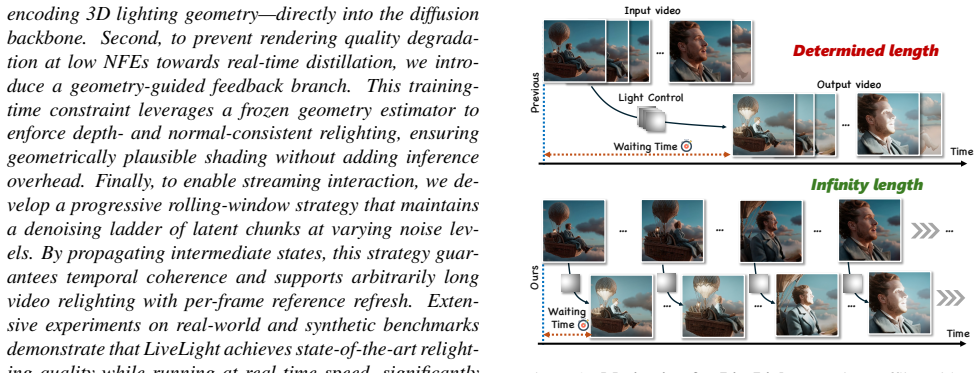
LiveLight is the first diffusion-based video relighting system to run in real time: a user can drag a 3D light and see temporally coherent relit frames stream out at about 16 FPS, on arbitrarily long videos.
Reviewed by Pith at T0; open to challenge. T0 means a machine referee read the full paper against a public rubric. the ladder, T0–T4 →
2026-08-04 21:11 UTC pith:ARFV3ERX
load-bearing objection Real-time streaming relighting is a genuine integration win, but the SOTA claim is undercut by the missing RelightMaster comparison and an ambiguous synthetic benchmark that may use oracle depth. the 4 major comments →
LiveLight: Real-time Streaming Video Relighting with Interactive Control
The pith
A machine-rendered reading of the paper's core claim, the machinery that carries it, and where it could break.
Core claim
LiveLight shows that real-time interactive video relighting is achievable inside a diffusion model by replacing the offline 'trajectory first, render later' workflow with a streaming one. Three designs work together: a 12-channel depth-aware Multi-Plane Light Irradiance condition, built by projecting the user's light onto four fronto-parallel depth planes and injected through a one-million-parameter cross-attention adapter, keeps light position, intensity, and color explicit and editable per frame; a training-only geometry feedback branch, supervised by a frozen depth-and-normal estimator, preserves geometric plausibility when inference is capped at four denoising steps; and a rolling window
What carries the argument
The central object is the Multi-Plane Light Irradiance (MPLI) condition: the user's light is projected onto four fronto-parallel depth planes around the subject, yielding a 12-channel, depth-aware tensor that encodes 3D light geometry. A ~1M-parameter adapter turns this tensor into lighting tokens, injected by cross-attention into the shallow layers of a Stable Diffusion-based backbone, so updating the light only means recomputing and re-encoding the MPLI map. Two further mechanisms carry speed and streaming: a training-only geometry feedback branch (Eq. 4) back-propagates depth and normal errors from a frozen estimator, keeping four-step denoising geometrically plausible at zero inference c
Load-bearing premise
The entire pipeline depends on a pretrained depth-and-normal estimator: it builds the lighting condition at inference and supervises training-time geometry, so wherever that estimator is wrong—complex hairstyles, occlusions, extreme poses—the claimed relighting fidelity degrades.
What would settle it
Run LiveLight on videos where the monocular depth estimator is known to fail (heavy occlusion, complex hair, unusual poses) and compare against a synthetic ground-truth relighting render: if fidelity (PSNR/SSIM, shadow placement) does not drop relative to simple-geometry control videos, the depth prior is less load-bearing than claimed; if it collapses, the central claim fails. A cleaner quantitative probe: perturb the depth map used to build the MPLI condition (e.g., ±10% plane shifts) and measure the drop in lighting-tracking accuracy and temporal consistency—that drop measures how much of t
If this is right
- Video relighting becomes a live parameter: position, intensity, and color of a light can be changed while the output is streaming, with the model following per frame instead of per clip.
- Temporal coherence over long videos is achieved without overlap re-generation or blending, so latency stays roughly constant (~1.01 s per 16-frame clip) while stream length is unbounded.
- The TinyVAE variant raises throughput to 18.34 FPS with marginal quality loss, showing the pipeline can trade decoder fidelity for interactivity whenever latency is the priority.
- Geometry-guided feedback offers a recipe for few-step diffusion distillation that does not sacrifice shading plausibility, because the constraints are imposed offline and add no inference cost.
- Releasing the models, training data, and the synthetic UE5 generator would give the community a shared, controllable benchmark for interactive relighting.
Where Pith is reading between the lines
- Because the lighting condition is recomputed per frame, LiveLight could double as an interactive light-scripting tool—animating a light along a keyframed path or syncing color shifts to audio—which the paper only gestures at as 'dynamic control'.
- The admitted failure modes (complex hairstyles, occlusions, extreme poses) all trace to the depth prior, so coupling the pipeline to a more robust or user-correctable geometry source is the most direct route to broader coverage; the paper leaves that coupling unexplored.
- None of the three designs except the MPLI map itself is lighting-specific, so the same recipe—compact physical condition, training-only geometry feedback, rolling-window ladder—plausibly transfers to other per-frame controllable video edits such as camera or pose.
- A stress test the paper does not report: measuring appearance and lighting drift over streams of thousands of frames, to quantify how tightly the rolling window bounds error accumulation relative to overlap-blending alternatives.
Editorial analysis
A structured set of objections, weighed in public.
Referee Report
Summary. The paper presents LiveLight, a diffusion-based framework for real-time streaming video relighting with interactive 3D lighting control. The method has three components: (i) a lightweight adapter that injects a Multi-Plane Light Irradiance (MPLI) condition into the diffusion backbone; (ii) few-step diffusion distillation with a geometry-guided feedback branch that supervises depth and normal consistency at training time; and (iii) a rolling-window streaming strategy over latent micro-chunks that emits frames with per-frame reference refresh. The model is trained on a large UE5-rendered paired dataset. Experiments compare LiveLight with AnyV2V, LightCtrl, Light-A-Video, and TC-Light on real Internet videos, synthetic UE5 sequences, and a user study, reporting 15.78 FPS with the standard SD VAE (18.34 FPS with TinyVAE) and 1.01 s per 16-frame clip. Section 5 candidly lists limitations, including reliance on off-the-shelf depth/normal estimators and artifacts on small faces and high-frequency details.
Significance. If the reported results hold, LiveLight would be a meaningful step toward interactive, streaming video relighting: the rolling-window latent propagation is a sensible way to bound latency while maintaining temporal coherence, and the training-time geometry feedback is a clean way to preserve structure without adding inference cost. The three-stage ablation study is internally consistent, and the authors' promise to release models, data, and the synthetic generator would be a valuable community contribution. However, the evaluation as written does not yet support the headline 'state-of-the-art' and 'significantly outperforming' claims: the closest baseline is omitted, the synthetic evaluation may use oracle geometry, the quantitative metrics lack statistical grounding, and real-world transfer is not quantitatively tested.
major comments (4)
- [§3.2, Eq. (2); §4.3, Tables 1–3] The MPLI condition is taken from RelightMaster [1], which is itself a video relighting method, yet it appears in references only as the representation source and is never included in any quantitative comparison. Without this baseline, the claim that LiveLight achieves 'state-of-the-art relighting quality' is not testable. Please add RelightMaster to Tables 1–3, or explain why it is not a valid baseline for this setting.
- [§3.2, Eq. (2); §4.3, Table 2; §5] The synthetic margin in Table 2 (43.264 PSNR vs 39.726 for TC-Light) is only meaningful if the deployed geometry pipeline is used at evaluation. The text does not state whether the MPLI condition in Table 2 is built from the off-the-shelf monocular depth estimator or from the UE5-exported ground-truth depth. Training-data synthesis (Sec. 3.1) exports GT depth, while Eq. (2) refers to 'estimated subject depth d_i'; Sec. 5 admits the estimator is unreliable for complex hair, occlusions, and extreme poses. If GT depth was used, the result measures an oracle-geometry system. Please specify the evaluation protocol and, if GT depth was used, rerun with the deployed estimator and report the drop.
- [§4.3, Tables 1–3; user study] The quantitative claims are single numbers with no confidence intervals or significance tests; several VBench margins are small (e.g., Temporal Cons. 0.9872 vs 0.9799 in Table 1), so 'significantly outperforming' is not established. The two relighting-specific metrics in Table 1 are nonstandard: PSNR_y is computed against a pure-white reference inside a mask, which rewards over-brightening rather than correct illumination, and PSNR_light is computed against an overlay of the target light map, not against calibrated ground truth. The synthetic test set (Table 2) is rendered by the same UE5 pipeline used for training, so it is not an independent test of real-world transfer. Add error bars/paired tests, validate the custom metrics, and evaluate on real-world data with known lighting.
- [§3.4; §4.3, Table 1] Real-time interactivity is the central claim, but only FPS and total clip time are reported. With a rolling window of K micro-chunks, chunk size M=4, and per-frame reference refresh, end-to-end latency from a user light change to the displayed output is not determined by throughput alone. Please report startup latency, per-frame incremental latency, and memory usage for arbitrarily long streams.
minor comments (6)
- [§3.4] The text says 'Details are provided in Appendix??' — this unresolved reference should be fixed before submission.
- [Tables 1–3; Fig. 6] The baseline 'AnyV2V' is cited as [64], but reference [64] is the IC-Light paper. Provide the correct AnyV2V citation and clarify the IC-Light+AnyV2V pipeline described in Sec. 4.3.
- [Fig. 3b; §3.3] Fig. 3b shows a 'Stop Grad' path, but the text does not specify exactly which branches are detached during the m-step distillation rollout. Clarify the gradient flow.
- [Eq. (6)] The Stage 1 objective uses \hat{z}_0 and z_0 without defining the prediction head or whether this is a z0-prediction variant of the standard SD loss. Make the objective and the role of \tau and \epsilon precise.
- [Table 2; Fig. 5] Table 2 has the typo '10 different scene' (should be 'scenes'). Fig. 5 reports relative improvements but the axes and raw curves are not labeled.
- [§3.2; §5] The specific off-the-shelf depth/normal estimator used for MPLI construction and geometry feedback is never named. Specify the architecture and source of this estimator, since Sec. 5 identifies it as a source of failure.
Circularity Check
No circularity: the derivation is a forward-trained conditional pipeline; evaluation and support concerns are not definitional circularity.
full rationale
LiveLight's derivation chain is not circular. The MPLI condition (Eq. 2) is an input representation adopted from RelightMaster [1], not a quantity the paper claims to derive; the lightweight adapter (Eq. 3), few-step distillation (Sec. 3.3), geometry-guided feedback (Eq. 4), and rolling-window scheme (Eq. 5) are all trained end-to-end on paired synthetic renders and then evaluated forward. No parameter is fitted to the evaluation set, and no reported 'prediction' reduces by construction to a training input or to a fitted value. The synthetic benchmark in Table 2 comes from the same UE5 generator as the training data, but the paper states the evaluation scenes and lights are unseen; this is a distribution-match and benchmark-fairness concern, not a definitional circularity. The more salient issues—omission of RelightMaster [1] from comparisons, ambiguity about whether synthetic evaluation uses ground-truth depth or the deployed monocular estimator, the unresolved 'Appendix??' reference in Sec. 3.4, and the acknowledged geometry-estimator limitation in Sec. 5—are correctness and evidence concerns, not circular steps. Self-citations appear in related work and background but are not load-bearing; the load-bearing MPLI citation [1] is not authored by the present paper's authors. Therefore the central claim retains independent content.
Axiom & Free-Parameter Ledger
free parameters (6)
- Number of MPLI planes P =
4
- Micro-chunk size M =
4
- Number of distillation denoising steps =
4
- Reconstruction and geometry loss weights (lambda_mse, lambda_lpips, lambda_geo, lambda_N) =
not reported
- Light intensity range for synthetic data =
[0.5, 1.5] normalized UE units
- Color vs white illumination ratio in synthetic data =
6:4
axioms (5)
- domain assumption MPLI representation is a sufficient carrier of lighting information for video relighting
- domain assumption Pretrained Stable Diffusion and AnimateDiff weights provide useful priors that survive fine-tuning
- domain assumption The frozen off-the-shelf geometry estimator provides reliable depth and normals on synthetic and real images
- domain assumption Synthetic UE5 renders with domain randomization transfer to real-world videos
- standard math Standard diffusion denoising and distillation equations
Cite this review
Pith. "Pith review of LiveLight: Real-time Streaming Video Relighting with Interactive Control." pith.science (2026). https://pith.science/paper/ARFV3ERX
@misc{pith2026260801771,
  author       = {Pith},
  title        = {Pith review of: LiveLight: Real-time Streaming Video Relighting with Interactive Control},
  year         = {2026},
  howpublished = {\url{https://pith.science/paper/ARFV3ERX}},
  note         = {Machine review of arXiv:2608.01771}
}
read the original abstract
We present LiveLight, the first diffusion-based framework for real-time streaming video relighting with interactive 3D lighting control. Achieving this is non-trivial, as it requires overcoming three critical challenges: effectively injecting dynamic 3D lighting into a diffusion model, maintaining high-fidelity generation under an extremely low NFE (Number of Function Evaluations) budget for real-time speed, and facilitating continuous streaming for interactive control. To address these pain points, we propose three key designs. First, for accurate lighting injection, we propose a lightweight adapter that feeds Multi-Plane Light Irradiance (MPLI) conditions-depth-aware irradiance maps encoding 3D lighting geometry-directly into the diffusion backbone. Second, to prevent rendering quality degradation at low NFEs towards real-time distillation, we introduce a geometry-guided feedback branch. This training-time constraint leverages a frozen geometry estimator to enforce depth- and normal-consistent relighting, ensuring geometrically plausible shading without adding inference overhead. Finally, to enable streaming interaction, we develop a progressive rolling-window strategy that maintains a denoising ladder of latent chunks at varying noise levels. By propagating intermediate states, this strategy guarantees temporal coherence and supports arbitrarily long video relighting with per-frame reference refresh. Extensive experiments on real-world and synthetic benchmarks demonstrate that LiveLight achieves state-of-the-art relighting quality while running at real-time speed, significantly outperforming offline baselines in temporal stability, lighting controllability, and user preference. To foster real-time interactive relighting research, we will publicly release our models, training data, and synthetic data generator.
Figures



Reference graph
Works this paper leans on
-
[1]
Weikang Bian, Xiaoyu Shi, Zhaoyang Huang, Jianhong Bai, Qinghe Wang, Xintao Wang, Pengfei Wan, Kun Gai, and Hongsheng Li. Relightmaster: Precise video relighting with multi-plane light images.arXiv preprint arXiv:2511.06271,
-
[2]
Andreas Blattmann, Tim Dockhorn, Sumith Kulal, Daniel Mendelevitch, Maciej Kilian, Dominik Lorenz, Yam Levi, Zion English, Vikram V oleti, Adam Letts, et al. Stable video diffusion: Scaling latent video diffusion models to large datasets.arXiv preprint arXiv:2311.15127, 2023. 3
Pith/arXiv arXiv 2023
-
[3]
Real-time 3d-aware portrait video relighting
Ziqi Cai, Kaiwen Jiang, Shu-Yu Chen, Yu-Kun Lai, Hongbo Fu, Boxin Shi, and Lin Gao. Real-time 3d-aware portrait video relighting. InProceedings of the IEEE/CVF Confer- ence on Computer Vision and Pattern Recognition, pages 6221–6231, 2024. 4
work page 2024
-
[4]
SynthLight: Portrait Relighting with Diffusion Model by Learning to Re-render Synthetic Faces
Sumit Chaturvedi, Mengwei Ren, Yannick Hold-Geoffroy, Jingyuan Liu, Julie Dorsey, and Zhixin Shu. Synthlight: Por- trait relighting with diffusion model by learning to re-render synthetic faces.arXiv preprint arXiv:2501.09756, 2025. 3
work page internal anchor Pith review Pith/arXiv arXiv 2025
-
[5]
Boyuan Chen, Diego Mart ´ı Mons ´o, Yilun Du, Max Sim- chowitz, Russ Tedrake, and Vincent Sitzmann. Diffusion forcing: Next-token prediction meets full-sequence diffu- sion.Advances in Neural Information Processing Systems, 37:24081–24125, 2024. 3
work page 2024
-
[6]
Yiyang Chen, Xuanhua He, Xiujun Ma, and Yue Ma. Con- textflow: Training-free video object editing via adaptive con- text enrichment.arXiv preprint arXiv:2509.17818, 2025. 3
arXiv 2025
-
[7]
Paul Debevec. Rendering synthetic objects into real scenes: Bridging traditional and image-based graphics with global illumination and high dynamic range photography. InAcm siggraph 2008 classes, pages 1–10. 2008. 3
work page 2008
-
[8]
Acquiring the reflectance field of a human face
Paul Debevec, Tim Hawkins, Chris Tchou, Haarm-Pieter Duiker, Westley Sarokin, and Mark Sagar. Acquiring the reflectance field of a human face. InProceedings of the 27th annual conference on Computer graphics and interac- tive techniques, pages 145–156, 2000. 3
work page 2000
-
[9]
Scaling recti- fied flow transformers for high-resolution image synthesis
Patrick Esser, Sumith Kulal, Andreas Blattmann, Rahim Entezari, Jonas M ¨uller, Harry Saini, Yam Levi, Dominik Lorenz, Axel Sauer, Frederic Boesel, et al. Scaling recti- fied flow transformers for high-resolution image synthesis. InForty-first international conference on machine learning,
-
[10]
Ye Fang, Zeyi Sun, Shangzhan Zhang, Tong Wu, Yinghao Xu, Pan Zhang, Jiaqi Wang, Gordon Wetzstein, and Dahua Lin. Relightvid: Temporal-consistent diffusion model for video relighting.arXiv preprint arXiv:2501.16330, 2025. 2, 3
Pith/arXiv arXiv 2025
-
[11]
Dit4edit: Dif- fusion transformer for image editing
Kunyu Feng, Yue Ma, Bingyuan Wang, Chenyang Qi, Haozhe Chen, Qifeng Chen, and Zeyu Wang. Dit4edit: Dif- fusion transformer for image editing. InProceedings of the AAAI Conference on Artificial Intelligence, pages 2969– 2977, 2025. 3
2025
-
[12]
One step diffusion via shortcut models.arXiv preprint arXiv:2410.12557, 2024
Kevin Frans, Danijar Hafner, Sergey Levine, and Pieter Abbeel. One step diffusion via shortcut models.arXiv preprint arXiv:2410.12557, 2024. 3
Pith/arXiv arXiv 2024
-
[13]
Pai-studio: Cinematic video background replacement with camera-aware motion
Heyuan Gao, Bangxun Tang, Yiren Song, Guian Fang, Zijian He, Jie Yang, and Mike Zheng Shou. Pai-studio: Cinematic video background replacement with camera-aware motion. arXiv preprint arXiv:2606.01399, 2026. 4
Pith/arXiv arXiv 2026
-
[14]
Yuwei Guo, Ceyuan Yang, Anyi Rao, Zhengyang Liang, Yaohui Wang, Yu Qiao, Maneesh Agrawala, Dahua Lin, and Bo Dai. Animatediff: Animate your personalized text- to-image diffusion models without specific tuning.arXiv preprint arXiv:2307.04725, 2023. 8
Pith/arXiv arXiv 2023
-
[15]
Hao He, Yinghao Xu, Yuwei Guo, Gordon Wetzstein, Bo Dai, Hongsheng Li, and Ceyuan Yang. Cameractrl: Enabling camera control for text-to-video generation.arXiv preprint arXiv:2404.02101, 2024. 4
Pith/arXiv arXiv 2024
-
[16]
Kai He, Ruofan Liang, Jacob Munkberg, Jon Hasselgren, Nandita Vijaykumar, Alexander Keller, Sanja Fidler, Igor Gilitschenski, Zan Gojcic, and Zian Wang. Unirelight: Learning joint decomposition and synthesis for video relight- ing.Advances in Neural Information Processing Systems, 38:108435–108459, 2026. 3
work page 2026
-
[17]
Xun Huang, Zhengqi Li, Guande He, Mingyuan Zhou, and Eli Shechtman. Self forcing: Bridging the train-test gap in autoregressive video diffusion.Advances in Neural Informa- tion Processing Systems, 38:167283–167308, 2026. 3
work page 2026
-
[18]
Vbench: Comprehensive bench- mark suite for video generative models
Ziqi Huang, Yinan He, Jiashuo Yu, Fan Zhang, Chenyang Si, Yuming Jiang, Yuanhan Zhang, Tianxing Wu, Qingyang Jin, Nattapol Chanpaisit, et al. Vbench: Comprehensive bench- mark suite for video generative models. InProceedings of the IEEE/CVF Conference on Computer Vision and Pattern Recognition, pages 21807–21818, 2024. 9, 10, 11
work page 2024
-
[19]
Neural gaffer: Relighting any object via diffusion.Advances in Neu- ral Information Processing Systems, 37:141129–141152,
Haian Jin, Yuan Li, Fujun Luan, Yuanbo Xiangli, Sai Bi, Kai Zhang, Zexiang Xu, Jin Sun, and Noah Snavely. Neural gaffer: Relighting any object via diffusion.Advances in Neu- ral Information Processing Systems, 37:141129–141152,
-
[20]
Hoon Kim, Minje Jang, Wonjun Yoon, Jisoo Lee, Donghyun Na, and Sanghyun Woo. Switchlight: Co-design of physics- driven architecture and pre-training framework for human portrait relighting. InProceedings of the IEEE/CVF Con- ference on Computer Vision and Pattern Recognition, pages 25096–25106, 2024
work page 2024
-
[21]
In- trinsic image diffusion for indoor single-view material es- timation
Peter Kocsis, Vincent Sitzmann, and Matthias Nießner. In- trinsic image diffusion for indoor single-view material es- timation. InProceedings of the IEEE/CVF Conference on Computer Vision and Pattern Recognition, pages 5198– 5208, 2024. 3
work page 2024
-
[22]
Streamdiffusion: A pipeline-level solution for real-time in- teractive generation
Akio Kodaira, Chenfeng Xu, Toshiki Hazama, Takanori Yoshimoto, Kohei Ohno, Shogo Mitsuhori, Soichi Sugano, Hanying Cho, Zhijian Liu, Masayoshi Tomizuka, et al. Streamdiffusion: A pipeline-level solution for real-time in- teractive generation. InProceedings of the IEEE/CVF In- ternational Conference on Computer Vision, pages 12371– 12380, 2025. 3
work page 2025
-
[23]
Weijie Kong, Qi Tian, Zijian Zhang, Rox Min, Zuozhuo Dai, Jin Zhou, Jiangfeng Xiong, Xin Li, Bo Wu, Jianwei Zhang, et al. Hunyuanvideo: A systematic framework for large video generative models.arXiv preprint arXiv:2412.03603, 2024. 3
Pith/arXiv arXiv 2024
-
[24]
Looking backward: Streaming video-to-video translation with feature banks
Feng Liang, Akio Kodaira, Chenfeng Xu, Masayoshi Tomizuka, Kurt Keutzer, and Diana Marculescu. Looking backward: Streaming video-to-video translation with feature banks. InInternational Conference on Learning Represen- tations, pages 46425–46445, 2025. 3
work page 2025
-
[25]
Diffusion renderer: Neural inverse and forward rendering with video diffusion models
Ruofan Liang, Zan Gojcic, Huan Ling, Jacob Munkberg, Jon Hasselgren, Chih-Hao Lin, Jun Gao, Alexander Keller, Nandita Vijaykumar, Sanja Fidler, et al. Diffusion renderer: Neural inverse and forward rendering with video diffusion models. InProceedings of the Computer Vision and Pattern Recognition Conference, pages 26069–26080, 2025. 3
work page 2025
-
[26]
Illumicraft: Unified geometry and illumination diffusion for controllable video generation
Yuanze Lin, Yi-Wen Chen, Yi-Hsuan Tsai, Ronald Clark, and Ming-Hsuan Yang. Illumicraft: Unified geometry and illumination diffusion for controllable video generation. Advances in Neural Information Processing Systems, 38: 27798–27829, 2026. 3
work page 2026
-
[27]
OPSD-V: On-Policy Self-Distillation for Post-Training Few-Step Autoregressive Video Generators
Hongyu Liu, Chun Wang, Feng Gao, Xuanhua He, Yue Ma, Ziyu Wan, Yong Zhang, Xiaoming Wei, and Qifeng Chen. Opsd-v: On-policy self-distillation for post-training few-step autoregressive video generators.arXiv preprint arXiv:2607.08766, 2026. 3
work page internal anchor Pith review Pith/arXiv arXiv 2026
-
[28]
Xingchao Liu, Chengyue Gong, and Qiang Liu. Flow straight and fast: Learning to generate and transfer data with rectified flow.arXiv preprint arXiv:2209.03003, 2022. 3
Pith/arXiv arXiv 2022
-
[29]
Yang Liu, Chuanchen Luo, Zimo Tang, Yingyan Li, Yuany- ong Ning, Lue Fan, Junran Peng, ZHAO-XIANG ZHANG, et al. Tc-light: Temporally coherent generative rendering for realistic world transfer.Advances in Neural Information Processing Systems, 38:51463–51489, 2026. 2, 8, 9, 10, 11
work page 2026
-
[30]
Zeqian Long, Mingzhe Zheng, Kunyu Feng, Xinhua Zhang, Hongyu Liu, Harry Yang, Linfeng Zhang, Qifeng Chen, and Yue Ma. Follow-your-shape: Shape-aware image edit- ing via trajectory-guided region control.arXiv preprint arXiv:2508.08134, 2025. 3
arXiv 2025
-
[31]
Follow your pose: Pose- guided text-to-video generation using pose-free videos
Yue Ma, Yingqing He, Xiaodong Cun, Xintao Wang, Siran Chen, Xiu Li, and Qifeng Chen. Follow your pose: Pose- guided text-to-video generation using pose-free videos. In Proceedings of the AAAI Conference on Artificial Intelli- gence, pages 4117–4125, 2024. 4
2024
-
[32]
Follow-your-emoji: Fine-controllable and expressive freestyle portrait animation
Yue Ma, Hongyu Liu, Hongfa Wang, Heng Pan, Yingqing He, Junkun Yuan, Ailing Zeng, Chengfei Cai, Heung-Yeung Shum, Wei Liu, et al. Follow-your-emoji: Fine-controllable and expressive freestyle portrait animation. InSIGGRAPH Asia 2024 Conference Papers, pages 1–12, 2024. 3
2024
-
[33]
Controllable video generation: A survey.arXiv preprint arXiv:2507.16869,
Yue Ma, Kunyu Feng, Zhongyuan Hu, Xinyu Wang, Yucheng Wang, Mingzhe Zheng, Xuanhua He, Chenyang Zhu, Hongyu Liu, Yingqing He, et al. Controllable video generation: A survey.arXiv preprint arXiv:2507.16869,
-
[34]
Yue Ma, Kunyu Feng, Xinhua Zhang, Hongyu Liu, David Junhao Zhang, Jinbo Xing, Yinhan Zhang, Ayden Yang, Zeyu Wang, and Qifeng Chen. Follow-your-creation: Empowering 4d creation through video inpainting.arXiv preprint arXiv:2506.04590, 2025. 3
Pith/arXiv arXiv 2025
-
[35]
Yue Ma, Yulong Liu, Qiyuan Zhu, Ayden Yang, Kunyu Feng, Xinhua Zhang, Zhifeng Li, Sirui Han, Chenyang Qi, and Qifeng Chen. Follow-your-motion: Video motion transfer via efficient spatial-temporal decoupled finetuning.arXiv preprint arXiv:2506.05207, 2025. 3
arXiv 2025
-
[36]
Yue Ma, Zexuan Yan, Hongyu Liu, Hongfa Wang, Heng Pan, Yingqing He, Junkun Yuan, Ailing Zeng, Chengfei Cai, Heung-Yeung Shum, et al. Follow-your-emoji-faster: To- wards efficient, fine-controllable, and expressive freestyle portrait animation.arXiv preprint arXiv:2509.16630, 2025. 4
arXiv 2025
-
[37]
Fastvmt: Eliminat- ing redundancy in video motion transfer.arXiv preprint arXiv:2602.05551, 2026
Yue Ma, Zhikai Wang, Tianhao Ren, Mingzhe Zheng, Hongyu Liu, Jiayi Guo, Kunyu Feng, Yuxuan Xue, Zix- iang Zhao, Konrad Schindler, et al. Fastvmt: Eliminat- ing redundancy in video motion transfer.arXiv preprint arXiv:2602.05551, 2026. 3
arXiv 2026
-
[38]
Taesd.https://huggingface.co/ madebyollin/taesd, 2023
madebyollin. Taesd.https://huggingface.co/ madebyollin/taesd, 2023. Hugging Face model repos- itory. 10
work page 2023
-
[39]
Yiqun Mei, Mingming He, Li Ma, Julien Philip, Wenqi Xian, David M George, Xueming Yu, Gabriel Dedic, Ahmet Lev- ent Tas ¸el, Ning Yu, et al. Lux post facto: Learning portrait performance relighting with conditional video diffusion and a hybrid dataset. InProceedings of the Computer Vision and Pattern Recognition Conference, pages 5510–5522, 2025. 4
work page 2025
-
[40]
Total relighting: learning to relight portraits for background replacement.ACM Trans
Rohit Pandey, Sergio Orts-Escolano, Chloe Legendre, Chris- tian Haene, Sofien Bouaziz, Christoph Rhemann, Paul E De- bevec, and Sean Ryan Fanello. Total relighting: learning to relight portraits for background replacement.ACM Trans. Graph., 40(4):43–1, 2021. 3
2021
-
[41]
Lightctrl: Training-free controllable video relighting.arXiv preprint arXiv:2603.27083, 2026
Yizuo Peng, Xuelin Chen, Kai Zhang, and Xiaodong Cun. Lightctrl: Training-free controllable video relighting.arXiv preprint arXiv:2603.27083, 2026. 2, 3, 8, 9, 10, 11
-
[42]
Relightful harmonization: Lighting-aware portrait background replacement
Mengwei Ren, Wei Xiong, Jae Shin Yoon, Zhixin Shu, Jianming Zhang, HyunJoon Jung, Guido Gerig, and He Zhang. Relightful harmonization: Lighting-aware portrait background replacement. InProceedings of the IEEE/CVF Conference on Computer Vision and Pattern Recognition, pages 6452–6462, 2024. 3
work page 2024
-
[43]
High-resolution image synthesis with latent diffusion models
Robin Rombach, Andreas Blattmann, Dominik Lorenz, Patrick Esser, and Bj ¨orn Ommer. High-resolution image synthesis with latent diffusion models. InProceedings of the IEEE/CVF conference on computer vision and pattern recognition, pages 10684–10695, 2022. 7, 12
work page 2022
-
[44]
Progressive distillation for fast sampling of diffusion models.arXiv preprint arXiv:2202.00512, 2022
Tim Salimans and Jonathan Ho. Progressive distillation for fast sampling of diffusion models.arXiv preprint arXiv:2202.00512, 2022. 3
Pith/arXiv arXiv 2022
-
[45]
Yutao Shen, Junkun Yuan, Toru Aonishi, Hideki Nakayama, and Yue Ma. Follow-your-preference: Towards preference- aligned image inpainting.arXiv preprint arXiv:2509.23082,
-
[46]
Pro- cesspainter: Learning to draw from sequence data
Yiren Song, Shijie Huang, Chen Yao, Hai Ci, Xiaojun Ye, Jiaming Liu, Yuxuan Zhang, and Mike Zheng Shou. Pro- cesspainter: Learning to draw from sequence data. InSIG- GRAPH Asia 2024 Conference Papers, pages 1–10, 2024. 4
work page 2024
-
[47]
Yiren Song, Cheng Liu, Yuxin Jiang, and Mike Zheng Shou. Streamingeffect: Real-time human-centric video effect gen- eration.arXiv preprint arXiv:2605.17019, 2026
Pith/arXiv arXiv 2026
-
[48]
Yiren Song, Wangzi Yao, Haofan Wang, and Mike Zheng Shou. Vista: Triplet-supervised video style transfer with diffusion transformers.arXiv preprint arXiv:2605.17312, 2026
Pith/arXiv arXiv 2026
-
[49]
Linrui Tian, Qi Wang, Bang Zhang, and Liefeng Bo. Emo: Emote portrait alive generating expressive portrait videos with audio2video diffusion model under weak conditions. In European Conference on Computer Vision, pages 244–260. Springer, 2024. 4
work page 2024
-
[50]
Wan: Open and advanced large-scale video generative models.arXiv preprint arXiv:2503.20314, 2025
Team Wan, Ang Wang, Baole Ai, Bin Wen, Chaojie Mao, Chen-Wei Xie, Di Chen, Feiwu Yu, Haiming Zhao, Jianx- iao Yang, et al. Wan: Open and advanced large-scale video generative models.arXiv preprint arXiv:2503.20314, 2025. 3
Pith/arXiv arXiv 2025
-
[51]
Unipaint: Unified space-time video inpainting via mixture-of-experts
Zhen Wan, Chenyang Qi, Zhiheng Liu, Tao Gui, and Yue Ma. Unipaint: Unified space-time video inpainting via mixture-of-experts. InProceedings of the IEEE/CVF Inter- national Conference on Computer Vision, pages 1861–1871,
-
[52]
Tam- ing rectified flow for inversion and editing.arXiv preprint arXiv:2411.04746, 2024
Jiangshan Wang, Junfu Pu, Zhongang Qi, Jiayi Guo, Yue Ma, Nisha Huang, Yuxin Chen, Xiu Li, and Ying Shan. Tam- ing rectified flow for inversion and editing.arXiv preprint arXiv:2411.04746, 2024. 3
Pith/arXiv arXiv 2024
-
[53]
Videolcm: Video latent consistency model.arXiv preprint arXiv:2312.09109,
Xiang Wang, Shiwei Zhang, Han Zhang, Yu Liu, Yingya Zhang, Changxin Gao, and Nong Sang. Videolcm: Video latent consistency model.arXiv preprint arXiv:2312.09109,
-
[54]
LiveEdit: Towards Real-Time Diffusion-Based Streaming Video Editing
Xinyu Wang, Chongbo Zhao, Fangneng Zhan, and Yue Ma. Liveedit: Towards real-time diffusion-based streaming video editing.arXiv preprint arXiv:2606.26740, 2026. 3
work page internal anchor Pith review Pith/arXiv arXiv 2026
-
[55]
Jinbo Xing, Menghan Xia, Yuxin Liu, Yuechen Zhang, Yong Zhang, Yingqing He, Hanyuan Liu, Haoxin Chen, Xiaodong Cun, Xintao Wang, et al. Make-your-video: Customized video generation using textual and structural guidance.IEEE transactions on visualization and computer graphics, 31(2): 1526–1541, 2024. 4
work page 2024
-
[56]
Motioncanvas: Cinematic shot design with controllable image-to-video generation
Jinbo Xing, Long Mai, Cusuh Ham, Jiahui Huang, Anirud- dha Mahapatra, Chi-Wing Fu, Tien-Tsin Wong, and Feng Liu. Motioncanvas: Cinematic shot design with controllable image-to-video generation. InProceedings of the Special Interest Group on Computer Graphics and Interactive Tech- niques Conference Conference Papers, pages 1–11, 2025. 4
work page 2025
-
[57]
Yuxuan Xue, Ruofan Liang, Egor Zakharov, Timur Bagaut- dinov, Chen Cao, Giljoo Nam, Shunsuke Saito, Gerard Pons-Moll, and Javier Romero. Georelight: Learning joint geometrical relighting and reconstruction with flex- ible multi-modal diffusion transformers.arXiv preprint arXiv:2604.20715, 2026. 3
Pith/arXiv arXiv 2026
-
[58]
Unified video editing with temporal reasoner
Xiangpeng Yang, Ji Xie, Yiyuan Yang, Yan Huang, Min Xu, and Qiang Wu. Unified video editing with temporal reasoner. arXiv preprint arXiv:2512.07469, 2025. 3
Pith/arXiv arXiv 2025
-
[59]
Zhuoyi Yang, Jiayan Teng, Wendi Zheng, Ming Ding, Shiyu Huang, Jiazheng Xu, Yuanming Yang, Wenyi Hong, Xiao- han Zhang, Guanyu Feng, et al. Cogvideox: Text-to-video diffusion models with an expert transformer.arXiv preprint arXiv:2408.06072, 2024. 3
Pith/arXiv arXiv 2024
-
[60]
Dilightnet: Fine-grained light- ing control for diffusion-based image generation
Chong Zeng, Yue Dong, Pieter Peers, Youkang Kong, Hongzhi Wu, and Xin Tong. Dilightnet: Fine-grained light- ing control for diffusion-based image generation. InACM SIGGRAPH 2024 Conference Papers, pages 1–12, 2024. 3
work page 2024
-
[61]
Jianshu Zeng, Yuxuan Liu, Yutong Feng, Chenxuan Miao, Zixiang Gao, Jiwang Qu, Jianzhang Zhang, Bin Wang, and Kun Yuan. Lumen: Consistent video relighting and harmo- nious background replacement with video generative mod- els.arXiv preprint arXiv:2508.12945, 2025. 3
Pith/arXiv arXiv 2025
-
[62]
Kai Zhang, Fujun Luan, Qianqian Wang, Kavita Bala, and Noah Snavely. Physg: Inverse rendering with spherical gaus- sians for physics-based material editing and relighting. In Proceedings of the IEEE/CVF Conference on Computer Vi- sion and Pattern Recognition, pages 5453–5462, 2021. 3
work page 2021
-
[63]
Neural video portrait relighting in real-time via con- sistency modeling
Longwen Zhang, Qixuan Zhang, Minye Wu, Jingyi Yu, and Lan Xu. Neural video portrait relighting in real-time via con- sistency modeling. InProceedings of the IEEE/CVF interna- tional conference on computer vision, pages 802–812, 2021. 4
work page 2021
-
[64]
Lvmin Zhang, Anyi Rao, and Maneesh Agrawala. Scal- ing in-the-wild training for diffusion-based illumination har- monization and editing by imposing consistent light trans- port. InThe Thirteenth International Conference on Learn- ing Representations, 2025. 2, 3, 8, 9, 10, 11
work page 2025
-
[65]
Modeling indirect illumination for inverse rendering
Yuanqing Zhang, Jiaming Sun, Xingyi He, Huan Fu, Rongfei Jia, and Xiaowei Zhou. Modeling indirect illumination for inverse rendering. InProceedings of the IEEE/CVF Con- ference on Computer Vision and Pattern Recognition, pages 18643–18652, 2022. 3
work page 2022
-
[66]
Controlvideo: Training-free controllable text-to-video generation
Yabo Zhang, Yuxiang Wei, XIAOPENG ZHANG, Wang- meng Zuo, Qi Tian, et al. Controlvideo: Training-free controllable text-to-video generation. InInternational Con- ference on Learning Representations, pages 54441–54461,
-
[67]
Lumis- culpt: A consistency lighting control network for video gen- eration
Yuxin Zhang, Dandan Zheng, Biao Gong, Jingdong Chen, Ming Yang, Weiming Dong, and Changsheng Xu. Lumis- culpt: A consistency lighting control network for video gen- eration. 2024. 3
work page 2024
-
[68]
Motiondirector: Motion customization of text-to-video diffusion models
Rui Zhao, Yuchao Gu, Jay Zhangjie Wu, David Jun- hao Zhang, Jia-Wei Liu, Weijia Wu, Jussi Keppo, and Mike Zheng Shou. Motiondirector: Motion customization of text-to-video diffusion models. InEuropean Conference on Computer Vision, pages 273–290. Springer, 2024. 4
work page 2024
-
[69]
Trajec- tory consistency distillation.arXiv e-prints, pages arXiv– 2402, 2024
Jianbin Zheng, Minghui Hu, Zhongyi Fan, Chaoyue Wang, Changxing Ding, Dacheng Tao, and Tat-Jen Cham. Trajec- tory consistency distillation.arXiv e-prints, pages arXiv– 2402, 2024. 3
work page 2024
-
[70]
Yujie Zhou, Jiazi Bu, Pengyang Ling, Pan Zhang, Tong Wu, Qidong Huang, Jinsong Li, Xiaoyi Dong, Yuhang Zang, Yuhang Cao, et al. Light-a-video: Training-free video relighting via progressive light fusion.arXiv preprint arXiv:2502.08590, 2025. 2, 3, 8, 9, 10, 11
Pith/arXiv arXiv 2025
This paper was first reviewed by deepseek-v4-flash on August 4, 2026.
discussion (0)
Sign in with ORCID, Apple, or X to comment. Anyone can read and Pith papers without signing in.