REVIEW 3 major objections 5 minor 2 cited by
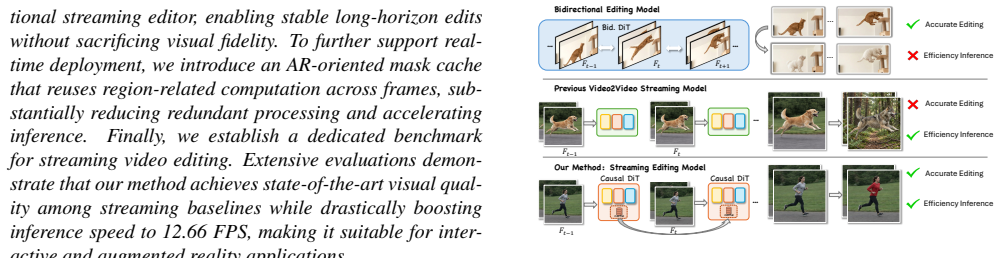
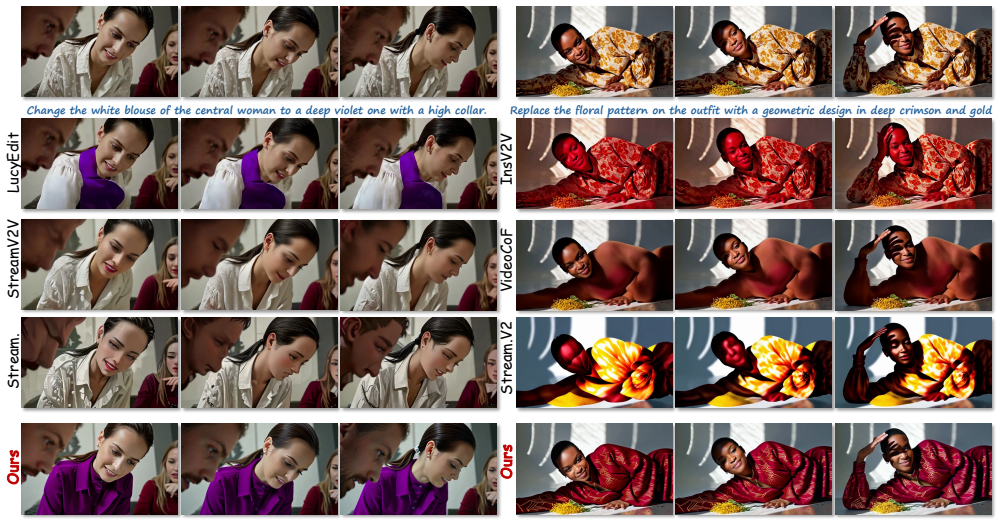
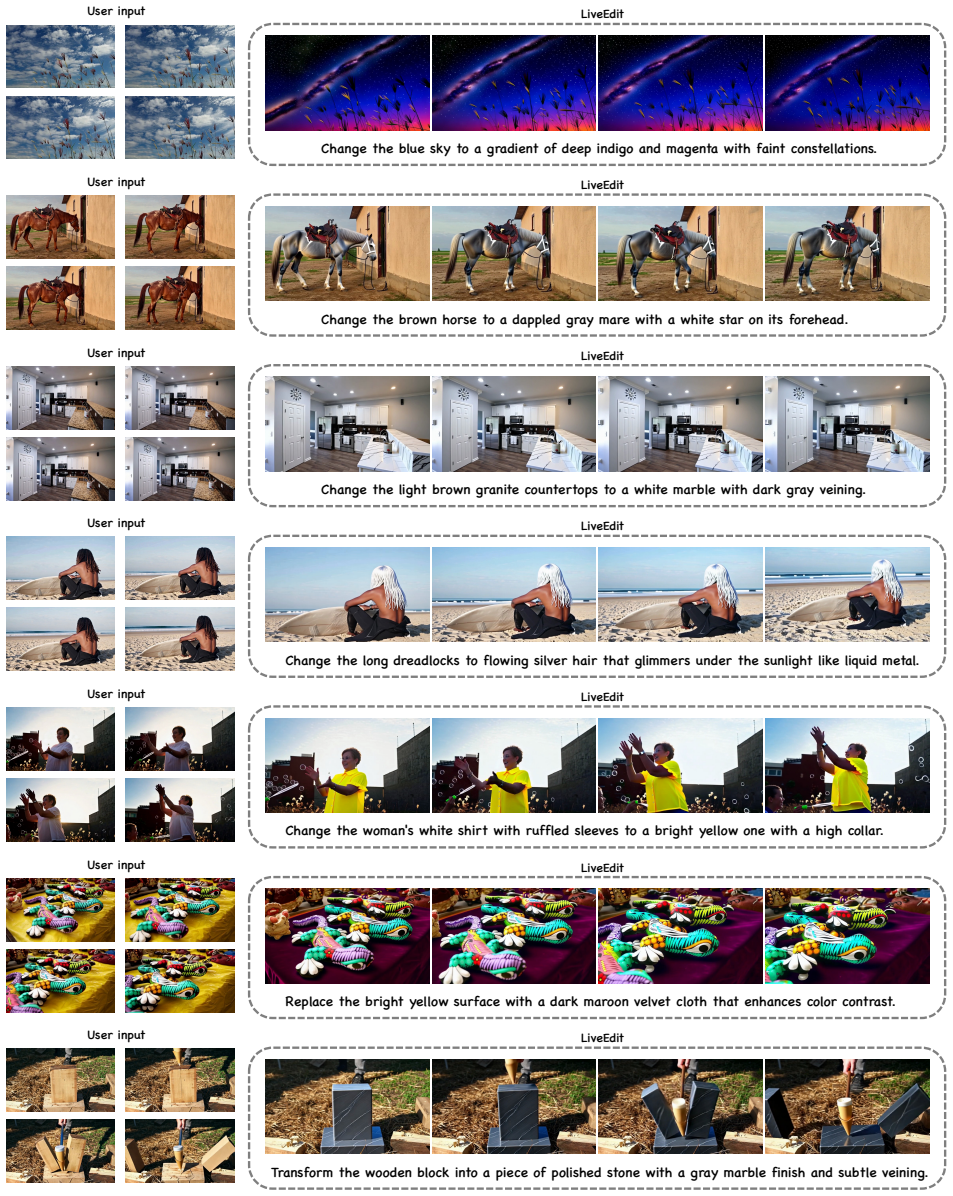
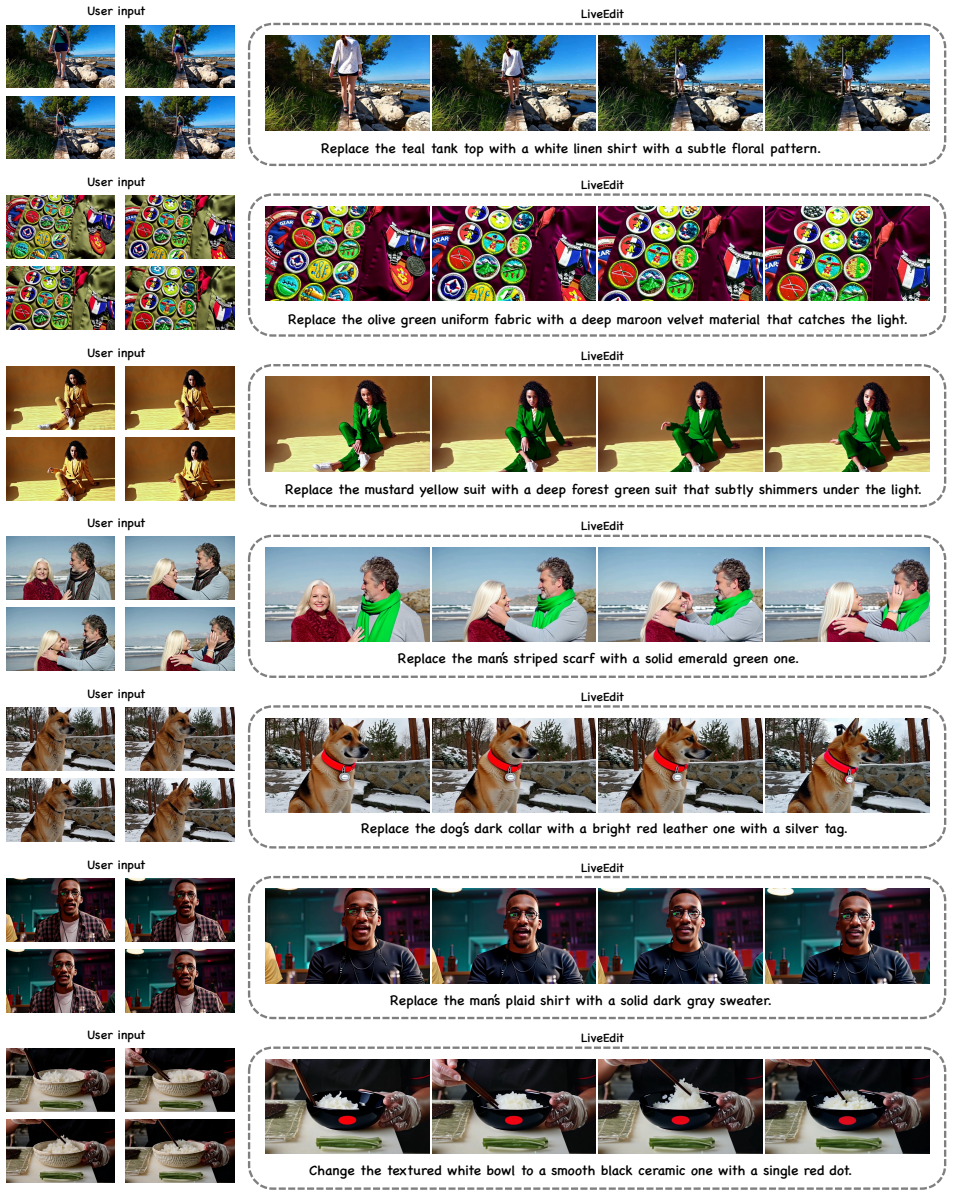
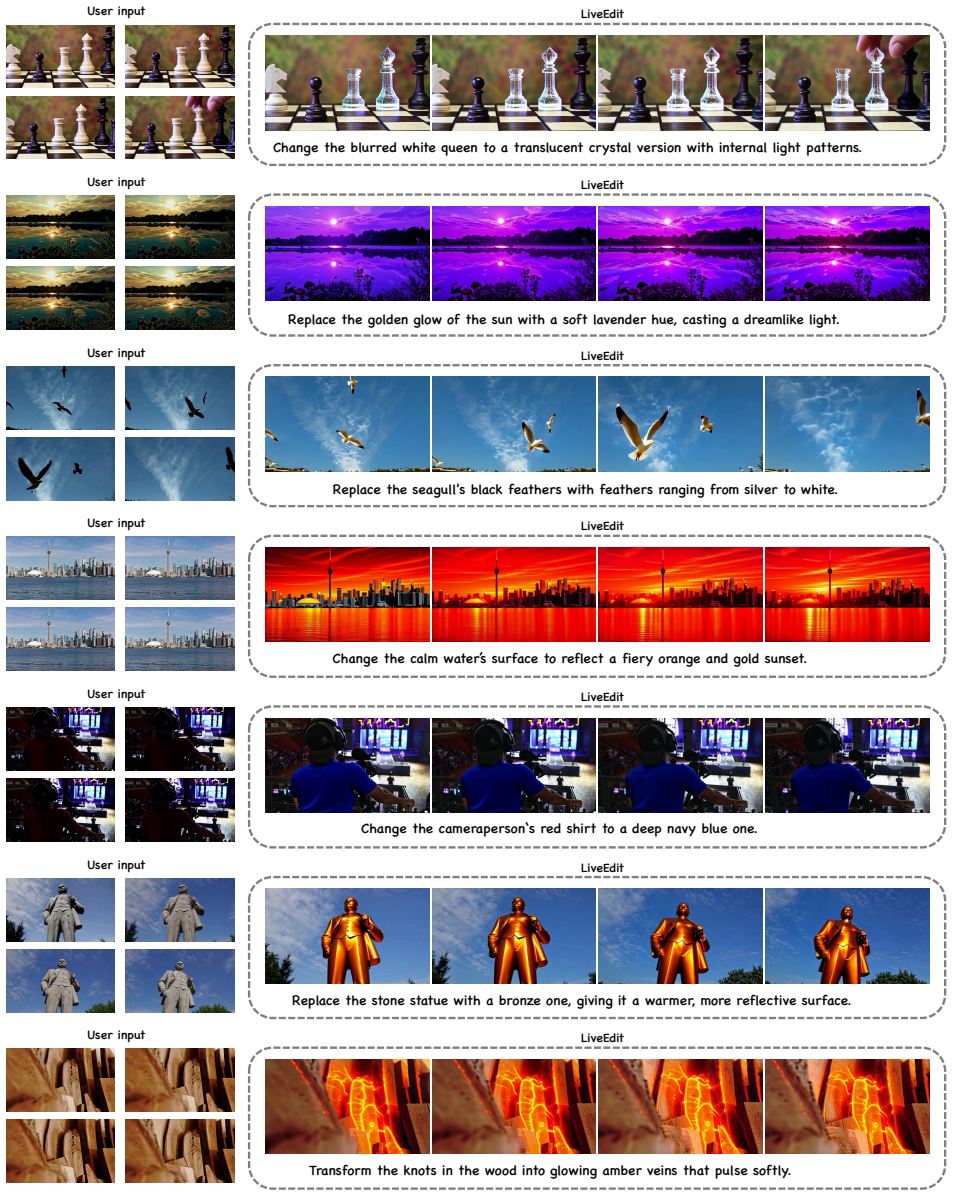
LiveEdit turns bidirectional video editors into a causal 4-step streaming model that edits at 12.66 FPS while keeping unedited backgrounds stable.
Reviewed by Pith at T0; open to challenge. T0 means a machine referee read the full paper against a public rubric. the ladder, T0–T4 →
T0 review · grok-4.5
2026-07-14 17:14 UTC pith:Q3SFXGZQ
load-bearing objection Clean systems fix for real-time region-preserving streaming video editing: staged bidir-to-causal-to-4-step DMD plus SA-only mask cache hits 12.66 FPS with SOTA streaming quality on their bench. the 3 major comments →
LiveEdit: Towards Real-Time Diffusion-Based Streaming Video Editing
The pith
A machine-rendered reading of the paper's core claim, the machinery that carries it, and where it could break.
Core claim
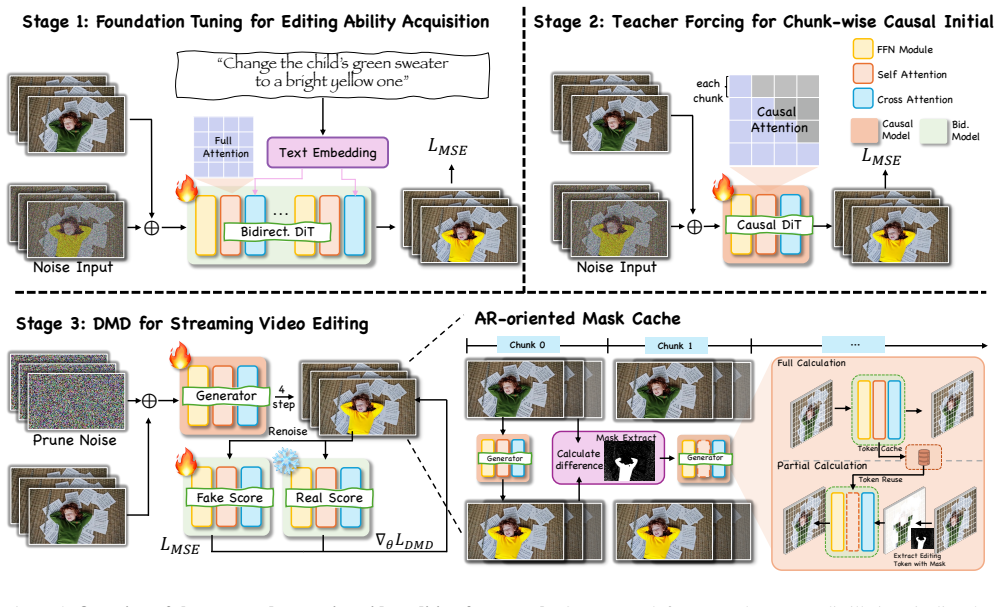
A progressive three-stage distillation (foundation tuning, teacher-forcing chunk-wise causal DiT, then 4-step distribution-matching distillation) transfers high-fidelity editing ability into a unidirectional streaming model; combined with an L2-derived mask cache that reuses self-attention features on unedited tokens, the system reaches state-of-the-art streaming quality at 12.66 FPS with strict background preservation.
What carries the argument
Three-stage distillation pipeline plus AR-oriented Mask Cache: the pipeline converts a bidirectional DiT into a 4-step causal editor; the cache extracts an L2 editing mask from the previous chunk and reuses self-attention features for static tokens, pruning roughly 70 percent of redundant computation.
Load-bearing premise
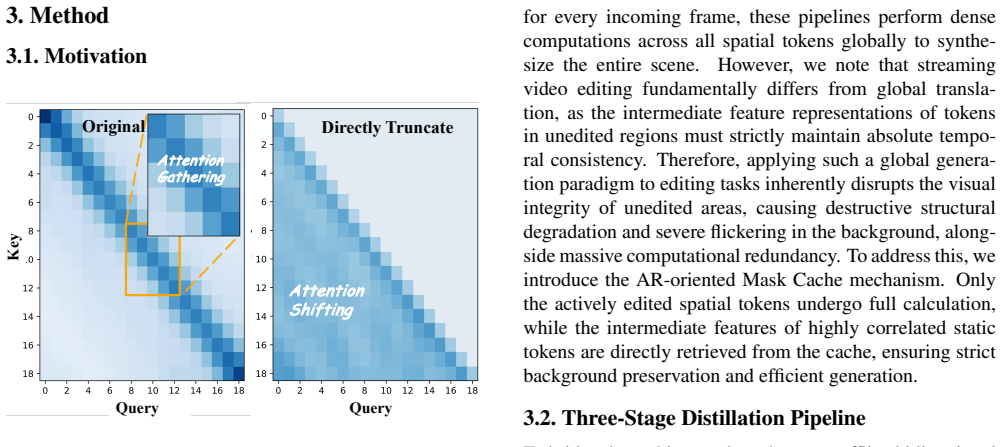
An L2 difference mask taken from the immediately previous chunk remains a reliable router for which tokens can safely reuse cached self-attention features on the current chunk.
What would settle it
Re-run the 120-pair benchmark on clips with large camera or object motion so the previous-chunk mask poorly predicts the current frame; if background consistency or text alignment then falls below the no-cache baseline, the cache claim fails.
If this is right
- Interactive and AR applications can apply text-guided local edits with sub-100 ms latency and no background flicker.
- Existing bidirectional editing models can be converted into causal streaming editors without training a new network from scratch.
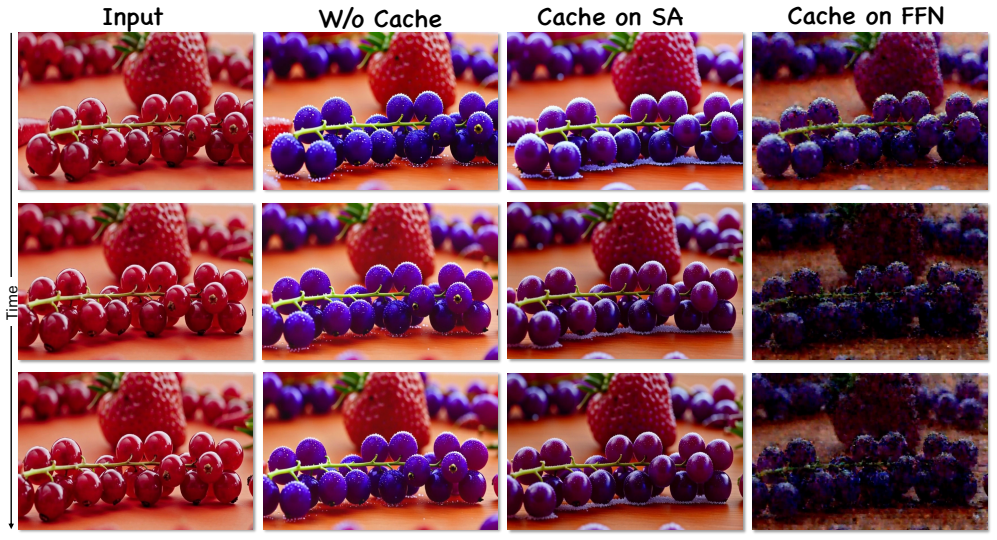
- Self-attention, not FFN layers, is the right place to cache redundant spatial-temporal tokens for streaming editing.
- A dedicated streaming-editing benchmark becomes the reference for joint quality-and-latency evaluation.
Where Pith is reading between the lines
- The same distillation-plus-selective-cache pattern may transfer to other region-conditioned live tasks such as object removal or style transfer.
- Highly dynamic camera motion could drop the cache hit rate and erase most of the reported latency gain.
- Longer untrimmed streams may still accumulate drift that the current short-clip benchmark does not expose.
Editorial analysis
A structured set of objections, weighed in public.
Referee Report
Summary. LiveEdit proposes a causal, chunk-by-chunk diffusion framework for streaming video editing. It transfers editing capability from a bidirectional DiT (Wan2.1-T2V-1.3B backbone) to a 4-step unidirectional Causal DiT via a three-stage pipeline—Foundation Tuning (MSE on full attention), Teacher Forcing with chunk-wise causal attention, and Distribution Matching Distillation (DMD) that bypasses ODE initialization. An AR-oriented Mask Cache then extracts an L2-based binary mask from the preceding 3-frame chunk, prunes ~70% of tokens, and reuses Self-Attention features for unedited regions. On a private 120-pair benchmark the method reports best or near-best TA/BC/MS/DD/AQ/IQ among streaming baselines, a 20-person user study preference, and 12.66 FPS (79 ms/frame) with the cache.
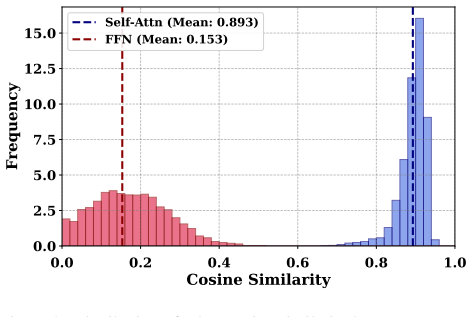
Significance. Real-time streaming video editing with strict background preservation is a genuine deployment bottleneck for AR and live interactive applications; generation-oriented streaming systems do not transfer cleanly. The progressive three-stage distillation (especially Stage-2 teacher forcing that enables direct DMD initialization without ODE) and the selective SA-only mask cache are concrete, well-motivated engineering contributions. Ablations isolating each stage (Table 2) and cache location (SA vs FFN, Table 3 + Fig. 8 cosine similarities) plus a human ranking study strengthen the empirical case. If the quality–speed claims hold under broader motion and the benchmark is released, the work would be a useful practical advance for interactive video editing.
major comments (3)
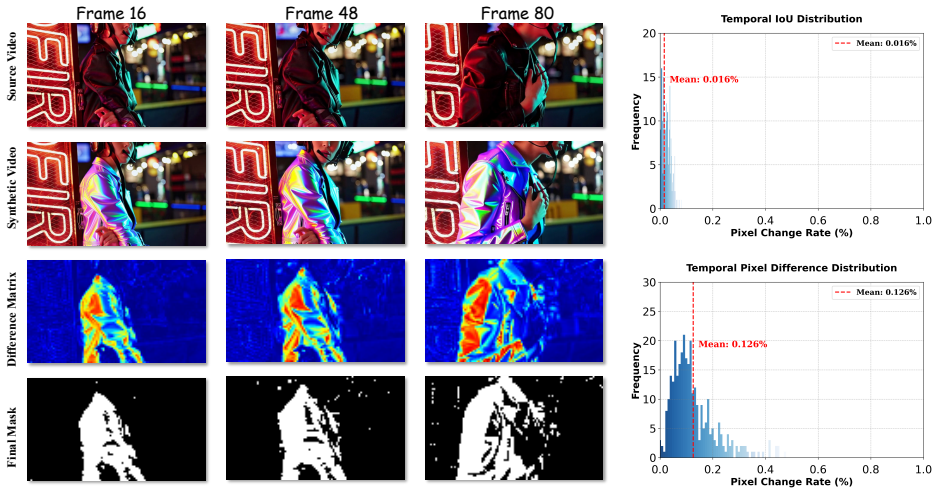
- Sec. 3.3 and Fig. 5: The AR-oriented Mask Cache is load-bearing for both the quality numbers in Table 1 (Ours W/ Cache) and the 12.66 FPS / 79 ms claim. The mask is lagged (computed from chunk k−1) and thresholded to prune ~70% of tokens; Fig. 5 reports mean Temporal IoU 0.016% and Pixel Diff 0.126%, implying near-stationary edited regions. No motion-stratified mask IoU, quality, or latency breakdown is given (camera pan, subject translation, appearing objects). If the lagged mask mis-routes tokens under non-static backgrounds, either background integrity or the latency claim collapses. A stratified evaluation (or explicit failure cases) is required to support the joint SOTA+real-time claim for interactive/AR use.
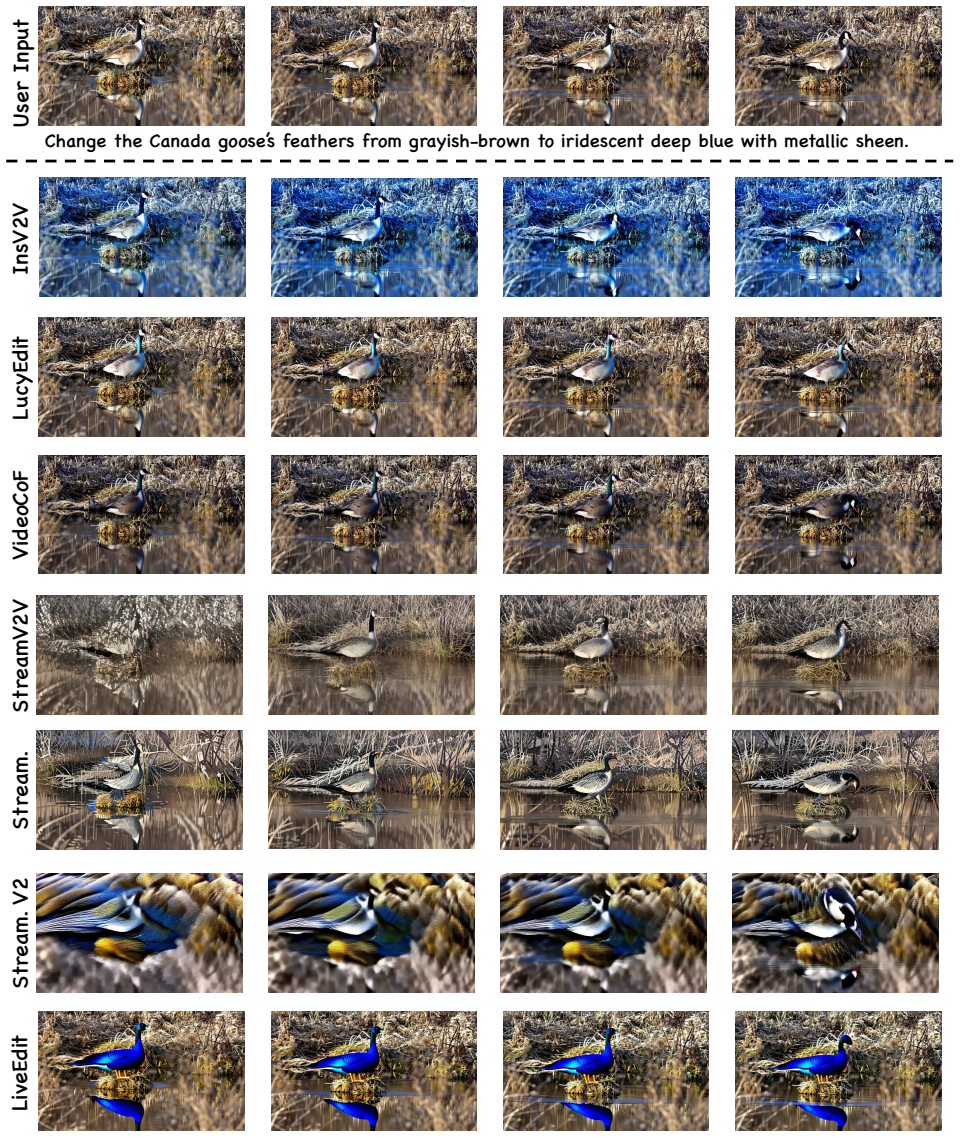
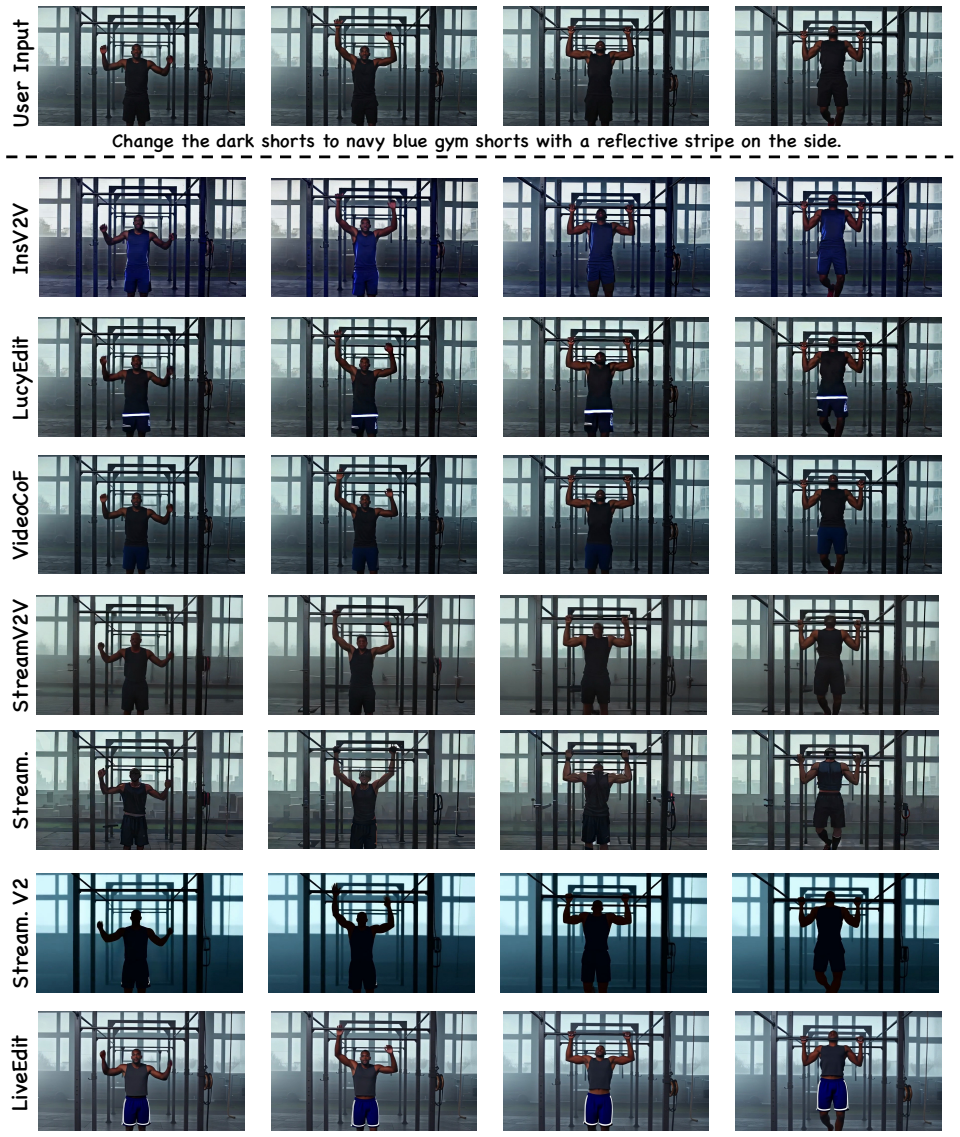
- Sec. 4.2–4.3 and Table 1: SOTA claims rest on a private 120-pair benchmark with no public release, no description of motion/edit-type diversity, and no error bars or multi-seed statistics. Without these, it is impossible to judge whether the reported margins (e.g., TA 0.270 vs InsV2V 0.259) generalize beyond the low-motion regime suggested by Fig. 5. Releasing the split and reporting variance (or at least motion statistics) is necessary for the comparative claims to be verifiable.
- Table 2 / Sec. 4.1: Latency figures (7.89 s for 81 frames without cache; 12.66 FPS with cache) omit resolution, hardware beyond “8 A100s for training,” batching, and whether VAE encode/decode and text encoding are included. Because the real-time suitability claim is central, a precise measurement protocol (resolution, device, end-to-end vs DiT-only) is needed so the 79 ms/frame number can be reproduced and compared fairly to StreamDiffusionV2 et al.
minor comments (5)
- Fig. 1 caption and gallery text contain concatenated words (“Changetheskytoagradient…”, “12.05× 97 .38×”); clean for camera-ready.
- Sec. 3.2 Stage 3: the DMD gradient formula is written with mixed notation (ϵreal_ϕ vs ϵf ake_ψ); align subscripts and define w(t) explicitly or cite the exact DMD reference used.
- Table 2 “Latency 7.89” is labeled in seconds for 81 frames while Fig. 1 reports FPS; state both consistently and note whether CFG is disabled only at Stage 3.
- Related Work: EgoEdit and Self-Forcing are discussed in the supplement; a short main-text paragraph clarifying the ODE-bypass and editing-vs-generation distinction would help readers who skip the supplement.
- Fig. 7 / Table 3: “Cache on FFN” collapse is clear; add a one-sentence note on whether Cross-Attention was ever cached (the text says only SA is cached).
Circularity Check
No circularity: empirical distillation-and-cache pipeline evaluated on held-out pairs against external baselines; no prediction reduces to a fitted input by construction.
full rationale
LiveEdit is an engineering paper that defines a three-stage training procedure (bidirectional foundation MSE, teacher-forced causal DiT, then 4-step DMD) plus an AR-oriented Mask Cache that reuses Self-Attention features for tokens whose L2 difference on the preceding chunk falls below a dynamic threshold. All quantitative claims (Table 1 TA/BC/MS/etc., FPS/latency numbers, ablations in Tables 2-3, user study) are obtained by running the trained model on a 120-pair benchmark and comparing to independently published baselines (InsV2V, LucyEdit, StreamDiffusionV2, etc.). No equation equates a claimed prediction to a parameter that was fitted on the same quantity; the mask is an inference-time routing heuristic whose quality impact is measured, not assumed by definition. Self-citations appear only as ordinary related-work baselines or architectural starting points (Wan2.1, DMD formulations) and are not load-bearing uniqueness theorems. The derivation chain is therefore self-contained and non-circular.
Axiom & Free-Parameter Ledger
free parameters (4)
- mask prune ratio / τ =
~70 % prune
- chunk size =
3
- DMD sampling timesteps =
[0,250,500,750]
- learning rates and step counts =
1e-5; 9k/20k/10k
axioms (3)
- domain assumption Channel-wise concatenation of noisy and condition latents preserves editing capacity while avoiding quadratic sequence growth.
- ad hoc to paper Self-Attention features of unedited regions exhibit high temporal cosine similarity (mean 0.893) and can be safely reused.
- domain assumption Teacher-forcing with chunk-wise causal masks transfers bidirectional editing priors without future frames.
invented entities (2)
-
AR-oriented Mask Cache
independent evidence
-
Three-stage distillation pipeline (Foundation → Teacher-Forcing → DMD)
independent evidence
Cite this review
Pith. "Pith review of LiveEdit: Towards Real-Time Diffusion-Based Streaming Video Editing." pith.science (2026). https://pith.science/paper/Q3SFXGZQ
@misc{pith2026260626740,
  author       = {Pith},
  title        = {Pith review of: LiveEdit: Towards Real-Time Diffusion-Based Streaming Video Editing},
  year         = {2026},
  howpublished = {\url{https://pith.science/paper/Q3SFXGZQ}},
  note         = {Machine review of arXiv:2606.26740}
}
read the original abstract
Streaming video editing has made rapid progress, yet practical deployment is still limited by two core issues: maintaining stable backgrounds and non-edited regions over time, and achieving the low latency required for real-time interactive scenarios. Meanwhile, recent streaming video generation methods are mostly developed for synthesis and cannot be directly applied to editing due to the strict preservation requirement and region-specific control. In this work, we present a novel streaming video editing framework that performs causal, frame-by-frame editing with strong content preservation and real-time responsiveness. Our key design is a three-stage distillation pipeline that progressively transfers editing capability from a powerful bidirectional foundation model to an efficient unidirectional streaming editor, enabling stable long-horizon edits without sacrificing visual fidelity. To further support real-time deployment, we introduce an AR-oriented mask cache that reuses region-related computation across frames, substantially reducing redundant processing and accelerating inference. Finally, we establish a dedicated benchmark for streaming video editing. Extensive evaluations demonstrate that our method achieves state-of-the-art visual quality among streaming baselines while drastically boosting inference speed to 12.66 FPS, making it suitable for interactive and augmented reality applications.
Figures


Forward citations
Cited by 2 Pith papers
-
JoyAI-Video-Edit: Real-Time Open-Ended Video Editing with Autoregressive Diffusion
A 16B causal autoregressive diffusion system reports real-time 720p video editing at about 30 FPS on one B200 GPU, beating streaming editors and matching several offline systems in benchmark scores.
-
LiveLight: Real-time Streaming Video Relighting with Interactive Control
A diffusion-based system performs real-time, interactive video relighting by injecting multi-plane light irradiance conditions and streaming latent chunks.
Reference graph
Works this paper leans on
-
[1]
Qingyan Bai, Qiuyu Wang, Hao Ouyang, Yue Yu, Hanlin Wang, Wen Wang, Ka Leong Cheng, Shuailei Ma, Yanhong Zeng, Zichen Liu, Yinghao Xu, Yujun Shen, and Qifeng Chen. Scaling instruction-based video editing with a high- quality synthetic dataset.arXiv preprint arXiv:2510.15742,
-
[2]
Training diffusion models with reinforce- ment learning.arXiv preprint arXiv:2305.13301, 2023
Kevin Black, Michael Janner, Yilun Du, Ilya Kostrikov, and Sergey Levine. Training diffusion models with reinforce- ment learning.arXiv preprint arXiv:2305.13301, 2023. 3
Pith/arXiv arXiv 2023
-
[3]
Andreas Blattmann, Tim Dockhorn, Sumith Kulal, Daniel Mendelevitch, Maciej Kilian, Dominik Lorenz, Yam Levi, Zion English, Vikram V oleti, Adam Letts, et al. Stable video diffusion: Scaling latent video diffusion models to large datasets.arXiv preprint arXiv:2311.15127, 2023. 3
Pith/arXiv arXiv 2023
-
[4]
To- ken merging: Your vit but faster.arXiv preprint arXiv:2210.09461, 2022
Daniel Bolya, Cheng-Yang Fu, Xiaoliang Dai, Peizhao Zhang, Christoph Feichtenhofer, and Judy Hoffman. To- ken merging: Your vit but faster.arXiv preprint arXiv:2210.09461, 2022. 3
Pith/arXiv arXiv 2022
-
[5]
Diffusion forcing: Next-token prediction meets full-sequence diffu- sion.Advances in Neural Information Processing Systems, 37:24081–24125, 2024
Boyuan Chen, Diego Mart ´ı Mons´o, Yilun Du, Max Sim- chowitz, Russ Tedrake, and Vincent Sitzmann. Diffusion forcing: Next-token prediction meets full-sequence diffu- sion.Advances in Neural Information Processing Systems, 37:24081–24125, 2024. 3
2024
-
[6]
Skyreels-v2: Infinite-length film generative model.arXiv preprint arXiv:2504.13074, 2025
Guibin Chen, Dixuan Lin, Jiangping Yang, Chunze Lin, Junchen Zhu, Mingyuan Fan, Hao Zhang, Sheng Chen, Zheng Chen, Chengcheng Ma, et al. Skyreels-v2: Infinite-length film generative model.arXiv preprint arXiv:2504.13074, 2025. 3
Pith/arXiv arXiv 2025
-
[7]
Yiyang Chen, Xuanhua He, Xiujun Ma, and Yue Ma. Con- textflow: Training-free video object editing via adaptive con- text enrichment.arXiv preprint arXiv:2509.17818, 2025. 2
arXiv 2025
-
[8]
Dove: Efficient one- step diffusion model for real-world video super-resolution,
Zheng Chen, Zichen Zou, Kewei Zhang, Xiongfei Su, Xin Yuan, Yong Guo, and Yulun Zhang. Dove: Efficient one- step diffusion model for real-world video super-resolution,
-
[9]
Consistent video- to-video transfer using synthetic dataset.arXiv preprint arXiv:2311.00213, 2023
Jiaxin Cheng, Tianjun Xiao, and Tong He. Consistent video- to-video transfer using synthetic dataset.arXiv preprint arXiv:2311.00213, 2023. 3, 7
Pith/arXiv arXiv 2023
-
[10]
Flashattention: Fast and memory-efficient exact attention with io-awareness.Advances in neural information processing systems, 35:16344–16359, 2022
Tri Dao, Dan Fu, Stefano Ermon, Atri Rudra, and Christo- pher R ´e. Flashattention: Fast and memory-efficient exact attention with io-awareness.Advances in neural information processing systems, 35:16344–16359, 2022. 3
2022
-
[11]
Compact 3d gaussian splatting for dense visual slam.arXiv preprint arXiv:2403.11247, 2024
Tianchen Deng, Yaohui Chen, Leyan Zhang, Jianfei Yang, Shenghai Yuan, Jiuming Liu, Danwei Wang, Hesheng Wang, and Weidong Chen. Compact 3d gaussian splatting for dense visual slam.arXiv preprint arXiv:2403.11247, 2024. S1
Pith/arXiv arXiv 2024
-
[12]
Gaussiandwm: 3d gaussian driving world model for unified scene understanding and multi-modal generation
Tianchen Deng, Xuefeng Chen, Yi Chen, Qu Chen, Yuyao Xu, Lijin Yang, Le Xu, Yu Zhang, Bo Zhang, Wuxiong Huang, and Hesheng Wang. Gaussiandwm: 3d gaussian driving world model for unified scene understanding and multi-modal generation. InProceedings of the IEEE/CVF Conference on Computer Vision and Pattern Recognition (CVPR), pages 10656–10667, 2026. S1
2026
-
[13]
Tsd-sr: One-step diffusion with target score distillation for real-world image super-resolution
Linwei Dong, Qingnan Fan, Yihong Guo, Zhonghao Wang, Qi Zhang, Jinwei Chen, Yawei Luo, and Changqing Zou. Tsd-sr: One-step diffusion with target score distillation for real-world image super-resolution. InProceedings of the IEEE/CVF Conference on Computer Vision and Pattern Recognition (CVPR), pages 23174–23184, 2025. 3
2025
-
[14]
Dit4edit: Dif- fusion transformer for image editing
Kunyu Feng, Yue Ma, Bingyuan Wang, Chenyang Qi, Haozhe Chen, Qifeng Chen, and Zeyu Wang. Dit4edit: Dif- fusion transformer for image editing. InProceedings of the AAAI Conference on Artificial Intelligence, pages 2969– 2977, 2025. 2
2025
-
[15]
Tianrui Feng, Zhi Li, Shuo Yang, Haocheng Xi, Muyang Li, Xiuyu Li, Lvmin Zhang, Keting Yang, Kelly Peng, Song Han, et al. Streamdiffusionv2: A streaming system for dynamic and interactive video generation.arXiv preprint arXiv:2511.07399, 2025. 3, 4, 7
arXiv 2025
-
[16]
Pai-studio: Cinematic video background replacement with camera-aware motion
Heyuan Gao, Bangxun Tang, Yiren Song, Guian Fang, Zijian He, Jie Yang, and Mike Zheng Shou. Pai-studio: Cinematic video background replacement with camera-aware motion. arXiv preprint arXiv:2606.01399, 2026. S1
Pith/arXiv arXiv 2026
-
[17]
Streamingt2v: Con- sistent, dynamic, and extendable long video generation from text
Roberto Henschel, Levon Khachatryan, Hayk Poghosyan, Daniil Hayrapetyan, Vahram Tadevosyan, Zhangyang Wang, Shant Navasardyan, and Humphrey Shi. Streamingt2v: Con- sistent, dynamic, and extendable long video generation from text. InProceedings of the Computer Vision and Pattern Recognition Conference, pages 2568–2577, 2025. 3
2025
-
[18]
Xun Huang, Zhengqi Li, Guande He, Mingyuan Zhou, and Eli Shechtman. Self forcing: Bridging the train- test gap in autoregressive video diffusion.arXiv preprint arXiv:2506.08009, 2025. 3, S1
Pith/arXiv arXiv 2025
-
[19]
Vbench: Comprehensive bench- mark suite for video generative models
Ziqi Huang, Yinan He, Jiashuo Yu, Fan Zhang, Chenyang Si, Yuming Jiang, Yuanhan Zhang, Tianxing Wu, Qingyang Jin, Nattapol Chanpaisit, et al. Vbench: Comprehensive bench- mark suite for video generative models. InProceedings of the IEEE/CVF Conference on Computer Vision and Pattern Recognition, pages 21807–21818, 2024. 8
2024
-
[20]
Vace: All-in-one video creation and editing
Zeyinzi Jiang, Zhen Han, Chaojie Mao, Jingfeng Zhang, Yulin Pan, and Yu Liu. Vace: All-in-one video creation and editing. InProceedings of the IEEE/CVF International Con- ference on Computer Vision, pages 17191–17202, 2025. 2, 3
2025
-
[21]
Xuan Ju, Tianyu Wang, Yuqian Zhou, He Zhang, Qing Liu, Nanxuan Zhao, Zhifei Zhang, Yijun Li, Yuanhao Cai, Shaoteng Liu, et al. Editverse: Unifying image and video editing and generation with in-context learning.arXiv preprint arXiv:2509.20360, 2025. 3
Pith/arXiv arXiv 2025
-
[22]
Streamdiffusion: A pipeline-level solution for real-time in- teractive generation
Akio Kodaira, Chenfeng Xu, Toshiki Hazama, Takanori Yoshimoto, Kohei Ohno, Shogo Mitsuhori, Soichi Sugano, Hanying Cho, Zhijian Liu, Masayoshi Tomizuka, et al. Streamdiffusion: A pipeline-level solution for real-time in- teractive generation. InProceedings of the IEEE/CVF In- ternational Conference on Computer Vision, pages 12371– 12380, 2025. 3, 4, 7
2025
-
[23]
Runjia Li, Moayed Haji-Ali, Ashkan Mirzaei, Chaoyang Wang, Arpit Sahni, Ivan Skorokhodov, Aliaksandr Siarohin, Tomas Jakab, Junlin Han, Sergey Tulyakov, et al. Egoedit: Dataset, real-time streaming model, and benchmark for ego- centric video editing.arXiv preprint arXiv:2512.06065,
-
[24]
Vmem: Consistent interactive video scene generation with surfel-indexed view memory
Runjia Li, Philip Torr, Andrea Vedaldi, and Tomas Jakab. Vmem: Consistent interactive video scene generation with surfel-indexed view memory. InProceedings of the IEEE/CVF International Conference on Computer Vision, pages 25690–25699, 2025. 3
2025
-
[25]
Wuyang Li, Wentao Pan, Po-Chien Luan, Yang Gao, and Alexandre Alahi. Stable video infinity: Infinite-length video generation with error recycling.arXiv preprint arXiv:2510.09212, 2025. 3
arXiv 2025
-
[26]
Zhiyuan Li, Chi-Man Pun, Chen Fang, Jue Wang, and Xi- aodong Cun. Personalive! expressive portrait image anima- tion for live streaming.arXiv preprint arXiv:2512.11253,
-
[27]
Feng Liang, Akio Kodaira, Chenfeng Xu, Masayoshi Tomizuka, Kurt Keutzer, and Diana Marculescu. Looking backward: Streaming video-to-video translation with feature banks.arXiv preprint arXiv:2405.15757, 2024. 4, 7
Pith/arXiv arXiv 2024
-
[28]
Cot-edit: Let cot guide instruction video edit- ing
Sen Liang, Fengbin Guan, Youliang Zhang, Xin Li, and Zhibo Chen. Cot-edit: Let cot guide instruction video edit- ing. InProceedings of the IEEE/CVF Conference on Com- puter Vision and Pattern Recognition, pages 37960–37970,
-
[29]
Sen Liang, Cong Wang, Fengbin Guan, Zhentao Yu, Yiting Lu, Yuanzhi Wang, Yuan Zhou, Xin Li, and Zhibo Chen. Spongebob: Sync-aware harmonious audio-visual generative editing.arXiv preprint arXiv:2605.25193, 2026. S1
Pith/arXiv arXiv 2026
-
[30]
Sdxl- lightning: Progressive adversarial diffusion distillation
Shanchuan Lin, Anran Wang, and Xiao Yang. Sdxl- lightning: Progressive adversarial diffusion distillation. arXiv preprint arXiv:2402.13929, 2024. 3
Pith/arXiv arXiv 2024
-
[31]
Diffusion adversarial post-training for one-step video generation.arXiv preprint arXiv:2501.08316,
Shanchuan Lin, Xin Xia, Yuxi Ren, Ceyuan Yang, Xuefeng Xiao, and Lu Jiang. Diffusion adversarial post-training for one-step video generation.arXiv preprint arXiv:2501.08316,
-
[32]
Jiacheng Liu, Xinyu Wang, Yuqi Lin, Zhikai Wang, Peiru Wang, Peiliang Cai, Qinming Zhou, Zhengan Yan, Zexuan Yan, Zhengyi Shi, et al. A survey on cache methods in diffu- sion models: Toward efficient multi-modal generation.arXiv preprint arXiv:2510.19755, 2025. 3
arXiv 2025
-
[33]
Kunhao Liu, Wenbo Hu, Jiale Xu, Ying Shan, and Shijian Lu. Rolling forcing: Autoregressive long video diffusion in real time.arXiv preprint arXiv:2509.25161, 2025. 3
Pith/arXiv arXiv 2025
-
[34]
Instaflow: One step is enough for high-quality diffusion- based text-to-image generation
Xingchao Liu, Xiwen Zhang, Jianzhu Ma, Jian Peng, et al. Instaflow: One step is enough for high-quality diffusion- based text-to-image generation. InThe Twelfth International Conference on Learning Representations, 2023. 3
2023
-
[35]
Deepcache: Accelerating diffusion models for free
Xinyin Ma, Gongfan Fang, and Xinchao Wang. Deepcache: Accelerating diffusion models for free. InProceedings of the IEEE/CVF conference on computer vision and pattern recognition, pages 15762–15772, 2024. 3
2024
-
[36]
Follow your pose: Pose- guided text-to-video generation using pose-free videos
Yue Ma, Yingqing He, Xiaodong Cun, Xintao Wang, Siran Chen, Xiu Li, and Qifeng Chen. Follow your pose: Pose- guided text-to-video generation using pose-free videos. In Proceedings of the AAAI Conference on Artificial Intelli- gence, pages 4117–4125, 2024. 3
2024
-
[37]
Follow-your-emoji: Fine-controllable and expressive freestyle portrait animation
Yue Ma, Hongyu Liu, Hongfa Wang, Heng Pan, Yingqing He, Junkun Yuan, Ailing Zeng, Chengfei Cai, Heung-Yeung Shum, Wei Liu, et al. Follow-your-emoji: Fine-controllable and expressive freestyle portrait animation. InSIGGRAPH Asia 2024 Conference Papers, pages 1–12, 2024. S1
2024
-
[38]
Magic- stick: Controllable video editing via control handle transfor- mations
Yue Ma, Xiaodong Cun, Sen Liang, Jinbo Xing, Yingqing He, Chenyang Qi, Siran Chen, and Qifeng Chen. Magic- stick: Controllable video editing via control handle transfor- mations. In2025 IEEE/CVF Winter Conference on Applica- tions of Computer Vision (WACV), pages 9385–9395. IEEE,
-
[39]
Controllable video generation: A survey.arXiv preprint arXiv:2507.16869,
Yue Ma, Kunyu Feng, Zhongyuan Hu, Xinyu Wang, Yucheng Wang, Mingzhe Zheng, Xuanhua He, Chenyang Zhu, Hongyu Liu, Yingqing He, et al. Controllable video generation: A survey.arXiv preprint arXiv:2507.16869,
-
[40]
Yue Ma, Kunyu Feng, Xinhua Zhang, Hongyu Liu, David Junhao Zhang, Jinbo Xing, Yinhan Zhang, Ayden Yang, Zeyu Wang, and Qifeng Chen. Follow-your-creation: Empowering 4d creation through video inpainting.arXiv preprint arXiv:2506.04590, 2025. 3
Pith/arXiv arXiv 2025
-
[41]
Yue Ma, Yulong Liu, Qiyuan Zhu, Ayden Yang, Kunyu Feng, Xinhua Zhang, Zhifeng Li, Sirui Han, Chenyang Qi, and Qifeng Chen. Follow-your-motion: Video motion transfer via efficient spatial-temporal decoupled finetuning.arXiv preprint arXiv:2506.05207, 2025. 3
arXiv 2025
-
[42]
Yue Ma, Zexuan Yan, Hongyu Liu, Hongfa Wang, Heng Pan, Yingqing He, Junkun Yuan, Ailing Zeng, Chengfei Cai, Heung-Yeung Shum, et al. Follow-your-emoji-faster: To- wards efficient, fine-controllable, and expressive freestyle portrait animation.arXiv preprint arXiv:2509.16630, 2025. S1
arXiv 2025
-
[43]
Group editing: Edit multiple im- ages in one go.arXiv preprint arXiv:2603.22883, 2026
Yue Ma, Xinyu Wang, Qianli Ma, Qinghe Wang, Mingzhe Zheng, Xiangpeng Yang, Hao Li, Chongbo Zhao, Jixuan Ying, Harry Yang, et al. Group editing: Edit multiple im- ages in one go.arXiv preprint arXiv:2603.22883, 2026. 3
arXiv 2026
-
[44]
Fastvmt: Eliminat- ing redundancy in video motion transfer.arXiv preprint arXiv:2602.05551, 2026
Yue Ma, Zhikai Wang, Tianhao Ren, Mingzhe Zheng, Hongyu Liu, Jiayi Guo, Mark Fong, Yuxuan Xue, Zixi- ang Zhao, Konrad Schindler, et al. Fastvmt: Eliminat- ing redundancy in video motion transfer.arXiv preprint arXiv:2602.05551, 2026. 3
arXiv 2026
-
[45]
Null-text inversion for editing real im- ages using guided diffusion models
Ron Mokady, Amir Hertz, Kfir Aberman, Yael Pritch, and Daniel Cohen-Or. Null-text inversion for editing real im- ages using guided diffusion models. InProceedings of the IEEE/CVF conference on computer vision and pattern recognition, pages 6038–6047, 2023. 3
2023
-
[46]
Fatezero: Fus- ing attentions for zero-shot text-based video editing
Chenyang Qi, Xiaodong Cun, Yong Zhang, Chenyang Lei, Xintao Wang, Ying Shan, and Qifeng Chen. Fatezero: Fus- ing attentions for zero-shot text-based video editing. In Proceedings of the IEEE/CVF International Conference on Computer Vision, pages 15932–15942, 2023. 2
2023
-
[47]
Learning transferable visual models from natural language supervi- sion
Alec Radford, Jong Wook Kim, Chris Hallacy, Aditya Ramesh, Gabriel Goh, Sandhini Agarwal, Girish Sastry, Amanda Askell, Pamela Mishkin, Jack Clark, et al. Learning transferable visual models from natural language supervi- sion. InInternational conference on machine learning, pages 8748–8763. PmLR, 2021. 8
2021
-
[48]
Progressive distillation for fast sampling of diffusion models.arXiv preprint arXiv:2202.00512, 2022
Tim Salimans and Jonathan Ho. Progressive distillation for fast sampling of diffusion models.arXiv preprint arXiv:2202.00512, 2022. 3
Pith/arXiv arXiv 2022
-
[49]
Laion-aesthetics, 2022
Christoph Schuhmann. Laion-aesthetics, 2022. 8
2022
-
[50]
Make-a-video: Text-to-video generation without text-video data.arXiv preprint arXiv:2209.14792,
Uriel Singer, Adam Polyak, Thomas Hayes, Xi Yin, Jie An, Songyang Zhang, Qiyuan Hu, Harry Yang, Oron Ashual, Oran Gafni, et al. Make-a-video: Text-to-video generation without text-video data.arXiv preprint arXiv:2209.14792,
-
[51]
Consistency models, 2023
Yang Song, Prafulla Dhariwal, Mark Chen, and Ilya Sutskever. Consistency models, 2023. 3
2023
-
[52]
Pro- cesspainter: Learning to draw from sequence data
Yiren Song, Shijie Huang, Chen Yao, Hai Ci, Xiaojun Ye, Jiaming Liu, Yuxuan Zhang, and Mike Zheng Shou. Pro- cesspainter: Learning to draw from sequence data. InSIG- GRAPH Asia 2024 Conference Papers, pages 1–10, 2024. S1
2024
-
[53]
Yiren Song, Cheng Liu, Yuxin Jiang, and Mike Zheng Shou. Streamingeffect: Real-time human-centric video effect gen- eration.arXiv preprint arXiv:2605.17019, 2026
Pith/arXiv arXiv 2026
-
[54]
Yiren Song, Wangzi Yao, Haofan Wang, and Mike Zheng Shou. Vista: Triplet-supervised video style transfer with dif- fusion transformers.arXiv preprint arXiv:2605.17312, 2026. S1
Pith/arXiv arXiv 2026
-
[55]
Lucy edit: Open-weight text-guided video editing, 2025
DecartAI Team. Lucy edit: Open-weight text-guided video editing, 2025. 2, 3, 7
2025
-
[56]
Magi-1: Autoregressive video genera- tion at scale.arXiv preprint arXiv:2505.13211, 2025
Hansi Teng, Hongyu Jia, Lei Sun, Lingzhi Li, Maolin Li, Mingqiu Tang, Shuai Han, Tianning Zhang, WQ Zhang, Weifeng Luo, et al. Magi-1: Autoregressive video genera- tion at scale.arXiv preprint arXiv:2505.13211, 2025. 3
Pith/arXiv arXiv 2025
-
[57]
Wan: Open and advanced large-scale video generative models, 2025
Team Wan, Ang Wang, Baole Ai, Bin Wen, Chaojie Mao, Chen-Wei Xie, Di Chen, Feiwu Yu, Haiming Zhao, Jianx- iao Yang, Jianyuan Zeng, Jiayu Wang, Jingfeng Zhang, Jin- gren Zhou, Jinkai Wang, Jixuan Chen, Kai Zhu, Kang Zhao, Keyu Yan, Lianghua Huang, Mengyang Feng, Ningyi Zhang, Pandeng Li, Pingyu Wu, Ruihang Chu, Ruili Feng, Shiwei Zhang, Siyang Sun, Tao Fan...
2025
-
[58]
Cove: Unleashing the diffusion fea- ture correspondence for consistent video editing.Advances in Neural Information Processing Systems, 37:96541–96565,
Jiangshan Wang, Yue Ma, Jiayi Guo, Yicheng Xiao, Gao Huang, and Xiu Li. Cove: Unleashing the diffusion fea- ture correspondence for consistent video editing.Advances in Neural Information Processing Systems, 37:96541–96565,
-
[59]
Tam- ing rectified flow for inversion and editing.arXiv preprint arXiv:2411.04746, 2024
Jiangshan Wang, Junfu Pu, Zhongang Qi, Jiayi Guo, Yue Ma, Nisha Huang, Yuxin Chen, Xiu Li, and Ying Shan. Tam- ing rectified flow for inversion and editing.arXiv preprint arXiv:2411.04746, 2024. 2
Pith/arXiv arXiv 2024
-
[60]
Jianyi Wang, Shanchuan Lin, Zhijie Lin, Yuxi Ren, Meng Wei, Zongsheng Yue, Shangchen Zhou, Hao Chen, Yang Zhao, Ceyuan Yang, et al. Seedvr2: One-step video restora- tion via diffusion adversarial post-training.arXiv preprint arXiv:2506.05301, 2025. 3
arXiv 2025
-
[61]
Videolcm: Video latent consistency model.arXiv preprint arXiv:2312.09109,
Xiang Wang, Shiwei Zhang, Han Zhang, Yu Liu, Yingya Zhang, Changxin Gao, and Nong Sang. Videolcm: Video latent consistency model.arXiv preprint arXiv:2312.09109,
-
[62]
Tune-a-video: One-shot tuning of image diffusion models for text-to-video generation
Jay Zhangjie Wu, Yixiao Ge, Xintao Wang, Stan Weixian Lei, Yuchao Gu, Yufei Shi, Wynne Hsu, Ying Shan, Xiaohu Qie, and Mike Zheng Shou. Tune-a-video: One-shot tuning of image diffusion models for text-to-video generation. In Proceedings of the IEEE/CVF international conference on computer vision, pages 7623–7633, 2023. 2
2023
-
[63]
Yunfeng Wu, Jiayi Song, Zhenxiong Tan, Zihao He, and Songhua Liu. Freeswim: Revisiting sliding-window atten- tion mechanisms for training-free ultra-high-resolution video generation.arXiv preprint arXiv:2511.14712, 2025. S1
arXiv 2025
-
[64]
Yunfeng Wu, Hongying Cheng, Zihao He, and Songhua Liu. Vibe: Ultra-high-resolution video synthesis born from pure images.arXiv preprint arXiv:2603.23326, 2026
arXiv 2026
-
[65]
Smrabooth: Subject and motion representation alignment for customized video generation
Xuancheng Xu, Yaning Li, Sisi You, and Bing-Kun Bao. Smrabooth: Subject and motion representation alignment for customized video generation. InProceedings of the IEEE/CVF Conference on Computer Vision and Pattern Recognition, pages 16130–16141, 2026. S1
2026
-
[66]
Sparse videogen2: Accelerate video generation with sparse attention via semantic-aware permutation, 2025
Shuo Yang, Haocheng Xi, Yilong Zhao, Muyang Li, Jintao Zhang, Han Cai, Yujun Lin, Xiuyu Li, Chenfeng Xu, Kelly Peng, Jianfei Chen, Song Han, Kurt Keutzer, and Ion Stoica. Sparse videogen2: Accelerate video generation with sparse attention via semantic-aware permutation, 2025. 3
2025
-
[67]
Unified video editing with temporal reasoner
Xiangpeng Yang, Ji Xie, Yiyuan Yang, Yan Huang, Min Xu, and Qiang Wu. Unified video editing with temporal reasoner. arXiv preprint arXiv:2512.07469, 2025. 2, 7
Pith/arXiv arXiv 2025
-
[68]
Zhuoyi Yang, Jiayan Teng, Wendi Zheng, Ming Ding, Shiyu Huang, Jiazheng Xu, Yuanming Yang, Wenyi Hong, Xiao- han Zhang, Guanyu Feng, et al. Cogvideox: Text-to-video diffusion models with an expert transformer.arXiv preprint arXiv:2408.06072, 2024. 3
Pith/arXiv arXiv 2024
-
[69]
Unic: Unified in-context video editing.arXiv preprint arXiv:2506.04216, 2025
Zixuan Ye, Xuanhua He, Quande Liu, Qiulin Wang, Xintao Wang, Pengfei Wan, Di Zhang, Kun Gai, Qifeng Chen, and Wenhan Luo. Unic: Unified in-context video editing.arXiv preprint arXiv:2506.04216, 2025. 3
Pith/arXiv arXiv 2025
-
[70]
Im- proved distribution matching distillation for fast image syn- thesis.Advances in neural information processing systems, 37:47455–47487, 2024
Tianwei Yin, Micha ¨el Gharbi, Taesung Park, Richard Zhang, Eli Shechtman, Fredo Durand, and Bill Freeman. Im- proved distribution matching distillation for fast image syn- thesis.Advances in neural information processing systems, 37:47455–47487, 2024. 3
2024
-
[71]
From slow bidirectional to fast autoregressive video diffusion mod- els
Tianwei Yin, Qiang Zhang, Richard Zhang, William T Free- man, Fredo Durand, Eli Shechtman, and Xun Huang. From slow bidirectional to fast autoregressive video diffusion mod- els. InProceedings of the IEEE/CVF Conference on Com- puter Vision and Pattern Recognition, pages 22963–22974,
-
[72]
Controllable text-to-image generation with gpt- 4.arXiv preprint arXiv:2305.18583, 2023
Tianjun Zhang, Yi Zhang, Vibhav Vineet, Neel Joshi, and Xin Wang. Controllable text-to-image generation with gpt- 4.arXiv preprint arXiv:2305.18583, 2023. 2
Pith/arXiv arXiv 2023
-
[73]
Forecast then calibrate: Feature caching as ode for efficient diffusion transformers
Shikang Zheng, Liang Feng, Xinyu Wang, Qinming Zhou, Peiliang Cai, Chang Zou, Jiacheng Liu, Yuqi Lin, Junjie Chen, Yue Ma, et al. Forecast then calibrate: Feature caching as ode for efficient diffusion transformers. InProceedings of the AAAI Conference on Artificial Intelligence, pages 13449– 13457, 2026. 3
2026
-
[74]
Compute only 16 tokens in one timestep: Accelerating diffusion transformers with cluster-driven fea- ture caching
Zhixin Zheng, Xinyu Wang, Chang Zou, Shaobo Wang, and Linfeng Zhang. Compute only 16 tokens in one timestep: Accelerating diffusion transformers with cluster-driven fea- ture caching. InProceedings of the 33rd ACM International Conference on Multimedia, pages 10181–10189, 2025. 3
2025
-
[75]
Hongzhou Zhu, Min Zhao, Guande He, Hang Su, Chongx- uan Li, and Jun Zhu. Causal forcing: Autoregressive diffu- sion distillation done right for high-quality real-time inter- active video generation.arXiv preprint arXiv:2602.02214,
-
[76]
Junhao Zhuang, Shi Guo, Xin Cai, Xiaohui Li, Yihao Liu, Chun Yuan, and Tianfan Xue. Flashvsr: Towards real- time diffusion-based streaming video super-resolution.arXiv preprint arXiv:2510.12747, 2025. 3 LiveEditUserinput Change the blue sky to a gradient of deep indigo and magenta with faint constellations. LiveEditUserinput Change the brown horse to a da...
arXiv 2025
discussion (0)
Sign in with ORCID, Apple, or X to comment. Anyone can read and Pith papers without signing in.