REVIEW 4 major objections 5 minor 26 references
Standalone DINOv3 for Training-Free Open-Vocabulary Semantic Segmentation in Remote Sensing
T0 review · 4 major / 5 minor · reviewed 2026-08-08 · deepseek-v4-flash
Pith's one-line read This paper establishes that a fully frozen DINOv3 backbone, cleaned by text-aware Laplacian diffusion and lifted to pixels by test-time Gaussian splatting, can match or beat the best training-free remote sensing segmenters without any…
desk verdict First training-free DINOv3 open-vocabulary segmentation for remote sensing with competitive numbers, but the core TLP equation does the opposite of what the prose claims and the experimental reporting is too thin to verify. read the letter →
The pith
A machine-rendered reading of the paper's core claim, the machinery that carries it, and where it could break.
The reading
What carries the argument
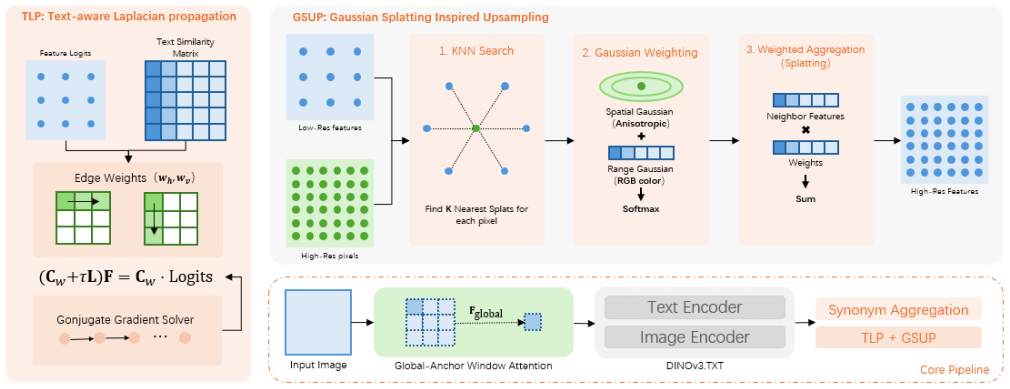
The load-bearing mechanism is the pairing of TLP and GSUP. TLP is a closed-form label-propagation step, mathematically a graph-Laplacian solve $\lambda(u)X(u)+\tau LX(u)=\lambda(u)X^{in}(u)$ on a four-neighborhood graph whose symmetric edge weights blend an RGB-gradient term with a text-semantic affinity term, so diffusion is strong inside a predicted region and weak across its boundary. GSUP replaces a fixed upsampling kernel with anisotropic Gaussian primitives: each low-resolution patch token is a primitive with learnable scale, rotation, and color bandwidth, and the parameters are fit at test time by minimizing the $\ell^1$ difference between the splatted low-resolution RGB and the full-resolution image, after which the same weights lift the semantic features to pixel resolution. The global-anchor sliding window then stitches arbitrarily large images using the CLS token as a cross-window context reference.
What would settle it
Take a remote sensing image in which two different land-cover classes have nearly identical RGB values (for example, a dirt road beside a plowed field, or a red roof beside a red car), run DinoSplat-OV, and compare the boundary pixels against a manual labeling; if the RGB-guided splatting propagates the dominant class across the color-matched region, the mIoU on those pixels will drop sharply relative to the boundary-preserving baseline, falsifying the assumption that RGB similarity tracks semantics.
Extended reading notes
Core claim
The central claim is that DINOv3, which is locked under the LiT training paradigm and therefore cannot be altered internally, is still a sufficient backbone for open-vocabulary remote sensing segmentation provided the coarse $72\times72$ patch features are processed by two inference-only modules. Text-aware Laplacian Propagation (TLP) solves a sparse graph-Laplacian system in which edge weights combine image gradients and text-semantic affinities, smoothing homogeneous regions while preserving boundaries. Gaussian Splatting Upsampling (GSUP) treats each patch token as a 2D Gaussian primitive, optimizes the Gaussian covariance and color bandwidth at test time so that splatting the low-resolution RGB reconstructs the original image, then passes semantic features through the same learned splatting weights. On the four benchmarks the pipeline reports an average mIoU of 37.5, with the clearest gain on dense-object scenes: 28.6 on DOTA versus 22.3 for SegEarth-OV, the strongest previous training-free method.
Load-bearing premise
The pipeline assumes that pixels with similar RGB color belong to the same semantic class, because color similarity is what lets the test-time Gaussian upsampling move features from coarse patches to full-resolution pixels; when color cuts across class boundaries, the upsampling will smear labels.
Editorial extensions
If this is right
- If the result holds, DINOv3 becomes a drop-in segmenter for remote sensing without any fine-tuning, so new datasets or geographic regions do not need annotation or adaptation.
- The reported DOTA margin (mIoU 28.6 vs 22.3) suggests density-heavy aerial scenes are where training-free methods gain most from the text-aware diffusion plus splatting recipe.
- Because GSUP requires no pre-trained upsampler, the pipeline avoids the cross-domain bottleneck of upsamplers trained mostly on natural images, making it portable to sensors whose image statistics differ from ImageNet.
- The ablation on UDD5 attributes +8.3 mIoU over the DINO.txt baseline to TLP and +2.2 additional points to GSUP, so the two modules are complementary rather than redundant.
Reading between the lines
- Extension not in the paper: the same GSUP test-time optimization should transfer to any frozen backbone that emits patch tokens, such as CLIP, SigLIP, or SAM, offering a general pre-training-free route from coarse features to pixel labels.
- Extension not in the paper: TLP's dependence on a reliable text-semantic matrix suggests a stress test on class lists with near-synonyms or visually similar categories; the diffusion term may over-smooth between categories whose text embeddings are close, so per-class temperature tuning may be needed.
- Extension not in the paper: the global-anchor sliding window ties each window to the CLS token of that window, so a very large mosaic spanning multiple scene types could benefit from periodic re-anchoring; a testable variant would cluster windows by dominant class before computing the anchor.
Editorial analysis
A structured set of objections, weighed in public.
Referee Report
Summary. This paper proposes DinoSplat-OV, a training-free open-vocabulary semantic segmentation method for remote sensing built on the DINOv3 visual backbone and its DINO.txt text encoder. The pipeline consists of synonym aggregation for text embeddings, a Text-aware Laplacian Propagation (TLP) module that diffuses patch-level logits under image/text guidance, a Gaussian Splatting Upsampling (GSUP) module that reconstructs pixel-level features via test-time optimization without a pretrained upsampler, and a global-anchor sliding-window strategy for large images. On UDD5, DOTA, LoveDA and Vaihingen the method reports mIoU of 42.9, 28.6, 36.3 and 42.3, respectively, outperforming or matching existing training-free baselines including SegEarth-OV. Ablations on UDD5 attribute +3.0 mIoU to TLP and +2.2 mIoU to GSUP.
Significance. If the results are reproducible, the paper fills a concrete gap: it is the first DINO-only training-free open-vocabulary segmentation framework for remote sensing, and the use of per-image Gaussian-splatting optimization in place of a pretrained upsampler is a meaningful design choice that avoids domain-specific pretraining. The ablation structure is clear and the improvement from 32.4 to 42.9 mIoU on UDD5 is substantial. However, the main technical description of TLP is internally inconsistent (see major comment 1), and the experimental specification is too incomplete to verify the SOTA claims. The contribution is therefore promising but needs revision.
major comments (4)
- [Text-aware Laplacian Propagation (TLP), Eq. (7)] The implemented equation contradicts the stated diffusion-gating mechanism. The text says that λ(u) controls diffusion strength and that high-confidence, self-consistent regions are smoothed while low-confidence regions suppress diffusion, but in Eq. (7) λ(u) multiplies the data-fidelity term, not the Laplacian term. Rearranging as τ·LX(u)=λ(u)(X_in(u)−X(u)) shows that as λ(u)→∞ the solution X(u) approaches X_in(u) (no smoothing), whereas as λ(u)→0 the Laplacian term dominates and the solution is maximally smoothed within each connected component. Thus Eq. (7) preserves high-confidence regions and smooths low-confidence regions, the opposite of the prose. Because TLP contributes +3.0 mIoU in Table 3 and is one of the two core contributions, this is not a wording issue: either the equation or the prose must be corrected, and the ablation gain must be explained in terms of the behavior that was actually implemented.
- [Experiments / Table 1] The evaluation protocol is underspecified in several load-bearing ways. The paper does not state which splits of UDD5, DOTA, LoveDA, and Vaihingen are used, how the synonym phrases are generated, what prompt templates are used for DINO.txt, or the values of hyperparameters τ_S, kI, τ, σ, K, the number of SGD iterations, and the downsample target size. The window size and stride of the sliding-window strategy are not given, and no error bars or repeated runs are reported. Since the method is purely inference-time and several of these parameters are hand-set, the reported 28.6 on DOTA and the comparison with SegEarth-OV cannot be independently verified from the text.
- [GSUP vs Other Feature Reconstruction Models / Table 2] The GSUP comparison is not reproducible as written. Table 2 is captioned "on the ImageNet dataset subset," but the surrounding text and the paper's framing concern remote sensing feature reconstruction, and the caption does not say which ImageNet subset, which backbone features are upsampled, or how the mIoU is computed. If the comparison is on ImageNet, it does not support the claim that GSUP is competitive in remote sensing scenarios; if it is on a remote sensing dataset, the caption is wrong. This needs clarification because the "no pre-trained upsampler" claim is a central selling point.
- [Global-Anchor Window Attention, Eq. (13)] The global-anchor mechanism is not fully specified. F_global is introduced as the CLS token of "the current window," but the softmax in Eq. (13) is over windows j, and it is never stated how the scalar weight w_i is applied to the window's feature map or prediction. Simply multiplying by a per-window scalar would rescale confidences without changing class boundaries, so the +3.7 mIoU gain attributed to this module cannot be understood or reproduced from the paper. Please specify the exact tensor operations and the role of the global anchor.
minor comments (5)
- [Throughout] The manuscript contains numerous typographical and spacing errors, e.g., "Recently,TherecentreleaseofDINOv3", "Wefirstapplysynonymaggregation", and other run-together words; please run a careful copyedit.
- [Eq. (5)] Equation (5) is followed by a second displayed equation that is referenced as Eq. (5a) but never numbered; please renumber the equations consistently.
- [Table 4] Table 4's "Base" row for DINO.txt reports 37.7 mIoU, while Table 1 reports the DINO.txt baseline as 32.4; the composition of "Base" (which modules are included) should be stated explicitly.
- [GSUP vs Other Feature Reconstruction Models] The sentence "Their reconstruct 72×72 DINOv3 patch features into 224×224 dense feature maps" is ungrammatical and ambiguous; please rephrase.
- [Generalizability of different backbones] The sentence "effectively enabling Segment-Anything performance" is unclear; please rephrase to state what is meant.
Circularity Check
No significant circularity: the inference-time pipeline is self-contained and does not fit to segmentation labels.
full rationale
The claimed derivation chain is not circular. DINOv3/DINO.txt visual features and text embeddings are external, fixed model outputs. Synonym aggregation is a weighted average of text embeddings and does not involve any segmentation label. TLP solves a sparse linear system whose data term is the input logits and whose diffusion weights combine the text-prior matrix S (derived from text embeddings) with local RGB/image affinities; this is a deterministic post-processing filter. The prose description of the gating coefficient lambda is internally inconsistent with Eq. (7) — lambda multiplies the fidelity term, not the Laplacian, so high-confidence regions are preserved rather than smoothed — but that is a correctness/consistency concern, not a circularity. GSUP optimizes only the 2D Gaussian parameters (scale, rotation, color bandwidth) by minimizing an L1 RGB reconstruction loss between the splatted low-resolution RGB and the high-resolution RGB; the semantic features are propagated only after optimization with fixed parameters, so the upsampled semantics never influence the optimization. The sliding-window and global-anchor weighting are hand-set and independent of benchmark labels. No parameter is fitted to any segmentation dataset, and no load-bearing claim is justified by a self-citation chain; the references contain no prior work by the present authors, and all cited methods are external. The comparison against SegEarth-OV and other methods is an external benchmark evaluation. Therefore no 'prediction' reduces to its input by construction, and the paper warrants a circularity score of 0.
Assumptions & free parameters
free parameters (9)
- tau_S =
not specified
- gamma_min =
0.05
- kI =
5.0
- tau (smoothing strength) =
not specified
- sigma (global anchor) =
0.5
- K =
16
- SGD iterations =
10
- downsample target size =
72x72
- synonym weights w_c,i =
uniform
assumptions (7)
- standard math Symmetric positive definite coefficient matrix in Eq. (7) guarantees CG convergence
- standard math Graph Laplacian is positive semidefinite
- domain assumption RGB color similarity is a valid proxy for semantic class similarity in remote sensing
- domain assumption DINO.txt text embeddings align sufficiently with DINOv3 visual features for open-vocabulary matching
- domain assumption The semantic matrix S from text embeddings captures meaningful inter-class relations
- domain assumption Low-resolution DINOv3 patch features contain enough information for pixel-level segmentation after upsampling
- domain assumption All competing methods are fairly compared with identical sliding-window parameters
invented entities (1)
-
2D Gaussian splatting primitives
Cite this review
Pith. "Pith review of Standalone DINOv3 for Training-Free Open-Vocabulary Semantic Segmentation in Remote Sensing." pith.science (2026). https://pith.science/paper/FGRYUBJO
@misc{pith2026260803023,
  author       = {Pith},
  title        = {Pith review of: Standalone DINOv3 for Training-Free Open-Vocabulary Semantic Segmentation in Remote Sensing},
  year         = {2026},
  howpublished = {\url{https://pith.science/paper/FGRYUBJO}},
  note         = {Machine review of arXiv:2608.03023}
}
read the original abstract
Remote sensing semantic segmentation is hindered by costly pixel-level annotations, motivating training-free open-vocabulary methods. Recently, the recent release of DINOv3 brings DINO.txt, which equips the standalone DINO backbone with image-text contrastive learning and thus opens up the possibility of open-vocabulary segmentation. We propose DinoSplat-OV, a training-free framework that adapts DINOv3 to remote sensing without fine-tuning or additional pretraining. Targeting the dense distribution, multi-scale nature, and large size of remote sensing imagery, we design two core modules. Its Text-aware Laplacian Propagation module de-noises patch-level predictions by combining textual semantic affinities with local visual similarity, improving regional consistency while preserving boundaries. Its Gaussian Splatting Upsampling module reconstructs pixel-level features through RGB-guided anisotropic aggregation and test-time optimization. A global-anchor sliding-window strategy further supports large-scale imagery. Experiments on UDD5, DOTA, and LoveDA demonstrate competitive or superior performance over existing training-free methods, effectively filling the gap of DINO-series models in training-free open-vocabulary segmentation and providing a viable new path for further advances in this direction.
Figures


Figures from the paper (3 more)


Reference graph
Works this paper leans on
-
[1]
arXiv preprint arXiv:2412.16334 , year=
DINOv2 Meets Text: A Unified Framework for Image- and Pixel-Level Vision-Language Alignment , author=. arXiv preprint arXiv:2412.16334 , year=. 2412.16334 , archivePrefix=
-
[2]
arXiv preprint arXiv:2312.01597 , year=
SCLIP: Rethinking Self-Attention for Dense Vision-Language Inference , author=. arXiv preprint arXiv:2312.01597 , year=
-
[3]
CLIP-DINOiser: Teaching CLIP a few DINO tricks for open-vocabulary semantic segmentation , author=. ECCV , year=
-
[4]
European Conference on Computer Vision , pages=
Clearclip: Decomposing clip representations for dense vision-language inference , author=. European Conference on Computer Vision , pages=. 2024 , organization=
2024
-
[5]
IEEE Transactions on Geoscience and Remote Sensing , year=
Open-Vocabulary High-Resolution Remote Sensing Image Semantic Segmentation , author=. IEEE Transactions on Geoscience and Remote Sensing , year=
-
[6]
Proceedings of the AAAI Conference on Artificial Intelligence , year=
Towards Open-Vocabulary Remote Sensing Image Semantic Segmentation , author=. Proceedings of the AAAI Conference on Artificial Intelligence , year=
-
[7]
Stojni\'c, Vladan and Kalantidis, Yannis and Matas, Ji. LPOSS: Label Propagation Over Patches and Pixels for Open-vocabulary Semantic Segmentation , booktitle =
-
[8]
European Conference on Computer Vision , pages=
Proxyclip: Proxy attention improves clip for open-vocabulary segmentation , author=. European Conference on Computer Vision , pages=. 2024 , organization=
2024
Show all 26 references
-
[9]
Proceedings of the Computer Vision and Pattern Recognition Conference , pages=
Segearth-ov: Towards training-free open-vocabulary segmentation for remote sensing images , author=. Proceedings of the Computer Vision and Pattern Recognition Conference , pages=
-
[10]
Proceedings of the International Conference on Learning Representations (
AnyUp: Universal Feature Upsampling , author=. Proceedings of the International Conference on Learning Representations (
-
[11]
2025 , url=
NAF: Zero-Shot Feature Upsampling via Neighborhood Attention Filtering , author=. 2025 , url=
2025
-
[12]
2025 , booktitle=
Pay Attention to Your Neighbours: Training-Free Open-Vocabulary Semantic Segmentation , author=. 2025 , booktitle=
2025
-
[13]
The Twelfth International Conference on Learning Representations , year=
FeatUp: A Model-Agnostic Framework for Features at Any Resolution , author=. The Twelfth International Conference on Learning Representations , year=
-
[14]
3D Gaussian Splatting for Real-Time Radiance Field Rendering , journal =
Kerbl, Bernhard and Kopanas, Georgios and Leimk. 3D Gaussian Splatting for Real-Time Radiance Field Rendering , journal =. 2023 , url =
2023
-
[15]
Proceedings of the IEEE/CVF Conference on Computer Vision and Pattern Recognition (CVPR) , year=
Looking Beyond the Window: Global-Local Aligned CLIP for Training-free Open-Vocabulary Semantic Segmentation , author=. Proceedings of the IEEE/CVF Conference on Computer Vision and Pattern Recognition (CVPR) , year=
-
[16]
2026 , journal=
PEARL: Geometry Aligns Semantics for Training-Free Open-Vocabulary Semantic Segmentation , author=. 2026 , journal=
2026
-
[17]
arXiv preprint arXiv:2512.08730 , year=
SegEarth-OV3: Exploring SAM 3 for Open-Vocabulary Semantic Segmentation in Remote Sensing Images , author=. arXiv preprint arXiv:2512.08730 , year=
-
[18]
2024 , eprint=
CAT-Seg: Cost Aggregation for Open-Vocabulary Semantic Segmentation , author=. 2024 , eprint=
2024
-
[19]
LoveDA: A Remote Sensing Land-Cover Dataset for Domain Adaptive Semantic Segmentation , url =
Wang, Junjue and Zheng, Zhuo and Ma, Ailong and Lu, Xiaoyan and Zhong, Yanfei , booktitle =. LoveDA: A Remote Sensing Land-Cover Dataset for Domain Adaptive Semantic Segmentation , url =
-
[20]
The IEEE Conference on Computer Vision and Pattern Recognition (CVPR) , month =
Xia, Gui-Song and Bai, Xiang and Ding, Jian and Zhu, Zhen and Belongie, Serge and Luo, Jiebo and Datcu, Mihai and Pelillo, Marcello and Zhang, Liangpei , title =. The IEEE Conference on Computer Vision and Pattern Recognition (CVPR) , month =
-
[21]
Chinese Conference on Pattern Recognition and Computer Vision (PRCV) , year=
Large-scale structure from motion with semantic constraints of aerial images , author=. Chinese Conference on Pattern Recognition and Computer Vision (PRCV) , year=
-
[22]
SAMRS: Scaling-up Remote Sensing Segmentation Dataset with Segment Anything Model , volume =
Wang, Di and Zhang, Jing and Du, Bo and Xu, Minqiang and Liu, Lin and Tao, Dacheng and Zhang, Liangpei , booktitle =. SAMRS: Scaling-up Remote Sensing Segmentation Dataset with Segment Anything Model , volume =
-
[23]
Proceedings of the Computer Vision and Pattern Recognition Conference , pages=
Feat2gs: Probing visual foundation models with gaussian splatting , author=. Proceedings of the Computer Vision and Pattern Recognition Conference , pages=
-
[24]
arXiv preprint arXiv:2601.17950 , year=
UPLiFT: Efficient Pixel-Dense Feature Upsampling with Local Attenders , author=. arXiv preprint arXiv:2601.17950 , year=
-
[25]
ISPRS Annals of Photogrammetry, Remote Sensing and Spatial Information Sciences , volume=
ISPRS 2D Semantic Labeling Contest , author=. ISPRS Annals of Photogrammetry, Remote Sensing and Spatial Information Sciences , volume=
-
[26]
IEEE Journal of Selected Topics in Applied Earth Observations and Remote Sensing , year=
On Creating Benchmark Dataset for Aerial Image Interpretation: Reviews, Guidances and Million-AID , author=. IEEE Journal of Selected Topics in Applied Earth Observations and Remote Sensing , year=
Reviewed August 8, 2026 · model on record in the stance chip above.
Discussion (0). Continue with ORCID to comment.