REVIEW 3 major objections 5 minor 63 references
GSTEP: Global Spatio-Temporal Density-Driven Visual Token Pruning for Efficient Video Large Language Models
T0 review · 3 major / 5 minor · reviewed 2026-08-15 · deepseek-v4-flash
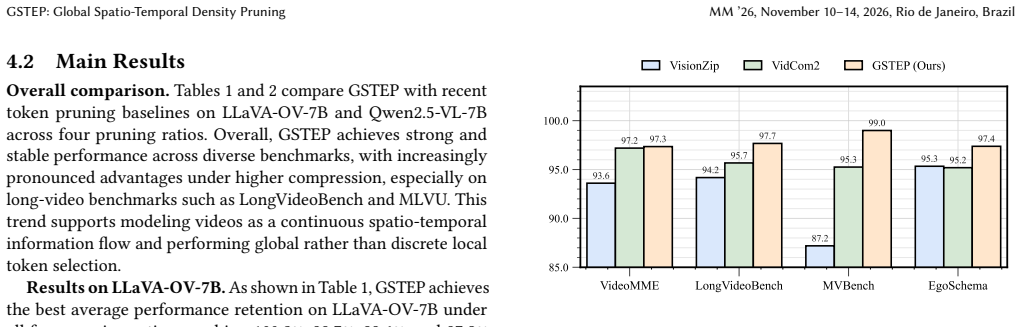
Pith's one-line read Video token pruning should be global, not segment-by-segment: GSTEP removes 75-90% of visual tokens while retaining near-full benchmark accuracy across three VideoLLMs.
desk verdict GSTEP is a solid, reproducible engineering contribution to training-free video token pruning; the global density-guided FPS design is new and mostly well-tested, but the multiplicative fusion and lack of error bars leave conditional room. read the letter →
The pith
A machine-rendered reading of the paper's core claim, the machinery that carries it, and where it could break.
The reading
What carries the argument
The load-bearing object is the spatio-temporal density field $\rho_{t,i}=\hat b_t\cdot s_{t,i}$, in which $\hat b_t$ is a Gaussian-smoothed, mean-normalized frame-level semantic change intensity and $s_{t,i}$ is a token's L2 distance from its frame's mean feature, normalized within the frame. This field feeds a greedy global sampler: it starts at the token with maximum $\rho$ and, at each step, adds the token maximizing $\alpha\log(l_n+\beta)+(1-\alpha)\log(\rho_n+\beta)$, where $l_n$ is the shortest cosine distance from the new token to the already selected set. The mechanism works because temporal density scales a whole frame's contribution, spatial density ranks tokens inside a frame, and the log-decoupled FPS prevents the sampler from wandering to isolated outliers while still covering the feature space.
What would settle it
Build a mostly static video in which the single answer-bearing event is a small object that appears briefly in one low-change frame; compare GSTEP's token allocation to that frame and the downstream question-answering accuracy against a version of GSTEP with a per-frame floor on the temporal density. If the floor version answers correctly while GSTEP misses the object, the multiplicative independence in Eq. (8) is the mechanism.
Extended reading notes
Core claim
GSTEP's central claim is that the right unit of token selection for video is the entire video, not a set of independently budgeted segments. It represents the video as a continuous information flow: each frame receives a temporal density $\hat b_t$ obtained by Gaussian-smoothing and mean-normalizing the frame-level semantic change relative to neighbors, and each token within a frame receives a spatial density $s_{t,i}$ equal to its normalized distance from the frame's mean feature. The token-level score is $\rho_{t,i}=\hat b_t s_{t,i}$, and global selection proceeds by farthest-point sampling with a log-decoupled score that combines shortest cosine distance to already selected tokens with the density value. The paper reports that this procedure keeps 97-100% of original average performance at 75-90% pruning across LLaVA-OneVision-7B, Qwen2.5-VL-7B, and Qwen3-VL-8B, with the largest margins on long-video benchmarks such as MLVU and LongVideoBench.
Load-bearing premise
Everything rests on the assumption in Eq. (8) that a token's importance equals its frame's temporal change intensity times its own spatial deviation; if a frame is judged temporally static, its whole token budget shrinks regardless of what is inside it.
Editorial extensions
If this is right
- At 75% pruning on LLaVA-OneVision-7B, the average retention reaches 100.2% across VideoMME, LongVideoBench, MLVU, MVBench, and EgoSchema, with a 1.17x end-to-end speedup and a 1.61x speedup in the LLM stage.
- The advantage grows with compression and on temporally demanding benchmarks: GSTEP leads all baselines at 85-90% pruning on MLVU and LongVideoBench, where segment-level methods degrade fastest.
- Because GSTEP is training-free and uses one fixed hyperparameter setting across datasets and ratios, it can be dropped into existing VideoLLM pipelines without per-model tuning.
- KV cache and GPU memory drop sharply: on LongVideoBench at 75% pruning, KV cache falls from 340 MB to about 90 MB while retaining accuracy.
Reading between the lines
- The multiplicative form $\rho_{t,i}=\hat b_t s_{t,i}$ implies a static frame with one small critical object receives almost no budget; an explicit per-frame floor on temporal density would be a natural, testable fix that the paper does not explore.
- The same temporal density curve $\hat b_t$ could drive variable frame-rate sampling or keyframe selection, not just token pruning, so GSTEP's global view may transfer to other video-compression stages.
- Because the density field is computed from the vision encoder before the LLM, it is query-agnostic; coupling it with the LLM's attention to the question would likely improve question-specific benchmarks like MVBench, at the cost of losing the plug-and-play property.
- If global sampling is the real cause of the gains, then the segment boundaries themselves, not the local density estimators, are the main source of failure in baselines; an ablation that feeds the same density into segment-wise versus global selection would isolate this.
Signed reviews
Editorial analysis
A structured set of objections, weighed in public.
Referee Report
Summary. This manuscript proposes GSTEP, a training-free visual token pruning method for VideoLLMs. The method computes a frame-level temporal density by smoothing a centered frame-level change signal (Eqs. 4–7), computes a token-level spatial density via deviation from the frame mean (Eq. 3), fuses them multiplicatively (Eq. 8), and selects a global token subset via density-guided farthest point sampling with a log-decoupled score (Eqs. 9–12). Experiments compare with FastV, FastVID, CDPruner, VisionZip, and VidCom2 on LLaVA-OV-7B, Qwen2.5-VL-7B, and Qwen3-VL-8B across VideoMME, LongVideoBench, MLVU, MVBench, and EgoSchema at 75–90% pruning ratios. The main reported result is that GSTEP preserves 94–100% of average performance while giving end-to-end speedups of 1.17–1.20×.
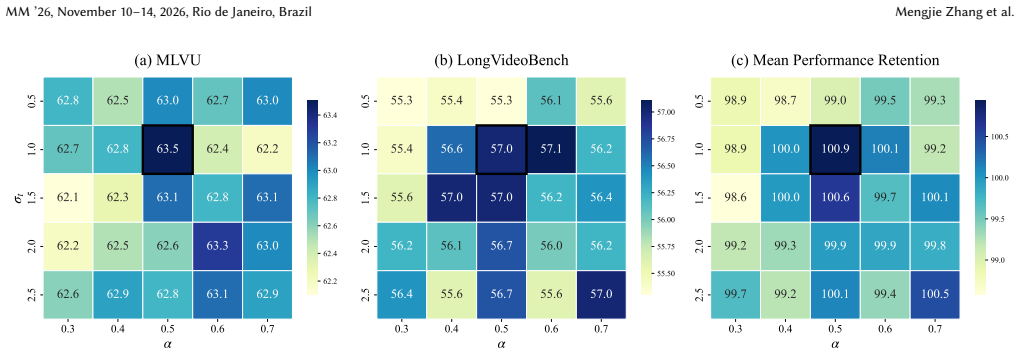
Significance. If the claims hold, GSTEP is a useful plug-and-play component: it requires no training, uses one fixed hyperparameter setting across models and ratios, and its sensitivity analysis (Fig. 4) indicates a broad stable region. The paper also ships code and evaluates with the standard LMMs-Eval harness. The main risk is that the core modeling assumption—multiplicative fusion of temporal and spatial density—is not directly validated and could cause systematic failure on static-frame-critical content; the current experiments are aggregated averages that cannot reveal such per-video failures.
major comments (3)
- [§3.2.3 (Eq. 8) and Table 4] The multiplicative factorization rho_{t,i} = b_t * s_{t,i} is the core modeling assumption, but the paper does not provide direct evidence for it. Since Eq. (7) mean-normalizes b_t to expectation 1, frames in temporally static regions can have b_t close to 0; in a mixed video such frames' tokens receive a strongly negative (1-alpha)*log(rho+beta) term in Eq. (11), and at 10–25% token retention the FPS coverage term cannot be expected to restore them. Table 4 compares temporal-only, spatial-only, and the product, but it does not compare additive or max fusion, and none of the five benchmarks isolates videos where a small critical object appears in a static frame. Please add ablations over fusion operators and a targeted analysis (e.g., per-frame retention for low-motion frames, or a static-critical subset of an existing benchmark) to show that the product form does not systematically starve such frames. This is load-bearing for the abstract's generalization claim.
- [§3.2.3 vs. Table 4] The paper's motivating insight is that segment-level pruning starves short but crucial segments, but the experiments never isolate this variable. The ablation in Table 4 varies the sampling strategy (Random, Uniform, Top-k, FPS) and the density signal, but it does not include a segment-level version of GSTEP in which the same density definitions are used with per-segment budget allocation. Without such a comparison, the improvement over existing segment-level methods (FastVID, VidCom2) could come from the density design or the score function rather than from globality. Please add an ablation that replaces global FPS with segment-level FPS under the same density definitions; this directly tests the stated key insight.
- [Tables 1–2 and §4.1] The quantitative claims rest on single-run evaluations and small margins. For example, in Table 2 at 75% pruning, GSTEP's average retention (97.7%) is only 0.1 point above VisionZip (97.6%), and several adjacent entries in Tables 1 and 2 differ by less than one point across methods. The paper does not state whether decoding is greedy or sampled, nor does it report any variance. If the evaluation is deterministic, please say so explicitly; if not, please provide repeated runs or confidence intervals for the headline retention numbers. As written, "consistently achieves the best average retention" is too strong a reading of differences that may be within evaluation noise.
minor comments (5)
- [Tables 1–2] Several numeric entries are concatenated in the tables, e.g., "53.760.394.0%" in Table 1 and "64.756.496.6" in Table 2; these must be spaced and aligned properly.
- [Eq. (10)] Equation (10) uses \tilde{h}^v_n without defining the normalization; please state explicitly that the visual features are L2-normalized before computing the cosine distance.
- [Author affiliation block] The affiliation block lists "He Fei, China" twice; this should be corrected to "Hefei" and the duplicate entry removed.
- [Abstract and Table 1] The 100.2% average retention exceeds 100% because GSTEP gains on some benchmarks while losing on others (e.g., Table 1: EgoSchema drops from 60.4 to 59.5 at 75% pruning). A sentence explaining why pruning can improve accuracy would prevent the number from being misread as error-free retention.
- [Table 3] At 75% pruning, VidCom2 has lower end-to-end latency (767.1 s) than GSTEP (777.5 s); the text should acknowledge this explicitly when claiming a 1.17× speedup and clarify that GSTEP's advantage is accuracy retention at comparable speed, not absolute speed.
Circularity Check
No derivation-level circularity; only mild hyperparameter selection on the evaluation grid.
-
fitted input called prediction
[Sec. 4.5 (Parameter Sensitivity Analysis), Fig. 4; Sec. 4.1 (Implementation details)]
"Although the exact optimum varies slightly across benchmarks, the default setting (σt, α)=(1.0, 0.5) lies within this stable high-performance region and achieves the best mean performance retention. We therefore use it as the default configuration in all main experiments."
The default hyperparameters are selected because they achieve the best mean performance retention on the MLVU and LongVideoBench grid shown in Fig. 4, and the same benchmarks then appear in Tables 1 and 2 as evidence of GSTEP's near-full performance retention. The headline '100.2%' average is therefore not a fully out-of-sample prediction: the two hyperparameters were tuned to maximize the very retention averages later reported. This is a mild self-confirming evaluation step rather than an equation-level reduction, because the density heuristic itself is not fit to benchmark labels and the reported sensitivity range is small.
full rationale
The core derivation chain in GSTEP is self-contained: the spatio-temporal density rho_{t,i} in Eq. (8) is a designed heuristic formed by multiplying a mean-normalized smoothed temporal change signal with a normalized spatial deviation, and it is never fit to benchmark accuracies. The benchmark scores in Tables 1-3 are external outcomes that cannot be algebraically recovered from rho, so the central claim does not reduce to its input by construction. There are no load-bearing self-citations or imported uniqueness theorems: the cited prior work on FastVID, FPS, and VideoLLMs is background, not author self-citation. The only circularity-adjacent practice is the choice of sigma_t and alpha in Sec. 4.5, where the defaults are selected using the same MLVU and LongVideoBench evaluation grid that appears in the main results. This is a mild selection-on-evaluation issue, not a derivation-level circularity, and the parameter sensitivity analysis shows the method is stable across the grid. Accordingly, the paper receives a low score reflecting this minor self-confirming element while acknowledging that the method's evaluation is otherwise externally grounded.
Assumptions & free parameters
free parameters (4)
- sigma_t (temporal Gaussian smoothing scale) =
1.0
- alpha (density-coverage trade-off in Eq. 11) =
0.5
- beta (numerical stability constant in Eqs. 10 and 11) =
not reported
- epsilon (mean-normalization stabilizer in Eq. 7) =
not reported
assumptions (4)
- domain assumption Feature-space distance between frame-level average embeddings is a reliable proxy for semantic change in video.
- ad hoc to paper Token importance factorizes as the product of frame-level temporal density and token-level spatial density, as in Eq. 8.
- ad hoc to paper FPS with the log-decoupled score in Eq. 11 provides a good approximation of the pruning objective in Eq. 1.
- domain assumption Benchmark scores on VideoMME, LongVideoBench, MLVU, MVBench, and EgoSchema are valid proxies for video understanding quality.
Cite this review
Pith. "Pith review of GSTEP: Global Spatio-Temporal Density-Driven Visual Token Pruning for Efficient Video Large Language Models." pith.science (2026). https://pith.science/paper/KZKHXR6C
@misc{pith2026260803083,
  author       = {Pith},
  title        = {Pith review of: GSTEP: Global Spatio-Temporal Density-Driven Visual Token Pruning for Efficient Video Large Language Models},
  year         = {2026},
  howpublished = {\url{https://pith.science/paper/KZKHXR6C}},
  note         = {Machine review of arXiv:2608.03083}
}
read the original abstract
Video large language models (VideoLLMs) achieve strong video understanding performance, but their inference remains expensive due to the large number of redundant spatio-temporal visual tokens in long videos. Existing token pruning methods alleviate this cost by reducing redundant tokens, yet most of them rely on segment-level local pruning, where videos are partitioned into isolated segments and tokens are selected independently within each segment. Such designs may under-preserve short but semantically dense segments and discard tokens that appear non-salient locally but remain critical from a global perspective. To address this issue, we propose GSTEP (Global Spatio-Temporal Density Pruning), a plug-and-play pruning framework that models video as a continuous spatio-temporal information flow. GSTEP constructs a token-level spatio-temporal density by combining a continuous temporal density, obtained from a smoothed centered frame-level change signal, with intra-frame spatial density, and then performs global token sampling by jointly balancing information density and coverage. Extensive experiments on multiple VideoLLMs and public benchmarks demonstrate that GSTEP consistently achieves strong accuracy-efficiency trade-offs and generalizes well across model architectures and evaluation settings. On LLaVA-OneVision-7B, GSTEP prunes 75% of visual tokens, preserves up to 100.2% of the original average performance across benchmarks, and achieves a 1.17 end-to-end speedup.
Figures


Figures from the paper (1 more)
Reference graph
Works this paper leans on
-
[1]
Jean-Baptiste Alayrac, Jeff Donahue, Pauline Luc, Antoine Miech, Iain Barr, Yana Hasson, Karel Lenc, Arthur Mensch, Katherine Millican, Malcolm Reynolds, et al
-
[2]
Saeed Ranjbar Alvar, Gursimran Singh, Mohammad Akbari, and Yong Zhang
-
[3]
Anurag Arnab, Mostafa Dehghani, Georg Heigold, Chen Sun, Mario Lučić, and Cordelia Schmid. 2021. Vivit: A video vision transformer. InProceedings of the IEEE/CVF international conference on computer vision. 6836–6846
2021
-
[4]
Kirolos Ataallah, Xiaoqian Shen, Eslam Abdelrahman, Essam Sleiman, Deyao Zhu, Jian Ding, and Mohamed Elhoseiny. 2024. Minigpt4-video: Advancing multimodal llms for video understanding with interleaved visual-textual tokens. arXiv preprint arXiv:2404.03413(2024)
arXiv 2024
-
[5]
Shuai Bai, Yuxuan Cai, Ruizhe Chen, Keqin Chen, Xionghui Chen, Zesen Cheng, Lianghao Deng, Wei Ding, Chang Gao, Chunjiang Ge, et al . 2025. Qwen3-vl technical report.arXiv preprint arXiv:2511.21631(2025)
arXiv 2025
-
[6]
Shuai Bai, Keqin Chen, Xuejing Liu, Jialin Wang, Wenbin Ge, Sibo Song, Kai Dang, Peng Wang, Shijie Wang, Jun Tang, et al. 2025. Qwen2. 5-VL Technical Report.arXiv preprint arXiv:2502.13923(2025)
arXiv 2025
-
[7]
Daniel Bolya, Cheng-Yang Fu, Xiaoliang Dai, Peizhao Zhang, Christoph Feichten- hofer, and Judy Hoffman. 2022. Token merging: Your vit but faster.arXiv preprint arXiv:2210.09461(2022)
arXiv 2022
-
[8]
Guo Chen, Yin-Dong Zheng, Jiahao Wang, Jilan Xu, Yifei Huang, Junting Pan, Yi Wang, Yali Wang, Yu Qiao, Tong Lu, et al. 2023. Videollm: Modeling video sequence with large language models.arXiv preprint arXiv:2305.13292(2023)
arXiv 2023
Show all 63 references
-
[9]
Liang Chen, Haozhe Zhao, Tianyu Liu, Shuai Bai, Junyang Lin, Chang Zhou, and Baobao Chang. 2024. An image is worth 1/2 tokens after layer 2: Plug-and-play inference acceleration for large vision-language models. InEuropean Conference on Computer Vision. Springer, 19–35
2024
-
[10]
Yukang Chen, Fuzhao Xue, Dacheng Li, Qinghao Hu, Ligeng Zhu, Xiuyu Li, Yunhao Fang, Haotian Tang, Shang Yang, Zhijian Liu, et al . 2024. Longvila: Scaling long-context visual language models for long videos.arXiv preprint arXiv:2408.10188(2024)
2024 arXiv
-
[11]
Zhe Chen, Weiyun Wang, Yue Cao, Yangzhou Liu, Zhangwei Gao, Erfei Cui, Jinguo Zhu, Shenglong Ye, Hao Tian, Zhaoyang Liu, et al . 2024. Expanding performance boundaries of open-source multimodal models with model, data, and test-time scaling.arXiv preprint arXiv:2412.05271(2024)
2024 arXiv
-
[12]
Wenliang Dai, Junnan Li, Dongxu Li, Anthony Tiong, Junqi Zhao, Weisheng Wang, Boyang Li, Pascale N Fung, and Steven Hoi. 2023. Instructblip: Towards general-purpose vision-language models with instruction tuning.Advances in neural information processing systems36 (2023), 49250–49267
2023
-
[13]
Tri Dao. 2023. Flashattention-2: Faster attention with better parallelism and work partitioning.arXiv preprint arXiv:2307.08691(2023)
2023 arXiv
-
[14]
Mohamed Dhouib, Davide Buscaldi, Sonia Vanier, and Aymen Shabou. 2025. Pact: Pruning and clustering-based token reduction for faster visual language models. InProceedings of the Computer Vision and Pattern Recognition Conference. 14582–14592
2025
-
[15]
Alexey Dosovitskiy, Lucas Beyer, Alexander Kolesnikov, Dirk Weissenborn, Xi- aohua Zhai, Thomas Unterthiner, Mostafa Dehghani, Matthias Minderer, Georg Heigold, Sylvain Gelly, et al. 2020. An image is worth 16x16 words: Transformers for image recognition at scale.arXiv preprin...
2020 arXiv
-
[16]
Mohsen Fayyaz, Soroush Abbasi Koohpayegani, Farnoush Rezaei Jafari, Sunando Sengupta, Hamid Reza Vaezi Joze, Eric Sommerlade, Hamed Pirsiavash, and Jürgen Gall. 2022. Adaptive token sampling for efficient vision transformers. In European conference on computer vision. Springer...
2022
-
[17]
Chaoyou Fu, Yuhan Dai, Yongdong Luo, Lei Li, Shuhuai Ren, Renrui Zhang, Zihan Wang, Chenyu Zhou, Yunhang Shen, Mengdan Zhang, et al. 2025. Video-mme: The first-ever comprehensive evaluation benchmark of multi-modal llms in video analysis. InProceedings of the IEEE/CVF conferen...
2025
-
[18]
Tianyu Fu, Tengxuan Liu, Qinghao Han, Guohao Dai, Shengen Yan, Huazhong Yang, Xuefei Ning, and Yu Wang. 2025. Framefusion: Combining similarity and importance for video token reduction on large vision language models. In Proceedings of the IEEE/CVF International Conference on ...
2025
-
[19]
Xiaohu Huang, Hao Zhou, and Kai Han. 2025. Prunevid: Visual token prun- ing for efficient video large language models. InFindings of the Association for Computational Linguistics: ACL 2025. 19959–19973
2025
-
[20]
Jeongseok Hyun, Sukjun Hwang, Su Ho Han, Taeoh Kim, Inwoong Lee, Dongyoon Wee, Joon-Young Lee, Seon Joo Kim, and Minho Shim. 2025. Multi-granular spatio- temporal token merging for training-free acceleration of video llms. InProceedings of the IEEE/CVF International Conference...
2025
-
[21]
Yizhang Jin, Jian Li, Tianjun Gu, Yexin Liu, Bo Zhao, Jinxiang Lai, Zhenye Gan, Yabiao Wang, Chengjie Wang, Xin Tan, et al. 2025. Efficient multimodal large language models: A survey.Visual Intelligence3, 1 (2025), 27
2025
-
[22]
Bo Li, Yuanhan Zhang, Dong Guo, Renrui Zhang, Feng Li, Hao Zhang, Kaichen Zhang, Peiyuan Zhang, Yanwei Li, Ziwei Liu, et al. 2024. Llava-onevision: Easy visual task transfer.arXiv preprint arXiv:2408.03326(2024)
2024 arXiv
-
[23]
Junnan Li, Dongxu Li, Silvio Savarese, and Steven Hoi. 2023. Blip-2: Bootstrapping language-image pre-training with frozen image encoders and large language models. InInternational conference on machine learning. PMLR, 19730–19742
2023
-
[24]
KunChang Li, Yinan He, Yi Wang, Yizhuo Li, Wenhai Wang, Ping Luo, Yali Wang, Limin Wang, and Yu Qiao. 2025. Videochat: Chat-centric video understanding. Science China Information Sciences68, 10 (2025), 200102
2025
-
[25]
Kunchang Li, Yali Wang, Yinan He, Yizhuo Li, Yi Wang, Yi Liu, Zun Wang, Jilan Xu, Guo Chen, Ping Luo, et al. 2024. Mvbench: A comprehensive multi-modal video understanding benchmark. InProceedings of the IEEE/CVF Conference on Computer Vision and Pattern Recognition. 22195–22206
2024
-
[26]
Yulin Li, Haokun Gui, Ziyang Fan, Junjie Wang, Bin Kang, Bin Chen, and Zhuotao Tian. 2025. Less Is More, but Where? Dynamic Token Compression via LLM- Guided Keyframe Prior.arXiv preprint arXiv:2512.06866(2025)
2025
-
[27]
Youwei Liang, Chongjian Ge, Zhan Tong, Yibing Song, Jue Wang, and Pengtao Xie. 2022. Not all patches are what you need: Expediting vision transformers via token reorganizations.arXiv preprint arXiv:2202.07800(2022)
2022 arXiv
-
[28]
Bin Lin, Yang Ye, Bin Zhu, Jiaxi Cui, Munan Ning, Peng Jin, and Li Yuan. 2024. Video-llava: Learning united visual representation by alignment before projection. InProceedings of the 2024 conference on empirical methods in natural language processing. 5971–5984
2024
-
[29]
Haotian Liu, Chunyuan Li, Qingyang Wu, and Yong Jae Lee. 2023. Visual in- struction tuning.Advances in neural information processing systems36 (2023), 34892–34916
2023
-
[30]
Ting Liu, Liangtao Shi, Richang Hong, Yue Hu, Quanjun Yin, and Linfeng Zhang
-
[31]
Xuyang Liu, Yiyu Wang, Junpeng Ma, and Linfeng Zhang. 2025. Video compres- sion commander: Plug-and-play inference acceleration for video large language models. InProceedings of the 2025 Conference on Empirical Methods in Natural Language Processing. 1910–1924
2025
-
[32]
Yudong Liu, Jingwei Sun, Yueqian Lin, Jianyi Zhang, Jingyang Zhang, Ming Yin, Qinsi Wang, Hai Li, and Yiran Chen. 2025. Keyframe-oriented vision token pruning: Enhancing efficiency of large vision language models on long-form video processing. InProceedings of the IEEE/CVF Int...
2025
-
[33]
Muhammad Maaz, Hanoona Rasheed, Salman Khan, and Fahad Khan. 2024. Video-chatgpt: Towards detailed video understanding via large vision and lan- guage models. InProceedings of the 62nd Annual Meeting of the Association for Computational Linguistics (Volume 1: Long Papers). 12585–12602
2024
-
[34]
Karttikeya Mangalam, Raiymbek Akshulakov, and Jitendra Malik. 2023. Egoschema: A diagnostic benchmark for very long-form video language un- derstanding.Advances in Neural Information Processing Systems36 (2023), 46212– 46244
2023
-
[35]
Thong Nguyen, Yi Bin, Junbin Xiao, Leigang Qu, Yicong Li, Jay Zhangjie Wu, Cong-Duy Nguyen, See Kiong Ng, and Luu Anh Tuan. 2024. Video-language understanding: A survey from model architecture, model training, and data perspectives. InFindings of the Association for Computatio...
2024
-
[36]
Yongming Rao, Wenliang Zhao, Benlin Liu, Jiwen Lu, Jie Zhou, and Cho-Jui Hsieh
-
[37]
Kele Shao, Keda Tao, Can Qin, Haoxuan You, Yang Sui, and Huan Wang. 2025. Holitom: Holistic token merging for fast video large language models.arXiv preprint arXiv:2505.21334(2025)
2025
-
[38]
Leqi Shen, Guoqiang Gong, Tao He, Yifeng Zhang, Pengzhang Liu, Sicheng Zhao, and Guiguang Ding. 2025. Fastvid: Dynamic density pruning for fast video large language models.arXiv preprint arXiv:2503.11187(2025)
2025
-
[39]
Yan Shu, Zheng Liu, Peitian Zhang, Minghao Qin, Junjie Zhou, Zhengyang Liang, Tiejun Huang, and Bo Zhao. 2025. Video-xl: Extra-long vision language model for hour-scale video understanding. InProceedings of the Computer Vision and Pattern Recognition Conference. 26160–26169
2025
-
[40]
Enxin Song, Wenhao Chai, Guanhong Wang, Yucheng Zhang, Haoyang Zhou, Feiyang Wu, Haozhe Chi, Xun Guo, Tian Ye, Yanting Zhang, et al. 2024. Moviechat: From dense token to sparse memory for long video understanding. InProceedings of the IEEE/CVF Conference on Computer Vision and...
2024
-
[41]
Fengyuan Sun, Leqi Shen, Hui Chen, Sicheng Zhao, Jungong Han, and Guiguang Ding. 2025. Adatp: Attention-debiased token pruning for video large language models.arXiv preprint arXiv:2505.201002 (2025)
2025 arXiv
-
[42]
Yunlong Tang, Jing Bi, Siting Xu, Luchuan Song, Susan Liang, Teng Wang, Daoan Zhang, Jie An, Jingyang Lin, Rongyi Zhu, et al. 2025. Video understanding with large language models: A survey.IEEE Transactions on Circuits and Systems for Video Technology(2025)
2025
-
[43]
Keda Tao, Can Qin, Haoxuan You, Yang Sui, and Huan Wang. 2025. Dycoke: Dy- namic compression of tokens for fast video large language models. InProceedings of the Computer Vision and Pattern Recognition Conference. 18992–19001
2025
-
[44]
Han Wang, Yuxiang Nie, Yongjie Ye, Yanjie Wang, Shuai Li, Haiyang Yu, Jinghui Lu, and Can Huang. 2025. Dynamic-vlm: Simple dynamic visual token com- pression for videollm. InProceedings of the IEEE/CVF International Conference on Computer Vision. 20812–20823
2025
-
[45]
Haoning Wu, Dongxu Li, Bei Chen, and Junnan Li. 2024. Longvideobench: A benchmark for long-context interleaved video-language understanding.Advances in Neural Information Processing Systems37 (2024), 28828–28857
2024
-
[46]
Long Xing, Qidong Huang, Xiaoyi Dong, Jiajie Lu, Pan Zhang, Yuhang Zang, Yuhang Cao, Conghui He, Jiaqi Wang, Feng Wu, et al . 2024. Pyramiddrop: Accelerating your large vision-language models via pyramid visual redundancy reduction.arXiv preprint arXiv:2410.17247(2024)
2024 arXiv
-
[47]
Minhao Xiong, Zichen Wen, Zhuangcheng Gu, Xuyang Liu, Rui Zhang, Hen- grui Kang, Jiabing Yang, Junyuan Zhang, Weijia Li, Conghui He, et al . 2025. Prune2drive: A plug-and-play framework for accelerating vision-language mod- els in autonomous driving.arXiv preprint arXiv:2508.1...
2025
-
[48]
Lin Xu, Yilin Zhao, Daquan Zhou, Zhijie Lin, See Kiong Ng, and Jiashi Feng. 2024. Pllava: Parameter-free llava extension from images to videos for video dense captioning.arXiv preprint arXiv:2404.16994(2024)
2024 arXiv
-
[49]
Cheng Yang, Yang Sui, Jinqi Xiao, Lingyi Huang, Yu Gong, Chendi Li, Jinghua Yan, Yu Bai, Ponnuswamy Sadayappan, Xia Hu, et al. 2025. Topv: Compatible token pruning with inference time optimization for fast and low-memory multi- modal vision language model. InProceedings of the...
2025
-
[50]
Senqiao Yang, Yukang Chen, Zhuotao Tian, Chengyao Wang, Jingyao Li, Bei Yu, and Jiaya Jia. 2025. Visionzip: Longer is better but not necessary in vision language models. InProceedings of the IEEE/CVF Conference on Computer Vision and Pattern Recognition. 19792–19802
2025
-
[51]
Linli Yao, Long Xing, Yang Shi, Sida Li, Yuanxin Liu, Yuhao Dong, Yi-Fan Zhang, Lei Li, Qingxiu Dong, Xiaoyi Dong, et al. 2025. Towards Efficient Multimodal Large Language Models: A Survey on Token Compression.Authorea Preprints (2025)
2025
-
[52]
Weihao Ye, Qiong Wu, Wenhao Lin, and Yiyi Zhou. 2025. Fit and prune: Fast and training-free visual token pruning for multi-modal large language models. In Proceedings of the AAAI Conference on Artificial Intelligence, Vol. 39. 22128–22136
2025
-
[53]
Hang Zhang, Xin Li, and Lidong Bing. 2023. Video-llama: An instruction-tuned audio-visual language model for video understanding. InProceedings of the 2023 conference on empirical methods in natural language processing: system demon- strations. 543–553
2023
-
[54]
Kaichen Zhang, Bo Li, Peiyuan Zhang, Fanyi Pu, Joshua Adrian Cahyono, Kairui Hu, Shuai Liu, Yuanhan Zhang, Jingkang Yang, Chunyuan Li, et al. 2025. Lmms- eval: Reality check on the evaluation of large multimodal models. InFindings of the Association for Computational Linguisti...
2025
-
[55]
Qizhe Zhang, Mengzhen Liu, Lichen Li, Ming Lu, Yuan Zhang, Junwen Pan, Qi She, and Shanghang Zhang. 2025. Beyond attention or similarity: Maximizing conditional diversity for token pruning in mllms.arXiv preprint arXiv:2506.10967 (2025)
2025 arXiv
-
[56]
Yuan Zhang, Chun-Kai Fan, Junpeng Ma, Wenzhao Zheng, Tao Huang, Kuan Cheng, Denis Gudovskiy, Tomoyuki Okuno, Yohei Nakata, Kurt Keutzer, et al
-
[57]
Junjie Zhou, Yan Shu, Bo Zhao, Boya Wu, Zhengyang Liang, Shitao Xiao, Minghao Qin, Xi Yang, Yongping Xiong, Bo Zhang, et al. 2025. Mlvu: Benchmarking multi- task long video understanding. InProceedings of the IEEE/CVF Conference on Computer Vision and Pattern Recognition. 13691–13701
2025
-
[58]
Deyao Zhu, Jun Chen, Xiaoqian Shen, Xiang Li, and Mohamed Elhoseiny. 2023. Minigpt-4: Enhancing vision-language understanding with advanced large lan- guage models.arXiv preprint arXiv:2304.10592(2023)
2023 arXiv
-
[61]
Sparsevlm: Visual token sparsification for efficient vision-language model inference.arXiv preprint arXiv:2410.04417(2024)
2024 arXiv
-
[2021]
Advances in neural information processing systems34 (2021), 13937–13949
Dynamicvit: Efficient vision transformers with dynamic token sparsification. Advances in neural information processing systems34 (2021), 13937–13949
2021
-
[2022]
Flamingo: a visual language model for few-shot learning.Advances in neural information processing systems35 (2022), 23716–23736
2022
-
[2024]
Multi-stage vision token dropping: Towards efficient multimodal large language model.arXiv preprint arXiv:2411.10803(2024)
2024 arXiv
-
[2025]
InProceedings of the Computer Vision and Pattern Recognition Conference
Divprune: Diversity-based visual token pruning for large multimodal models. InProceedings of the Computer Vision and Pattern Recognition Conference. 9392–9401
Reviewed August 15, 2026 · model on record in the stance chip above.
Discussion (0). Continue with ORCID to comment.