REVIEW 4 major objections 4 minor 43 references
The Tell-Tale Trace: Detecting Reasoning Failures in LLMs Using Chain-of-Thought Dynamics
T0 review · 4 major / 4 minor · reviewed 2026-08-05 · deepseek-v4-flash
Pith's one-line read This paper claims that the dynamics of a large language model's visible chain of thought—how early it starts checking, how repetitively it cycles, how soon it finalizes—can betray whether the reasoning will end in a wrong answer, and that o
desk verdict A genuinely useful empirical study of CoT failure dynamics on SAT/UNSAT, but the unvalidated regex role tagger is the load-bearing part and needs to be released and checked before the claims can be trusted. read the letter →
The pith
A machine-rendered reading of the paper's core claim, the machinery that carries it, and where it could break.
The reading
What carries the argument
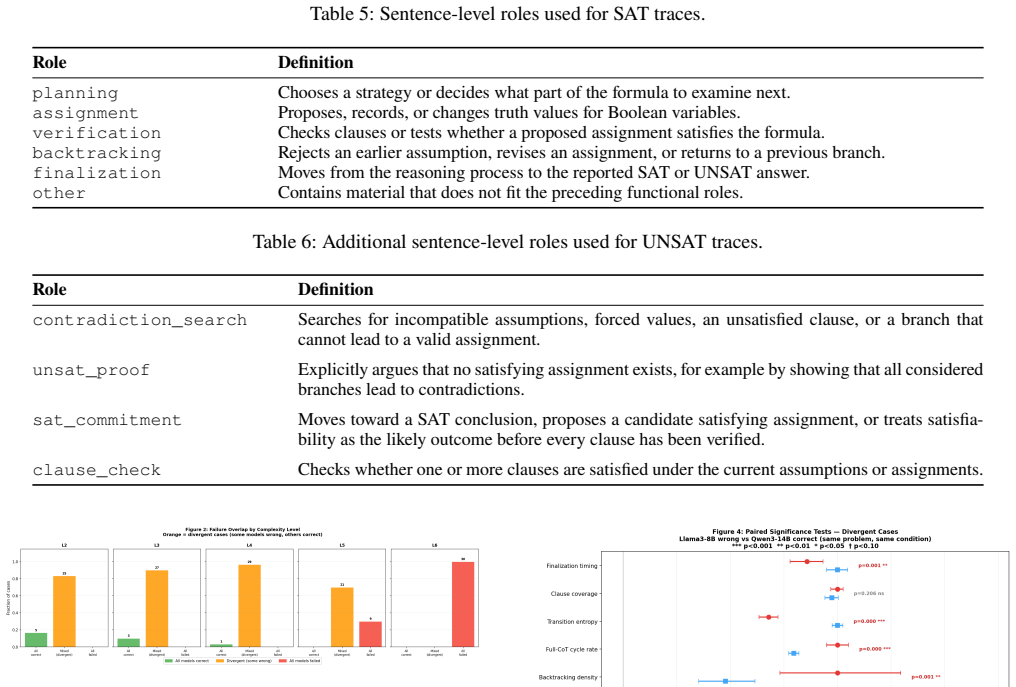
The machinery is a role-sequence analysis of visible chain-of-thought: each sentence is tagged with a coarse reasoning function (planning, assignment, verification, backtracking, finalization, plus UNSAT-specific proof roles), and the resulting role sequence is summarized by a row-normalized transition matrix, cycle rate, weighted self-transition, transition entropy, role densities, and normalized finalization timing. These dynamics features are what separate correct from incorrect traces, generate early-warning scores over trace prefixes, and reveal the SAT-versus-UNSAT procedure mismatch that motivates the intervention. Because the features are computed from surface text alone, they do not
What would settle it
Re-tag the same traces with a learned semantic role classifier or human annotations and recompute the matched SAT/UNSAT comparisons; if the premature-verification-collapse pattern and the UNSAT procedure-mismatch AUROCs (0.80–0.91) vanish or reverse, the reported signatures are labeling artifacts rather than properties of reasoning. A weaker test: run the same prefix-based early-warning protocol on an independent SAT/UNSAT instance set and check whether flagged-wrong rates and lead times reproduce.
Extended reading notes
Core claim
On satisfiable Boolean formulas, failed traces shift into clause checking earlier, repeat similar role patterns more often, and begin finalization sooner—'premature verification collapse'—while covering the same clauses as correct traces. On unsatisfiable formulas, models check candidate assignments and commit to SAT instead of constructing contradiction proofs; this procedure mismatch survives removal of answer-related language (AUROC 0.80–0.91 across the tested models). The sharpest evidence is the intervention: a proof-search prompt raises Llama3-70B accuracy on UNSAT problems from 13.3% to 85.0% by correcting 44 of 52 wrong-SAT completions, while a generic retry does not. The paper reads
Load-bearing premise
The load-bearing premise is that the deterministic regex classifier correctly assigns each sentence to a reasoning function; every dynamics feature inherits whatever error the tagger introduces, and the paper gives no agreement figures or labeled data, so the failure signatures could be artifacts of the labeling scheme rather than properties of the reasoning.
Editorial extensions
If this is right
- Incorrect traces can sometimes be flagged before the final answer: on held-out problems, 80.2% of Llama3-8B wrong-complete traces and 78.2% of OLMo2-13B traces are flagged with median lead times of 23 and 17.5 sentences, though Llama3-70B is weaker.
- The UNSAT intervention shows that many reasoning failures are procedure failures rather than capability limits: directing the model toward case splitting and contradiction search corrects 84.6% of false SAT claims, so similar diagnosis-then-reprompt strategies may work in other verifiable domains.
- The robust across-family signature is repetition and reduced transition entropy in failing traces, while length and verification effects depend on model family; therefore any practical monitor must be calibrated per model and difficulty level.
- Because the dynamics analysis does not treat individual CoT statements as faithful, it remains applicable to models whose verbalized reasoning may be obfuscated or unfaithful, extending monitoring beyond semantic step-checking.
Reading between the lines
- A testable extension: applying the same role-dynamics features to domains with asymmetric proof demands, such as theorem proving or puzzle solving with an external grader, to see whether the SAT/UNSAT procedure-mismatch pattern transfers.
- The paper's early-warning score is calibrated per model and difficulty, but the underlying signal—repetition and low entropy—suggests a simple, model-agnostic 'looping detector' might be built; this is an inference beyond the reported results, since the authors only evaluate the full feature set.
- If the regex-based tagger is the main threat, then re-running the analysis with a trained classifier or human annotations would either reinforce or overturn the signatures; the paper does not provide the annotated data to do this, leaving it as the most direct stress test.
- The intervention is oracle-assisted: solver labels pick which failures to rerun. An end-to-end monitor that uses the early-warning score to trigger the proof-search prompt would test whether correction works without ground truth, which the paper explicitly leaves open.
Editorial analysis
A structured set of objections, weighed in public.
Referee Report
Summary. The paper proposes to detect reasoning failures in LLMs by analyzing the dynamics of visible chain-of-thought (CoT) on Boolean satisfiability (SAT/UNSAT) tasks. Sentences in each trace are assigned coarse functional roles by a deterministic regex classifier, and features such as role densities, transition entropy, cycle rate, and finalization position are computed. The authors report a 'premature verification collapse' on SAT problems: incorrect traces enter verification earlier, repeat operations, and finalize sooner. On UNSAT problems they find that models substitute assignment search for contradiction proof, and a targeted proof-search prompt raises Llama3-70B accuracy from 13.3% to 85.0%. The paper is candid about several limitations, including the unvalidated role tagger and the post-hoc nature of the intervention.
Significance. If the central claims hold, this would be a useful contribution: it offers a faithfulness-free behavioral signal for monitoring and correcting reasoning failures on verifiable tasks. Strengths include external solver ground truth, paired Wilcoxon tests on matched problem-condition pairs, a held-out problem split for early-warning calibration, and explicit separation of generation failures from wrong reasoning. The authors are also unusually transparent about limitations. However, the three main contributions (SAT collapse signature, early warning signal, diagnosis-informed correction) all hinge on the validity of the regex role tagger and on the strength of comparisons that control for model-specific response style. Those load-bearing points are currently under-supported.
major comments (4)
- [Reasoning dynamics and analysis protocols; Supplement C] The deterministic regex role classifier is the sole source of every role-sequence feature, and the paper states that 'every dynamics feature we report inherits whatever error the tagger introduces.' Yet no validation is provided: no regex rules, no annotated data, no agreement statistics, and no release of the tagger. Because the central SAT and UNSAT signatures are defined on these labels, unvalidated label noise is load-bearing. I request per-role precision/recall on a held-out annotated sample, inter-annotator agreement, a sensitivity analysis in which role labels are perturbed and effect sizes re-estimated, and release of the tagger. Without this, the reported patterns could be artifacts of the labeling scheme rather than properties of the reasoning.
- [Table 1 and Table 7; Abstract and Introduction] The headline claim of 'premature verification collapse' is overstated relative to the evidence. In the within-family Llama comparison (Table 1), the length effect is absent/reversed and verification density is significantly lower in wrong traces (0.61 vs 0.64, p = .0427). In the within-model comparisons (Table 7), only backtracking density is consistently higher across all three models; cycle rate and entropy reverse direction for Llama3-70B and OLMo2-13B. The abstract and contributions nonetheless state that incorrect traces 'enter clause checking earlier, repeat similar operations, and finalize sooner.' The robust pattern is model-dependent and mainly visible in cross-family comparisons. Please reframe the central claim or supply matched within-family evidence for the earlier-clause-checking and finalization components.
- [Reasoning dynamics provide model-dependent early warnings; Figure 5] The early-warning evaluation reports AUROC over normalized trace position and coverage/lead-time, but it does not compare against simple baselines such as trace length, finalization position, or role densities without transition features, and it does not report false-positive rates, precision, or threshold sensitivity. The Discussion acknowledges this gap. Without such baselines, the claim that transition-based dynamics add signal beyond cheaper features is not established. This is necessary to support the early-warning contribution.
- [Prompting for proof search rescues most UNSAT failures; Table 2] The proof-search intervention is compared only against a much shorter generic retry prompt, so the 85% accuracy gain may reflect instruction length/detail rather than the diagnosed UNSAT-specific procedure. The authors acknowledge that the prompts are unmatched. To support the 'diagnosis-informed correction' claim, an ablation is needed: either a length-matched generic instruction or a structured but domain-general prompt that does not mention contradiction proof. The observed shift in contradiction-search density is suggestive but does not by itself separate specificity from verbosity.
minor comments (4)
- [Supplement A] The paragraph 'We use this setting because correctness is established independently...' is duplicated verbatim within the Task Construction subsection.
- [Supplement] Several supplement cross-references are unresolved or empty, e.g., 'Supplementary Section explains...' and 'Supplementary Section .' before the qualitative examples. These should be numbered.
- [Table 3 caption] The caption refers to 'sample counts explicitly reported in the main-paper drafts.' This is inappropriate for a final manuscript; remove the word 'drafts.'
- [Supplement C, Tables 5-6] The role definitions would benefit from concrete sentence examples, especially for the UNSAT roles contradiction_search versus unsat_proof, since the UNSAT diagnosis relies on these distinctions.
Circularity Check
No significant circularity: external solver labels, held-out evaluation, and explicit leakage controls keep the central claims non-circular.
full rationale
The paper's correctness labels are fixed by an external SAT solver, so the SAT/UNSAT outcome is not defined by the model's trace. The early-warning detector is calibrated on a 50% problem split and evaluated on the held-out half ('We split problems in half, using one half to fix these choices and the other only for evaluation, so no formula contributes to both'), so the reported flagging rates are not fit-forced. The UNSAT diagnosis explicitly guards against the trivial labeling confound: 'Any such difference could arise trivially, since a trace that concludes SAT contains language announcing the same. We therefore repeat the comparison twice... so that any remaining separation reflects how the reasoning is organized rather than what it reports,' and it reports AUROC after removing answer-related features. The proof-search intervention is acknowledged as 'post hoc and oracle-assisted' and is tested on solver-certified UNSAT cases; this limits the strength of the causal claim but does not make the measured accuracy gain circular. The main limitation is the unvalidated regex role tagger: 'every dynamics feature we report inherits whatever error the tagger introduces' (Discussion and Limitations). That is a measurement-validity risk and a reason to be cautious about the role-based signatures, but it is not a circularity: the role labels are not derived from the correctness labels, and the paper provides leakage controls for the UNSAT analysis. Also, the proof-search prompt includes 'This formula may be UNSAT', a possible answer cue; that is a confound for the intervention interpretation, not a circularity. There are no self-citations, no imported uniqueness theorems, and no fitted parameter that is renamed as a prediction. The 'premature verification collapse' label is a post-hoc description of the observed feature differences, not a prediction derived from those features. Overall, no step in the derivation reduces to its own input by construction.
Assumptions & free parameters
free parameters (3)
- capability_frontier_thresholds =
0.30 and 0.90 accuracy bounds
- per_model_early_warning_threshold =
Not reported numerically
- normalization_statistics =
mu and sigma per model and level
assumptions (6)
- domain assumption The external SAT solver correctly certifies every instance label and every reported assignment.
- domain assumption Sentence splitting plus the coarse role taxonomy (planning, assignment, verification, etc.) yields a meaningful abstraction of reasoning.
- domain assumption Role sequences can be summarized by a first-order transition matrix P_ij = Pr(r_{t+1}=j | r_t=i).
- domain assumption UNSAT demands contradiction-based proof, so assignment checking is the wrong procedure.
- domain assumption Verbalized CoT can be analyzed behaviorally without assuming faithfulness to internal computation.
- domain assumption D1 and D2 prompt framings are controlled perturbations that do not change the task or ground truth.
Cite this review
Pith. "Pith review of The Tell-Tale Trace: Detecting Reasoning Failures in LLMs Using Chain-of-Thought Dynamics." pith.science (2026). https://pith.science/paper/2FFCMN3U
@misc{pith2026260803291,
  author       = {Pith},
  title        = {Pith review of: The Tell-Tale Trace: Detecting Reasoning Failures in LLMs Using Chain-of-Thought Dynamics},
  year         = {2026},
  howpublished = {\url{https://pith.science/paper/2FFCMN3U}},
  note         = {Machine review of arXiv:2608.03291}
}
read the original abstract
Chain-of-thought (CoT) reasoning improves large language model (LLM) performance while also providing an observable interface to the model's reasoning process. Existing approaches that leverage verbalized CoTs to monitor reasoning correctness, however, largely evaluate the semantic correctness or consistency of individual intermediate steps, rather than how the reasoning process evolves across the trace. As a result, failures distributed across the reasoning trajectory, rather than those localized to a single incorrect step, remain comparatively underexplored. Furthermore, verbalized CoTs need not faithfully reflect the model's internal reasoning, motivating analyses that do not treat individual statements as literal accounts of internal computation. In this work, we therefore ask whether the dynamics of visible CoT can be leveraged to systematically distinguish successful from failed reasoning without assuming such semantic faithfulness. We study a range of LLMs on verifiable Boolean satisfiability tasks with variable complexity, enabling controlled comparisons near each model's capability frontier. Tagging CoT sentences by reasoning function reveals premature verification collapse on SAT problems: incorrect traces enter clause checking earlier, repeat similar operations, and finalize sooner. On UNSAT problems, models presumptuously move towards incorrect SAT conclusions, checking candidate assignments rather than deriving contradictions across constructed cases. Subsequently, a targeted proof-search prompt intervention raises Llama3-70B accuracy from 13.3% to 85%, correcting 84.6% of these errors. These results show that capability failures can manifest as distributed, task-dependent changes in the structure of visible reasoning, and that CoT dynamics agnostic to whether the verbalized trace reflects the model's internal computations can help diagnose and correct failures.
Figures


Figures from the paper (6 more)




Reference graph
Works this paper leans on
-
[1]
Communication, Simulation, and Intelligent Agents: Implications of Personal Intelligent Machines for Medical Education
Clancey, William J. Communication, Simulation, and Intelligent Agents: Implications of Personal Intelligent Machines for Medical Education. Proceedings of the Eighth International Joint Conference on Artificial Intelligence (IJCAI-83)
-
[2]
Classification Problem Solving
Clancey, William J. Classification Problem Solving. Proceedings of the Fourth National Conference on Artificial Intelligence
-
[3]
, title =
Robinson, Arthur L. , title =. 1980 , doi =. https://science.sciencemag.org/content/208/4447/1019.full.pdf , journal =
1980
-
[4]
New Ways to Make Microcircuits Smaller---Duplicate Entry
Robinson, Arthur L. New Ways to Make Microcircuits Smaller---Duplicate Entry. Science
-
[5]
Clancey and Glenn Rennels , abstract =
Diane Warner Hasling and William J. Clancey and Glenn Rennels , abstract =. Strategic explanations for a diagnostic consultation system , journal =. 1984 , issn =. doi:https://doi.org/10.1016/S0020-7373(84)80003-6 , url =
-
[6]
and Rennels, Glenn R
Hasling, Diane Warner and Clancey, William J. and Rennels, Glenn R. and Test, Thomas. Strategic Explanations in Consultation---Duplicate. The International Journal of Man-Machine Studies
-
[7]
Poligon: A System for Parallel Problem Solving
Rice, James. Poligon: A System for Parallel Problem Solving
-
[8]
Transfer of Rule-Based Expertise through a Tutorial Dialogue
Clancey, William J. Transfer of Rule-Based Expertise through a Tutorial Dialogue
Show all 43 references
-
[9]
The Engineering of Qualitative Models
Clancey, William J. The Engineering of Qualitative Models
-
[10]
2023 , eprint=
Attention Is All You Need , author=. 2023 , eprint=
2023
-
[11]
Pluto: The 'Other' Red Planet
NASA. Pluto: The 'Other' Red Planet
-
[12]
arXiv e-prints , keywords =
SATBench: Benchmarking LLMs' Logical Reasoning via Automated Puzzle Generation from SAT Formulas. arXiv e-prints , keywords =. doi:10.48550/arXiv.2505.14615 , archivePrefix =. 2505.14615 , primaryClass =
-
[13]
1980 , publisher=
Applications of Item Response Theory to Practical Testing Problems , author=. 1980 , publisher=
1980
-
[14]
2001 , publisher=
The Basics of Item Response Theory , author=. 2001 , publisher=
2001
-
[15]
arXiv e-prints , keywords =
Can Reasoning Models Obfuscate Reasoning? Stress-Testing Chain-of-Thought Monitorability. arXiv e-prints , keywords =. doi:10.48550/arXiv.2510.19851 , archivePrefix =. 2510.19851 , primaryClass =
-
[16]
Davis, Martin and Logemann, George and Loveland, Donald , title =. Commun. ACM , month = jul, pages =. 1962 , issue_date =. doi:10.1145/368273.368557 , abstract =
1962
-
[17]
arXiv e-prints , keywords =
Contested Cluster Selectors: Local Ambiguity, Normal Forms, and Backtracking Cost in Random Constraint Satisfaction. arXiv e-prints , keywords =. doi:10.48550/arXiv.2606.16063 , archivePrefix =. 2606.16063 , primaryClass =
-
[18]
arXiv e-prints , keywords =
Thought Anchors: Which LLM Reasoning Steps Matter?. arXiv e-prints , keywords =. doi:10.48550/arXiv.2506.19143 , archivePrefix =. 2506.19143 , primaryClass =
- [19]
-
[20]
Advances in neural information processing systems , volume=
Chain-of-thought prompting elicits reasoning in large language models , author=. Advances in neural information processing systems , volume=
-
[21]
arXiv preprint arXiv:2412.16720 , year=
Openai o1 system card , author=. arXiv preprint arXiv:2412.16720 , year=
-
[22]
arXiv preprint arXiv:2505.09388 , year=
Qwen3 technical report , author=. arXiv preprint arXiv:2505.09388 , year=
-
[23]
arXiv preprint arXiv:2507.11473 , year=
Chain of thought monitorability: A new and fragile opportunity for ai safety , author=. arXiv preprint arXiv:2507.11473 , year=
-
[24]
Forty-third International Conference on Machine Learning , year=
Monitoring monitorability , author=. Forty-third International Conference on Machine Learning , year=
-
[25]
arXiv preprint arXiv:2503.11926 , year=
Monitoring reasoning models for misbehavior and the risks of promoting obfuscation , author=. arXiv preprint arXiv:2503.11926 , year=
-
[26]
arXiv preprint arXiv:2211.14275 , year=
Solving math word problems with process-and outcome-based feedback , author=. arXiv preprint arXiv:2211.14275 , year=
-
[27]
International Conference on Learning Representations , volume=
Let's verify step by step , author=. International Conference on Learning Representations , volume=
-
[28]
arXiv preprint arXiv:2412.06559 , year=
Processbench: Identifying process errors in mathematical reasoning , author=. arXiv preprint arXiv:2412.06559 , year=
-
[29]
Proceedings of the 63rd Annual Meeting of the Association for Computational Linguistics (Volume 1: Long Papers) , pages=
Can large language models detect errors in long chain-of-thought reasoning? , author=. Proceedings of the 63rd Annual Meeting of the Association for Computational Linguistics (Volume 1: Long Papers) , pages=
-
[30]
Findings of the Association for Computational Linguistics: NAACL 2024 , pages=
How interpretable are reasoning explanations from prompting large language models? , author=. Findings of the Association for Computational Linguistics: NAACL 2024 , pages=
2024
-
[31]
Advances in Neural Information Processing Systems , volume=
Language models don't always say what they think: Unfaithful explanations in chain-of-thought prompting , author=. Advances in Neural Information Processing Systems , volume=
-
[32]
arXiv preprint arXiv:2307.13702 , year=
Measuring faithfulness in chain-of-thought reasoning , author=. arXiv preprint arXiv:2307.13702 , year=
-
[33]
Preprint, alphaXiv , pages=
Chain-of-thought is not explainability , author=. Preprint, alphaXiv , pages=
-
[34]
arXiv preprint arXiv:2506.19143 , year=
Thought Anchors: Which LLM Reasoning Steps Matter? , author=. arXiv preprint arXiv:2506.19143 , year=
-
[35]
arXiv preprint arXiv:2510.27484 , year=
Thought Branches: Interpreting LLM Reasoning Requires Resampling , author=. arXiv preprint arXiv:2510.27484 , year=
-
[36]
arXiv preprint arXiv:2506.22058 , year=
Lost at the beginning of reasoning , author=. arXiv preprint arXiv:2506.22058 , year=
-
[37]
Proceedings of the 2025 Conference on Empirical Methods in Natural Language Processing , pages=
Analysing Chain of Thought Dynamics: Active Guidance or Unfaithful Post-hoc Rationalisation? , author=. Proceedings of the 2025 Conference on Empirical Methods in Natural Language Processing , pages=
2025
-
[38]
arXiv preprint arXiv:2603.18940 , year=
Entropy trajectory shape predicts LLM reasoning reliability: A diagnostic study of uncertainty dynamics in chain-of-thought , author=. arXiv preprint arXiv:2603.18940 , year=
-
[39]
Proceedings of the 64th Annual Meeting of the Association for Computational Linguistics (Volume 1: Long Papers) , pages=
Llm reasoning as trajectories: Step-specific representation geometry and correctness signals , author=. Proceedings of the 64th Annual Meeting of the Association for Computational Linguistics (Volume 1: Long Papers) , pages=
-
[40]
Proceedings of the 2025 Conference on Empirical Methods in Natural Language Processing , pages=
Understanding the thinking process of reasoning models: A perspective from schoenfeld’s episode theory , author=. Proceedings of the 2025 Conference on Empirical Methods in Natural Language Processing , pages=
2025
-
[41]
arXiv preprint arXiv:2605.29192 , year=
ReasonOps: Operator Segmentation for LLM Reasoning Traces , author=. arXiv preprint arXiv:2605.29192 , year=
-
[42]
Proceedings of the 64th Annual Meeting of the Association for Computational Linguistics (Volume 1: Long Papers) , pages=
Dissecting failure dynamics in large language model reasoning , author=. Proceedings of the 64th Annual Meeting of the Association for Computational Linguistics (Volume 1: Long Papers) , pages=
-
[43]
arXiv preprint arXiv:2506.18167 , year=
Understanding reasoning in thinking language models via steering vectors , author=. arXiv preprint arXiv:2506.18167 , year=
Reviewed August 5, 2026 · model on record in the stance chip above.
Discussion (0). Sign in to comment.