REVIEW 5 major objections 4 minor
Breaking the Curse of Multilinguality in Many-to-Many Speech-to-Text Translation via a Resource-Aware Mixture of Speech Encoders
T0 review · 5 major / 4 minor · reviewed 2026-08-06 · deepseek-v4-flash
Pith's one-line read Two speech encoders with asymmetric roles beat the curse of multilinguality.
desk verdict A credible 4B many-to-many S2TT system with a resource-aware frozen/trainable encoder split that beats much larger baselines, though the causal role of the resource-aware routing is not yet proven. read the letter →
The pith
A machine-rendered reading of the paper's core claim, the machinery that carries it, and where it could break.
The reading
What carries the argument
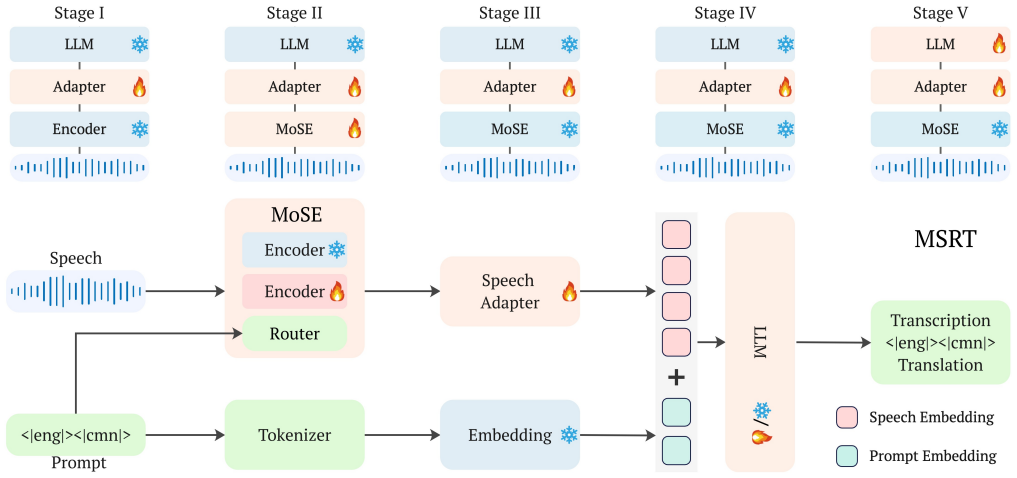
The load-bearing mechanism is MoSE, a mixture of two homogeneous speech encoders under an explicit language-level router. The frozen expert $E_f$ preserves the original Whisper representations for high-resource languages; the trainable expert $E_t$ starts from the same initialization and adapts to medium- and low-resource speech; and the router maps each source-language token to one expert, $R(\ell_s)\in\{f,t\}$, so only one encoder runs per utterance. Because the two experts share architecture, their outputs pass through one Q-Former and MLP adapter into a frozen LLM, avoiding expert-specific projections. A five-stage curriculum, from English ASR through multilingual ASR, translation activation, end-to-end SRT, and LLM LoRA adaptation, is what makes this alignment work with roughly 10 hours of paired data per language.
What would settle it
Re-run the ablation with the Table 3 assignments permuted, routing a random half of the high-resource languages through the trainable expert and a random half of the medium- or low-resource languages through the frozen expert while keeping all other settings fixed. If average COMET does not fall relative to the paper's assignment, the gain comes from having two encoders rather than from the resource-aware routing itself.
Extended reading notes
Core claim
The paper's central claim is that resource-aware encoder specialization, not parameter count, is what produces consistent many-to-many speech-to-text translation. MSRT-4B pairs a frozen Whisper encoder that keeps the original weights for 15 high-resource languages with a trainable Whisper encoder, starting from the same initialization, that specializes in 33 medium- and low-resource languages; the source-language token selects the expert for each utterance. The ablation evidence is that this two-expert design raises average COMET by 3.0 points on low-resource, 2.2 on medium-resource, and 1.4 on high-resource languages relative to the single-shared-encoder variant, so the claimed effect is a simultaneous improvement rather than a trade-off, with the largest absolute gains on the languages that usually fare worst.
Load-bearing premise
The load-bearing premise is the fixed, hand-chosen split of the 45 languages into 15 high-resource and 33 medium/low-resource groups in Table 3, together with the claim that high-resource speech is best served by keeping the original Whisper weights frozen while a trainable copy serves everyone else.
Editorial extensions
If this is right
- If the central claim holds, multilingual speech translation quality comes from separating preservation from adaptation on the speech side, and scaling the encoder or LLM is not the decisive lever.
- Low-resource languages should show the largest gains, around 3.0 COMET points over a single shared encoder, while high-resource languages hold steady and gain about 1.4 points.
- The five-stage curriculum implies new languages can be added with about 10 hours of paired speech each, provided the underlying LLM already translates them.
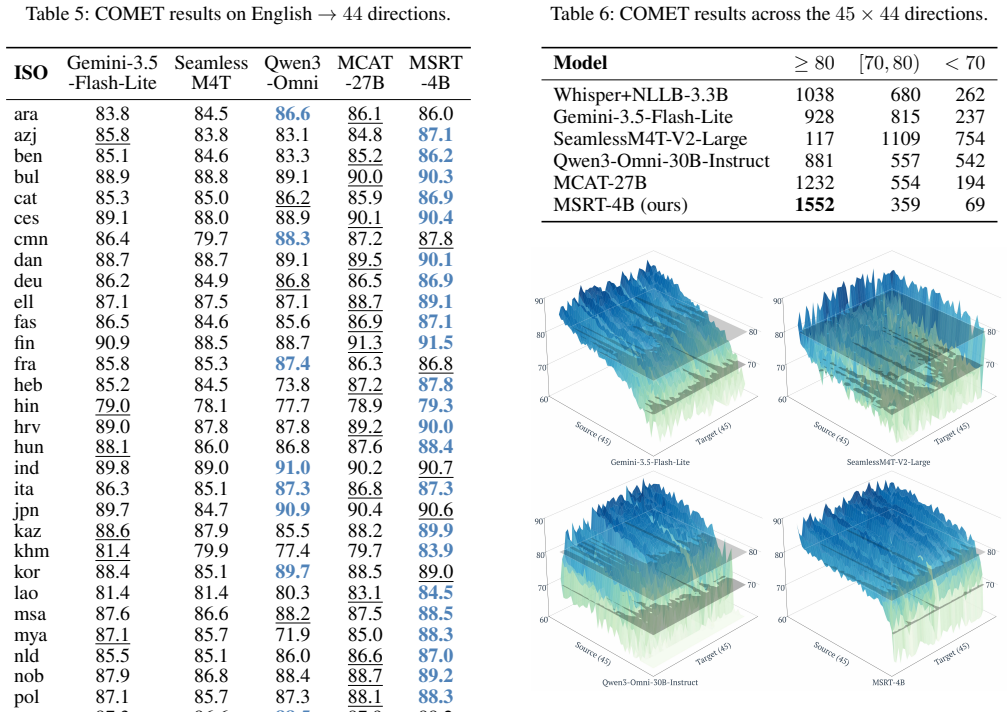
- Consistency spreads across the whole direction grid: 1,552 of 1,980 directions score at least 80 COMET, versus 1,232 for the 27B-parameter baseline, narrowing the gap between English-centric and many-to-many performance.
Reading between the lines
- (Editorial inference) The same architecture could be tested with a learned or measured router: assigning languages to experts by observed COMET gains instead of resource-level tables would remove the dependence on an external taxonomy.
- (Editorial inference) A quick stress test the paper leaves implicit is to swap the assignment for a few languages, routing a high-resource language through the trainable expert and a low-resource language through the frozen one; the resource-aware story predicts a clear COMET drop.
- (Editorial inference) The frozen-generalist plus trainable-specialist pattern may transfer to other many-to-many speech tasks, such as multilingual ASR or speech-to-speech translation, but the paper tests only speech-to-text translation.
Editorial analysis
A structured set of objections, weighed in public.
Referee Report
Summary. The paper proposes MSRT, a many-to-many speech-to-text translation (S2TT) model built around a resource-aware Mixture of Speech Encoders (MoSE). MoSE pairs a frozen Whisper encoder for 15 high-resource languages with a trainable Whisper encoder for 33 medium- and low-resource languages, using an explicit language router to select the expert per utterance, followed by a shared Q-Former/MLP adapter and a frozen LLM that is later adapted with LoRA. The authors introduce a five-stage curriculum and claim that the model, MSRT-4B, requires only about 10 hours of paired S2TT data per language, achieves 83.3 average COMET over all 1,980 FLEURS directions, outperforms larger baselines such as MCAT-27B and Qwen3-Omni-30B, and transfers to CoVoST-2. Ablation results attribute the gains to MoSE, with reported improvements of +1.4, +2.2, and +3.0 COMET points for high-, medium-, and low-resource languages, respectively.
Significance. If the central claims hold, the paper makes a useful empirical contribution: it shows that a simple, explicit, utterance-level routing of speech encoders by resource level can mitigate multilingual interference and improve consistency across many translation directions, while keeping inference cost equal to a single encoder. The evaluation is comprehensive in coverage — all 45×44 non-identity FLEURS directions — and the authors state they will release code and models, which strengthens reproducibility. The claimed parameter efficiency and data efficiency are also practically relevant. However, the causal role of the 'resource-aware' partition is not established by the current experiments, and several reporting gaps (training/evaluation split, error bars, total parameter count) prevent the results from being fully load-bearing.
major comments (5)
- [Ablation Study (Table 7, Figure 4)] The central claim that resource-aware routing, rather than the mere presence of two encoders, is what breaks the curse of multilinguality is not supported by the ablations as reported. Table 7 and Figure 4 compare the two-expert MoSE against a single-expert variant, but this comparison varies at least three factors at once: the number of experts, the freeze status of the high-resource expert, and the specific language-to-expert partition. A comparison against a two-trainable-expert model with the same partition, or against a two-expert model with a random or reversed partition, would be needed to isolate the effect of the resource-aware assignment. As written, the observed gains could be explained by parameter separation alone or by preserving the pretrained Whisper weights for high-resource languages, rather than by the specific high/medium-low partitioning.
- [Experimental Settings – Datasets; Main Results] The paper does not state how the FLEURS data are split between training and evaluation. The text says paired speech–text data from FLEURS are used for S2TT training and that the models are then evaluated 'on both FLEURS and the CoVoST-2 benchmark.' Without an explicit train/dev/test split, the reported COMET scores on FLEURS risk train–test contamination. The authors should specify the exact split (e.g., FLEURS train/dev/test), confirm that no evaluation utterances were seen during training, and report results separately for each split if applicable.
- [Main Results (Tables 4–7)] No error bars, confidence intervals, or significance tests are reported for any COMET or spBLEU result. Several headline differences are small relative to the typical variability of COMET on speech translation test sets — for example, the overall average 83.3 vs. 80.9 for MCAT-27B in Table 4, or the 75.1 vs. 75.3 comparison between two-expert and three-expert configurations in Table 7. To support the ranking claims and the ablation claims, the authors should report variance across test folds, bootstrap confidence intervals, or pairwise significance tests (e.g., paired bootstrap on the direction-level scores).
- [Model Architecture; Parameter Efficiency] The manuscript repeatedly calls the model 'MSRT-4B' a '4B-parameter model' (Abstract, Table 4, Experiments), but the model comprises a MiLMMT-4B LLM plus two Whisper encoders and a Q-Former/MLP adapter. If MiLMMT-4B is a 4B-parameter LLM, then the total parameter count necessarily exceeds 4B. The parameter-efficiency comparison against MCAT-27B and Qwen3-Omni-30B depends on a correct total count, so the authors should report the total number of parameters, including both speech encoders and the adapter, and clarify what '4B' refers to.
- [Methodology – Speech Adapter (Sec. 3.1)] The shared Q-Former/MLP adapter is assumed to work with both the frozen and the trainable Whisper encoders without expert-specific projection layers. The paper states this compatibility is due to identical initialization, but the trainable expert is fine-tuned on medium- and low-resource speech, so its representation space can drift away from the frozen expert. No experiment or analysis addresses whether this drift affects adapter quality. A simple check would be to compare the current shared adapter against per-expert adapters, or to measure the representation distance between the two encoders on held-out utterances before and after training.
minor comments (4)
- [Table 3] The resource-level assignments are said to follow SeamlessM4T, but the paper does not point to the specific SeamlessM4T resource-level table or definition; please provide a precise reference or reproduce the grouping criterion.
- [Abstract and Datasets] The claim of 'only 10 hours of paired S2TT data per language' should state explicitly that this figure refers to FLEURS paired speech–translation data and does not include the additional Common Voice 24 data used for ASR pre-training; otherwise the data-efficiency statement is ambiguous.
- [Ablation Study (Table 7)] The sentence that 'larger language inventories may benefit from finer-grained expert partitioning' is speculative; the 3-expert result (75.3 vs. 75.1) does not provide evidence of such a benefit, and the statement should be softened or supported.
- [Figure 4] Figure 4 is referenced for the per-resource-group gains of +1.4/+2.2/+3.0, but the caption does not state the number of languages or directions averaged in each resource group; please clarify the denominator and whether this is the same six-language set as Table 7 or the full 45-language set.
Circularity Check
No significant circularity: the MoSE result is an empirical same-data ablation, and the resource partition is externally defined.
full rationale
We find no circular derivation. The paper's central claim is that MoSE improves translation for low-, medium-, and high-resource languages relative to a single shared encoder. This is substantiated by Table 7 and Figure 4, where the two-expert model (75.1 average COMET) is compared with a one-expert variant (70.0) trained in the same pipeline; the gains are empirical and are not constructed from fitted values. The language-to-expert routing in Table 3 is taken from SeamlessM4T's external resource levels, not from the paper's own outputs, so the 'resource-aware' assignment is an input assumption rather than a predicted quantity. The curriculum is inherited from the authors' prior work (Du et al. 2025), and MCAT (Du et al. 2026) is used as a baseline, but neither citation is invoked to force the MoSE conclusion; the ablation and full-direction evaluation are self-contained in this paper. The absence of a random-partition or trainable-high-resource counterfactual is a limitation on causal attribution, but it is not circularity: the conclusion does not reduce to the design choice by definition. No fitted parameter is renamed as a prediction, and no uniqueness theorem is imported.
Assumptions & free parameters
free parameters (3)
- Language-to-expert routing table =
Table 3: 15 high-resource languages routed to frozen expert; 18 medium + 12 low to trainable expert
- LoRA rank and alpha =
r=16, alpha=32
- Q-Former query count =
80 learnable queries
assumptions (3)
- domain assumption The curse of multilinguality, defined for text representations by Conneau et al. 2020, is the binding bottleneck for a shared speech encoder at about 10 hours of paired data per language.
- domain assumption COMET-22 scores faithfully rank system quality across all 1,980 translation directions; no human evaluation is reported.
- domain assumption FLEURS training and evaluation use the standard split, and all baselines were evaluated under comparable prompts and decoding conditions.
Cite this review
Pith. "Pith review of Breaking the Curse of Multilinguality in Many-to-Many Speech-to-Text Translation via a Resource-Aware Mixture of Speech Encoders." pith.science (2026). https://pith.science/paper/YL5HM35H
@misc{pith2026260804586,
  author       = {Pith},
  title        = {Pith review of: Breaking the Curse of Multilinguality in Many-to-Many Speech-to-Text Translation via a Resource-Aware Mixture of Speech Encoders},
  year         = {2026},
  howpublished = {\url{https://pith.science/paper/YL5HM35H}},
  note         = {Machine review of arXiv:2608.04586}
}
abstract
Multimodal large language models (MLLMs) have achieved significant success in speech-to-text translation (S2TT). However, when processing multilingual speech inputs, a single speech encoder shared across all languages suffers from the curse of multilinguality: languages at different resource levels compete for limited representation capacity, leading to strong high-resource performance but substantial degradation on low-resource speech. To address this problem and improve multilingual consistency, we propose MSRT, a novel framework built around a resource-aware Mixture of Speech Encoders (MoSE). MoSE uses an explicit language router to assign each utterance to an appropriate expert encoder. A frozen expert preserves high-resource language capabilities, while a trainable expert adapts to and specializes in medium- and low-resource languages. We further introduce a five-stage curriculum learning strategy that substantially reduces data dependence, requiring only 10 hours of paired S2TT data per language for effective alignment. We conduct extensive experiments on 45 languages, systematically evaluating all $45 \times 44$ translation directions. Our 4B-parameter model achieves state-of-the-art performance, outperforming substantially larger baselines. Empirical analyses show that MoSE improves high-, medium-, and low-resource languages simultaneously, with the largest gains on low-resource speech, thereby breaking the curse of multilinguality without compromising high-resource performance. To support future multilingual S2TT research, we release our code and models.
Figures

Figures from the paper (2 more)


Reviewed August 6, 2026 · model on record in the stance chip above.
Discussion (0). Sign in to comment.