REVIEW 3 major objections 5 minor 25 references
An improved car-oriented mean-field theory for stochastic traffic flow models
T0 review · 3 major / 5 minor · reviewed 2026-08-06 · deepseek-v4-flash
Pith's one-line read Pairing cars with their leaders reproduces jam states analytically.
desk verdict A new mean-field closure that captures phase separation in the VDR model; the exactness claim needs proof, but the method is a genuine contribution. read the letter →
The pith
A machine-rendered reading of the paper's core claim, the machinery that carries it, and where it could break.
The reading
What carries the argument
The central object is the two-car joint distribution $P(n;u,v)$: the probability that a car of velocity $u$ has exactly $n$ empty cells in front of a car of velocity $v$. The master equations for these distributions are closed by replacing the movement of the leading car with the global conditional probability $g_v=(1-p(v))(1-P_{v0}(0)/P_v)$, which depends only on the leader's velocity and the marginal probability that a velocity-$v$ car has zero headway. Generating functions $F_{uv}(z)$ convert the infinite set of equations into an algebraic system whose solution is fixed by a cubic equation for $g_0$ and the density condition $F'(1)=1/\rho$. The vanishing of the Garden-of-Eden probabilities $P_{01}(0)=P_{11}(0)=0$ is built into the master equations and is what forces the phase-separated structure: pair configurations that the dynamics can never create are absent from the stationary state.
What would settle it
Simulate the VDR model with $v_{\max}=1$ and measure, for every pair configuration, the probability $M(u,v,n)$ that the car ahead moves during an update given that the car behind has velocity $u$, the leading car has velocity $v$, and the distance between them is $n$. iCOMF's master equations use $M=g_v$, independent of $u$ and $n$; a systematic dependence of $M$ on $u$ or $n$ would show the factorization is only an approximation.
Extended reading notes
Core claim
The paper's claim is that the stationary state of the VDR model with $v_{\max}=1$ is captured by a factorized description over pairs of successive cars, $P(\{n_i;v_i\}) \sim \prod_i P(n_i; v_i, v_{i+1})$, in which each pair's joint velocity and headway distribution is treated exactly. The coupling between pairs enters through one conditional probability $g_v$: the chance that a car of velocity $v$ moves during an update, evaluated as $(1-p(v))\,(1-P_{v0}(0)/P_v)$. Solving the resulting master equations by generating functions reduces the stationary state to the root of a cubic equation for $g_0$ together with the density condition. In the cruise-control limit $p=0$, explicit formulas show that the only configurations surviving in the congested phase are a stationary car immediately behind another stationary car and a moving car separated from a moving leader by at least one empty site; all other pair configurations vanish in the thermodynamic limit. The paper reports that these distributions, and the resulting fundamental diagram, match simulations for all $p_0$ and $p$, and it suggests this agreement may reflect an exact property of the model.
Load-bearing premise
The load-bearing premise is that a leading car's chance of moving depends only on its own velocity through one global average, not on the configuration further ahead; if that factorization fails, the predicted headway distributions and phase-separated structure collapse.
Editorial extensions
If this is right
- For the VDR model with $v_{\max}=1$, the stationary state can be computed analytically at every density and for every choice of $p_0$ and $p$, including the phase-separated regime where a single mega-jam coexists with free flow.
- In the cruise-control limit $p=0$, the explicit headway distributions show that only two pair configurations survive in the congested phase, and the average free-flow headway is $\langle n\rangle=(1-p_0)^{-1}$.
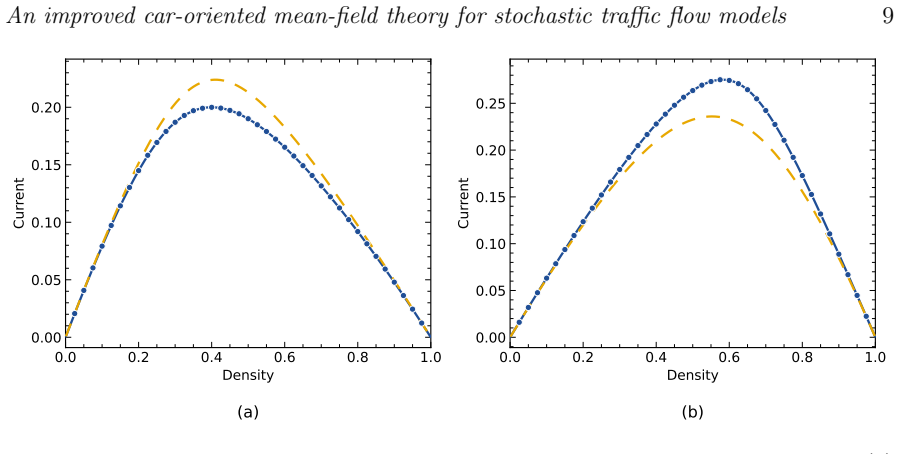
- For $p>0$, the original COMF flow--density curve deviates from simulations once the cruise-control 'error cancellation' is lost; iCOMF removes that deviation and matches the simulated fundamental diagram.
- If the paper's suggestion of exactness is right, the pair factorization is not merely an approximation but the exact stationary-state structure of the VDR model with $v_{\max}=1$.
Reading between the lines
- The paper leaves the three-car test unstated: if the simulated probability that a car moves depends on the velocity of the car two places ahead, beyond what the immediate leader's velocity already encodes, the pair factorization would show itself as approximate at that order.
- For $v_{\max}>1$, the natural next step is to include the second leader's velocity or the leader's own headway in the pair variable; the paper's success suggests a hierarchy of closures whose convergence could be tested on the metastable branches seen in simulations for longer interaction ranges.
- The explicit cruise-control solutions imply finite-size predictions, such as the distribution of mega-jam lengths as a function of density, which the paper does not derive and which could be checked on small lattices where thermodynamic-limit simplifications break down.
Editorial analysis
A structured set of objections, weighed in public.
Referee Report
Summary. The manuscript proposes an improved car-oriented mean-field theory (iCOMF) for one-dimensional cellular automaton traffic models. The steady state is taken as a product over nearest-neighbor pairs of cars, with pair probabilities P_uv(n) for a car of velocity u having n empty cells ahead of a leader of velocity v, and a closure (Eq. 4) in which the probability that the leader moves is the single-car marginal g_v. The resulting nonlinear master equations are solved by generating functions. The theory is applied to the VDR model with v_max=1. In the cruise-control limit p=0 the authors obtain closed-form headway distributions and a fundamental diagram that coincide with COMF for the current but improve on COMF for headway distributions by reproducing the phase-separated mega-jam structure. For general p0 and p the paper reports excellent agreement with simulations for the current and headway distributions at selected parameter values and suggests that iCOMF may be exact for this model.
Significance. If the claims are correct, iCOMF provides a rare analytic handle on inhomogeneous and phase-separated stationary states of slow-to-start traffic models, going beyond COMF and the two-site cluster method for v_max=1. The derivations are transparent, the cruise-control limit yields explicit formulas, and no parameter is fitted to simulation data. The main value is the explicit demonstration that a mild extension of COMF, conditioning on the velocity of the car ahead, captures the structure of the phase-separated state and the headway distributions that COMF misses. However, the paper's strongest claims, possible exactness and agreement for all parameter values, are not supported to the same standard as the derivations and require revision.
major comments (3)
- [Section 3, Eq. (4); Appendix A, Eqs. (A.1)-(A.8)] The closure g_v replaces the leader's move probability by the single-car marginal (1-p(v)) Prob(headway>=1 | v). In the exact dynamics the probability that the leader moves in a transition starting from a pair state (u,v,n) is (1-p(v)) Prob(h_leader>=1 | u,v,n), which depends on the leader's own headway and generally on the following car's state. The master equations are therefore not exact pair equations; they assume conditional independence of the leader's mobility from the pair configuration. The paper neither proves this independence for the stationary state nor quantifies the induced error. Consequently the Section 6 statement that the results may, in fact, be exact is unsupported. The authors should either prove the closure in the stationary state or explicitly label iCOMF as an approximation and temper the exactness conjecture.
- [Appendix A, Eq. (A.21)] The solution procedure reduces the problem to the roots g0 of a cubic, but no selection criterion for the physical root is given. In the cruise-control limit there are distinct stable and metastable branches, and for p>0 the paper does not state whether the cubic has a unique root in [0,1] or how the relevant branch is chosen. Without this, the reported curves cannot be reproduced and the claim that the theory applies across all densities is incomplete.
- [Section 5 and Figs. 5-7] The claim of agreement for all values of p0 and p is not established by the data presented. Only two generic parameter sets (p0=0.5, p=0.1 and p0=0.1, p=0.5) are shown, together with the cruise-control limit p=0. The simulation data have no error bars and the text gives no system size, averaging time, or number of runs. The authors should provide a parameter scan, or at least error bars and statistical details for the shown curves, or restrict the claim to the tested parameter region.
minor comments (5)
- [Fig. 4 caption] The caption uses 'p1 = 0' where it should read 'p = 0'.
- [Section 4, Eqs. (9)-(12)] The notation Pv(0)(COMF) mixes superscripts and function arguments; the formulas would be clearer as P_v^{(COMF)}(n).
- [Fig. 3(a)] The caption states that stable and metastable theoretical results are compared with simulations, but the curves are not identified; please label the branches explicitly.
- [Section 6] The sentences claiming excellent agreement for other models and for NaSch v_max > 1 cite forthcoming work [25] and are not substantiated in this manuscript; they should be moved to a clearly labeled outlook or removed.
- [Throughout] The text uses both 'v_max' and 'vmax'; please unify the notation.
Circularity Check
No circularity: iCOMF is a self-consistent closure with g_v fixed by normalization and density, validated against external simulations; self-citations to GOE/COMF are building blocks, not the target result.
full rationale
The central derivation is self-contained. The iCOMF master equations (A.1)-(A.8) introduce a closure g_v in Eq. (4) that is defined in terms of the stationary pair probabilities and then fixed by normalization and the density condition F'(1)=1/rho (A.15, A.21); no parameter is fitted to simulation data. The inputs p0, p, and rho are external. The zeros P01(0)=P11(0)=0 are justified by the Garden-of-Eden argument cited to the authors' earlier work [12], but this is an independently verifiable exact statement about the parallel update, not an assumption that contains the target result. The comparison to computer simulations is an external benchmark. The paper's own caveat that the closure is an approximation, and the Sec. 6 exactness conjecture presented as a suggestion, is a correctness or rigor concern rather than circularity. Self-citations to prior COMF [14] and GOE [12] results are used as building blocks, not as the predicted conclusion.
Assumptions & free parameters
assumptions (3)
- domain assumption The stationary state factorizes over pairs of consecutive cars: P({n_i;v_i}) ~ prod_i P(n_i; v_i, v_{i+1}) (Eq. 3).
- domain assumption A car's movement probability is captured by the global conditional probability g_v defined in Eq. (4), which depends only on the car's own velocity and the marginal zero-headway probability P_v0(0)/P_v.
- domain assumption Garden of Eden states P01(0)=P11(0)=0 (Eqs. A.3, A.7) hold exactly for the VDR model with vmax=1.
Cite this review
Pith. "Pith review of An improved car-oriented mean-field theory for stochastic traffic flow models." pith.science (2026). https://pith.science/paper/DOJML7F4
@misc{pith2026260804731,
  author       = {Pith},
  title        = {Pith review of: An improved car-oriented mean-field theory for stochastic traffic flow models},
  year         = {2026},
  howpublished = {\url{https://pith.science/paper/DOJML7F4}},
  note         = {Machine review of arXiv:2608.04731}
}
abstract
We propose an improved mean-field analysis of cellular automata models of single-lane vehicular traffic. By combining aspects of the Car-Oriented-Mean-Field (COMF) theory and the 2-site cluster method, which have been previously successfully applied to similar models, we aim to capture both short- and long-range correlations more accurately. In contrast to classical mean-field theories, the improved method is well suited for models with inhomogeneous stationary states and able to capture the essential properties of phase separation, e.g. in models with slow-to-start rules. The improved accuracy and new physical insights are illustrated through an application to the VDR model with $v_{\text{max}}=1$.
Figures


Figures from the paper (4 more)



Reference graph
Works this paper leans on
-
[1]
D. Chowdhury, L. Santen, and A. Schadschneider. Statistical physics of vehicular traffic and some related systems.Physics Reports, 329:199–329, 2000
work page 2000
-
[2]
A. Schadschneider, D. Chowdhury, and K. Nishinari.Stochastic Transport in Complex Systems. From Molecules to Vehicles. Elsevier, 2010. An improved car-oriented mean-field theory for stochastic traffic flow models16
work page 2010
-
[3]
J. Esser and M. Schreckenberg. Microscopic simulation of urban traffic based on cellular automata. Int. J. Mod. Phys. C, 8:1025, 1997
work page 1997
- [4]
- [5]
-
[6]
D. Chowdhury, J. Kertesz, K. Nagel, L. Santen, and A. Schadschneider. Comment on ”Critical behavior of a traffic flow model”.Phys. Rev. E, 61:3270, 2000
work page 2000
- [7]
-
[8]
K. Nagel and M. Schreckenberg. A cellular automaton model for freeway traffic.Journal de Physique I, 2:2221, 1992
work page 1992
Show all 25 references
-
[9]
B. Derrida. An exactly soluble non-equilibrium system: The asymmetric simple exclusion process. Physics Reports, 301(1):65–83, 1998
1998
-
[10]
Sch¨ utz
G.M. Sch¨ utz. Exactly solvable models for many-body systems far from equilibrium.Phase Transitions and Critical Phenomena, 19:1, 2000
2000
-
[11]
Evans and R.A
M.R. Evans and R.A. Blythe. Nonequilibrium dynamics in low-dimensional systems.Physica A, 313:110, 2002
2002
-
[12]
Schadschneider and M
A. Schadschneider and M. Schreckenberg. Garden of Eden states in traffic models.J. Phys. A, 31:L225, 1998
1998
-
[13]
Schreckenberg, A
M. Schreckenberg, A. Schadschneider, K. Nagel, and N. Ito. Discrete stochastic models for traffic flow.Phys. Rev. E, 51:2939, 1995
1995
-
[14]
Schadschneider and M
A. Schadschneider and M. Schreckenberg. Car-oriented mean-field theory for traffic flow models. J. Phys. A, 30:L69, 1997
1997
-
[15]
Barlovic, L
R. Barlovic, L. Santen, A. Schadschneider, and M. Schreckenberg. Metastable states in cellular automata for traffic flow.Eur. Phys. J. B, 5:793–800, 1998
1998
-
[16]
Evans and T
M.R. Evans and T. Hanney. Nonequilibrium statistical mechanics of the zero-range process and related models.J. Phys. A: Math. Gen., 38:R195–R240, 2005
2005
-
[17]
F. Spitzer. Interaction of Markov processes.Adv. Math., 5:246, 1970
1970
-
[18]
Schadschneider and M
A. Schadschneider and M. Schreckenberg. Traffic flow models with ‘slow-to-start’ rules.Annalen der Physik, 509(7):541–551, 1997
1997
-
[19]
Takayasu and H
M. Takayasu and H. Takayasu. 1/fnoise in a traffic model.Fractals, 1(4):860, 1993
1993
-
[20]
Benjamin, N.F
S.C. Benjamin, N.F. Johnson, and P.M. Hui. Cellular automata models of traffic flow along a highway containing a junction.J. Phys. A, 29:3119, 1996
1996
-
[21]
Barlovic
R. Barlovic. Exact stationary state for an ASEP with fully parallel dynamics.Diploma Thesis, Duisburg University, 1998
1998
-
[22]
Nagel and M
K. Nagel and M. Paczuski. Emergent traffic jams.Phys. Rev. E, 51:2909, 1995
1995
-
[23]
Schadschneider
A. Schadschneider. The Nagel-Schreckenberg model revisited.Eur. Phys. J. B, 10(3):573–582, 1999
1999
-
[24]
Appert and L
C. Appert and L. Santen. Boundary induced phase transitions in driven lattice gases with metastable states.Phys. Rev. Lett., 86:2498–2501, 2001
2001
-
[25]
Efe Dai, A
Y. Efe Dai, A. Schadschneider, and M. Schreckenberg. Applications of improved car-oriented- mean-field theories. In preparation, 2026
2026
Reviewed August 6, 2026 · model on record in the stance chip above.
Discussion (0). Continue with ORCID to comment.