REVIEW 3 major objections 5 minor 47 references
In-Context Forcing: Uncovering Context Effects in Autoregressive Video Diffusion
T0 review · 3 major / 5 minor · reviewed 2026-08-08 · deepseek-v4-flash
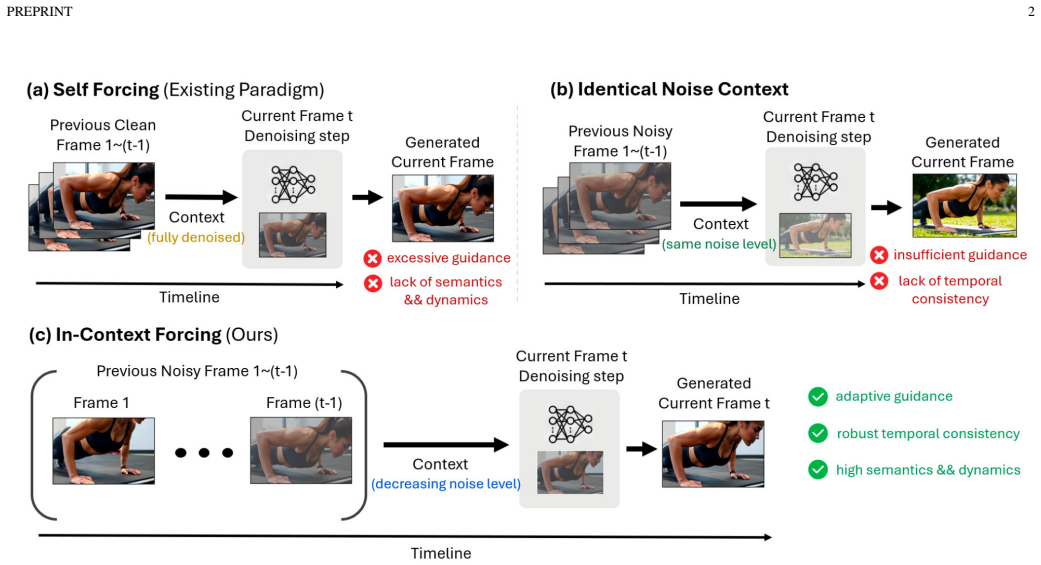
Pith's one-line read In-Context Forcing claims that conditioning each frame on previous frames at decreasing noise levels—noisier for close frames, cleaner for distant ones—simultaneously improves temporal dynamics and cuts inference time by up to 45.1%.
desk verdict A concrete and plausible new context-noise schedule for autoregressive video diffusion, but the mechanism is confounded with attention-parallelism changes and the empirical reporting is too thin to fully certify. read the letter →
The pith
A machine-rendered reading of the paper's core claim, the machinery that carries it, and where it could break.
The reading
What carries the argument
The mechanism is the progressive context schedule with decreasing noise levels, combined with a Step-wise Rolling KV Cache for training and cross-frame causal attention for inference. In the schedule matrix $\mathcal{T}$ of Eq. (6), each column runs monotonically from $t_0$ to $t_T$, and the lower-triangular dominance ensures a frame only attends to preceding frames at equal or higher noise levels; this staircase encodes a relaxed causal order in which a new frame can start denoising once its predecessors have advanced to informative states. The Step-wise Rolling KV Cache stores one key-value memory per noise level, updates them with a bottom-up rolling pass after each frame finishes, and simulates the inference schedule during training to keep the student's output distribution consistent with inference. At inference, the multi-level caches are collapsed into a single unified KV cache, and the schedule matrix selects which frames are active at each step so they can be denoised in parallel.
What would settle it
Train the same student with identical data, teacher, and distribution-matching loss under four context schedules—progressive decreasing noise, identical noise, a constant noise offset, and random per-frame noise—and compare the standard benchmark's total score and dynamic-degree metric; if any alternative matches or beats In-Context Forcing while all beat the clean-context baseline, then the specific decreasing schedule is not what drives the improvement.
Extended reading notes
Core claim
The central discovery is that the noise level of the context frames should be scheduled along both the frame distance and the denoising step: frame $i$ at step $t_j$ is conditioned on frame $i-k$ at step $t_{j-k}$, with $t_{j-k}$ clipped to $t_0$ when $j-k<0$, so nearby frames are seen at higher noise and distant frames at lower noise. This is read as diffusion as masking: noise is a mask that hides detail, and the schedule controls how much local detail each context frame reveals at each stage. The paper shows that this progressive schedule prevents the shortcut of copying exact local patterns, producing smoother cross-frame attention in early steps that converges to sharp attention later, and that it improves the reported benchmark scores, including dynamic degree and semantic alignment. In addition, the same decoupling of dependence on clean frames enables cross-frame causal attention, so multiple frames denoise in parallel through a single unified key-value cache at inference.
Load-bearing premise
The load-bearing premise is that the hand-chosen decreasing-noise context schedule in Eq. (5) is the right schedule, and the paper does not ablate it against alternatives such as a constant noise offset, identical noise, or random per-frame noise in a controlled training experiment.
Editorial extensions
If this is right
- The same architecture trained with progressive contexts scores higher on the standard benchmark than the clean-context baseline, with the largest gains in dynamic degree (72 vs 63 on short clips) and long-video motion diversity.
- The schedule can be applied plug-and-play to an already trained clean-context model's weights, improving quality without retraining, suggesting that distilled few-step models retain multi-noise-level competence.
- Cross-frame parallel denoising cuts inference time by 45.1% in the frame-wise setting and 9.3% in the chunk-wise setting relative to the clean-context baseline, with no measured quality loss.
- Attention maps show the early denoising stage spreads attention broadly across previous frames rather than concentrating on exact matching pixels, then narrows in later steps; this coarse-to-fine attention behavior is part of the claimed mechanism.
- The gain comes with a training cost: the model needs more distillation iterations (1,900 vs 1,500) to adapt to the diverse context noise levels.
Reading between the lines
- Editorial inference: the decreasing-noise context principle should transfer to other sequential generative settings, such as world models or streaming video prediction, where clean context causes copying; a direct test would be swapping the schedule into a non-video autoregressive diffusion model and measuring diversity.
- Editorial inference: the fixed hand-chosen schedule may be suboptimal for content with very different motion scales; a content-adaptive schedule learned from data could outperform it, especially in high-motion scenes.
- Editorial inference: the persistence of sparse attention maps even after distillation suggests that pruning or sparsifying attention could compound the parallel-denonising speedup, a direction the paper itself mentions as future work.
Editorial analysis
A structured set of objections, weighed in public.
Referee Report
Summary. The paper proposes In-Context Forcing, a progressive autoregressive paradigm for few-step video diffusion in which previous frames are provided as context with decreasing noise levels (higher noise for adjacent frames, lower noise for distant frames), rather than as fully denoised clean frames. The method is trained with a Step-wise Rolling KV Cache that maintains these progressive contexts via self-simulation, and inference is accelerated with cross-frame parallel denoising under a unified KV cache with causal attention. The authors report improved VBench scores, better user-study preferences, and substantial inference speedups over CausVid, Self Forcing, and Rolling Forcing.
Significance. If the central mechanism holds, the paper identifies and addresses a genuine limitation of clean-context autoregressive video diffusion: clean contexts can leak local details and induce shortcut copying, which the proposed progressive-noise schedule mitigates while also enabling parallel denoising. The plug-and-play result in Table IV is a valuable piece of evidence because it shows that the progressive context helps even without retraining, and the attention-map analysis provides a plausible qualitative mechanism. The paper is also credit-worthy for its careful articulation of the train-test consistency problem in Rolling Forcing and for releasing video comparisons. However, the central attribution of the gains to the specific decreasing-context-noise schedule is not yet established because the plug-and-play comparison confounds the schedule with a changed inference organization, and the paper lacks controlled ablations over context schedules.
major comments (3)
- [Section III-D, Table IV] The plug-and-play comparison changes two variables at once: the context noise schedule and the inference organization (cross-frame parallel denoising with a unified KV cache and causal attention across frames). Even if the latter is nominally output-equivalent to sequential generation, attention composition and KV reuse differ, so the 0.02 dynamic-degree gain over Self Forcing cannot be attributed to the decreasing-noise schedule alone. The paper asserts that identical-noise contexts 'provide insufficient guidance' but reports no controlled experiment for that assertion, and no reversed-order or constant-offset control is given. Please add ablations that hold training, model weights, and the exact parallel inference procedure fixed while varying only the context noise schedule (e.g., identical noise, reversed ordering, constant offset, random per-frame levels). This is load-bearing because the central claim is specifically that the progressive ordering of context noise is what improves temporal consistency and dynamics.
- [Section III-C, Eq. (6)] The schedule matrix T is underspecified and its stated property is inconsistent with the displayed matrix. The text says 'each column follows a monotonically non-decreasing trajectory from t_0 to t_T,' but the first column shown is t_T, t_{T-1}, ..., t_0, 0 (= t_0), ..., t_0, which is non-increasing in the first rows and then constant. The dimensions N×M, the row/column indexing, and the meaning of the entries relative to Eq. (5) are also not defined precisely enough to reconstruct the intended context schedule. Please provide a self-consistent formal specification, correct the monotonicity statement, and clarify how the matrix maps to the progressive context schedule used in Algorithm 1 and Algorithm 2.
- [Section IV-A and Appendix D] The quantitative evaluation is reported without variance: Table I's footnote says the evaluation was conducted with a consistent random seed, but no repeated-seed statistics are given, and several headline comparisons are small (e.g., 84.34 vs. 83.95 total score; 0.653 vs. 0.633 dynamic degree in Table IV). The user study in Fig. 5 and Appendix D does not report the number of participants, the number of pairwise ratings per baseline, or any significance test. Because the paper claims 'significantly outperforms' and the user study is a central part of that claim, please report means and standard deviations over multiple seeds and include participant counts with a statistical test or at least confidence intervals for the preference results.
minor comments (5)
- [Abstract / Section III-B, Eq. (5)] The indexing in Eq. (5) is easy to misread: the context frame x^{i-k} at t_{j-k} means smaller k gives larger t (higher noise). Please state explicitly that k is the distance in frames and that the noise level decreases as frame distance increases, to match the prose in the abstract and Section III-B.
- [Appendix E] The limitation paragraph says the method needs 1900 iterations versus 1500 for the baseline. This is a modest but real cost; please state whether this is a fixed number of iterations or whether it reflects a convergence criterion, and note the wall-clock impact if available.
- [Fig. 5 and Appendix D] The bar chart in Fig. 5 reports only aggregate preferences; the appendix describes a 'comprehensive score evaluation' but Table V does not state how many videos or participants were used. Adding that information would make the user study auditable.
- [Algorithm 1, line 18] The operation G_KV^θ(ˆx_i^0; 0, KV) computes a KV cache from a clean −x0, which is consistent with the t=0 context, but the paper elsewhere emphasizes contexts at decreasing noise levels; please clarify why the clean-frames cache is stored and how it is used in later steps.
- [Section III-D, Algorithm 2] The initialization 'X_θ ← x^{1:M}_{t_T} ∼ N(0, I)' overwrites the previously initialized model output X_θ of line 6 and the KV cache; please clarify whether the initial KV cache is empty or is pre-populated from a warm-up frame, and how the first M frames are seeded.
Circularity Check
No circularity found: the central claims are tested against external benchmarks and user study, and the progressive context schedule is a proposed design rather than a fitted prediction or self-citation load-bearing result.
full rationale
The paper's central claim is empirical: that a progressive context noise schedule improves temporal consistency, dynamics, and inference speed. This claim is evaluated against external benchmarks (VBench) and a blind user study, not derived from the evaluation metric or from the method's defining equations. Equation (5) formalizes the proposed schedule as an ansatz, and the DMD training objective in Eq. (3) is standard external machinery reused from prior work. The plug-and-play experiment in Table IV changes both the context noise schedule and the inference procedure, which is an experimental confound and a limitation of the ablation, not a circular derivation. No fitted parameter is later reported as a prediction, and no load-bearing step is justified solely by a self-citation. The cited prior works (DMD, CausVid, Self Forcing, Rolling Forcing, Diffusion Forcing) are external baselines and engineering components; reliance on them is normal reuse. The concern that alternative context schedules are not ablated, or that the schedule matrix in Eq. (6) is underspecified, is a correctness or evidence-strength issue, not circularity, because it does not show that any claimed result is equivalent to its inputs by construction. Therefore the paper exhibits no significant circularity.
Assumptions & free parameters
free parameters (1)
- Context noise offset schedule t_{j-k} =
linear staircase: t_{j-1}, t_{j-2}, ...
assumptions (4)
- domain assumption Diffusion noise level acts as a mask that hides local details, and progressive denoising follows a coarse-to-fine hierarchy.
- domain assumption The DMD framework in Eq (3), using Wan2.1-14B as teacher and fake score network, produces a valid training signal for a causal student.
- domain assumption Self Forcing weights, through CausVid and Diffusion Forcing initialization, already generalize to diverse noise-level contexts, enabling training-free plug-and-play improvement.
- ad hoc to paper Step-wise Rolling KV Cache training simulates inference behavior closely enough to avoid the train-test gap attributed to Rolling Forcing.
invented entities (2)
-
Step-wise Rolling KV Cache
-
Cross-frame causal attention schedule
Cite this review
Pith. "Pith review of In-Context Forcing: Uncovering Context Effects in Autoregressive Video Diffusion." pith.science (2026). https://pith.science/paper/CS4SOTIK
@misc{pith2026260805237,
  author       = {Pith},
  title        = {Pith review of: In-Context Forcing: Uncovering Context Effects in Autoregressive Video Diffusion},
  year         = {2026},
  howpublished = {\url{https://pith.science/paper/CS4SOTIK}},
  note         = {Machine review of arXiv:2608.05237}
}
read the original abstract
Current few-step autoregressive video diffusion models depend on previous fully denoised clean frames as context for all denoising steps of the current frame. However, these clean frames leak excessive local details, which causes the model to take shortcuts, resulting in compromised temporal semantics and dynamics. Inspired by the perspective of diffusion as masking, we explore the impact of noisy contexts on few-step autoregressive generation. Yet, simply applying contexts with the same noise levels provides insufficient guidance, leading to poor temporal consistency. To resolve this dilemma, we introduce In-Context Forcing, a progressive autoregressive paradigm that utilizes contexts with decreasing noise levels. By applying less masking to distant frames and more masking to adjacent ones, this approach provides adaptive guidance, effectively ensuring both robust temporal consistency and high inter-frame dynamics. Furthermore, by decoupling the strict dependence on previous clean frames, our paradigm enables cross-frame parallel denoising, achieving substantial inference acceleration without sacrificing performance. Extensive experiments on VBench demonstrate that our method significantly outperforms state-of-the-art approaches in both visual fidelity and inference speed.
Figures


Figures from the paper (15 more)


Reference graph
Works this paper leans on
-
[1]
Stable video diffusion: Scaling latent video diffusion models to large datasets,
A. Blattmann, T. Dockhorn, S. Kulal, D. Mendelevitch, M. Kilian, D. Lorenz, Y . Levi, Z. English, V . V oleti, A. Lettset al., “Stable video diffusion: Scaling latent video diffusion models to large datasets,”arXiv preprint arXiv:2311.15127, 2023
arXiv 2023
-
[2]
Align your latents: High-resolution video synthesis with latent diffusion models,
A. Blattmann, R. Rombach, H. Ling, T. Dockhorn, S. W. Kim, S. Fidler, and K. Kreis, “Align your latents: High-resolution video synthesis with latent diffusion models,” inProc. CVPR, 2023
work page 2023
-
[3]
Video generation models as world simulators,
T. Brooks, B. Peebles, C. Holmes, W. DePue, Y . Guo, L. Jing, D. Schnurr, J. Taylor, T. Luhman, E. Luhman, N. Ng, R. Wang, and A. Ramesh, “Video generation models as world simulators,” https: //openai.com/research/video-generation-models-as-world-simulators, 2024, accessed: Jul. 13, 2026
work page 2024
-
[4]
Photorealistic video generation with diffusion models,
A. Gupta, L. Yu, K. Sohn, X. Gu, M. Hahn, F.-F. Li, I. Essa, L. Jiang, and J. Lezama, “Photorealistic video generation with diffusion models,” inProc. ECCV, 2024
work page 2024
-
[5]
LTX-Video: Realtime video latent diffusion,
Y . HaCohen, N. Chiprut, B. Brazowski, D. Shalem, D. Moshe, E. Richardson, E. Levin, G. Shiran, N. Zabari, O. Gordon et al., “LTX-Video: Realtime video latent diffusion,”arXiv preprint arXiv:2501.00103, 2024
arXiv 2024
-
[6]
Imagen video: High definition video generation with diffusion models,
J. Ho, W. Chan, C. Saharia, C. Whang, R. Gao, A. A. Gritsenko, D. P. Kingma, B. Poole, M. Norouzi, D. J. Fleet, and T. Salimans, “Imagen video: High definition video generation with diffusion models,”arXiv preprint arXiv:2210.02303, 2022
-
[7]
J. Ho, T. Salimans, A. Gritsenko, W. Chan, M. Norouzi, and D. J. Fleet, “Video diffusion models,” inProc. NeurIPS, 2022
work page 2022
-
[8]
HunyuanVideo: A systematic framework for large video generative models,
W. Kong, Q. Tian, Z. Zhang, R. Min, Z. Dai, J. Zhou, J. Xiong, X. Li, B. Wu, J. Zhanget al., “HunyuanVideo: A systematic framework for large video generative models,”arXiv preprint arXiv:2412.03603, 2024
arXiv 2024
Show all 47 references
-
[9]
Movie Gen: A cast of media foundation models,
A. Polyak, A. Zohar, A. Brown, A. Tjandra, A. Sinha, A. Lee, A. Vyas, A. Shi, B. Ma, C. Y . Chuanget al., “Movie Gen: A cast of media foundation models,”arXiv preprint arXiv:2410.13720, 2024
2024 arXiv
-
[10]
Phenaki: Variable length video generation from open domain textual description,
R. Villegas, M. Babaeizadeh, P.-J. Kindermans, H. Moraldo, H. Zhang, M. T. Saffar, S. Castro, J. Kunze, and D. Erhan, “Phenaki: Variable length video generation from open domain textual description,”arXiv preprint arXiv:2210.02399, 2022
-
[11]
Wan: Open and advanced large-scale video generative models,
A. Wang, B. Ai, B. Wen, C. Mao, C.-W. Xie, D. Chen, F. Yu, H. Zhao, J. Yang, J. Zenget al., “Wan: Open and advanced large-scale video generative models,”arXiv preprint arXiv:2503.20314, 2025
2025 arXiv
-
[12]
CogVideoX: Text-to-video diffusion models with an expert transformer,
Z. Yang, J. Teng, W. Zheng, M. Ding, S. Huang, J. Xu, Y . Yang, W. Hong, X. Zhang, G. Fenget al., “CogVideoX: Text-to-video diffusion models with an expert transformer,” inProc. ICLR, 2025
2025
-
[13]
Denoising diffusion probabilistic models,
J. Ho, A. Jain, and P. Abbeel, “Denoising diffusion probabilistic models,” inProc. NeurIPS, 2020
2020
-
[14]
Deep unsupervised learning using nonequilibrium thermodynamics,
J. Sohl-Dickstein, E. Weiss, N. Maheswaranathan, and S. Ganguli, “Deep unsupervised learning using nonequilibrium thermodynamics,” inProc. ICML, 2015
2015
-
[15]
Score-based generative modeling through stochastic differ- ential equations,
Y . Song, J. Sohl-Dickstein, D. P. Kingma, A. Kumar, S. Ermon, and B. Poole, “Score-based generative modeling through stochastic differ- ential equations,” inProc. ICLR, 2021
2021
-
[16]
Scalable diffusion models with transformers,
W. S. Peebles and S. Xie, “Scalable diffusion models with transformers,” inProc. ICCV, 2023
2023
-
[17]
Oasis: A universe in a transformer,
Decart, J. Quevedo, Q. McIntyre, S. Campbell, X. Chen, and R. Wachen, “Oasis: A universe in a transformer,” https://oasis-model.github.io/, 2024, accessed: Jul. 13, 2026
2024
-
[18]
Diffusion models are real-time game engines,
D. Valevski, Y . Leviathan, M. Arar, and S. Fruchter, “Diffusion models are real-time game engines,” inProc. ICLR, 2025
2025
-
[19]
GameFactory: Creating new games with generative interactive videos,
J. Yu, Y . Qin, X. Wang, P. Wan, D. Zhang, and X. Liu, “GameFactory: Creating new games with generative interactive videos,”arXiv preprint arXiv:2501.08325, 2025
2025
-
[20]
Streaming video dif- fusion: Online video editing with diffusion models,
F. Chen, Z. Yang, B. Zhuang, and Q. Wu, “Streaming video dif- fusion: Online video editing with diffusion models,”arXiv preprint arXiv:2405.19726, 2024
2024 arXiv
-
[21]
Looking backward: Streaming video-to-video translation with feature banks,
F. Liang, A. Kodaira, C. Xu, M. Tomizuka, K. Keutzer, and D. Mar- culescu, “Looking backward: Streaming video-to-video translation with feature banks,” inProc. ICLR, 2025
2025
-
[22]
Unified video action model,
S. Li, Y . Gao, D. Sadigh, and S. Song, “Unified video action model,” arXiv preprint arXiv:2503.00200, 2025
2025 arXiv
-
[23]
Learning interactive real-world simulators,
M. Yang, Y . Du, K. Ghasemipour, J. Tompson, D. Schuurmans, and P. Abbeel, “Learning interactive real-world simulators,” inProc. ICLR, 2024
2024
-
[24]
Genie: Gener- ative interactive environments,
J. Bruce, M. D. Dennis, A. Edwards, J. Parker-Holder, Y . Shi, E. Hughes, M. Lai, A. Mavalankar, R. Steigerwald, N. Appset al., “Genie: Gener- ative interactive environments,” inProc. ICML, 2024
2024
-
[25]
VideoPoet: A large language model for zero-shot video generation,
D. Kondratyuk, L. Yu, X. Gu, J. Lezama, J. Huang, G. Schindler, R. Hornung, V . Birodkar, J. Yan, M. C. Chiuet al., “VideoPoet: A large language model for zero-shot video generation,” inProc. ICML, 2024
2024
-
[26]
Loong: Generating minute-level long videos with autoregressive language models,
Y . Wang, T. Xiong, D. Zhou, Z. Lin, Y . Zhao, B. Kang, J. Feng, and X. Liu, “Loong: Generating minute-level long videos with autoregressive language models,”arXiv preprint arXiv:2410.02757, 2024
2024 arXiv
-
[27]
Scaling autoregressive video models,
D. Weissenborn, O. T ¨ackstr¨om, and J. Uszkoreit, “Scaling autoregressive video models,” inProc. ICLR, 2020
2020
-
[28]
VideoGPT: Video genera- tion using VQ-V AE and transformers,
W. Yan, Y . Zhang, P. Abbeel, and A. Srinivas, “VideoGPT: Video genera- tion using VQ-V AE and transformers,”arXiv preprint arXiv:2104.10157, 2021
2021 arXiv
-
[29]
From slow bidirectional to fast autoregressive video diffusion models,
T. Yin, Q. Zhang, R. Zhang, W. T. Freeman, F. Durand, E. Shechtman, and X. Huang, “From slow bidirectional to fast autoregressive video diffusion models,” inProc. CVPR, 2025
2025
-
[30]
One-step diffusion with distribution matching distillation,
T. Yin, M. Gharbi, R. Zhang, E. Shechtman, F. Durand, W. T. Freeman, and T. Park, “One-step diffusion with distribution matching distillation,” inProc. CVPR, 2024
2024
-
[31]
Diffusion forcing: Next-token prediction meets full- sequence diffusion,
B. Chen, D. M. Mons ´o, Y . Du, M. Simchowitz, R. Tedrake, and V . Sitzmann, “Diffusion forcing: Next-token prediction meets full- sequence diffusion,” inProc. NeurIPS, 2024
2024
-
[32]
SkyReels-V2: Infinite-length film generative model,
G. Chen, D. Lin, J. Yang, C. Lin, J. Zhu, M. Fan, H. Zhang, S. Chen, Z. Chen, C. Maet al., “SkyReels-V2: Infinite-length film generative model,”arXiv preprint arXiv:2504.13074, 2025
2025 arXiv
-
[33]
MAGI-1: Autoregressive video generation at scale,
Sand-AI, “MAGI-1: Autoregressive video generation at scale,” https:// static.magi.world/static/files/MAGI 1.pdf, 2025, accessed: Jul. 13, 2026
2025
-
[34]
History-guided video diffusion,
K. Song, B. Chen, M. Simchowitz, Y . Du, R. Tedrake, and V . Sitzmann, “History-guided video diffusion,”arXiv preprint arXiv:2502.06764, 2025
2025 arXiv
-
[35]
Self forcing: Bridging the train-test gap in autoregressive video diffusion,
X. Huang, Z. Li, G. He, M. Zhou, and E. Shechtman, “Self forcing: Bridging the train-test gap in autoregressive video diffusion,”arXiv preprint arXiv:2506.08009, 2025
2025 arXiv
-
[36]
Rolling forcing: Autoregres- sive long video diffusion in real time,
K. Liu, W. Hu, J. Xu, Y . Shan, and S. Lu, “Rolling forcing: Autoregres- sive long video diffusion in real time,”arXiv preprint arXiv:2509.25161, 2025
2025 arXiv
-
[37]
Next block prediction: Video generation via semi-auto-regressive modeling,
S. Ren, S. Ma, X. Sun, and F. Wei, “Next block prediction: Video generation via semi-auto-regressive modeling,”arXiv preprint arXiv:2502.07737, 2025
2025 arXiv
-
[38]
Block diffusion: Interpolating between autoregressive and diffusion language models,
M. Arriola, A. Gokaslan, J. T. Chiu, Z. Yang, Z. Qi, J. Han, S. S. Sahoo, and V . Kuleshov, “Block diffusion: Interpolating between autoregressive and diffusion language models,” inProc. ICLR, 2025
2025
-
[39]
Pyramidal flow matching for efficient video generative modeling,
Y . Jin, Z. Sun, N. Li, K. Xu, H. Jiang, N. Zhuang, Q. Huang, Y . Song, Y . Mu, and Z. Lin, “Pyramidal flow matching for efficient video generative modeling,” inProc. ICLR, 2025
2025
-
[40]
Redefining temporal modeling in video diffusion: The vectorized timestep approach,
Y . Liu, Y . Ren, X. Cun, A. Artola, Y . Liu, T. Zeng, R. H. Chan, and J.-M. Morel, “Redefining temporal modeling in video diffusion: The vectorized timestep approach,”arXiv preprint arXiv:2410.03160, 2024
2024 arXiv
-
[41]
Progressive autoregressive video diffusion models,
D. Xie, Z. Xu, Y . Hong, H. Tan, D. Liu, F. Liu, A. Kaufman, and Y . Zhou, “Progressive autoregressive video diffusion models,” inProc. CVPR, 2025, pp. 6322–6332. PREPRINT 11
2025
-
[42]
Consistency models,
Y . Song, P. Dhariwal, M. Chen, and I. Sutskever, “Consistency models,” inProc. ICML, 2023
2023
-
[43]
Score identity distillation: Exponentially fast distillation of pretrained diffusion models for one-step generation,
M. Zhou, H. Zheng, Z. Wang, M. Yin, and H. Huang, “Score identity distillation: Exponentially fast distillation of pretrained diffusion models for one-step generation,” inProc. ICML, 2024
2024
-
[44]
VidProM: A million-scale real prompt-gallery dataset for text-to-video diffusion models,
W. Wang and Y . Yang, “VidProM: A million-scale real prompt-gallery dataset for text-to-video diffusion models,” inProc. NeurIPS, 2024
2024
-
[45]
VBench: Comprehensive benchmark suite for video generative models,
Z. Huang, Y . He, J. Yu, F. Zhang, C. Si, Y . Jiang, Y . Zhang, T. Wu, Q. Jin, N. Chanpaisit, Y . Wang, X. Chen, L. Wang, D. Lin, Y . Qiao, and Z. Liu, “VBench: Comprehensive benchmark suite for video generative models,” inProc. CVPR, 2024
2024
-
[46]
Autoregressive video generation without vector quantization,
H. Deng, T. Pan, H. Diao, Z. Luo, Y . Cui, H. Lu, S. Shan, Y . Qi, and X. Wang, “Autoregressive video generation without vector quantization,” inProc. ICLR, 2025
2025
-
[47]
Qwen2.5 technical report,
A. Yang, B. Yang, B. Zhang, B. Hui, B. Zheng, B. Yu, C. Li, D. Liu, F. Huang, H. Weiet al., “Qwen2.5 technical report,”arXiv preprint arXiv:2412.15115, 2024. PREPRINT 12 Supplementary Material for In-Context Forcing: Uncovering Context Effects in Autoregressive Video Diffusion...
2024 arXiv
Reviewed August 8, 2026 · model on record in the stance chip above.
Discussion (0). Continue with ORCID to comment.