REVIEW 4 major objections 5 minor 17 references
When Self-Evolution Backfires: Pre-Commit Gating against Skill Contamination in LLM Agents
T0 review · 4 major / 5 minor · reviewed 2026-08-07 · deepseek-v4-flash
Pith's one-line read Unconditional skill accumulation in self-evolving agents is non-monotonic and structurally hard to undo, so skills must be vetted before entering runtime context.
desk verdict A genuine phenomenon and a sensible gate, but the irreversibility claim is load-bearing and unproven; the paper deserves review with revisions. read the letter →
The pith
A machine-rendered reading of the paper's core claim, the machinery that carries it, and where it could break.
The reading
What carries the argument
The load-bearing object is the admission operator $G$ in Eq. (1): ungated evolution sets $G=\mathrm{identity}$, while VaG replaces it with a progressive trust hierarchy $\mathcal{L}=\{\mathrm{Cold},\mathrm{Warm},\mathrm{Hot}\}$. The first gate (Cold to Warm) requires a skill to pass all three heterogeneous critics—a deterministic schema check, a single-skill A-B behavioral replay on held-out tasks, and one LLM semantic review—so a harmful skill must fail to fool all three to enter. The second gate (Warm to Hot) is a marginal-gain greedy selection over measured joint held-out performance $f(H)$, adding a candidate only when it strictly improves the set, which targets combinatorial contamination that per-skill checks cannot see. The conceptual machinery behind the motivation is the inequality $R(\mathcal{M}_r \setminus \{s\}) < R(\mathcal{M}_r \setminus (\{s\} \cup \mathrm{desc}(s)))$ (Eq. 5), which formalizes why post-hoc rollback is structurally weaker than full-lineage cleanup.
What would settle it
Run a controlled lineage-tracing experiment: inject one skill carrying a known false instruction into a live pool, distill one or two more rounds, then test descendants on tasks where the false instruction would matter, and also attempt post-hoc removal of source plus descendants. If descendants never reproduce the false step, or if a post-hoc operation restores nearly all of the lost pass@1, the structural irreversibility claim collapses.
Extended reading notes
Core claim
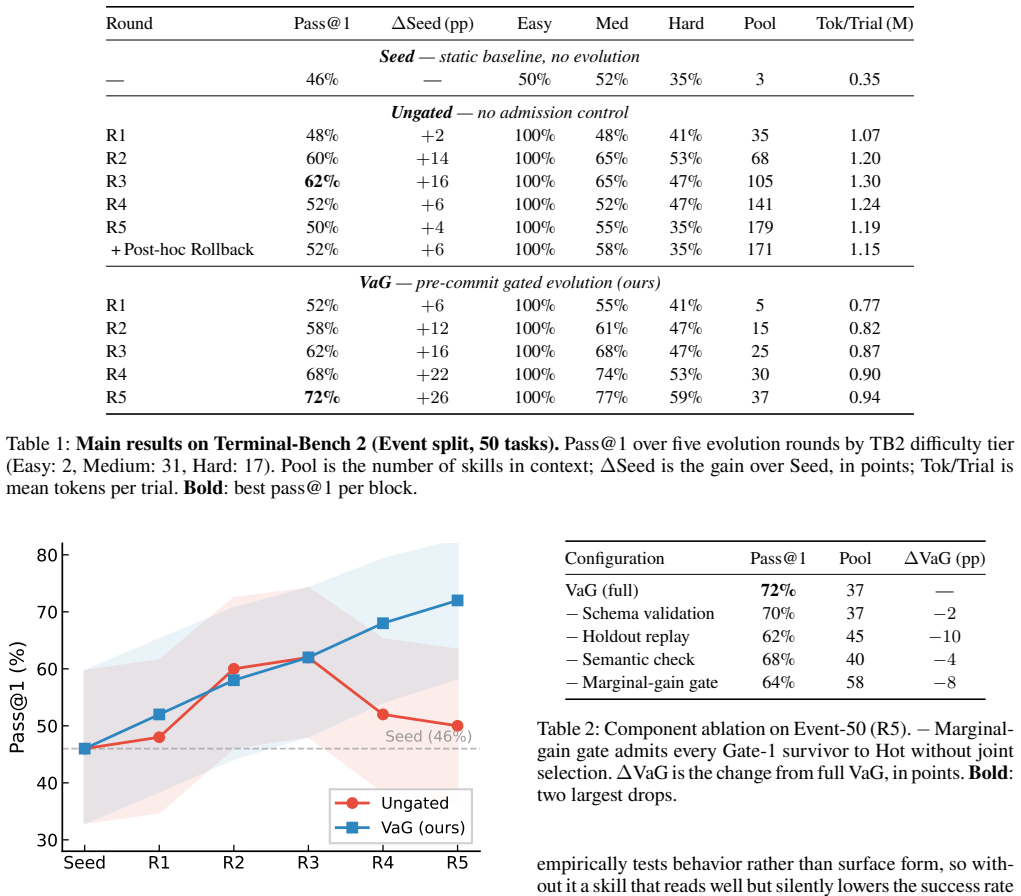
The paper's central claim is a phase transition in self-evolving agents: the capability curve $P(k)$ over pool size is not monotone but single-peaked, with a critical size $k^*$ beyond which the marginal value of adding skills turns negative. It offers a three-level contamination taxonomy—individual, combinatorial, and systemic—and an irreversibility argument: because round-$r$ skills are generated conditioned on the then-live pool, a defective source skill has descendants that inherit its flawed reasoning, so source-only removal is strictly dominated by full-lineage cleanup (Eq. 5). Empirically, source removal recovers only 1.7pp of the 12.3pp peak-to-R5 drop on Terminal-Bench 2, and even oracle full-lineage cleanup leaves 5.6pp unrecovered, which the paper reads as evidence that no post-hoc remediation can fully undo contamination. The constructive consequence is VaG: a three-tier Cold/Warm/Hot trust hierarchy with three heterogeneous critics at the first gate and marginal-gain subset selection at the second; gated evolution improves every round to 72% pass@1 with a pool roughly five times smaller, and its frozen pool transfers positively to other backbones and a second benchmark.
Load-bearing premise
The load-bearing premise is that skills distilled after a defective skill enters the context inherit that skill's flawed reasoning, an inheritance the paper asserts rather than measures.
Editorial extensions
If this is right
- Self-evolving agents that admit skills unconditionally should expect capability to peak and then decline as the pool grows past a critical size, rather than keep improving.
- Skill admission must be treated as a pre-commit decision, because post-hoc removal of a culprit skill cannot undo contamination carried by descendant skills.
- Pre-commit gating can outperform even oracle early stopping, since a smaller, cleaner pool beats the best round of unchecked accumulation.
- Reliable self-evolution needs joint or combinatorial verification, not just per-skill checks, because skills that are individually harmless can conflict when injected together.
- Gated skill pools can transfer across backbones and benchmarks without re-evolution, indicating that they encode reusable, model-agnostic engineering knowledge.
Reading between the lines
- If contamination inheritance is as broad as the paper assumes, the same single-peaked risk should appear in any growing-context mechanism, such as tool-document stores, retrieval packs, or memory queues, so the gate design generalizes beyond skill libraries.
- A stress test the paper does not run is exhaustive selection on small Warm pools; comparing it with the marginal-gain greedy would quantify the gap the heuristic leaves.
- Recording provenance at distillation time would make full-lineage cleanup practical; re-running the rollback analysis with real provenance could either shrink the 5.6 percentage points the oracle still loses or confirm them as structurally irrecoverable.
Signed reviews
Editorial analysis
A structured set of objections, weighed in public.
Referee Report
Summary. The paper studies self-evolving LLM agents that accumulate natural-language skills in their context. It reports that unconditional skill accumulation on Terminal-Bench 2 is non-monotone: pass@1 rises from 48% at R1 to 62% at R3, then falls to 50% at R5 as the pool grows from 35 to 179 skills. The paper formalizes a 'capability-contamination phase transition,' argues that contamination is structurally irreversible because descendants of defective skills inherit flawed reasoning, and proposes Verifier-as-Gatekeeper (VaG), a two-gate pipeline that filters skills individually and via marginal-gain subset selection before they enter the runtime context. Experiments report that VaG improves monotonically to 72% pass@1 with a 37-skill pool, and that the frozen pool transfers positively to four other backbones and a second benchmark. The central claims of non-monotonicity and irreversibility are currently supported by a single evolution run and by a rollback analysis testing only two cleanup policies.
Significance. If the non-monotonic capability trajectory and the structural irreversibility of skill contamination hold, the paper identifies an important failure mode in self-evolving agents and a sensible remedy in pre-commit gating. The VaG design is clearly presented, the ablation structure is clean, and the use of a deterministic verifier and cross-model/cross-benchmark transfer are strengths. The paper is also honest about the overlap of its Wilson confidence intervals. However, the primary evidence for the phenomenon is a single 5-round run, and the irreversibility conclusion is inferred from only two cleanup policies without direct measurement of the proposed inheritance mechanism. The 'structural necessity' framing therefore goes beyond what the data currently establish. The issues are addressable with additional seeds and targeted experiments, so the paper is a candidate for major revision rather than rejection.
major comments (4)
- [Experiments; Table 1, Figure 3] The central phenomenon of non-monotone skill accumulation is reported from a single evolution run with one fixed seed on the 50-task Event split. The paper acknowledges that the 95% Wilson CIs are approximately 30pp wide and that per-round point tests are underpowered, but then asserts that a direction-of-trend difference '50 tasks cannot produce by chance.' With only one trajectory there is no sampling distribution over runs, so this assertion is unsupported; a single lucky R3 and unlucky R5 could produce the same shape. Please provide multiple independent seeds (at least five) or a per-task paired test (e.g., bootstrap over the 50 tasks of the peak-round versus final-round pass rate) to establish that the inverted-U shape is not noise. The current evidence is insufficient for the paper's headline claim that 'unconditional skill accumulation is non-monotone.'
- [§Irreversibility of Contamination (Eq. 5); §Post-hoc Rollback Analysis (Figure 4)] The conclusion that contamination is 'structurally irreversible' and that pre-commit gating is a 'structural necessity' rests on two unverified links. First, Eq. (5) holds only in the regime where descendants have inherited the source's flawed reasoning, but the paper never measures this inheritance; the sole supporting evidence is one anecdote about the git-conflict skill. Second, Figure 4 tests exactly two cleanup policies (source-only deletion and oracle full-lineage deletion); the 5.6pp residual labeled 'irrecoverable even under Oracle cleanup' has not been shown to be unrecoverable by other post-hoc operations, such as editing descendants, re-distilling descendants with the sources removed from context, or applying the paper's own marginal-gain selection to the R5 pool. Moreover, oracle cleanup removes the entire lineage, which may include net-beneficial descendants, so the residual gap could be a removal artifact. Please either provide systematic evidence of inherited flawed reasoning in descendants (e.g., trace a specific defective logic from source to descendant behavior) or soften the irreversibility claim to 'the two tested cleanup policies fail to fully recover the peak.' The current overreach is load-bearing because the entire motivation for VaG depends on post-hoc remediation being impossible in principle, not merely ineffective in two configurations.
- [§Problem Formalization (Eq. 4)] The 'capability-contamination phase transition' is formalized as k* = argmax P(k), which is a definition of the observed peak rather than a prediction. A formalization should yield testable content; as written, Eq. (4) merely labels the empirically highest round. To make the phase transition a substantive claim, the paper could specify a null model (e.g., a random walk or a model where each skill has i.i.d. utility) and show that the observed single-peaked trajectory is unlikely under it, or derive a prediction for k* as a function of pool composition or task difficulty. Without such a test, the 'formalize' contribution is descriptive.
- [§Ablation Studies (Table 2)] The ablations are interpreted as demonstrating that the three critics are complementary and non-substitutable, and that the marginal-gain gate removes combinatorial contamination (8pp drop when removed). However, these are single-run differences on 50 tasks with a reported CI width of about 30pp; the observed 4-10pp differences are within that noise band. Please provide per-task paired analyses or multiple seeds for the ablation configurations before drawing conclusions about non-substitutability. This also applies to the claim that 'each critic intercepts a largely disjoint class of harmful skills,' which would be better supported by reporting the overlap of rejected skills across the three critics.
minor comments (5)
- [§Main Results] The text says source-only rollback recovers 'only 2pp (50%→52%)' while Figure 4 reports 1.7pp; please reconcile the numbers for consistency.
- [§Pre-commit Gating (Gate 2)] The cost bound 'a single greedy pass costs at most |W|−1 joint replays' is incorrect for a greedy algorithm that selects the candidate with the largest estimated marginal gain at each step; such a pass requires O(|W|²) joint evaluations. The error does not affect the experimental conclusions given |W| ≤ 15, but the stated bound should be corrected.
- [§Implementation details] The distillation process π that converts execution trajectories into skills is not described in the main text beyond 'short natural-language skills' and a reference to the Supplementary Material; please provide the distillation prompt and selection criteria, since the non-monotonicity phenomenon may be sensitive to the distiller's behavior.
- [§Experiments] The paper does not state how many independent evolution runs were performed; please specify the number of seeds and, if only one, say so explicitly and temper the claims accordingly.
- [§Abstract and §Conclusion] The phrase 'the empirical signature of irreversibility' and the statement that contamination is 'structurally irreversible' are stronger than what Figure 4 shows; consider replacing with 'consistent with irreversibility' or 'not fully recoverable by the tested cleanup policies.'
Circularity Check
Mild circularity burden: the phase-transition location k* is defined as the observed argmax and then called a prediction, and Eq. (5)'s irreversibility is conditional on the unmeasured inheritance premise it is later used to 'confirm'; the VaG-vs-ungated comparison itself is independent.
-
fitted input called prediction
[Methodology, Problem Formalization and Contamination Taxonomy, Eq. (4); Main Results paragraph on the R3 peak]
"Writing P(k) = R(M_r) for the aggregate success rate when the pool has grown to k = |M_r| skills, unconstrained evolution without admission control exhibits a critical size k* = arg max_k P(k), with P(k) increasing for k < k* and decreasing for k > k*. ... This R3 peak instantiates the critical skill count k* of Eq. (4): beyond it, cumulative contamination outweighs the benefit of new skills."
k* is defined as the argument maximizing the measured success curve P(k). The 'increasing then decreasing' behavior around k* is therefore a restatement of the argmax definition, not an independent prediction. Calling the observed R3 peak an 'instantiation' of k* merely renames the data point from which k* was constructed. The formalization adds no predictive content beyond the empirical non-monotonic curve it is fitted to.
-
self definitional
[Methodology, Irreversibility of Contamination, Eq. (5); Post-hoc Rollback Analysis and Figure 4]
"Inequality (5) holds whenever desc(s) contains at least one skill that inherited s's flawed reasoning; in that regime source-only rollback is strictly dominated by full-lineage cleanup ... the remaining 5.6pp is irrecoverable even under Oracle cleanup—no post-hoc operation can restore the pre-degradation state."
Eq. (5)'s 'structural irreversibility' is explicitly conditional on the unmeasured premise that descendants inherited s's flawed reasoning. The Figure 4 residual is then presented as the empirical signature of Eq. (5) and generalized to 'no post-hoc operation can restore the pre-degradation state', even though only two cleanup policies (source deletion and full-lineage deletion) were tested. The gap is attributed to the very inheritance mechanism assumed in Eq. (5), so the conditional assumption and the measured residual mutually define each other; the 'pre-commit necessity' conclusion is not independently established.
full rationale
The paper's main empirical comparison—ungated accumulation peaking at R3 and degrading to R5, versus VaG improving monotonically to 72% pass@1 with a 37-skill pool—is a self-contained experimental result. It does not reduce to a fitted parameter or a self-citation: the Event/Holdout/Test split is explicit, the paper concedes Event is an optimistic upper bound, and the 95% Wilson intervals make clear that the trajectory shape, not single-round significance, carries the evidence. Cross-backbone and cross-benchmark transfer further support the independent content of VaG. The circularity burden is limited to two framing moves. First, Eq. (4) defines k* as the argmax of the measured P(k) and the paper later says the observed R3 peak 'instantiates' k*, which is a fitted description rather than a predicted phase transition. Second, Eq. (5) is stated to hold only in a regime where descendants have 'inherited s's flawed reasoning'; the Figure 4 residual is then labeled 'irrecoverable even under Oracle cleanup' on the basis of that same unmeasured inheritance premise. These moves add definitional circularity to the irreversibility argument, but they do not contaminate the core VaG comparison. No load-bearing self-citations or imported uniqueness theorems appear. Overall score 3 reflects mild, partial circularity in the formalization and irreversibility framing, with the central method comparison intact.
Assumptions & free parameters
free parameters (4)
- rollouts per task k =
3
- holdout task count for gating =
14
- evolution round budget =
5
- Gate 2 strict-improvement threshold =
gain > 0
assumptions (4)
- domain assumption Skill distillation is conditioned on the full live pool: S_r ~ pi(· | M_{r-1})
- ad hoc to paper Removing a source plus its entire lineage strictly dominates removing the source alone whenever a descendant inherited the flaw
- domain assumption The three critics are sufficiently disjoint that a harmful skill must fool all three to pass
- ad hoc to paper The 14-task holdout mean with k=3 replays is an adequate estimator of joint utility f(H)
invented entities (2)
-
cross-round contamination chains / skill lineage desc(s)
-
capability-contamination phase transition k*
Cite this review
Pith. "Pith review of When Self-Evolution Backfires: Pre-Commit Gating against Skill Contamination in LLM Agents." pith.science (2026). https://pith.science/paper/5D6Q5UUY
@misc{pith2026260805810,
  author       = {Pith},
  title        = {Pith review of: When Self-Evolution Backfires: Pre-Commit Gating against Skill Contamination in LLM Agents},
  year         = {2026},
  howpublished = {\url{https://pith.science/paper/5D6Q5UUY}},
  note         = {Machine review of arXiv:2608.05810}
}
read the original abstract
Self-evolving agents accumulate capability by distilling reusable skills from their execution trajectories, but we find this process is not monotonic: past a critical pool size, newly added skills degrade performance instead of improving it. We formalize this capability-contamination phase transition and trace it to a structural cause: once a defective skill enters the decision context, it becomes reference material for distilling later skills, forming cross-round contamination chains. We further show the contamination is structurally irreversible: removing a source skill after the fact cannot erase the flawed reasoning its descendants have already inherited, so post-hoc rollback recovers only a small fraction of the lost performance. This makes skill admission a pre-commit necessity rather than a post-hoc fix, and motivates Verifier-as-Gatekeeper (VaG): a progressive trust hierarchy whose three heterogeneous critics - structural validity, behavioral harmlessness, and semantic consistency - filter each skill individually, coupled with a marginal-gain subset selection that removes combinatorial contamination at the top tier before skills reach the runtime context. On Terminal-Bench 2, unconditional accumulation rises to a peak and then degrades, giving back most of its gains as the pool keeps growing, and post-hoc removal of the culprit skills recovers only a small part of the drop - the empirical signature of irreversibility. In contrast, VaG improves every round, reaching 72% pass@1 with a pool roughly 5x smaller, and its frozen skill pool transfers positively to four other backbones and a second benchmark without re-evolution. Ablations confirm the three critics are complementary and mutually non-substitutable, each intercepting a largely disjoint class of harmful skills.
Figures


Figures from the paper (1 more)

Reference graph
Works this paper leans on
-
[4]
SearchArt: Training Long-Horizon Search Agent with Scalable Synthetic and Verified Task
SearchArt: Train- ingLong-HorizonSearchAgentwithScalableSyntheticand Verified Task. arXiv:2607.24850. Merrill, M. A.; Shaw, A. G.; Carlini, N.; Li, B.; Raj, H.; Bercovich, I.; Shi, L.; Shin, J. Y.; Walshe, T.; Buchanan, E. K.; et al
-
[5]
Mirzasoleiman,B.;Badanidiyuru,A.;Karbasi,A.;Vondrák, J.; and Krause, A
Terminal-bench: Benchmarking agents on hard, realistic tasks in command line interfaces.arXiv preprint arXiv:2601.11868. Mirzasoleiman,B.;Badanidiyuru,A.;Karbasi,A.;Vondrák, J.; and Krause, A
- [7]
-
[8]
Qwen3.6-35B-A3B: Agentic Coding Power, Now Open to All. Schick, T.; Dwivedi-Yu, J.; Dessì, R.; Raileanu, R.; Lomeli, M.;Hambro,E.;Zettlemoyer,L.;Cancedda,N.;andScialom, T.2023. Toolformer:Languagemodelscanteachthemselves to use tools.Advances in neural information processing systems, 36: 68539–68551. Shinn, N.; Cassano, F.; Gopinath, A.; Narasimhan, K.; a...
work page 2023
-
[10]
Wang, J.; Yan, Q.; Wang, Y.; Tian, Y.; Mishra, S
Voyager: An open- ended embodied agent with large language models.arXiv preprint arXiv:2305.16291. Wang, J.; Yan, Q.; Wang, Y.; Tian, Y.; Mishra, S. S.; Xu, Z.; Gandhi, M.; Xu, P.; and Cheong, L. L
-
[11]
Reinforcement Learning for Self-Improving Agent with Skill Library. In Liakata, M.; Moreira, V. P.; Zhang, J.; and Jurgens, D., eds., Proceedings of the 64th Annual Meeting of the Association forComputationalLinguistics(Volume1:LongPapers),ACL 2026, San Diego, California, United States, July 2-7, 2026, 1529–1550. Association for Computational Linguistics....
arXiv 2026
-
[13]
arXiv preprint arXiv:2603.17187
MetaClaw: Just Talk–An Agent That Meta-Learns and Evolves in the Wild. arXiv preprint arXiv:2603.17187. Xiao, W.; Tang, X.; Zhou, B.; Hu, S.; and Han, J
-
[14]
RouteGuard: Internal-Signal Detection of Skill Poisoning in LLM Agents
RouteGuard:Internal-Signal Detectionof SkillPoisoningin LLM Agents.CoRR, abs/2604.22888. Xu, A.; Lin, B.; Xue, B.; Wang, B.; Xu, B.; Wu, B.; Zhang, B.; Lin, C.; Dong, C.; Ling, C.; et al
Show all 17 references
-
[15]
arXiv preprint arXiv:2606.19348
Deepseek-v4: Towards highly efficient million-token context intelligence. arXiv preprint arXiv:2606.19348. Yang, J.; Prabhakar, A.; Narasimhan, K.; and Yao, S
-
[17]
Zhang,Z.;Zhang,A.;Li,M.;andSmola,A.2022.Automatic chain of thought prompting in large language models.arXiv preprint arXiv:2210.03493
Agentic context engineering: Evolving contexts for self-improving language models.arXiv preprint arXiv:2510.04618. Zhang,Z.;Zhang,A.;Li,M.;andSmola,A.2022.Automatic chain of thought prompting in large language models.arXiv preprint arXiv:2210.03493. Zhao,A.;Huang,D.;Xu,Q.;Lin,...
2022 arXiv
-
[2011]
Feige, U.; Mirrokni, V
Submodular meets spectral: Greedyalgorithmsforsubsetselection,sparseapproximation and dictionary selection.arXiv preprint arXiv:1102.3975. Feige, U.; Mirrokni, V. S.; and Vondrák, J
-
[2014]
Nemhauser,G.L.;Wolsey,L.A.;andFisher,M.L.1978
Lazier than lazy greedy.arXiv preprint arXiv:1409.7938. Nemhauser,G.L.;Wolsey,L.A.;andFisher,M.L.1978. An analysis of approximations for maximizing submodular set functions—I.Mathematical programming, 14(1): 265–294. Packer, C.; Fang, V.; Patil, S.; Lin, K.; Wooders, S.; and G...
1978 arXiv
-
[2022]
InNeurIPS 2022 Foundation Models for Decision Making Workshop
React: Synergizing reasoning and acting in language models. InNeurIPS 2022 Foundation Models for Decision Making Workshop. Zelikman, E.; Wu, Y.; Mu, J.; and Goodman, N
2022
-
[2023]
Huang, J.; Gu, S.; Hou, L.; Wu, Y.; Wang, X.; Yu, H.; and Han, J
Reinforced self-training (rest) for language modeling.arXiv preprint arXiv:2308.08998. Huang, J.; Gu, S.; Hou, L.; Wu, Y.; Wang, X.; Yu, H.; and Han, J
-
[2024]
Wang, G.; Xie, Y.; Jiang, Y.; Mandlekar, A.; Xiao, C.; Zhu, Y.; Fan, L.; and Anandkumar, A
A survey on self-evolution of large language models.arXiv preprint arXiv:2404.14387. Wang, G.; Xie, Y.; Jiang, Y.; Mandlekar, A.; Xiao, C.; Zhu, Y.; Fan, L.; and Anandkumar, A
-
[2025]
Xia, P.; Chen, J.; Yang, X.; Tu, H.; Liu, J.; Xiong, K.; Han, S.; Qiu, S.; Ji, H.; Zhou, Y.; et al
EvolveR: Self-Evolving LLM Agents through an Experience-Driven Lifecycle.CoRR, abs/2510.16079. Xia, P.; Chen, J.; Yang, X.; Tu, H.; Liu, J.; Xiong, K.; Han, S.; Qiu, S.; Ji, H.; Zhou, Y.; et al
-
[2026]
Madaan, A.; Tandon, N.; Gupta, P.; Hallinan, S.; Gao, L.; Wiegreffe, S.; Alon, U.; Dziri, N.; Prabhumoye, S.; Yang, Y.; et al
Agentic har- ness engineering: Observability-driven automatic evolution ofcoding-agentharnesses.arXivpreprintarXiv:2604.25850. Madaan, A.; Tandon, N.; Gupta, P.; Hallinan, S.; Gao, L.; Wiegreffe, S.; Alon, U.; Dziri, N.; Prabhumoye, S.; Yang, Y.; et al
Reviewed August 7, 2026 · model on record in the stance chip above.
Discussion (0). Continue with ORCID to comment.