REVIEW 3 major objections 5 minor 24 references
AppDeltaWorld: Transition-Grounded Delta Code World Model for Mobile GUI Agents
T0 review · 3 major / 5 minor · reviewed 2026-08-07 · deepseek-v4-flash
Pith's one-line read AppDeltaWorld claims that predicting a mobile GUI's next screen as a reachable code update—constrained by the action taken—produces more faithful and stable transitions than generating an unconstrained image or fresh HTML, and that the…
desk verdict A genuinely new retrieval-plus-delta-code world model with convincing downstream agent gains, but the headline CMGUIBench-500 fidelity result is at risk from train/eval overlap until the authors show a clean split. read the letter →
The pith
A machine-rendered reading of the paper's core claim, the machinery that carries it, and where it could break.
The reading
What carries the argument
The carrying mechanism is the two-level delta code formulation with transition-constrained retrieval. Level-1 HTML is a reusable, app-specific page template; Level-2 HTML is the executable next screen written as a change on top of that template. A transition index maps each source cluster, action type, and action-target grid to allowed target clusters, so unsupported actions are rejected rather than hallucinated, and the retrieved Level-1 reference is guaranteed reachable. The final rendered observation is produced by generating Level-2 HTML, synthesizing visual assets for image slots, and rendering in a browser, which is what lets the model combine precise text and layout with photographic visual regions.
What would settle it
Take a fixed set of actions executed on real Android devices where the actual next-screen view hierarchy is recorded, run AppDeltaWorld on the same actions from the same starting screens, and compare the rendered next screen's text and clickable-element coordinates against the recorded hierarchy; if the agreement is no better than image-only baselines, the central claim of transition-grounded fidelity is not supported.
Extended reading notes
Core claim
AppDeltaWorld's central claim is that predicting the next GUI as a delta over retrieved, action-reachable code is more stable and more faithful than generating the next screen as an unconstrained image or as fresh HTML from scratch. The world model decomposes each screen into a Level-1 structural reference (layout, widgets, DOM organization) and Level-2 executable HTML (the concrete next screen). At inference, it localizes the current screen to a source cluster, uses a per-app transition index to restrict candidate target clusters to those reachable by the action, retrieves the Level-1 code under that constraint, then generates Level-2 HTML conditioned on the current screen, the action, predicted next-screen text, and the retrieved structure. Visual regions are synthesized by a text-to-image model and inserted into image slots before browser rendering. The paper reports that this pipeline achieves the highest overall fidelity score of 73.51 on CMGUIBench-500 under the Code2World evaluation, with the largest gains in element-level and layout-level visual quality, and that filtered rollouts from the pipeline improve a Qwen3-VL-8B-based agent on AndroidLens, MobileGym, and MobileWorld.
Load-bearing premise
The load-bearing premise is that the reverse-engineered HTML used as training ground truth faithfully represents the real apps; if the AI-generated conversions misstate text, positions, or what an action changes, the simulator teaches agents a distorted version of the apps, and no check against real-device ground truth is reported.
Editorial extensions
If this is right
- Fidelity-wise, the 73.51 overall score on CMGUIBench-500 under Code2World evaluation would make AppDeltaWorld the strongest next-screen predictor among the tested image, code, and hybrid systems, with the largest margins on element and layout scores (56.26/57.43) over image-only models.
- Training-wise, 33,133 filtered AppDeltaWorld rollouts mixed with public supervision take AndroidLens Total-LL AMS/ATP from 80.33/34.96 to 90.28/46.63 and Total-HL ATP from 23.30 to 33.05, so closed-loop world-model experience complements static demonstrations.
- Deployment-wise, online gains on MobileGym (10.2% to 14.1% SR) and MobileWorld GUI-only (9.4% to 14.9% SR) suggest the benefit carries beyond static action matching into real execution.
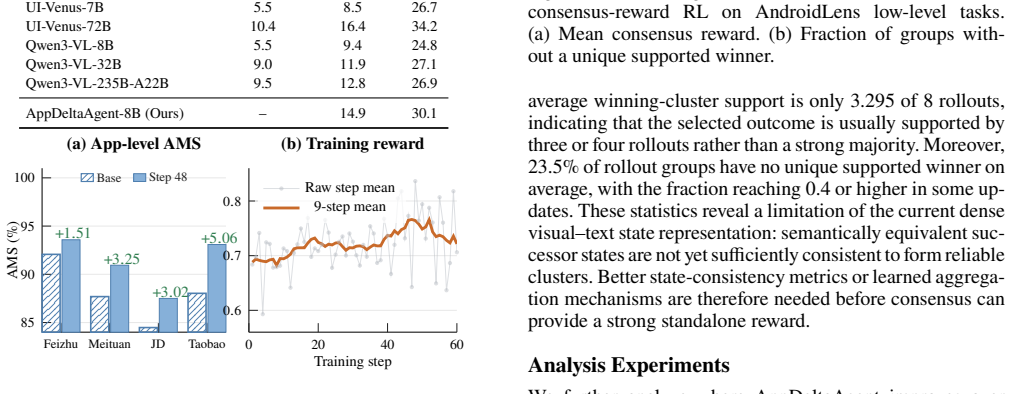
- Optimization-wise, test-time RL with world-model-rendered successor states improves app-specific AMS by 1.51 to 5.06 points over 48 steps, which implies policies can be adapted without touching real devices.
Reading between the lines
- Editorial inference: the same retrieval-constrained delta formulation should transfer to web, desktop, or in-car GUI agents whenever a DOM-like structure exists, because the hard part being solved—stable next-state generation under action constraints—is not phone-specific.
- Editorial inference: a head-to-head fidelity check against recorded real-device view hierarchies would test whether the reported scores reflect true app consistency or internal consistency with the reverse-engineered HTML; the paper does not report such a check.
- Editorial inference: the scaling curve's saturation after roughly 20K added rollouts suggests that simply generating more trajectories will not keep improving the agent; expanding the transition index and Level-1 memory to cover more screens and actions is the likely next lever.
- Editorial inference: the consensus-reward RL experiment's own statistics (average winner support 3.295 of 8 rollouts; 23.5% groups with no unique winner) indicate that a learned state-similarity metric, rather than a fixed visual-text threshold, is the key to making self-supervised world-model rewards reliable.
Editorial analysis
A structured set of objections, weighed in public.
Referee Report
Summary. The paper proposes AppDeltaWorld, a world model for mobile GUI agents that predicts the next screen as a transition-grounded delta code update. It retrieves a Level-1 HTML reference under an action-transition constraint, generates Level-2 HTML conditioned on the current screen and predicted next-screen text, inserts synthesized visual assets, and renders the result. The world model is trained on reverse-engineered HTML from multiple datasets (95.47% CMGUI) and evaluated on CMGUIBench-500 under Code2World scoring. The authors report a state-of-the-art overall fidelity score of 73.51, and they use the world model to generate filtered rollouts for SFT and test-time RL, training AppDeltaAgent, which achieves state-of-the-art results on AndroidLens and consistent gains on MobileGym and MobileWorld.
Significance. If the fidelity results survive an evaluation with a proper train/test split, the delta-code retrieval-plus-completion design is a meaningful step toward scalable GUI world models that combine structural stability, modality coverage, and transition consistency. The paper ships public dataset and evaluation code, includes several ablations, and is unusually candid about the limitations of the cluster-based RL reward. However, the headline fidelity claim currently rests on an evaluation setup where the benchmark screens and the retrieval memory come from the same underlying corpus, so the main contribution is not yet verified.
major comments (3)
- [Settings; Eq. (6); Table 1; Table 4] The CMGUIBench-500 evaluation set is described as '500 random samples from the original CMGUI benchmark', while the world-model training data includes 95,614 CMGUI transitions, 95.47% of the training mixture (Table 1). No screen-level or transition-level split is described, and Eq. (6) selects the final Level-1 reference by similarity search over a memory built from that same training data. The high S_ad/S_id scores (79.69/77.00) may therefore reflect retrieval of near-duplicate training screens rather than generalization to unseen transitions. The w/o RAG ablation in Table 4 drops S_ad/S_id to 65.16/69.40, indicating that the functional score is carried largely by the memory. The authors should state explicitly whether any CMGUIBench-500 screen or its associated transitions appear in the world-model training set or retrieval memory, and, if not, describe the deduplication procedure used. They should also report fidelity separately for transitions whose source and target clusters are present in memory versus genuinely novel transitions.
- [Training Data Statistics] The world-model training data is 'all reverse engineered using Claude-4.8-Opus and Gemini-3.1-Pro to obtain renderable code', and this reconstructed HTML is treated as ground truth for Level-1/Level-2 labels and as the rendered next state for both training and evaluation. No fidelity check of this reconstruction against real view hierarchies, accessibility trees, or actual device screenshots is reported. Consequently, even a clean evaluation split would certify fidelity only to the reverse-engineered reconstruction, not to real mobile screens. To support the claim that AppDeltaWorld is a faithful world model of real apps, the authors should validate the reconstruction quality on a random sample (e.g., human or model-based comparison of text, coordinates, and element presence against ground-truth view hierarchies) and report agreement metrics.
- [World-Model Fidelity Evaluation; Table 4] The ablation study removes 'RAG' as a single component, but the transition-grounded retrieval described in Eqs. (4)-(6) has two independent parts: the memory-based structural reference and the action-transition constraint. Removing both conflates the contribution of the transition index with that of retrieval. Since transition logic consistency is a stated contribution and a claimed advantage over unconstrained generation, the authors should ablate the transition constraint separately (e.g., unconstrained retrieval over all clusters instead of only C_{t+1}) and, ideally, report invalid-action rejection rates (precision/recall for transitions that should be refused).
minor comments (5)
- [Table 2 discussion] The sentence 'It's important to note' contains an apostrophe error; 'Its' would be correct.
- [World-Model-in-the-Loop SFT Data Construction] The text states that 'only 1/10 of the data passed the quality verification', but the relationship between the number of seeds, the number of accepted trajectories (33,133 in Table 1), and the 1/10 ratio is not stated; please clarify the denominator.
- [Figure 2 caption] The caption mentions a 'Trajectory Audit' stage, but this term is not defined in the main text; the corresponding filtering and QC steps in Algorithm 1 should be referenced explicitly.
- [Methodology; Eq. (5)] The action-target grid quantization for clicks and long presses into a 6×12 grid is introduced without specifying how the grid is aligned to screen coordinates or how swipe start/end grids are encoded; a sentence with the coordinate convention would improve reproducibility.
- [Related Work] The related work discusses MobileWorld as a text-level world model, citing Li et al. 2025a, but the experiments section evaluates on 'MobileWorld' as a real-environment benchmark with a different citation (Kong et al. 2026); please disambiguate these two uses to avoid confusion.
Circularity Check
The CMGUIBench-500 fidelity claim is partly a retrieval-memory self-match: benchmark and memory are both drawn from the same CMGUI corpus with no reported split.
-
fitted input called prediction
[Settings; Methodology Eq. (6); Table 1; World-Model Fidelity Evaluation]
"we use CMGUIBench-500 (500 random samples from the original CMGUI benchmark (Xie et al. 2026)) with Code2World evaluation. ... i∗ = arg max_{i:a_i=a, c_i^(1) ∈ C_{t+1}} ⟨e(q^tar_{t+1}), e(r_i)⟩ (6) ... CMGUI (Xie et al. 2026) 95,614 95.47%"
By Eq. (6), the predicted Level-1 structure is selected from a retrieval memory of historical screens. The memory is populated from the training mixture whose dominant component is CMGUI (95,614 of 100,149 steps, 95.47%); the evaluation set is 500 random samples from that same CMGUI benchmark. No screen-level train/eval split, deduplication, or exclusion of the evaluation samples from the memory is reported. Therefore, for any benchmark transition whose target screen is already stored, the 'predicted' next-screen structure is the ground-truth screen retrieved by nearest-neighbor lookup. The w/o RAG ablation (Sad drops from 79.69 to 65.16; Sid from 77.00 to 69.40) confirms that most functional-logic fidelity is carried by the retrieved memory content.
full rationale
AppDeltaWorld's downstream-agent results (AndroidLens, MobileGym, MobileWorld) are external benchmarks and are not circular: the world-model rollouts are only one component of the SFT mixture, and the ADW-only ablation shows they are not self-certifying. The one genuine circularity concern is the world-model fidelity evaluation. Eq. (6) makes the final Level-1 reference a nearest-neighbor retrieval from an index built on the training transitions; Table 1 shows that index is 95.47% CMGUI; and Settings samples the evaluation set from that same CMGUI benchmark. With no reported screen-level split, the evaluation cannot distinguish next-state generation from lookup of a stored ground-truth screen. The w/o RAG ablation quantifies how much of the score is retrieval-driven. There is also a minor self-citation (Xu et al. 2026a) used only as motivation for the RL experiment; it is not load-bearing. The reverse-engineered HTML ground truth is a fidelity-to-reconstruction concern, not a circularity concern. Overall score 6 reflects partial circularity of the central world-model claim, while the agent-policy gains remain independently grounded.
Assumptions & free parameters
free parameters (3)
- retrieval vector weights =
0.45 layout, 0.25 DOM, 0.20 semantic, 0.10 slot (Eq. 3)
- action-target grid quantization =
6x12 grid
- visual/text similarity weights in consensus RL =
0.60 visual, 0.40 text, threshold 0.82
assumptions (4)
- domain assumption Reverse-engineered HTML from proprietary LLMs is faithful ground truth
- domain assumption Transition index built from training trajectories is complete
- domain assumption Browser rendering of generated HTML approximates real device pixels
- domain assumption The judge model Gemini-3-Flash reliably scores functional logic and visual quality
Cite this review
Pith. "Pith review of AppDeltaWorld: Transition-Grounded Delta Code World Model for Mobile GUI Agents." pith.science (2026). https://pith.science/paper/C35VP7K3
@misc{pith2026260805891,
  author       = {Pith},
  title        = {Pith review of: AppDeltaWorld: Transition-Grounded Delta Code World Model for Mobile GUI Agents},
  year         = {2026},
  howpublished = {\url{https://pith.science/paper/C35VP7K3}},
  note         = {Machine review of arXiv:2608.05891}
}
read the original abstract
Mobile GUI agents can operate apps through pixel perception and touch actions, making them a promising interface for collecting and improving long-horizon mobile interaction policies. However, real trajectories are difficult to obtain for sensitive apps and privacy-critical operations. At the same time, existing simulated environments are costly to scale up, and GUI world models still suffer from unstable generation, limited modality coverage, and inconsistent action-transition logic. To address these limitations, we propose AppDeltaWorld, a transition-grounded delta code world model that predicts the next GUI as a reachable code update rather than as an unconstrained image or text description. AppDeltaWorld retrieves app-specific Level-1 HTML references under an action-transition constraint, generates Level-2 executable HTML conditioned on the current screen, action, predicted next-screen text, and retrieved structure, and inserts generated visual assets into image slots before browser rendering. As a world model, AppDeltaWorld achieves the highest fidelity on CMGUIBench-500 under Code2World evaluation, with clear gains in structural layout and UI element reconstruction over image-only and code-only baselines. As a training environment, AppDeltaWorld supports filtered closed-loop SFT data construction that, when combined with public supervision, enables AppDeltaAgent to achieve state-of-the-art performance on AndroidLens and consistent gains on MobileGym and MobileWorld. Moreover, world-model-based test-time reinforcement learning enables policy adaptation and shows further improvements without additional interaction with real apps.
Figures


Figures from the paper (4 more)



Reference graph
Works this paper leans on
-
[1]
AndroidLens:Long- latencyEvaluationwithNestedSub-targetsforAndroidGUI Agents
Cao,Y.;Wang,Y.;Bu,P.;Xing,J.;Jiang,W.;Zhu,Z.;Ma,J.; Zhou,S.;Lu,T.;Song,J.;etal.2026a. AndroidLens:Long- latencyEvaluationwithNestedSub-targetsforAndroidGUI Agents. InProceedings of the IEEE/CVF Conference on Computer Vision and Pattern Recognition, 1903–1912. Cao, Y.; Zhong, Y.; Zeng, Z.; Zheng, L.; Huang, J.; Qiu, H.; Shi, P.; Mao, W.; and Guanglu, W. 20...
arXiv 1903
-
[4]
InFindings of the Association for Computational Linguistics: ACL 2026, 18956–18978
Guitester: Enabling gui agents for exploratory defect discovery. InFindings of the Association for Computational Linguistics: ACL 2026, 18956–18978. Gu, Y.; Zhang, K.; Ning, Y.; Zheng, B.; Gou, B.; Xue, T.; Chang, C.; Srivastava, S.; Xie, Y.; Qi, P.; et al
work page 2026
-
[6]
Guan,Y.;Yu,R.;Zhang,J.;Wang,L.;Zhang,C.;Li,L.;Qiao, B.;Qin,S.;Huang,H.;Yang,F.;etal.2026
Ui-venus technical report: Building high-performance ui agents with rft.arXiv preprint arXiv:2508.10833. Guan,Y.;Yu,R.;Zhang,J.;Wang,L.;Zhang,C.;Li,L.;Qiao, B.;Qin,S.;Huang,H.;Yang,F.;etal.2026. Computer-using world model.arXiv preprint arXiv:2602.17365. Hong, W.; Wang, W.; Lv, Q.; Xu, J.; Yu, W.; Ji, J.; Wang, Y.; Wang, Z.; Dong, Y.; Ding, M.; and Tang, J
arXiv 2026
-
[8]
Jiang,Z.;Zhao,K.;Xu,W.;Lin,X.;Liu,W.;Luan,J.;Shang, S.; and Han, P
MobileIPL: Enhanc- ingMobileAgentsThinkingProcessviaIterativePreference Learning.arXiv preprint arXiv:2505.12299. Jiang,Z.;Zhao,K.;Xu,W.;Lin,X.;Liu,W.;Luan,J.;Shang, S.; and Han, P
-
[9]
Koh,W.;Han,S.;Lee,S.;Yun,S.-Y.;andShin,J.2026
Rˆ 3: Replay, Reflection, and Ranking Rewards for LLM Reinforcement Learning.arXiv preprint arXiv:2601.19620. Koh,W.;Han,S.;Lee,S.;Yun,S.-Y.;andShin,J.2026. Gen- erative Visual Code Mobile World Models.arXiv preprint arXiv:2602.01576. Kong,Q.;Zhang,X.;Yang,Z.;Gao,N.;Liu,C.;Tong,P.;Cai, C.; Zhou, H.; Zhang, J.; Chen, L.; et al
arXiv 2026
-
[10]
Mobileworld: Benchmarking autonomous mobile agents in agent-user in- teractiveandmcp-augmentedenvironments. InProceedings of the 64th Annual Meeting of the Association for Computa- tional Linguistics (Volume 1: Long Papers), 6142–6167. Li, S.; Kallidromitis, K.; Gokul, A.; Kato, Y.; Kozuka, K.; and Grover, A. 2025a. MobileWorldBench: Towards Se- mantic Wo...
-
[11]
Lian,S.;Wu,Y.;Ma,J.;Ding,Y.;Song,Z.;Chen,B.;Zheng, X.; Li, H.; and Ji, R
Appagent v2: Ad- vancedagentforflexiblemobileinteractions.arXivpreprint arXiv:2408.11824. Lian,S.;Wu,Y.;Ma,J.;Ding,Y.;Song,Z.;Chen,B.;Zheng, X.; Li, H.; and Ji, R
-
[12]
InProceedings of the 31st ACM SIGKDD Conference on Knowledge Discovery and Data Mining V
Mobilesteward: Integrating multiple app-oriented agentswithself-evolutiontoautomatecross-appinstructions. InProceedings of the 31st ACM SIGKDD Conference on Knowledge Discovery and Data Mining V. 1, 883–893. Liu, Y.; Xu,W.; Huang, K.; Chen, C.;Zhao, J.; Gao, P.;Liu, W.;Luan,J.;Shang,S.;Du,B.;etal.2026. CoME:Empow- ering Channel-of-Mobile-Experts with Info...
arXiv 2026
Show all 24 references
-
[13]
Qin,Y.;Ye,Y.;Fang,J.;Wang,H.;Liang,S.;Tian,S.;Zhang, J.; Li, J.; Li, Y.; Huang, S.; et al
Vimo: A genera- tive visual gui world model for app agents.arXiv preprint arXiv:2504.13936. Qin,Y.;Ye,Y.;Fang,J.;Wang,H.;Liang,S.;Tian,S.;Zhang, J.; Li, J.; Li, Y.; Huang, S.; et al
-
[14]
Shen, H.; Liu, C.; Li, G.; Wang, X.; Zhou, Y.; Ma, C.; and Ji, X
Ui-tars: Pioneering automated gui interaction with native agents.arXiv preprint arXiv:2501.12326. Shen, H.; Liu, C.; Li, G.; Wang, X.; Zhou, Y.; Ma, C.; and Ji, X
-
[15]
Shi,Y.;Yu,W.;Li,Z.;Wang,Y.;Zhang,H.;Liu,N.;Mi,H.; and Yu, D
Falcon-ui: Understanding gui before following user instructions.arXiv preprint arXiv:2412.09362. Shi,Y.;Yu,W.;Li,Z.;Wang,Y.;Zhang,H.;Liu,N.;Mi,H.; and Yu, D
-
[16]
Sun, H.; Xu, W.; Liu, W.; Luan, J.; Wang, B.; Shang, S.; Wen, J.-R.; and Yan, R
MobileGUI-RL: Advancing Mobile GUI Agent through Reinforcement Learning in Online Environ- ment.arXiv preprint arXiv:2507.05720. Sun, H.; Xu, W.; Liu, W.; Luan, J.; Wang, B.; Shang, S.; Wen, J.-R.; and Yan, R
-
[17]
InProceedings of the 62nd Annual Meeting of the Associa- tionforComputationalLinguistics(Volume1:LongPapers), 9828–9862
Determlr: Augmenting llm- based logical reasoning from indeterminacy to determinacy. InProceedings of the 62nd Annual Meeting of the Associa- tionforComputationalLinguistics(Volume1:LongPapers), 9828–9862. Tang, L.; Dong, S.; Huang, Y.; Xiang, M.; Ruan, H.; Wang, B.;Li,S.;Xi,Z...
2025 arXiv
-
[18]
Wang, H.; Zou, H.; Song, H.; Feng, J.; Fang, J.; Lu, J.; Liu, L.; Luo, Q.; Liang, S.; Huang, S.; et al
PhoneWorld: Scaling Phone-Use Agent Environments.arXiv preprint arXiv:2605.29486. Wang, H.; Zou, H.; Song, H.; Feng, J.; Fang, J.; Lu, J.; Liu, L.; Luo, Q.; Liang, S.; Huang, S.; et al. 2025a. Ui- tars-2 technical report: Advancing gui agent with multi-turn reinforcement learn...
-
[19]
Wang, Z.; Xu, H.; Wang, J.; Zhang, X.; Yan, M.; Zhang, J.; Huang, F.; and Ji, H
Mobile-agent-v2: Mobile device operation assistant with effective navigation via multi-agent collaboration.Advances in Neural Informa- tion Processing Systems, 37: 2686–2710. Wang, Z.; Xu, H.; Wang, J.; Zhang, X.; Yan, M.; Zhang, J.; Huang, F.; and Ji, H. 2025b. Mobile-agent-e...
-
[20]
Xie, Y.; Chen, S.; Xing, J.; Jiang, W.; Zhu, Z.; Wang, Y.; Bu, P.; Song, J.; Jiang, Y.; and Zheng, B
WebWorld: A Large- Scale World Model for Web Agent Training.arXiv preprint arXiv:2602.14721. Xie, Y.; Chen, S.; Xing, J.; Jiang, W.; Zhu, Z.; Wang, Y.; Bu, P.; Song, J.; Jiang, Y.; and Zheng, B
-
[21]
Xu, W.; Huang, K.; Feng, Y.; Li, J.; Chen, Y.; Liu, Y.; Jiang, Z.; Qu, H.; Gao, P.; Liu, W.; et al
SecAgent: Efficient Mobile GUI Agent with Semantic Context.arXiv preprint arXiv:2603.08533. Xu, W.; Huang, K.; Feng, Y.; Li, J.; Chen, Y.; Liu, Y.; Jiang, Z.; Qu, H.; Gao, P.; Liu, W.; et al. 2026a. How Mobile World Model Guides GUI Agents?arXiv preprint arXiv:2605.10347. Xu, ...
-
[22]
Xu, W.; Jiang, Z.; Liu, Y.; Gao, P.; Liu, W.; Luan, J.; Liu, Y.; Li, Y.; Wang, B.; and An, B
Mobile-Bench-v2: AMoreRealisticandComprehensiveBenchmarkforVLM- based Mobile Agents.arXiv preprint arXiv:2505.11891. Xu, W.; Jiang, Z.; Liu, Y.; Gao, P.; Liu, W.; Luan, J.; Liu, Y.; Li, Y.; Wang, B.; and An, B. 2026b. SMAN-Bench: A Cross-System Benchmark for Mobile Agents unde...
2026
-
[23]
Zuo,Y.;Xiao,Z.;Sheng,L.;Huang,F.;Tu,J.;Liu,Y.;Tang, T.; Hu, X.; Su, Y.; Lan, Q.; et al
Code2world: A gui world model via renderable code generation.arXiv preprint arXiv:2602.09856. Zuo,Y.;Xiao,Z.;Sheng,L.;Huang,F.;Tu,J.;Liu,Y.;Tang, T.; Hu, X.; Su, Y.; Lan, Q.; et al
-
[24]
Zuo, Y.; Zhang, K.; Sheng, L.; Qu, S.; Cui, G.; Zhu, X.; Li, H.;Zhang,Y.;Long,X.;Hua,E.;etal.2025
Qwen-AgentWorld: LanguageWorld ModelsforGeneral Agents.arXivpreprint arXiv:2606.24597. Zuo, Y.; Zhang, K.; Sheng, L.; Qu, S.; Cui, G.; Zhu, X.; Li, H.;Zhang,Y.;Long,X.;Hua,E.;etal.2025. Ttrl:Test-time reinforcement learning.arXiv preprint arXiv:2504.16084
2025 arXiv
-
[2023]
arXiv:2312.08914
CogAgent: A Visual Language Model for GUI Agents. arXiv:2312.08914. Huang, K.; Xu, W.; Liu, Y.; Wang, Q.; Gao, P.; Liu, W.; Luan, J.; Wang, B.; and An, B
-
[2024]
Gu,Z.;Zeng,Z.;Xu,Z.;Zhou,X.;Shen,S.;Liu,Y.;Zhou,B.; Meng, C.; Xia, T.; Chen, W.; et al
Is yourllmsecretlyaworldmodeloftheinternet?model-based planning for web agents.arXiv preprint arXiv:2411.06559. Gu,Z.;Zeng,Z.;Xu,Z.;Zhou,X.;Shen,S.;Liu,Y.;Zhou,B.; Meng, C.; Xia, T.; Chen, W.; et al
-
[2025]
Cheng,K.;Li,Z.;Ma,Z.;Chen,N.;Cao,J.;Sun,Q.;Ding,Z.; Xu,F.;Yan,H.;Chen,J.;etal.2026
STEP: Success-Rate-Aware Trajectory-Efficient Policy Optimization.arXiv preprint arXiv:2511.13091. Cheng,K.;Li,Z.;Ma,Z.;Chen,N.;Cao,J.;Sun,Q.;Ding,Z.; Xu,F.;Yan,H.;Chen,J.;etal.2026. OpenMobile:Building openmobileagentswithtaskandtrajectorysynthesis.arXiv preprint arXiv:2604.1...
2026
-
[2026]
Gao, Y.; Wu, J.; Chen, X.; Yang, Y.; Cui, Z.; Ma, T.; Zhang, J.; and Sang, J
Agent- world:Scalingreal-worldenvironmentsynthesisforevolving generalagentintelligence.arXivpreprintarXiv:2604.18292. Gao, Y.; Wu, J.; Chen, X.; Yang, Y.; Cui, Z.; Ma, T.; Zhang, J.; and Sang, J
Reviewed August 7, 2026 · model on record in the stance chip above.
Discussion (0). Sign in to comment.