REVIEW 2 major objections 4 minor 294 references
Why do massive stars form bow shocks? Bulk ISM motion as the main driver of bow shock formation and geometry
T0 review · 2 major / 4 minor · reviewed 2026-08-07 · deepseek-v4-flash
Pith's one-line read Massive-star bow shocks are mainly made by bulk ISM motion, not by the star's own motion.
desk verdict Careful sample re-analysis shows most bow shocks are misaligned with stellar motion, but the headline ISM speed of 10–15 km/s is an artifact of a data-conditioned prior. read the letter →
The pith
A machine-rendered reading of the paper's core claim, the machinery that carries it, and where it could break.
The reading
What carries the argument
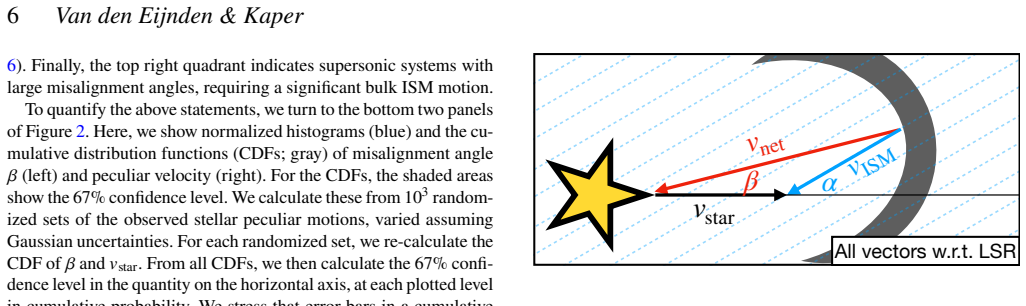
The argument is carried by a two-vector model of the relative ISM velocity seen by the star. With $v_{\rm star}$ the stellar peculiar velocity and $v_{\rm ISM}$ a bulk ISM velocity making angle $\alpha$ with the stellar direction, the net flow direction gives the misalignment angle $\cos\beta=(1+r_v\cos\alpha)/\sqrt{1+r_v^2+2r_v\cos\alpha}$, and the same factor $f_{\rm corr}=1+r_v^2+2r_v\cos\alpha$ quantifies by how much the stand-off distance shrinks and hence by how much the inferred wind momentum flux is underestimated. On the data side, the load-bearing step is a close-neighbor Galactic rotation correction: for each of 210 stars, the median proper motion of its physically nearest Gaia neighbors within 20–100 pc, selected with the same quality cuts, is subtracted to obtain the peculiar motion. The model is then fit statistically by drawing 210 random ISM vectors, computing the resulting $\beta$ distribution, and comparing it with the observed distribution using a Kolmogorov–Smirnov test over 1000 Monte Carlo realizations.
What would settle it
Measure radial velocities for a sample of these bow-shock-driving stars and their surrounding gas, solve the 3D version of the paper's two-vector system per source, and test whether the inferred ISM velocities are centered near 10–15 km/s; if they are consistent with zero while large misalignment angles remain, the central claim fails. Alternatively, compare nearby bow-shock apex orientations with parsec-scale HI or CO velocity maps: if the shock orientations show no correlation with the mapped bulk ISM flow directions at typical speeds well below 10 km/s, bulk ISM motion is not the dominant driver.
Extended reading notes
Core claim
The central claim is that bulk ISM motion, not stellar peculiar motion, dominates the formation and geometry of massive-star bow shocks. The evidence is a statistical decomposition of 210 systems: only 21±2% have both a supersonic peculiar velocity and a shock apex aligned within 30° of the stellar motion; 48±2% of the driving stars are subsonic and would not form a shock against a stationary ISM; and 70±2% of all shocks are substantially misaligned. The paper introduces a two-parameter model in which the net relative ISM velocity is the vector sum of the stellar peculiar velocity $v_{\rm star}$ and a bulk ISM velocity $v_{\rm ISM}$ at angle $\alpha$ to the stellar direction. From this geometry it derives the misalignment angle $\beta$ and a correction factor $f_{\rm corr}=1+r_v^2+2r_v\cos\alpha$ with $r_v=v_{\rm ISM}/v_{\rm star}$, which measures how much the stand-off distance shrinks and therefore how much wind momentum flux is underestimated if ISM motion is ignored. The observed $\beta$ distribution is reproduced by a zero-truncated Gaussian ISM velocity distribution with mean $\mu\simeq12$ km s$^{-1}$ (broadly 10–15 km s$^{-1}$), and the subset of shocks facing HII regions requires outflow speeds above 25 km s$^{-1}$. The authors conclude that ignoring ISM motion systematically underestimates $\dot{M}_{\rm wind}v_{\rm wind}$ for subsonic stars, by more than an order of magnitude in the slowest velocity quintile.
Load-bearing premise
The load-bearing premise is that the median proper motion of each star's physical neighbors traces the local standard of rest, so subtracting it isolates the star's true peculiar motion; if the neighbors drift systematically or if the ISM moves relative to them, every derived velocity and misalignment angle is biased.
Editorial extensions
If this is right
- Bow shocks can no longer be treated as a standalone diagnostic of runaway stars: only about 21% of detections imply an aligned, supersonic star.
- Wind momentum fluxes derived from stand-off distances are systematically too low for slowly moving stars, with the slowest quintile showing correction factors $f_{\rm corr}$ exceeding an order of magnitude.
- Galactic rotation corrections that leave a mean residual in $\mu_{l*}$ inflate inferred peculiar velocities and thus overestimate the ISM speed needed to misalign shocks, so the close-neighbor correction is preferable for large samples.
- Bulk ISM motions of 10–15 km/s can make a subsonic star experience a supersonic net velocity contrast, explaining why bow shocks appear around nominally stationary stars.
- For bow shocks facing HII regions, the driving flow appears to be the region's outflow moving at more than 25 km/s, consistent with champagne-flow models of expanding HII regions.
Reading between the lines
- Inference: if ISM motion dominates, many published bow-shock mass-loss rates are systematically biased, so the observed correlation between inferred mass-loss rate and peculiar velocity may be partly an artifact of ignoring ISM motion.
- Inference: infrared bow-shock catalogs are selected on arc-shaped structures, which biases them toward systems with a large net velocity contrast; the true fraction of classical runaway bow shocks in the general massive-star population is likely even lower than 21%.
- Inference: for nearby bow shocks, the apex orientations predicted from local HI or CO velocity fields should match the observed directions; if independent velocity maps show no 10–15 km/s bulk flows aligned with the shocks, the model would be contradicted.
- Inference: adding radial velocities would allow the two-vector model to be solved per system rather than statistically; the 10–15 km/s range is probably a lower bound, since the paper's 2D treatment can underestimate ISM speeds.
Editorial analysis
A structured set of objections, weighed in public.
Referee Report
Summary. The manuscript combines Gaia DR3 astrometry with two existing infrared bow shock catalogs to measure peculiar velocities and misalignment angles for 210 massive stars. The authors find that only 52±2% of the stars are supersonic, 70±2% have misalignment angles >30°, and only 21±2% fit the classical picture of a supersonic star with an aligned bow shock. They then introduce a Monte Carlo model in which the ISM has a zero-truncated Gaussian velocity distribution and a direction drawn from a uniform distribution whose lower limit is the observed misalignment angle, and use KS tests to infer a best-fit mean ISM velocity of ~12 km/s. The paper concludes that bulk ISM motion is the dominant driver of bow shock formation and geometry and that ignoring it underestimates wind momentum fluxes, in some cases by more than an order of magnitude.
Significance. If the quantitative result holds, the paper would make a valuable contribution by showing that massive star bow shocks are not reliable indicators of runaway stars and that ISM motions of only ~10–15 km/s can dominate bow shock orientation. The observational data set (210 systems with Gaia DR3 proper motions and a close-neighbor Galactic rotation correction) is a useful resource, and the paper's demonstration of a systematic bias in standard rotation curve corrections is important. The direct fractions (supersonic, misaligned, classical) are based on straightforward measurements and are likely robust in direction, although they rely on the close-neighbor velocity correction. However, the central inference about the ISM velocity distribution is compromised by a circular statistical prior, as detailed below.
major comments (2)
- [Section 3.2, Eq. (3), Figure 5] The generative model draws the ISM direction α for each star from a uniform distribution over [β_obs, 180°], where β_obs is that star's observed misalignment angle. This conditions the simulation on the very data it is then tested against via the KS test. The physical prior for α in the LSR is independent of the star's peculiar motion and, under the paper's 2D axisymmetric assumption, is uniform on [0°, 180°]. The inequality β ≤ α is automatically enforced by Eq. (3) for any α and r_v; it is not a reason to restrict the prior. Because β → α for large r_v, drawing α ≥ β_obs makes it structurally easy for the simulation to produce large β values, so the reported best-fit μ ≈ 12 km/s is not an independent measurement but a lower bound imposed by the data-conditioned prior. The authors should redo the Monte Carlo analysis drawing α from a fixed Uniform[0°, 180°] distribution and refit the ISM velocity distribution; without this change the headline claim that 10–15 km/s ISM motions suffice is unsupported.
- [Section 2.2, Figure 1] The close-neighbor Galactic rotation correction assumes that the median proper motion of each target's neighbors within 20–100 pc traces the local standard of rest. This assumption is not validated against an independent velocity reference (e.g., astrometric maser surveys or a rotation curve model after correcting for the quadrant bias). If the neighbor population has a net asymmetric drift or if the ISM itself moves relative to the field stars, the resulting peculiar velocities and misalignment angles are systematically biased, which would directly change the headline fractions (52%, 70%, 21%) and the inferred ISM speeds. The authors note that sample-average residuals are zero, but this does not exclude a constant offset, and the method is used for all 210 sources. A validation or at least a quantitative estimate of the associated systematic error is needed.
minor comments (4)
- [Section 2.2, Data availability] The reproduction repository URL and DOI are placeholders ("URL-WILL-BE-ADDED" and "DOI-WILL-BE-ADDED"); these should be filled before publication.
- [Section 3.2] The text says "we draw 210 random ISM directions α and velocities v_ISM" but does not clearly specify how these are paired with the 210 observed stars; clarify that the i-th simulated ISM vector is combined with the i-th star, and that α is drawn from [β_i, 180°] for that particular star.
- [Section 3.3.1, Figure 5] The left and middle panels show the 95% confidence level of the simulated CDFs, but the caption does not define the shaded regions; state explicitly that the shaded bands are the 95% confidence interval from the 1000 Monte Carlo iterations.
- [Section 5, Figure 5 caption] The caption text "indicating the level of 1 with the dash-dotted line" is garbled; it should read "indicating the level of 1 (i.e., zero rejection rate) with the dash-dotted line".
Circularity Check
The 10–15 km/s ISM velocity is an in-sample artifact: the alpha prior is conditioned on the observed beta, and the simulated beta distribution is then KS-tested against the same observed beta.
-
self definitional
[Section 3.2, 'Methodology: how to constrain ISM motion from observables']
"Its lower limit differs for each individual system: as the misalignment can never exceed the angle between ISM and stellar motion, alpha follows a unique uniform distribution between [beta,180] for each system."
The simulation prior for the unknown ISM direction alpha is set using the observed misalignment beta of that same system. The paper then draws alpha from [beta_i,180], computes a new beta' via Eq. 3, and KS-tests the simulated beta' distribution against the same observed beta_i distribution. Because Eq. 3 guarantees beta' <= alpha, conditioning alpha on beta_i biases the simulated distribution toward large misalignments, so the best-fit mu~12 km/s is partially forced by the data-conditioned prior rather than independently measured. A forward model drawing alpha from a fixed U[0,180] prior would require larger ISM velocities to reproduce the high-beta tail.
-
self definitional
[Section 3.3.3, 'Results per environment type' (FH-class analysis)]
"Here, we have made an additional assumption on the direction of the ISM: we assume that the ISM motion driving the bow shock orientation is due to an outflow from the HII region, which means we can use that alpha approximately equals beta."
For the FH subset, the unknown ISM direction is set equal to the observed misalignment beta of each system, and the simulated beta' is recomputed from Eq. 3 and compared with the same observed beta distribution via the same KS procedure. Since beta' approaches alpha as v_ISM/v_star grows, fixing alpha=beta_i makes the model reproduce the observed beta_i in the large-velocity limit, so the inferred mu>25 km/s is a lower limit already contained in the assumption. This is the same data-conditioning pattern as the main analysis.
full rationale
The paper's direct observational measurements (peculiar velocities, misalignment statistics, and f_corr distributions) are derived from Gaia astrometry and catalog orientations and are not circular. The circularity is concentrated in the statistical inference of the ISM velocity in Section 3.2. The prior for the unknown ISM direction alpha is set to U[beta_obs,180] using the very misalignment angles that the simulation is then tested against, so the KS test measures in-sample consistency rather than independent predictive power. The reported mu~12 km/s is therefore a data-conditioned lower bound rather than an independent measurement. The FH-region sub-analysis repeats the same conditioning by setting alpha=beta_obs. No load-bearing self-citation or uniqueness-theorem argument is present; the self-citations (e.g., Van den Eijnden et al. 2024) are used as examples and do not carry the derivation. The paper's comparison of the inferred ISM speed to external measurements (Marasco et al. 2017) does not cure the in-sample conditioning. Consequently, the headline ISM-velocity magnitude is partially circular, while the descriptive statistics retain independent value.
Assumptions & free parameters
free parameters (5)
- ISM velocity distribution mean (mu, zero-truncated Gaussian) =
~12 km/s
- ISM velocity distribution width (sigma, zero-centered Gaussian) =
23 km/s
- Width-to-mean ratio sigma/mu in truncated Gaussian model =
1/3
- Alignment threshold beta=30 degrees =
30 degrees
- Bow shock orientation measurement uncertainty =
5 degrees
assumptions (6)
- domain assumption Bow shock apex lies along the net relative velocity vector between star and ISM (ram-pressure balance, Wilkin 1996).
- domain assumption ISM bulk motion is uniform in the region and its direction is uniformly distributed; problem is treated in 2D.
- ad hoc to paper The median proper motion of close neighbor stars equals the local standard of rest motion.
- ad hoc to paper The ISM velocity distribution is a zero-truncated Gaussian with sigma=mu/3.
- domain assumption The warm ISM sound speed is ~10 km/s.
- domain assumption IR-selected bow shock samples are not biased relative to the full population in a way that affects the fractions.
Cite this review
Pith. "Pith review of Why do massive stars form bow shocks? Bulk ISM motion as the main driver of bow shock formation and geometry." pith.science (2026). https://pith.science/paper/N4DZ6IE4
@misc{pith2026260805946,
  author       = {Pith},
  title        = {Pith review of: Why do massive stars form bow shocks? Bulk ISM motion as the main driver of bow shock formation and geometry},
  year         = {2026},
  howpublished = {\url{https://pith.science/paper/N4DZ6IE4}},
  note         = {Machine review of arXiv:2608.05946}
}
abstract
Bow shocks are one the most commonly observed impact sites of massive star feedback. Their existence is often taken as evidence of the supersonic motion or even runaway nature of the massive star. Bow shock geometry is also used to infer the properties of the stellar wind. However, some bow shocks have been reported around sub-sonic massive stars or are orientated differently than the stellar direction of movement, suggesting a substantial influence of the interstellar medium (ISM). In this work, we quantitatively investigate the dominant cause of bow shock formation around massive stars. Starting from an infrared sample of known bow shocks, we measure the stellar peculiar velocities and degree of alignment of the bow shocks. We find that only half ($52\pm2\%$) of the bow shocks is driven by a supersonic star and that $70\pm2\%$ of bow shocks is substantially misaligned (>30 degrees). Of our sample, only $21\pm2\%$ of systems can be regarded as classical bow shocks, driven by a supersonic star in the direction of stellar movement. For the remaining $79\pm2\%$ of systems, the role of bulk ISM movement in creating the shock is equal to or dominant over the stellar movement. We then introduce a new statistical method to derive the magnitude of the ISM motions required to play this dominant role. We find that ISM motion of the order $10-15$ km s$^{-1}$, oriented randomly within the local standard of rest, suffices to explain the existence and orientations of the bow shocks in our sample. For the subset of systems facing HII regions, we find evidence that outflows at $>25$ km s$^{-1}$ from those regions drive the nearby shocks. We conclude that ISM motion is the dominant factor in creating massive star bow shocks and discuss how ignoring these motions can lead to underestimates of the stellar wind's mass loss rate by more than an order of magnitude.
Figures


Figures from the paper (7 more)


Reference graph
Works this paper leans on
-
[1]
A persistent ultraviolet outflow from an accreting neutron star binary transient. , keywords =. doi:10.1038/s41586-021-04324-2 , archivePrefix =. 2203.01372 , primaryClass =
-
[2]
The Morphologies and Physical Properties of Ultracompact H II Regions. , keywords =. doi:10.1086/191329 , adsurl =
-
[3]
Soviet Physics Doklady , year = 1971, month = mar, volume =
A Model of the Interaction of the Solar Wind with the Interstellar Medium. Soviet Physics Doklady , year = 1971, month = mar, volume =
1971
-
[4]
On the absence of wind bow-shocks around OB-runaway stars: Probing the physical conditions of the interstellar medium. , keywords =. doi:10.1051/0004-6361:20011793 , archivePrefix =. astro-ph/0112428 , primaryClass =
-
[5]
An IRAS/ISSA Survey of Bow Shocks Around Runaway Stars. , keywords =. doi:10.1086/117739 , adsurl =
-
[6]
Quantifying jet interstellar medium interactions in Cyg X-1: Insights from dual-frequency bow shock detection with MeerKAT. , keywords =. doi:10.1051/0004-6361/202452837 , archivePrefix =. 2504.17635 , primaryClass =
-
[7]
, year = 1969, month = oct, volume =
Large-Scale Shock Formation in Spiral Galaxies and its Implications on Star Formation. , year = 1969, month = oct, volume =. doi:10.1086/150177 , adsurl =
doi:10.1086/150177 1969
-
[8]
Gas Streams and Spiral Structure in the Milky Way
Gas Streams and Spiral Structure in the Milky Way. Reviews in Modern Astronomy , keywords =. doi:10.48550/arXiv.astro-ph/0001350 , archivePrefix =. astro-ph/0001350 , primaryClass =
work page Pith review arXiv doi:10.48550/arxiv.astro-ph/0001350
Show all 294 references
-
[9]
, keywords =
Blowing in the wind: The dust wave around Orionis AB. , keywords =. doi:10.1051/0004-6361/201322873 , archivePrefix =. 1401.7185 , primaryClass =
-
[10]
, keywords =
On the Formation and Expansion of H II Regions. , keywords =. doi:10.1086/168300 , adsurl =
-
[11]
, keywords =
From Ultracompact to Extended H II Regions. , keywords =. doi:10.1086/177769 , adsurl =
-
[12]
, keywords =
On the Evolution of Ultracompact H II Regions. , keywords =. doi:10.1086/343794 , adsurl =
-
[13]
, keywords =
Expansion Signatures in 35 H II Regions Traced by SOFIA [C II] Emission. , keywords =. doi:10.3847/1538-4357/ade852 , archivePrefix =. 2506.16700 , primaryClass =
-
[14]
, keywords =
Discovery of two distorted interstellar bubbles. , keywords =. doi:10.1086/157137 , adsurl =
-
[15]
, keywords =
Radiation-pressure-driven dust waves inside bursting interstellar bubbles. , keywords =. doi:10.1051/0004-6361/201423545 , archivePrefix =. 1404.2807 , primaryClass =
-
[16]
, keywords =
ATLASGAL - Kinematic distances and the dense gas mass distribution of the inner Galaxy. , keywords =. doi:10.1051/0004-6361/201424802 , archivePrefix =. 1503.00007 , primaryClass =
-
[17]
, keywords =
Validation of the new Hipparcos reduction. , keywords =. doi:10.1051/0004-6361:20078357 , archivePrefix =. 0708.1752 , primaryClass =
-
[18]
Summary of the content and survey properties
Gaia Data Release 3. Summary of the content and survey properties. , keywords =. doi:10.1051/0004-6361/202243940 , archivePrefix =. 2208.00211 , primaryClass =
-
[19]
, keywords =
X3: A High-mass Young Stellar Object Close to the Supermassive Black Hole Sgr A*. , keywords =. doi:10.3847/1538-4357/aca977 , archivePrefix =. 2302.14127 , primaryClass =
-
[20]
, keywords =
Thermal and non-thermal X-ray emission from stellar clusters and superbubbles. , keywords =. doi:10.1007/s10509-019-3719-5 , adsurl =
-
[21]
, keywords =
Interstellar Weather Vanes: GLIMPSE Mid-Infrared Stellar Wind Bow Shocks in M17 and RCW 49. , keywords =. doi:10.1086/592565 , archivePrefix =. 0808.2168 , primaryClass =
-
[22]
, keywords =
Cosmic-ray acceleration and escape from supernova remnants. , keywords =. doi:10.1093/mnras/stt179 , archivePrefix =. 1301.7264 , primaryClass =
-
[23]
, keywords =
An observational study of rotation and binarity of Galactic O-type runaway stars. , keywords =. doi:10.1051/0004-6361/202556646 , archivePrefix =. 2510.21577 , primaryClass =
-
[24]
, keywords =
Massive runaway stars in the Large Magellanic Cloud. , keywords =. doi:10.1051/0004-6361/201014871 , archivePrefix =. 1006.0225 , primaryClass =
-
[25]
, keywords =
Bow Shocks and Bubbles Are Seen around Hot Stars by IRAS. , keywords =. doi:10.1086/185184 , adsurl =
-
[26]
, keywords =
Massive runaway stars in the Small Magellanic Cloud. , keywords =. doi:10.1051/0004-6361/201015656 , archivePrefix =. 1010.2490 , primaryClass =
-
[28]
, keywords =
A targeted radio survey of infrared-selected bow shock candidates. , keywords =. doi:10.1051/0004-6361/202557036 , archivePrefix =. 2510.23470 , primaryClass =
-
[29]
, keywords =
OB runaway stars originating in the Vel OB1 association. , keywords =. doi:10.1051/0004-6361/202659021 , archivePrefix =. 2604.11988 , primaryClass =
-
[30]
Science , keywords =
A magnetic massive star has experienced a stellar merger. Science , keywords =. doi:10.1126/science.adg7700 , archivePrefix =. 2404.10167 , primaryClass =
-
[31]
, keywords =
Evolutionary status of the Of?p star HD 148937 and of its surrounding nebula NGC 6164/5. , keywords =. doi:10.1051/0004-6361/201629585 , archivePrefix =. 1611.07257 , primaryClass =
-
[33]
, keywords =
Dissecting the Homunculus nebula around Eta Carinae with spatially resolved near-infrared spectroscopy. , keywords =. doi:10.1046/j.1365-8711.2002.05966.x , archivePrefix =. astro-ph/0211614 , primaryClass =
2002
-
[34]
, keywords =
Ultra-high-energy gamma-ray bubble around microquasar V4641 Sgr. , keywords =. doi:10.1038/s41586-024-07995-9 , archivePrefix =. 2410.16117 , primaryClass =
-
[36]
Nature Astronomy , keywords =
Observational constraints on stellar feedback in dwarf galaxies. Nature Astronomy , keywords =. doi:10.1038/s41550-022-01657-4 , archivePrefix =. 2205.06825 , primaryClass =
-
[37]
The gas dynamics of H II regions. I. The champagne model. , keywords =
-
[38]
, keywords =
Mass Loss: Its Effect on the Evolution and Fate of High-Mass Stars. , keywords =. doi:10.1146/annurev-astro-081913-040025 , archivePrefix =. 1402.1237 , primaryClass =
-
[39]
, keywords =
A dark jet dominates the power output of the stellar black hole Cygnus X-1. , keywords =. doi:10.1038/nature03879 , archivePrefix =. astro-ph/0508228 , primaryClass =
-
[40]
, keywords =
Numerical simulations of wind bow shocks produced by runaway OB stars. , keywords =
-
[41]
, keywords =
True versus apparent shapes of bow shocks. , keywords =. doi:10.1093/mnras/sty669 , archivePrefix =. 1712.02300 , primaryClass =
-
[42]
, keywords =
Modelling multiwavelength observational characteristics of bow shocks from runaway early-type stars. , keywords =. doi:10.1093/mnras/stv2632 , archivePrefix =. 1511.03059 , primaryClass =
-
[43]
The gas dynamics of H II regions. II. Two-dimensional axisymmetric calculations. , keywords =. doi:10.1086/157368 , adsurl =
-
[44]
, keywords =
Self-similar Champagne Flows in H II Regions. , keywords =. doi:10.1086/343859 , archivePrefix =. astro-ph/0209036 , primaryClass =
-
[45]
, keywords =
The cometary H II regions of DR 21: Bow shocks or champagne flows or both?. , keywords =. doi:10.1051/0004-6361/201321736 , archivePrefix =. 1401.1343 , primaryClass =
-
[46]
The early evolution of young massive clusters. II. The kinematic history of NGC 6618/M 17. , keywords =. doi:10.1051/0004-6361/202347383 , archivePrefix =. 2311.04174 , primaryClass =
-
[47]
, keywords =
EWOCS-III: JWST observations of the supermassive star cluster Westerlund 1. , keywords =. doi:10.1051/0004-6361/202452150 , archivePrefix =. 2411.13051 , primaryClass =
- [48]
-
[49]
, keywords =
Properties of bow-shock sources at the Galactic center. , keywords =. doi:10.1051/0004-6361/201423657 , archivePrefix =. 1405.4528 , primaryClass =
-
[50]
, keywords =
Distribution and kinematics of atomic and molecular gas inside the solar circle. , keywords =. doi:10.1051/0004-6361/201731054 , archivePrefix =. 1707.00743 , primaryClass =
-
[51]
, keywords =
The velocity field of the outer galaxy. , keywords =
-
[52]
The Green Bank Telescope H II Region Discovery Survey. III. Kinematic Distances. , keywords =. doi:10.1088/0004-637X/754/1/62 , archivePrefix =. 1205.4228 , primaryClass =
-
[53]
, keywords =
Streaming motions and kinematic distances to molecular clouds. , keywords =. doi:10.1093/mnras/stx2866 , archivePrefix =. 1711.01154 , primaryClass =
-
[54]
, keywords =
Fundamental Parameters for Central Stars of 103 Infrared Bow Shock Nebulae. , keywords =. doi:10.3847/1538-4357/ade22f , archivePrefix =. 2506.07904 , primaryClass =
-
[55]
, keywords =
Infrared nebulae around bright massive stars as indicators for binary interactions. , keywords =. doi:10.1051/0004-6361/201832722 , archivePrefix =. 1806.01294 , primaryClass =
-
[56]
Galactic Dynamics: Second Edition
-
[57]
, keywords =
MeerKAT discovers a jet-driven bow shock near GRS 1915+105: How an invisible large-scale jet sculpts a microquasar's environment. , keywords =. doi:10.1051/0004-6361/202452838 , archivePrefix =. 2504.17425 , primaryClass =
1915 arXiv
-
[58]
, keywords =
Galactic runaway O and Be stars found using Gaia DR3. , keywords =. doi:10.1051/0004-6361/202346613 , archivePrefix =. 2311.01827 , primaryClass =
-
[59]
, keywords =
Particle acceleration at the bow shock of runaway star LS 2355: non-thermal radio emission but no -ray counterpart. , keywords =. doi:10.1093/mnras/stae1622 , archivePrefix =. 2407.00380 , primaryClass =
-
[60]
, keywords =
Kinematics of the Central Stars Powering Bowshock Nebulae and the Large Multiplicity Fraction of Runaway OB Stars. , keywords =. doi:10.3847/1538-3881/ac7f2b , archivePrefix =. 2206.09281 , primaryClass =
-
[61]
, keywords =
Candidate bow shock stars: Spectral analysis and environment. , keywords =. doi:10.1051/0004-6361/202452262 , adsurl =
-
[62]
, keywords =
Mass-loss Rates for O and Early B Stars Powering Bow Shock Nebulae: Evidence for Bistability Behavior. , keywords =. doi:10.3847/1538-3881/ab2716 , adsurl =
-
[63]
Diagnostics
Bow shocks, bow waves, and dust waves - III. Diagnostics. , keywords =. doi:10.1093/mnras/stz2283 , archivePrefix =. 1904.00343 , primaryClass =
1904 arXiv
-
[64]
Beyond the rip point
Bow shocks, bow waves, and dust waves - II. Beyond the rip point. , keywords =. doi:10.1093/mnras/stz1130 , archivePrefix =. 1903.07774 , primaryClass =
1903 arXiv
-
[65]
Strong coupling limit
Bow shocks, bow waves, and dust waves - I. Strong coupling limit. , keywords =. doi:10.1093/mnras/stz1043 , archivePrefix =. 1903.03737 , primaryClass =
1903 arXiv
-
[66]
, keywords =
Modeling Nonaxisymmetric Bow Shocks: Solution Method and Exact Analytic Solutions. , keywords =. doi:10.1086/308576 , archivePrefix =. astro-ph/0003389 , primaryClass =
-
[67]
, keywords =
The Milky Way Project MOBStIRS: Parameterizing Infrared Stellar-wind Bow Shock Morphologies with Citizen Science. , keywords =. doi:10.3847/1538-3881/adcd72 , archivePrefix =. 2504.09898 , primaryClass =
-
[68]
, keywords =
New stellar bow shocks and bubbles found around runaway stars. , keywords =. doi:10.1051/0004-6361/202451336 , archivePrefix =. 2502.02658 , primaryClass =
-
[69]
, keywords =
Local kinematics and the local standard of rest. , keywords =. doi:10.1111/j.1365-2966.2010.16253.x , archivePrefix =. 0912.3693 , primaryClass =
2010
-
[70]
Physics of the Galaxy and Interstellar Matter
-
[71]
, keywords =
A very massive runaway star from Cygnus OB2. , keywords =. doi:10.1051/0004-6361:20077304 , archivePrefix =. 0704.0676 , primaryClass =
-
[72]
The kinematic history of NGC 6611/M16
The early evolution of young massive clusters. The kinematic history of NGC 6611/M16. , keywords =. doi:10.1051/0004-6361/202244511 , archivePrefix =. 2207.08452 , primaryClass =
-
[73]
, keywords =
Wind nebulae and supernova remnants of very massive stars. , keywords =. doi:10.1093/mnras/staa554 , archivePrefix =. 2002.08268 , primaryClass =
2002 arXiv
-
[74]
, keywords =
The extraordinary mass-loss bubble G 2.4+1.4 and its central star. , keywords =. doi:10.1086/168493 , adsurl =
-
[75]
arXiv , Author =:1307.6212 , Journal =
doi:10.1051/0004-6361/201322068 , Eid =. arXiv , Author =:1307.6212 , Journal =
-
[76]
, keywords =
The Astropy Project: Building an Open-science Project and Status of the v2.0 Core Package. , keywords =. doi:10.3847/1538-3881/aabc4f , archivePrefix =. 1801.02634 , primaryClass =
-
[77]
, keywords =
emcee: The MCMC Hammer. , keywords =. doi:10.1086/670067 , archivePrefix =. 1202.3665 , primaryClass =
-
[78]
Harris and K
Charles R. Harris and K. Jarrod Millman and St. Array programming with. 2020 , month = sep, journal =. doi:10.1038/s41586-020-2649-2 , publisher =
2020 doi
-
[79]
Science , keywords =
Binary Interaction Dominates the Evolution of Massive Stars. Science , keywords =. doi:10.1126/science.1223344 , archivePrefix =. 1207.6397 , primaryClass =
-
[80]
First detection
Radio emission from the high-mass X-ray binary BP Crucis. First detection. , keywords =. doi:10.1051/0004-6361/200913151 , archivePrefix =. 0909.2511 , primaryClass =
-
[81]
, keywords =
An XMM-Newton view of FeK in high-mass X-ray binaries. , keywords =. doi:10.1051/0004-6361/201425004 , archivePrefix =. 1501.03636 , primaryClass =
-
[82]
, keywords =
A Chandra Survey of Fluorescence Fe Lines in X-ray Binaries at High Resolution. , keywords =. doi:10.1088/0004-637X/715/2/947 , archivePrefix =. 1004.2345 , primaryClass =
-
[83]
, keywords =
Supergiant fast X-ray transients versus classical supergiant high mass X-ray binaries: Does the difference lie in the companion wind?. , keywords =. doi:10.1051/0004-6361/201731487 , archivePrefix =. 1711.10510 , primaryClass =
-
[84]
, keywords =
Supergiant, fast, but not so transient 4U 1907+09. , keywords =. doi:10.1051/0004-6361/201220085 , archivePrefix =. 1210.4428 , primaryClass =
1907 arXiv
-
[85]
, keywords =
The Astropy Project: Sustaining and Growing a Community-oriented Open-source Project and the Latest Major Release (v5.0) of the Core Package. , keywords =. doi:10.3847/1538-4357/ac7c74 , archivePrefix =. 2206.14220 , primaryClass =
-
[86]
, keywords =
High proper motion X-ray binaries from the Yale Southern Proper Motion Survey. , keywords =. doi:10.1093/mnras/stu320 , archivePrefix =. 1402.3616 , primaryClass =
-
[87]
A Quick Look at the 3 GHz Radio Sky. I. Source Statistics from the Very Large Array Sky Survey. , keywords =. doi:10.3847/1538-4365/ac05c0 , archivePrefix =. 2102.11753 , primaryClass =
-
[88]
Coupling hydrodynamics with comoving frame radiative transfer. II. Stellar wind stratification in the high-mass X-ray binary Vela X-1. , keywords =. doi:10.1051/0004-6361/201731575 , archivePrefix =. 1708.02947 , primaryClass =
-
[89]
Case study of a well-known X-ray binary and the limits of our knowledge
Revisiting the archetypical wind accretor Vela X-1 in depth. Case study of a well-known X-ray binary and the limits of our knowledge. , keywords =. doi:10.1051/0004-6361/202040272 , archivePrefix =. 2104.13148 , primaryClass =
-
[90]
, keywords =
Confirming NGC 6231 as the parent cluster of the runaway high-mass X-ray binary HD 153919/4U 1700-37 with Gaia DR2. , keywords =. doi:10.1051/0004-6361/202040114 , archivePrefix =. 2108.12918 , primaryClass =
-
[91]
Magnetized accretion-ejection structures. III. Stellar and extragalactic jets as weakly dissipative disk outflows. , keywords =
-
[92]
, keywords =
General-relativistic Simulations of Four States of Accretion onto Millisecond Pulsars. , keywords =. doi:10.3847/2041-8213/aa9c85 , archivePrefix =. 1708.06362 , primaryClass =
-
[93]
, keywords =
GRMHD simulations of accreting neutron stars with non-dipole fields. , keywords =. doi:10.1093/mnras/stac1817 , archivePrefix =. 2204.00249 , primaryClass =
-
[94]
, archivePrefix = "arXiv", eprint =
Torque Enhancement, Spin Equilibrium, and Jet Power from Disk-Induced Opening of Pulsar Magnetic Fields. , archivePrefix = "arXiv", eprint =. doi:10.3847/0004-637X/822/1/33 , adsurl =
-
[95]
, archivePrefix = "arXiv", eprint =
Relativistic Disk Reflection in the Neutron Star X-Ray BinaryXTE J1709-267 with NuSTAR. , archivePrefix = "arXiv", eprint =. doi:10.3847/1538-4357/aa661a , adsurl =
-
[96]
, archivePrefix = "arXiv", eprint =
1RXS J180408.9-342058: An ultra compact X-ray binary candidate with a transient jet. , archivePrefix = "arXiv", eprint =. doi:10.1051/0004-6361/201527147 , adsurl =
-
[97]
, keywords =
Self-similar Models of Magnetized Accretion Disks. , keywords =. doi:10.1086/167585 , adsurl =
-
[98]
, keywords =
The thermal-radiative wind in the neutron star low-mass X-ray binary GX 13 + 1. , keywords =. doi:10.1093/mnras/staa2254 , archivePrefix =. 2007.14607 , primaryClass =
2007 arXiv
-
[99]
, keywords =
Thermal and radiation driving can produce observable disc winds in hard-state X-ray binaries. , keywords =. doi:10.1093/mnras/staa209 , archivePrefix =. 2001.08547 , primaryClass =
2001 arXiv
-
[100]
, eprint =
On the Role of the Ultraviolet and X-Ray Radiation in Driving a Disk Wind in X-Ray Binaries. , eprint =. doi:10.1086/324534 , adsurl =
-
[101]
, keywords =
Disc reflection and a possible disc wind during a soft X-ray state in the neutron star low-mass X-ray binary 1RXS J180408.9-342058. , keywords =. doi:10.1093/mnras/stw1593 , archivePrefix =. 1607.01780 , primaryClass =
-
[102]
Compton heated winds and coronae above accretion disks. I. Dynamics. , keywords =. doi:10.1086/161178 , adsurl =
-
[103]
, keywords =
X-Ray--heated Coronae and Winds from Accretion Disks: Time-dependent Two-dimensional Hydrodynamics with Adaptive Mesh Refinement. , keywords =. doi:10.1086/177101 , adsurl =
-
[104]
Astronomical Data Analysis Software and Systems V , year = 1996, editor =
XSPEC: The First Ten Years. Astronomical Data Analysis Software and Systems V , year = 1996, editor =
1996
-
[105]
, year = 2009, month = mar, volume =
Accretion disk winds as the jet suppression mechanism in the microquasar GRS 1915+105. , year = 2009, month = mar, volume =. doi:10.1038/nature07680 , adsurl =
1915 doi
-
[106]
, keywords =
An Ultra-fast X-Ray Disk Wind in the Neutron Star Binary GX 340+0. , keywords =. doi:10.3847/2041-8205/822/1/L18 , archivePrefix =. 1604.03329 , primaryClass =
-
[107]
, keywords =
High-resolution X-Ray Spectroscopy of the Bursting Pulsar GRO J1744-28. , keywords =. doi:10.1088/2041-8205/796/1/L9 , archivePrefix =. 1410.4841 , primaryClass =
-
[108]
, keywords =
An Extreme X-Ray Disk Wind in the Black Hole Candidate IGR J17091-3624. , keywords =. doi:10.1088/2041-8205/746/2/L20 , archivePrefix =. 1112.3648 , primaryClass =
-
[109]
, keywords =
Near-infrared emission lines trace the state-independent accretion disc wind of the black hole transient MAXI J1820+070. , keywords =. doi:10.1051/0004-6361/202038406 , archivePrefix =. 2007.07257 , primaryClass =
2007 arXiv
-
[110]
, keywords =
Regulation of black-hole accretion by a disk wind during a violent outburst of V404 Cygni. , keywords =. doi:10.1038/nature17446 , archivePrefix =. 1605.02358 , primaryClass =
-
[111]
Lecture Notes in Physics, Berlin Springer Verlag , year = 2016, editor =
The Balance of Power: Accretion and Feedback in Stellar Mass Black Holes. Lecture Notes in Physics, Berlin Springer Verlag , year = 2016, editor =. doi:10.1007/978-3-319-19416-5\_3 , adsurl =
2016 doi
-
[112]
, keywords =
The very faint X-ray binary IGR J17062-6143: a truncated disc, no pulsations, and a possible outflow. , keywords =. doi:10.1093/mnras/stx3224 , adsurl =
-
[113]
, keywords =
Chandra reveals a possible ultrafast outflow in the super-Eddington Be/X-ray binary Swift J0243.6+6124. , keywords =. doi:10.1093/mnras/stz1548 , archivePrefix =. 1906.01597 , primaryClass =
1906 arXiv
-
[114]
, keywords =
Searching for outflows in ultraluminous X-ray sources through high-resolution X-ray spectroscopy. , keywords =. doi:10.1093/mnras/stx2695 , archivePrefix =. 1710.06438 , primaryClass =
-
[115]
, keywords =
Evidence for a variable Ultrafast Outflow in the newly discovered Ultraluminous Pulsar NGC 300 ULX-1. , keywords =. doi:10.1093/mnras/sty1626 , archivePrefix =. 1803.02367 , primaryClass =
-
[116]
, keywords =
Resolved atomic lines reveal outflows in two ultraluminous X-ray sources. , keywords =. doi:10.1038/nature17417 , archivePrefix =. 1604.08593 , primaryClass =
-
[117]
, keywords =
Hard-state Accretion Disk Winds from Black Holes: The Revealing Case of MAXI J1820+070. , keywords =. doi:10.3847/2041-8213/ab2768 , archivePrefix =. 1906.04835 , primaryClass =
1906 arXiv
-
[118]
, keywords =
Infrared spectroscopic variability of Cygnus X-3 in outburst and quiescence. , keywords =. doi:10.1046/j.1365-8711.1999.02726.x , archivePrefix =. astro-ph/9903435 , primaryClass =
1999
-
[119]
, keywords =
Multidimensional modelling of X-ray spectra for AGN accretion disc outflows. , keywords =. doi:10.1111/j.1365-2966.2008.13466.x , archivePrefix =. 0805.2251 , primaryClass =
2008
-
[120]
, keywords =
NuSTAR and XMM-Newton Observations of the Neutron Star X-Ray Binary 1RXS J180408.9-34205. , keywords =. doi:10.3847/0004-637X/824/1/37 , archivePrefix =. 1604.04252 , primaryClass =
-
[121]
, keywords =
Coronae and Winds from Irradiated Disks in X-Ray Binaries. , keywords =. doi:10.1088/0004-637X/807/1/107 , archivePrefix =. 1504.03328 , primaryClass =
-
[122]
, keywords =
Ubiquitous equatorial accretion disc winds in black hole soft states. , keywords =. doi:10.1111/j.1745-3933.2012.01224.x , archivePrefix =. 1201.4172 , primaryClass =
2012
-
[123]
, keywords =
Towards a unified model for black hole X-ray binary jets. , keywords =. doi:10.1111/j.1365-2966.2004.08384.x , archivePrefix =. astro-ph/0409360 , primaryClass =
2004
-
[124]
, keywords =
Outflows from AGNs: a brief overview of observations and models. , keywords =. doi:10.1007/s10509-007-9536-2 , adsurl =
-
[125]
, keywords =
The Evolution of Black Hole States. , keywords =. doi:10.1007/s10509-005-1197-4 , archivePrefix =. astro-ph/0412597 , primaryClass =
-
[126]
, keywords =
X-Ray Properties of Black-Hole Binaries. , keywords =. doi:10.1146/annurev.astro.44.051905.092532 , archivePrefix =. astro-ph/0606352 , primaryClass =
-
[127]
, keywords =
HI4PI: A full-sky H I survey based on EBHIS and GASS. , keywords =. doi:10.1051/0004-6361/201629178 , archivePrefix =. 1610.06175 , primaryClass =
-
[128]
Atomic Data for Astrophysics. II. New Analytic FITS for Photoionization Cross Sections of Atoms and Ions. , keywords =. doi:10.1086/177435 , archivePrefix =. astro-ph/9601009 , primaryClass =
-
[129]
, keywords =
On the Absorption of X-Rays in the Interstellar Medium. , keywords =. doi:10.1086/317016 , archivePrefix =. astro-ph/0008425 , primaryClass =
-
[130]
Radio continuum and H\_2\_O maser observations
Exploring the engines of molecular outflows. Radio continuum and H\_2\_O maser observations. , keywords =
-
[131]
, keywords =
The Accretion Disk Wind in the Black Hole GRO J1655-40. , keywords =. doi:10.1086/588521 , archivePrefix =. 0802.2026 , primaryClass =
2026 arXiv
-
[132]
, keywords =
Jet quenching in the neutron star low-mass X-ray binary 1RXS J180408.9-342058. , keywords =. doi:10.1093/mnras/stx1235 , archivePrefix =. 1705.06795 , primaryClass =
-
[134]
The Astronomer's Telegram , keywords =
Swift/BAT detects an outburst from the neutron star binary 1RXS J180408.9-342058. The Astronomer's Telegram , keywords =
-
[135]
, archivePrefix = "arXiv", eprint =
Potential cooling of an accretion-heated neutron star crust in the low-mass X-ray binary 1RXS J180408.9-342058. , archivePrefix = "arXiv", eprint =. doi:10.1093/mnras/stw3388 , adsurl =
-
[136]
The Astronomer's Telegram , keywords =
Swift observations of 1RXS J180408.9-342058. The Astronomer's Telegram , keywords =
-
[137]
The Astronomer's Telegram , keywords =
MAXI/GSC observation of 1RXS J180408.9-342058 in outburst. The Astronomer's Telegram , keywords =
-
[138]
Bright OB stars in the Galaxy. III. Constraints on the radial stratification of the clumping factor in hot star winds from a combined H _ , IR and radio analysis. , keywords =. doi:10.1051/0004-6361:20065073 , archivePrefix =. astro-ph/0604372 , primaryClass =
-
[139]
, keywords =
Towards a Unified View of Inhomogeneous Stellar Winds in Isolated Supergiant Stars and Supergiant High Mass X-Ray Binaries. , keywords =. doi:10.1007/s11214-017-0340-1 , archivePrefix =. 1701.08618 , primaryClass =
-
[140]
Astronomy Letters , keywords =
Broadband Analysis of the Wind System X1908+075 Based on NuSTAR Data. Astronomy Letters , keywords =. doi:10.1134/S1063773722060068 , adsurl =
- [141]
- [142]
-
[143]
, keywords =
Bright flares in supergiant fast X-ray transients. , keywords =. doi:10.1093/mnras/stu1027 , archivePrefix =. 1405.5707 , primaryClass =
-
[144]
, year = 1998, month = oct, volume =
Observations of Stellar Winds. , year = 1998, month = oct, volume =. doi:10.1023/A:1001827020719 , adsurl =
1998 doi
-
[145]
, keywords =
Magnetic field upper limits for jet formation. , keywords =. doi:10.1051/0004-6361:20077567 , archivePrefix =. 0709.4287 , primaryClass =
-
[147]
The Astronomer's Telegram , keywords =
MAXI/GSC detection of an X-ray brightening from the Be/X-ray binary pulsar LS V +44 17. The Astronomer's Telegram , keywords =
-
[148]
The Astronomer's Telegram , keywords =
NICER observation of LS V+44 17 during the record high outburst of 2022-2023. The Astronomer's Telegram , keywords =
2022
-
[149]
The Astronomer's Telegram , keywords =
Rebrightening of 1 Crab from LS V+44 17 observed by Swift/BAT and NICER. The Astronomer's Telegram , keywords =
-
[150]
The Astronomer's Telegram , keywords =
LS V +44 17 continues to rise beyond 2 Crab. The Astronomer's Telegram , keywords =
-
[151]
The Astronomer's Telegram , keywords =
Continued X-ray Monitoring of LS V +44 17 with NICER, Swift/BAT, and MAXI. The Astronomer's Telegram , keywords =
-
[152]
The Astronomer's Telegram , keywords =
Decreasing Flux of LS V +44 17 from 25 March 2023 through 3 April 2023. The Astronomer's Telegram , keywords =
2023
-
[153]
The Astronomer's Telegram , keywords =
NuSTAR observation of RX J0440.9+4431 near the peak of the 2022-2023 giant outburst. The Astronomer's Telegram , keywords =
2022
-
[154]
, keywords =
Submillimetre free-free emission from the winds of massive stars in the age of Atacama Large Millimeter/submillimeter Array. , keywords =. doi:10.1093/mnras/stw2184 , archivePrefix =. 1608.08380 , primaryClass =
- [155]
-
[156]
, year = 1970, month = mar, volume =
Mass Loss by Hot Stars. , year = 1970, month = mar, volume =. doi:10.1086/150365 , adsurl =
1970 doi
-
[157]
, keywords =
Mass loss from hot massive stars. , keywords =. doi:10.1007/s00159-008-0015-8 , archivePrefix =. 0811.0487 , primaryClass =
-
[158]
A closer look with INTEGRAL
High-mass X-ray binaries in the Milky Way. A closer look with INTEGRAL. , keywords =. doi:10.1007/s00159-015-0082-6 , archivePrefix =. 1505.03651 , primaryClass =
-
[159]
, keywords =
The radio and infrared spectrum of early type stars undergoing mass loss. , keywords =. doi:10.1093/mnras/170.1.41 , adsurl =
-
[160]
Accretion Power in Astrophysics: Third Edition
-
[161]
, keywords =
The spectrum of the free-free radiation from extended envelopes. , keywords =
-
[162]
, keywords =
Up and Down the Black Hole Radio/X-Ray Correlation: The 2017 Mini-outbursts from Swift J1753.5-0127. , keywords =. doi:10.3847/1538-4357/aa8d6d , archivePrefix =. 1709.05242 , primaryClass =
2017 arXiv
-
[163]
, keywords =
Radio monitoring of transient Be/X-ray binaries and the inflow-outflow coupling of strongly magnetized accreting neutron stars. , keywords =. doi:10.1093/mnras/stac2518 , archivePrefix =. 2208.14903 , primaryClass =
-
[164]
, keywords =
Radio emission from colliding outflows in high-mass X-ray binaries with strongly magnetized neutron stars. , keywords =. doi:10.1093/mnras/stab3098 , archivePrefix =. 2110.11906 , primaryClass =
-
[165]
, keywords =
Milky Way Star-forming Complexes and the Turbulent Motion of the Galaxy's Molecular Gas. , keywords =. doi:10.1088/0004-637X/752/2/146 , archivePrefix =. 1204.4190 , primaryClass =
-
[166]
, keywords =
The Milky Way Project second data release: bubbles and bow shocks. , keywords =. doi:10.1093/mnras/stz1738 , archivePrefix =. 1905.12625 , primaryClass =
1905 arXiv
-
[167]
, keywords =
The 7-year MAXI/GSC X-Ray Source Catalog in the High Galactic Latitude Sky (3MAXI). , keywords =. doi:10.3847/1538-4365/aad1ef , archivePrefix =. 1807.00874 , primaryClass =
- [168]
-
[169]
, keywords =
JEM-X: The X-ray monitor aboard INTEGRAL. , keywords =. doi:10.1051/0004-6361:20031358 , adsurl =
-
[170]
X-Ray and Gamma-Ray Instrumentation for Astronomy XI , year = 2000, editor =
Swift X-Ray Telescope. X-Ray and Gamma-Ray Instrumentation for Astronomy XI , year = 2000, editor =. doi:10.1117/12.409158 , adsurl =
2000 doi
-
[171]
, keywords =
Swift/XRT observations of superorbital modulations in wind-fed supergiant X-ray binaries. , keywords =. doi:10.1093/mnras/stad3878 , archivePrefix =. 2312.09172 , primaryClass =
-
[172]
Journal of Astrophysics and Astronomy , keywords =
Evolutionary Map of the Universe: Tracing Clusters to High Red-shift. Journal of Astrophysics and Astronomy , keywords =. doi:10.1007/s12036-011-9119-z , archivePrefix =. 1111.6317 , primaryClass =
-
[173]
, keywords =
The SARAO MeerKAT 1.3 GHz Galactic Plane Survey. , keywords =. doi:10.1093/mnras/stae1166 , archivePrefix =. 2312.07275 , primaryClass =
-
[174]
System set-up and early results
The MPIfR-MeerKAT Galactic Plane Survey - I. System set-up and early results. , keywords =. doi:10.1093/mnras/stad1900 , archivePrefix =. 2303.09231 , primaryClass =
-
[175]
Astronomische Nachrichten , keywords =
Masses and luminosities of O- and B-type stars and red supergiants. Astronomische Nachrichten , keywords =. doi:10.1002/asna.200911355 , archivePrefix =. 1003.2335 , primaryClass =
-
[176]
, keywords =
The Rapid ASKAP Continuum Survey I: Design and first results. , keywords =. doi:10.1017/pasa.2020.41 , archivePrefix =. 2012.00747 , primaryClass =
2020 arXiv
-
[177]
SUMSS: A Wide-Field Radio Imaging Survey of the Southern Sky. I. Science Goals, Survey Design, and Instrumentation. , keywords =. doi:10.1086/300786 , archivePrefix =. astro-ph/9812083 , primaryClass =
-
[178]
Deep H survey of the Milky Way. V. The l=289 ^ o to 295 ^ o area. , keywords =
-
[179]
, keywords =
Warped Ionized Hydrogen in the Galaxy. , keywords =. doi:10.1088/0004-637X/699/1/469 , adsurl =
-
[180]
Science , keywords =
An X-ray nebula associated with the millisecond pulsar B1957+20. Science , keywords =. doi:10.1126/science.1079841 , archivePrefix =. astro-ph/0302588 , primaryClass =
-
[181]
, keywords =
Radio detections of IR-selected runaway stellar bow shocks. , keywords =. doi:10.1093/mnras/stac823 , archivePrefix =. 2203.10842 , primaryClass =
-
[182]
, keywords =
Nonthermal Emission from Stellar Bow Shocks. , keywords =. doi:10.3847/1538-4357/aad333 , archivePrefix =. 1807.05895 , primaryClass =
-
[183]
Application to Ophiuchi
Non-thermal processes in bowshocks of runaway stars. Application to Ophiuchi. , keywords =. doi:10.1051/0004-6361/201218937 , archivePrefix =. 1204.4834 , primaryClass =
-
[184]
, keywords =
Infrared emission from dust in shocked gas. , keywords =. doi:10.1086/158864 , adsurl =
-
[185]
Research in Astronomy and Astrophysics , keywords =
A Catalog and Statistical Analysis for Magnetic Stars. Research in Astronomy and Astrophysics , keywords =. doi:10.1088/1674-4527/ace9b0 , archivePrefix =. 2307.12315 , primaryClass =
-
[186]
, keywords =
Multi-zone non-thermal radiative model for stellar bowshocks. , keywords =. doi:10.1051/0004-6361/201833321 , archivePrefix =. 1806.10863 , primaryClass =
-
[187]
, keywords =
Systematic search for high-energy gamma-ray emission from bow shocks of runaway stars. , keywords =. doi:10.1051/0004-6361/201423468 , archivePrefix =. 1404.4059 , primaryClass =
-
[188]
The Case of Oph and BD+43 3654
X-Ray Observations of Bow Shocks around Runaway O Stars. The Case of Oph and BD+43 3654. , keywords =. doi:10.3847/0004-637X/821/2/79 , archivePrefix =. 1602.07805 , primaryClass =
-
[189]
, keywords =
On the Absence of Non-thermal X-Ray Emission around Runaway O Stars. , keywords =. doi:10.3847/2041-8213/aa667c , archivePrefix =. 1703.04059 , primaryClass =
-
[190]
Identifying bow shocks with H allsky surveys
To see or not to see a bow shock. Identifying bow shocks with H allsky surveys. , keywords =. doi:10.1051/0004-6361:20041054 , archivePrefix =. astro-ph/0505098 , primaryClass =
-
[191]
, keywords =
On the observability of bow shocks of Galactic runaway OB stars. , keywords =. doi:10.1093/mnras/stw651 , archivePrefix =. 1603.04755 , primaryClass =
-
[192]
E-BOSS: an Extensive stellar BOw Shock Survey. I. Methods and first catalogue. , keywords =. doi:10.1051/0004-6361/201118116 , archivePrefix =. 1109.3689 , primaryClass =
-
[193]
E-BOSS: An Extensive stellar BOw Shock Survey. II. Catalogue second release. , keywords =. doi:10.1051/0004-6361/201424676 , archivePrefix =. 1504.04264 , primaryClass =
-
[194]
, keywords =
A Comprehensive Search for Stellar Bowshock Nebulae in the Milky Way: A Catalog of 709 Mid-infrared Selected Candidates. , keywords =. doi:10.3847/0067-0049/227/2/18 , archivePrefix =. 1609.02204 , primaryClass =
-
[195]
, year = 1961, month = may, volume =
On the origin of the O- and B-type stars with high velocities (the ``run-away'' stars), and some related problems. , year = 1961, month = may, volume =
1961
-
[196]
Boletin de los Observatorios Tonantzintla y Tacubaya , keywords =
Run-away Stars as the Result of the Gravitational Collapse of Proto-stellar Clusters. Boletin de los Observatorios Tonantzintla y Tacubaya , keywords =
-
[197]
, keywords =
X-ray study of bow shocks in runaway stars. , keywords =. doi:10.1093/mnras/stx1826 , archivePrefix =. 1708.04082 , primaryClass =
- [198]
-
[199]
, keywords =
Nonthermal High-Energy Emission from Colliding Winds of Massive Stars. , keywords =. doi:10.1086/503598 , archivePrefix =. astro-ph/0510701 , primaryClass =
-
[200]
, keywords =
Detection of nonthermal emission from the bow shock of a massive runaway star. , keywords =. doi:10.1051/0004-6361/201015232 , archivePrefix =. 1007.3279 , primaryClass =
-
[201]
, keywords =
High-sensitivity radio study of the non-thermal stellar bow shock EB27. , keywords =. doi:10.1093/mnras/stab662 , archivePrefix =. 2103.01317 , primaryClass =
-
[202]
, keywords =
Fermi Large Area Telescope Third Source Catalog. , keywords =. doi:10.1088/0067-0049/218/2/23 , archivePrefix =. 1501.02003 , primaryClass =
-
[203]
doi:10.1142/10986 , adsurl =
Science with the Cherenkov Telescope Array. doi:10.1142/10986 , adsurl =
-
[204]
Science with a Next Generation Very Large Array , year = 2018, editor =
The ngVLA Reference Design. Science with a Next Generation Very Large Array , year = 2018, editor =
2018
-
[205]
GAMERA: Source modeling in gamma astronomy
-
[206]
, keywords =
Runaway O-star Bow Shocks as Particle Accelerators? The Case of AE Aur Revisited. , keywords =. doi:10.3847/1538-4357/ab43e5 , archivePrefix =. 1909.01424 , primaryClass =
1909 arXiv
-
[207]
, keywords =
AE Aurigae: First Detection of Non-thermal X-Ray Emission from a Bow Shock Produced by a Runaway Star. , keywords =. doi:10.1088/2041-8205/757/1/L6 , archivePrefix =. 1208.6511 , primaryClass =
-
[208]
, keywords =
And then they were two: Detection of non-thermal radio emission from the bow shocks of two runaway stars. , keywords =. doi:10.1051/0004-6361/202243098 , archivePrefix =. 2204.11913 , primaryClass =
-
[209]
, keywords =
MeerKAT discovery of radio emission from the Vela X-1 bow shock. , keywords =. doi:10.1093/mnras/stab3395 , archivePrefix =. 2111.10159 , primaryClass =
- [210]
-
[211]
, keywords =
Suzaku Observation of the Supergiant Fast X-Ray Transient AX J1841.0-0536. , keywords =. doi:10.1093/pasj/64.5.99 , adsurl =
-
[212]
, keywords =
Confirmation of the supergiant fast X-ray transient nature of AX J1841.0-0536 from Swift outburst observations. , keywords =. doi:10.1111/j.1745-3933.2010.00999.x , archivePrefix =. 1012.0028 , primaryClass =
2010
-
[213]
, keywords =
X1908+075: A Pulsar Orbiting in the Stellar Wind of a Massive Companion. , keywords =. doi:10.1086/425567 , archivePrefix =. astro-ph/0404428 , primaryClass =
-
[214]
, keywords =
The donor star of the X-ray pulsar X1908+075. , keywords =. doi:10.1051/0004-6361/201424823 , archivePrefix =. 1505.00557 , primaryClass =
-
[215]
, keywords =
Unveiling the nature of six HMXBs through IR spectroscopy. , keywords =. doi:10.1051/0004-6361:200809645 , archivePrefix =. 0806.0295 , primaryClass =
-
[216]
, keywords =
The Discordance of Mass-Loss Estimates for Galactic O-Type Stars. , keywords =. doi:10.1086/498560 , archivePrefix =. astro-ph/0510252 , primaryClass =
-
[217]
, keywords =
The stellar and wind parameters of six prototypical HMXBs and their evolutionary status. , keywords =. doi:10.1051/0004-6361/201935498 , archivePrefix =. 2001.02420 , primaryClass =
2001 arXiv
-
[218]
, keywords =
The Swift Gamma-Ray Burst Mission. , keywords =. doi:10.1086/422091 , archivePrefix =. astro-ph/0405233 , primaryClass =
-
[219]
, keywords =
Measuring the stellar wind parameters in IGR J17544-2619 and Vela X-1 constrains the accretion physics in supergiant fast X-ray transient and classical supergiant X-ray binaries. , keywords =. doi:10.1051/0004-6361/201527551 , archivePrefix =. 1603.00925 , primaryClass =
-
[220]
, keywords =
Infrared helium emission lines from Cygnus X-3 suggesting a Wolf-Rayet star companion. , keywords =. doi:10.1038/355703a0 , adsurl =
-
[221]
, keywords =
CASA, the Common Astronomy Software Applications for Radio Astronomy. , keywords =. doi:10.1088/1538-3873/ac9642 , archivePrefix =. 2210.02276 , primaryClass =
-
[222]
The Astronomer's Telegram , keywords =
VLA observation of LS V+44 17 during the giant outburst of 2022-2023. The Astronomer's Telegram , keywords =
2022
-
[223]
Space Telescopes and Instrumentation 2016: Ultraviolet to Gamma Ray , year = 2016, editor =
The Neutron star Interior Composition Explorer (NICER): design and development. Space Telescopes and Instrumentation 2016: Ultraviolet to Gamma Ray , year = 2016, editor =. doi:10.1117/12.2231304 , adsurl =
2016 doi
-
[224]
, keywords =
An Empirical Background Model for the NICER X-Ray Timing Instrument. , keywords =. doi:10.3847/1538-3881/ac4ae6 , archivePrefix =. 2105.09901 , primaryClass =
-
[225]
, keywords =
The Burst Alert Telescope (BAT) on the SWIFT Midex Mission. , keywords =. doi:10.1007/s11214-005-5096-3 , archivePrefix =. astro-ph/0507410 , primaryClass =
-
[226]
, keywords =
The Swift/BAT Hard X-Ray Transient Monitor. , keywords =. doi:10.1088/0067-0049/209/1/14 , archivePrefix =. 1309.0755 , primaryClass =
-
[227]
, keywords =
The MAXI Mission on the ISS: Science and Instruments for Monitoring All-Sky X-Ray Images. , keywords =. doi:10.1093/pasj/61.5.999 , archivePrefix =. 0906.0631 , primaryClass =
- [228]
-
[229]
, keywords =
RX J0440.9+4431: another supercritical X-ray pulsar. , keywords =. doi:10.1093/mnras/stad2124 , archivePrefix =. 2304.14881 , primaryClass =
-
[230]
, keywords =
Unstable Disk Accretion onto Magnetized Stars: First Global Three-dimensional Magnetohydrodynamic Simulations. , keywords =. doi:10.1086/527298 , archivePrefix =. 0711.0418 , primaryClass =
-
[231]
, keywords =
Gamma-ray binaries and related systems. , keywords =. doi:10.1007/s00159-013-0064-5 , archivePrefix =. 1307.7083 , primaryClass =
-
[232]
Observational appearance
Black holes in binary systems. Observational appearance. , year = 1973, month = jan, volume =
1973
-
[233]
, keywords =
Global Structure of Three Distinct Accretion Flows and Outflows around Black Holes from Two-dimensional Radiation-magnetohydrodynamic Simulations. , keywords =. doi:10.1088/0004-637X/736/1/2 , archivePrefix =. 1105.5474 , primaryClass =
-
[234]
, keywords =
Accreting, highly magnetized neutron stars at the Eddington limit: a study of the 2016 outburst of SMC X-3. , keywords =. doi:10.1051/0004-6361/201731623 , archivePrefix =. 1801.01168 , primaryClass =
2016 arXiv
-
[235]
, keywords =
Spectral analysis of SMC X-2 during its 2015 outburst. , keywords =. doi:10.1093/mnrasl/slw020 , archivePrefix =. 1602.02559 , primaryClass =
2015 arXiv
-
[236]
, keywords =
The clumpy absorber in the high-mass X-ray binary Vela X-1. , keywords =. doi:10.1051/0004-6361/201731843 , archivePrefix =. 1711.06743 , primaryClass =
-
[237]
, keywords =
X-ray pulsar GRO J1008 - 57 as an orthogonal rotator. , keywords =. doi:10.1051/0004-6361/202346134 , archivePrefix =. 2302.06680 , primaryClass =
-
[238]
Journal of Astronomical Telescopes, Instruments, and Systems , keywords =
The Imaging X-Ray Polarimetry Explorer (IXPE): Pre-Launch. Journal of Astronomical Telescopes, Instruments, and Systems , keywords =. doi:10.1117/1.JATIS.8.2.026002 , archivePrefix =. 2112.01269 , primaryClass =
-
[239]
, keywords =
X-ray polarimetry of X-ray pulsar X Persei: another orthogonal rotator?. , keywords =. doi:10.1093/mnras/stad1961 , archivePrefix =. 2303.17325 , primaryClass =
-
[240]
, keywords =
Relativistic jets as compact radio sources. , keywords =. doi:10.1086/157262 , adsurl =
-
[241]
Synchrotron emission from radio to X-rays in the Low/Hard spectral state
A jet model for the broadband spectrum of XTE J1118+480. Synchrotron emission from radio to X-rays in the Low/Hard spectral state. , keywords =. doi:10.1051/0004-6361:20010420 , archivePrefix =. astro-ph/0010560 , primaryClass =
- [242]
-
[243]
, keywords =
Observations of the High-mass X-Ray Binary A 0535+26 in Quiescence. , keywords =. doi:10.1088/0004-637X/770/1/19 , archivePrefix =. 1304.7283 , primaryClass =
-
[244]
, keywords =
Mass loss in main-sequence B stars. , keywords =. doi:10.1051/0004-6361/201321980 , archivePrefix =. 1401.5511 , primaryClass =
-
[246]
, keywords =
The Nuclear Spectroscopic Telescope Array (NuSTAR) High-energy X-Ray Mission. , keywords =. doi:10.1088/0004-637X/770/2/103 , archivePrefix =. 1301.7307 , primaryClass =
- [247]
- [248]
-
[249]
, keywords =
Recurrent low-level luminosity behaviour after a giant outburst in the Be/X-ray transient 4U 0115+63. , keywords =. doi:10.1051/0004-6361/201936287 , archivePrefix =. 1907.04724 , primaryClass =
1907 arXiv
-
[250]
, keywords =
Stable accretion from a cold disc in highly magnetized neutron stars. , keywords =. doi:10.1051/0004-6361/201630248 , archivePrefix =. 1703.04528 , primaryClass =
-
[251]
, keywords =
The X-ray properties of Be/X-ray pulsars in quiescence. , keywords =. doi:10.1093/mnras/stx1255 , archivePrefix =. 1703.04634 , primaryClass =
-
[252]
, keywords =
A Radio Frequency Study of the Accreting Millisecond X-ray Pulsar, IGR J16597-3704, in the Globular Cluster NGC 6256. , keywords =. doi:10.3847/1538-4357/aaa95a , archivePrefix =. 1801.05778 , primaryClass =
-
[253]
, keywords =
The influence of spin on jet power in neutron star X-ray binaries. , keywords =. doi:10.1111/j.1365-2966.2011.18868.x , archivePrefix =. 1104.1115 , primaryClass =
2011
-
[254]
, keywords =
Insight-HXMT Discovery of the Highest-energy CRSF from the First Galactic Ultraluminous X-Ray Pulsar Swift J0243.6+6124. , keywords =. doi:10.3847/2041-8213/ac7711 , archivePrefix =. 2206.04283 , primaryClass =
-
[255]
, keywords =
Hydromagnetic flows from accretion disks and the production of radio jets. , keywords =. doi:10.1093/mnras/199.4.883 , adsurl =
-
[256]
, keywords =
Quasi-simultaneous radio and X-ray observations of Aql X-1 : probing low luminosities. , keywords =. doi:10.1093/mnras/stz3420 , archivePrefix =. 1908.04778 , primaryClass =
1908 arXiv
-
[257]
, keywords =
Spectral differences between the jets in `radio-loud' and `radio-quiet' hard-state black hole binaries. , keywords =. doi:10.1093/mnras/stx2467 , archivePrefix =. 1709.07388 , primaryClass =
-
[258]
, keywords =
A Fundamental Plane of black hole activity. , keywords =. doi:10.1046/j.1365-2966.2003.07017.x , archivePrefix =. astro-ph/0305261 , primaryClass =
2003
-
[259]
, keywords =
Radio-loudness in black hole transients: evidence for an inclination effect. , keywords =. doi:10.1093/mnras/sty1440 , archivePrefix =. 1806.00015 , primaryClass =
-
[260]
, keywords =
The radio/X-ray domain of black hole X-ray binaries at the lowest radio luminosities. , keywords =. doi:10.1093/mnras/stu1599 , archivePrefix =. 1408.3130 , primaryClass =
- [261]
-
[262]
, keywords =
The frequency of Kozai-Lidov disc oscillation driven giant outbursts in Be/X-ray binaries. , keywords =. doi:10.1093/mnras/stz2250 , archivePrefix =. 1908.04143 , primaryClass =
1908 arXiv
-
[263]
, keywords =
Long-term optical/IR variability of the Be/X-ray binary <ASTROBJ>LS V +44 17</ASTROBJ>/<ASTROBJ>RX J0440.9+4431</ASTROBJ>. , keywords =. doi:10.1051/0004-6361:20053124 , archivePrefix =. astro-ph/0506230 , primaryClass =
- [264]
-
[265]
, year = 1975, month = feb, volume =
Why the Number of Galactic X-ray Stars Is so Small?. , year = 1975, month = feb, volume =
1975
-
[266]
High Energy Astrophysics
-
[267]
, keywords =
Broad-band observations of the Be/X-ray binary pulsar RX J0440.9+4431: discovery of a cyclotron absorption line. , keywords =. doi:10.1111/j.1365-2966.2012.20475.x , archivePrefix =. 1201.0616 , primaryClass =
2012
-
[268]
, keywords =
Possible Association of Two Stellar Bowshocks with Unidentified Fermi Sources. , keywords =. doi:10.3847/1538-4357/aac7c7 , archivePrefix =. 1806.00614 , primaryClass =
-
[269]
The Astronomer's Telegram , keywords =
New outburst from the X-ray pulsar RX J0440.9+4431 and discovery of a possible -0.5ex 155 days orbital period. The Astronomer's Telegram , keywords =
-
[270]
The Astronomer's Telegram , keywords =
MAXI transient confirmed to be LS V +44 17. The Astronomer's Telegram , keywords =
-
[271]
The Astronomer's Telegram , keywords =
MAXI/GSC detects a possible outburst of Be/X-ray binary LS V +44 17. The Astronomer's Telegram , keywords =
-
[272]
, keywords =
RX J0440.9 + 4431: a persistent Be/X-ray binary in outburst. , keywords =. doi:10.1051/0004-6361/201321053 , archivePrefix =. 1303.7087 , primaryClass =
-
[273]
, keywords =
XMM-Newton observation of the persistent Be/NS X-ray binary pulsar RX J0440.9+4431. , keywords =. doi:10.1051/0004-6361/201118221 , archivePrefix =. 1112.5341 , primaryClass =
-
[274]
, archivePrefix = "arXiv", eprint =
Possible regular phenomena in EXO 2030+375. , archivePrefix = "arXiv", eprint =. doi:10.1051/0004-6361/201629373 , adsurl =
-
[275]
, archivePrefix = "arXiv", eprint =
Giant Outbursts in Be/X-Ray Binaries. , archivePrefix = "arXiv", eprint =. doi:10.1088/2041-8205/790/2/L34 , adsurl =
-
[276]
, archivePrefix = "arXiv", eprint =
Precessing Warped Be Disk Triggering the Giant Outbursts in 2009 and 2011 in A0535+262/V725Tau. , archivePrefix = "arXiv", eprint =. doi:10.1093/pasj/65.4.83 , adsurl =
2009 doi
-
[277]
, eprint =
A universal radio-X-ray correlation in low/hard state black hole binaries. , eprint =. doi:10.1046/j.1365-8711.2003.06791.x , adsurl =
2003
-
[278]
, archivePrefix = "arXiv", eprint =
Hard state neutron star and black hole X-ray binaries in the radio:X-ray luminosity plane. , archivePrefix = "arXiv", eprint =. doi:10.1093/mnrasl/sly083 , adsurl =
-
[279]
, archivePrefix = "arXiv", eprint =
Disc-jet coupling in low-luminosity accreting neutron stars. , archivePrefix = "arXiv", eprint =. doi:10.1093/mnras/stx1168 , adsurl =
-
[280]
, eprint =
Jets in neutron star X-ray binaries: a comparison with black holes. , eprint =. doi:10.1111/j.1365-2966.2005.09777.x , adsurl =
2005
-
[281]
, eprint =
Radio/X-ray correlation in the low/hard state of GX 339-4. , eprint =. doi:10.1051/0004-6361:20030090 , adsurl =
- [282]
-
[283]
, keywords =
3D RMHD simulations of jet-wind interactions in high-mass X-ray binaries. , keywords =. doi:10.1051/0004-6361/202142968 , archivePrefix =. 2202.11119 , primaryClass =
-
[284]
, keywords =
Global Simulations of the Interaction of Microquasar Jets with a Stellar Wind in High-mass X-ray Binaries. , keywords =. doi:10.1088/0004-637X/801/1/55 , archivePrefix =. 1501.03827 , primaryClass =
-
[285]
, keywords =
A Be-type star with a black-hole companion. , keywords =. doi:10.1038/nature12916 , archivePrefix =. 1401.3711 , primaryClass =
-
[286]
, keywords =
The effects of the stellar wind and orbital motion on the jets of high-mass microquasars. , keywords =. doi:10.1051/0004-6361/201628564 , archivePrefix =. 1604.06360 , primaryClass =
-
[287]
, keywords =
Relativistic hydrodynamical simulations of the effects of the stellar wind and the orbit on high-mass microquasar jets. , keywords =. doi:10.1093/mnras/stab3609 , archivePrefix =. 2112.04202 , primaryClass =
-
[288]
, keywords =
MOST radio monitoring of GX 339-4. , keywords =
-
[289]
, year = 1994, month = sep, volume =
A superluminal source in the Galaxy. , year = 1994, month = sep, volume =. doi:10.1038/371046a0 , adsurl =
1994 doi
-
[290]
, keywords =
Disk-Jet Coupling in the 2017/2018 Outburst of the Galactic Black Hole Candidate X-Ray Binary MAXI J1535-571. , keywords =. doi:10.3847/1538-4357/ab3d36 , archivePrefix =. 1906.00998 , primaryClass =
2017 arXiv
-
[291]
, keywords =
An evolving jet from a strongly magnetized accreting X-ray pulsar. , keywords =. doi:10.1038/s41586-018-0524-1 , archivePrefix =. 1809.10204 , primaryClass =
-
[292]
, keywords =
The Radio-bright Accreting Millisecond X-Ray Pulsar IGR J17591-2342. , keywords =. doi:10.3847/2041-8213/aaf4f9 , archivePrefix =. 1811.00085 , primaryClass =
-
[293]
, keywords =
Searches for correlated X-ray and radio emission from X-ray burst sources. , keywords =. doi:10.1086/156184 , adsurl =
-
[294]
Bulletin of the Astronomical Society of India , year = 1980, month = jun, volume =
An upper limit on flux density of radio bursts at 327-MHZ from MXB 1730-335. Bulletin of the Astronomical Society of India , year = 1980, month = jun, volume =
1980
- [295]
-
[296]
, keywords =
Radio Observations of Galactic Bulge and Globular Cluster X-Ray Sources. , keywords =. doi:10.1086/164673 , adsurl =
-
[297]
, keywords =
Near-infrared properties of 12 globular clusters towards the inner bulge of the Galaxy. , keywords =. doi:10.1111/j.1365-2966.2009.15991.x , archivePrefix =. 0911.1264 , primaryClass =
2009
-
[298]
, keywords =
Radio observations of the X-ray binary Cygnus X-2. , keywords =
-
[299]
Protostars and Planets VI , year = 2014, editor =
Jets and Outflows from Star to Cloud: Observations Confront Theory. Protostars and Planets VI , year = 2014, editor =. doi:10.2458/azu_uapress_9780816531240-ch020 , archivePrefix =. 1402.3553 , primaryClass =
2014 arXiv
-
[300]
, keywords =
On the peak radio and X-ray emission from neutron star and black hole candidate X-ray transients. , keywords =. doi:10.1046/j.1365-8711.2001.04345.x , archivePrefix =. astro-ph/0101155 , primaryClass =
2001
Reviewed August 7, 2026 · model on record in the stance chip above.
Discussion (0). Continue with ORCID to comment.