REVIEW 2 major objections 6 minor 61 references
Reversible Unlearnable Examples: Towards the Copyright Protection in Deep Learning Era
T0 review · 2 major / 6 minor · reviewed 2026-08-07 · deepseek-v4-flash
Pith's one-line read A reversible class-wise perturbation makes images unlearnable to unauthorized models while keeping watermarks extractable on both perturbed and recovered images, with near-random accuracy and sub-0.35% bit error rates on three datasets.
desk verdict Strong empirical results under a mislabeled theory: the perturbation really works, but the mutual-information story in Section III-C does not survive contact with the paper's own equations. read the letter →
The pith
A machine-rendered reading of the paper's core claim, the machinery that carries it, and where it could break.
The reading
What carries the argument
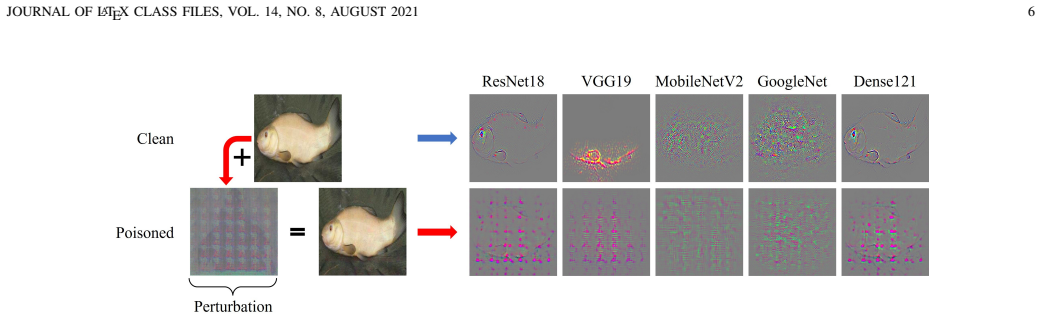
The load-bearing mechanism is the mutual-information-minimization perturbation. The paper defines the goal as reducing $I(\hat{X};\hat{Y})$, the mutual information between protected inputs and model outputs; for a deterministic network the conditional entropy vanishes, so the objective collapses to minimizing the output entropy $H(\hat{Y})$, i.e., minimizing the expected softmax entropy $\hat{y}\log\hat{y}$ over protected images. This is complemented by a class-wise universal perturbation: per-image perturbations are averaged within each class to yield $C$ noise vectors that can be transmitted to authorized users and subtracted to recover watermarked images. The second pillar is the dual watermark extractor, a second decoder $D_d$ trained on perturbed watermarked images so that the framework can verify ownership in both the perturbed and the recovered state. A differentiable JPEG approximation is included in both watermark and perturbation training so the protection holds up against compression.
What would settle it
Train a self-supervised representation model on the protected images (e.g., a contrastive learner) and then fit a linear classifier on the learned representations using clean labels; if the linear probe reaches accuracy close to the clean baseline (about 72% on ImageNet-100), the perturbed data remain learnable for label-agnostic training, which would contradict the framework's semantic-information-protection claim.
Extended reading notes
Core claim
The central claim is that availability attacks and watermarking do not have to conflict, and that a perturbation that minimizes the mutual information between a model's input and output, implemented by minimizing the entropy of the victim model's softmax outputs over protected images, generalizes across architectures and leaves enough signal for a second watermark decoder. The dual-extraction design trains one decoder for perturbation-free watermarked images and a second decoder for the same images with the perturbation added; ownership is established if either decoder's extracted message matches the embedded watermark. Because the perturbation is shared across all images in a class, authorized users can remove it by a single subtraction, restoring normal learnability. The reported results on ImageNet-100 show an average unauthorized accuracy of 6.76% against 72.78% for clean training, with watermark bit error rates of 0.16% with perturbation and 0.22% without, and similar patterns on CIFAR10 and Pets.
Load-bearing premise
The attack's theory rests on the step where, for a deterministic network, the conditional entropy $H(\hat{Y}|\hat{X})$ is set to zero so that minimizing output entropy $H(\hat{Y})$ is treated as minimizing input–output mutual information; if the network is not effectively deterministic, or if the softmax entropy is not a faithful proxy for dependence between input and output, that theoretical grounding weakens.
Editorial extensions
If this is right
- Unauthorized models trained on the protected data should stay near random accuracy even when the model architecture differs from the one that generated the perturbation, because the MI-based objective is tied to shared feature extraction rather than a single decision boundary.
- Dataset owners can publish protected images and still verify ownership both on the published (perturbed) images and on any clean images that an attacker may redistribute after removing the perturbation.
- Authorized access becomes practical: subscription or key distribution only needs to convey the class-wise perturbations and class labels, after which users subtract one vector per class and train normally.
- The protection remains usable under common cloud-operating conditions such as JPEG compression, because differentiable JPEG is integrated into both watermark and perturbation training.
Reading between the lines
- A testable extension not pursued in the paper: since the implemented loss is output entropy, an ablation that directly minimizes a nonparametric estimate of mutual information (rather than entropy) would reveal whether the MI framing adds anything beyond naive output-entropy minimization.
- The paper assumes the unauthorized user will train a classifier with labels; a label-agnostic attack (e.g., self-supervised pretraining followed by linear probing on clean labels) might bypass the class-wise perturbation, so the framework's semantic-information-protection guarantee could be scoped to supervised training.
- The class-wise perturbation is noise that can, in principle, be estimated from the protected dataset alone (for instance, by clustering protected images and averaging within inferred classes); the paper does not analyze this attack, and testing whether such clustering can recover the perturbations would determine the real-world security margin.
Editorial analysis
A structured set of objections, weighed in public.
Referee Report
Summary. The paper proposes a copyright protection framework that combines reversible unlearnable perturbations with digital watermarking. The pipeline trains a watermark encoder/decoder, generates class-wise perturbations by alternating between training a victim model and updating perturbations via a first-order step on Eq. (6), and trains a dual decoder so that watermarks are extractable both from perturbed and from recovered images. Experiments on ImageNet-100, CIFAR10, and Pets report near-random accuracy for multiple architectures on protected data (e.g., 6.76% average vs. 72.78% clean on ImageNet-100) while maintaining watermark BER below 0.35%, along with robustness studies against JPEG compression, data augmentation, adversarial training, and commercial training platforms.
Significance. If the framework works as claimed, it would be a practically relevant contribution to dataset copyright protection. The empirical evaluation is extensive and honestly reports failure modes (e.g., JPEG compression can partially break the availability attack). The dual-extractor design is a clean, well-ablated solution to the interference between unlearnable perturbations and watermark extraction. The paper also provides code. However, the central theoretical claim that the perturbation minimizes mutual information is not supported by the derivation, and this weakens the claimed novelty; the contribution as implemented is an entropy-minimization availability attack combined with dual watermarking.
major comments (2)
- [III-C, Eqs. (4)-(6)] The derivation that replaces I(X;Y) with H(Y) and then with the average softmax entropy is internally inconsistent. For a deterministic network, H(Y|X)=0, so I(X;Y)=H(Y), where H(Y) is the entropy of the marginal distribution of the model output over the data distribution. Equation (6), however, computes E_{x_hat}[-Σ_j p_j(x_hat) log p_j(x_hat)], which is exactly the conditional entropy H(Y|X) if Y is a label sampled from the softmax probabilities. These two objects are not equal in general, and the latter does not estimate the former. Therefore the optimization implemented in Algorithm 1 minimizes per-sample conditional entropy, not mutual information. The abstract and the contribution bullet that describe the method as minimizing mutual information of input and output are unsupported as written. Please either provide a correct estimator of marginal output entropy and optimize it, or reframe the paper honestly as an entropy-minimization approach and adjust the novelty claims accordingly.
- [III-C, MI validation paragraph] The paragraph after Algorithm 1 reports that mutual information decreased by 97% for ResNet18, 82% for VGG19, 89% for MobileNet, 83% for GoogleNet, and 97% for Dense121, but the manuscript does not describe the estimator used to compute these numbers. Given the issue in Eqs. (5)-(6), these figures are not interpretable as mutual information unless a separate, valid estimator is used and reported. Please specify the estimator, the random variables, and the evaluation protocol, or remove the quantitative MI claim.
minor comments (6)
- [III-C, Eq. (6)] Equation (6) uses the shorthand -f(...) log f(...) without an explicit sum over classes; write it as -Σ_j f_j(...) log f_j(...) to avoid ambiguity.
- [IV-A, Table II] In Table II, the protected Pets accuracy is exactly 2.70% for all five architectures, which equals the random-guess accuracy for this dataset; please explain this uniformity (e.g., all models collapse to one class) or correct the entries.
- [IV-B] Section IV-B reports BER values without stating the total number of bits evaluated; specify the message length and the number of test images so the reader can assess statistical uncertainty.
- [IV-F, Table VII] Table VII: the rows Ours+JPEG 85 and Ours+JPEG N/A are not explained in the text; clarify what differs from the Ours+JPEG 75 row.
- [Algorithm 1] Algorithm 1 uses a stop criterion e that is never given a value in the experiments; report the chosen e for each dataset.
- [III-C, reference [50]] The citation of equation (9) in reference [50] is not verifiable from the manuscript; please provide the exact equation number or a direct quotation.
Circularity Check
No significant circularity; the MI-entropy substitution in Eq. (6) is a correctness flaw, not a circular reduction.
full rationale
The paper's central claims are evaluated against held-out clean test data and external baselines (Emax, Emin, Tattack, GEAA, Adv-watermark), so no fitted parameter is reused as a prediction. The unlearnable perturbations are optimized on the protected training set and then assessed by training five architectures on that set and testing on clean test data; the watermark BER is measured with a separately trained dual decoder and a standard decoder, with the watermark test set described as a validation set (Section IV-D). The class-wise perturbation is an average of per-image perturbations (Eq. 8), and reversibility is a deterministic subtraction, not a fitted quantity. The only potentially load-bearing citation to a coauthored work is [59], used for the differentiable JPEG implementation in Eq. (6); this is a standard preprocessing component and does not supply the watermark or unlearnability results. The derivation from Eq. (4) to Eq. (6) is formally incorrect because H(Y|X)=0 for deterministic networks makes I(X;Y)=H(Y), yet Eq. (6) evaluates the per-sample softmax entropy, which is E[H(Y|X=x)], not H(Y). That invalidates the paper's claim that the objective minimizes mutual information, but it is not circular: the implemented objective is not defined in terms of the claimed outcome, and the empirical comparison remains self-contained. No self-citation chain or uniqueness theorem is invoked to force the method, so the circularity score is low.
Assumptions & free parameters
free parameters (5)
- L_inf perturbation budget epsilon =
4 (default); 8 and 16 also tested
- Victim model f used for perturbation generation =
ResNet18
- Stop criterion e for victim accuracy =
not specified numerically
- JPEG quality factor in differentiable JPEG =
75
- Watermark message length =
64 bits for ImageNet-100 and Pets; 32 bits for CIFAR10
assumptions (6)
- standard math Mutual information identity I(X;Y)=H(Y)-H(Y|X)
- domain assumption Neural network output is deterministic given input, so H(Y|X)=0
- domain assumption Different models extract shared semantic features from the same images
- domain assumption Differentiable JPEG is a faithful gradient proxy for standard JPEG
- domain assumption Class-wise perturbations transmitted over a secure channel can be subtracted by authorized users without other degradation
- ad hoc to paper Watermark verification can accept if either of two decoders matches
Cite this review
Pith. "Pith review of Reversible Unlearnable Examples: Towards the Copyright Protection in Deep Learning Era." pith.science (2026). https://pith.science/paper/INWA3V2S
@misc{pith2026260806211,
  author       = {Pith},
  title        = {Pith review of: Reversible Unlearnable Examples: Towards the Copyright Protection in Deep Learning Era},
  year         = {2026},
  howpublished = {\url{https://pith.science/paper/INWA3V2S}},
  note         = {Machine review of arXiv:2608.06211}
}
read the original abstract
Significant advancements in deep learning have been made possible by the utilization of large datasets, underscoring the critical importance of copyright protection. Adding meticulously designed perturbations to examples, making them unlearnable has become a crucial approach for safeguarding data copyright. Existing methods for creating unlearnable examples overlook the risk of data leakage, which can threaten data ownership. Thus, copyright protection in deep learning faces two main threats: illegal model training and malicious data leakage. We investigate that these two threats cannot be solved by straightforwardly combining existing availability attacks and watermarking techniques as their negative interaction effects. Therefore, in this paper, we propose a novel copyright protection mechanism for the aforementioned security concerns. Considering that the prevention of unauthorized model training requires powerful generalizability of unlearnable perturbations, we generate perturbations to induce the model to learn uncorrelated features of input images. It works by minimizing the mutual information of the input and output of the model. On the other hand, to eliminate the side impact of unlearnable perturbations on the watermark extraction, we design a dual extraction strategy by using two distinct watermark extractors. Extensive experiments on the image datasets {ImageNet, CIFAR10, and Pets} show that our proposed method could provide comprehensive copyright protection to images. The code is available at {https://github.com/Yeah21/ReversibleUnlearnableExamples}.
Figures


Figures from the paper (6 more)


Reference graph
Works this paper leans on
-
[1]
Prest-net: Multi-domain probability estimation network for robust image forgery detection,
J. Chen, X. Liao, Z. Qian, and Z. Qin, “Prest-net: Multi-domain probability estimation network for robust image forgery detection,”ACM Trans. Multimedia Comput. Commun. Appl., vol. 21, no. 3, Mar. 2025
work page 2025
-
[2]
A recent survey on image watermarking using scaling factor techniques for copyright protection,
F. Ernawan and D. Ariatmanto, “A recent survey on image watermarking using scaling factor techniques for copyright protection,”Multimedia Tools and Applications, pp. 1–41, 2023
work page 2023
-
[3]
Client-side embedding of screen-shooting resilient image watermarking,
X. Xiao, Y . Zhang, Z. Hua, Z. Xia, and J. Weng, “Client-side embedding of screen-shooting resilient image watermarking,”IEEE Transactions on Information Forensics and Security, vol. 19, pp. 5357–5372, 2024
work page 2024
-
[4]
L. Xiong, X. Han, C.-N. Yang, and Y .-Q. Shi, “Robust reversible watermarking in encrypted image with secure multi-party based on lightweight cryptography,”IEEE Transactions on Circuits and Systems for Video Technology, vol. 32, no. 1, pp. 75–91, 2022
work page 2022
-
[5]
Truncated robust natural watermarking with hungarian optimization,
J. You, Y .-G. Wang, G. Zhu, and S. Kwong, “Truncated robust natural watermarking with hungarian optimization,”IEEE Transactions on Cir- cuits and Systems for Video Technology, vol. 32, no. 2, pp. 483–495, 2022
work page 2022
-
[6]
Independent embedding domain based two- stage robust reversible watermarking,
X. Wang, X. Li, and Q. Pei, “Independent embedding domain based two- stage robust reversible watermarking,”IEEE Transactions on Circuits and Systems for Video Technology, vol. 30, no. 8, pp. 2406–2417, 2020
work page 2020
-
[7]
Y . Tang, S. Wang, C. Wang, S. Xiang, and Y .-M. Cheung, “A highly robust reversible watermarking scheme using embedding optimization and rounded error compensation,”IEEE Transactions on Circuits and Systems for Video Technology, vol. 33, no. 4, pp. 1593–1609, 2023
work page 2023
-
[8]
Z. Jia, H. Fang, and W. Zhang, “Mbrs: Enhancing robustness of dnn- based watermarking by mini-batch of real and simulated jpeg compres- sion,” inProceedings of the 29th ACM International Conference on Multimedia, 2021, pp. 41–49
work page 2021
Show all 61 references
-
[9]
Hidden: Hiding data with deep networks,
J. Zhu, R. Kaplan, J. Johnson, and L. Fei-Fei, “Hidden: Hiding data with deep networks,” inProceedings of the European Conference on Computer Vision, 2018, pp. 657–672
2018
-
[10]
Copy, right? a testing framework for copyright protection of deep learning models,
J. Chen, J. Wang, T. Peng, Y . Sun, P. Cheng, S. Ji, X. Ma, B. Li, and D. Song, “Copy, right? a testing framework for copyright protection of deep learning models,” in2022 IEEE Symposium on Security and Privacy (SP), 2022, pp. 824–841
2022
-
[11]
Modellock: Locking your model with a spell,
Y . Gao, Y . Sun, X. Ma, Z. Wu, and Y .-G. Jiang, “Modellock: Locking your model with a spell,” inProceedings of the 32nd ACM International Conference on Multimedia, 2024, p. 11156–11165
2024
-
[12]
The secretive company that might end privacy as we know it,
K. Hill, “The secretive company that might end privacy as we know it,” inEthics of Data and Analytics. Auerbach Publications, 2022, pp. 170–177
2022
-
[13]
Adversarial privacy-preserving filter,
J. Zhang, J. Sang, X. Zhao, X. Huang, Y . Sun, and Y . Hu, “Adversarial privacy-preserving filter,” inProceedings of the 28th ACM International Conference on Multimedia, 2020, pp. 1423–1431
2020
-
[14]
Adversarial examples make strong poisons,
L. Fowl, M. Goldblum, P.-y. Chiang, J. Geiping, W. Czaja, and T. Gold- stein, “Adversarial examples make strong poisons,” inProceedings of Advances in Neural Information Processing Systems, 2021, pp. 30 339– 30 351
2021
-
[15]
Autoregressive perturbations for data poisoning,
P. Sandoval-Segura, V . Singla, J. Geiping, M. Goldblum, T. Goldstein, and D. Jacobs, “Autoregressive perturbations for data poisoning,” in Proceedings of Advances in Neural Information Processing Systems, 2022, pp. 27 374–27 386
2022
-
[16]
Availability attacks create shortcuts,
D. Yu, H. Zhang, W. Chen, J. Yin, and T.-Y . Liu, “Availability attacks create shortcuts,” inProceedings of the 28th ACM SIGKDD Conference on Knowledge Discovery and Data Mining, 2022, pp. 2367–2376
2022
-
[17]
Learnability lock: Authorized learnability con- trol through adversarial invertible transformations,
W. Peng and J. Chen, “Learnability lock: Authorized learnability con- trol through adversarial invertible transformations,” inProceedings of International Conference on Learning Representations, 2022, pp. 1–12
2022
-
[18]
Preventing unauthorized use of proprietary data: Poisoning for secure dataset release,
L. Fowl, P.-y. Chiang, M. Goldblum, J. Geiping, A. Bansal, W. Czaja, and T. Goldstein, “Preventing unauthorized use of proprietary data: Poisoning for secure dataset release,” inProceedings of International Conference on Learning Representations Workshop, 2021, pp. 1–10
2021
-
[19]
Robust unlearnable examples: Protecting data against adversarial learning,
S. Fu, F. He, Y . Liu, L. Shen, and D. Tao, “Robust unlearnable examples: Protecting data against adversarial learning,” inProceedings of International Conference on Learning Representations, 2022, pp. 1– 13
2022
-
[20]
Unlearnable examples: Making personal data unexploitable,
H. Huang, X. Ma, S. M. Erfani, J. Bailey, and Y . Wang, “Unlearnable examples: Making personal data unexploitable,” inProceedings of International Conference on Learning Representations, 2021, pp. 1–12
2021
-
[21]
Unlearnable clusters: Towards label-agnostic unlearnable examples,
J. Zhang, X. Ma, Q. Yi, J. Sang, Y .-G. Jiang, Y . Wang, and C. Xu, “Unlearnable clusters: Towards label-agnostic unlearnable examples,” inProceedings of the IEEE/CVF Conference on Computer Vision and Pattern Recognition, 2023, pp. 3984–3993
2023
-
[22]
Guided erasable adversarial attack (geaa) toward shared data protection,
M. Zhao, B. Wang, W. Wang, Y . Kong, T. Zheng, and K. Ren, “Guided erasable adversarial attack (geaa) toward shared data protection,”IEEE Transactions on Information Forensics and Security, pp. 2468–2482, 2022
2022
-
[23]
Adv-watermark: A novel watermark perturbation for adversarial examples,
X. Jia, X. Wei, X. Cao, and X. Han, “Adv-watermark: A novel watermark perturbation for adversarial examples,” inProceedings of the 28th ACM International Conference on Multimedia, 2020, pp. 1579–1587
2020
-
[24]
A self- supervised cnn for image watermark removal,
C. Tian, M. Zheng, T. Jiao, W. Zuo, Y . Zhang, and C.-W. Lin, “A self- supervised cnn for image watermark removal,”IEEE Transactions on Circuits and Systems for Video Technology, vol. 34, no. 8, pp. 7566– 7576, 2024
2024
-
[25]
Poisoning attacks against support vector machines,
B. Biggio, B. Nelson, and P. Laskov, “Poisoning attacks against support vector machines,” inProceedings of the International Conference on Machine Learning, 2012, pp. 1467–1474
2012
-
[26]
Towards poisoning of deep learning algorithms with back-gradient optimization,
L. Mu ˜noz-Gonz´alez, B. Biggio, A. Demontis, A. Paudice, V . Wongras- samee, E. C. Lupu, and F. Roli, “Towards poisoning of deep learning algorithms with back-gradient optimization,” inProceedings of the 10th ACM workshop on artificial intelligence and security, 2017, pp. 27–38
2017
-
[27]
Metapoison: Practical general-purpose clean-label data poisoning,
W. R. Huang, J. Geiping, L. Fowl, G. Taylor, and T. Goldstein, “Metapoison: Practical general-purpose clean-label data poisoning,” in Proceedings of Advances in Neural Information Processing Systems, 2020, pp. 12 080–12 091
2020
-
[28]
Witches’ brew: Industrial scale data poisoning via gradient matching,
J. Geiping, L. Fowl, W. R. Huang, W. Czaja, G. Taylor, M. Moeller, and T. Goldstein, “Witches’ brew: Industrial scale data poisoning via gradient matching,” inProceedings of the International Conference on Learning Representations, 2020, pp. 1–13
2020
-
[29]
Neural tangent generalization attacks,
C. Yuan and S. Wu, “Neural tangent generalization attacks,” inPro- ceedings of International Conference on Machine Learning, 2021, pp. 12 230–12 240
2021
-
[30]
Transferable unlearnable examples,
J. Ren, H. Xu, Y . Wan, X. Ma, L. Sun, and J. Tang, “Transferable unlearnable examples,” inInternational Conference on Learning Repre- sentations, 2023, pp. 1–9
2023
-
[31]
Unseg: One universal unlearnable example generator is enough against all image segmentation,
Y . Sun, H. Zhang, T. Zhang, X. Ma, and Y .-G. Jiang, “Unseg: One universal unlearnable example generator is enough against all image segmentation,” inNeurIPS, 2024
2024
-
[32]
Red- mark: Framework for residual diffusion watermarking based on deep networks,
M. Ahmadi, A. Norouzi, N. Karimi, S. Samavi, and A. Emami, “Red- mark: Framework for residual diffusion watermarking based on deep networks,”Expert Systems with Applications, vol. 146, p. 113157, 2020
2020
-
[33]
A novel two-stage separable deep learning framework for practical blind watermarking,
Y . Liu, M. Guo, J. Zhang, Y . Zhu, and X. Xie, “A novel two-stage separable deep learning framework for practical blind watermarking,” in Proceedings of the 27th ACM International conference on multimedia, 2019, pp. 1509–1517
2019
-
[34]
Stegastamp: Invisible hyperlinks in physical photographs,
M. Tancik, B. Mildenhall, and R. Ng, “Stegastamp: Invisible hyperlinks in physical photographs,” inProceedings of the IEEE/CVF Conference on Computer Vision and Pattern Recognition, 2020, pp. 2117–2126
2020
-
[35]
Robust high- capacity watermarking over online social network shared images,
W. Sun, J. Zhou, Y . Li, M. Cheung, and J. She, “Robust high- capacity watermarking over online social network shared images,”IEEE Transactions on Circuits and Systems for Video Technology, vol. 31, no. 3, pp. 1208–1221, 2021
2021
-
[36]
Waverecovery: Screen- shooting watermarking based on wavelet and recovery,
L. Fu, X. Liao, J. Guo, L. Dong, and Z. Qin, “Waverecovery: Screen- shooting watermarking based on wavelet and recovery,”IEEE Transac- tions on Circuits and Systems for Video Technology, vol. 35, no. 4, pp. 3603–3618, 2025
2025
-
[37]
Screen-shooting resistant watermarking with grayscale deviation simulation,
Y . Li, X. Liao, and X. Wu, “Screen-shooting resistant watermarking with grayscale deviation simulation,”IEEE Transactions on Multimedia, vol. 26, pp. 10 908–10 923, 2024
2024
-
[38]
The unreasonable effectiveness of deep features as a perceptual metric,
R. Zhang, P. Isola, A. A. Efros, E. Shechtman, and O. Wang, “The unreasonable effectiveness of deep features as a perceptual metric,” inProceedings of the IEEE/CVF Conference on Computer Vision and Pattern Recognition, 2018, pp. 586–595
2018
-
[39]
The jpeg still picture compression standard,
G. K. Wallace, “The jpeg still picture compression standard,”IEEE Transactions on Consumer Electronics, vol. 34, no. 4, pp. 30–44, 1991
1991
-
[40]
Squeeze-and-excitation networks,
J. Hu, L. Shen, S. Albanie, G. Sun, and E. Wu, “Squeeze-and-excitation networks,” inProceedings of the IEEE/CVF Conference on Computer Vision and Pattern Recognition, 2017, pp. 7132–7141
2017
-
[41]
Explaining and harnessing adversarial examples,
I. J. Goodfellow, J. Shlens, and C. Szegedy, “Explaining and harnessing adversarial examples,” inProceedings of International Conference on Learning Representations, 2015
2015
-
[42]
Deepfool: a simple and accurate method to fool deep neural networks,
S.-M. Moosavi-Dezfooli, A. Fawzi, and P. Frossard, “Deepfool: a simple and accurate method to fool deep neural networks,” inProceedings of JOURNAL OF LATEX CLASS FILES, VOL. 14, NO. 8, AUGUST 2021 14 the IEEE/CVF Conference on Computer Vision and Pattern Recognition, 2016, pp....
2021
-
[43]
The robustness of deep networks: A geometrical perspective,
A. Fawzi, S.-M. Moosavi-Dezfooli, and P. Frossard, “The robustness of deep networks: A geometrical perspective,”IEEE Signal Processing Magazine, vol. 34, no. 6, pp. 50–62, 2017
2017
-
[44]
Delving into transferable adversarial examples and black-box attacks,
Y . Liu, X. Chen, C. Liu, and D. Song, “Delving into transferable adversarial examples and black-box attacks,” inProceedings of 5th International Conference on Learning Representations, 2017
2017
-
[45]
Revisiting model stitching to compare neural representations,
Y . Bansal, P. Nakkiran, and B. Barak, “Revisiting model stitching to compare neural representations,” inProceedings of Advances in Neural Information Processing Systems, vol. 34, 2021, pp. 225–236
2021
-
[46]
Grounding representation similarity with statistical testing,
F. Ding, J.-S. Denain, and J. Steinhardt, “Grounding representation similarity with statistical testing,” inProceedings of Advances in Neural Information Processing Systems, 2021, pp. 1–13
2021
-
[47]
Similarity of neural network representations revisited,
S. Kornblith, M. Norouzi, H. Lee, and G. Hinton, “Similarity of neural network representations revisited,” inInternational Conference on Machine Learning, 2019, pp. 3519–3529
2019
-
[48]
Insights on representational similarity in neural networks with canonical correlation,
A. Morcos, M. Raghu, and S. Bengio, “Insights on representational similarity in neural networks with canonical correlation,” inProceedings of Advances in Neural Information Processing Systems, vol. 31, 2018, pp. 1–10
2018
-
[49]
Do wide and deep networks learn the same things? uncovering how neural network representations vary with width and depth,
T. Nguyen, M. Raghu, and S. Kornblith, “Do wide and deep networks learn the same things? uncovering how neural network representations vary with width and depth,” inInternational Conference on Learning Representations, 2021, pp. 1–9
2021
-
[50]
Maximum-entropy adver- sarial data augmentation for improved generalization and robustness,
L. Zhao, T. Liu, X. Peng, and D. Metaxas, “Maximum-entropy adver- sarial data augmentation for improved generalization and robustness,” inProceedings of Advances in Neural Information Processing Systems, 2020, pp. 14 435–14 447
2020
-
[51]
Ima- genet: A large-scale hierarchical image database,
J. Deng, W. Dong, R. Socher, L.-J. Li, K. Li, and L. Fei-Fei, “Ima- genet: A large-scale hierarchical image database,” inProceedings of the IEEE/CVF Conference on Computer Vision and Pattern Recognition, 2009, pp. 248–255
2009
-
[52]
Cifar-10 image classification with con- volutional neural networks for embedded systems,
R. C. C ¸ alik and M. F. Demirci, “Cifar-10 image classification with con- volutional neural networks for embedded systems,” in2018 IEEE/ACS 15th International Conference on Computer Systems and Applications, 2018, pp. 1–2
2018
-
[53]
Cats and dogs,
O. M. Parkhi, A. Vedaldi, A. Zisserman, and C. V . Jawahar, “Cats and dogs,” inIEEE Conference on Computer Vision and Pattern Recognition, 2012
2012
-
[54]
Deep residual learning for image recognition,
K. He, X. Zhang, S. Ren, and J. Sun, “Deep residual learning for image recognition,” inProceedings of the IEEE/CVF Conference on Computer Vision and Pattern Recognition, 2016, pp. 770–778
2016
-
[55]
Very deep convolutional networks for large-scale image recognition,
K. Simonyan and A. Zisserman, “Very deep convolutional networks for large-scale image recognition,” inProceedings of International Conference on Learning Representations, 2015, pp. 1–10
2015
-
[56]
Mo- bilenetv2: Inverted residuals and linear bottlenecks,
M. Sandler, A. Howard, M. Zhu, A. Zhmoginov, and L.-C. Chen, “Mo- bilenetv2: Inverted residuals and linear bottlenecks,” inProceedings of the IEEE/CVF Conference on Computer Vision and Pattern Recognition, 2018, pp. 4510–4520
2018
-
[57]
Going deeper with convolutions,
C. Szegedy, W. Liu, Y . Jia, P. Sermanet, S. Reed, D. Anguelov, D. Erhan, V . Vanhoucke, and A. Rabinovich, “Going deeper with convolutions,” inProceedings of the IEEE/CVF Conference on Computer Vision and Pattern Recognition, 2015, pp. 1–9
2015
-
[58]
Densely connected convolutional networks,
G. Huang, Z. Liu, L. Van Der Maaten, and K. Q. Weinberger, “Densely connected convolutional networks,” inProceedings of the IEEE/CVF Conference on Computer Vision and Pattern Recognition, 2017, pp. 4700–4708
2017
-
[59]
Robust image forgery detection against transmission over online social networks,
H. Wu, J. Zhou, J. Tian, J. Liu, and Y . Qiao, “Robust image forgery detection against transmission over online social networks,”IEEE Trans- actions on Information Forensics and Security, pp. 443–456, 2022
2022
-
[60]
Learning the unlearnable: Adversarial augmentations suppress unlearnable example attacks,
T. Qin, X. Gao, J. Zhao, K. Ye, and C.-Z. Xu, “Learning the unlearnable: Adversarial augmentations suppress unlearnable example attacks,”arXiv preprint arXiv:2303.15127, 2023
2023 arXiv
-
[61]
Dual defense: Adversarial, traceable, and invisible robust watermarking against face swapping,
Y . Zhang, D. Ye, C. Xie, L. Tang, X. Liao, Z. Liu, C. Chen, and J. Deng, “Dual defense: Adversarial, traceable, and invisible robust watermarking against face swapping,”IEEE Transactions on Information Forensics and Security, vol. 19, pp. 4628–4641, 2024. Binze Wangreceived t...
2024
Reviewed August 7, 2026 · model on record in the stance chip above.
Discussion (0). Continue with ORCID to comment.