REVIEW 3 major objections 4 minor 15 references
EliSeg: Verified Target Construction for Report-Grounded Abnormality Segmentation
T0 review · 3 major / 4 minor · reviewed 2026-08-12 · deepseek-v4-flash
Pith's one-line read Report-grounded segmentation without a target oracle: EliSeg reaches 59.4 IoU on MIMIC-CXR-ILS, surpassing direct text-based and extract-then-segment baselines while rejecting most ineligible mentions.
desk verdict EliSeg is a genuinely new formulation with an honest evaluation; the unverified slot-to-finding binding is a real but disclosed limitation. read the letter →
The pith
A machine-rendered reading of the paper's core claim, the machinery that carries it, and where it could break.
The reading
What carries the argument
The load-bearing mechanism is the canonical control-sequence grammar. The Actor emits up to three segmentation tokens [SEG1]–[SEG3] under a fixed finding ordering (cardiomegaly, edema, effusion, atelectasis, lung opacity, pneumonia, consolidation); the k-th token is supervised against the k-th positive finding in that order, so the token's contextual representation carries the finding's identity without an explicit label. The Verifier independently produces a verified inventory in the same canonical order, and Revision constructs a teacher-forced sequence of the verified length but does not inject finding names; the correspondence is recovered from the Actor's report-conditioned representations under the same ordering. This lets the framework correct eligibility and cardinality errors—false targets, omissions, wrong counts—while still using a single shared mask decoder, with no explicit slot-level identity verification.
What would settle it
Read a test set of sentences that assert two eligible findings in reverse canonical order (for instance 'pneumonia and cardiomegaly' instead of 'cardiomegaly and pneumonia'), decode both masks, then record whether the first-slot mask matches the cardiomegaly reference or the pneumonia reference; if, despite a correct count, the first-slot mask more often matches the second-listed finding than chance, the canonical slot-to-finding identity is broken and pooled overlap metrics would hide the swap.
Extended reading notes
Core claim
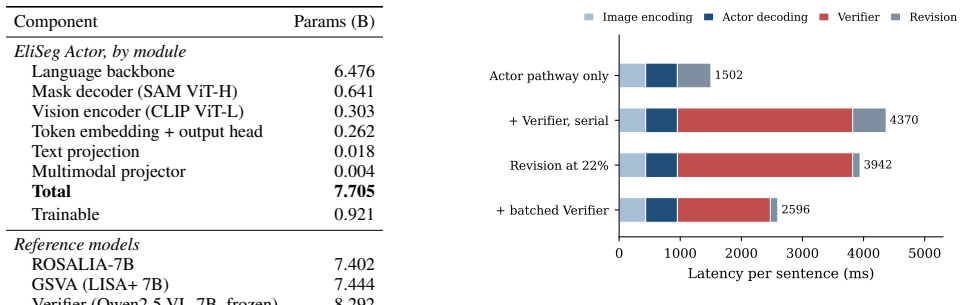
EliSeg establishes that report-grounded abnormality segmentation can be performed without any predefined target identity or spatial prompt: given a chest radiograph and its unfiltered report, the model predicts a sentence-level action (SEG/REJ/SILENT), a target cardinality, and one mask per eligible finding. The framework is an actor–verify–revise loop: a grammar-constrained Actor proposes mask slots through control tokens [SEG1]...[SEG_K]; an independent text-only Verifier (a frozen Qwen2.5-VL-7B) reconstructs the eligible finding inventory; a consistency gate compares action and cardinality; and when they disagree, Revision builds a corrected canonical control sequence and re-executes the shared Actor in a teacher-forced pass. On MIMIC-CXR-ILS, EliSeg attains 59.4 IoU, 74.5 Dice, 23.2 NSD, and 213.9 HD95 under report-inferred input, surpassing the best direct text-based method (ROSALIA, 40.8 IoU) and the best extract-then-segment cascade (CheXbert→ROSALIA, 53.9 IoU), while achieving a false segmentation rate of 14.2% and an IoU+ of 60.8 on eligible targets. Ablations show that neither verification alone nor revision alone improves much over the Actor (circa 49–50 IoU), whereas the closed loop reaches 54.1 IoU on a shared Actor, with Revision primarily rescuing cases where the Actor declined to segment or dropped a slot (22% of sentences) and leaving intact the 78% with full slot structure. The paper further reports zero-shot transfer of the Actor to CheXlocalize (31.9 IoU in a given-target setting), and shows the framework adds no trainable parameters over its ROSALIA-7B initialization, with the extra inference cost coming almost entirely from the frozen Verifier.
Load-bearing premise
The k-th mask slot always refers to the k-th eligible finding under the fixed vocabulary order, so a correct count is assumed to mean correct finding-to-mask pairing; the consistency gate never checks which finding each mask represents, and count-preserving swaps go undetected.
Editorial extensions
If this is right
- Report-grounded segmentation becomes a one-pass structured prediction: a report goes in and all eligible masks come out, without one target-conditioned invocation per finding.
- Eligibility and cardinality errors that are invisible to mask geometry—false targets, omitted findings, wrong counts—can be repaired at the target-construction stage, and the ablation attributes a roughly 200-pixel HD95 reduction to this structural correction.
- The frozen text-only Verifier acts as a plug-in consistency signal: any future Actor can be gated against it without retraining the Verifier, and the gate fires only on disagreement, which occurs in 22% of sentences.
- The gain over extract-then-segment cascades (59.4 vs 53.9 IoU) comes precisely from recovering omitted targets and suppressing spurious ones, errors a cascade cannot fix after extraction, and the Actor alone transfers to CheXlocalize (31.9 vs 29.6 IoU for ROSALIA).
- The framework adds no trainable parameters over the segmenter it initializes from, so its improvements are attributable to the verify–revise loop rather than added capacity.
Reading between the lines
- The framework effectively treats the fixed vocabulary ordering as an implicit language of slot identity; a natural testable extension is to make finding identity explicit in the control tokens (for instance, emitting a 'cardiomegaly' token) so that per-slot verification can catch count-preserving swaps, which Section 5 flags as missing.
- Because the Verifier dominates serial latency (roughly two thirds of per-sentence cost) and is frozen, batching its fixed prompt prefix or distilling it into a smaller labeler is the obvious lever to make the gate practical at scale; the paper already measures batching amortization (1,522 ms vs 2,868 ms per sentence at batch 8).
- The residual rejection error is concentrated on 'prior' mentions (29% false-segmentation rate vs 2% for negated and 11.5% for uncertain evidence), which suggests temporal assertion reasoning, not lexical negation, is the next bottleneck for report-grounded segmentation; a verifier that reads across the full report section rather than the current sentence is the direct test.
- The paper reports that over-planning materializes a mask for non-existent targets in 5.6% of sentences, with lung opacity most affected; since reference masks in MIMIC-CXR-ILS are sometimes pixel-identical across labels, some of this 'false target' rate is annotation arbitrariness, and an external adjudicated set would separate verifier errors from label noise.
Signed reviews
Editorial analysis
A structured set of objections, weighed in public.
Referee Report
Summary. The paper introduces EliSeg, a propose-verify-revise framework for report-grounded abnormality segmentation on chest radiographs. Given an image and an unfiltered report sentence, a grammar-constrained Actor proposes a sentence-level action, a target cardinality, and provisional masks through a fixed set of control tokens; a frozen text-only Verifier independently reconstructs the eligible finding inventory; a deterministic gate compares action and cardinality, and when they disagree, Revision teacher-forces a corrected control sequence through the same Actor. The method is evaluated on MIMIC-CXR-ILS under report-inferred, gold-inventory, and native-prompt settings, with additional zero-shot given-target transfer on CheXlocalize. The reported results show large improvements over direct text-based segmentation and extract-then-segment cascades, with detailed appendices on annotation, metrics, inference cost, and parameter accounting.
Significance. If the results hold, EliSeg addresses a genuine and under-studied problem: constructing executable segmentation targets from radiology reports without a hidden target oracle. The paper is unusually transparent in several respects: it reports a shared metric implementation, retains missing predictions as empty masks, accounts for parameter counts and inference cost, releases code, and includes an explicit limitations section. These strengths make the empirical comparisons reproducible within the chosen evaluation universe. However, the central claim of correct finding-to-mask correspondence rests on an unverified canonical-ordering assumption, and the empirical evidence is based on single deterministic runs without variability estimates or a fully specified balanced sampling procedure. The contribution is potentially significant, but the current manuscript needs revision before the central claim is fully supported.
major comments (3)
- [Sec. 3.3, 3.5, A.2] The finding-to-mask correspondence is never explicitly predicted or verified. Slot k is assumed to correspond to the k-th positive finding under the fixed canonical vocabulary order, the Verifier supplies only cardinality and action, and Section 3.5 states that verified finding names are not injected into the Actor. Consequently, any count-preserving permutation of mask identities is invisible to the consistency gate and to Revision. The paper itself concedes in Section 5 that such semantic errors may remain undetected. This assumption is load-bearing because Table 2 assigns per-finding IoU values to slots using the same canonical order, so those numbers cannot independently validate the binding. I recommend adding an explicit slot-level identity check or a human-audited correspondence analysis, or otherwise demonstrating that slot identity errors are rare in practice.
- [Sec. 4.2, B.3] All comparisons are single deterministic runs with no confidence intervals, and Appendix B.3 explains that significance tests are deliberately omitted. This is understandable given target correlation within studies, but it leaves several claims undersupported. For example, Table 2 shows EliSeg's cardiomegaly IoU advantage over CheXbert to ROSALIA is 2.8 points, and the NSD gains for several findings are 1-2 points; without seed variance or a study-level bootstrap, it is not possible to assess whether these differences are stable. I request at least a small number of training seeds for EliSeg and the strongest baseline, or a bootstrap over studies, reported as confidence intervals on the headline metrics.
- [Sec. A.1, A.8] The evaluation universe is a balanced subsample of the test split (1,008 targets and 600 ineligible mentions), but the sampling protocol is not specified. Because IoU and Dice are pooled over targets, the prevalence of each finding in the evaluation set directly affects the aggregate numbers. A balanced subsample gives rare findings such as pneumonia and consolidation much larger weight than in the natural MIMIC-CXR-ILS distribution, which may change the relative ranking between systems if their per-finding error profiles differ. Please describe how the balanced subsample was constructed, whether studies or targets were sampled, and also report results on the full test split or on both the natural and balanced universes.
minor comments (4)
- [Abstract and Sec. 4.5] The abstract and conclusion state that EliSeg transfers to CheXlocalize, but Section 4.5 evaluates only the Actor without the Verifier or Revision because paired reports are unavailable. Please soften the wording to 'the EliSeg Actor transfers' or explicitly state that full-framework transfer remains untested.
- [Sec. A.6] The parameter accounting is inconsistent as written: Table 9 lists ROSALIA-7B as 7.402B while the text says 'Under a common accounting both total 7.705B.' Clarify whether the 7.402B figure excludes the bundled CLIP encoder and state which accounting is used for the comparison.
- [Sec. 4.1 and Table 1] The Report-Inferred setting for direct text-based baselines is not fully specified. For models whose native interface is a finding phrase (e.g., ROSALIA, MedCLIP-SAMv2), it is unclear whether the entire unfiltered report is used as the text prompt and how long reports are truncated. Please document the exact input construction for each baseline under the R setting.
- [Abstract] There is a typo in the abstract: 'atcor-verify-revise' should read 'actor-verify-revise'.
Circularity Check
No significant circularity: EliSeg's report-inferred gains are measured on fixed external benchmarks with a frozen off-the-shelf Verifier; the canonical slot-order convention is a supervised label-assignment protocol, not a fitted value or a self-citation chain.
full rationale
The derivation chain is self-contained. The headline Report-Inferred numbers (Table 1: 59.4 IoU, 74.5 Dice, 23.2 NSD, 213.9 HD95) are obtained on the fixed MIMIC-CXR-ILS test universe of 1,008 targets, plus zero-shot transfer on CheXlocalize; the Actor is trained only on the training split, the Verifier is a frozen Qwen2.5-VL-7B model that is never trained or modified, and Kmax and loss weights are chosen from training-set statistics (Sec. A.4, Table 8), not from test labels. No reported 'prediction' reduces by the paper's own equations to a fitted parameter. The canonical-slot convention (A.2: 'slot index k corresponds to the k-th positive finding under this ordering rather than to an explicitly decoded label') is a label-assignment protocol for supervised training and evaluation, not a fitted input: the mask pixels are still predicted from image and report, so per-finding IoU/Dice values are genuine measurements and the per-finding rows are not forced by construction. The paper explicitly flags the count-preserving swap limitation in Sec. 5: 'semantic errors that preserve the target count may remain undetected; slot-level verification could provide finer correction.' That is an acknowledged robustness/correctness caveat, not a circular step. Self-citations (e.g., Yang et al. 2025; Jiang et al. 2026b) appear only in related-work surveys and are not load-bearing. There is no imported uniqueness theorem, no ansatz smuggled in via citation, and no renaming of a known result as a new derivation. Overall circularity score: 0.
Assumptions & free parameters
free parameters (6)
- Kmax (max segmentation slots) =
3
- Lambda_CE =
0.5
- Lambda_BCE =
5.0
- Lambda_Dice =
1.0
- LoRA rank =
8
- Learning rate =
5e-5
assumptions (5)
- domain assumption Eligibility for segmentation is determined by whether the sentence asserts current presence; negated, prior, uncertain, and out-of-scope mentions are ineligible.
- ad hoc to paper The k-th segmentation token corresponds to the k-th positive finding under the fixed vocabulary order (cardiomegaly, edema, effusion, atelectasis, lung opacity, pneumonia, consolidation), so slot identity can be recovered without explicit labels.
- ad hoc to paper The frozen Qwen2.5-VL-7B model, given the hand-crafted 17-shot text-only prompt, reliably classifies each of seven findings as positive, negated, prior, uncertain, or absent.
- domain assumption Sentences with positive assertions but no reference mask (UNSUPPORTED) can be excluded from training and evaluation without biasing the measured task.
- domain assumption Pooled IoU/Dice with empty predictions retained and HD95 with a fixed empty penalty is an appropriate oracle-free evaluation protocol.
Cite this review
Pith. "Pith review of EliSeg: Verified Target Construction for Report-Grounded Abnormality Segmentation." pith.science (2026). https://pith.science/paper/3V2AAKUU
@misc{pith2026260807299,
  author       = {Pith},
  title        = {Pith review of: EliSeg: Verified Target Construction for Report-Grounded Abnormality Segmentation},
  year         = {2026},
  howpublished = {\url{https://pith.science/paper/3V2AAKUU}},
  note         = {Machine review of arXiv:2608.07299}
}
read the original abstract
Radiology reports describe clinical observations but do not specify executable segmentation targets. They may contain present, negated, prior,uncertain, or irrelevant findings, while multiple valid abnormalities may coexist. Existing segmentation methods largely bypass this ambiguity by receiving a target identity or spatial prompt before inference, which acts as a hidden target oracle. We study report-grounded abnormality segmentation, where a model must determine target eligibility, cardinality, and finding-to-mask correspondence directly from an unfiltered report before delineating the corresponding regions. We propose \textbf{EliSeg}, an atcor--verify--revise framework that integrates target construction with mask generation. A grammar-constrained Actor proposes target slots and masks, an independent text-only Verifier reconstructs the eligible finding inventory, and Revision selectively re-executes the shared Actor when their target structures disagree. EliSeg requires no predefined target identity, finding prompt, point, or bounding box. Experiments on MIMIC-CXR-ILS show that EliSeg consistently outperforms direct segmentation methods and extract-then-segment cascades across findings, while effectively suppressing masks for ineligible report mentions. Ablation studies confirm the complementary roles of verification and revision, and evaluation on CheXlocalize demonstrates effective transfer of the EliSeg to an external dataset.Code is available at https://github.com/Maybach-dream/EliSeg.
Figures


Figures from the paper (5 more)



Reference graph
Works this paper leans on
-
[1]
it rarely produces a mask at all, and the same caution applies as in Sec. 4.3. A.8 Evaluation Protocol All systems are scored by a single shared implementation on identical target universes:1,008finding-level targets for MIMIC-CXR-ILS and899for CheXlocalize. Masks are compared in a common1024×1024label space. Overlap metrics.IoU and Dice arepooledover tar...
2000
-
[3]
In ProceedingsoftheComputerVisionandPatternRecognition Conference, 20841–20851
Interactive medical image segmentation: A benchmark dataset and baseline. In ProceedingsoftheComputerVisionandPatternRecognition Conference, 20841–20851. Choi, G.; Yoon, H.; Shin, H.; Park, H.; Seo, S. H.; Yang, E.; andChoi,E.2025. Instruction-GuidedLesionSegmentation for Chest X-rays with Automatically Generated Large-Scale Dataset.arXiv preprint arXiv:2...
arXiv 2025
-
[4]
Huang,Y.;Peng,Z.;Zhao,Y.;Yang,P.;Yang,X.;andShen, W.2025. Medseg-r:Reasoningsegmentationinmedicalim- ageswithmultimodallargelanguagemodels.arXivpreprint arXiv:2506.10465. Irvin, J.; Rajpurkar, P.; Ko, M.; Yu, Y.; Ciurea-Ilcus, S.; Chute,C.;Marklund,H.;Haghgoo,B.;Ball,R.;Shpanskaya, K.; et al
arXiv 2025
-
[8]
Saporta,A.;Gui,X.;Agrawal,A.;Pareek,A.;Truong,S.Q.; Nguyen, C
Voxtell: Free-text promptableuniversal3dmedicalimagesegmentation.arXiv preprint arXiv:2511.11450. Saporta,A.;Gui,X.;Agrawal,A.;Pareek,A.;Truong,S.Q.; Nguyen, C. D.; Ngo, V.-D.; Seekins, J.; Blankenberg, F. G.; Ng, A. Y.; et al
-
[10]
Trinh, Q.-H.; Nguyen, M.-V.; Peng, J.; Bagci, U.; and Jha, D
MediRound: Multi-Round Entity-Level Reasoning Segmen- tationinMedicalImages.arXivpreprintarXiv:2511.12110. Trinh, Q.-H.; Nguyen, M.-V.; Peng, J.; Bagci, U.; and Jha, D
-
[12]
Zhao, T.; Gu, Y.; Yang, J.; Usuyama, N.; Lee, H
Tk-mamba: Marrying kan withmamba for text-driven 3d medicalimage segmentation.arXiv preprint arXiv:2505.18525. Zhao, T.; Gu, Y.; Yang, J.; Usuyama, N.; Lee, H. H.; Nau- mann, T.; Gao, J.; Crabtree, A.; Abel, J.; Moung-Wen, C.; etal.2024. Biomedparse:abiomedicalfoundationmodelfor image parsing of everything everywhere all at once.arXiv preprint arXiv:2405....
arXiv 2024
-
[13]
Med- ical sam 2: Segment medical images as video via segment anything model 2.arXiv preprint arXiv:2408.00874. Appendix Contents A Additional Experimental Details...........................................................2 A.1 Sentence-Level Annotation...........................................................2 A.2 Actor Response Grammar.....................
-
[14]
No large effusino or pneumothorax
A.2 Actor Response Grammar TheActoremitsastructuredresponseoveracompactcontrol vocabulary.Thegrammarrestrictsdecodingtothefollowing productions, whereKmax = 3: Segmentationslotsfollowthecanonicalfindingordercar- diomegaly, edema, effusion, atelectasis, lung opacity, pneu- monia, consolidation. Reference targets are serialized in ex- actly this order durin...
2000
Show all 15 references
-
[654]
D.; Patel, Y.; Meyer, C.; Askham, H.; Romera-Paredes, B.; Kelly, C.; Karthikesalingam, A.; Chu, C.; Carnell, D.; Boon, C.; D’Souza, D.; Moinuddin, S
Nikolov, S.; Blackwell, S.; Zverovitch, A.; Mendes, R.; Livne, M.; Fauw, J. D.; Patel, Y.; Meyer, C.; Askham, H.; Romera-Paredes, B.; Kelly, C.; Karthikesalingam, A.; Chu, C.; Carnell, D.; Boon, C.; D’Souza, D.; Moinuddin, S. A.; Garie, B.; McQuinlan, Y.; Ireland, S.; Hampton,...
2021 arXiv
-
[2020]
InProceedings of the 2020 conference on empirical methods in natural language processing (EMNLP), 1500–
Combining automatic labelers and ex- pertannotationsforaccurateradiologyreportlabelingusing BERT. InProceedings of the 2020 conference on empirical methods in natural language processing (EMNLP), 1500–
2020
-
[2021]
Jiang,C.;Ding,T.;Song,C.;Tu,J.;Yan,Z.;Shao,Y.;Wang, Z.; Shang, Y.; Han, T.; and Tian, Y
Radgraph: Extracting clinical en- tities and relations from radiology reports.arXiv preprint arXiv:2106.14463. Jiang,C.;Ding,T.;Song,C.;Tu,J.;Yan,Z.;Shao,Y.;Wang, Z.; Shang, Y.; Han, T.; and Tian, Y. 2026a. Medical SAM3: A Foundation Model for Universal Prompt-Driven Medical I...
-
[2023]
InProceedings of the IEEE/CVF international conference on computer vision, 21152–21164
Clip- driven universal model for organ segmentation and tumor detection. InProceedings of the IEEE/CVF international conference on computer vision, 21152–21164. Loshchilov,I.;andHutter,F.2017. Decoupledweightdecay regularization.arXiv preprint arXiv:1711.05101. Ma, J.; He, Y.;...
2017 arXiv
-
[2024]
InAAAI 2024 Spring Symposium on Clinical Foundation Models
Chexagent: Towards a foundation model for chest x-ray interpretation. InAAAI 2024 Spring Symposium on Clinical Foundation Models. Cheng, J.; Fu, B.; Ye, J.; Wang, G.; Li, T.; Wang, H.; Li, R.; Yao, H.; Cheng, J.; Li, J.; et al
2024
-
[2025]
5-VL Technical Report.arXiv e-prints, arXiv–2502
Qwen2. 5-VL Technical Report.arXiv e-prints, arXiv–2502. Bannur, S.; Bouzid, K.; Castro, D. C.; Schwaighofer, A.; Thieme, A.; Bond-Taylor, S.; Ilse, M.; Pérez-García, F.; Sal- vatelli,V.;Sharma,H.;etal.2024. Maira-2:Groundedradi- ology report generation.arXiv preprint arXiv:24...
2024 arXiv
-
[2026]
Xing,Z.;Wan,L.;Fu,H.;Yang,G.;Yang,Y.;Yu,L.;Lei,B.; andZhu,L.2025
MedVL-SAM2: A uni- fied 3D medical vision-language model for multimodal rea- soning and prompt-driven segmentation.arXiv preprint arXiv:2601.09879. Xing,Z.;Wan,L.;Fu,H.;Yang,G.;Yang,Y.;Yu,L.;Lei,B.; andZhu,L.2025. Diff-UNet:Adiffusionembeddednetwork for robust 3D medical image...
2025
Reviewed August 12, 2026 · model on record in the stance chip above.
Discussion (0). Continue with ORCID to comment.