REVIEW 4 major objections 4 minor 71 references
JWST Reveals a Galaxy-Wide Association of Red Supergiants with OB Stars in NGC 5584
T0 review · 4 major / 4 minor · reviewed 2026-08-12 · deepseek-v4-flash
Pith's one-line read In NGC 5584, 82% of ultraviolet-bright star-forming complexes coincide with red-supergiant overdensities, and the ultraviolet and near-infrared luminosities of those complexes correlate tightly; the association is galaxy-wide but…
desk verdict Solid, honest new RSG–UV association result from JWST in one galaxy, but the 82% headline lacks a null control and the analysis needs more rigorous statistics before publication. read the letter →
The pith
A machine-rendered reading of the paper's core claim, the machinery that carries it, and where it could break.
The reading
What carries the argument
The load-bearing mechanism is matched-aperture comparison. UV-bright star-forming complexes are segmented from the Swift/UVOT UVW2 morphology, and those exact apertures are then projected onto the GALEX FUV/NUV and JWST/NIRCam images so that every wavelength measures the same physical regions. The RSG population is selected from a JWST/NIRCam colour-magnitude diagram with fixed boundary lines, and the spatial association is quantified by comparing the RSG surface density inside each complex with the galaxy-wide average, splitting complexes into high-, candidate-high-, and normal-density classes. Ultraviolet luminosities are corrected for internal dust with a UV-slope method and a standard extinction curve, while ages come from fitting stellar-evolution isochrones to the combined red supergiant and blue candidate populations in each complex.
What would settle it
Place hundreds of random apertures with the same size distribution as the 106 UV-defined complexes across the same JWST field and measure the red-supergiant overdensity fraction; if random apertures also yield roughly 82% high- or candidate-high-density classifications, the claimed association is not specific to star-forming regions. A complementary check is spectroscopy of a random sample of the 5,310 candidates: a large foreground-dwarf or AGB fraction would mean the overdensity signal is an artifact of the colour-magnitude selection.
Extended reading notes
Core claim
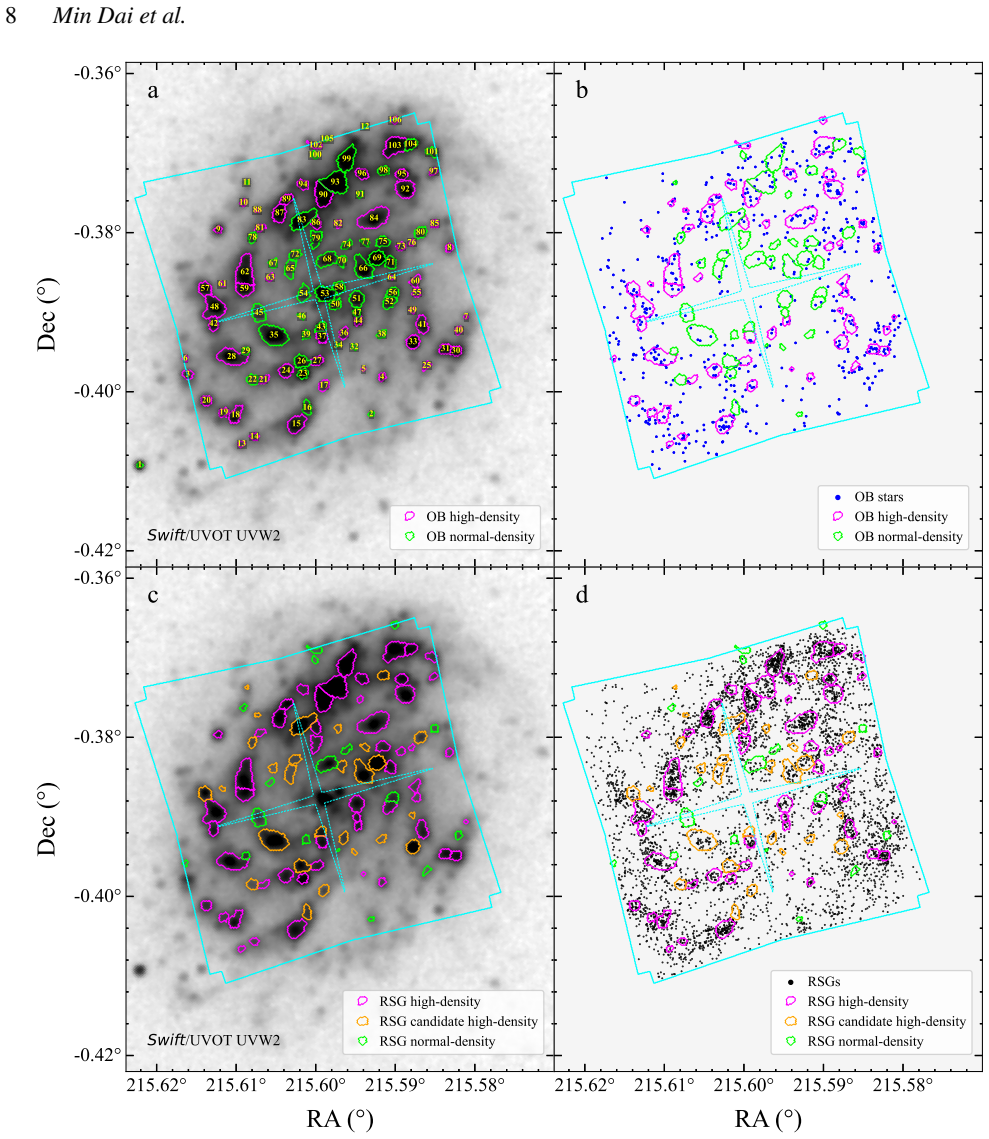
On its own terms, the paper establishes a statistical rather than one-to-one connection between evolved and young massive stars in NGC 5584. Among the 96 UV-selected complexes with usable JWST coverage, 52 are high-density in red supergiants and 27 are candidate high-density, so 82% of the complexes sit on significant RSG overdensities; many individual RSGs nevertheless fall outside the UV boundaries. The same apertures show a second, quantitative result: after a UV-slope dust correction, GALEX FUV and NUV luminosities correlate with JWST/NIRCam F090W, F150W, and F277W luminosities with Pearson coefficients $r=0.962$--$0.971$, and the 43 RSG-rich complexes fitted with isochrones cluster near $\log(\mathrm{age/yr}) \simeq 7.16$. The paper interprets these as related but distinct phases: the UV light marks the youngest massive stars, while the RSG overdensities mark the evolved products of recent massive-star formation, displaced by drift and dust.
Load-bearing premise
The 82% measure rests on the photometric classification of 5,310 sources as red supergiants; the paper itself notes that the foreground-dwarf locus is less clearly separated in this small JWST field than in wide-field surveys, and no spectroscopy confirms the RSG identities.
Editorial extensions
If this is right
- If the result holds, red supergiant overdensities become a usable resolved tracer of recent massive-star formation across a whole disk, independent of UV or H-alpha emission.
- The 82% overlap provides a quantitative target for models of massive-star lifetimes and cluster dispersal: simulated galaxies should reproduce the same fraction and the same roughly 15 megayear characteristic age.
- Because many RSGs lie outside the UV-bright regions, star-formation rates derived from UV light alone will systematically undercount the evolved massive-star content of a galaxy.
- The tight UV-near-infrared luminosity correlations imply that these UV-defined apertures are stable photometric units, so comparing future JWST surveys with archival GALEX imaging is feasible at hundreds-of-parsec scales.
Reading between the lines
- A natural extension the paper leaves implicit: in galaxies with higher inclinations or stronger spiral arms, the same matched-aperture statistic should be measured; if the 82% figure is mostly a spiral-arm effect, it should change, and if it reflects massive-star lifetimes, it should stay roughly constant.
- The photometric RSG sample could be validated with low-resolution near-infrared spectroscopy: showing that even a small random subset are foreground dwarfs or bright AGB stars would make the measured overdensity dilution concrete rather than hypothetical.
- The narrow age spread the authors report invites a sharper test: resolved age gradients within individual complexes, rather than one isochrone per complex, would show whether the youngest UV-bright stars sit at the edges of older RSG groups.
Editorial analysis
A structured set of objections, weighed in public.
Referee Report
Summary. The paper combines JWST/NIRCam near-infrared photometry with Swift/UVOT UVW2 morphology and GALEX FUV/NUV imaging for the spiral galaxy NGC 5584. It constructs a photometric catalogue of 5,310 red supergiant candidates, defines 106 UV-selected star-forming complexes from the UVOT image, and then measures the density of RSG candidates inside those apertures. The central claim is that 82% of the UV-selected SFCs coincide with RSG overdensities, indicating a galaxy-wide statistical association between current UV-bright star-forming regions and the evolved massive-star population. The paper also reports strong Pearson correlations between extinction-corrected GALEX UV luminosities and matched-aperture NIRCam luminosities (r = 0.962–0.971), a MUSE Balmer-decrement check on the UV extinction scale, and MIST isochrone fits yielding a characteristic age of log(age/yr) ≈ 7.16 for 43 RSG-rich SFCs. The authors are careful to state that the association is statistical and not one-to-one, and they interpret the tracers as related but distinct phases of recent massive-star formation.
Significance. If the statistical association is established, this would be a valuable empirical result: it uses JWST's resolved near-infrared view of an external spiral disk to connect RSG candidates with UV-bright star-forming complexes at ~100 pc scales, something that has rarely been done galaxy-wide. The paper's strengths include the multiwavelength dataset, the public machine-readable catalogues and supplementary data, the matched-aperture analysis with an independent MUSE-based extinction check, and the explicit caution against overinterpreting spatial overlap as causal or coeval star formation. The significance is currently limited, however, because the headline 82% figure is not accompanied by a null test: without control apertures or a permutation test, the measured overlap may largely reflect the fact that both RSG candidates and UV-bright SFCs trace the same spiral arms.
major comments (4)
- [Section 4.1] The RSG overdensity classification uses a fixed threshold relative to the field average (ρ_clump > 2ρ_avg for high-density, ρ_avg < ρ_clump ≤ 2ρ_avg for candidate high-density) with no null or control apertures. Since the RSG candidates trace the spiral arms (Section 3.1, Figure 8) and the UV-selected SFCs are located on the same arms, the field-average density is dominated by inter-arm area, so an aperture placed anywhere on an arm will tend to be classified as overdense by construction. The 82% figure therefore does not by itself establish that the association is stronger than expected for random arm-located positions. Please add control apertures matched in galactocentric radius and arm/inter-arm environment, or a permutation test that randomizes SFC positions, and report the significance of the resulting overlap fraction.
- [Abstract and Section 4.1] The abstract states that 82% of the UV-selected SFCs overlap significant RSG overdensities, but the 82% is computed for 96 clumps after excluding 10 (five outside the JWST footprint and five near the center), and it combines the 52 high-density clumps (ρ > 2ρ_avg) with the 27 candidate high-density clumps (ρ_avg < ρ ≤ 2ρ_avg). The candidate high-density class is not a significant overdensity under any stated statistical test. Please state the denominator explicitly in the abstract and report the high-density and candidate high-density fractions separately; the phrase 'significant RSG overdensities' should be reserved for the high-density class, or a significance threshold should be defined and used.
- [Section 3.1, Eq. (1)] The RSG selection is purely photometric, and the authors themselves note that the foreground-dwarf separation is less clearly defined than in wide-field surveys because of the small field of view. Since the central 82% number depends directly on the selected RSG catalogue, the paper should include a sensitivity test in which the CMD boundaries in Eq. (1) are varied by plausible amounts (for example, a few tenths of a magnitude in the F090W−F277W and F277W limits) and the high-density fraction is recomputed. Without such a test, it is unclear whether the association fraction is robust to plausible changes in the photometric classification, particularly at the faint end near the TRGB where contamination is acknowledged to be present.
- [Section 5.3] The isochrone result of log(age/yr) ≈ 7.16 is based on 43 of the 106 SFCs, selected because each contains at least 12 RSG candidates and yields visually clear fits, but the paper provides no uncertainties on the fitted ages, no quantitative criteria for 'clear and distinguishable' fits, and no discussion of how excluding the other 63 regions affects the age distribution. If this age is retained as a conclusion, the fitting uncertainties and the potential selection bias from restricting to RSG-rich regions need to be quantified.
minor comments (4)
- [Figures 5 and 8] The RSG candidates are described as red dots in the text and in Figure 8, but in Figure 5d they appear as black dots; please unify the symbol colours across figures and captions.
- [Section 4.2] The Pearson correlation coefficients are reported without uncertainties, and it is not explicitly stated whether the fits use log luminosities as plotted; please add confidence intervals and specify the exact quantities used in the correlation.
- [Equation (1)] The selection region in Eq. (1) is written without restating that F277W and F090W are apparent magnitudes and that all boundaries are in magnitude units; please add a short sentence for clarity.
- [Section 2.1] The criteria 'Object Type ≤ 2' and 'Error Flag = 2' are DOLPHOT output conventions; a brief definition or reference for readers not familiar with DOLPHOT would improve reproducibility.
Circularity Check
No significant circularity: the 82% RSG-overlap claim is an empirical spatial measurement, not a definitional consequence of the RSG or SFC selection.
full rationale
The paper's central claim is an observational association, not a prediction derived from fitted inputs. RSG candidates are selected purely from NIRCam colour-magnitude cuts (Eq. 1, with an external TRGB and distance modulus), while SFC apertures are defined independently from Swift/UVOT UVW2 morphology; the two catalogues are therefore constructed from independent data. The overdensity classification compares local RSG density inside each UV-defined aperture with the field average, and there is no equation or selection step by which the UV mask forces the RSG density to exceed that average. The self-citations that appear (e.g., Dai et al. 2025b for the foreground-dwarf locus and Ren et al. 2022 for the C/M metallicity diagnostic) are methodological or auxiliary rather than load-bearing: foreground removal is additionally validated against a TRILEGAL simulation, and the C/M estimate is explicitly not adopted as the fiducial metallicity. The luminosity correlations and MIST isochrone ages use external calibrations and matched apertures, so they are also empirical rather than self-referential. The absence of explicit null/control apertures is a legitimate statistical-significance concern, but it is a correctness risk, not a constructional circularity, and under the given rules it does not raise the circularity score.
Assumptions & free parameters
free parameters (6)
- UV SFC segmentation parameters =
3 sigma threshold, 50-pixel initial size, nlevels=128, contrast=0.001
- RSG CMD selection boundaries in Eq. (1) =
slopes -11 and -6, color range F090W-F277W 1.4 to 4.5, magnitude limits 22.198 and 25.698
- Density threshold for high-density classification =
2 times the field average
- Crowding quality cut =
<= 0.5 for primary sample, <= 1.0 for expanded sample
- Metallicity [Fe/H] in MIST isochrone fits =
-0.1 dex
- Internal extinction AV in isochrone fits =
free, constrained to be >= 0.11 mag, values not tabulated
assumptions (7)
- domain assumption Distance to NGC 5584 is 23.3 Mpc, distance modulus 31.838 mag (Riess et al. 2024)
- domain assumption Absolute TRGB magnitude in F277W is -6.14 mag (Newman et al. 2024)
- domain assumption MIST stellar models and isochrones are accurate for massive star evolution
- domain assumption CCM89 and Calzetti extinction curves are applicable
- domain assumption Reddy et al. (2018) UV-beta to E(B-V) calibration is valid for these SFCs
- standard math Case B recombination with H alpha / H beta = 2.86 for the Balmer check
- domain assumption Gaia DR3 astrometry and TRILEGAL model correctly describe foreground contamination
Cite this review
Pith. "Pith review of JWST Reveals a Galaxy-Wide Association of Red Supergiants with OB Stars in NGC 5584." pith.science (2026). https://pith.science/paper/YIBTASZD
@misc{pith2026260808006,
  author       = {Pith},
  title        = {Pith review of: JWST Reveals a Galaxy-Wide Association of Red Supergiants with OB Stars in NGC 5584},
  year         = {2026},
  howpublished = {\url{https://pith.science/paper/YIBTASZD}},
  note         = {Machine review of arXiv:2608.08006}
}
abstract
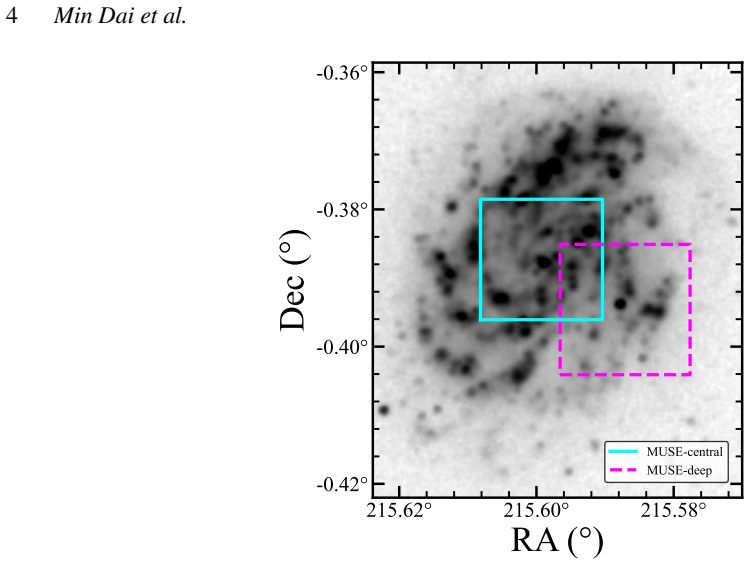
The spatial relationship between young and evolved massive-star tracers offers a means of probing recent star formation across galactic disks. We combine JWST/NIRCam, $Swift$/UVOT UVW2, and GALEX FUV/NUV images to investigate the spatial association between red-supergiant (RSG) candidates and UV-selected star-forming complexes (SFCs) in the spiral galaxy NGC 5584. We identify 5,310 RSG candidates using colour--magnitude criteria and define 106 UV-selected SFCs from the UVOT/UVW2 morphology, with their FUV and NUV luminosities measured independently using the GALEX images. We find that 82% of the UV-selected SFCs overlap significant RSG overdensities, indicating a galaxy-wide statistical association between UV-bright SFCs and the evolved massive-star population. Among the 93 SFCs with reliable JWST coverage, the UV-$\beta$-corrected FUV and NUV luminosities correlate tightly with the JWST/NIRCam luminosities, with Pearson correlation coefficients of $r=0.962$--$0.971$. MIST isochrone comparisons for 43 RSG-rich SFCs indicate a characteristic age of $\log(\mathrm{age/yr})\simeq 7.16$. These results show that RSG overdensities and UV-selected SFCs trace related but distinct phases of recent massive-star formation. Their spatial correspondence is statistical rather than one-to-one and likely reflects differences in stellar age, dust extinction, spatial resolution, aperture coverage, and local star-formation history.
Figures


Figures from the paper (7 more)



Reference graph
Works this paper leans on
-
[1]
The Tip of Red Giant Branch Distances to Nearby Dwarf Galaxies WLM and Sextans A with JWST. , keywords =. doi:10.3847/1538-4357/add52e , archivePrefix =. 2505.03511 , primaryClass =
-
[2]
The evolution of stars and astrophysics
-
[3]
The kinematics of the Scorpius-Centaurus OB association from Gaia DR1. , keywords =. doi:10.1093/mnras/sty207 , archivePrefix =. 1801.08540 , primaryClass =
-
[4]
A new survey of cool supergiants in the Magellanic Clouds. , keywords =. doi:10.1051/0004-6361/201425362 , archivePrefix =. 1504.00003 , primaryClass =
-
[6]
Tracing Hierarchical Star Formation out to Kiloparsec Scales in Nearby Spiral Galaxies with UVIT
Tracing hierarchical star formation out to kiloparsec scales in nearby spiral galaxies with UVIT. , keywords =. doi:10.1051/0004-6361/202451739 , archivePrefix =. 2412.00872 , primaryClass =
-
[7]
Tracing young star-forming clumps in the nearby flocculent spiral galaxy NGC 7793 with UVIT imaging
Tracing Young Star-forming Clumps in the Nearby Flocculent Spiral Galaxy NGC 7793 with UVIT Imaging. , keywords =. doi:10.3847/1538-4357/abe0b4 , archivePrefix =. 2101.11314 , primaryClass =
-
[8]
The Samples and Binary Fractions of Red Supergiants in M31 and M33 by the HST Observations. , keywords =. doi:10.3847/1538-4357/ade156 , archivePrefix =. 2505.24559 , primaryClass =
-
[9]
Red Supergiants in M31 and M33. I. The Complete Sample. , keywords =. doi:10.3847/1538-4357/abcda5 , archivePrefix =. 2011.12051 , primaryClass =
work page Pith review arXiv 2011
Show all 71 references
-
[10]
, keywords =
Testing Evolutionary Models with Red Supergiant and Wolf-Rayet Populations. , keywords =. doi:10.3847/1538-4357/ac15f5 , archivePrefix =. 2107.08304 , primaryClass =
-
[11]
, keywords =
The historical record of massive star formation in Cygnus. , keywords =. doi:10.1051/0004-6361/202039188 , archivePrefix =. 2009.12779 , primaryClass =
2009 arXiv
-
[12]
High-resolution spectroscopic study of massive blue and red supergiants in Perseus OB1. I. Definition of the sample, membership, and kinematics. , keywords =. doi:10.1051/0004-6361/202039019 , archivePrefix =. 2008.13299 , primaryClass =
2008 arXiv
-
[13]
, keywords =
Structure, kinematics, and ages of the young stellar populations in the Orion region. , keywords =. doi:10.1051/0004-6361/201935781 , archivePrefix =. 1906.07002 , primaryClass =
1906 arXiv
-
[14]
, year = 2003, month = jan, volume =
MASSIVE STARS IN THE LOCAL GROUP: Implications for Stellar Evolution and Star Formation. , year = 2003, month = jan, volume =. doi:10.1146/annurev.astro.41.071601.170033 , adsurl =
2003
-
[15]
, year = 1949, month = jan, volume =
Stellar Associations. , year = 1949, month = jan, volume =
1949
-
[16]
, keywords =
The binary fraction of red supergiants in the Magellanic Clouds. , keywords =. doi:10.1093/mnras/staf560 , archivePrefix =. 2504.03357 , primaryClass =
-
[17]
and Haberland, Matt and Reddy, Tyler and Cournapeau, David and Burovski, Evgeni and Peterson, Pearu and Weckesser, Warren and Bright, Jonathan and
Virtanen, Pauli and Gommers, Ralf and Oliphant, Travis E. and Haberland, Matt and Reddy, Tyler and Cournapeau, David and Burovski, Evgeni and Peterson, Pearu and Weckesser, Warren and Bright, Jonathan and. Nature Methods , year =
-
[18]
, keywords =
A Search of Periodic Variable Stars in the LMC by JWST Photometry. , keywords =. doi:10.3847/1538-4365/adea45 , archivePrefix =. 2506.21971 , primaryClass =
-
[19]
, keywords =
OB Associations: Massive Stars in Context. , keywords =. doi:10.1086/133338 , adsurl =
-
[20]
Tip of the Red Giant Branch Distances with JWST. II. I-band Measurements in a Sample of Hosts of 10 Type Ia Supernova Match HST Cepheids. , keywords =. doi:10.3847/1538-4357/ad84f3 , archivePrefix =. 2408.00065 , primaryClass =
-
[21]
, keywords =
Crowded No More: The Accuracy of the Hubble Constant Tested with High-resolution Observations of Cepheids by JWST. , keywords =. doi:10.3847/2041-8213/acf769 , archivePrefix =. 2307.15806 , primaryClass =
-
[22]
The O Associations in the Solar Neighborhood
Blaauw, Adriaan. The O Associations in the Solar Neighborhood. Annual Review of Astronomy and Astrophysics. 1964. doi:https://doi.org/10.1146/annurev.aa.02.090164.001241
1964
-
[23]
Wright , keywords =
Nicholas J. Wright , keywords =. OB Associations and their origins , journal =. 2020 , issn =. doi:https://doi.org/10.1016/j.newar.2020.101549 , url =
2020
-
[24]
, year = 2013, month = aug, volume =
Nucleosynthesis in Stars and the Chemical Enrichment of Galaxies. , year = 2013, month = aug, volume =. doi:10.1146/annurev-astro-082812-140956 , adsurl =
2013 doi
-
[25]
, keywords =
De re metallica: the cosmic chemical evolution of galaxies. , keywords =. doi:10.1007/s00159-018-0112-2 , archivePrefix =. 1811.09642 , primaryClass =
-
[26]
, keywords =
Star Formation in the Milky Way and Nearby Galaxies. , keywords =. doi:10.1146/annurev-astro-081811-125610 , archivePrefix =. 1204.3552 , primaryClass =
-
[27]
, keywords =
Galactic Winds. , keywords =. doi:10.1146/annurev.astro.43.072103.150610 , archivePrefix =. astro-ph/0504435 , primaryClass =
-
[28]
Theoretical Challenges in Galaxy Formation
Naab, Thorsten and Ostriker, Jeremiah P. Theoretical Challenges in Galaxy Formation. Annual Review of Astronomy and Astrophysics. 2017. doi:https://doi.org/10.1146/annurev-astro-081913-040019
2017 doi
-
[29]
, keywords =
Star Clusters Across Cosmic Time. , keywords =. doi:10.1146/annurev-astro-091918-104430 , archivePrefix =. 1812.01615 , primaryClass =
-
[30]
de Zeeuw, P. T. and Hoogerwerf, R. and de Bruijne, J. H. J. and Brown, A. G. A. and Blaauw, A. , title =. The Astronomical Journal , abstract =. 1999 , month =. doi:10.1086/300682 , url =
1999 doi
-
[31]
Galaxies , VOLUME =
Ekström, Sylvia and Georgy, Cyril , TITLE =. Galaxies , VOLUME =. 2025 , NUMBER =
2025
-
[32]
doi:10.1088/978-0-7503-1329-2 , adsurl =
Astrophysics of Red Supergiants. doi:10.1088/978-0-7503-1329-2 , adsurl =
-
[33]
Mesa Isochrones and Stellar Tracks (MIST). I. Solar-scaled Models. , keywords =. doi:10.3847/0004-637X/823/2/102 , archivePrefix =. 1604.08592 , primaryClass =
-
[34]
Grids of stellar models with rotation. I. Models from 0.8 to 120 M _ at solar metallicity (Z = 0.014). , keywords =. doi:10.1051/0004-6361/201117751 , archivePrefix =. 1110.5049 , primaryClass =
-
[35]
scikit-image: image processing in
van der Walt,. scikit-image: image processing in. PeerJ , issn =. 2014 , month =
2014
-
[36]
Astronomical Data Analysis Software and Systems XIV , year = 2005, editor =
TOPCAT & STIL: Starlink Table/VOTable Processing Software. Astronomical Data Analysis Software and Systems XIV , year = 2005, editor =
2005
-
[37]
Hunter, J. D. , Title =. Computing in Science & Engineering , Volume =
-
[38]
, keywords =
The Astropy Project: Sustaining and Growing a Community-oriented Open-source Project and the Latest Major Release (v5.0) of the Core Package. , keywords =. doi:10.3847/1538-4357/ac7c74 , archivePrefix =. 2206.14220 , primaryClass =
-
[39]
Uncrowding the Cepheids for an Improved Determination of the Hubble Constant
-
[40]
Universe , keywords =
The C/M Ratio of AGB Stars in the Local Group Galaxies. Universe , keywords =. doi:10.3390/universe8090465 , archivePrefix =. 2209.02506 , primaryClass =
-
[41]
The JWST Resolved Stellar Populations Early Release Science Program. V. DOLPHOT Stellar Photometry for NIRCam and NIRISS. , keywords =. doi:10.3847/1538-4365/ad2600 , archivePrefix =. 2402.03504 , primaryClass =
-
[42]
Evolved massive stars at low-metallicity. I. A source catalog for the Small Magellanic Cloud. , keywords =. doi:10.1051/0004-6361/201935916 , archivePrefix =. 1907.06717 , primaryClass =
1907 arXiv
-
[43]
Evolved massive stars at low metallicity. II. Red supergiant stars in the Small Magellanic Cloud. , keywords =. doi:10.1051/0004-6361/201937168 , archivePrefix =. 2005.10108 , primaryClass =
2005 arXiv
-
[44]
Evolved massive stars at low-metallicity. III. A source catalog for the Large Magellanic Cloud. , keywords =. doi:10.1051/0004-6361/202039475 , archivePrefix =. 2012.08623 , primaryClass =
2012 arXiv
-
[45]
, keywords =
Further calibration of the Swift ultraviolet/optical telescope. , keywords =. doi:10.1111/j.1365-2966.2010.16832.x , archivePrefix =. 1004.2448 , primaryClass =
2010
-
[46]
, keywords =
The Calibration and Data Products of GALEX. , keywords =. doi:10.1086/520512 , archivePrefix =. 0706.0755 , primaryClass =
-
[47]
, keywords =
Improving the full spectrum fitting method: accurate convolution with Gauss-Hermite functions. , keywords =. doi:10.1093/mnras/stw3020 , archivePrefix =. 1607.08538 , primaryClass =
-
[48]
The Propagation of Uncertainties in Stellar Population Synthesis Modeling. III. Model Calibration, Comparison, and Evaluation. , keywords =. doi:10.1088/0004-637X/712/2/833 , archivePrefix =. 0911.3151 , primaryClass =
-
[49]
, keywords =
The Dust Content and Opacity of Actively Star-forming Galaxies. , keywords =. doi:10.1086/308692 , archivePrefix =. astro-ph/9911459 , primaryClass =
-
[50]
, keywords =
The Integrated Spectra of Nearby Galaxies: General Properties and Emission-Line Spectra. , keywords =. doi:10.1086/171154 , adsurl =
-
[51]
, keywords =
Optical Star Formation Rate Indicators. , keywords =. doi:10.1086/500964 , archivePrefix =. astro-ph/0511730 , primaryClass =
-
[52]
, keywords =
The PHANGS-AstroSat Atlas of Nearby Star-forming Galaxies. , keywords =. doi:10.3847/1538-4365/ad152c , archivePrefix =. 2312.06031 , primaryClass =
-
[53]
, keywords =
The Chemical Composition of the Sun. , keywords =. doi:10.1146/annurev.astro.46.060407.145222 , archivePrefix =. 0909.0948 , primaryClass =
-
[54]
, keywords =
The HDUV Survey: A Revised Assessment of the Relationship between UV Slope and Dust Attenuation for High-redshift Galaxies. , keywords =. doi:10.3847/1538-4357/aaa3e7 , archivePrefix =. 1705.09302 , primaryClass =
-
[55]
, keywords =
Photometric calibration of the Swift ultraviolet/optical telescope. , keywords =. doi:10.1111/j.1365-2966.2007.12563.x , archivePrefix =. 0708.2259 , primaryClass =
2007
-
[56]
, keywords =
The Relationship between Infrared, Optical, and Ultraviolet Extinction. , keywords =. doi:10.1086/167900 , adsurl =
-
[57]
, keywords =
Measuring Reddening with Sloan Digital Sky Survey Stellar Spectra and Recalibrating SFD. , keywords =. doi:10.1088/0004-637X/737/2/103 , archivePrefix =. 1012.4804 , primaryClass =
-
[58]
Astrophysics of gaseous nebulae and active galactic nuclei
-
[59]
, keywords =
The Heraklion Extragalactic Catalogue (HECATE): a value-added galaxy catalogue for multimessenger astrophysics. , keywords =. doi:10.1093/mnras/stab1799 , archivePrefix =. 2106.12101 , primaryClass =
-
[60]
, keywords =
A Pilot Method to Determine the High Mass End of the Stellar Initial Mass Function in Galaxies Using UVIT, H -MUSE Observations and Applied to NGC 628. , keywords =. doi:10.3847/1538-4357/add68d , archivePrefix =. 2505.03226 , primaryClass =
-
[61]
, keywords =
Dust Extinction of the Stellar Continua in Starburst Galaxies: The Ultraviolet and Optical Extinction Law. , keywords =. doi:10.1086/174346 , adsurl =
-
[62]
Evolved massive stars at low-metallicity. IV. Using the 1.6 m H-bump to identify red supergiant stars: Case study of NGC 6822. , keywords =. doi:10.1051/0004-6361/202039596 , archivePrefix =. 2101.08689 , primaryClass =
-
[63]
, keywords =
The Optical to Mid-infrared Extinction Law Based on the APOGEE, Gaia DR2, Pan-STARRS1, SDSS, APASS, 2MASS, and WISE Surveys. , keywords =. doi:10.3847/1538-4357/ab1c61 , archivePrefix =. 1904.04575 , primaryClass =
1904 arXiv
-
[64]
, keywords =
The Optical to Infrared 0.6 5.3 m Dust Extinction Law of the Milky Way with JWST NIRSpec: Westerlund 2. , keywords =. doi:10.3847/2041-8213/ad2e98 , archivePrefix =. 2402.17239 , primaryClass =
-
[65]
, keywords =
The New Galaxy: Signatures of Its Formation. , keywords =. doi:10.1146/annurev.astro.40.060401.093840 , archivePrefix =. astro-ph/0208106 , primaryClass =
-
[66]
Harris and K
Charles R. Harris and K. Jarrod Millman and St. Array programming with. 2020 , month = sep, journal =. doi:10.1038/s41586-020-2649-2 , publisher =
2020 doi
-
[67]
astropy/photutils: 2.2.0 , month = feb, year = 2025, publisher =
Larry Bradley and Brigitta Sip. astropy/photutils: 2.2.0 , month = feb, year = 2025, publisher =. doi:10.5281/zenodo.14889440 , url =
2025 doi
-
[68]
, keywords =
A New Approach to Identifying Red Supergiant Stars in Metal-poor Galaxies: A Case Study of NGC 6822. , keywords =. doi:10.3847/1538-4357/ada1d4 , archivePrefix =. 2412.15763 , primaryClass =
- [69]
-
[70]
, keywords =
The Sample of Red Supergiants in 12 Low-mass Galaxies of the Local Group. , keywords =. doi:10.3847/1538-4357/ac307b , archivePrefix =. 2110.08793 , primaryClass =
-
[71]
An Empirical Calibration of the Tip of the Red Giant Branch Distance Method in the Near Infrared. II. JWST NIRCam Wide Filters. , keywords =. doi:10.3847/1538-4357/ad79f8 , archivePrefix =. 2406.03532 , primaryClass =
-
[72]
, keywords =
JWST Observations Reject Unrecognized Crowding of Cepheid Photometry as an Explanation for the Hubble Tension at 8 Confidence. , keywords =. doi:10.3847/2041-8213/ad1ddd , archivePrefix =. 2401.04773 , primaryClass =
Reviewed August 12, 2026 · model on record in the stance chip above.
Discussion (0). Continue with ORCID to comment.