REVIEW 4 major objections 5 minor 15 references
Compiling and Benchmarking Task-State Horizons for Embodied Agents
T0 review · 4 major / 5 minor · reviewed 2026-08-12 · deepseek-v4-flash
Pith's one-line read Long-horizon robotic agents fail most when they must maintain, explore, and update task-relevant world state, and this paper shows that this "task-state horizon" predicts success better than action length or subgoal count.
desk verdict The benchmark is big, the TSH construct is well motivated, but the paper never measures the TSH tuple it claims to control, so the central claim is untested. read the letter →
The pith
A machine-rendered reading of the paper's core claim, the machinery that carries it, and where it could break.
The reading
What carries the argument
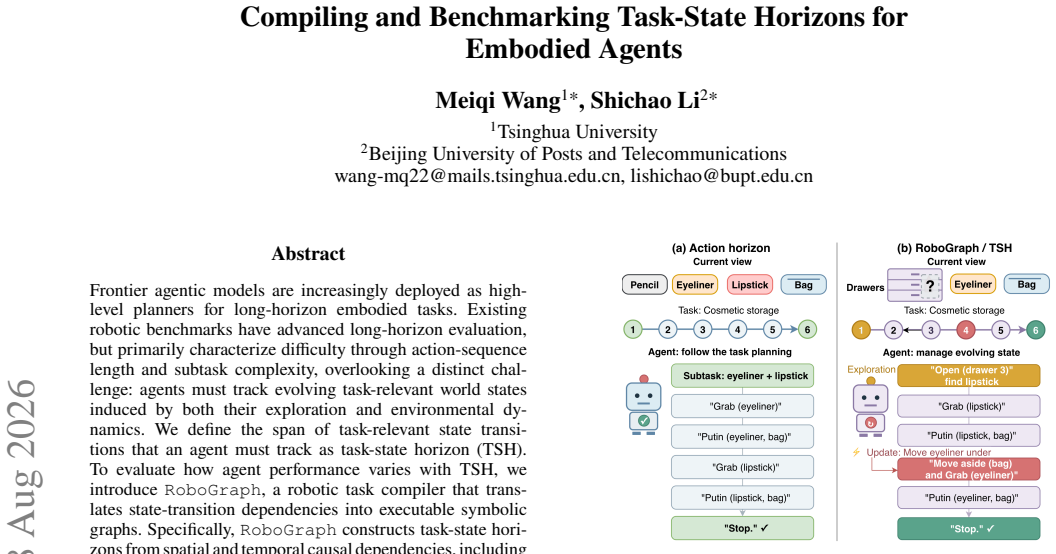
The load-bearing machinery is the TSH tuple plus the compiler that controls it. $H_{\mathrm{maintain}}$ counts how long a fact must be carried from acquisition to last use, $H_{\mathrm{explore}}$ counts the minimal view-expanding steps needed to reveal hidden facts, and $H_{\mathrm{update}}$ counts facts invalidated by exogenous events; RoboGraph encodes these as executable scene graphs with an observation operator $O(G_t,h_t)$ that removes out-of-view facts and an event schedule $\Lambda=\{\langle\psi_\lambda,\delta_\lambda,\kappa_\lambda\rangle\}$ that rewrites the graph on semantic triggers. The controlled comparison mechanism is the paired baseline-plus-intervention design: each of 84 scenes yields one baseline and six intervention conditions (action failure, state regression, completed-subgoal rollback, wrong relocation, added occlusion, and added object), so episodes differ in state-tracking demand while sharing the base scene.
What would settle it
Enumerate or sample all shortest oracle action sequences for a set of compiled scenes, recompute the TSH tuple for each, and compare: if equally short plans yield different tuples in a nontrivial share of scenes, the TSH-controlled comparison is not controlling a single quantity.
Extended reading notes
Core claim
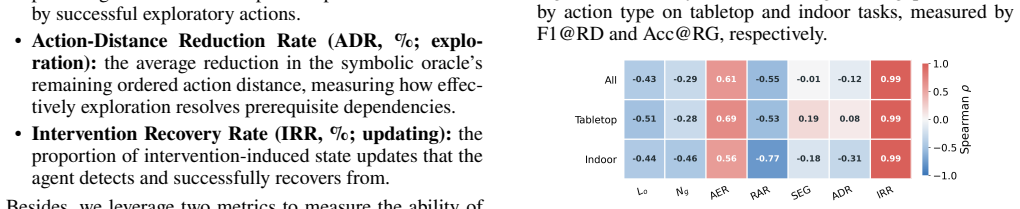
RoboGraph represents a task as a latent scene graph $G_t=(V_t,E_t,X_t)$ with an observation operator that exposes only the currently visible subgraph, so agents act under partial observability. A fact is a state dependency of a decision if the decision relies on the fact while the fact is not recoverable from the current view; dependencies are spatial when the fact is hidden and must be exposed by view-expanding actions, and temporal when an earlier-observed fact still constrains a later decision. The task-state horizon is defined from a shortest oracle action sequence $\tau^*$ as the tuple $H=(H_{\mathrm{maintain}},H_{\mathrm{explore}},H_{\mathrm{update}})$, respectively the maximum number of steps a temporally dependent fact must be retained before its last use, the maximum minimal number of view-expanding actions needed to expose hidden facts, and the number of facts invalidated by exogenous events along $\tau^*$. The benchmark then correlates these quantities, and five associated state-management metrics, with success: oracle action length and subgoal count show only moderate correlation with per-scene success, while maintenance metrics on tabletop tasks (AER, $\rho=0.69$) and indoor tasks (RAR, $\rho=-0.71$), and within-scene exploration metrics (median SEG/ADR correlations of $0.61$-$0.74$), associate more strongly. On the paper's own account, the most disruptive intervention is added occlusion, and even the best-performing models show residual maintenance, exploration, and updating failures.
Load-bearing premise
The benchmark rests on the assumption that a shortest oracle action sequence is representative of the task: if equally short optimal plans force agents to track different hidden facts, then task-state horizon is not a single well-defined property of a task instance.
Editorial extensions
If this is right
- TSH-controlled compilation lets benchmark builders vary state-tracking load while holding the underlying scene fixed, making state management an isolable evaluation axis.
- State-management metrics diagnose failure modes: high redundancy points to maintenance failures, premature termination to exploration failures, and slow recovery to updating failures.
- The comparison results imply that action-sequence length and subgoal count alone understate model difficulty for tasks with hidden or changing state.
- Open-weight models in this evaluation achieve near-zero success on demanding episodes, suggesting state tracking is a major bottleneck for current agents, not a marginal one.
- Positive correlations between symbolic and visual metrics indicate that the symbolic interface can serve as a cheaper proxy for state-management capability before visual grounding is added.
Reading between the lines
- A natural next step is to construct paired episodes that hold action length and subgoal count fixed while changing only one TSH component; systematic success differences would establish each component as a causal difficulty factor rather than merely a correlate.
- The compiler could be extended from symbolic facts to continuous state, such as object poses, articulated joints, or partially known maps, and from deterministic event schedules to stochastic or adversary-triggered ones, making the benchmark a stress test of state tracking under distributional shift.
- If TSH is stable across optimal plans, it also gives a curriculum signal: order training or evaluation episodes by $H_{\mathrm{maintain}}$, $H_{\mathrm{explore}}$, and $H_{\mathrm{update}}$ independently of plan length, so models are trained specifically on the state-management skills they lack.
Signed reviews
Editorial analysis
A structured set of objections, weighed in public.
Referee Report
Summary. The paper proposes task-state horizon (TSH), a tuple (H_maintain, H_explore, H_update) intended to measure the state-management burden of embodied tasks, and introduces RoboGraph, a compiler that turns spatial and temporal state dependencies into executable symbolic scene graphs. The authors release RoboGraphBench, consisting of 588 episodes across 84 scenes and six intervention conditions, and evaluate 15 foundation models in both symbolic and visual closed-loop backends. They report success rates, action-executability and exploration metrics, and correlations between these metrics and task success. The central claim, stated in the conclusion, is that TSH-based state-management measures are more closely associated with task success than action-sequence length or subgoal count.
Significance. If the central claim were established, the paper would provide a useful complement to existing long-horizon benchmarks by separating state-tracking demands from action-planning length. The evaluation is extensive and internally consistent in many respects: 8820 rollouts across 15 models, precise metric formulas in the appendix, a detailed action catalog, and per-scene results. The difficulty analysis also includes useful per-task-family diagnostics. However, the manuscript does not currently test its own central claim: the TSH tuple is never reported for any scene, and the correlational evidence is based on rollout-derived metrics rather than on the task-instance TSH. The paper therefore reads as a promising framework with a substantial verification gap rather than as a completed demonstration.
major comments (4)
- [Definition 2 and RoboGraphBench] The central construct is never reported. No table or figure gives H_maintain, H_explore, or H_update for any of the 84 scenes; Table 8 reports only L_o and N_g per scene. The abstract and conclusion describe the benchmark as containing episodes with 'varying TSHs' and 'TSH-controlled tasks', but without the tuple values or a distribution over them, the reader cannot verify that TSH varies independently of L_o and N_g, nor that matched episodes hold L_o and N_g fixed while varying H. The conclusion's claim that TSH-based measures outperform L_o and N_g therefore rests on an unmeasured variable.
- [RQ2, Figures 6 and 7] The correlational evidence in Figures 6 and 7 is computed from the five rollout-derived metrics (AER, RAR, SEG, ADR, IRR), not from the task-instance tuple H defined in Eq. (6). AER and RAR are properties of the policy's behavior in the same rollouts whose success is the regressand, so the reported correlations can be driven by model capability rather than by a distinct task-difficulty axis. Establishing the paper's central claim requires regressing success on the H components themselves, or at least a matched analysis in which H varies while L_o and N_g are held fixed; neither analysis is present.
- [Definition 2] Definition 2 defines TSH using 'a shortest oracle action sequence' without addressing non-uniqueness of optimal plans. If different equally short oracle sequences impose different hidden-state dependencies, then H is not a well-defined property of the task instance, and the benchmark would not control a single quantity. The paper provides no sensitivity analysis over optimal tie-breaking, so this load-bearing premise is unvalidated.
- [Appendix, Table 9 and Table 5] The reported rollout in Table 9 issues 'failed_grab' and 'recover()' as model-selected actions, but the action catalog in Table 5 contains no such entries, and the system-prompt constraints in Figure 12 state that 'recover' is an internal transition, not a second physical action. This inconsistency makes the evaluation protocol ambiguous: it is unclear whether recovery is a free internal reset or a policy-selected action, which directly affects the interpretation of IRR and RQ3.
minor comments (5)
- [Figures 6 and 7] The captions report correlation values denoted by ρ but do not state whether these are Spearman or Pearson coefficients, nor do they give the number of scenes or models used in each correlation; please clarify the statistic and the sample sizes.
- [Table 1] Several rows in Table 1 contain formatting artifacts, such as missing spaces before numeric values (e.g., the Qwen3-VL-32B row), which make the table harder to read accurately.
- [Appendix, Table 9] The model responses in Table 9 repeatedly refer to a provided 'valid_actions' list, while the harness description states that the policy is not given a list of grounded valid actions; this discrepancy should be reconciled in the protocol description.
- [Equation (14)] The SSAL definition assigns a score of 1 to any successful rollout whose non-stop step count N_s is less than the oracle length L_o; the surrounding text says that 'additional non-stop actions reduce the score' but does not discuss sub-oracle-length rollouts, so the intended treatment should be stated explicitly.
- [RoboGraphBench, Data analysis] The main text gives average scene-graph size and subgoal counts without standard deviations, while the appendix reports them; please unify these presentations so the reader does not need to cross-check two sections for the same statistic.
Circularity Check
No significant circularity: TSH is defined from a shortest-oracle task property, the state-management metrics are measured from rollouts, and the reported correlations are descriptive rather than forced by construction.
full rationale
RoboGraph's derivation chain is self-contained. Definition 2 defines TSH as a tuple (H_maintain, H_explore, H_update) computed over a shortest oracle sequence, which is a task-instance property independent of the evaluated models; Eq. (6) is never fitted to success. The five state-management metrics (AER, RAR, SEG, ADR, IRR) have their own rollout-based definitions and are not algebraic transforms of the success predicate in Eq. (5); for example, Table 1 shows open-source models with high AER (roughly 70–80%) and near-zero SR, so the observed correlations are empirical rather than definitionally forced. Figures 6 and 7 report within-sample descriptive correlations between scene- or model-aggregated metric values and SR; correlating scene-average metric values with scene-average SR is not equivalent to defining difficulty via those metrics. The stronger concern—that the H tuple of Eq. (6) is never reported or directly correlated with SR, so the conclusion's phrase 'TSH-based state-management measures' is under-supported—is a measurement/validity gap, not a circular reduction of the derivation to its own inputs. There is no load-bearing self-citation, no imported uniqueness theorem, and no fitted parameter renamed as a prediction. Under the requirement to exhibit an actual reduction by construction, no circular step is present.
Assumptions & free parameters
assumptions (4)
- standard math The POMDP formulation with scene graphs, partial observations, and exogenous events is an appropriate model for embodied task execution.
- domain assumption A shortest oracle action sequence tau* is representative for computing TSH.
- domain assumption The observation operator O faithfully removes non-visible facts and reveals hidden changes only upon re-observation.
- domain assumption Scene difficulty can be estimated by averaging success rate over the 15 evaluated models.
Cite this review
Pith. "Pith review of Compiling and Benchmarking Task-State Horizons for Embodied Agents." pith.science (2026). https://pith.science/paper/CSIE6OUI
@misc{pith2026260808036,
  author       = {Pith},
  title        = {Pith review of: Compiling and Benchmarking Task-State Horizons for Embodied Agents},
  year         = {2026},
  howpublished = {\url{https://pith.science/paper/CSIE6OUI}},
  note         = {Machine review of arXiv:2608.08036}
}
read the original abstract
Frontier agentic models are increasingly deployed as high-level planners for long-horizon embodied tasks. Existing robotic benchmarks have advanced long-horizon evaluation, but primarily characterize difficulty through action-sequence length and subtask complexity, overlooking a distinct challenge: agents must track evolving task-relevant world states induced by both their exploration and environmental dynamics. We define the span of task-relevant state transitions that an agent must track as task-state horizon (TSH). To evaluate how agent performance varies with TSH, we introduce RoboGraph, a robotic task compiler that translates state-transition dependencies into executable symbolic graphs. Specifically, RoboGraph constructs task-state horizons from spatial and temporal causal dependencies, including those induced by unexpected failures and interventions during task execution. Building on RoboGraph, we release a benchmark comprising 588 episodes across 84 scenes with varying TSHs. Experiments evaluating 15 advanced agentic models in both semantic and visual closed-loop environments show that most models struggle with demanding TSHs, revealing substantial gaps in maintaining, exploring, and updating task-relevant state over long horizon.
Figures


Figures from the paper (10 more)




Reference graph
Works this paper leans on
-
[1]
Doasican,notasisay:Groundinglanguage in robotic affordances.arXiv preprint arXiv:2204.01691
Ahn, M.; Brohan, A.; Brown, N.; Chebotar, Y.; Cortes, O.; David, B.; Finn, C.; Fu, C.; Gopalakrishnan, K.; Hausman, K.;etal.2022. Doasican,notasisay:Groundinglanguage in robotic affordances.arXiv preprint arXiv:2204.01691. Anthropic.2026.IntroducingClaudeOpus4.7.https://www. anthropic.com/news/claude-opus-4-7. Azzolini,A.;Bai,J.;Brandon,H.;Cao,J.;Chattopa...
arXiv 2022
-
[3]
InInter- national Conference on Learning Representations, volume 2025, 65205–65268
Partnr: A benchmark for plan- ning and reasoning in embodied multi-agent tasks. InInter- national Conference on Learning Representations, volume 2025, 65205–65268. Chen, T.; Chen, Z.; Chen, B.; Cai, Z.; Liu, Y.; Li, Z.; Liang, Q.;Lin,X.;Ge,Y.;Gu,Z.;etal.2025. Robotwin2.0:Ascal- able data generator and benchmark with strong domain ran- domizationforrobustb...
arXiv 2025
-
[6]
3dllm- mem: Long-term spatial-temporal memory for embodied 3d large language model.Advances in Neural InformationPro- cessing Systems, 38: 67856–67884. Intelligence, P.; Ai, B.; Amin, A.; Aniceto, R.; Balakrishna, A.; Balke, G.; Black, K.; Bokinsky, G.; Cao, S.; Charbon- nier, T.; et al. 2026.π 0.7: a Steerable Generalist Robotic Foundation Model with Eme...
arXiv 2026
-
[7]
RoboMemArena: A Comprehensive and Challenging Robotic Memory Benchmark.arXiv preprint arXiv:2605.10921. Li, C.; Zhang, R.; Wong, J.; Gokmen, C.; Srivastava, S.; Martín-Martín, R.; Wang, C.; Levine, G.; Ai, W.; Martinez, B.; et al
-
[9]
Spamem: Benchmarking dynamic spatial reasoning via perception- memory integration in embodied environments.arXiv preprint arXiv:2604.22409. Nasiriany, S.; Maddukuri, A.; Zhang, L.; Parikh, A.; Lo, A.; Joshi,A.;Mandlekar,A.;andZhu,Y.2024.Robocasa:Large- scalesimulationofeverydaytasksforgeneralistrobots.arXiv preprint arXiv:2406.02523. OpenAI. 2026a. GPT-5....
arXiv 2024
-
[11]
Wang,L.;Ling,Y.;Yuan,Z.;Shridhar,M.;Bao,C.;Qin,Y.; Wang,B.;Xu,H.;andWang,X.2024a
Robobrain 2.0 technical report.arXiv preprint arXiv:2507.02029. Wang,L.;Ling,Y.;Yuan,Z.;Shridhar,M.;Bao,C.;Qin,Y.; Wang,B.;Xu,H.;andWang,X.2024a. Gensim:Generating roboticsimulationtasksvialargelanguagemodels. InInter- national Conference on Learning Representations, volume 2024, 4890–4924. Wang, Q.; Li, M.; Guan, J.; Ye, J.; Xie, S.; Liu, Y.; Chen, J.; L...
arXiv 2024
-
[12]
arXiv preprint arXiv:2606.19348
Deepseek-v4: Towards highly efficient million-token context intelligence. arXiv preprint arXiv:2606.19348. Yadav, K.; Ali, Y.; Gupta, G.; Gal, Y.; and Kira, Z
-
[13]
Zhang, L.; Wang, Y.; Gu, H.; Hamidizadeh, A.; Zhang, Z.; Liu, Y.; Wang, Y.; Bravo, D
Glm-5: from vibe coding to agentic engineering.arXiv preprint arXiv:2602.15763. Zhang, L.; Wang, Y.; Gu, H.; Hamidizadeh, A.; Zhang, Z.; Liu, Y.; Wang, Y.; Bravo, D. G. A.; Dong, J.; Zhou, S.; et al
Show all 15 references
-
[14]
Zhu, Z.; Guo, L.; Mei, Y.; Pang, B.; Zhang, Z.; He, X.; Ji, R.; and Liu, J
Worldlines: Benchmarkingandmodelinglong-horizonstatefulembodied agents.arXiv preprint arXiv:2606.18847. Zhu, Z.; Guo, L.; Mei, Y.; Pang, B.; Zhang, Z.; He, X.; Ji, R.; and Liu, J
-
[15]
When Robots Do the Chores: A Benchmark and Agent for Long-Horizon Household Task Execution.arXiv preprint arXiv:2605.14504. Benchmark and Data Analysis Compiled task instances.As mentioned in the paper, RoboGraphcompiles a task-family specification and a source scene graph int...
-
[2018]
InProceedingsoftheIEEEconference on computer vision and pattern recognition, 8494–8502
Virtualhome: Simulating household ac- tivitiesviaprograms. InProceedingsoftheIEEEconference on computer vision and pattern recognition, 8494–8502. Qwen Team. 2026a. Qwen3.6-Plus: Towards Real World Agents. Qwen Team. 2026b. Qwen3.7-Plus: Multimodal Agent In- telligence. https:...
2010 arXiv
-
[2022]
InNeurIPS
ProcTHOR: Large-Scale Embodied AI Using Procedural Generation. InNeurIPS. Outstanding Paper Award. GoogleDeepMind.2026. Gemini3.1ProModelCard. https: //deepmind.google/models/model-cards/gemini-3-1-pro/. Hu,W.;Hong,Y.;Wang,Y.;Gao,L.;Wei,Z.;Yao,X.;Peng, N.; Bitton, Y.; Szpektor...
2026
-
[2024]
Liao, C.-T.; Xiao, X.; Meng, C.; Chen, Z.; Qiao, Y.; Zhou, W.; Wang, T.; Zheng, X.; and Cao, X
Behavior-1k: A human-centered, embodied ai benchmark with 1,000 everyday activities and realistic simulation.arXiv preprint arXiv:2403.09227. Liao, C.-T.; Xiao, X.; Meng, C.; Chen, Z.; Qiao, Y.; Zhou, W.; Wang, T.; Zheng, X.; and Cao, X
-
[2025]
Chang,M.;Chhablani,G.;Clegg,A.;DallaireCote,M.;De- sai, R.; Hlavac, M.; Karashchuk, V.; Krantz, J.; Mottaghi, R.; Parashar, P.; et al
Qwen3-vl technical report.arXiv preprint arXiv:2511.21631. Chang,M.;Chhablani,G.;Clegg,A.;DallaireCote,M.;De- sai, R.; Hlavac, M.; Karashchuk, V.; Krantz, J.; Mottaghi, R.; Parashar, P.; et al
-
[2026]
In The Fourteenth International Conference on Learning Rep- resentations
Memory, Benchmark & Robots: A Benchmark for Solving Complex Tasks with Reinforcement Learning. In The Fourteenth International Conference on Learning Rep- resentations. Dai,L.;Wang,H.;Wan,W.;andSu,H.2025.Manitaskgen:A comprehensivetaskgeneratorforbenchmarkingandimprov- ing vis...
2025 arXiv
Reviewed August 12, 2026 · model on record in the stance chip above.
Discussion (0). Continue with ORCID to comment.