REVIEW 4 major objections 5 minor 73 references
Fourier Self-Supervision for Fine-Grained Generalized Category Discovery
T0 review · 4 major / 5 minor · reviewed 2026-08-14 · deepseek-v4-flash
Pith's one-line read Adding Fourier-filtered versions of each image as extra contrastive views improves fine-grained generalized category discovery beyond current methods, the paper reports.
desk verdict Solid DINOv1 results and a novel frequency-latent combination, but the abstract's SOTA claim doesn't survive DINOv2 and the promised appendix proof is missing. read the letter →
The pith
A machine-rendered reading of the paper's core claim, the machinery that carries it, and where it could break.
The reading
What carries the argument
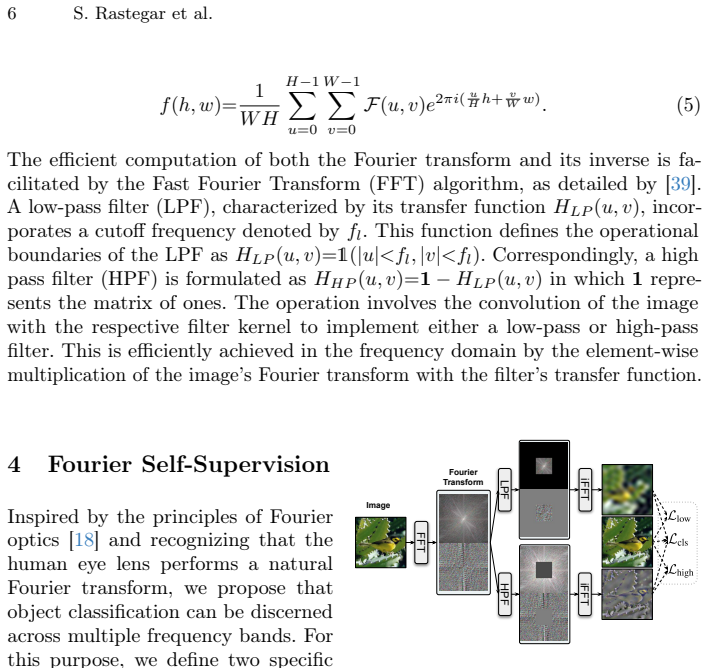
The central mechanism is Fourier Self-Supervision: an image is transformed to the frequency domain, a dataset-dependent cutoff is selected where the signal-to-noise ratio reaches 15 dB, and low-pass and high-pass filters produce two reconstructions used as extra positive views for contrastive learning. The ratio of the random cutoff frequency to the threshold determines what fraction of the latent dimension each band's contrastive loss is applied to, so the model is forced to represent coarse category structure in the low-frequency half and fine-grained detail in the high-frequency half. A classification term on the filtered reconstructions reinforces that low- and high-pass versions share the original image's label, and the whole set of losses is added to a base GCD objective.
What would settle it
Take a fine-grained dataset whose class-defining differences are concentrated in mid-frequency bands, such as synthetic bird images that differ only in a mid-frequency wing pattern. If FourEx still improves over its SelEx baseline on that dataset, then the frequency-decomposition story does not explain the gains; the same test can be run by comparing the 15 dB cutoff with a data-driven cutoff chosen to maximize class-discriminative energy, and checking whether the method's advantage tracks the discriminative cutoff.
Extended reading notes
Core claim
The paper claims that category identity is stable across the frequency spectrum of an image's Fourier transform, and that exploiting this stability as self-supervision lets a model learn both the broad attributes needed to generalize to novel categories and the fine details needed to tell similar classes apart. Concretely, each image is low-pass and high-pass filtered; the reconstructions are used as positive views in contrastive learning, with low frequencies assigned to the left half of the latent space and high frequencies to the right half. The paper shows that this dual-frequency scheme improves over the SelEx and SimGCD baselines it is attached to, and that the resulting FourEx method outperforms published state-of-the-art methods on fine-grained benchmarks in most settings, including when the number of classes is estimated rather than known.
Load-bearing premise
The load-bearing premise is that an object's category remains recognizable across its low- and high-frequency filtered versions, with low frequencies carrying broad category attributes and high frequencies carrying fine-grained distinctions; if the 15 dB cutoff is miscalibrated for a dataset, the extra contrastive losses would be noise rather than signal.
Editorial extensions
If this is right
- Fine-grained GCD models can be improved by adding Fourier-filtered views as auxiliary positives without changing the backbone or the clustering procedure.
- The gains are largest on datasets where categories differ by subtle details, such as CUB-200, FGVC-Aircraft, and Herbarium, and smaller or negative on datasets with more pronounced differences, such as Stanford-Cars.
- The method remains competitive when the true number of classes is unknown and must be estimated, so the reported improvements are not an artifact of knowing the cluster count.
- Because the frequency threshold is set per dataset from training images, applying the method to a new dataset requires only a forward Fourier transform pass, not new annotations.
- The same loss terms can be attached to different contrastive GCD baselines, and the paper shows each attached variant improves over its own baseline.
Reading between the lines
- A testable extension is to replace the fixed 15 dB SNR threshold with a per-dataset or per-class cutoff chosen by how much class-discriminative signal each frequency band carries; if the method's gains track that signal rather than a perceptual-quality threshold, the proposed mechanism is confirmed.
- The same frequency-split self-supervision could be applied to other self-supervised representation learning tasks, such as domain adaptation or few-shot recognition, where low-frequency abstraction and high-frequency detail are both known to matter.
- The implicit-hierarchy story suggests the low-frequency contrastive loss could serve as a lightweight hierarchical pretraining signal, potentially reducing the number of training epochs needed to learn transferable features.
Signed reviews
Editorial analysis
A structured set of objections, weighed in public.
Referee Report
Summary. The paper proposes Fourier Self-Supervision (FourEx, with variants FourSim and FourGCD) for fine-grained Generalized Category Discovery. The method applies low-pass and high-pass filters in the Fourier domain to construct alternative views of each image, uses these views in supervised and unsupervised contrastive losses over dedicated portions of the latent dimension, and adds a classification loss on the filtered reconstructions. Experiments on CUB-200, FGVC-Aircraft, Stanford-Cars, Oxford-IIIT Pet, and Herbarium19, with DINOv1 and DINOv2 backbones, report gains over the SelEx and SimGCD baselines, and the paper claims state-of-the-art results including when the number of categories is unknown.
Significance. If the reported gains hold, the method is significant as a simple, plug-and-play self-supervision signal that improves fine-grained category discovery, a setting where existing contrastive GCD methods are known to struggle. The paper's strengths include a clear motivation grounded in the frequency spectrum, ablations of each loss component, hyperparameter sensitivity studies, time-complexity reporting, and a public code release. However, the central 'outperforms state-of-the-art' claim is weakened by the DINOv2 results, where the average All accuracy is exactly tied with the SelEx baseline and Stanford-Cars drops by 2.1 points, and by the absence of error bars or multiple-seed experiments. The method's core assumption that filtered views retain the category information needed for contrastive learning is not directly validated.
major comments (4)
- [Section 5.2, Table 1] The abstract and Section 5.2 claim that Fourier Self-Supervision outperforms state-of-the-art methods, but the DINOv2 rows in Table 1 show an average All accuracy of 83.1 for both SelEx and FourEx, i.e., a +0.0 aggregate gain. Stanford-Cars specifically drops by 2.1 All and 3.5 Novel. Since the claim is based on the average across datasets, a single negative result on one of the three fine-grained benchmarks is load-bearing. The authors should either revise the claim to per-dataset improvements or provide statistical evidence that the aggregate is robust.
- [Tables 1-5, 8-10] No error bars or multiple-seed results are reported anywhere. GCD evaluations use k-means followed by Hungarian matching, which is sensitive to initialization and seed, and the reported differences with DINOv2 are small (e.g., +0.4 All on CUB, -2.1 on Cars). Without standard deviations over at least three seeds, the reader cannot tell whether these differences are meaningful. Please add mean and standard deviation for the main comparisons, especially for the negative Stanford-Cars result.
- [Section 4, Eqs. (6)-(9)] The method rests on the assumption that an object's category remains recognizable in low- and high-pass filtered versions and that low frequencies carry broad category information while high frequencies carry fine-grained distinctions. The 15 dB SNR threshold is a signal-quality metric, not a measure of category information content. The paper provides no quantitative check that the filtered views preserve enough discriminative signal for the contrastive losses to be beneficial rather than noisy. I suggest a direct measurement, e.g., linear-probe or k-NN accuracy on the filtered reconstructions versus the originals, or an SNR sweep evaluated per dataset on both All and Novel accuracy.
- [Section 5.3, Table 5 and Section 5.1] The loss weights alpha_low, alpha_high, alpha_cls, the SNR threshold, and the Gaussian blur kernel are all selected on CUB-200 with DINOv1, and the same values are then applied across all datasets and backbones. The hyperparameter study in Table 5 is only on CUB. This makes the cross-dataset generalization claims less secure, especially because the SNR cutoff itself is computed per dataset but the loss coefficients are not adapted. Please show sensitivity of the main results to these choices on at least one additional dataset or provide a justification for why the CUB-tuned values transfer.
minor comments (5)
- [Section 4, sentence after Eq. (5)] The text says 'select an SNR of 32, equivalent to 15 dB,' but the SNR formula is in decibels by definition. Please rewrite this sentence to say that a power ratio of approximately 31.6 corresponds to 15 dB, or simply state the cutoff in dB consistently.
- [Section 4, Eqs. (6) and (7)] The notation d = (fl/T)D and the instruction to use the 'first d leftmost latent dimensions' is clear for the low-frequency loss, but the high-frequency loss uses '-d' without defining negative indexing. Please define the subvector explicitly, e.g., the last d dimensions.
- [Section 5.2, paragraph before Table 2] The text says 'We also report results on Oxford-IIIT Pet' but the main text does not show the table; it appears only in Table 2 later. Please either point to Table 2 at that location or move the relevant numbers into the main text.
- [Figure 6] The radar chart is difficult to read because many methods are overlaid. Consider a table or separate plots for Known, All, and Novel, or highlight only the baselines most relevant to the comparison.
- [Section 5.1, implementation details] The paper says 'For FourSim, we froze the initial 11 blocks' but the appendix, Section 9.1, says 'we froze the first 9 blocks of ViT-B/16 for FourEx.' Please harmonize the numbers of frozen/fine-tuned blocks between the main text and the appendix.
Circularity Check
No circularity: measured benchmark results and external SNR standard; self-citations are baselines, not load-bearing reductions.
full rationale
No circularity found. FourEx is evaluated by measured cluster accuracy on external benchmarks (CUB-200, FGVC-Aircraft, Stanford-Cars, Oxford-Pet, Herbarium19, CIFAR-10/100, ImageNet-100) against published baselines, so the central 'outperforms' claim is an empirical comparison, not a derived consequence of the method's definitions. The frequency cutoffs are fixed by an external image-quality standard (SNR=15 dB, cited to Poynton and Winkler), computed from the Fourier energy of training images; they are not fit to the test labels or to the reported accuracies. The three loss terms are added to an existing baseline with coefficients reported as hyperparameters and ablated in Table 5; no equation in Sections 4 or 8 constructs the reported accuracy from those coefficients. Reliance on the authors' prior SelEx and InfoSieve as baselines is self-citation, but SelEx is a published ECCV method with independent code and results, and the paper also benchmarks FourGCD on the external GCD/SimGCD pipeline, so the comparison does not reduce to the authors' own unverified claims. Concerns in the skeptic note—the DINOv2 Stanford-Cars regression (-2.1 All) and the aggregation that hides dataset-specific losses—are about interpretation and statistical honesty, not about circularity. The sentence 'In the Appendix, we show that fine details reside only in high-frequency modes' promises an analysis that the appendix does not actually contain; that is missing support, but it is not a circular derivation. Overall score 0.
Assumptions & free parameters
free parameters (6)
- alpha_low =
0.1 (CUB-200)
- alpha_high =
0.1 (CUB-200)
- alpha_cls =
0.1 (CUB-200)
- SNR_threshold =
15 dB
- Gaussian_blur_kernel =
5
- fine_tuned_blocks =
3 (FourEx)
assumptions (4)
- domain assumption Neural networks learn lower Fourier frequencies before higher ones (F-principle).
- ad hoc to paper An object's category remains recognizable across its low- and high-frequency filtered versions.
- ad hoc to paper Low frequencies carry broad category information and high frequencies carry fine-grained details.
- domain assumption The 15 dB SNR threshold separates informative from noisy frequency components.
Cite this review
Pith. "Pith review of Fourier Self-Supervision for Fine-Grained Generalized Category Discovery." pith.science (2026). https://pith.science/paper/45ZN3JH5
@misc{pith2026260808963,
  author       = {Pith},
  title        = {Pith review of: Fourier Self-Supervision for Fine-Grained Generalized Category Discovery},
  year         = {2026},
  howpublished = {\url{https://pith.science/paper/45ZN3JH5}},
  note         = {Machine review of arXiv:2608.08963}
}
read the original abstract
Generalized Category Discovery aims to recognize known categories while identifying novel ones within unlabeled data. Existing methods, typically based on self-supervision and contrastive learning, often struggle to capture fine-grained distinctions, relying on superficial visual cues rather than the intrinsic attributes humans use for categorization. We introduce Fourier Self-Supervision, that leverages the Fourier transform of images to enhance the discrimination of subtle differences and support the discovery of new categories. Our method employs a dual frequency filtering strategy: a low-pass filter first extracts broad, abstract attributes that capture high-level category information, while a high-pass filter emphasizes fine details such as edges and textures that are essential for fine-grained recognition. Each operates on a dedicated latent space, and their overlapping representations together yield a richer, more complete feature space. This dual-frequency approach not only refines feature extraction to identify novel categories, but also strengthens the model's discriminative power in fine-grained category discovery. Experiments on multiple fine-grained datasets show that incorporating Fourier Self-Supervision outperforms state-of-the-art methods, even when the number of classes is unknown, demonstrating its effectiveness for Generalized Category Discovery. Our code is available at: https://github.com/SarahRastegar/FourEx.
Figures


Figures from the paper (7 more)


Reference graph
Works this paper leans on
-
[1]
In: Proceedings of the AAAI Conference on Artificial Intelligence
An, W., Tian, F., Zheng, Q., Ding, W., Wang, Q., Chen, P.: Generalized cate- gory discovery with decoupled prototypical network. In: Proceedings of the AAAI Conference on Artificial Intelligence. vol. 37 (2023) 1, 4, 28
work page 2023
-
[2]
In: Proceedings of the IEEE/CVF Winter Conference on Applications of Computer Vision
Banerjee, A., Kallooriyakath, L.S., Biswas, S.: Amend: Adaptive margin and ex- panded neighborhood for efficient generalized category discovery. In: Proceedings of the IEEE/CVF Winter Conference on Applications of Computer Vision. pp. 2101–2110 (2024) 4, 28
work page 2024
-
[3]
In: Proceed- ings of the International Conference on Learning Representations (2022) 1, 3, 26, 28
Cao, K., Brbic, M., Leskovec, J.: Open-world semi-supervised learning. In: Proceed- ings of the International Conference on Learning Representations (2022) 1, 3, 26, 28
work page 2022
-
[4]
In: Proceedings of the IEEE/CVF International Conference on Computer Vision
Cao, X., Chen, K., Yang, F., Zheng, X., Tian, Y., Lu, Y.: Allgcd: Leveraging all unlabeled data for generalized category discovery. In: Proceedings of the IEEE/CVF International Conference on Computer Vision. pp. 3293–3303 (2025) 10
work page 2025
-
[5]
In: Proceedings of the IEEE/CVF Conference on Computer Vision and Pattern Recognition
Cao, X., Zheng, X., Wang, G., Yu, W., Shen, Y., Li, K., Lu, Y., Tian, Y.: Solving the catastrophic forgetting problem in generalized category discovery. In: Proceedings of the IEEE/CVF Conference on Computer Vision and Pattern Recognition. pp. 16880–16889 (2024) 10
work page 2024
-
[6]
In: Proceedings of the European conference on computer vision (ECCV)
Caron, M., Bojanowski, P., Joulin, A., Douze, M.: Deep clustering for unsupervised learning of visual features. In: Proceedings of the European conference on computer vision (ECCV). pp. 132–149 (2018) 1
work page 2018
-
[7]
Advances in neural information processing systems33, 9912–9924 (2020) 1 16 S
Caron, M., Misra, I., Mairal, J., Goyal, P., Bojanowski, P., Joulin, A.: Unsupervised learning of visual features by contrasting cluster assignments. Advances in neural information processing systems33, 9912–9924 (2020) 1 16 S. Rastegar et al
work page 2020
-
[8]
In: Proceedings of the IEEE/CVF International Conference on Computer Vision
Caron, M., Touvron, H., Misra, I., Jégou, H., Mairal, J., Bojanowski, P., Joulin, A.: Emerging properties in self-supervised vision transformers. In: Proceedings of the IEEE/CVF International Conference on Computer Vision. pp. 9650–9660 (2021) 1, 9, 23
work page 2021
Show all 73 references
-
[9]
et al., eds.; 2006)[book reviews]
Chapelle, O., Scholkopf, B., Zien, A.: Semi-supervised learning (chapelle, o. et al., eds.; 2006)[book reviews]. IEEE Transactions on Neural Networks20(3), 542–542 (2009) 4, 28
2009
-
[10]
In: International conference on machine learning
Chen, T., Kornblith, S., Norouzi, M., Hinton, G.: A simple framework for contrastive learning of visual representations. In: International conference on machine learning. pp. 1597–1607. PMLR (2020) 1
2020
-
[11]
In: Proceedings of the IEEE/CVF International Conference on Computer Vision
Chiaroni, F., Dolz, J., Masud, Z.I., Mitiche, A., Ben Ayed, I.: Parametric information maximization for generalized category discovery. In: Proceedings of the IEEE/CVF International Conference on Computer Vision. pp. 1729–1739 (2023) 1, 4, 28
2023
-
[12]
In: Proceedings of the IEEE/CVF Conference on Computer Vision and Pattern Recognition (2024) 4, 10, 12, 29
Choi, S., Kang, D., Cho, M.: Contrastive mean-shift learning for generalized category discovery. In: Proceedings of the IEEE/CVF Conference on Computer Vision and Pattern Recognition (2024) 4, 10, 12, 29
2024
-
[13]
Cole, E., Yang, X., Wilber, K., Mac Aodha, O., Belongie, S.: When does contrastive visual representation learning work? In: Proceedings of the IEEE/CVF Conference on Computer Vision and Pattern Recognition. pp. 14755–14764 (2022) 4, 28
2022
-
[14]
In: Proceedings of the Computer Vision and Pattern Recognition Conference
Dai, Q., Huang, H., Wu, Y., Yang, S.: Adaptive part learning for fine-grained generalized category discovery: A plug-and-play enhancement. In: Proceedings of the Computer Vision and Pattern Recognition Conference. pp. 25444–25453 (2025) 4, 10
2025
-
[15]
In: Proceedings of the IEEE Conference on Computer Vision and Pattern Recognition
Deng, J., Dong, W., Socher, R., Li, L.J., Li, K., Fei-Fei, L.: Imagenet: A large-scale hierarchical image database. In: Proceedings of the IEEE Conference on Computer Vision and Pattern Recognition. pp. 248–255 (2009) 9, 22, 23, 25
2009
-
[16]
In: British Machine Vision Conference (2022) 4, 26
Fei, Y., Zhao, Z., Yang, S., Zhao, B.: Xcon: Learning with experts for fine-grained category discovery. In: British Machine Vision Conference (2022) 4, 26
2022
-
[17]
In: Proceedings of the IEEE/CVF International Conference on Computer Vision
Fini, E., Sangineto, E., Lathuilière, S., Zhong, Z., Nabi, M., Ricci, E.: A unified objective for novel class discovery. In: Proceedings of the IEEE/CVF International Conference on Computer Vision. pp. 9284–9292 (2021) 28
2021
-
[18]
Roberts and Company publishers (2005) 6, 20
Goodman, J.W.: Introduction to Fourier optics. Roberts and Company publishers (2005) 6, 20
2005
-
[19]
In: Proceedings of the IEEE/CVF international Conference on Computer Vision
Han, J., Luo, P., Wang, X.: Deep self-learning from noisy labels. In: Proceedings of the IEEE/CVF international Conference on Computer Vision. pp. 5138–5147 (2019) 27
2019
-
[20]
In: The Thirty-ninth Annual Conference on Neural Information Processing Systems 12
Han, J., Wang, S., He, Y., Ding, C., Wang, Q., Gao, X., Dong, S., Gong, Y.: Consistent supervised-unsupervised alignment for generalized category discovery. In: The Thirty-ninth Annual Conference on Neural Information Processing Systems 12
-
[21]
In: Proceedings of the International Conference on Learning Representations (2020) 1, 28
Han, K., Rebuffi, S.A., Ehrhardt, S., Vedaldi, A., Zisserman, A.: Automatically dis- covering and learning new visual categories with ranking statistics. In: Proceedings of the International Conference on Learning Representations (2020) 1, 28
2020
-
[22]
In: Proceedings of the IEEE/CVF International Conference on Computer Vision
Han, K., Vedaldi, A., Zisserman, A.: Learning to discover novel visual categories via deep transfer clustering. In: Proceedings of the IEEE/CVF International Conference on Computer Vision. pp. 8401–8409 (2019) 27
2019
-
[23]
Transactions on Machine Learning Research (2024) 1, 4, 28 Fourier Self-Supervision 17
Hao, S., Han, K., Wong, K.Y.K.: CiPR: An efficient framework with cross-instance positive relations for generalized category discovery. Transactions on Machine Learning Research (2024) 1, 4, 28 Fourier Self-Supervision 17
2024
-
[24]
In: Proceedings of the IEEE/CVF conference on computer vision and pattern recognition
He, K., Fan, H., Wu, Y., Xie, S., Girshick, R.: Momentum contrast for unsupervised visual representation learning. In: Proceedings of the IEEE/CVF conference on computer vision and pattern recognition. pp. 9729–9738 (2020) 1
2020
-
[25]
In: The Thirty-ninth Annual Conference on Neural Information Processing Systems (2025) 4, 10, 11
He, Z., Liu, Y., Han, K.: SEAL: Semantic-aware hierarchical learning for generalized category discovery. In: The Thirty-ninth Annual Conference on Neural Information Processing Systems (2025) 4, 10, 11
2025
-
[26]
arXiv preprint arXiv:1711.10125 (2017) 27
Hsu, Y.C., Lv, Z., Kira, Z.: Learning to cluster in order to transfer across domains and tasks. arXiv preprint arXiv:1711.10125 (2017) 27
2017 arXiv
-
[27]
arXiv preprint arXiv:1901.00544 (2019) 27
Hsu, Y.C., Lv, Z., Schlosser, J., Odom, P., Kira, Z.: Multi-class classification without multi-class labels. arXiv preprint arXiv:1901.00544 (2019) 27
2019 arXiv
-
[28]
Technologies9(1), 2 (2020) 1
Jaiswal, A., Babu, A.R., Zadeh, M.Z., Banerjee, D., Makedon, F.: A survey on contrastive self-supervised learning. Technologies9(1), 2 (2020) 1
2020
-
[29]
In: Proceedings of the IEEE International Conference on Computer Vision Workshops
Krause, J., Stark, M., Deng, J., Fei-Fei, L.: 3d object representations for fine-grained categorization. In: Proceedings of the IEEE International Conference on Computer Vision Workshops. pp. 554–561 (2013) 9, 22, 23, 24
2013
-
[30]
Krizhevsky, A., Hinton, G.: Learning multiple layers of features from tiny images. Tech. Rep. 0, University of Toronto, Toronto, Ontario (2009) 9, 22, 23, 25
2009
-
[31]
In: Pereira, F., Burges, C., Bottou, L., Weinberger, K
Krizhevsky, A., Sutskever, I., Hinton, G.E.: Imagenet classification with deep convolutional neural networks. In: Pereira, F., Burges, C., Bottou, L., Weinberger, K. (eds.) Advances in Neural Information Processing Systems. vol. 25. Curran Associates, Inc. (2012) 9, 23
2012
-
[32]
In: International Conference on Learning Representations (2021) 1
Li, J., Zhou, P., Xiong, C., Hoi, S.: Prototypical contrastive learning of unsupervised representations. In: International Conference on Learning Representations (2021) 1
2021
-
[33]
In: Thirty-eighth Conference on Neural Information Processing Systems (2024) 10
Lin, H., An, W., Wang, J., Chen, Y., Tian, F., Wang, M., Dai, G., Wang, Q., Wang, J.: Flipped classroom: Aligning teacher attention with student in generalized category discovery. In: Thirty-eighth Conference on Neural Information Processing Systems (2024) 10
2024
-
[34]
arXiv preprint arXiv:2506.02334 (2025) 4
Liu, D., Tan, Z., Zhao, L., Zhang, Z., Fang, X., Huang, W.: Generalized category discovery via reciprocal learning and class-wise distribution regularization. arXiv preprint arXiv:2506.02334 (2025) 4
2025 arXiv
-
[35]
IEEE Transactions on Knowledge and Data Engineering35(1), 857–876 (2021) 1
Liu, X., Zhang, F., Hou, Z., Mian, L., Wang, Z., Zhang, J., Tang, J.: Self-supervised learning: Generative or contrastive. IEEE Transactions on Knowledge and Data Engineering35(1), 857–876 (2021) 1
2021
-
[36]
In: The Thirteenth International Conference on Learning Representations (2025) 10, 11
Liu, Y., Han, K.: DebGCD: Debiased learning with distribution guidance for generalized category discovery. In: The Thirteenth International Conference on Learning Representations (2025) 10, 11
2025
-
[37]
arXiv preprint arXiv:1306.5151 (2013) 9, 22, 23, 24
Maji, S., Rahtu, E., Kannala, J., Blaschko, M., Vedaldi, A.: Fine-grained visual classification of aircraft. arXiv preprint arXiv:1306.5151 (2013) 9, 22, 23, 24
2013 arXiv
-
[38]
In: European Conference on Computer Vision
Noroozi, M., Favaro, P.: Unsupervised learning of visual representations by solving jigsaw puzzles. In: European Conference on Computer Vision. pp. 69–84. Springer (2016) 1
2016
-
[39]
Springer (1982) 6
Nussbaumer, H.J., Nussbaumer, H.J.: The fast Fourier transform. Springer (1982) 6
1982
-
[40]
In: Advances in neural information processing systems
Oliver, A., Odena, A., Raffel, C.A., Cubuk, E.D., Goodfellow, I.: Realistic evaluation of deep semi-supervised learning algorithms. In: Advances in neural information processing systems. vol. 31 (2018) 4, 28
2018
-
[41]
Rastegar et al
Oquab, M., Darcet, T., Moutakanni, T., Vo, H.V., Szafraniec, M., Khalidov, V., Fernandez, P., HAZIZA, D., Massa, F., El-Nouby, A., Assran, M., Ballas, N., Galuba, W., Howes, R., Huang, P.Y., Li, S.W., Misra, I., Rabbat, M., Sharma, V., Synnaeve, G., Xu, H., Jegou, H., Mairal, ...
2024
-
[42]
In: Proceedings of the IEEE/CVF Winter Conference on Applications of Computer Vision
Otholt, J., Meinel, C., Yang, H.: Guided cluster aggregation: A hierarchical ap- proach to generalized category discovery. In: Proceedings of the IEEE/CVF Winter Conference on Applications of Computer Vision. pp. 2618–2627 (2024) 4, 12, 27, 28
2024
-
[43]
arXiv preprint arXiv:2006.05278 (2020) 4, 28
Ouali, Y., Hudelot, C., Tami, M.: An overview of deep semi-supervised learning. arXiv preprint arXiv:2006.05278 (2020) 4, 28
2020 arXiv
-
[44]
In: Proceed- ings of the IEEE Conference on Computer Vision and Pattern Recognition
Parkhi, O.M., Vedaldi, A., Zisserman, A., Jawahar, C.: Cats and dogs. In: Proceed- ings of the IEEE Conference on Computer Vision and Pattern Recognition. pp. 3498–3505. IEEE (2012) 9, 11, 22, 23, 24
2012
-
[45]
In: Proceedings of the Computer Vision and Pattern Recognition Conference
Peng, Z., Ma, J., Sun, Z., Yi, R., Song, H., Tan, X., Ma, L.: Mos: Modeling object-scene associations in generalized category discovery. In: Proceedings of the Computer Vision and Pattern Recognition Conference. pp. 15118–15128 (2025) 4, 10
2025
-
[46]
Morgan Kaufmann Publishers (2012) 6
Poynton, C.: Digital Video and HD: Algorithms and Interfaces. Morgan Kaufmann Publishers (2012) 6
2012
-
[47]
In: Proceedings of the IEEE/CVF Conference on Computer Vision and Pattern Recognition (2023) 4, 26, 27, 28
Pu, N., Zhong, Z., Sebe, N.: Dynamic conceptional contrastive learning for general- ized category discovery. In: Proceedings of the IEEE/CVF Conference on Computer Vision and Pattern Recognition (2023) 4, 26, 27, 28
2023
-
[48]
In: Thirty-seventh Conference on Neural Information Processing Systems (2023) 1, 4, 10, 11, 26, 28
Rastegar, S., Doughty, H., Snoek, C.: Learn to categorize or categorize to learn? self-coding for generalized category discovery. In: Thirty-seventh Conference on Neural Information Processing Systems (2023) 1, 4, 10, 11, 26, 28
2023
-
[49]
In: ECCV (2024) 4, 9, 10, 11, 12, 20, 25, 26
Rastegar, S., Salehi, M., Asano, Y.M., Doughty, H., Snoek, C.G.M.: Selex: Self- expertise in fine-grained generalized category discovery. In: ECCV (2024) 4, 9, 10, 11, 12, 20, 25, 26
2024
-
[50]
In: Proceedings of the IEEE/CVF conference on computer vision and pattern recognition workshops
Rebuffi, S.A., Ehrhardt, S., Han, K., Vedaldi, A., Zisserman, A.: Semi-supervised learning with scarce annotations. In: Proceedings of the IEEE/CVF conference on computer vision and pattern recognition workshops. pp. 762–763 (2020) 4, 28
2020
-
[51]
In: European Conference on Computer Vision
Rizve, M.N., Kardan, N., Shah, M.: Towards realistic semi-supervised learning. In: European Conference on Computer Vision. pp. 437–455. Springer (2022) 28
2022
-
[52]
In: European Conference on Computer Vision
Roy, S., Liu, M., Zhong, Z., Sebe, N., Ricci, E.: Class-incremental novel class discovery. In: European Conference on Computer Vision. pp. 317–333. Springer (2022) 28
2022
-
[53]
In: European Conference on Computer Vision
Sun, J., Mehra, A., Kailkhura, B., Chen, P.Y., Hendrycks, D., Hamm, J., Mao, Z.M.: A spectral view of randomized smoothing under common corruptions: Benchmarking and improving certified robustness. In: European Conference on Computer Vision. pp. 654–671. Springer (2022) 5, 29
2022
-
[54]
arXiv preprint arXiv:1906.05372 (2019) 9, 11, 22, 23, 24
Tan, K.C., Liu, Y., Ambrose, B., Tulig, M., Belongie, S.: The herbarium challenge 2019 dataset. arXiv preprint arXiv:1906.05372 (2019) 9, 11, 22, 23, 24
2019 arXiv
-
[55]
In: Thirty-eighth Conference on Neural Information Processing Systems (2024) 12
Tan, Z., Yang, X., Wang, Q., Nguyen, A., Huang, K.: Interpret your decision: Logical reasoning regularization for generalization in visual classification. In: Thirty-eighth Conference on Neural Information Processing Systems (2024) 12
2024
-
[56]
In: Proceedings of the IEEE/CVF Conference on Computer Vision and Pattern Recognition (2022) 1, 3, 5, 9, 10, 11, 12, 20, 23, 25, 26, 27, 28
Vaze, S., Han, K., Vedaldi, A., Zisserman, A.: Generalized category discovery. In: Proceedings of the IEEE/CVF Conference on Computer Vision and Pattern Recognition (2022) 1, 3, 5, 9, 10, 11, 12, 20, 23, 25, 26, 27, 28
2022
-
[57]
Advances in Neural Information Processing Systems 37 (2023) 1, 4, 10, 12, 27, 28
Vaze, S., Vedaldi, A., Zisserman, A.: No representation rules them all in category discovery. Advances in Neural Information Processing Systems 37 (2023) 1, 4, 10, 12, 27, 28
2023
-
[58]
Wah, C., Branson, S., Welinder, P., Perona, P., Belongie, S.: The Caltech-UCSD Birds-200-2011 Dataset (Jul 2011) 9, 22, 23, 24 Fourier Self-Supervision 19
2011
-
[59]
In: The Twelfth International Conference on Learning Representations (2024) 4, 10, 26, 29
Wang, H., Vaze, S., Han, K.: SPTNet: An efficient alternative framework for gener- alized category discovery with spatial prompt tuning. In: The Twelfth International Conference on Learning Representations (2024) 4, 10, 26, 29
2024
-
[60]
In: Proceedings of the IEEE/CVF International Conference on Computer Vision
Wen, X., Zhao, B., Qi, X.: Parametric classification for generalized category discov- ery: A baseline study. In: Proceedings of the IEEE/CVF International Conference on Computer Vision. pp. 16590–16600 (2023) 1, 4, 9, 10, 11, 12, 26, 27, 28
2023
-
[61]
John Wiley & Sons (2005) 6
Winkler, S.: Digital video quality: vision models and metrics. John Wiley & Sons (2005) 6
2005
-
[62]
Computers & Operations Research17(1), 95–96 (1990) 24
Wright, M.: Speeding up the Hungarian algorithm. Computers & Operations Research17(1), 95–96 (1990) 24
1990
-
[63]
In: Proceedings of the IEEE/CVF conference on computer vision and pattern recognition
Xiao, R., Feng, L., Tang, K., Zhao, J., Li, Y., Chen, G., Wang, H.: Targeted representation alignment for open-world semi-supervised learning. In: Proceedings of the IEEE/CVF conference on computer vision and pattern recognition. pp. 23072–23082 (2024) 10
2024
-
[64]
In: Proceedings of the IEEE/CVF conference on computer vision and pattern recognition
Xu, Q., Zhang, R., Zhang, Y., Wang, Y., Tian, Q.: A fourier-based framework for domain generalization. In: Proceedings of the IEEE/CVF conference on computer vision and pattern recognition. pp. 14383–14392 (2021) 5, 29
2021
-
[65]
In: Neural Information Processing: 26th International Conference, ICONIP 2019, Sydney, NSW, Australia, December 12–15, 2019, Proceedings, Part I 26
Xu, Z.Q.J., Zhang, Y., Xiao, Y.: Training behavior of deep neural network in frequency domain. In: Neural Information Processing: 26th International Conference, ICONIP 2019, Sydney, NSW, Australia, December 12–15, 2019, Proceedings, Part I 26. pp. 264–274. Springer (2019) 2
2019
-
[66]
In: European Conference on Computer Vision
Yang, F., Pu, N., Li, W., Luo, Z., Li, S., Sebe, N., Zhong, Z.: Learning to distinguish samples for generalized category discovery. In: European Conference on Computer Vision. pp. 105–122. Springer (2024) 4, 12
2024
-
[67]
IEEE Transactions on Knowledge and Data Engineering (2022) 4, 28
Yang, X., Song, Z., King, I., Xu, Z.: A survey on deep semi-supervised learning. IEEE Transactions on Knowledge and Data Engineering (2022) 4, 28
2022
-
[68]
In: Proceedings of the IEEE/CVF conference on computer vision and pattern recognition
Yang, Y., Soatto, S.: Fda: Fourier domain adaptation for semantic segmentation. In: Proceedings of the IEEE/CVF conference on computer vision and pattern recognition. pp. 4085–4095 (2020) 5, 29
2020
-
[69]
In: Proceedings of the IEEE/CVF international conference on computer vision
Zhai, X., Oliver, A., Kolesnikov, A., Beyer, L.: S4l: Self-supervised semi-supervised learning. In: Proceedings of the IEEE/CVF international conference on computer vision. pp. 1476–1485 (2019) 1
2019
-
[70]
In: Proceedings of the IEEE/CVF Conference on Computer Vision and Pattern Recognition (2023) 1, 4, 10, 26, 28
Zhang, S., Khan, S., Shen, Z., Naseer, M., Chen, G., Khan, F.: Promptcal: Con- trastive affinity learning via auxiliary prompts for generalized novel category dis- covery. In: Proceedings of the IEEE/CVF Conference on Computer Vision and Pattern Recognition (2023) 1, 4, 10, 26, 28
2023
-
[71]
Advances in Neural Information Processing Systems 34, 22982–22994 (2021) 28
Zhao, B., Han, K.: Novel visual category discovery with dual ranking statistics and mutual knowledge distillation. Advances in Neural Information Processing Systems 34, 22982–22994 (2021) 28
2021
-
[72]
In: Proceedings of the IEEE/CVF International Conference on Computer Vision (2023) 26
Zhao, B., Wen, X., Han, K.: Learning semi-supervised gaussian mixture models for generalized category discovery. In: Proceedings of the IEEE/CVF International Conference on Computer Vision (2023) 26
2023
-
[73]
In: Proceedings of the IEEE/CVF Conference on Computer Vision and Pattern Recognition
Zhong, Z., Zhu, L., Luo, Z., Li, S., Yang, Y., Sebe, N.: Openmix: Reviving known knowledge for discovering novel visual categories in an open world. In: Proceedings of the IEEE/CVF Conference on Computer Vision and Pattern Recognition. pp. 9462–9470 (2021) 28 20 S. Rastegar et...
2021
Reviewed August 14, 2026 · model on record in the stance chip above.
Discussion (0). Continue with ORCID to comment.