REVIEW 4 major objections 5 minor 79 references
GALA: Graph-Augmented LLM Agents for Root Cause Analysis and Incident Response in Microservices
T0 review · 4 major / 5 minor · reviewed 2026-08-14 · deepseek-v4-flash
Pith's one-line read GALA+ claims that bounding LLM investigation by the service dependency graph, with fused metric- and trace-based hypotheses, raises microservice root cause accuracy to 74.44% AC@1 on OnlineBoutique and 73.33% on TrainTicket, more than 25…
desk verdict GALA+ is a genuine incremental contribution to LLM-based microservice RCA with a clean architecture and thorough ablations, but its headline accuracy claim overstates diagnosis quality because the ranking metric ignores failure-mode match. read the letter →
The pith
A machine-rendered reading of the paper's core claim, the machinery that carries it, and where it could break.
The reading
What carries the argument
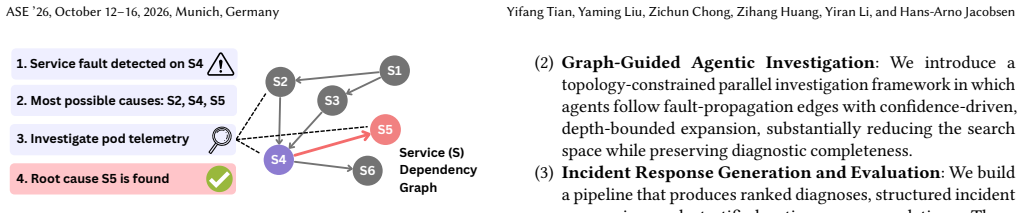
The load-bearing machinery has two parts. STRIX (Structural Trace Ranking via Intermodal eXploration) constructs a weighted directed service dependency graph from trace spans and scores each service on three dimensions: instability $\phi_1(v)=p_{99}(v)/p_{50}(v)$, centrality $\phi_2(v)=\mathrm{PageRank}(v)\cdot\frac{1+\mathrm{in}(v)}{1+\mathrm{out}(v)}$, and impact $\phi_3(v)=\mathrm{TotalLatency}(v)\cdot\max\left(0,1-\frac{\max_u \mathrm{AvgLatency}(u)}{\mathrm{AvgLatency}(v)}\right)$, then aggregates rank positions by reciprocal rank fusion with smoothing constant $\epsilon=60$. The second part is the graph-guided investigation algorithm: $k$ parallel Investigator Agents start from the top consolidated candidates, each returns a confidence $\hat{c}_v$, and unless $\hat{c}_v\ge\theta=0.6$, the agent samples batches of size $b=2$ from the candidate's predecessors and successors, bounding worst-case work to $O(k\Delta)$ where $\Delta$ is the maximum graph degree. Final ranking follows two arbitration rules: signal anchoring, which keeps initial confidences as priors, and chain coherence, which requires the top candidate's causal chain to explain symptoms seen in other branches.
What would settle it
Run GALA+ on a benchmark case where the true faulty service is connected to the alerted service only through an edge that is deliberately missing or reversed in the trace-derived dependency graph; if the bounded search never examines that service and the top-ranked diagnosis is wrong, the central claim that graph-guided bounding preserves diagnostic completeness is refuted.
Extended reading notes
Core claim
The paper's central discovery is that root cause analysis in microservice systems becomes substantially more accurate and operationally useful when LLM agents are prevented from exploring freely and must instead reason along a service dependency graph derived from traces. GALA+ builds an initial hypothesis from complementary metric- and trace-based sources, consolidates them with provenance-aware confidence, then dispatches parallel Investigator Agents that expand only to predecessors and successors when local evidence is inconclusive. The reported results are 74.44% AC@1 and 98.89% AC@3 on OnlineBoutique, and 73.33% AC@1 and 85.56% AC@3 on TrainTicket; removing STRIX alone drops OnlineBoutique AC@1 from 74.44% to 35.56%. The framework also produces incident summaries and three stratified remediation actions. SURE-Score, co-developed with industry SRE experts, grades GALA+ highest on evidence groundedness, operational feasibility, diagnostic precision, and triage logic, with the two evaluator LLMs agreeing (Kendall's $\tau=0.68$) and automated scores correlating with human SRE ratings (Spearman's $\rho=0.92$).
Load-bearing premise
The trace-derived service dependency graph has to be a faithful map of how failures actually travel between services, because a missing, reversed, or spurious edge would keep the bounded investigation from ever visiting the true faulty service.
Editorial extensions
If this is right
- Bounded search is enough: restricting agentic investigation to the local dependency neighborhood (worst-case $O(k\Delta)$) yields higher accuracy than unrestricted exploration, which drifts and hallucinates.
- Complementary signals matter: the fused metric-and-trace hypothesis generation beats either signal alone; removing the trace-based scorer drops OnlineBoutique AC@1 from 74.44% to 35.56%.
- RCA output can be a usable incident response: the same pipeline produces ranked diagnoses, an incident summary, and immediate, permanent, and preventative remediation actions, which is what SURE-Score's highest ratings reflect.
- Evaluation of RCA reports should test causality and actionability, not lexical overlap: BERTScore, ROUGE, and cosine similarity barely discriminate methods, while checklist-based SURE-Score and human SRE ratings do.
- Stronger and cheaper LLMs trade off predictably: top-1 accuracy ranges from 55.6% to 78.9% across seven LLMs, with open-source models approaching the top at much lower per-incident cost.
Reading between the lines
- A natural extension is to make the dependency graph time-varying: the paper assumes a static DAG built from one trace corpus, but production systems change topology during an incident, and STRIX scoring could be recomputed over sliding trace windows.
- The bounded-investigation pattern is domain-general: any diagnostic task with a known causal topology, such as network fault localization, distributed data pipeline debugging, or multi-stage CI failures, could reuse the same confidence-driven, edge-bounded agent search.
- Because STRIX already emphasizes centrality, the paper's finding that random neighbor sampling matches or beats STRIX-ordered expansion in Phase III suggests diversity is protective; a targeted test on low-centrality leaf faults would reveal whether centrality bias ever hurts.
- SURE-Score was co-developed with SREs from one organization; the high automated-human correlation ($\rho=0.92$) supports transfer, but having a second organization build its own checklist would test whether the four dimensions generalize.
Signed reviews
Editorial analysis
A structured set of objections, weighed in public.
Referee Report
Summary. The paper presents GALA+, a graph-augmented LLM agentic framework for microservice root cause analysis (RCA) and incident response. The pipeline has four phases: (I) initial hypothesis generation that fuses a metrics-based ranking (BARO) with a new trace- and graph-structure-aware ranking module (STRIX) via a consolidation agent; (II) construction of compact per-pod diagnostic bundles from metrics, logs, and a 1-hop dependency subgraph; (III) graph-guided, depth-bounded agentic investigation in which investigator agents examine local neighborhoods and write to a shared memory; and (IV) evidence synthesis into a final ranking, incident summary, and stratified remediation recommendations. The paper also introduces SURE-Score, a human-guided LLM evaluation framework for RCA report quality. On OnlineBoutique and TrainTicket, GALA+ is reported to achieve 74.44% and 73.33% AC@1, outperforming the strongest LLM baseline (Flow-of-Action) by more than 25 percentage points, with supporting ablations, a McNemar significance test, a parameter study, and human SRE evaluation.
Significance. If the results hold, the paper is a substantive contribution to LLM-based RCA: it demonstrates that bounding agentic exploration with a service dependency graph and fusing complementary telemetry signals yields large accuracy gains over unconstrained agentic baselines, and it addresses the under-evaluated incident-response output via SURE-Score. The ablations are valuable, particularly the replacement of the Consolidation and Evidence Synthesis agents with deterministic rules, which gives evidence that the LLM agents add real value. The McNemar test on majority-vote outcomes is an appropriate significance check for nondeterministic LLM runs, and the cost/accuracy comparison across seven LLMs is practically useful. However, the central quantitative claim is weakened by an inconsistency between the paper's root-cause definition and its ranking metric, and by reproducibility limitations (no code, no per-run variance, and defaults that appear to be selected on the test set).
major comments (4)
- [Section 5.2 ('Evaluation Metrics') and Section 2 ('Problem Statement')] The paper defines a root cause as 'the specific pod and failure mode' (Section 2), but Section 5.2 states that all ranking metrics are 'computed at the pod level: a ranked candidate counts as correct when it matches the ground-truth faulty pod, and no fault-type match is required.' These two statements are internally inconsistent: a diagnosis that names the correct pod but the wrong failure mechanism is counted as a correct top-1 answer, even though Phase IV remediation actions are explicitly stratified by failure mode and the case study emphasizes fault type. The headline 74.44%/73.33% AC@1 numbers therefore measure pod localization, not the defined RCA task, and the claim that GALA+ performs 'accurate RCA' while producing 'actionable incident response' is stronger than what the metric supports. The SURE-Score Diagnostic Precision criterion also does not explicitly require the failure mode to be correct, so the textual evaluation does not fully rescue the claim. Please re-evaluate with a fault-type-aware AC@1/MRR (e.g., correct only if both pod and failure mode match), or at minimum report fault-type accuracy separately and discuss how wrong-fault-type top-1 diagnoses affect the remediation recommendations.
- [Section 5.1 ('Parameter Settings') and Section 5.3.5 (RQ5)] The default parameters for Algorithm 1 are k=6, theta=0.6, and b=2, and Section 5.3.5 reports AC@1 and execution time on the TrainTicket test set across variations of these parameters, with the best-performing settings matching the defaults. This suggests that the default configuration was selected on the same data used for the headline comparison, which can bias the reported gains over baselines. Please clarify whether these defaults were fixed a priori or chosen from a validation split, and, if they were tuned on the test set, report the sensitivity of the central comparison (GALA+ vs. Flow-of-Action and vs. the best non-LLM baseline) across a plausible range of parameter values on both datasets, or show that the conclusions are unchanged under alternative reasonable defaults.
- [Data Availability and Table 1] The Data Availability statement says the source code cannot be released and only aggregate measurement data are available on request, and Table 1 reports a single mean per metric with no standard deviations, confidence intervals, or per-run values, despite Section 8 stating that 'results averaged over three runs.' This makes it impossible for a reader to verify the McNemar test, the ablations in Figure 4, the variance of the headline AC@1 numbers, or the cost/accuracy trade-offs in Table 5. Please release at least the per-incident predictions, per-run results, and the prompt and agent templates in the artifact repository, or provide a concrete justification for why each of these cannot be shared.
- [Section 3.1.2, Section 3.3 (Algorithm 1), and Section 5.3.3 (Figure 4)] Algorithm 1 bounds investigation to predecessors and successors in the trace-derived dependency graph, and STRIX scores services using the same graph. If a failure-propagation edge is missing, reversed, or spurious, the true root cause can be excluded from investigation entirely. The ablation in Figure 4 shows how much the result depends on graph-based ranking (removing STRIX drops OnlineBoutique AC@1 from 74.44% to 35.56%), yet the paper does not report graph coverage or accuracy statistics for the two benchmarks, nor does it analyze scenarios where the dependency graph is incomplete or incorrect. Please add such an analysis, or a sensitivity study over graph perturbations (e.g., edge removal or reversal), to substantiate the completeness assumption underlying the bounded search.
minor comments (5)
- [Table 2] The column layout of Table 2 is difficult to parse in the manuscript text; please format the numeric values with clearer separators and add standard deviations or inter-evaluator ranges for the SURE-Score results.
- [Section 5.3.2 ('Human Evaluation')] Please clarify whether the three human SRE graders were among the eight Company A experts who co-developed the SURE-Score checklist, and define precisely what 'independent' means in this context, since the same industrial partner appears to be involved in both checklist construction and human grading.
- [Figure 5] The parameter study shows point estimates without error bars or per-seed values, even though models are run at temperature 1.0; please include variability information or state the number of runs per configuration.
- [Section 3.1.2 ('Rank Aggregation via Reciprocal Rank Fusion')] The RRF smoothing constant is written as epsilon=60; in the cited original implementation the corresponding parameter is usually called k, and aligning the notation with the cited source would avoid confusion.
- [Section 5.3.1 ('AegisLab Results')] The AegisLab results are only summarized in the main paper and deferred to a technical report; including the full result table in an appendix would make the additional-dataset claim verifiable by reviewers and readers.
Circularity Check
No circular derivation: central RCA accuracy claims are external benchmark measurements, not fitted constructions; flagged metric mismatch is a validity concern, not circularity.
full rationale
The paper's central claim is an empirical accuracy result measured on external benchmarks (RCAEval OB/TT, AegisLab) against non-LLM and LLM baselines. STRIX's ranking is a fixed closed-form score (p99/p50, PageRank times degree ratio, latency-decomposition impact) with no fitted label-dependent parameters; the Consolidation, Investigator, and Evidence Synthesis agents are LLM prompts; the only tunable quantities (k, theta, b) are workflow hyperparameters, not per-incident predictions, so no reported AC@1 value is forced by an equation or a fit. Self-citations (GALA [55], technical report [56]) are used for comparison and auxiliary reporting, not to justify a premise of the derivation. SURE-Score was constructed by the authors with Company A experts, which raises possible bias, but it is an evaluation instrument rather than an input to the ranking pipeline, and human SRE grading is an external check; this is a validity concern, not a circular step. Two passages create an internal inconsistency: Section 2 defines a root cause as 'the specific pod and failure mode,' while Section 5.2 states 'no fault-type match is required' for AC@1, and RQ5's parameter study appears to tune defaults on the same benchmarks used for final results. These are metric-validity and evaluation-leakage problems that can inflate the headline numbers, but they do not make the derivation circular, because the accuracy values are not equivalent to any input by construction. Under a strict circularity standard, the derivation chain is self-contained; score 0.
Assumptions & free parameters
free parameters (5)
- pruning threshold theta =
0.6
- parallel branches k =
6
- batch size b =
2
- look-around window Delta tau =
not specified
- RRF smoothing constant epsilon =
60
assumptions (5)
- domain assumption The trace-derived service dependency graph is a DAG whose edges represent failure propagation directions.
- ad hoc to paper Root-cause services exhibit the three STRIX signatures: tail-heavy latency (p99/p50), high fan-in centrality, and latency attributable to their own processing.
- domain assumption The RCAEval and AegisLab fault-injection benchmarks have correct and complete ground truth, so pods not labeled as faulty are not root causes.
- domain assumption The LLM-generated confidence scores in Consolidation and Investigation agents are meaningful enough to gate search expansion and ranking.
- domain assumption All three telemetry modalities are available and reliable across every incident window.
Cite this review
Pith. "Pith review of GALA: Graph-Augmented LLM Agents for Root Cause Analysis and Incident Response in Microservices." pith.science (2026). https://pith.science/paper/6X4LRMT4
@misc{pith2026260808968,
  author       = {Pith},
  title        = {Pith review of: GALA: Graph-Augmented LLM Agents for Root Cause Analysis and Incident Response in Microservices},
  year         = {2026},
  howpublished = {\url{https://pith.science/paper/6X4LRMT4}},
  note         = {Machine review of arXiv:2608.08968}
}
read the original abstract
Microservice root cause analysis (RCA) requires correlating failures across heterogeneous telemetry within complex service dependency graphs. Existing methods often rely on a single telemetry modality; recent LLM-based approaches can suffer from unconstrained exploration and hallucination; and most systems stop at fault ranking without producing actionable incident response. We present GALA+, a graph-augmented LLM agentic framework centered on graph-guided investigation, which uses service dependencies to bound exploration and refine diagnosis through localized multi-modal evidence. For initial hypothesis generation, GALA+ combines complementary telemetry signals with STRIX, a novel trace- and graph-structure-aware scoring module. GALA+ then produces ranked diagnoses, incident summaries, and stratified action recommendations. We further introduce SURE-Score, a human-guided evaluation framework co-developed with industry SRE experts for assessing RCA-specific output quality beyond conventional text similarity metrics. On two microservice benchmarks, GALA+ consistently achieves the strongest overall results, surpassing the best LLM-based baseline by more than 25 percentage points in AC@1, while also receiving the highest ratings from both SURE-Score and independent human SRE evaluation.
Figures


Figures from the paper (3 more)


Reference graph
Works this paper leans on
-
[1]
Toufique Ahmed, Supriyo Ghosh, Chetan Bansal, Thomas Zimmermann, Xuchao Zhang, and Saravan Rajmohan. 2023. Recommending root-cause and mitigation steps for cloud incidents using large language models. In2023 IEEE/ACM 45th International Conference on Software Engineering (ICSE). IEEE, 1737–1749
2023
-
[2]
2025.Claude-sonnet-4-5 Release
Anthropic. 2025.Claude-sonnet-4-5 Release. https://www.anthropic.com/news/ claude-sonnet-4-5
work page 2025
-
[3]
Satanjeev Banerjee and Alon Lavie. 2005. METEOR: An automatic metric for MT evaluation with improved correlation with human judgments. InProceedings of the acl workshop on intrinsic and extrinsic evaluation measures for machine translation and/or summarization. 65–72
2005
-
[4]
P Bhosale. 2022. Metrics, Logs, and Traces: A Unified Approach to Observability in Microservices.Journal of Artificial Intelligence, Machine Learning and Data Science1 (2022), 2084–2088
work page 2022
-
[5]
Monica Bianchini, Marco Gori, and Franco Scarselli. 2005. Inside pagerank.ACM Transactions on Internet Technology (TOIT)5, 1 (2005), 92–128
work page 2005
-
[6]
Tom Brown, Benjamin Mann, Nick Ryder, Melanie Subbiah, Jared D Kaplan, Prafulla Dhariwal, Arvind Neelakantan, Pranav Shyam, Girish Sastry, Amanda Askell, et al. 2020. Language models are few-shot learners.Advances in neural information processing systems33 (2020), 1877–1901
2020
-
[7]
Sarthak Chakraborty, Shubham Agarwal, Shaddy Garg, Abhimanyu Sethia, Udit Narayan Pandey, Videh Aggarwal, and Shiv Saini. 2023. ESRO: Experience Assisted Service Reliability against Outages. In2023 38th IEEE/ACM International Conference on Automated Software Engineering (ASE). 255–267
work page 2023
-
[8]
Yinfang Chen, Huaibing Xie, Minghua Ma, Yu Kang, Xin Gao, Liu Shi, Yunjie Cao, Xuedong Gao, Hao Fan, Ming Wen, et al. 2024. Automatic root cause analysis via large language models for cloud incidents. InProceedings of the Nineteenth European Conference on Computer Systems. 674–688
2024
Show all 79 references
-
[9]
Zhi-Yuan Chen, Hao Wang, Xinyu Zhang, Enrui Hu, and Yankai Lin. 2025. Beyond the surface: Measuring self-preference in llm judgments. InProceedings of the 2025 Conference on Empirical Methods in Natural Language Processing. 1653–1672
2025
-
[10]
Seong Yeub Chu, Jong Woo Kim, and Mun Yong Yi. 2025. Think together and work better: Combining humans’ and LLMs’ think-aloud outcomes for effective text evaluation. InProceedings of the 2025 CHI Conference on Human Factors in Computing Systems. 1–23
2025
-
[11]
Gordon V Cormack, Charles LA Clarke, and Stefan Buettcher. 2009. Reciprocal rank fusion outperforms condorcet and individual rank learning methods. In Proceedings of the 32nd international ACM SIGIR conference on Research and development in information retrieval. 758–759
2009
-
[12]
2025.deepseek-ai/DeepSeek-V3.1
DeepSeek. 2025.deepseek-ai/DeepSeek-V3.1. https://www.together.ai/models/ deepseek-v3-1
2025
-
[13]
Jacob Devlin, Ming-Wei Chang, Kenton Lee, and Kristina Toutanova. 2019. Bert: Pre-training of deep bidirectional transformers for language understanding. In Proceedings of the 2019 conference of the North American chapter of the association for computational linguistics: human...
2019
-
[14]
Nicola Dragoni, Saverio Giallorenzo, Alberto Lluch Lafuente, Manuel Mazzara, Fab- rizio Montesi, Ruslan Mustafin, and Larisa Safina. 2017. Microservices: yesterday, today, and tomorrow.Present and ulterior software engineering(2017), 195–216
2017
-
[15]
Darren Edge, Ha Trinh, Newman Cheng, Joshua Bradley, Alex Chao, Apurva Mody, Steven Truitt, Dasha Metropolitansky, Robert Osazuwa Ness, and Jonathan Larson. 2024. From local to global: A graph rag approach to query-focused summarization.arXiv preprint arXiv:2404.16130(2024)
2024 arXiv
-
[16]
Aoyang Fang, Songhan Zhang, Yifan Yang, Haotong Wu, Junjielong Xu, Xuyang Wang, Rui Wang, Manyi Wang, Qisheng Lu, and Pinjia He. 2026. Rethinking the Evaluation of Microservice RCA with a Fault Propagation-Aware Benchmark. Proceedings of the ACM on Software EngineeringFSE (2026)
2026
-
[17]
Nan Fu, Guang Cheng, Guangye Dai, Hantao Mei, Xing Qiu, and Yue Teng. 2025. A failure analysis framework to provide pure anomalous data using multi-source data of fault-sensitive microservices.Journal of Systems and Software230 (2025), 112513. doi:10.1016/j.jss.2025.112513
2025
-
[18]
2025.Gemini-2.5-flash Model Card
Google. 2025.Gemini-2.5-flash Model Card. https://docs.cloud.google.com/vertex- ai/generative-ai/docs/models/gemini/2-5-flash
2025
-
[19]
2025.Gemini-2.5-pro Model Card
Google. 2025.Gemini-2.5-pro Model Card. https://docs.cloud.google.com/vertex- ai/generative-ai/docs/models/gemini/2-5-pro
2025
-
[20]
Guijiao He. 2023. Construction and Experimental Evaluation of Document Causality Extraction Model Based on CGCN-BERT. In2023 International Conference on Applied Intelligence and Sustainable Computing (ICAISC). 1–6
2023
-
[21]
Azam Ikram, Sarthak Chakraborty, Subrata Mitra, Shiv Saini, Saurabh Bagchi, and Murat Kocaoglu. 2022. Root cause analysis of failures in microservices through causal discovery.Advances in Neural Information Processing Systems(2022)
2022
-
[22]
Yuxuan Jiang, Chaoyun Zhang, Shilin He, Zhihao Yang, Minghua Ma, Si Qin, Yu Kang, Yingnong Dang, Saravan Rajmohan, Qingwei Lin, et al. 2024. Xpert: Empowering incident management with query recommendations via large language models. InProceedings of the IEEE/ACM 46th Internati...
2024
-
[23]
Jinxi Kuang, Jinyang Liu, Junjie Huang, Renyi Zhong, Jiazhen Gu, Lan Yu, Rui Tan, Zengyin Yang, and Michael R Lyu. 2024. Knowledge-aware alert aggregation in large-scale cloud systems: a hybrid approach. InProceedings of the 46th International Conference on Software Engineerin...
2024
-
[24]
2010.Random walk: a modern introduction
Gregory F Lawler and Vlada Limic. 2010.Random walk: a modern introduction. Vol. 123. Cambridge University Press
2010
-
[25]
Patrick Lewis, Ethan Perez, Aleksandra Piktus, Fabio Petroni, Vladimir Karpukhin, Naman Goyal, Heinrich Küttler, Mike Lewis, Wen-tau Yih, Tim Rocktäschel, et al. 2020. Retrieval-augmented generation for knowledge-intensive nlp tasks. Advances in neural information processing s...
2020
-
[26]
Mingjie Li, Zeyan Li, Kanglin Yin, Xiaohui Nie, Wenchi Zhang, Kaixin Sui, and Dan Pei. 2022. Causal inference-based root cause analysis for online service systems with intervention recognition. InProceedings of the 28th ACM SIGKDD conference on knowledge discovery and data min...
2022
-
[27]
Peiwen Li, Xin Wang, Zeyang Zhang, Yuan Meng, Fang Shen, Yue Li, Jialong Wang, Yang Li, and Wenwu Zhu. 2024. RealTCD: temporal causal discovery from interventional data with large language model. InProceedings of the 33rd ACM International Conference on Information and Knowled...
2024
-
[28]
Yichen Li, Yulun Wu, Jinyang Liu, Zhihan Jiang, Zhuangbin Chen, Guangba Yu, and Michael R. Lyu. 2025. COCA: Generative Root Cause Analysis for Distributed Systems with Code Knowledge. InProceedings of the IEEE/ACM 47th International Conference on Software Engineering. 1346–1358
2025
-
[29]
Zeyan Li, Junjie Chen, Rui Jiao, Nengwen Zhao, Zhijun Wang, Shuwei Zhang, Yanjun Wu, Long Jiang, Leiqin Yan, Zikai Wang, et al. 2021. Practical root cause localization for microservice systems via trace analysis. In2021 IEEE/ACM 29th International Symposium on Quality of Servi...
2021
-
[30]
Cheng-Ming Lin, Ching Chang, Wei-Yao Wang, Kuang-Da Wang, and Wen-Chih Peng. 2024. Root Cause Analysis in Microservice Using Neural Granger Causal Discovery. InProceedings of the AAAI Conference on Artificial Intelligence, Vol. 38. 206–213
2024
-
[31]
Chin-Yew Lin. 2004. ROUGE: A Package for Automatic Evaluation of Summaries. InText Summarization Branches Out (Workshop at ACL 2004). 74–81
2004
-
[32]
Fengrui Liu, Yang Wang, Zhenyu Li, Rui Ren, Hongtao Guan, Xian Yu, Xiaofan Chen, and Gaogang Xie. 2022. Microcbr: Case-based reasoning on spatio-temporal fault knowledge graph for microservices troubleshooting. InInternational Conference on Case-Based Reasoning. 224–239
2022
-
[33]
2025.meta-llama/Llama-4-Maverick-17B-128E-Instruct-FP8
Meta. 2025.meta-llama/Llama-4-Maverick-17B-128E-Instruct-FP8. https://www.together.ai/models/llama-4-maverick
2025
-
[34]
2025.GPT-4.1-mini Model Card
OpenAI. 2025.GPT-4.1-mini Model Card. https://developers.openai.com/api/ docs/models/gpt-4.1-mini
2025
-
[35]
2025.GPT-4.1 Model Card
OpenAI. 2025.GPT-4.1 Model Card. https://platform.openai.com/docs/models/gpt- 4.1
2025
-
[36]
Yue Pang, Min Zhang, Yanli Liu, Xiangbin Li, Yidi Wang, Yahang Huan, Zhuo Liu, Jin Li, and Danshi Wang. 2024. Large language model-based optical network log analysis using LLaMA2 with instruction tuning.Journal of Optical Communications and Networking16, 11 (2024), 1116–1132
2024
-
[37]
Zhendong Pang, Hao Zhang, and Teng Li. 2024. Hybrid Fine-Tuning in Large Language Model Learning for Machinery Fault Diagnosis. In2024 IEEE 22nd International Conference on Industrial Informatics (INDIN). 1–6
2024
-
[38]
Kishore Papineni, Salim Roukos, Todd Ward, and Wei-Jing Zhu. 2002. BLEU: a Method for Automatic Evaluation of Machine Translation. InProceedings of the 40th Annual Meeting of the Association for Computational Linguistics (ACL). 311–318
2002
-
[39]
Changhua Pei, Zexin Wang, Fengrui Liu, Zeyan Li, Yang Liu, Xiao He, Rong Kang, Tieying Zhang, Jianjun Chen, Jianhui Li, Gaogang Xie, and Dan Pei. 2025. Flow-of-Action: SOP Enhanced LLM-Based Multi-Agent System for Root Cause Analysis. InCompanion Proceedings of the ACM on Web ...
2025
-
[40]
Matilda QR Pembury Smith and Graeme D Ruxton. 2020. Effective use of the McNemar test.Behavioral Ecology and Sociobiology74, 11 (2020), 133
2020
-
[41]
Luan Pham, Huong Ha, and Hongyu Zhang. 2024. Baro: Robust root cause analysis for microservices via multivariate bayesian online change point detection. Proceedings of the ACM on Software Engineering1, FSE (2024), 2214–2237
2024
-
[42]
Luan Pham, Huong Ha, and Hongyu Zhang. 2024. Root Cause Analysis for Microservice System based on Causal Inference: How Far Are We?. InProceedings of the 39th IEEE/ACM International Conference on Automated Software Engineering. 706–715
2024
-
[43]
Luan Pham, Hongyu Zhang, Huong Ha, Flora Salim, and Xiuzhen Zhang. 2025. RCAEval: A Benchmark for Root Cause Analysis of Microservice Systems with Telemetry Data. InThe 2025 ACM Web Conference (WWW). 777–780
2025
-
[44]
2025.Qwen/Qwen3-Next-80B-A3B-Instruct
Qwen. 2025.Qwen/Qwen3-Next-80B-A3B-Instruct. https://www.together.ai/ models/qwen3-next-80b-a3b-instruct
2025
-
[45]
Devjeet Roy, Xuchao Zhang, Rashi Bhave, Chetan Bansal, Pedro Las-Casas, Rodrigo Fonseca, and Saravan Rajmohan. 2024. Exploring llm-based agents for root cause analysis. InCompanion Proceedings of the 32nd ACM International Conference on the Foundations of Software Engineering. 208–219
2024
-
[46]
Amrita Saha and Steven CH Hoi. 2022. Mining root cause knowledge from cloud service incident investigations for aiops. InProceedings of the 44th international conference on software engineering: Software engineering in practice. 197–206. GALA: Graph-Augmented LLM Agents for Ro...
2022
-
[47]
Gerard Salton and Michael J. McGill. 1986.Introduction to modern information retrieval. McGraw-Hill, Inc
1986
-
[48]
Friedrich Schmid and Rafael Schmidt. 2007. Multivariate extensions of Spearman’s rho and related statistics.Statistics & probability letters77, 4 (2007), 407–416
2007
-
[49]
Pranab Kumar Sen. 1968. Estimates of the regression coefficient based on Kendall’s tau.Journal of the American statistical association63, 324 (1968), 1379–1389
1968
-
[50]
Hoyer, Aapo Hyvärinen, and Antti Kerminen
Shohei Shimizu, Patrik O. Hoyer, Aapo Hyvärinen, and Antti Kerminen. 2006. A Linear Non-Gaussian Acyclic Model for Causal Discovery.Journal of Machine Learning Research7 (2006), 2003–2030
2006
-
[51]
Sigelman, Luiz André Barroso, Mike Burrows, Pat Stephenson, Manoj Plakal, Donald Beaver, Saul Jaspan, and Chandan Shanbhag
Benjamin H. Sigelman, Luiz André Barroso, Mike Burrows, Pat Stephenson, Manoj Plakal, Donald Beaver, Saul Jaspan, and Chandan Shanbhag. 2010.Dapper, a Large-Scale Distributed Systems Tracing Infrastructure. Technical Report. Google, Inc. http://research.google.com/archive/pape...
2010
-
[52]
2001.Causation, prediction, and search
Peter Spirtes, Clark Glymour, and Richard Scheines. 2001.Causation, prediction, and search. MIT press
2001
-
[53]
Yongqian Sun, Zihan Lin, Binpeng Shi, Shenglin Zhang, Shiyu Ma, Pengxiang Jin, Zhenyu Zhong, Lemeng Pan, Yicheng Guo, and Dan Pei. 2025. Interpretable failure localization for microservice systems based on graph autoencoder.ACM Transactions on Software Engineering and Methodol...
2025
-
[54]
Lei Tao, Shenglin Zhang, Zedong Jia, Jinrui Sun, Minghua Ma, Zhengdan Li, Yongqian Sun, Canqun Yang, Yuzhi Zhang, and Dan Pei. 2024. Giving Every Modality a Voice in Microservice Failure Diagnosis via Multimodal Adaptive Optimization. InProceedings of the 39th IEEE/ACM Interna...
2024
-
[55]
Yifang Tian, Yaming Liu, Zichun Chong, Zihang Huang, and Hans-Arno Jacobsen
-
[56]
Yifang Tian, Yaming Liu, Zichun Chong, Zihang Huang, Yiran Li, and Hans- Arno Jacobsen. 2026. GALA: Graph-Augmented LLM Agents for Root Cause Analysis and Incident Response in Microservices [Technical Report]. https: //github.com/EvanTian233/GALA-for-RCA/blob/main/techinical_r...
2026
-
[57]
2026.Together AI Pricing
Together AI. 2026.Together AI Pricing. https://www.together.ai/pricing
2026
-
[58]
Zexin Wang, Jianhui Li, Minghua Ma, Ze Li, Yu Kang, Chaoyun Zhang, Chetan Bansal, Murali Chintalapati, Saravan Rajmohan, Qingwei Lin, et al. 2024. Large Lan- guage Models Can Provide Accurate and Interpretable Incident Triage. In2024 IEEE 35th International Symposium on Softwa...
2024
-
[59]
Zefan Wang, Zichuan Liu, Yingying Zhang, Aoxiao Zhong, Jihong Wang, Fengbin Yin, Lunting Fan, Lingfei Wu, and Qingsong Wen. 2024. Rcagent: Cloud root cause analysis by autonomous agents with tool-augmented large language models. InProceedings of the 33rd ACM International Conf...
2024
-
[60]
Jason Wei, Xuezhi Wang, Dale Schuurmans, Maarten Bosma, Fei Xia, Ed Chi, Quoc V Le, Denny Zhou, et al. 2022. Chain-of-thought prompting elicits reasoning in large language models.Advances in neural information processing systems35 (2022), 24824–24837
2022
-
[61]
Li Wu, Johan Tordsson, Erik Elmroth, and Odej Kao. 2020. Microrca: Root cause localization of performance issues in microservices. InNOMS 2020-2020 IEEE/IFIP Network Operations and Management Symposium. 1–9
2020
-
[62]
Zhiqiang Xie, Yujia Zheng, Lizi Ottens, Kun Zhang, Christos Kozyrakis, and Jonathan Mace. 2024. Cloud Atlas: Efficient Fault Localization for Cloud Systems using Language Models and Causal Insight.arXiv preprint arXiv:2407.08694(2024)
2024 arXiv
-
[63]
Ruyue Xin, Peng Chen, and Zhiming Zhao. 2023. Causalrca: Causal inference based precise fine-grained root cause localization for microservice applications. Journal of Systems and Software203 (2023), 111724
2023
-
[64]
Xueyang Xing, Bo Jia, Zhicheng Huang, Yongzhi Chen, Junjie Wang, Anfei Fan, Xin Chen, and Lei Cao. 2023. A fusion inference method for large language models and knowledge graphs based on structured injection and causal inference. InProceedings of the 2023 5th International Con...
2023
-
[65]
Junjielong Xu, Qinan Zhang, Zhiqing Zhong, Shilin He, Chaoyun Zhang, Qingwei Lin, Dan Pei, Pinjia He, Dongmei Zhang, and Qi Zhang. 2025. OpenRCA: Can Large Language Models Locate the Root Cause of Software Failures?. InThe Thirteenth International Conference on Learning Repres...
2025
-
[66]
Shunyu Yao, Dian Yu, Jeffrey Zhao, Izhak Shafran, Tom Griffiths, Yuan Cao, and Karthik Narasimhan. 2023. Tree of thoughts: Deliberate problem solving with large language models.Advances in neural information processing systems36 (2023), 11809–11822
2023
-
[67]
Shunyu Yao, Jeffrey Zhao, Dian Yu, Nan Du, Izhak Shafran, Karthik R Narasimhan, and Yuan Cao. 2023. ReAct: Synergizing Reasoning and Acting in Language Models. InThe Eleventh International Conference on Learning Representations
2023
-
[68]
Guangba Yu, Pengfei Chen, Pairui Li, Tianjun Weng, Haibing Zheng, Yuetang Deng, and Zibin Zheng. 2023. Logreducer: Identify and reduce log hotspots in kernel on the fly. In2023 IEEE/ACM 45th International Conference on Software Engineering (ICSE). 1763–1775
2023
-
[69]
Guangba Yu, Pengfei Chen, Yufeng Li, Hongyang Chen, Xiaoyun Li, and Zibin Zheng. 2023. Nezha: Interpretable fine-grained root causes analysis for microservices on multi-modal observability data. InProceedings of the 31st ACM Joint European Software Engineering Conference and S...
2023
-
[70]
Dylan Zhang, Xuchao Zhang, Chetan Bansal, Pedro Las-Casas, Rodrigo Fonseca, and Saravan Rajmohan. 2024. LM-PACE: Confidence estimation by large language models for effective root causing of cloud incidents. InCompanion Proceedings of the 32nd ACM International Conference on th...
2024
-
[71]
Shenglin Zhang, Sibo Xia, Wenzhao Fan, Binpeng Shi, Xiao Xiong, Zhenyu Zhong, Minghua Ma, Yongqian Sun, and Dan Pei. 2025. Failure diagnosis in microservice systems: A comprehensive survey and analysis.ACM Transactions on Software Engineering and Methodology35, 1 (2025), 1–55
2025
-
[72]
Weinberger, and Yoav Artzi
Tianyi Zhang, Varsha Kishore, Felix Wu, Kilian Q. Weinberger, and Yoav Artzi
-
[73]
Wei Zhang, Hongcheng Guo, Jian Yang, Zhoujin Tian, Yi Zhang, Yan Chaoran, Zhoujun Li, Tongliang Li, Xu Shi, Liangfan Zheng, and Bo Zhang. 2024. mABC: Multi-Agent Blockchain-inspired Collaboration for Root Cause Analysis in Micro-Services Architecture. InFindings of the Associa...
2024
-
[74]
Xuchao Zhang, Supriyo Ghosh, Chetan Bansal, Rujia Wang, Minghua Ma, Yu Kang, and Saravan Rajmohan. 2024. Automated root causing of cloud incidents using in-context learning with GPT-4. InCompanion Proceedings of the 32nd ACM International Conference on the Foundations of Softw...
2024
-
[75]
Lecheng Zheng, Zhengzhang Chen, Jingrui He, and Haifeng Chen. 2024. MULAN: Multi-modal Causal Structure Learning and Root Cause Analysis for Microservice Systems. InProceedings of the ACM Web Conference 2024. 4107–4116. doi:10.1145/3589334.3645442
2024
-
[76]
Zhouruixing Zhu, Cheryl Lee, Xiaoying Tang, and Pinjia He. 2024. HeMiRCA: Fine-grained root cause analysis for microservices with heterogeneous data sources.ACM Transactions on Software Engineering and Methodology(2024)
2024
-
[77]
Qingheng Zhuang, Li Zhu, and Sen Lin. 2022. A GAN-Bert Based Fault Diagnosis Model for CBTC Data Communication Systems Using Edge-to-edge Collabo- ration Training. InICC 2022-IEEE International Conference on Communications. 5076–5081. Received 2026-03-26; accepted 2026-06-18
2022
-
[2020]
InInternational Conference on Learning Representations (ICLR)
BERTScore: Evaluating Text Generation with BERT. InInternational Conference on Learning Representations (ICLR)
-
[2025]
GALA: Can Graph-Augmented Large Language Model Agentic Workflows Elevate Root Cause Analysis?arXiv preprint arXiv:2508.12472(2025)
2025 arXiv
Reviewed August 14, 2026 · model on record in the stance chip above.
Discussion (0). Continue with ORCID to comment.