REVIEW 4 major objections 6 minor 38 references
Visual Distortion Detection in UGC Images Using Large Multimodal Models
T0 review · 4 major / 6 minor · reviewed 2026-08-11 · deepseek-v4-flash
Pith's one-line read Trained only on 140K synthetic distortions, VIGIL-8B localizes authentic distortion regions in real UGC images with mAP 0.482.
desk verdict VIGIL has a genuine new dataset and a clever LMM-based multi-detector design, but the headline synthetic-to-authentic result leans on an author-annotated 815-image test set that needs independent agreement data before the margin over baselines is fully trusted. read the letter →
The pith
A machine-rendered reading of the paper's core claim, the machinery that carries it, and where it could break.
The reading
What carries the argument
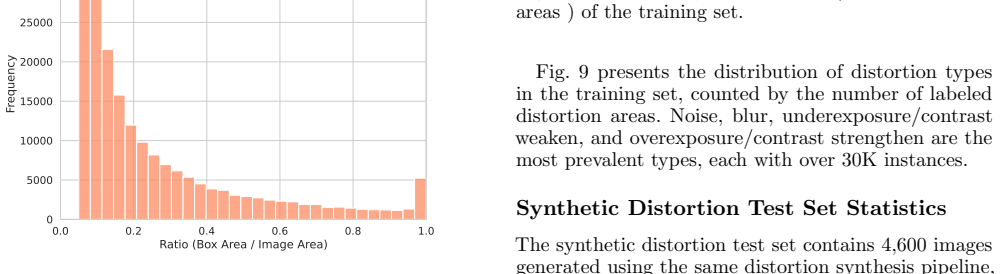
The load-bearing mechanism is the multi-detector LMM: N trainable area query tokens attend globally to image tokens while image tokens use causal attention, and each of M chosen LLM layers (10th, 15th, 20th, 25th, and 28th in the final model) carries its own linear head for 9-way classification (8 distortions plus non-distortion) and box regression. Each detector is trained with independent Hungarian matching against the set of ground-truth boxes, and the final loss is the average over detectors, with empty-class log-probabilities down-weighted by 0.05. For the synthetic-to-authentic gap, the paper reuses boxes classified as non-distortion by taking the second-highest class probability as a candidate distortion, then applies class-wise non-maximum suppression and probability filtering to produce final boxes. The training data is VIGIL-140K: more than 145K images filtered from a pool of over 1000K samples by six no-reference IQA scorers (threshold 85 on a 0-100 scale), with 1-3 irregular local regions injected per image across 8 distortion categories, 31 sub-types, and two severity levels.
What would settle it
Re-annotate a random sample of the 815 test images with fresh annotators and compute VIGIL-8B's AP50 against majority-vote boxes: if AP50 drops to the level of the detection baselines, around 0.36, the reported 0.502 is an artifact of the original annotation protocol.
Extended reading notes
Core claim
On its own terms, the paper's central claim is that an LMM with DETR-style detection heads attached to several LLM layers, trained only on synthetically distorted images, can localize authentic distortions in UGC images better than both general LMMs prompted to output bounding boxes and conventional object detectors trained on the same synthetic data. The reported evidence is that VIGIL-8B reaches mAP 0.482, AP50 0.502, and AP75 0.439 on the authentic test set, compared with 0.362/0.362/0.293 for Grounding-DINO and below 0.25 mAP for text-output LMMs. The paper also reports in-domain synthetic detection at mAP 0.736 and AP50 0.879, and ablations showing that discarding the non-distortion-class cue lowers authentic mAP from 0.482 to 0.407, while single-layer detection lowers it to 0.397.
Load-bearing premise
The evaluation assumes the 815 human-annotated test images, labeled by an iterative correction procedure with no reported agreement statistics, are a valid ground truth for real-world distortion location.
Editorial extensions
If this is right
- If the reported numbers hold, text-driven supervised fine-tuning for coordinate output is a bottleneck in LMM-based distortion localization, and regression-head detection should become the default for such tasks.
- Synthetic distortion injection scaled to 140K images can substitute for costly authentic distortion annotation, at least for the eight categories tested.
- The multi-layer detector design converges faster and predicts more regions than single-layer variants, which could carry over to other fine-grained perception tasks with scarce labels.
- The S2A trick's margin (authentic mAP 0.482 versus 0.407 without it) suggests that even noisy background-class predictions carry useful cross-domain signal.
- Joint training with Q-Instruct-200K preserves both distortion detection and text-based quality assessment abilities, so detection can be added to existing IQA-LMMs without sacrificing their general functionality.
Reading between the lines
- The authors report no inter-annotator agreement statistics for the 815-image authentic test set; if fresh annotators disagree substantially on region boundaries and categories, the absolute AP numbers will shift, though the relative ranking may persist.
- The supplementary Limitations section states that the dataset scale prevents verifying a data scaling law and that no large-scale authentic data is used in training, so the reported S2A gain is evidence for, not proof of, unbounded scaling of this approach.
- A natural extension is to test VIGIL on distortions outside its eight categories, such as AI-generated artifacts or sensor noise; the multi-layer feature stacking might generalize further than the taxonomy suggests.
- The background-cue trick is a form of pseudo-label mining; an adaptive rule that keeps the second-best class only when its probability exceeds a class-dependent threshold could reduce the false positives that the current global probability filter tolerates.
Signed reviews
Editorial analysis
A structured set of objections, weighed in public.
Referee Report
Summary. The paper proposes VIGIL, an LMM-based visual distortion detector trained entirely on a new synthetic dataset (VIGIL-140K, 145K images / 205K labeled regions). The model augments an InternVL-3-8B backbone with N area-query tokens and attaches independent classification/regression heads to M selected LLM decoder layers, treating each layer as a detector with its own Hungarian matching. At inference, the model keeps boxes that are classified as non-distortion and re-uses the second-highest class probability as a distortion candidate, followed by class-wise NMS and probability filtering. Experiments compare VIGIL against general LMMs (InternVL, Qwen3-VL, LLaVA-OV, GPT, Gemini) and object detectors (Faster R-CNN, DETR variants, YOLO-V11, Grounding-DINO) on two tasks: an in-domain synthetic distortion detection test set and an out-of-domain authentic distortion localization test set of 815 human-annotated COCO images. The paper reports state-of-the-art results on both, with the headline S2A claim being an mAP of 0.482 for VIGIL-8B versus 0.362 for the strongest baseline (Grounding-DINO) on the authentic test set.
Significance. If the S2A result is trustworthy, the paper makes a valuable empirical contribution: it shows that a model trained only on synthetic distortions can localize authentic distortions in user-generated content substantially better than current text-based LMMs and standard object detectors. The paper's strengths include a carefully constructed synthetic training set with quality filtering and distortion combination, a clean multi-detector design with ablations, a thorough comparison against both LMM and detection baselines, and useful supplementary analyses (parameter-freezing strategies, area-number generalization, threshold selection, and compatibility with text-based instruction tuning). The main risk is that the central S2A claim rests entirely on an author-constructed test set whose annotation reliability has not been demonstrated.
major comments (4)
- [Validation / Test Set Construction] The central S2A claim (Table 3: mAP 0.482 vs. 0.362 for Grounding-DINO) is evaluated solely on the 815-image authentic test set. The described iterative annotation-correction procedure involves a leader annotator, four reviewers, and a final pass in which only deletions are allowed, but the paper provides no inter-annotator agreement statistics, no independent re-annotation, and no statement about whether annotators were blind to VIGIL's predictions. Because the final pass can only remove regions, the authors' prior knowledge of the model's likely outputs could systematically delete regions the model does not detect, inflating the reported AP. The authors should report pairwise agreement (e.g., IoU or kappa on a subset), conduct an independent re-annotation by outside annotators, and explicitly state whether model outputs were available during any annotation stage.
- [Experiments Settings and Main Results] All AP/mAP values in Tables 2, 3, 4, 6, and 8 are reported as single numbers without variance, confidence intervals, or statistical significance tests. The headline margin of 0.120 mAP over Grounding-DINO in Table 3 could be within run-to-run noise or annotation noise. The authors should report means and standard deviations over at least three training runs (or resampled subsets of the test images with bootstrapping), and ideally a paired test for the VIGIL vs. baseline difference.
- [Training Data Preparation / Validation / Test Set Construction] The in-domain synthetic test set is generated with the same distortion pipeline (types, severity levels, region selection, and 1-3 regions per image) as the training set, so in-domain results largely measure the model's ability to fit that pipeline rather than generalization. More importantly, the authentic test set also uses the same 8-category taxonomy and the same 1-3 regions-per-image constraint as the synthetic training data, which may bias the S2A evaluation toward distortions that resemble the synthetic types. The paper should explicitly discuss this potential bias and, if possible, evaluate on an independently defined distortion taxonomy (e.g., the categories in ViDA-UGC or a broader UGC quality taxonomy) or report statistics showing that authentic annotations span the taxonomy naturally rather than being forced into it.
- [Additional Justification of Key Points (Supplementary)] The post-processing thresholds (TNMS=0.3, TProb=0.1 for authentic; 0.7, 0.8 for synthetic) are selected by a combinatorial search on a validation set of only 100 images, with step size 0.05 for both thresholds. With roughly 400 evaluated combinations, the selected thresholds may overfit this small validation set. The paper should report the robustness of the final AP to small perturbations of the selected thresholds (e.g., a sensitivity table or heatmap) and consider a larger validation set or cross-validated threshold selection.
minor comments (6)
- [Abstract and Introduction] There are multiple missing spaces in phrases such as "thesynthetic-to-authentic (S2A)problem" and "theFG-BGindistinguishability inS2A". The text should be copyedited throughout.
- [Supplementary, Justification on the Use of In-domain Baselines] The section contains an unresolved reference to "Sec." with no section number; this should be completed.
- [Supplementary, Authentic Distortion Test Set Statistics] Immediately after Figure 19, the supplementary text contains a long uninterpretable string of "/uni..." characters that appears to be a rendering artifact. This should be removed or replaced with the intended caption text.
- [Tables 2 and 3] The column layout is dense and the meaning of the per-type "mAP" column (AP averaged over IoU thresholds 0.05-0.95 for that type) versus the overall mAP column is not explained in the caption. Adding a clear note would improve readability.
- [Table 10] The table is captioned "Area number generalization test" but the version column is labeled "Authentic-Supp"; please clarify that the test set is the supplementary 100-image set with 4-5 distortion regions.
- [Limitations] The limitations paragraph is concise and appropriately acknowledges the absence of real-world training data, but it does not mention the annotation-reliability concern of the authentic test set; a sentence on this limitation would align the text with the actual evaluation risk.
Circularity Check
No significant circularity: the central S2A claim is evaluated on an external human-labeled test set, and no construction step forces the reported numbers.
full rationale
The paper's derivation chain is self-contained. VIGIL-140K is constructed from a 1.03M-image source pool with quality filtering and explicit distortion injection; the training bbox labels are generated by the construction algorithm, not derived from the target metric. The in-domain test set uses the same distortion synthesis pipeline on held-out images, but this is disclosed and serves only to measure in-domain fit; it is not the evidence for the synthetic-to-authentic claim. The S2A claim is supported by average-precision metrics on an 815-image human-annotated COCO test set that the model never sees during training. No fitted parameter is renamed as a prediction: post-processing thresholds are selected on a separate 100-image validation set, and checkpoint selection is also validation-based, which is standard practice. Self-citations (e.g., Refine-IQA-S1 and other prior works) appear only as baselines or related-work context and are not load-bearing; no uniqueness theorem or ansatz is imported from the authors' prior work. The lack of inter-annotator agreement statistics is a legitimate concern about test-set reliability, but it is a validity issue rather than a circularity issue: nothing in the model's construction makes the reported OOD numbers equivalent to its training inputs by definition.
Assumptions & free parameters
free parameters (8)
- Number of area query tokens N =
3
- Number of detector layers M =
5
- NMS IoU threshold T_NMS =
0.3 authentic, 0.7 synthetic
- Probability threshold T_Prob =
0.1 authentic, 0.8 synthetic
- Loss weights lambda_giou and lambda_L1 =
2 and 5
- Non-distraction class down-weight factor =
0.05
- Region filtering thresholds for brightness, sharpness, colorfulness =
B in [0.25,0.75], S_norm >= 0.9, C > 0.2 (and C < 0.8 for saturation)
- Distortion severity levels =
noticeable and severe
assumptions (4)
- domain assumption The six selected no-reference IQA models (TOPIQ-NR, TReS, LIQE, ARNIQA, QualiCLIP, Q-Align) produce scores where values above 85 indicate images suitable for distortion injection.
- standard math Standard DETR-style set prediction with Hungarian matching is a valid training objective for distortion detection.
- domain assumption The distortion taxonomy from KADIS-700K, merged into 8 categories, covers the major distortion types in authentic UGC images.
- domain assumption Intermediate LLM layers preserve low-level visual cues relevant to distortion detection.
Cite this review
Pith. "Pith review of Visual Distortion Detection in UGC Images Using Large Multimodal Models." pith.science (2026). https://pith.science/paper/BNFFC4WB
@misc{pith2026260809122,
  author       = {Pith},
  title        = {Pith review of: Visual Distortion Detection in UGC Images Using Large Multimodal Models},
  year         = {2026},
  howpublished = {\url{https://pith.science/paper/BNFFC4WB}},
  note         = {Machine review of arXiv:2608.09122}
}
read the original abstract
The localized depiction of perceptual quality has long been a crucial, yet underexplored, challenge in image quality assessment (IQA). Existing approaches based on large multimodal models (LMMs) predominantly rely on text-driven supervised fine-tuning (SFT). However, this training paradigm exhibits notable limitations in detection accuracy. Moreover, synthetically distorted images, which are often used as the primary training data source, show a significant generalization gap when deployed in real-world scenarios; thus, the \textbf{synthetic-to-authentic (\textit{S2A})} problem represents a critical challenge. Motivated by these issues, we propose \textbf{\textit{VIGIL}}, which leverages the LMM architecture for precise visual distortion detection. From a candidate pool of over 1000K samples, we construct the \textbf{\textit{VIGIL-140K}} training set, which consists of over 140K distorted images. These images are obtained through rigorous quality filtering and carefully crafted distortion injection, covering 8 major synthetic distortion categories. Our model leverages different layers of the large language model (LLM) decoder, treating them as \textit{multiple detectors} that perform synchronous distortion detection using multi-level features. Additionally, we retain distortion cues from predictions assigned to the non-distortion class, which helps mitigate the ambiguous foreground-background (\textit{FG-BG}) separation commonly encountered in the \textit{S2A} problem. After post-processing, our model consistently outperforms strong baselines on both in-domain synthetic distortion detection and \textit{S2A} tasks.
Figures


Figures from the paper (16 more)




Reference graph
Works this paper leans on
-
[1]
Perceptual image quality assessment: a survey , author=. SCIS , volume=. 2020 , publisher=
work page 2020
-
[2]
AIBench: Towards trustworthy evaluation under the 45° law , author =. Displays , year =
-
[3]
Zhang, Zicheng and Wang, Junying and Wen, Farong and Guo, Yijin and Zhao, Xiangyu and Fang, Xinyu and Ding, Shengyuan and Jia, Ziheng and Xiao, Jiahao and Shen, Ye and Zheng, Yushuo and Zhu, Xiaorong and Wu, Yalun and Jiao, Ziheng and Sun, Wei and Chen, Zijian and Zhang, Kaiwei and Fu, Kang and Cao, Yuqin and Hu, Ming and Zhou, Yue and Zhou, Xuemei and Ca...
- [4]
-
[5]
Faster R-CNN: Towards real-time object detection with region proposal networks , author=. IEEE TPAMI , volume=. 2016 , publisher=
work page 2016
-
[6]
ECCV , pages=
End-to-end object detection with transformers , author=. ECCV , pages=
- [7]
-
[8]
Deformable DETR: Deformable Transformers for End-to-End Object Detection , author=. ICLR , year=
Show all 38 references
-
[9]
The Eleventh International Conference on Learning Representations , year=
DINO: DETR with Improved DeNoising Anchor Boxes for End-to-End Object Detection , author=. The Eleventh International Conference on Learning Representations , year=
-
[10]
ACM MM , pages=
Q-ground: Image quality grounding with large multi-modality models , author=. ACM MM , pages=
-
[11]
arXiv preprint arXiv:2411.17237 , year=
Grounding-iqa: Multimodal language grounding model for image quality assessment , author=. arXiv preprint arXiv:2411.17237 , year=
-
[12]
AAAI , year=
Refine-IQA: Multi-Stage Reinforcement Finetuning for Perceptual Image Quality Assessment , author=. AAAI , year=
-
[13]
arXiv preprint arXiv:2508.12605 , year=
ViDA-UGC: Detailed Image Quality Analysis via Visual Distortion Assessment for UGC Images , author=. arXiv preprint arXiv:2508.12605 , year=
-
[14]
ECCV , pages=
Microsoft coco: Common objects in context , author=. ECCV , pages=
-
[15]
ICML , pages=
Learning transferable visual models from natural language supervision , author=. ICML , pages=
-
[16]
IEEE Transactions on Image Processing , volume=
Topiq: A top-down approach from semantics to distortions for image quality assessment , author=. IEEE Transactions on Image Processing , volume=. 2024 , publisher=
2024
-
[17]
WACV , pages=
No-reference image quality assessment via transformers, relative ranking, and self-consistency , author=. WACV , pages=
-
[18]
CVPR , pages=
Blind image quality assessment via vision-language correspondence: A multitask learning perspective , author=. CVPR , pages=
-
[19]
WACV , pages=
Arniqa: Learning distortion manifold for image quality assessment , author=. WACV , pages=
-
[20]
arXiv e-prints , journal=
Quality-aware image-text alignment for real-world image quality assessment , author=. arXiv e-prints , journal=
-
[21]
ICML , pages=
Q-ALIGN: teaching LMMs for visual scoring via discrete text-defined levels , author=. ICML , pages=
-
[22]
QoMEX , pages=
KADID-10k: A large-scale artificially distorted IQA database , author=. QoMEX , pages=
-
[23]
IEEE TIP , volume=
KonIQ-10k: An ecologically valid database for deep learning of blind image quality assessment , author=. IEEE TIP , volume=. 2020 , publisher=
2020
-
[24]
NRLQ , volume=
The Hungarian method for the assignment problem , author=. NRLQ , volume=. 1955 , publisher=
1955
-
[25]
5: Advancing open-source multimodal models in versatility, reasoning, and efficiency , author=
Internvl3. 5: Advancing open-source multimodal models in versatility, reasoning, and efficiency , author=. arXiv preprint arXiv:2508.18265 , year=
-
[26]
arXiv preprint arXiv:2504.10479 , year=
Internvl3: Exploring advanced training and test-time recipes for open-source multimodal models , author=. arXiv preprint arXiv:2504.10479 , year=
-
[27]
arXiv preprint arXiv:2303.08774 , year=
Gpt-4 technical report , author=. arXiv preprint arXiv:2303.08774 , year=
-
[28]
ECCV , pages=
Grounding dino: Marrying dino with grounded pre-training for open-set object detection , author=. ECCV , pages=. 2024 , organization=
2024
-
[29]
CVPR , pages=
You only look once: Unified, real-time object detection , author=. CVPR , pages=
-
[30]
arXiv preprint arXiv:2509.23661 , year=
Llava-onevision-1.5: Fully open framework for democratized multimodal training , author=. arXiv preprint arXiv:2509.23661 , year=
-
[31]
AAAI , volume =
Scaling-up Perceptual Video Quality Assessment , author =. AAAI , volume =. 2026 , doi =
2026
-
[32]
CVPR , pages=
Q-instruct: Improving low-level visual abilities for multi-modality foundation models , author=. CVPR , pages=
-
[33]
SCIS , volume=
Towards versatile multimedia quality assessment for visual communications , author=. SCIS , volume=. 2026 , publisher=
2026
-
[34]
2026 , month = may, howpublished =
2026
-
[35]
2024 , month = aug, howpublished =
2024
-
[36]
2025 , month = aug, howpublished =
2025
-
[37]
arXiv preprint arXiv:2412.15115 , year =
-
[38]
Bai, Shuai and Cai, Yuxuan and Chen, Ruizhe and Chen, Keqin and Chen, Xionghui and Cheng, Zesen and Deng, Lianghao and Ding, Wei and Gao, Chang and others , journal =
Reviewed August 11, 2026 · model on record in the stance chip above.
Discussion (0). Continue with ORCID to comment.