REVIEW 4 major objections 7 minor 75 references
Impact of disk magnetic fields on the propagation of stellar-scale jets in the magnetically arrested accretion disks of active galactic nuclei
T0 review · 4 major / 7 minor · reviewed 2026-08-11 · deepseek-v4-flash
Pith's one-line read This paper argues that magnetic fields in magnetically arrested disks squeeze the jet cocoon, collimate the jet, and modestly speed the jet head, making low-power jets from stellar-mass binary black hole mergers more likely to break out…
desk verdict A transparent analytic parameter study of cocoon confinement by MAD magnetic pressure; the mechanism rests on an unconstrained f_c≈1, but the authors say so, and the paper deserves referee time. read the letter →
The pith
A machine-rendered reading of the paper's core claim, the machinery that carries it, and where it could break.
The reading
What carries the argument
The engine is the analytic jet-cocoon model, in which the jet head is a double-shock structure and the cocoon's lateral expansion is set by pressure balance. The paper's new term is a sideways magnetic pressure $P_{B,c}=f_cB_d^2/8\pi$ with $f_c\simeq1$, which caps the cocoon expansion velocity at the Alfv\'en speed $\beta_A=\sqrt{\sigma_d/(1+\sigma_d)}$ and can set it to zero if cocoon pressure is too low. It also adds a magnetic-reconnection power term to the cocoon energy. The confinement term is what produces the enhanced collimation and the modest head-velocity increase; the reconnection term mainly adds cocoon energy at low jet power.
What would settle it
Run a three-dimensional simulation of a low-power jet propagating through a MAD-like disk and compare cocoon half-opening angle and jet-head velocity with the ambient poloidal field present and artificially removed; if the cocoon expands at the same rate and the head speed is unchanged at low jet power, the proposed mechanism is not operating.
Extended reading notes
Core claim
Within the magnetically arrested disk model, the ambient disk magnetic field, not the jet's own magnetization, is the controlling agent. Because MAD fields are mostly poloidal, they do not push directly on the jet head; instead, their pressure opposes sideways cocoon expansion. That confinement narrows the jet, raises its density and ram pressure, and modestly increases the jet-head velocity. The paper reports that at jet powers around $10^{43}$--$10^{45}$ erg/s, this confined-cocoon effect raises the breakout luminosity of the jet-head shock and shortens the breakout time, so low-power jets from binary black hole mergers can break out and appear as X-ray flares.
Load-bearing premise
The central assumption is that the MAD's large-scale poloidal magnetic field presses inward on the cocoon with nearly its full magnetic pressure; if field coherence is imperfect, turbulence scrambles the field, or field-line draping turns sideways resistance into tension rather than pressure, the cocoon confinement, extra collimation, and faster jet head would all weaken.
Editorial extensions
If this is right
- Low-power jets ($L_j\sim10^{43}$--$10^{45}$ erg/s) from stellar-mass black hole mergers are more likely to break out of an AGN disk when the disk is a MAD, because magnetic cocoon confinement raises the jet-head velocity.
- The breakout time is shorter with disk magnetic fields, so the electromagnetic flare should follow the gravitational-wave signal with a smaller delay than in an unmagnetized disk.
- At low jet power, the jet-head shock breakout luminosity is enhanced relative to the unmagnetized case, but the size of the enhancement depends on the adopted emission prescription.
- Cocoon luminosity at breakout is suppressed by magnetic pressure, making the post-breakout cocoon cooling signal fainter.
- Above jet powers near $10^{48}$ erg/s, magnetic effects on the jet head become almost negligible, so high-power jets behave as in the unmagnetized case.
Reading between the lines
- The low-power luminosity boost comes partly from the magnetized jet head crossing the boundary into the relativistic emission prescription; that part of the prediction is more fragile than the purely dynamical collimation effect.
- Because the model folds any field-line draping into the geometric factors $f_h$ and $f_c$ rather than computing tension, simulations are needed to test whether real MAD fields confine the cocoon as strongly as assumed.
- The same cocoon-confinement logic should apply in other moderately magnetized environments with $\sigma\sim10^{-3}$--$10^{-1}$, such as shock-compressed supernova remnant layers or pulsar wind nebulae, where jets may show similar collimation-driven acceleration.
Editorial analysis
A structured set of objections, weighed in public.
Referee Report
Summary. This paper extends the analytic jet-cocoon framework of Bromberg et al. (2011) to stellar-scale jets propagating inside magnetically arrested AGN disks. The ambient magnetic field enters in two places: magnetic pressure opposing the lateral expansion of the cocoon (Eq. 5, via PB,c = fc Bd²/8π with fc ≈ 1, plus an Alfvén-speed cap βA) and turbulent magnetic-reconnection power injected into the cocoon (Eqs. 8-10). The disk field, density, and magnetization are computed from a MAD accretion model (Eqs. 1-2), giving σd ~ 10^-3 to 10^-1 for MBH = 10^6-10^8 M☉. The authors find that the magnetic pressure suppresses cocoon expansion, narrows the jet-head opening angle, and thereby modestly raises the jet-head velocity through enhanced jet collimation; the effect is strongest at low jet power. For low-power jets from stellar-mass binary black hole mergers (Lj ~ 10^43-10^45 erg/s), the breakout luminosity is enhanced and the breakout time shortened (Figs. 8-10), with the luminosity enhancement flagged as sensitive to the adopted emission prescription.
Significance. If the mechanism holds, the paper offers a concrete, falsifiable prediction: coherent MAD poloidal fields shorten the delay between the gravitational-wave signal of a stellar-mass BBH merger in an AGN disk and its electromagnetic breakout flare, and move the breakout emission to higher luminosity and earlier times. The dynamical calculation is internally consistent, reduces to the unmagnetized jet-cocoon model in the σd → 0 limit, and is presented with unusually explicit caveats: the fc ≈ 1 coherence assumption, the maximal reconnection scale zx = zh, the subdominance of the head-on factor fh, and the prescription dependence of the luminosity contrast are all acknowledged in the text. The main weakness is quantitative robustness. The stress-test concern largely lands: the cocoon-side factor fc is the only coupling through which the ambient field affects jet dynamics, it is a free parameter set to ≈ 1, and no sensitivity study is provided; the luminosity-enhancement claim is partly a boundary artifact of the emission prescriptions; and the breakout calculation rests on an unspecified vertical density profile. These issues are fixable within the scope of the manuscript.
major comments (4)
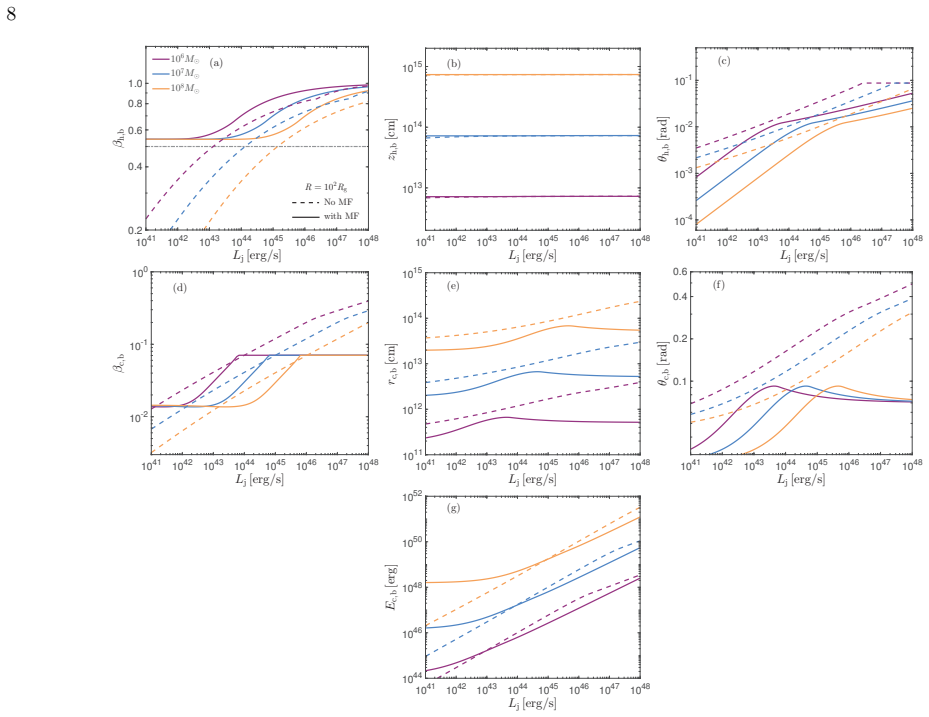
- [§2.2.1, Eq. (5)] The central mechanism is carried entirely by the term PB,c = fc Bd²/8π with fc ≈ 1. Section 3.2 shows that the head-on factor fh is dynamically subdominant, so fc is the only channel through which the ambient field influences the jet-cocoon system. The text concedes that imperfect field coherence, turbulence, or a nonpoloidal component would reduce the effective pressure, but no reduced value is ever computed or explored. Because the collimation, the jet-density increase, and the modest βh increase in Figures 4-7 all scale with this confinement, the qualitative conclusion is not established unless the sensitivity to fc (e.g., fc = 0.3 and 0.1) preserves the effect. I request an explicit fc robustness study; as written, the central claim is an assumption encoded in Eq. (5) rather than a derived consequence of MAD physics.
- [§2.2.1, Eq. (5)] The Alfvén-speed cap βc = min(..., βA) is asserted rather than derived. In the regime Pc >> PB,c, which covers much of the explored parameter space because σd ~ 10^-3-10^-1, a pressure-driven lateral expansion is limited by the inertia of the swept-up medium, at a speed of order sqrt(Pc/ρ̄d c²), and there is no obvious reason for it to be capped at βA; the magnetic pressure PB,c is already subtracted inside the square root. The cap therefore suppresses βc exactly in the cases where the magnetic pressure is too weak to confine the cocoon on its own, and it strengthens the confinement effect beyond what PB,c alone justifies. The cap needs a physical justification in terms of field-line advection or draping, or the no-cap case needs to be computed, to establish that the collimation-driven increase in βh survives.
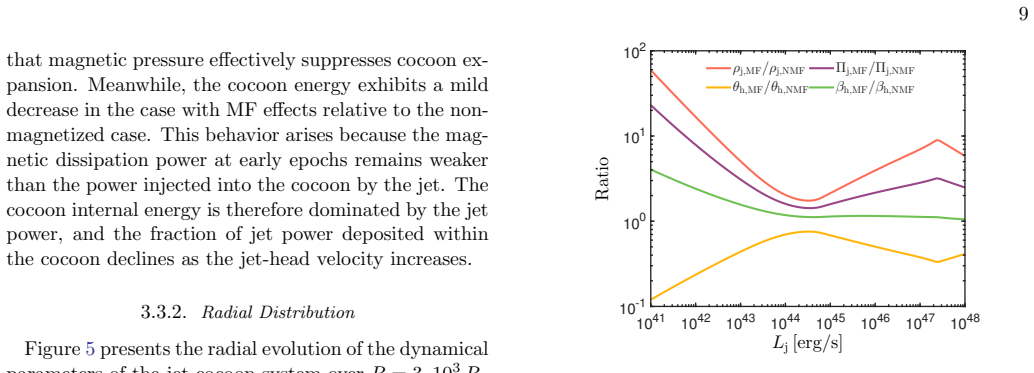
- [§3.4, Fig. 8] The enhanced breakout luminosity at low jet power is largely a consequence of the two solutions falling on different emission prescriptions: the magnetized solutions have βh,b > 0.5 throughout and are evaluated with Eq. (14), while the unmagnetized solutions drop below βh,b ≈ 0.5 at low power and are evaluated with the Newtonian and mildly relativistic formulas. The authors acknowledge this in the text, but the abstract retains the luminosity enhancement as a headline result. Since the prescription boundaries depend on the uncertain values of fc and the Alfvén cap, the direction of the luminosity contrast is not robust. Please recompute the comparison with a single prescription applied consistently to both cases, or explicitly demote the luminosity enhancement to a prescription-dependent indicative result.
- [§2.3] The breakout criterion τ(zh,b) = c/vh,b requires a vertical density profile for the MAD and an opacity, but neither is specified anywhere in Sections 2 or 3. All breakout quantities reported in Figures 5, 6, and 8-10 depend on the resulting zh,b, and the text only states that breakout occurs close to the disk surface. Please specify the adopted vertical profile (e.g., a uniform slab of height Hd = R/2 or a Gaussian) and opacity, and state how τ is computed, so that the quantitative predictions are reproducible.
minor comments (7)
- [§2.2.1] The sentence 'the jet-head velocity, βh, is calculated numerically' does not describe the procedure; a sentence stating that Eq. (3) is solved for βh given Lj, Bd, and ρd would aid reproducibility.
- [§3.1, Fig. 1] The illustrative σ = 10^1 and 10^3 curves dominate the figure visually, while the physically realized MAD interval σd ~ 10^-3-10^-1 is where the effects are weakest; consider plotting the fiducial MAD range with a distinct style or in a separate panel.
- [§3.3.3] The claim that jet-head breakout parameters show 'only minor variations' when zx < zh is not shown; a quantitative statement or a supplementary panel would support the assertion that the conclusions are unchanged.
- [§2.2.2] The symbol vh is used in v_inj = min(0.3 vh, vA) without a definition; state explicitly that vh = βh c.
- [§3.4, Eq. (14)] The relativistic breakout luminosity Lh,r depends on E0 and th,th, which are not defined in the text beyond a one-line gloss; since this formula drives the high-power behavior in Fig. 8, define E0 and th,th explicitly or give the relevant equation from Chen & Dai (2025).
- [Fig. 4 caption] The Figure 4 caption appears to contain a leftover editing repetition ('(a) with MF No MF (a) with MF No MF'); please clean it up.
- [§4] The discussion of supernova remnants, pulsar wind nebulae, dark matter, and magnetar binaries is speculative and only loosely connected to the model; shortening it would focus the paper on its MAD conclusions.
Circularity Check
No significant circularity
full rationale
The paper's central effect is introduced transparently in Eq. (5), where the lateral cocoon velocity is written with the magnetic-pressure term P_B,c = f_c B_d^2/8π and the Alfvén-speed cap. The abstract's statement that disk magnetic pressure suppresses lateral cocoon expansion is therefore a direct consequence of the adopted model equation, not a hidden fit or a redefinition. The subsequent claims that this suppression enhances jet collimation and modestly raises the jet-head velocity are derived by integrating the coupled evolution equations (6)-(10), i.e., d z_h/dt = β_h c, d r_c/dt = β_c c, and d E_c/dt = η_h L_j(1-β_h) + L_B, with the head velocity following from the pressure balance in Eq. (3). No parameter is fitted to a subset of data and then renamed as a prediction, and no load-bearing self-citation is used: the MAD field strength and magnetization profiles are computed from standard accretion-disk scalings (Eqs. 1-2), and the relevant background citations (Bromberg et al. 2011; Narayan et al. 2003; Chen & Dai 2025, etc.) are external and independent of the present authors. The paper itself flags the sensitivity of its mechanism to the fiducial choice f_c ≈ 1, noting that imperfect field coherence, turbulence, or nonpoloidal components would weaken the cocoon confinement, and it explicitly cautions that the breakout-luminosity enhancement is model-dependent because different velocity regimes use different emission prescriptions. These are robustness caveats about an assumed physical input, not circularity in the derivation chain. The analytic model is self-contained: given its stated assumptions, the jet collimation, head-velocity increase, and breakout time/luminosity changes follow from the coupled dynamics rather than being imposed as outputs.
Assumptions & free parameters
free parameters (11)
- mdot (dimensionless accretion rate) =
1
- epsilon (radial inflow velocity fraction) =
0.01
- eta_e (radiative efficiency) =
0.1
- f_h (head-on magnetic pressure geometric factor) =
0.1
- f_c (cocoon lateral magnetic pressure factor) =
1.0
- Gamma_j (jet Lorentz factor) =
100
- theta_j (jet initial half-opening angle) =
5 degrees
- v_inj factor (turbulent injection velocity fraction) =
0.3
- z_x / z_h (reconnection scale relative to jet height) =
1
- eta_j (BHL jet power efficiency) =
0.1
- t_j (engine duration for Fig. 1) =
10 s
assumptions (8)
- standard math Bromberg et al. 2011 jet-cocoon pressure balance and evolution equations
- domain assumption MAD field strength given by Eq. (1) with Hd = R/2
- domain assumption The jet is nonmagnetized at the head
- domain assumption Thermal pressures Pj and Pth,d are negligible versus ram pressures
- ad hoc to paper Lateral magnetic pressure factor f_c approaching 1 and head-on factor f_h = 0.1
- ad hoc to paper Reconnection power L_B with z_x = z_h and v_inj = 0.3 v_h
- domain assumption Breakout occurs when tau(z_h,b) = c / v_h,b and the optical depth can be integrated with an implicit disk profile and opacity
- domain assumption Regime-dependent emission prescriptions for breakout luminosity and temperature
Cite this review
Pith. "Pith review of Impact of disk magnetic fields on the propagation of stellar-scale jets in the magnetically arrested accretion disks of active galactic nuclei." pith.science (2026). https://pith.science/paper/GLQUC3YJ
@misc{pith2026260809284,
  author       = {Pith},
  title        = {Pith review of: Impact of disk magnetic fields on the propagation of stellar-scale jets in the magnetically arrested accretion disks of active galactic nuclei},
  year         = {2026},
  howpublished = {\url{https://pith.science/paper/GLQUC3YJ}},
  note         = {Machine review of arXiv:2608.09284}
}
read the original abstract
It is widely recognized that active galactic nucleus (AGN) disks host numerous massive stars and compact objects. Stellar-scale jets triggered by collapses of massive stars and mergers of compact objects could propagate through the disk and produce observable electromagnetic radiation. Magnetically arrested disks (MADs), supported by both numerical simulations and observations, possess strong magnetic fields (MFs). As jets travel within such environments, the MFs should regulate jet evolution and shape radiation signatures. In this work, we explore the effects of disk MFs on jet propagation and breakout emission within the MAD framework. We employ a jet-cocoon model that accounts for potential disk-MF effects, including both magnetic pressure and magnetic energy dissipation driven by magnetic reconnection. We find that magnetic pressure effectively suppresses the lateral expansion of the cocoon, which enhances jet collimation and modestly increases the jet-head velocity. Furthermore, magnetic pressure effects are more pronounced at relatively low jet powers. In this regime, the breakout luminosity of the jet-head shock is enhanced, while its breakout time is shortened. However, the magnitude of the luminosity enhancement is sensitive to the adopted regime-dependent emission prescriptions. These findings suggest that, within the explored parameter space, disk MFs can facilitate the breakout of low-power jets arising from binary black hole mergers in AGN MADs.
Figures


Figures from the paper (7 more)




Reference graph
Works this paper leans on
-
[1]
Aktar, R., Pan, K.-C., & Okuda, T.\ 2026, arXiv:2603.11452. doi:10.48550/arXiv.2603.11452
-
[2]
Artymowicz, P., Lin, D. N. C., & Wampler, E. J.\ 1993, , 409, 592. doi:10.1086/172690
doi:10.1086/172690 1993
-
[3]
Begelman, M. C., & Cioffi, D. F.\ 1989, , 345, L21. doi:10.1086/185542
doi:10.1086/185542 1989
-
[4]
Blandford, R. D. & Znajek, R. L.\ 1977, , 179, 433. doi:10.1093/mnras/179.3.433
-
[5]
Bondi, H.\ 1952, , 112, 195. doi:10.1093/mnras/112.2.195
-
[6]
doi:10.1088/0004-637X/740/2/100
Bromberg, O., Nakar, E., Piran, T., et al.\ 2011, , 740, 100. doi:10.1088/0004-637X/740/2/100
-
[7]
& Tchekhovskoy, A.\ 2016, , 456, 1739
Bromberg, O. & Tchekhovskoy, A.\ 2016, , 456, 1739. doi:10.1093/mnras/stv2591
-
[8]
Chatterjee, K., Kaaz, N., Liska, M., et al.\ 2025, , 112, 063013. doi:10.1103/hgj9-v4fk
Show all 75 references
-
[9]
& Dai, Z.-G.\ 2024, , 961, 206
Chen, K. & Dai, Z.-G.\ 2024, , 961, 206. doi:10.3847/1538-4357/ad0dfd
2024 doi
-
[10]
& Dai, Z.-G.\ 2025, , 987, 214
Chen, K. & Dai, Z.-G.\ 2025, , 987, 214. doi:10.3847/1538-4357/addb48
2025 doi
- [11]
-
[12]
de Gouveia dal Pino, E. M. & Lazarian, A.\ 2005, , 441, 845. doi:10.1051/0004-6361:20042590
2005 doi
-
[13]
M., Piovezan, P
de Gouveia Dal Pino, E. M., Piovezan, P. P., & Kadowaki, L. H. S.\ 2010, , 518, A5
2010
-
[14]
E.\ 2000, Journal of Fluid Mechanics, 409, 69
Dimotakis, P. E.\ 2000, Journal of Fluid Mechanics, 409, 69. doi:10.1017/S0022112099007946
2000 doi
-
[15]
E.\ 2005, Annual Review of Fluid Mechanics, 37, 329
Dimotakis, P. E.\ 2005, Annual Review of Fluid Mechanics, 37, 329. doi:10.1146/annurev.fluid.36.050802.122015
2005
-
[16]
Dittmann, A. J. & Miller, M. C.\ 2020, , 493, 3732. doi:10.1093/mnras/staa463
2020 doi
-
[17]
doi:10.1016/j.newar.2004.06.001
Edgar, R.\ 2004, , 48, 843. doi:10.1016/j.newar.2004.06.001
2004 doi
-
[18]
C., et al.\ 2021, , 910, L13
Event Horizon Telescope Collaboration, Akiyama, K., Algaba, J. C., et al.\ 2021, , 910, L13. doi:10.3847/2041-8213/abe4de
2021 doi
-
[19]
doi:10.3847/2041-8213/ad2df1
Event Horizon Telescope Collaboration, Akiyama, K., Alberdi, A., et al.\ 2024, , 964, L26. doi:10.3847/2041-8213/ad2df1
2024 doi
-
[20]
S., Caban, F., et al.\ 2020, , 499, 2608
Fabj, G., Nasim, S. S., Caban, F., et al.\ 2020, , 499, 2608. doi:10.1093/mnras/staa3004
2020 doi
-
[21]
J., Cantiello, M., et al.\ 2025, , 981, 16
Fabj, G., Dittmann, A. J., Cantiello, M., et al.\ 2025, , 981, 16. doi:10.3847/1538-4357/ada896
2025 doi
-
[22]
& Wu, Q.\ 2023, , 944, 159
Fan, X. & Wu, Q.\ 2023, , 944, 159. doi:10.3847/1538-4357/acb532
2023 doi
-
[23]
Gaensler, B. M. & Slane, P. O.\ 2006, , 44, 17. doi:10.1146/annurev.astro.44.051905.092528
2006 arXiv
-
[25]
B., et al.\ 2020, , 498, 3320
Gottlieb, O., Bromberg, O., Singh, C. B., et al.\ 2020, , 498, 3320. doi:10.1093/mnras/staa2567
2020 doi
-
[26]
doi:10.1093/mnras/stab3784
Gottlieb, O., Lalakos, A., Bromberg, O., et al.\ 2022, , 510, 4962. doi:10.1093/mnras/stab3784
2022 doi
-
[27]
J., Ford, K
Graham, M. J., Ford, K. E. S., McKernan, B., et al.\ 2020, , 124, 251102. doi:10.1103/PhysRevLett.124.251102
2020 doi
-
[28]
& K \"o nigl, A.\ 2003, , 594, L83
Granot, J. & K \"o nigl, A.\ 2003, , 594, L83. doi:10.1086/378733
2003 doi
-
[29]
doi:10.1093/mnras/sty760
Harrison, R., Gottlieb, O., & Nakar, E.\ 2018, , 477, 2128. doi:10.1093/mnras/sty760
2018 doi
-
[30]
& Lyttleton, R
Hoyle, F. & Lyttleton, R. A.\ 1939, Proceedings of the Cambridge Philosophical Society, 35, 405. doi:10.1017/S0305004100021150
1939 doi
-
[31]
doi:10.3847/1538-4357/abba7e
Huang, B.-Q., Liu, T., Huang, F., et al.\ 2020, , 904, 17. doi:10.3847/1538-4357/abba7e
2020 doi
-
[32]
doi:10.3847/1538-4357/ad3d54
Huang, B.-Q., Liu, T., Li, X.-Y., et al.\ 2024, , 967, 67. doi:10.3847/1538-4357/ad3d54
2024 doi
-
[33]
doi:10.1088/0004-637X/744/1/71
Inoue, T., Yamazaki, R., Inutsuka, S.-i., et al.\ 2012, , 744, 71. doi:10.1088/0004-637X/744/1/71
2012 doi
-
[34]
K., Bhake, A., Banerjee, B., et al.\ 2025, , 703, A304
Joshi, R. K., Bhake, A., Banerjee, B., et al.\ 2025, , 703, A304. doi:10.1051/0004-6361/202555874
2025 doi
-
[35]
Kadowaki, L. H. S., de Gouveia Dal Pino, E. M., & Singh, C. B.\ 2015, , 802, 113. doi:10.1088/0004-637X/802/2/113
2015 doi
-
[36]
R., et al.\ 2024, , 972, 101
Kathirgamaraju, A., Li, H., Ryan, B. R., et al.\ 2024, , 972, 101. doi:10.3847/1538-4357/ad63a3
2024 doi
- [37]
-
[38]
doi:10.3847/2041-8213/ac98ad
Lazzati, D., Soares, G., & Perna, R.\ 2022, , 938, L18. doi:10.3847/2041-8213/ac98ad
2022 doi
-
[39]
P., et al.\ 2023, , 950, L20
Lazzati, D., Perna, R., Gompertz, B. P., et al.\ 2023, , 950, L20. doi:10.3847/2041-8213/acd18c
2023 doi
-
[40]
J., Malesani, D
Levan, A. J., Malesani, D. B., Gompertz, B. P., et al.\ 2023, Nature Astronomy, 7, 976. doi:10.1038/s41550-023-01998-8
2023 doi
-
[41]
doi:10.3847/1538-4357/ae346b
Li, X.-Y., Liu, T., Huang, B.-Q., et al.\ 2026, , 998, 298. doi:10.3847/1538-4357/ae346b
2026 doi
-
[42]
doi:10.1103/PhysRevD.111.083033
Ma, Z.-P., Wang, K., Wu, Q., et al.\ 2025, , 111, 083033. doi:10.1103/PhysRevD.111.083033
2025 doi
-
[44]
McKernan, B., Ford, K. E. S., Bartos, I., et al.\ 2019, , 884, L50. doi:10.3847/2041-8213/ab4886
2019 doi
-
[46]
& Sari, R.\ 2010, , 725, 904
Nakar, E. & Sari, R.\ 2010, , 725, 904. doi:10.1088/0004-637X/725/1/904
2010 doi
-
[47]
& Sari, R.\ 2012, , 747, 88
Nakar, E. & Sari, R.\ 2012, , 747, 88. doi:10.1088/0004-637X/747/2/88
2012 doi
-
[48]
V., & Abramowicz, M
Narayan, R., Igumenshchev, I. V., & Abramowicz, M. A.\ 2003, , 55, L69. doi:10.1093/pasj/55.6.L69
2003 doi
-
[49]
F., et al.\ 2012, , 426, 3241
Narayan, R., S a dowski, A., Penna, R. F., et al.\ 2012, , 426, 3241. doi:10.1111/j.1365-2966.2012.22002.x
2012
-
[50]
S., Fabj, G., Caban, F., et al.\ 2023, , 522, 5393
Nasim, S. S., Fabj, G., Caban, F., et al.\ 2023, , 522, 5393. doi:10.1093/mnras/stad1295
2023 doi
-
[51]
doi:10.3847/2041-8213/abd319
Perna, R., Lazzati, D., & Cantiello, M.\ 2021, , 906, L7. doi:10.3847/2041-8213/abd319
2021 doi
-
[52]
doi:10.1103/RevModPhys.76.1143
Piran, T.\ 2004, Reviews of Modern Physics, 76, 1143. doi:10.1103/RevModPhys.76.1143
2004 doi
-
[53]
doi:10.1093/mnras/stad816
Ray, M., Lazzati, D., & Perna, R.\ 2023, , 521, 4233. doi:10.1093/mnras/stad816
2023 doi
-
[54]
C., Nemmen, R., & Bom, C
Rodr \' guez-Ram \' rez, J. C., Nemmen, R., & Bom, C. R.\ 2025, , 111, 083020. doi:10.1103/PhysRevD.111.083020
2025 doi
-
[55]
doi:10.1088/0004-637X/742/1/36
Sapir, N., Katz, B., & Waxman, E.\ 2011, , 742, 36. doi:10.1088/0004-637X/742/1/36
2011 doi
-
[56]
doi:10.1088/0004-637X/774/1/79
Sapir, N., Katz, B., & Waxman, E.\ 2013, , 774, 79. doi:10.1088/0004-637X/774/1/79
2013 doi
-
[57]
C., & Dexter, J.\ 2021, , 502, L50
Scepi, N., Begelman, M. C., & Dexter, J.\ 2021, , 502, L50. doi:10.1093/mnrasl/slab002
2021 doi
-
[58]
& Goodman, J.\ 2003, , 341, 501
Sirko, E. & Goodman, J.\ 2003, , 341, 501. doi:10.1046/j.1365-8711.2003.06431.x
2003
-
[59]
S., Haiman, Z., et al.\ 2023a, , 950, 13
Tagawa, H., Kimura, S. S., Haiman, Z., et al.\ 2023a, , 950, 13. doi:10.3847/1538-4357/acc4bb
-
[60]
S., Haiman, Z., et al.\ 2023b, , 946, L3
Tagawa, H., Kimura, S. S., Haiman, Z., et al.\ 2023b, , 946, L3. doi:10.3847/2041-8213/acc103
-
[61]
S., Haiman, Z., et al.\ 2024, , 966, 21
Tagawa, H., Kimura, S. S., Haiman, Z., et al.\ 2024, , 966, 21. doi:10.3847/1538-4357/ad2e0b
2024 doi
- [62]
- [63]
-
[64]
A., Quataert, E., & Murray, N.\ 2005, , 630, 167
Thompson, T. A., Quataert, E., & Murray, N.\ 2005, , 630, 167. doi:10.1086/431923
2005 doi
-
[65]
C.\ 2011, , 418, L79
Tchekhovskoy, A., Narayan, R., & McKinney, J. C.\ 2011, , 418, L79. doi:10.1111/j.1745-3933.2011.01147.x
2011
-
[66]
C., et al.\ 2021, , 911, L14
Wang, J.-M., Liu, J.-R., Ho, L. C., et al.\ 2021, , 911, L14. doi:10.3847/2041-8213/abee81
2021 doi
-
[67]
doi:10.1093/mnras/stac1968
Wang, Y.-H., Lazzati, D., & Perna, R.\ 2022, , 516, 5935. doi:10.1093/mnras/stac1968
2022 doi
-
[68]
Wang, Y., Zhu, Z., & Lin, D. N. C.\ 2024, , 528, 4958. doi:10.1093/mnras/stae321
2024 doi
-
[69]
doi:10.3847/1538-4357/ae2256
Wei, Y.-F., Liu, T., & Huang, B.-Q.\ 2025, , 995, 121. doi:10.3847/1538-4357/ae2256
2025 doi
-
[70]
doi:10.3847/1538-4357/adff71
Xing, J.-T., Liu, T., Huang, B.-Q., et al.\ 2025, , 991, 167. doi:10.3847/1538-4357/adff71
2025 doi
-
[71]
& Lei, W.-H.\ 2025, , 987, 167
Yuan, H.-Y. & Lei, W.-H.\ 2025, , 987, 167. doi:10.3847/1538-4357/addbe4
2025 doi
-
[72]
& Narayan, R.\ 2014, , 52, 529
Yuan, F. & Narayan, R.\ 2014, , 52, 529. doi:10.1146/annurev-astro-082812-141003
2014 doi
-
[73]
doi:10.3847/1538-4357/ac6ddf
Yuan, C., Murase, K., Guetta, D., et al.\ 2022, , 932, 80. doi:10.3847/1538-4357/ac6ddf
2022 doi
-
[74]
& Morris, M.\ 1987, , 322, 721
Yusef-Zadeh, F. & Morris, M.\ 1987, , 322, 721. doi:10.1086/165767
1987 doi
-
[75]
E., & MacFadyen, A
Zhang, W., Woosley, S. E., & MacFadyen, A. I.\ 2003, , 586, 356. doi:10.1086/367609
2003 doi
-
[76]
Zhang, B.\ 2019, The physics of gamma-ray bursts (Cambridge: Cambridge Univ. Press)
2019
-
[77]
doi:10.3847/1538-4357/ae3319
Zhang, S.-R., Wang, Y., Yuan, Y.-F., et al.\ 2026, , 998, 171. doi:10.3847/1538-4357/ae3319
2026 doi
-
[78]
doi:10.3847/2041-8213/abd412
Zhu, J.-P., Zhang, B., Yu, Y.-W., et al.\ 2021, , 906, L11. doi:10.3847/2041-8213/abd412
2021 doi
Reviewed August 11, 2026 · model on record in the stance chip above.
Discussion (0). Continue with ORCID to comment.