REVIEW 2 major objections 5 minor 49 references
FactorDrive: Adaptive Multi-Step Reasoning Driven by Planning-Critical Factors for End-to-End Autonomous Driving
T0 review · 2 major / 5 minor · reviewed 2026-08-11 · deepseek-v4-flash
Pith's one-line read FactorDrive claims that scene-adaptive chain-of-thought plus search-guided RL post-training — QS-GRPO — makes a VLM driving planner state of the art: 0.30 m average $L_2$, 0.08 % collision, 91.0 PDMS on NAVSIM.
desk verdict QS-GRPO is a genuine contribution; the nuScenes SOTA claim is undermined by a future-derived navigation command and needs a protocol fix before it's believable. read the letter →
The pith
A machine-rendered reading of the paper's core claim, the machinery that carries it, and where it could break.
The reading
What carries the argument
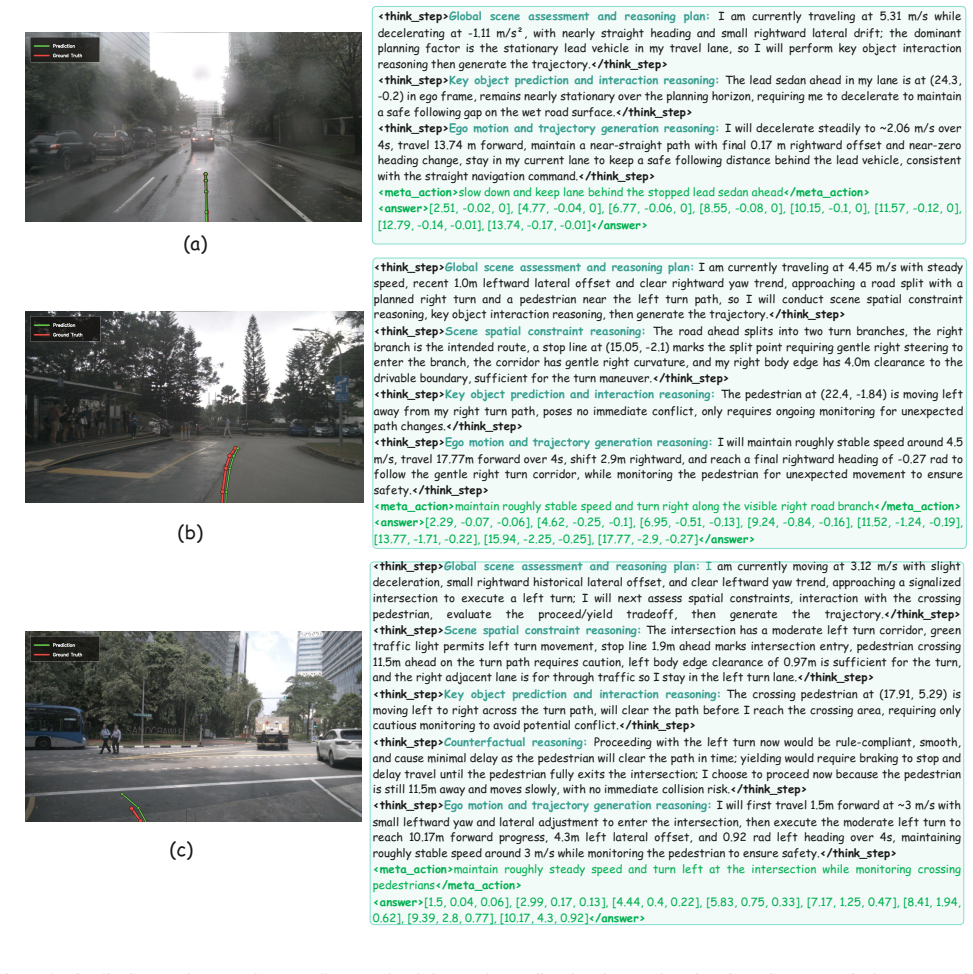
The load-bearing mechanism is the pair formed by the planning-critical-factor reasoning plan and the QS-GRPO search loop. In PCF-CoT every reasoning path opens with a 'Global scene assessment and reasoning plan' that identifies the active PCFs — road geometry, drivable corridors, traffic controls, critical interacting agents, and ego motion — and then decides which reasoning units to activate: Scene spatial constraint reasoning, Key object prediction and interaction reasoning, Counterfactual reasoning (activated only when at least two reasonable actions survive filtering), and Ego motion and trajectory generation reasoning. The path always ends with the trajectory-generation step, so reasoning composition and depth adapt to the scene. In QS-GRPO, Monte Carlo tree search over partial reasoning states uses PUCT selection with old-policy priors and the trajectory-level reward $r(\tau,\xi) = \lambda_{\mathrm{fmt}} R_{\mathrm{fmt}} + \lambda_{\mathrm{traj}} R_{\mathrm{traj}}$ to explore and select complete responses; the highest-reward cached response per hard sample is retained in a buffer and re-used, and group construction keeps the best response while adding high-confidence rollouts, so that high-confidence but low-reward paths receive negative group-relative advantage under the GRPO objective with clipping and KL regularization.
What would settle it
Re-run the nuScenes evaluation with the navigation command produced by a map-based routing engine over the recorded route — or with the command removed entirely — and check whether the 0.30 m average $L_2$ and 0.08 % average collision rate survive. If they degrade to baseline levels, the open-loop state-of-the-art claim rests on the expert-derived command rather than on adaptive reasoning or search-guided post-training; a complementary check is to run the post-trained policy in a reactive closed-loop simulator and see whether its safety gains persist when surrounding agents respond to the ego plan.
Extended reading notes
Core claim
The central claim is that planning-critical-factor-driven adaptive reasoning and quality-guided search-based post-training together produce state-of-the-art end-to-end trajectory planning in a vision-language driving model. FactorDrive first instruction-tunes the Qwen3-VL-8B base model on roughly 1.09 million driving-domain question–answer pairs, then fine-tunes it on PCF-CoT, a chain-of-thought dataset in which each reasoning path is organized around the factors that actually constrain the maneuver, with the composition and depth of reasoning steps selected per scene (paths range from two to five steps). QS-GRPO then post-trains only on hard samples: Monte Carlo tree search over reasoning steps, guided by a trajectory-level reward (format correctness plus an exponential $L_2$/FDE reward on nuScenes, or $L_2$ plus PDMS on NAVSIM), discovers higher-reward reasoning paths; a per-sample buffer caches the best response; and a confidence-aware group mixes the best response with high-confidence rollouts under the clipped GRPO objective with group-relative advantages. The paper reports the lowest average $L_2$ error on nuScenes and the highest PDMS on NAVSIM among the methods compared — 0.30 m and 0.08 % on nuScenes, 91.0 on NAVSIM — with ablations attributing a 2.6-point PDMS gain to QS-GRPO post-training and a 16.7 % relative reduction in average collision rate to PCF-CoT reasoning.
Load-bearing premise
The premise the open-loop nuScenes result rests on is that the route-level navigation command — constructed by looking roughly 20 m along the expert's future trajectory and labeling it Go Straight, Turn Left, or Turn Right by lateral displacement — is a legitimate route input that does not leak the ground-truth turn direction to the planner; if it leaks, FactorDrive's reported 0.30 m average $L_2$ is partly earned from information its comparison baselines never received.
Editorial extensions
If this is right
- Scene-adaptive reasoning paths (two to five steps, with counterfactual reasoning invoked only when a real trade-off exists) can replace fixed-template and fast–slow reasoning as the default CoT structure for driving VLMs.
- Explicitly searching over reasoning paths with trajectory-level rewards finds better plans than direct-rollout GRPO: QS-GRPO beats standard GRPO by 0.3 PDMS points on NAVSIM (90.7 → 91.0).
- Grounding CoT in spatial-physical evidence reduces collisions even when it does not reduce $L_2$ error: PCF-CoT cuts average collision rate from 0.12 % to 0.10 % while leaving 1 s and 2 s $L_2$ unchanged.
- The recipe transfers across benchmark styles: the same two-stage SFT plus QS-GRPO yields the top average $L_2$ on open-loop nuScenes and the top PDMS on closed-loop-oriented NAVSIM among the compared methods, with camera input only on NAVSIM.
- Hard-sample selection concentrates RL compute where it pays: fewer than 5,000 NAVSIM samples (4.8 % of the training split) account for the 2.6-point PDMS gain from post-training.
Reading between the lines
- Because the nuScenes navigation command is synthesized from roughly 20 m of the expert future trajectory (labeled by a 2 m lateral-displacement threshold), the open-loop comparison implicitly assumes this coarse route cue does not leak the ground-truth turn direction. A map-derived routing command independent of the expert path — or no command at all — would test whether the reported 0.30 m averag
- PCF-CoT is annotated by an LLM that is shown the ground-truth trajectory as a teacher-side reference, so the generated reasoning may partly rationalize the expert path rather than cause it. An inference-time intervention that deletes or corrupts individual reasoning units while keeping the final trajectory head would reveal how much of the planning quality actually flows through the reasoning toke
- The published path statistics show counterfactual reasoning is activated in only 0.6 % of NAVSIM samples and 1.1 % of nuScenes samples, with 96 % of NAVSIM paths running three or four steps, so the practical adaptivity is mostly a choice of whether to include spatial and interaction reasoning. A curated suite of genuinely ambiguous right-of-way scenes would stress whether the counterfactual unit —
- Both benchmarks are non-reactive or open-loop, so neither tests interactive safety against agents that respond to the ego plan. The qualitative before/after QS-GRPO example shows the policy switching from proceeding to yielding for an oncoming sedan; a reactive closed-loop test would show whether that reasoning change persists when the other agent actually reacts.
Signed reviews
Editorial analysis
A structured set of objections, weighed in public.
Referee Report
Summary. FactorDrive is a VLM-based end-to-end driving planner whose main contributions are (i) PCF-CoT, a chain-of-thought dataset in which reasoning steps are organized around planning-critical factors and grounded in spatial-physical evidence; and (ii) QS-GRPO, a post-training method that uses Monte Carlo Tree Search with trajectory-level planning rewards to find high-quality reasoning paths and then optimizes the policy with GRPO. The model is trained with two-stage SFT on a driving-domain instruction corpus and PCF-CoT, then post-trained on hard samples. The paper reports state-of-the-art numbers on nuScenes (0.30 m average L2, 0.08% average collision rate) and NAVSIM (91.0 PDMS), with ablations showing that QS-GRPO contributes a 2.6 PDMS gain over the SFT baseline on NAVSIM and that PCF-CoT reduces collision rate on nuScenes.
Significance. If the reported numbers hold under a fair protocol, the paper is a useful engineering contribution to VLM-based driving planning. Its strengths are that the full QS-GRPO algorithm is specified precisely (Algorithm 1, supplementary C), the training configurations are detailed, and the ablations are internally consistent. The NAVSIM result in particular is supported by a clean training-stage ablation (Table 3), and the qualitative before/after QS-GRPO example in Supplementary E.4 shows a concrete mechanism by which trajectory-level reward search changes reasoning. However, the nuScenes state-of-the-art claim rests on a one-centimeter margin over Drive-R1, and the evaluation protocol gives FactorDrive an input that is a deterministic function of the ground-truth future trajectory. That protocol gap is load-bearing. The paper does not release code or checkpoints at review time, but the reproducibility statement is explicit about planned release.
major comments (2)
- [Section 3.1; Supplementary A.2.1] The nuScenes evaluation is not controlled for the navigation command. The input c_nav is constructed by accumulating approximately 20 m along the expert future trajectory and then labeling it Turn Left/Turn Right/Go Straight based on a 2 m lateral-displacement threshold (Supplementary A.2.1), and Figure 4 shows that this command is part of the inference-time prompt. A 'Turn Left' or 'Turn Right' label directly reveals the dominant lateral maneuver in the next 3-4 s, which can only make the planning task easier than for a model that must infer the maneuver from the scene. The claimed SOTA margin over Drive-R1 is only 0.01 m average L2 (Table 1), and the ablation in Table 4 does not vary c_nav. This is a load-bearing protocol gap: please report nuScenes results with c_nav removed or with an equivalent route input provided to all baselines, and quantify how often the constructed command matches the actual future maneuver.
- [Section 4.4; Table 3] No QS-GRPO ablation is reported on nuScenes, so the paper does not demonstrate that the 0.30 m nuScenes result is attributable to the proposed RL method rather than to the navigation-command input. Tables 3 and 5 show the QS-GRPO gain only on NAVSIM (2.6 PDMS over SFT, 0.3 PDMS over standard GRPO). Please add the nuScenes training-stage ablation (SFT vs. SFT+RL), or explicitly limit the QS-GRPO effectiveness claim to NAVSIM.
minor comments (5)
- [Throughout] The benchmark name is written inconsistently as both 'NAVSIM' and 'NA VSIM' (abstract and tables); please unify.
- [Supplementary D.1] The paper states that a single complete evaluation run was performed with temperature 0 and top-p 1. Since the margins over prior work are very small, please state explicitly whether the decoding is fully deterministic and whether the baseline numbers are taken from the original papers under the same evaluation protocol; if any stochasticity remains, report multiple runs with standard deviations.
- [Table 4] The PCF-CoT ablation on nuScenes shows that the average L2 error slightly worsens (0.28 m to 0.29 m) while collision rate improves. This is worth discussing in the text: it weakens the claim that grounding reasoning in planning-critical factors directly improves trajectory accuracy on nuScenes.
- [Supplementary A.3] The human quality check of 120 samples is described, which is good, but for a dataset of over 117,000 samples this sample size yields a wide confidence interval around the reported 90.83% pass rate; please report the per-reviewer agreement and the confidence interval.
- [Equation (17)] The PDMS formula is only fully defined in the supplementary material; define NC, DAC, EP, TTC, and comfort in the main text where the metric is first used.
Circularity Check
nuScenes SOTA partially circular: the route-level navigation command is computed from the ground-truth future trajectory and then fed to the planner at inference.
-
self definitional
[Supplementary A.2.1; Section 3.1; Figure 4 prompt]
"Because nuScenes does not provide equivalent route-level navigation labels, inspired by AutoVLA [49], we construct a navigation target point by accumulating approximately 20 m along the expert future trajectory polyline. We then assign the same navigation semantics according to the lateral displacement of this target point relative to the trajectory starting point: a lateral displacement of at least 2 m is labeled Turn Left, a displacement of at most −2 m is labeled Turn Right, and all other cases are labeled Go Straight."
Section 3.1 defines the model input as z = (q, V, e, c_nav), where c_nav is a navigation command, and Figure 4 shows this command is supplied at inference. Supplementary A.2.1 defines c_nav as a deterministic function of the expert (ground-truth) future trajectory: accumulate about 20 m along the GT future polyline and threshold its lateral displacement. The model's output is a prediction of that same GT future trajectory, so the nuScenes planner is given a coarse label of the very quantity it is asked to predict. A Turn Left / Turn Right / Go Straight label encodes the dominant lateral maneuver and can reduce 3 s L2 error independently of visual reasoning.
full rationale
FactorDrive's core training pipeline is mostly externally grounded: PCF-CoT is built from public driving data with a separate VLM judge and a human audit of 120 samples, and QS-GRPO optimizes trajectory-level rewards computed against ground-truth trajectories, which is standard RL practice rather than circular derivation. The author-overlapping citations (AutoDrive-P3, STAIR) are used as baselines or inspiration, not as load-bearing justification for the claimed results. The one concrete circular step is the nuScenes navigation command: Supplementary A.2.1 constructs c_nav from the expert future trajectory, and Section 3.1 makes c_nav an inference-time input, so the open-loop prediction partially uses a coarse function of its own target. This affects only the nuScenes SOTA claim, whose margin is 0.01 m average L2; the NAVSIM result (91.0 PDMS) uses official route instructions and remains independent evidence. The score reflects this benchmark-specific target-derived input while recognizing that the central method retains substantial independent content.
Assumptions & free parameters
free parameters (4)
- Hard-sample selection thresholds =
nuScenes: L2_3s > 0.5 m; NAVSIM: PDMS < 0.80
- Reward weights and scales =
lambda_fmt:lambda_traj = 1:5; alpha_L2 = alpha_FDE = 1.0; delta_hq = 1.8/2.05
- MCTS and GRPO hyperparameters =
K=6, B=8, D=5, c_puct=1.5, G=8, beta=0.001
- nuScenes navigation-command thresholds =
Turn Left if lateral displacement >= 2 m; Turn Right if <= -2 m; otherwise Go Straight
assumptions (4)
- domain assumption Seed-2.0-Pro and Qwen3.6-Plus provide accurate planning-critical annotations and judgments.
- ad hoc to paper The nuScenes route-command heuristic built from the expert future trajectory is equivalent to a legitimate high-level navigation input.
- domain assumption The trajectory-level reward, L2/FDE and NAVSIM PDMS, is a sufficient and well-calibrated proxy for planning quality during RL.
- standard math Standard GRPO and PUCT equations are valid as used.
Cite this review
Pith. "Pith review of FactorDrive: Adaptive Multi-Step Reasoning Driven by Planning-Critical Factors for End-to-End Autonomous Driving." pith.science (2026). https://pith.science/paper/E5ILG7MZ
@misc{pith2026260809591,
  author       = {Pith},
  title        = {Pith review of: FactorDrive: Adaptive Multi-Step Reasoning Driven by Planning-Critical Factors for End-to-End Autonomous Driving},
  year         = {2026},
  howpublished = {\url{https://pith.science/paper/E5ILG7MZ}},
  note         = {Machine review of arXiv:2608.09591}
}
read the original abstract
Vision-language models (VLMs) have advanced scene understanding and enabled explicit reasoning in end-to-end autonomous driving. However, existing methods insufficiently integrate spatial-physical evidence into planning reasoning, while reasoning adaptation remains coarse-grained and falls short of scene-specific planning demands. Furthermore, reasoning-path optimization for higher planning quality remains largely unexplored in autonomous-driving post-training. To address these limitations, we propose FactorDrive, an end-to-end autonomous driving framework for adaptive multi-step reasoning driven by planning-critical factors (PCFs). We first perform large-scale driving-domain instruction tuning to establish foundational driving knowledge. Building on this foundation, we construct PCF-CoT, a chain-of-thought (CoT) dataset that grounds planning reasoning in trajectory-relevant spatial-physical evidence and organizes reasoning around scene-specific PCFs, enabling the composition and depth of reasoning paths to adapt to different planning demands. We further introduce Quality Search-Guided Group Relative Policy Optimization (QS-GRPO), which guides Monte Carlo Tree Search (MCTS) with trajectory-level planning rewards to discover reasoning paths with higher planning quality and uses the resulting responses to optimize the policy through GRPO, thereby improving trajectory planning performance. Extensive experiments on both open-loop (nuScenes) and closed-loop-oriented (NAVSIM) benchmarks demonstrate that FactorDrive achieves state-of-the-art planning performance.
Figures


Figures from the paper (7 more)




Reference graph
Works this paper leans on
-
[1]
Qwen3-vl technical report.arXiv preprint arXiv:2511.21631, 2025
Shuai Bai, Yuxuan Cai, Ruizhe Chen, Keqin Chen, Xionghui Chen, Zesen Cheng, Lianghao Deng, Wei Ding, Chang Gao, Chunjiang Ge, Wenbin Ge, Zhifang Guo, Qidong Huang, Jie Huang, Fei Huang, Binyuan Hui, Shutong Jiang, Zhao- hai Li, Mingsheng Li, Mei Li, Kaixin Li, Zicheng Lin, Jun- yang Lin, Xuejing Liu, Jiawei Liu, Chenglong Liu, Yang Liu, Dayiheng Liu, Shix...
arXiv 2025
-
[2]
ByteDance Seed Team. Seed2.0 Model Card: Towards in- telligence frontier for real-world complexity.https:// seed.bytedance.com/en/seed2, 2026. Accessed: 2026-07-25. 4, 2
work page 2026
-
[3]
nuscenes: A multi- modal dataset for autonomous driving
Holger Caesar, Varun Bankiti, Alex H Lang, Sourabh V ora, Venice Erin Liong, Qiang Xu, Anush Krishnan, Yu Pan, Gi- ancarlo Baldan, and Oscar Beijbom. nuscenes: A multi- modal dataset for autonomous driving. InProceedings of the IEEE/CVF conference on computer vision and pattern recognition, pages 11621–11631, 2020. 2, 6, 1, 9
work page 2020
-
[4]
Li Chen, Penghao Wu, Kashyap Chitta, Bernhard Jaeger, An- dreas Geiger, and Hongyang Li. End-to-end autonomous driving: Challenges and frontiers.IEEE Transactions on Pattern Analysis and Machine Intelligence, 46(12):10164– 10183, 2024. 1
work page 2024
-
[5]
Haohan Chi, Huan-ang Gao, Ziming Liu, Jianing Liu, Chenyu Liu, Jinwei Li, Kaisen Yang, Yangcheng Yu, Zeda Wang, Wenyi Li, et al. Impromptu vla: Open weights and open data for driving vision-language-action models.Ad- vances in Neural Information Processing Systems, 38, 2026. 4, 1
work page 2026
-
[6]
Kashyap Chitta, Aditya Prakash, Bernhard Jaeger, Zehao Yu, Katrin Renz, and Andreas Geiger. Transfuser: Imitation with transformer-based sensor fusion for autonomous driv- ing.IEEE transactions on pattern analysis and machine in- telligence, 45(11):12878–12895, 2022. 7
work page 2022
-
[7]
Daniel Dauner, Marcel Hallgarten, Tianyu Li, Xinshuo Weng, Zhiyu Huang, Zetong Yang, Hongyang Li, Igor Gilitschenski, Boris Ivanovic, Marco Pavone, et al. Navsim: Data-driven non-reactive autonomous vehicle simulation and benchmarking.Advances in Neural Information Processing Systems, 37:28706–28719, 2024. 2, 6, 1, 10
work page 2024
-
[8]
Daya Guo, Dejian Yang, Haowei Zhang, Junxiao Song, Peiyi Wang, Qihao Zhu, Runxin Xu, Ruoyu Zhang, Shirong Ma, Xiao Bi, et al. Deepseek-r1 incentivizes reasoning in llms through reinforcement learning.Nature, 645(8081):633– 638, 2025. 2, 3, 6
work page 2025
Show all 49 references
-
[9]
St-p3: End-to-end vision-based au- tonomous driving via spatial-temporal feature learning
Shengchao Hu, Li Chen, Penghao Wu, Hongyang Li, Junchi Yan, and Dacheng Tao. St-p3: End-to-end vision-based au- tonomous driving via spatial-temporal feature learning. In European Conference on Computer Vision, pages 533–549. Springer, 2022. 2, 6, 7, 9
2022
-
[10]
Planning-oriented autonomous driving
Yihan Hu, Jiazhi Yang, Li Chen, Keyu Li, Chonghao Sima, Xizhou Zhu, Siqi Chai, Senyao Du, Tianwei Lin, Wenhai Wang, et al. Planning-oriented autonomous driving. InPro- ceedings of the IEEE/CVF conference on computer vision and pattern recognition, pages 17853–17862, 2023. 1, 2, 7
2023
-
[11]
Mak- ing large language models better planners with reasoning- decision alignment
Zhijian Huang, Tao Tang, Shaoxiang Chen, Sihao Lin, Ze- qun Jie, Lin Ma, Guangrun Wang, and Xiaodan Liang. Mak- ing large language models better planners with reasoning- decision alignment. InEuropean Conference on Computer Vision, pages 73–90. Springer, 2024. 7
2024
-
[12]
EMMA: End-to-end multimodal model for autonomous driving.Transactions on Machine Learning Research, 2025
Jyh-Jing Hwang, Runsheng Xu, Hubert Lin, Wei-Chih Hung, Jingwei Ji, Kristy Choi, Di Huang, Tong He, Paul Covington, Benjamin Sapp, Yin Zhou, James Guo, Dragomir Anguelov, and Mingxing Tan. EMMA: End-to-end multimodal model for autonomous driving.Transactions on Machine Learnin...
2025
-
[13]
Drivelmm-o1: A step-by-step reasoning dataset and large multimodal model for driving scenario understanding
Ayesha Ishaq, Jean Lahoud, Ketan More, Omkar Thawakar, Ritesh Thawkar, Dinura Dissanayake, Noor Ahsan, Yuhao Li, Fahad Shahbaz Khan, Hisham Cholakkal, et al. Drivelmm-o1: A step-by-step reasoning dataset and large multimodal model for driving scenario understanding. In 2025 IE...
2025
-
[14]
Stride-qa: visual question an- swering dataset for spatiotemporal reasoning in urban driv- ing scenes
Keishi Ishihara, Kento Sasaki, Tsubasa Takahashi, Daiki Sh- iono, and Yu Yamaguchi. Stride-qa: visual question an- swering dataset for spatiotemporal reasoning in urban driv- ing scenes. InProceedings of the AAAI Conference on Arti- ficial Intelligence, pages 5257–5266, 2026. 4, 1
2026
-
[15]
Vad: Vectorized scene representa- tion for efficient autonomous driving
Bo Jiang, Shaoyu Chen, Qing Xu, Bencheng Liao, Jiajie Chen, Helong Zhou, Qian Zhang, Wenyu Liu, Chang Huang, and Xinggang Wang. Vad: Vectorized scene representa- tion for efficient autonomous driving. InProceedings of the IEEE/CVF International Conference on Computer Vision, p...
2023
-
[16]
Efficient memory management for large language model serving with pagedattention
Woosuk Kwon, Zhuohan Li, Siyuan Zhuang, Ying Sheng, Lianmin Zheng, Cody Hao Yu, Joseph Gonzalez, Hao Zhang, and Ion Stoica. Efficient memory management for large language model serving with pagedattention. InPro- ceedings of the 29th symposium on operating systems prin- ciples...
2023
-
[17]
SGDrive: Scene-to-goal hierarchical world cognition for autonomous driving
Jingyu Li, Junjie Wu, Dongnan Hu, Xiangkai Huang, Bin Sun, Zhihui Hao, Xianpeng Lang, Xiatian Zhu, and Li Zhang. SGDrive: Scene-to-goal hierarchical world cognition for autonomous driving. InProceedings of the IEEE/CVF Conference on Computer Vision and Pattern Recognition (CVP...
2026
-
[18]
End-to-end driving with online trajec- tory evaluation via bev world model
Yingyan Li, Yuqi Wang, Yang Liu, Jiawei He, Lue Fan, and Zhaoxiang Zhang. End-to-end driving with online trajec- tory evaluation via bev world model. InProceedings of the IEEE/CVF International Conference on Computer Vision, pages 27137–27146, 2025. 7
2025
-
[19]
Drive-r1: Bridging reasoning and planning in vlms for autonomous driving with reinforcement learning
Yue Li, Meng Tian, Dechang Zhu, Jiangtong Zhu, Zhenyu Lin, Zhiwei Xiong, and Xinhai Zhao. Drive-r1: Bridging reasoning and planning in vlms for autonomous driving with reinforcement learning. InProceedings of the AAAI Confer- ence on Artificial Intelligence, pages 6708–6716, 2...
2026
-
[20]
Diffusiondrive: Truncated diffusion model for end-to-end autonomous driving
Bencheng Liao, Shaoyu Chen, Haoran Yin, Bo Jiang, Cheng Wang, Sixu Yan, Xinbang Zhang, Xiangyu Li, Ying Zhang, Qian Zhang, et al. Diffusiondrive: Truncated diffusion model for end-to-end autonomous driving. InProceedings of the Computer Vision and Pattern Recognition Conferenc...
2025
-
[21]
Awq: Activation-aware weight quantization for on-device llm compression and accelera- tion.Proceedings of machine learning and systems, 6:87– 100, 2024
Ji Lin, Jiaming Tang, Haotian Tang, Shang Yang, Wei-Ming Chen, Wei-Chen Wang, Guangxuan Xiao, Xingyu Dang, Chuang Gan, and Song Han. Awq: Activation-aware weight quantization for on-device llm compression and accelera- tion.Proceedings of machine learning and systems, 6:87– 10...
2024
-
[22]
Ada- ThinkDrive: Adaptive Thinking via Reinforcement Learn- ing for Autonomous Driving
Yuechen Luo, Fang Li, Shaoqing Xu, Zhiyi Lai, Lei Yang, Qimao Chen, Ziang Luo, Zixun Xie, Shengyin Jiang, Ji- axin Liu, Long Chen, Bing Wang, and Zhi-Xin Yang. Ada- ThinkDrive: Adaptive Thinking via Reinforcement Learn- ing for Autonomous Driving. InProceedings of the 2026 IEE...
2026
-
[23]
Lingoqa: Visual question answering for autonomous driv- ing
Ana-Maria Marcu, Long Chen, Jan H ¨unermann, Alice Karn- sund, Benoit Hanotte, Prajwal Chidananda, Saurabh Nair, Vijay Badrinarayanan, Alex Kendall, Jamie Shotton, et al. Lingoqa: Visual question answering for autonomous driv- ing. InEuropean Conference on Computer Vision, pag...
2024
-
[24]
Llm evaluators recognize and favor their own generations
Arjun Panickssery, Samuel R Bowman, and Shi Feng. Llm evaluators recognize and favor their own generations. Advances in Neural Information Processing Systems, 37: 68772–68802, 2024. 4
2024
-
[25]
Counterfactual vla: Self- reflective vision-language-action model with adaptive rea- soning
Zhenghao Peng, Wenhao Ding, Yurong You, Yuxiao Chen, Wenjie Luo, Thomas Tian, Yulong Cao, Apoorva Sharma, Danfei Xu, Boris Ivanovic, et al. Counterfactual vla: Self- reflective vision-language-action model with adaptive rea- soning. InProceedings of the IEEE/CVF Conference on ...
2026
-
[26]
Nuscenes-qa: A multi-modal visual ques- tion answering benchmark for autonomous driving scenario
Tianwen Qian, Jingjing Chen, Linhai Zhuo, Yang Jiao, and Yu-Gang Jiang. Nuscenes-qa: A multi-modal visual ques- tion answering benchmark for autonomous driving scenario. InProceedings of the AAAI Conference on Artificial Intelli- gence, pages 4542–4550, 2024. 4, 1
2024
-
[27]
Qwen3.6-Plus.https://help.aliyun
Qwen Team. Qwen3.6-Plus.https://help.aliyun. com/zh/model-studio/qwen3-6-plus, 2026. Ac- cessed: 2026-07-25. 4
2026
-
[28]
Direct preference optimization: Your language model is secretly a reward model.Advances in neural information processing systems, 36:53728–53741, 2023
Rafael Rafailov, Archit Sharma, Eric Mitchell, Christo- pher D Manning, Stefano Ermon, and Chelsea Finn. Direct preference optimization: Your language model is secretly a reward model.Advances in neural information processing systems, 36:53728–53741, 2023. 3
2023
-
[29]
Plant: Explain- able planning transformers via object-level representations
Katrin Renz, Kashyap Chitta, Otniel-Bogdan Mercea, A Koepke, Zeynep Akata, and Andreas Geiger. Plant: Explain- able planning transformers via object-level representations. arXiv preprint arXiv:2210.14222, 2022. 2
2022 arXiv
-
[30]
Proximal policy optimization algo- rithms.arXiv preprint arXiv:1707.06347, 2017
John Schulman, Filip Wolski, Prafulla Dhariwal, Alec Rad- ford, and Oleg Klimov. Proximal policy optimization algo- rithms.arXiv preprint arXiv:1707.06347, 2017. 3
2017 arXiv
-
[31]
Deepseekmath: Pushing the limits of math- ematical reasoning in open language models.arXiv preprint arXiv:2402.03300, 2024
Zhihong Shao, Peiyi Wang, Qihao Zhu, Runxin Xu, Junxiao Song, Xiao Bi, Haowei Zhang, Mingchuan Zhang, YK Li, Yang Wu, et al. Deepseekmath: Pushing the limits of math- ematical reasoning in open language models.arXiv preprint arXiv:2402.03300, 2024. 3
2024 arXiv
-
[32]
Dast: Difficulty-adaptive slow-thinking for large reasoning models
Yi Shen, Jian Zhang, Jieyun Huang, Shuming Shi, Wenjing Zhang, Jiangze Yan, Ning Wang, Kai Wang, Zhaoxiang Liu, and Shiguo Lian. Dast: Difficulty-adaptive slow-thinking for large reasoning models. InProceedings of the 2025 Confer- ence on Empirical Methods in Natural Language ...
2025
-
[33]
Mastering the game of go without human knowledge.nature, 550(7676): 354–359, 2017
David Silver, Julian Schrittwieser, Karen Simonyan, Ioannis Antonoglou, Aja Huang, Arthur Guez, Thomas Hubert, Lu- cas Baker, Matthew Lai, Adrian Bolton, et al. Mastering the game of go without human knowledge.nature, 550(7676): 354–359, 2017. 2, 6
2017
-
[34]
Drivelm: Driving with graph visual question answering
Chonghao Sima, Katrin Renz, Kashyap Chitta, Li Chen, Hanxue Zhang, Chengen Xie, Jens Beißwenger, Ping Luo, Andreas Geiger, and Hongyang Li. Drivelm: Driving with graph visual question answering. InEuropean conference on computer vision, pages 256–274. Springer, 2024. 1, 4
2024
-
[35]
Sparsedrive: End-to-end au- tonomous driving via sparse scene representation
Wenchao Sun, Xuewu Lin, Yining Shi, Chuang Zhang, Hao- ran Wu, and Sifa Zheng. Sparsedrive: End-to-end au- tonomous driving via sparse scene representation. In2025 IEEE International Conference on Robotics and Automation (ICRA), pages 8795–8801. IEEE, 2025. 1
2025
-
[36]
Plan-r1: Safe and feasible trajectory planning as language modeling
Xiaolong Tang, Meina Kan, Shiguang Shan, and Xilin Chen. Plan-r1: Safe and feasible trajectory planning as language modeling. InThe Fourteenth International Conference on Learning Representations, 2026. 3
2026
-
[37]
Nuscenes-spatialqa: A spatial understanding and reasoning benchmark for vision- language models in autonomous driving
Kexin Tian, Jingrui Mao, Yunlong Zhang, Jiwan Jiang, Yang Zhou, and Zhengzhong Tu. Nuscenes-spatialqa: A spatial understanding and reasoning benchmark for vision- language models in autonomous driving. InProceedings of the IEEE/CVF International Conference on Computer Vi- sion...
2025
-
[38]
DriveVLM: The Convergence of Autonomous Driving and Large Vision-Language Models
Xiaoyu Tian, Junru Gu, Bailin Li, Yicheng Liu, Yang Wang, Zhiyong Zhao, Kun Zhan, Peng Jia, XianPeng Lang, and Hang Zhao. DriveVLM: The Convergence of Autonomous Driving and Large Vision-Language Models. InProceed- ings of the 8th Conference on Robot Learning (CoRL), pages 469...
2025
-
[39]
Omnidrive: A holistic vision-language dataset for autonomous driving with counterfactual reasoning
Shihao Wang, Zhiding Yu, Xiaohui Jiang, Shiyi Lan, Min Shi, Nadine Chang, Jan Kautz, Ying Li, and Jose M Al- varez. Omnidrive: A holistic vision-language dataset for autonomous driving with counterfactual reasoning. InPro- ceedings of the computer vision and pattern recognitio...
2025
-
[40]
Drivecot: Integrating chain-of-thought reasoning with end-to-end driving.arXiv preprint arXiv:2403.16996, 2024
Tianqi Wang, Enze Xie, Ruihang Chu, Zhenguo Li, and Ping Luo. Drivecot: Integrating chain-of-thought reasoning with end-to-end driving.arXiv preprint arXiv:2403.16996, 2024. 2
2024 arXiv
-
[41]
Para-drive: Parallelized architecture for real- time autonomous driving
Xinshuo Weng, Boris Ivanovic, Yan Wang, Yue Wang, and Marco Pavone. Para-drive: Parallelized architecture for real- time autonomous driving. InProceedings of the IEEE/CVF Conference on Computer Vision and Pattern Recognition (CVPR), 2024. 7
2024
-
[42]
Deepsearch: Overcome the bottleneck of reinforcement learning with verifiable rewards via tree-based search
Fang Wu, Weihao Xuan, Heli Qi, Aaron Tu, Ximing Lu, Li Erran Li, and Yejin Choi. Deepsearch: Overcome the bottleneck of reinforcement learning with verifiable rewards via tree-based search. InThe Fourteenth International Con- ference on Learning Representations, 2026. 2, 5
2026
-
[43]
Smoothquant: Accurate and effi- cient post-training quantization for large language models
Guangxuan Xiao, Ji Lin, Mickael Seznec, Hao Wu, Julien Demouth, and Song Han. Smoothquant: Accurate and effi- cient post-training quantization for large language models. In International conference on machine learning, pages 38087– 38099. PMLR, 2023. 12
2023
-
[44]
Vlm-ad: End-to-end autonomous driving through vision-language model supervision.arXiv preprint arXiv:2412.14446, 2024
Yi Xu, Yuxin Hu, Zaiwei Zhang, Gregory P Meyer, Siva Karthik Mustikovela, Siddhartha Srinivasa, Eric M Wolff, and Xin Huang. Vlm-ad: End-to-end autonomous driving through vision-language model supervision.arXiv preprint arXiv:2412.14446, 2024. 1, 2
2024 arXiv
-
[45]
$autodrive\text{-}pˆ3$: Unified chain of perception–prediction–planning thought via rein- forcement fine-tuning
Yuqi Ye, Zijian Zhang, Junhong Lin, Shangkun Sun, Chang- hao Peng, and Wei Gao. $autodrive\text{-}pˆ3$: Unified chain of perception–prediction–planning thought via rein- forcement fine-tuning. InThe Fourteenth International Con- ference on Learning Representations, 2026. 1, 2,...
2026
-
[46]
Autodrive-r²: Incentivizing reasoning and self-reflection capacity for VLA model in autonomous driving
Zhenlong Yuan, Chengxuan Qian, Jing Tang, Rui Chen, Zi- jian Song, Lei Sun, Xiangxiang Chu, Yujun Cai, Dapeng Zhang, and Shuo Li. Autodrive-r²: Incentivizing reasoning and self-reflection capacity for VLA model in autonomous driving. InThe Fourteenth International Conference o...
2026
-
[47]
STAIR: Improving Safety Alignment with Introspective Reasoning
Yichi Zhang, Siyuan Zhang, Yao Huang, Zeyu Xia, Zheng- wei Fang, Xiao Yang, Ranjie Duan, Dong Yan, Yinpeng Dong, and Jun Zhu. STAIR: Improving Safety Alignment with Introspective Reasoning. InProceedings of the 42nd In- ternational Conference on Machine Learning, pages 76754– ...
2025
-
[48]
Opendrivevla: Towards end- to-end autonomous driving with large vision language action model
Xingcheng Zhou, Xuyuan Han, Feng Yang, Yunpu Ma, V olker Tresp, and Alois Knoll. Opendrivevla: Towards end- to-end autonomous driving with large vision language action model. InProceedings of the AAAI Conference on Artificial Intelligence, pages 13782–13790, 2026. 1, 7
2026
-
[49]
Autovla: A vision- language-action model for end-to-end autonomous driv- ing with adaptive reasoning and reinforcement fine-tuning
Zewei Zhou, Tianhui Cai, Seth Zhao, Yun Zhang, Zhiyu Huang, Bolei Zhou, and Jiaqi Ma. Autovla: A vision- language-action model for end-to-end autonomous driv- ing with adaptive reasoning and reinforcement fine-tuning. Advances in Neural Information Processing Systems, 38: 2792...
2026
Reviewed August 11, 2026 · model on record in the stance chip above.
Discussion (0). Continue with ORCID to comment.