REVIEW 2 major objections 4 minor 62 references
Black-Box Knowledge Transfer across Distinct Feature Sets
T0 review · 2 major / 4 minor · reviewed 2026-08-14 · deepseek-v4-flash
Pith's one-line read A two-step estimator transfers a black-box predictor to a different feature space and proves gains over labels-only learning when the leftover term is small or smooth.
desk verdict A genuinely new nonparametric framework for black-box transfer across feature spaces, with rate guarantees that hold conditional on a smoothness assumption on the induced transferable component; the real weakness is that the abstract oversells the regime of improvement and the motivating near-deterministic coupling case can violate that assumption. read the letter →
The pith
A machine-rendered reading of the paper's core claim, the machinery that carries it, and where it could break.
The reading
What carries the argument
The load-bearing identity is $g(x)=h(x)+\delta(x)$, with $h(x)=E[b_f(Z)\mid X=x]$ estimated first from abundant unlabeled pairs and $\delta(x)=E[Y-b_f(Z)\mid X=x]$ estimated second from the limited labels. Two deep ReLU network classes approximate the components, and the theory uses compositional H\"older classes, where each coordinate function depends on a small number of variables, to define rates $\varphi_h^n$ and $\varphi_\delta^n$. The validation split of the labeled data, choosing $\lambda\in\{0,1\}$, is what converts the oracle-style minimum into an adaptive procedure at the price of a $n_T^{-1/2}$ term.
What would settle it
Construct a model satisfying Assumptions A and C in which $\delta=0$ but $h(x)=E[b_f(Z)\mid X=x]$ is a sum of many high-frequency sine terms with frequency growing with $n_A$, so that $h$ is not in any compositional H\"older class with fixed smoothness; the two-step estimator's risk should fail to decay at the claimed $\varphi_h^{n_A}$ rate, showing Assumption B is doing the work.
Extended reading notes
Core claim
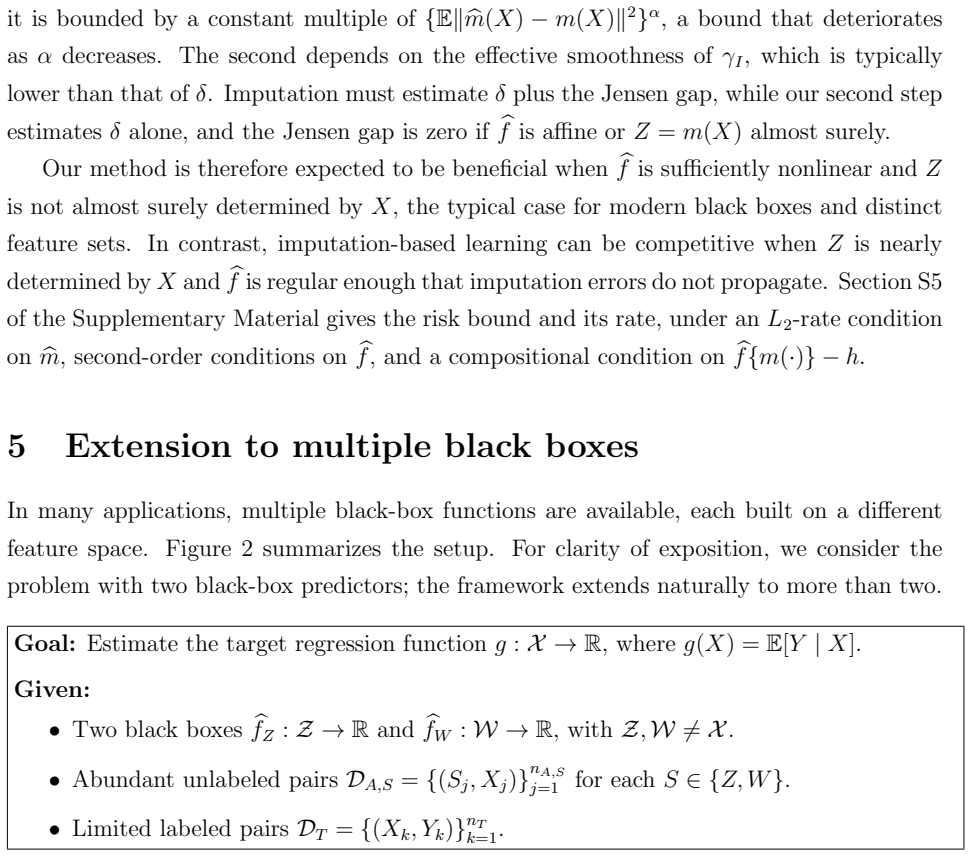
On its own terms, the paper establishes that the two-step estimator $\widehat{g}_{\widehat{\lambda}}=\widehat{h}+\widehat{\lambda}\widehat{\delta}$, with $\widehat{\lambda}\in\{0,1\}$ chosen by validation, has risk bounded by $C_h \varphi_h^{n_A}\log^3 n_A + \min\{2\|\delta\|_2^2, C_\delta \varphi_\delta^{n_T}\log^3 n_T\} + C_{\mathrm{val}} n_T^{-1/2}$. Here $\varphi_h^{n_A}$ is the sparse-ReLU estimation rate for a compositional H\"older $h$ from $n_A$ pairs, and $\varphi_\delta^{n_T}$ the analogous rate for $\delta$. The minimum encodes the two favorable regimes, small $\delta$ or smooth $\delta$, and the validation choice makes the estimator adaptive to whichever holds. When the auxiliary sample is large enough ($n_A\gg n_T^{\rho/\rho_h}$) and $\delta$ is strictly easier than $h$ ($\rho_\delta>\rho_h$, $\rho\le 1/2$), the paper proves the worst-case risk is of strictly smaller polynomial order than the minimax risk of any estimator using only the labeled data. For multiple black boxes, an ensemble of the per-box estimators is shown to be no worse than the best single box up to a $n_T^{-1/2}$ validation cost and strictly better when the boxes are comparably accurate but distinct.
Load-bearing premise
The proof assumes the transferable and non-transferable components $h$ and $\delta$ are compositional H\"older functions with limited effective dimension, so that deep ReLU networks learn them at the stated polynomial rates; if the black box's conditional mean given $X$ is highly oscillatory, the first-stage estimate from $n_A$ unlabeled pairs may not converge fast enough for the claimed gains.
Editorial extensions
If this is right
- When unlabeled paired features are abundant, the transferable component $h$ can be estimated almost for free; the scarce target labels only need to resolve the residual $\delta$.
- The validation step makes the method work in either favorable regime without knowing in advance whether the black box is accurate or explains the complex part of $g$.
- Under the polynomial conditions $n_A\gg n_T^{\rho/\rho_h}$, $\rho_\delta>\rho_h$, $\rho\le 1/2$, no estimator using only labeled data can match the transfer estimator's worst-case risk order.
- With several black boxes on different feature spaces, ensembling the per-box transfer estimators adapts to the best one and can strictly improve on it when the boxes are comparably accurate but distinct.
- Imputation-based transfer, which plugs imputed source features into the black box, can fail when the black box is highly nonlinear; the paper's method estimates the black-box output conditional on $X$ directly and avoids the Jensen gap.
Reading between the lines
- The decomposition suggests a pilot diagnostic the paper does not develop: estimating $\|\delta\|_2$ and the effective smoothness of $\delta$ from a small labeled sample could decide whether to include $\widehat{\delta}$ before the final fit, making the adaptive step even more direct.
- The Neyman-orthogonal residual estimator in the supplement could be turned into confidence bands for $\delta$ itself, which would elevate the transferable/non-transferable split from a prediction device to an inferential one.
- For the multi-box ensemble, the theory points to $D=\|\widehat{g}_Z-\widehat{g}_W\|_2^2$ as the operative measure of diversity; a practitioner could measure this quantity and use it to decide whether acquiring a second black box is worthwhile.
- The paper stops at prediction; a natural extension is to ask when transfer actively hurts, for instance when $\delta$ is both large and rough, which would provide a formal 'do not transfer' rule.
Signed reviews
Editorial analysis
A structured set of objections, weighed in public.
Referee Report
Summary. The paper proposes a method for transferring predictive knowledge from a pre-trained black-box function bf: Z -> R to a target regression g(X) = E[Y|X] on a different feature space X. Using the algebraic decomposition g = h + delta, with h(x) = E[bf(Z)|X=x] and delta(x) = E[Y - bf(Z)|X=x], it estimates h from abundant unlabeled paired observations (X,Z) by regressing bf(Z) on X, and delta from limited labeled observations (X,Y), followed by a validation-based choice of whether to include the delta estimate. The main theoretical results are a risk bound for the two-step estimator (Theorem 1), an upper bound for a non-transfer baseline (Theorem 2), a minimax lower bound showing that the transfer bound can be of strictly smaller polynomial order than any estimator based only on the labeled data (Theorem 3), and an ensemble extension to multiple black boxes (Theorem 4). Simulations and a real-data chlorophyll application support the qualitative predictions.
Significance. The problem is timely and the black-box, heterogeneous-feature setting is well motivated. The paper's main strengths are the full supplementary proofs, which appear complete; the minimax lower bound in Theorem 3, which formalizes when transfer learning from unlabeled pairs is fundamentally beneficial; the clean oracle-style ensemble inequality in Theorem 4; and the treatment of imputation as a competing baseline. If the theorems hold, the paper is a substantive contribution to nonparametric transfer learning. The principal caveat is that the rate gains are conditional on a smoothness assumption on the induced transferable component h = E[bf(Z)|X], which is not a property of the black box itself and may fail in the near-deterministic coupling regimes that motivate the applications; the paper would be strengthened by addressing this gap.
major comments (2)
- [§4.1, Assumption B; Theorem 1; Theorem 3] The rate improvement that is the paper's central claim rests on Assumption B, which postulates that h(x) = E[bf(Z)|X=x] lies in a compositional Holder class G(q_h, d_h, t_h, beta_h, K_h). This is not a primitive assumption about the black box; it is a regularity condition on the bridge distribution. In the near-deterministic regime Z approximately m(X) that motivates the new-sensor applications, h is approximately bf composed with m, so a highly oscillatory black box makes h as rough as bf and outside any fixed class with finite K_h. When this occurs, the first-stage estimate from n_A pairs need not converge faster than the direct estimate from n_T pairs, and the strict polynomial improvement claimed after Theorem 3 disappears. The manuscript offers no diagnostic or empirical check, such as an estimate of h's effective smoothness in the real-data application, that Assumption B holds. I recommend adding an explicit discussion of when this assumption is plausible, a robustness analysis for rough h, or a clear scope limitation in the abstract and conclusions.
- [§4.2, Theorem 1 and Assumption C] The claim that the estimator 'adaptively attains the oracle guarantee' is only adaptivity over the binary inclusion decision lambda in {0,1}. The class F_delta in Assumption C is constructed using the true compositional parameters (q_delta, t_delta, beta_delta, K_delta), so the rate C_delta phi_delta^{n_T} log^3 n_T is not achieved without prior knowledge of delta's smoothness and intrinsic dimension. Similarly, F_h uses (q_h, t_h, beta_h, K_h). The paper states that architectures are tuned by validation in practice, but the theory does not analyze this. Please either qualify the adaptivity claim in Section 4.2 and the abstract, or extend the analysis to model selection over a sieve of network classes.
minor comments (4)
- [§6.1] In the sentence 'we report the average relative MSE ... with it's standard error', 'it's' should be 'its'.
- [§6.2] The phrase 'The correspondingly labeled panels (a)-(c) of Figure 3' reads awkwardly; consider 'The corresponding panels (a)-(c) of Figure 3'.
- [Algorithm 1 and Lemma 1] The paper should clarify that Lemma 1's oracle estimator, which fits e_delta on all of D_T, is a non-implementable benchmark, whereas Algorithm 1 splits D_T into training and validation; this distinction is easy to miss on first reading.
- [§7] In the acknowledgments, 'for the use of data' should be 'for the use of the data'.
Circularity Check
No significant circularity: the component decomposition is an identity and all rates follow from explicit assumptions, with external benchmarks.
full rationale
The paper's central decomposition, Eq. (1), is an exact identity: g(X)=E[Y|X]=E[bf(Z)|X]+E[Y-bf(Z)|X]=h(X)+delta(X). The transferable component h is defined as a conditional expectation of black-box outputs, not as a quantity fitted to the target labels; delta is the residual difference between the target regression and that conditional expectation. The two-step estimator estimates h from the unlabeled paired sample D_A and delta from the labeled sample D_T, and the risk bounds in Lemma 1 and Theorem 1 are oracle inequalities whose two terms are exactly the estimation errors of these two steps plus a validation cost. Assumption B postulates that h and delta belong to compositional Holder classes; this is a load-bearing regularity premise about the coupling between Z and X, but it is not a fitted parameter and it is not defined in terms of the paper's own predictions. The non-transfer benchmark and minimax lower bound in Theorems 2 and 3 are built from the same function classes using standard external techniques (Schmidt-Hieber 2020), and the comparison between the transfer upper bound and the non-transfer lower bound is a rate comparison conditional on those assumptions. No self-citations by the authors are used as load-bearing evidence, and no fitted quantity is renamed as a prediction. The concern raised by the skeptic--that near-deterministic coupling can make h inherit black-box oscillations and violate Assumption B--is a substantive correctness/robustness issue, but it is not circularity: the paper's claims are conditional on explicitly stated regularity assumptions.
Assumptions & free parameters
assumptions (5)
- domain assumption Assumption A: D_A and D_T are i.i.d. with the same P_X; ξ and ε_X are conditionally sub-Gaussian.
- domain assumption Assumption B: h and δ belong to compositional Hölder classes G(q_h,d_h,t_h,β_h,K_h) and G(q_δ,d_δ,t_δ,β_δ,K_δ).
- ad hoc to paper Assumption C: Sparse ReLU network classes satisfy depth, width, and sparsity conditions with n_A and n_T.
- domain assumption Abundant unlabeled paired features (X,Z) exist and the black-box f is fixed and independent of the estimation samples.
- standard math Known nonparametric estimation results for ReLU networks (Schmidt-Hieber 2020) and standard Fano/Bernstein inequalities.
Cite this review
Pith. "Pith review of Black-Box Knowledge Transfer across Distinct Feature Sets." pith.science (2026). https://pith.science/paper/NO3COEKY
@misc{pith2026260812403,
  author       = {Pith},
  title        = {Pith review of: Black-Box Knowledge Transfer across Distinct Feature Sets},
  year         = {2026},
  howpublished = {\url{https://pith.science/paper/NO3COEKY}},
  note         = {Machine review of arXiv:2608.12403}
}
read the original abstract
Pre-trained black-box predictive functions encode knowledge distilled from massive datasets and extensive computation. However, when the available input features differ from those the black box expects, direct use is infeasible. We introduce a method for transferring predictive knowledge from the black box to a new, heterogeneous input space. Our approach decomposes the target regression function into a transferable component, which the black box can inform, and a non-transferable component, which captures information unique to the new space. We propose a two-step neural network procedure, estimating the transferable component from abundant unlabeled feature pairs that bridge the two input spaces and the non-transferable component from limited labels. We derive prediction risk bounds that improve on those of a non-transfer alternative when the non-transferable component is small or smooth, and the procedure adapts to either case. Under additional conditions, the worst-case risk of our estimator is of strictly smaller polynomial order than the minimax risk of estimation from the labeled data alone. We extend the framework to multiple black boxes, each on its own input space, and show that aggregation can reduce prediction error relative to the best single black box. Simulated and real data demonstrate the practical value of the method.
Figures


Figures from the paper (1 more)

Reference graph
Works this paper leans on
-
[1]
N., Bates, S., Fannjiang, C., Jordan, M
Angelopoulos, A. N., Bates, S., Fannjiang, C., Jordan, M. I., and Zrnic, T. (2023 a ), Prediction-powered inference, Science, 382, 669--674
work page 2023
-
[2]
Angelopoulos, A. N., Duchi, J. C., and Zrnic, T. (2023 b ), Ppi++: Efficient prediction-powered inference, arXiv preprint arXiv:2311.01453
arXiv 2023
-
[3]
Auddy, A., Cai, T. T., and Chakraborty, A. (2025), Minimax and adaptive transfer learning for nonparametric classification under distributed differential privacy constraints, Journal of the Royal Statistical Society Series B: Statistical Methodology, qkaf070
work page 2025
-
[4]
D., Sklar, M., Berk, R., Buja, A., and Zhao, L
Azriel, D., Brown, L. D., Sklar, M., Berk, R., Buja, A., and Zhao, L. (2022), Semi-supervised linear regression, Journal of the American Statistical Association, 117, 2238--2251
work page 2022
-
[5]
Bai, R., Zhang, Y., Yang, H., and Zhu, Z. (2024), Transfer learning for high-dimensional quantile regression with distribution shift, arXiv preprint arXiv:2411.19933
-
[6]
Bansal, M., Krizhevsky, A., and Ogale, A. (2018), Chauffeurnet: Learning to drive by imitating the best and synthesizing the worst, arXiv preprint arXiv:1812.03079
arXiv 2018
-
[7]
(2023), A recent survey of heterogeneous transfer learning, arXiv preprint arXiv:2310.08459
Bao, R., Sun, Y., Gao, Y., Wang, J., Yang, Q., Mao, Z.-H., and Ye, Y. (2023), A recent survey of heterogeneous transfer learning, arXiv preprint arXiv:2310.08459
arXiv 2023
-
[8]
Bos, T. and Schmidt-Hieber, J. (2024), A Supervised Deep Learning Method for Nonparametric Density Estimation, Electronic Journal of Statistics, 18, 5601--5658. DOI: 10.1214/24-EJS2332
Show all 62 references
-
[9]
(1996), Stacked regressions, Machine learning, 24, 49--64
Breiman, L. (1996), Stacked regressions, Machine learning, 24, 49--64
1996
-
[10]
T., and Li, H
Cai, C., Cai, T. T., and Li, H. (2024), Transfer learning for contextual multi-armed bandits, The Annals of Statistics, 52, 207--232
2024
-
[11]
Cai, T. T. and Pu, H. (2024), Transfer learning for nonparametric regression: Non-asymptotic minimax analysis and adaptive procedure, arXiv preprint arXiv:2401.12272
2024 arXiv
-
[12]
Cai, T. T. and Wei, H. (2021), Transfer learning for nonparametric classification, The Annals of Statistics, 49, 100--128
2021
-
[13]
and Cai, T
Chakrabortty, A. and Cai, T. (2018), Efficient and adaptive linear regression in semi-supervised settings, The Annals of Statistics, 46, 1541--1572
2018
-
[14]
H., Russo, M., and Paul, S
Chang, J. H., Russo, M., and Paul, S. (2024), Heterogeneous transfer learning for high-dimensional regression with feature mismatch, arXiv preprint arXiv:2412.18081
2024 arXiv
-
[15]
(2018), Double/Debiased Machine Learning for Treatment and Structural Parameters, The Econometrics Journal, 21, C1--C68
Chernozhukov, V., Chetverikov, D., Demirer, M., Duflo, E., Hansen, C., Newey, W., and Robins, J. (2018), Double/Debiased Machine Learning for Treatment and Structural Parameters, The Econometrics Journal, 21, C1--C68. DOI: 10.1111/ectj.12097 ://doi.org/10.1111/ectj.12097
2018 doi
-
[16]
and Khoshgoftaar, T
Day, O. and Khoshgoftaar, T. M. (2017), A survey on heterogeneous transfer learning, Journal of Big Data, 4, 29
2017
-
[17]
(2024), Optimal and safe estimation for high-dimensional semi-supervised learning, Journal of the American Statistical Association, 119, 2748--2759
Deng, S., Ning, Y., Zhao, J., and Zhang, H. (2024), Optimal and safe estimation for high-dimensional semi-supervised learning, Journal of the American Statistical Association, 119, 2748--2759
2024
-
[18]
(2024), Deep Learning for Regression Analysis of Interval-Censored Data, Electronic Journal of Statistics, 18, 4292--4321
Du, M., Wu, Q., Tong, X., and Zhao, X. (2024), Deep Learning for Regression Analysis of Interval-Censored Data, Electronic Journal of Statistics, 18, 4292--4321. DOI: 10.1214/24-EJS2298
2024 doi
-
[19]
Duan, L., Xu, D., and Tsang, I. W. (2012), Learning with augmented features for heterogeneous domain adaptation, in Proceedings of the 29th International Conference on Machine Learning, Omnipress, pp. 667--674
2012
-
[20]
Ehrenstein, V., Kharrazi, H., Lehmann, H., and Overby Taylor , C. (2019), Obtaining Data From Electronic Health Records, in Tools and Technologies for Registry Interoperability, Registries for Evaluating Patient Outcomes: A User's Guide, 3rd Edition, Addendum 2, eds. Gliklich,...
2019
-
[21]
(2024), How Do Noise Tails Impact on Deep ReLU Networks? The Annals of Statistics, 52, 1845--1871
Fan, J., Gu, Y., and Zhou, W.-X. (2024), How Do Noise Tails Impact on Deep ReLU Networks? The Annals of Statistics, 52, 1845--1871. DOI: 10.1214/24-AOS2428
2024 doi
-
[22]
(2024), LiDAR-CS dataset: LiDAR point cloud dataset with cross-sensors for 3D object detection, in 2024 IEEE International Conference on Robotics and Automation (ICRA), IEEE, pp
Fang, J., Zhou, D., Zhao, J., Wu, C., Tang, C., Xu, C.-Z., and Zhang, L. (2024), LiDAR-CS dataset: LiDAR point cloud dataset with cross-sensors for 3D object detection, in 2024 IEEE International Conference on Robotics and Automation (ICRA), IEEE, pp. 14822--14829
2024
-
[23]
(2024), Transfusion: Covariate-shift robust transfer learning for high-dimensional regression, in International Conference on Artificial Intelligence and Statistics, PMLR, pp
He, Z., Sun, Y., and Li, R. (2024), Transfusion: Covariate-shift robust transfer learning for high-dimensional regression, in International Conference on Artificial Intelligence and Statistics, PMLR, pp. 703--711
2024
-
[24]
(2017), The OLCI neural network swarm (ONNS): A bio-geo-optical algorithm for open ocean and coastal waters, Frontiers in Marine Science, 4, 140
Hieronymi, M., M \"u ller, D., and Doerffer, R. (2017), The OLCI neural network swarm (ONNS): A bio-geo-optical algorithm for open ocean and coastal waters, Frontiers in Marine Science, 4, 140
2017
-
[25]
A., Bailey, S
Hu, C., Feng, L., Lee, Z., Franz, B. A., Bailey, S. W., Werdell, P. J., and Proctor, C. W. (2019), Improving satellite global chlorophyll a data products through algorithm refinement and data recovery, Journal of Geophysical Research: Oceans, 124, 1524--1543
2019
-
[26]
D., Craven, C
Huang, C., Koppel, R., McGreevey, J. D., Craven, C. K., and Schreiber, R. (2020), Transitions from One Electronic Health Record to Another: Challenges, Pitfalls, and Recommendations, Applied Clinical Informatics, 11, 742--754. DOI: 10.1055/s-0040-1718535
2020 doi
-
[27]
(2024), Meet the 6th-generation Waymo Driver , Waymo Blog (Waypoint), accessed: 2026-04-07
Jeyachandran, S. (2024), Meet the 6th-generation Waymo Driver , Waymo Blog (Waypoint), accessed: 2026-04-07
2024
-
[28]
and Langer, S
Kohler, M. and Langer, S. (2021), On the rate of convergence of fully connected deep neural network regression estimates, The Annals of Statistics, 49, 2231--2249
2021
-
[29]
(2011), What you saw is not what you get: Domain adaptation using asymmetric kernel transforms, in CVPR 2011, IEEE, pp
Kulis, B., Saenko, K., and Darrell, T. (2011), What you saw is not what you get: Domain adaptation using asymmetric kernel transforms, in CVPR 2011, IEEE, pp. 1785--1792
2011
-
[30]
T., and Li, H
Li, S., Cai, T. T., and Li, H. (2022), Transfer learning for high-dimensional linear regression: Prediction, estimation and minimax optimality, Journal of the Royal Statistical Society Series B: Statistical Methodology, 84, 149--173
2022
-
[31]
--- (2023), Transfer learning in large-scale gaussian graphical models with false discovery rate control, Journal of the American Statistical Association, 118, 2171--2183
2023
-
[32]
T., and Li, H
Li, S., Zhang, L., Cai, T. T., and Li, H. (2024), Estimation and inference for high-dimensional generalized linear models with knowledge transfer, Journal of the American Statistical Association, 119, 1274--1285
2024
-
[33]
and Li, Y
Meng, X. and Li, Y. (2026), Inference for Deep Neural Network Estimators in Generalized Nonparametric Models, Journal of the American Statistical Association, 1--21
2026
-
[34]
and Witten, D
Motwani, K. and Witten, D. (2023), Revisiting inference after prediction, Journal of Machine Learning Research, 24, 1--18
2023
-
[35]
NASA Ocean Biology Processing Group (2025 a ), Aqua MODIS Level-3 Global Mapped Remote-Sensing Reflectance (RRS) Data, Version 2022.0 ,
2025
-
[36]
--- (2025 b ), Sentinel-3B OLCI Level-3 Global Mapped Earth-Observation Reduced Resolution (ERR) Remote-Sensing Reflectance (RRS) Data, Version 2022.0 ,
2025
-
[37]
--- (2025 c ), Suomi-NPP VIIRS Level-3 Global Mapped Remote-Sensing Reflectance (RRS) Data, Version 2022.0 ,
2025
-
[38]
E., Maritorena, S., Mitchell, B
O'Reilly, J. E., Maritorena, S., Mitchell, B. G., Siegel, D. A., Carder, K. L., Garver, S. A., Kahru, M., and McClain, C. (1998), Ocean color chlorophyll algorithms for SeaWiFS, Journal of Geophysical Research: Oceans, 103, 24937--24953
1998
-
[39]
O'Reilly, J. E. and Werdell, P. J. (2019), Chlorophyll algorithms for ocean color sensors-OC4, OC5 & OC6, Remote sensing of environment, 229, 32--47
2019
-
[40]
Padilla, O. H. M., Tansey, W., and Chen, Y. (2022), Quantile regression with ReLU networks: Estimators and minimax rates, Journal of Machine Learning Research, 23, 1--42
2022
-
[41]
W., Cannings, T
Reeve, H. W., Cannings, T. I., and Samworth, R. J. (2021), Adaptive transfer learning, The Annals of Statistics, 49, 3618--3649
2021
-
[42]
(2020), Nonparametric regression using deep neural networks with ReLU activation function , The Annals of Statistics, 48, 1875 -- 1897
Schmidt-Hieber, J. (2020), Nonparametric regression using deep neural networks with ReLU activation function , The Annals of Statistics, 48, 1875 -- 1897. DOI: 10.1214/19-AOS1875 ://doi.org/10.1214/19-AOS1875
2020 doi
-
[43]
(2025), SADA: Safe and Adaptive Aggregation of Multiple Black-Box Predictions in Semi-Supervised Learning, arXiv preprint arXiv:2509.21707
Shan, J., Chen, Z., Dong, Y., Wang, Y., and Zhao, J. (2025), SADA: Safe and Adaptive Aggregation of Multiple Black-Box Predictions in Semi-Supervised Learning, arXiv preprint arXiv:2509.21707
2025 arXiv
-
[44]
(2015), Weakly-shared deep transfer networks for heterogeneous-domain knowledge propagation, in Proceedings of the 23rd ACM international conference on Multimedia, pp
Shu, X., Qi, G.-J., Tang, J., and Wang, J. (2015), Weakly-shared deep transfer networks for heterogeneous-domain knowledge propagation, in Proceedings of the 23rd ACM international conference on Multimedia, pp. 35--44
2015
-
[45]
(2024), A general M-estimation theory in semi-supervised framework, Journal of the American Statistical Association, 119, 1065--1075
Song, S., Lin, Y., and Zhou, Y. (2024), A general M-estimation theory in semi-supervised framework, Journal of the American Statistical Association, 119, 1065--1075
2024
-
[46]
(2026), Prediction-Powered Conditional Inference, arXiv preprint arXiv:2603.05575
Sui, Y., Zhou, J., Zhou, H., and Dai, X. (2026), Prediction-Powered Conditional Inference, arXiv preprint arXiv:2603.05575
2026
-
[47]
(2015), Transitive transfer learning, in Proceedings of the 21th ACM SIGKDD international conference on knowledge discovery and data mining, pp
Tan, B., Song, Y., Zhong, E., and Yang, Q. (2015), Transitive transfer learning, in Proceedings of the 21th ACM SIGKDD international conference on knowledge discovery and data mining, pp. 1155--1164
2015
-
[48]
and Feng, Y
Tian, Y. and Feng, Y. (2023), Transfer learning under high-dimensional generalized linear models, Journal of the American Statistical Association, 118, 2684--2697
2023
-
[49]
Tsybakov, A. B. (2009), Introduction to Nonparametric Estimation, Springer Series in Statistics, New York: Springer. DOI: 10.1007/b13794
2009 doi
-
[50]
(2022), A compilation of global bio-optical in situ data for ocean-colour satellite applications--version three, Earth System Science Data Discussions, 2022, 1--61
Valente, A., Sathyendranath, S., Brotas, V., Groom, S., Grant, M., Jackson, T., Chuprin, A., Taberner, M., Airs, R., Antoine, D., et al. (2022), A compilation of global bio-optical in situ data for ocean-colour satellite applications--version three, Earth System Science Data D...
2022
-
[51]
J., Polley, E
van der Laan, M. J., Polley, E. C., and Hubbard, A. E. (2007), Super Learner, Statistical Applications in Genetics and Molecular Biology, 6, Article 25. DOI: 10.2202/1544-6115.1309
2007
-
[52]
Van Engelen, J. E. and Hoos, H. H. (2020), A survey on semi-supervised learning, Machine learning, 109, 373--440
2020
-
[53]
Wainwright, M. J. (2019), High-dimensional statistics: A non-asymptotic viewpoint, vol. 48, Cambridge university press
2019
-
[54]
and Breckon, T
Wang, Q. and Breckon, T. P. (2022), Cross-domain structure preserving projection for heterogeneous domain adaptation, Pattern Recognition, 123, 108362
2022
-
[55]
(2006), All of nonparametric statistics, Springer
Wasserman, L. (2006), All of nonparametric statistics, Springer
2006
-
[56]
(2001), Adaptive regression by mixing, Journal of the American Statistical Association, 96, 574--588
Yang, Y. (2001), Adaptive regression by mixing, Journal of the American Statistical Association, 96, 574--588
2001
-
[57]
and Terada, Y
Yara, A. and Terada, Y. (2026), Nonparametric logistic regression with deep learning, Bernoulli, 32, 952--977
2026
-
[58]
(2020), Heterogeneous few-shot model rectification with semantic mapping, IEEE Transactions on Pattern Analysis and Machine Intelligence, 43, 3878--3891
Ye, H.-J., Zhan, D.-C., Jiang, Y., and Zhou, Z.-H. (2020), Heterogeneous few-shot model rectification with semantic mapping, IEEE Transactions on Pattern Analysis and Machine Intelligence, 43, 3878--3891
2020
-
[59]
and Bradic, J
Zhang, Y. and Bradic, J. (2022), High-dimensional semi-supervised learning: in search of optimal inference of the mean, Biometrika, 109, 387--403
2022
-
[60]
(2026 a ), SMART: A Spectral Transfer Approach to Multi-Task Learning, arXiv preprint arXiv:2604.20161
Zhao, B., Kolar, M., and Lv, J. (2026 a ), SMART: A Spectral Transfer Approach to Multi-Task Learning, arXiv preprint arXiv:2604.20161
2026 arXiv
-
[61]
(2026 b ), Trans-glasso: A transfer learning approach to precision matrix estimation, Journal of the American Statistical Association, 1--13
Zhao, B., Ma, C., and Kolar, M. (2026 b ), Trans-glasso: A transfer learning approach to precision matrix estimation, Journal of the American Statistical Association, 1--13
2026
-
[62]
and Cand \`e s, E
Zrnic, T. and Cand \`e s, E. J. (2024), Cross-prediction-powered inference, Proceedings of the National Academy of Sciences, 121, e2322083121
2024
Reviewed August 14, 2026 · model on record in the stance chip above.
Discussion (0). Continue with ORCID to comment.