REVIEW 4 major objections 5 minor 43 references
Deliberate Practice: Learning Robot Skills under a Budget
T0 review · 4 major / 5 minor · reviewed 2026-08-14 · deepseek-v4-flash
Pith's one-line read This paper proves that a robot can spend a fixed practice budget across its skills in a globally optimal way, by solving one bilinear program that jointly picks the budget allocation and the task plan.
desk verdict A genuinely new exact reformulation of budgeted skill practice, with a sound derivation and a caveat that 'budget-optimal' is only as good as the fitted competence model. read the letter →
The pith
A machine-rendered reading of the paper's core claim, the machinery that carries it, and where it could break.
The reading
What carries the argument
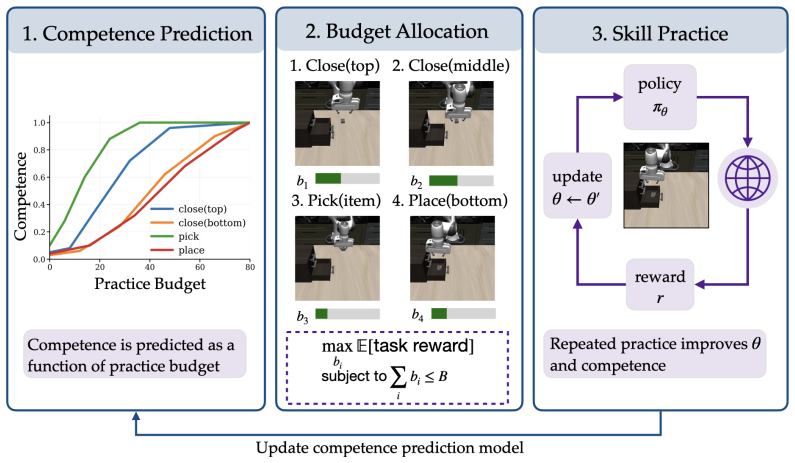
The load-bearing object is the bilinear program of Eq. (3), which jointly optimizes the practice allocation $b_u$ and dual state-action occupancy variables $\mu_s^a$, with skill transition probabilities $\bar P^a_{s's}(b) = f_{\text{improv}}(P^a_{s's}, b)$ entering bilinearly into the occupancy constraints. The competence prediction model $f_{\text{improv}}(u,b) = \min(1, p_u + \Delta_u b)$ is the mechanism that maps practice episodes into improved transitions, with $\Delta_u$ estimated online from observed improvement. The bilinear terms are relaxed by piecewise McCormick envelopes, and the resulting nonconvex program is solved to global optimality by spatial branch-and-bound, using finite bounds on $\mu$ and the transition probabilities to certify the result.
What would settle it
Run DP on a small MDP such as the five-state example in Section 4.1, enumerate every feasible allocation of a 20-episode budget by brute force, and solve each resulting MDP exactly; if any enumerated allocation achieves higher expected reward than DP's chosen allocation, Theorem 1 is false. On a real robot, give two robots the same budget but deliberately different competence priors: the one with optimistic priors should, per the paper's own limitation, sometimes pick a plan it cannot finish within the budget, showing that budget-optimality holds for predicted rather than realized improvement.
Extended reading notes
Core claim
The paper's central claim is that budgeted skill learning—maximize expected task value over a library of skills with a total practice budget—can be solved to global optimality by a single bilinear program (Eq. 3), rather than approximated by greedy one-step improvement. The move is to replace the inner MDP solve with its dual linear program, then fold the budget constraint into the dual feasibility equations, because the leader and follower optimize the same objective. Strong duality turns the bilevel max-min problem into a joint maximization over the allocation $b$ and the state-action occupancy variables $\mu$. The paper proves the reformulation is exact, gives finite bounds on the occupancy and transition variables so that piecewise McCormick envelopes produce valid convex relaxations, and invokes spatial branch-and-bound for global certification. The corollary, stated as Theorem 1, is that the returned allocation is budget-optimal: it maximizes expected cumulative reward among all allocations feasible within the budget, for the predicted competence dynamics.
Load-bearing premise
The whole plan is only as good as the robot's guess of how much each skill will improve per practice episode; if that guess is wrong, the 'optimal' allocation is optimal only inside the model.
Editorial extensions
If this is right
- A robot with a known downtime window can compute, before practicing, exactly which skills to train and for how long, instead of adapting greedily after each episode.
- Under small budgets the optimal behavior is conservative—practice only the easy, low-reward plan—while under larger budgets the same procedure shifts to hard high-reward plans that require multiple skills, as demonstrated in simulation and on a real robot.
- Greedy active-learning baselines plateau at local optima because one-step task improvement is zero for skills that only pay off when practiced together; DP's joint lookahead avoids that failure.
- The bilinear program scales to task MDPs with about 5,000 abstract states and 22 skills, solving within minutes; if interrupted before proving optimality, the solver still returns an allocation with an optimality-gap certificate.
Reading between the lines
- The duality reformulation is not tied to the particular linear competence model: any competence predictor that enters the transition probabilities as a function of $b$ and yields finite bounds could be placed in the same program, so the machinery may extend to saturating or learned improvement curves with the same global-optimality framework.
- Because Theorem 1 holds for the predicted competence model, a natural stress test is to compare DP's allocation under optimistically biased priors against a robust or uncertainty-aware allocation; the paper itself flags optimistic priors as the key failure mode.
- The same 'replace the follower with its dual' move applies to any bilevel resource-allocation problem whose inner problem is a linear program with an aligned objective, so budget-optimal skill learning may transfer to settings such as allocating teaching time among sub-skills or tuning a fleet of policies.
Signed reviews
Editorial analysis
A structured set of objections, weighed in public.
Referee Report
Summary. The paper addresses the problem of allocating a limited practice budget across a library of robot skills in a sequential task-and-motion-planning setting. It formulates budgeted skill learning as a bilevel optimization problem (Eq. 1) whose inner level solves the task MDP induced by the budget-dependent competence model, and whose outer level chooses a budget allocation. The main contribution is Deliberate Practice (DP), which models competence improvement with a piecewise-linear function (Eq. 2), derives an exact single-level bilinear reformulation of the bilevel problem via LP duality (Eq. 3 and Appendix A.2), and solves it with off-the-shelf global solvers. The authors claim that DP is provably budget-optimal (Theorem 1) and validate it in two simulated manipulation domains and one real-robot breakfast-making task.
Significance. The idea of coupling a practice budget to long-horizon task planning is timely and practically motivated, and the LP-duality reformulation is an interesting technical contribution that goes beyond greedy active-learning baselines. If the reformulation and its optimality proof are correct, the paper offers a principled way to make budget-aware decisions in robot skill learning, with experiments spanning nontrivial state spaces (up to 5000 abstract states and 22 skills) and a real robot. The paper also gives a clear, reproducible problem statement and an explicit comparison to myopic baselines. However, the optimality claim is conditional on the competence model and the proof contains fixable but nontrivial gaps; the empirical evidence does not yet establish that the computed allocations are optimal or even feasible for the real robot.
major comments (4)
- [Appendix A.2, Eq. (7) and Section 5.2, Eq. (3)] The displayed bilinear program omits the nonnegativity constraint on the dual variables mu_s^a. In the standard dual LP of an MDP these variables are state-action occupancies and must satisfy mu_s^a >= 0. Without this constraint, the feasible set allows negative values for individual actions as long as the sum over actions satisfies the flow equality. Because the objective is linear in mu, a solver could shift occupancy from a low-reward action to a higher-reward action with identical transition probabilities, improving the objective while violating the intended MDP interpretation. The claim that Eq. (3) is an exact reformulation of Eq. (1) therefore is not supported as written. The fix is straightforward -- add mu_s^a >= 0 -- but the theorem and proof must be updated to state and use this constraint.
- [Appendix A.2, Lemma 1] The proof of Slater's condition is incorrect: the proposed candidate hat v_s = alpha/gamma^2 does not strictly satisfy the constraints for discount factors with gamma > 0.618. For example, with gamma = 0.9 the left-hand side alpha/0.81 is smaller than the maximum right-hand side alpha + alpha/0.9 = alpha(1 + 1/gamma). A correct choice would be hat v_s = C with C > alpha/(1-gamma), which yields strict satisfaction. Since the LP is feasible and bounded for discounted MDPs, strong duality can be established by standard LP arguments, but the lemma as stated is mathematically wrong and must be corrected.
- [Section 4 and Section 5.1, Eq. (2)] The budget B is defined as a number of trials or episodes, but the optimization in Eq. (3) treats the allocation b as a continuous variable with no integrality constraint and no rounding analysis. The competence model f_improv(u,b) is evaluated at real-valued b, while practice episodes are indivisible. The proof of global optimality in Theorem 1 is therefore over the continuous relaxation, not over integer allocations. The paper does not show that the continuous optimum can be rounded to an integer allocation without losing optimality or feasibility. This is a load-bearing gap between the mathematical claim and the actual robot-setting where budgets are integer episode counts.
- [Section 8 and Section 6.1 (Fig. 6)] Theorem 1 certifies optimality only with respect to the competence prediction model of Eq. (2), not with respect to the robot's realized competence. The paper's own Section 8 states that optimistic priors can make the chosen plan infeasible within the budget, which means the 'provably budget-optimal' claim is conditional on an unvalidated model. The real-robot results in Fig. 6 are reported without error bars, without repeated trials, and without any calibration check comparing predicted competence f_improv to the competence actually achieved after practice. The abstract's wording that DP 'maximizes expected cumulative reward while being learnable within the budget' overstates what is established. The claims should be qualified to optimality under the assumed competence model, and the empirical section should include calibration evidence or a sensitivity analysis over priors.
minor comments (5)
- [Appendix A.5] The text uses 'Auroco Markers' and 'Auroco Detection'; the correct spelling is ArUco.
- [Section 5.1] The online estimation of Delta_u is not fully specified: the update uses p_t values, but it is not stated how p_t is estimated from the outcome of a single practice episode or how many episodes are used. A binary success/failure per episode makes a running average of differences very noisy; please specify the estimation window and any smoothing used in the experiments.
- [Section 6.1, Fig. 6] The real-robot figure lacks information about the number of independent runs and does not show variability. Reporting mean plus standard deviation or individual trial outcomes would strengthen the claim that DP reliably selects the correct plan under each budget.
- [Appendix A.2, Eq. (6) and Eq. (7)] The transition-probability indexing is inconsistent between the general notation P^a_{s's} in Eq. (7) and the earlier use of \bar P^a_{s's}(b) in Eq. (3); the reader must infer which index is the source state. Please unify the notation.
- [Section 5.2] The sentence claiming 'to our knowledge, this is the first exact formulation of robot learning on a budget as an optimization problem' is an overclaim and difficult to verify; tempering it to 'to our knowledge, the first exact single-level formulation of this budgeted skill-learning problem' would be more defensible.
Circularity Check
No circularity: Theorem 1 is a model-conditional optimality proof via standard LP duality; the competence model is an explicit assumption, not a fitted prediction renamed as a result.
full rationale
Theorem 1 (Section 5.2) claims that Deliberate Practice computes a globally optimal allocation of the practice budget. The proof is a self-contained mathematical derivation: the bilevel problem in Eq. (1) is instantiated as the LP bilevel program in Eq. (4), the inner LP is replaced by its dual using strong duality (Slater's condition verified in Lemma 1, Appendix A.2), and the resulting max-max problem is merged into the single-level bilinear program Eq. (7)/Eq. (3). This is an exact reformulation of the stated optimization problem, not an identity that assumes the conclusion. The optimal allocation is not set equal to a fitted constant by construction, and the global-optimality argument rests on standard MDP LP duality (Puterman [30]) and branch-and-bound global optimization [32], both independent of the authors. The competence prediction model f_improv in Eq. (2) is an explicit modeling assumption, with a domain-specific prior and an online estimate of Delta_u; the theorem's budget-optimality is conditional on that model. That is a model-validity limitation, explicitly acknowledged in Section 8 (optimistic priors may make the chosen plan infeasible), but it is not circularity: a theorem can be correct about a model while the model is imperfect. The empirical validation tests the practical usefulness of the model, but the derivation chain itself does not reduce to the fitted competence rates. No load-bearing self-citation or imported uniqueness theorem appears; the paper's own LP-duality derivation is shown in the appendix. Therefore no significant circularity is present.
Assumptions & free parameters
free parameters (3)
- competence improvement rate Delta_u =
estimated online via running average (Eq 2)
- smoothing factor epsilon =
chosen in [0,1], value not specified in the paper
- initial competence priors p_u =
domain-specific prior, values not given
assumptions (5)
- standard math Standard LP duality for MDPs
- standard math Slater's condition holds for the inner LP
- domain assumption Skill competence evolves as min(1, p + Delta b)
- domain assumption The abstract MDP and task planner are correct
- domain assumption Budget b is treated as continuous
Cite this review
Pith. "Pith review of Deliberate Practice: Learning Robot Skills under a Budget." pith.science (2026). https://pith.science/paper/P7I4OLT4
@misc{pith2026260813415,
  author       = {Pith},
  title        = {Pith review of: Deliberate Practice: Learning Robot Skills under a Budget},
  year         = {2026},
  howpublished = {\url{https://pith.science/paper/P7I4OLT4}},
  note         = {Machine review of arXiv:2608.13415}
}
read the original abstract
We consider the problem of autonomously learning robot skills under a limited practice budget for sequential tasks. We propose an active skill learning algorithm, \emph{Deliberate Practice (DP)}, that computes a provably \emph{budget-optimal} allocation---practicing skills that maximize expected cumulative reward while being learnable within the budget. DP estimates both the time needed to master skills and the cumulative reward of the task plans that the skills unlock. Computing a budget-optimal allocation is challenging as it requires reasoning about combinatorially many skill plans over a large practice budget. Our key contribution is a bilinear program that can compute this exactly using off-the-shelf solvers. Through simulated and real-world experiments on long-horizon manipulation tasks, we show that our approach allows robots to optimally use limited practice time to acquire useful policies and improve long-horizon planning.
Figures


Figures from the paper (5 more)


Reference graph
Works this paper leans on
- [1]
-
[2]
Y . Zhu, Z. Jiang, P. Stone, and Y . Zhu. Learning generalizable manipulation policies with object-centric 3d representations.arXiv preprint arXiv:2310.14386, 2023
arXiv 2023
-
[3]
C. Chi, Z. Xu, S. Feng, E. Cousineau, Y . Du, B. Burchfiel, R. Tedrake, and S. Song. Diffusion policy: Visuomotor policy learning via action diffusion.The International Journal of Robotics Research, 44(10-11):1684–1704, 2025
2025
- [4]
-
[5]
C. R. Garrett, R. Chitnis, R. Holladay, B. Kim, T. Silver, L. P. Kaelbling, and T. Lozano-P´erez. Integrated task and motion planning.Annual review of control, robotics, and autonomous systems, 4(1):265–293, 2021
2021
-
[6]
Task and Skill Planning: Hierarchical Robot Planning with Black-Box Skills
B. Hedegaard, Z. Yang, Y . Wei, A. Jaafar, S. Tellex, G. Konidaris, and N. Shah. Beyond task and motion planning: Hierarchical robot planning with general-purpose policies.arXiv preprint arXiv:2504.17901, 2025
work page Pith review arXiv 2025
- [7]
-
[8]
I. Mishani, Y . Shaoul, and M. Likhachev. Mosaic: A skill-centric algorithmic framework for long-horizon manipulation planning.arXiv preprint arXiv:2504.16738, 2025
arXiv 2025
Show all 43 references
-
[9]
Kober, J
J. Kober, J. A. Bagnell, and J. Peters. Reinforcement learning in robotics: A survey.The International Journal of Robotics Research, 32(11):1238–1274, 2013
2013
-
[10]
M. P. Deisenroth, G. Neumann, and J. Peters. A survey on policy search for robotics.Founda- tions and Trends® in Robotics, 2(1-2):1–142, 2013
2013
-
[11]
S. Gu, E. Holly, T. Lillicrap, and S. Levine. Deep reinforcement learning for robotic manipula- tion with asynchronous off-policy updates. In2017 IEEE international conference on robotics and automation (ICRA), pages 3389–3396. IEEE, 2017
2017
-
[12]
V . Mnih, K. Kavukcuoglu, D. Silver, A. A. Rusu, J. Veness, M. G. Bellemare, A. Graves, M. Riedmiller, A. K. Fidjeland, G. Ostrovski, et al. Human-level control through deep rein- forcement learning.nature, 518(7540):529–533, 2015
2015
-
[13]
Kalashnikov, A
D. Kalashnikov, A. Irpan, P. Pastor, J. Ibarz, A. Herzog, E. Jang, D. Quillen, E. Holly, M. Kalakrishnan, V . Vanhoucke, et al. Scalable deep reinforcement learning for vision-based robotic manipulation. InConference on robot learning, pages 651–673. PMLR, 2018
2018
-
[14]
Anders Ericsson
K. Anders Ericsson. Deliberate practice and acquisition of expert performance: a general overview.Academic emergency medicine, 15(11):988–994, 2008
2008
-
[15]
Da Silva, G
B. Da Silva, G. Konidaris, and A. Barto. Active learning of parameterized skills. InInterna- tional Conference on Machine Learning, pages 1737–1745. PMLR, 2014
2014
-
[16]
Chernova and M
S. Chernova and M. Veloso. Interactive policy learning through confidence-based autonomy. Journal of Artificial Intelligence Research, 34:1–25, 2009
2009
-
[17]
Fabisch and J
A. Fabisch and J. H. Metzen. Active contextual policy search.The Journal of Machine Learn- ing Research, 15(1):3371–3399, 2014. 10
2014
-
[18]
S. Vats, O. Kroemer, and M. Likhachev. Synergistic scheduling of learning and allocation of tasks in human-robot teams. In2022 International Conference on Robotics and Automation (ICRA), pages 2789–2795. IEEE, 2022
2022
-
[19]
S. Vats, M. Zhao, P. Callaghan, M. Jia, M. Likhachev, O. Kroemer, and G. Konidaris. Optimal interactive learning on the job via facility location planning.Robotics: Science and Systems (RSS), 2025
2025
-
[20]
Srivastava, E
S. Srivastava, E. Fang, L. Riano, R. Chitnis, S. Russell, and P. Abbeel. Combined task and motion planning through an extensible planner-independent interface layer. In2014 IEEE international conference on robotics and automation (ICRA), pages 639–646. IEEE, 2014
2014
-
[21]
Fox and D
M. Fox and D. Long. Pddl2. 1: An extension to pddl for expressing temporal planning domains. Journal of artificial intelligence research, 20:61–124, 2003
2003
-
[22]
K. Hauser. Task planning with continuous actions and nondeterministic motion planning queries. InProc. of AAAI Workshop on Bridging the Gap between Task and Motion Plan- ning, 2010
2010
-
[23]
C. R. Garrett, T. Lozano-P´erez, and L. P. Kaelbling. Pddlstream: Integrating symbolic planners and blackbox samplers via optimistic adaptive planning. InProceedings of the international conference on automated planning and scheduling, volume 30, pages 440–448, 2020
2020
-
[24]
Chitnis, D
R. Chitnis, D. Hadfield-Menell, A. Gupta, S. Srivastava, E. Groshev, C. Lin, and P. Abbeel. Guided search for task and motion plans using learned heuristics. In2016 IEEE International Conference on Robotics and Automation (ICRA), pages 447–454. IEEE, 2016
2016
-
[25]
Silver, R
T. Silver, R. Chitnis, J. Tenenbaum, L. P. Kaelbling, and T. Lozano-P ´erez. Learning sym- bolic operators for task and motion planning. In2021 IEEE/RSJ International Conference on Intelligent Robots and Systems (IROS), pages 3182–3189. IEEE, 2021
2021
-
[26]
Shah and S
N. Shah and S. Srivastava. Hierarchical planning and learning for robots in stochastic set- tings using zero-shot option invention. InProceedings of the AAAI Conference on Artificial Intelligence, volume 38, pages 10358–10367, 2024
2024
-
[27]
S. Vats, M. Likhachev, and O. Kroemer. Efficient recovery learning using model predictive meta-reasoning. In2023 IEEE International Conference on Robotics and Automation (ICRA), pages 7258–7264. IEEE, 2023
2023
-
[28]
Kumar, T
N. Kumar, T. Silver, W. McClinton, L. Zhao, S. Proulx, T. Lozano-P ´erez, L. P. Kaelbling, and J. Barry. Practice makes perfect: Planning to learn skill parameter policies. InRobotics: Science and Systems (RSS), 2024
2024
-
[29]
Abbatematteo, E
B. Abbatematteo, E. Rosen, S. Thompson, T. Akbulut, S. Rammohan, and G. Konidaris. Com- posable interaction primitives: A structured policy class for efficiently learning sustained- contact manipulation skills. In2024 IEEE International Conference on Robotics and Automa- tion ...
2024
-
[30]
M. L. Puterman.Markov decision processes: discrete stochastic dynamic programming. John Wiley & Sons, 2014
2014
-
[31]
Gurobi Optimizer Reference Manual, 2024
Gurobi Optimization, LLC. Gurobi Optimizer Reference Manual, 2024. URLhttps:// www.gurobi.com
2024
-
[32]
Tawarmalani and N
M. Tawarmalani and N. V . Sahinidis.Convexification and global optimization in continuous and mixed-integer nonlinear programming: theory, algorithms, software, and applications, volume 65. Springer Science & Business Media, 2013. 11
2013
-
[33]
Todorov, T
E. Todorov, T. Erez, and Y . Tassa. Mujoco: A physics engine for model-based control. In2012 IEEE/RSJ international conference on intelligent robots and systems, pages 5026–5033. IEEE, 2012
2012
-
[34]
B. Liu, Y . Zhu, C. Gao, Y . Feng, Q. Liu, Y . Zhu, and P. Stone. Libero: Benchmarking knowl- edge transfer for lifelong robot learning.arXiv preprint arXiv:2306.03310, 2023
2023 arXiv
-
[35]
Stout and A
A. Stout and A. G. Barto. Competence progress intrinsic motivation. In2010 IEEE 9th inter- national conference on development and learning, pages 257–262. IEEE, 2010
2010
-
[36]
Colas, P
C. Colas, P. Fournier, M. Chetouani, O. Sigaud, and P.-Y . Oudeyer. Curious: intrinsically motivated modular multi-goal reinforcement learning. InInternational conference on machine learning, pages 1331–1340. PMLR, 2019
2019
-
[37]
N. Hogan. Impedance control: An approach to manipulation: Part i—theory.Journal of Dynamic Systems, Measurement, and Control, 107(1):1–7, 1985
1985
-
[38]
Hansen and A
N. Hansen and A. Ostermeier. Completely derandomized self-adaptation in evolution strate- gies.Evolutionary computation, 9(2):159–195, 2001
2001
-
[39]
G. P. McCormick. Computability of global solutions to factorable nonconvex programs: Part i—convex underestimating problems.Mathematical programming, 10(1):147–175, 1976
1976
-
[40]
Garrido-Jurado, R
S. Garrido-Jurado, R. Mu ˜noz-Salinas, F. J. Madrid-Cuevas, and M. J. Mar ´ın-Jim´enez. Auto- matic generation and detection of highly reliable fiducial markers under occlusion.Pattern Recognition, 47(6):2280–2292, 2014
2014
-
[41]
G. Bradski. The opencv library.Dr. Dobb’s Journal: Software Tools for the Professional Programmer, 25(11):120–123, 2000
2000
-
[42]
I. A. Sucan, M. Moll, and L. E. Kavraki. The open motion planning library.IEEE Robotics & Automation Magazine, 19(4):72–82, 2012
2012
-
[43]
Chitta, I
S. Chitta, I. Sucan, and S. Cousins. Moveit![ros topics].IEEE robotics & automation maga- zine, 19(1):18–19, 2012. 12 A Appendix A.1 Linear Programming Formulation of MDPs We leverage the linear programming (LP) formulation of MDPs to instantiateSolveMDPin Equa- tion 1. Using ...
2012
Reviewed August 14, 2026 · model on record in the stance chip above.
Discussion (0). Continue with ORCID to comment.