REVIEW 3 major objections 6 minor 60 references
Concept Drift Detection and Adaptive Retraining of Malware Classification Models
T0 review · 3 major / 6 minor · reviewed 2026-08-14 · deepseek-v4-flash
Pith's one-line read This paper claims that malware classifiers can be retrained only when concept drift is detected, matching periodic retraining accuracy while substantially reducing the number of models that need to be trained.
desk verdict A well-documented comparative study of drift detectors for malware, but the headline numbers are in-sample upper bounds because both classifier and detector thresholds are tuned on the test batches; the claims need temporal hold-out validation before they can be taken at face value. read the letter →
The pith
A machine-rendered reading of the paper's core claim, the machinery that carries it, and where it could break.
The reading
What carries the argument
The central mechanism is a thresholded drift signal computed from successive temporal batches of malware samples. For OCSVM, a One-Class SVM trained on the first batch measures the ratio $r = n_{\mathrm{outliers}}/n_{\mathrm{inliers}}$ on each later batch; for MK-Means, the signal is the change in average silhouette coefficient of a minibatch clustering; for MMD, it is a kernel two-sample test $p$-value. A threshold exceedance marks the batch as a drift point and triggers retraining of the classifier, and Pareto-front analysis in the accuracy-efficiency plane selects the threshold.
What would settle it
Take the same 20 family pairs but hold out the most recent temporal batches: tune thresholds and hyperparameters only on earlier batches, then compare drift-aware, periodic, and static accuracy on the held-out batches. If drift-aware accuracy falls substantially below periodic, or OCSVM no longer beats MMD, the claimed tradeoff does not generalize to unseen future batches.
Extended reading notes
Core claim
The central discovery is that the outlier-to-inlier ratio of a One-Class SVM trained on the first temporal batch is a workable drift signal for malware data: when the ratio on a later batch differs from the initial value by more than a threshold, the data distribution has shifted enough that retraining the classifier pays off. Under this drift-aware policy, accuracy stays within a few percent of the periodic retraining baseline while the number of trained models drops by about 70 percent in the median configuration. The same retraining policy works with MK-Means and MMD as the drift signal, but OCSVM generally dominates on accuracy and detector runtime and is roughly tied with MMD on efficiency.
Load-bearing premise
The results assume that tuning detector thresholds and classifier hyperparameters on the very test batches used for the reported accuracies does not artificially inflate drift-aware performance relative to periodic retraining.
Editorial extensions
If this is right
- Deployed malware classifiers can switch from periodic retraining to drift-triggered retraining and keep accuracy close to the periodic baseline while training far fewer models.
- The OCSVM detector is the best overall choice among the three tested: it generally leads in drift-aware accuracy, matches MMD in retraining efficiency, and requires the least time to run per batch.
- Pareto-front hyperparameter selection gives an operator an explicit knob: choose a point on the accuracy-efficiency tradeoff curve rather than tuning thresholds by hand.
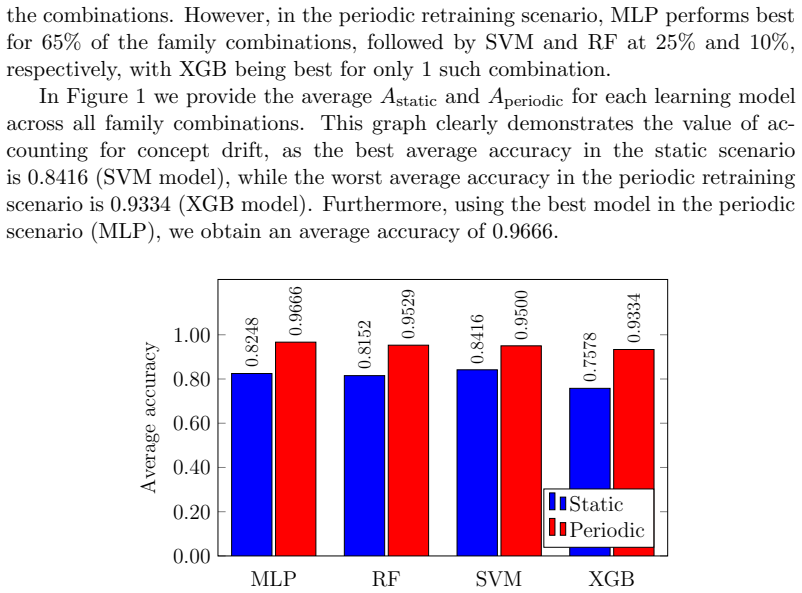
- The drift-aware scenario improves over the static model by a substantial margin for every classifier tested, so even a rough drift detector beats ignoring drift.
- The similar results across MK-Means and OCSVM with a much smaller hyperparameter search space suggests the detector configuration can be simplified in practice.
Reading between the lines
- Editorial inference: OCSVM may win because it flags only distributional changes that affect the classifier's decision boundary, while MMD flags any statistical shift; this would explain why the simpler machine-learning detector beats the statistical test on downstream accuracy.
- Editorial inference: the test-set-based tuning of both classifier hyperparameters and detector thresholds means the reported gap to periodic retraining is an oracle-style upper bound; a deployment protocol that selects thresholds on validation data could show a larger gap on truly unseen future batches.
- Editorial inference: a natural extension is to make the batch window adaptive, since the paper fixes it at 50 samples and notes that smaller windows detect drift sooner but add noise; an LSTM could learn the window size end-to-end.
Signed reviews
Editorial analysis
A structured set of objections, weighed in public.
Referee Report
Summary. The paper studies concept drift detection for malware classification models, comparing three detectors (OCSVM, MK-Means, and MMD) under static, periodic, and drift-aware retraining scenarios. It uses the KronoDroid dataset, five malware families, 20 family-pair classification tasks, and four classifiers (MLP, RF, SVM, XGB). Drift-aware detector hyperparameters are selected via Pareto-front analysis over the accuracy/efficiency tradeoff, and the authors report that drift-aware retraining achieves accuracy comparable to periodic retraining while retraining far fewer models, with OCSVM generally performing best. The paper concludes that these results provide strong evidence that concept drift can be accurately detected in malware classification models.
Significance. If the central claim were supported by a valid evaluation, the contribution would be practically useful: a lightweight, unsupervised drift-detection method that reduces retraining costs while preserving accuracy. The paper's experimental scope is substantial, covering 400 scenario experiments and 70,400 drift-detector grid evaluations, with fixed random seeds and a clearly specified workflow. However, the empirical evaluation as presented is an in-sample/oracle assessment: classifier hyperparameters are tuned on the test batches, drift-detector thresholds are selected from test-batch accuracy, and a fixed control set is reused across all batches. These design choices mean the reported parity with periodic retraining and the OCSVM advantage are upper bounds rather than estimates of deployment performance.
major comments (3)
- [Section 3.3.1, Eq. (6)] The classifier hyperparameters are tuned on D_test_i, the same test samples used in Eqs. (2), (3), and (4) to compute every reported accuracy. The manuscript discloses this as an oracle-style upper bound, but the abstract and conclusion do not carry that caveat; the claim that drift-aware retraining is 'comparable to periodic retraining' is therefore an in-sample comparison. A temporal hold-out protocol, in which hyperparameters and detector thresholds are tuned on batches up to time t and evaluated on later batches, is required before the results can support the abstract's 'strong evidence' claim.
- [Sections 3.4 and 3.5.4] The drift-detector thresholds are selected by Pareto-front analysis of Δdrift = A_drift − A_static computed on the test batches, and the reported median accuracy A_m*_drift is the accuracy of the specific ω*_m chosen on those same batches. This makes the headline accuracy an optimized in-sample value, not a representative deployment accuracy. In addition, the uneven grid sizes (OCSVM 540, MK-Means 240, MMD 100; Table 3) create a selection-bias advantage for OCSVM, since a larger search space is more likely to contain a favorable operating point. At minimum, the comparison should be repeated with thresholds fixed a priori on a validation split.
- [Section 3.2.3] The control set X_test consists of the same 20 samples in every temporal batch, so half of every test set is identical across all batches. This common repeated subset inflates every accuracy and mechanically compresses the differences among the static, drift-aware, and periodic scenarios, making 'comparable to periodic' easier to achieve; it also violates the independence of batch-level evaluations. The control samples should be redrawn per batch from temporally matched segments of the control family, or the reported metrics should be computed on drift-family samples only.
minor comments (6)
- [Section 4.1] The sentence 'From Figures 14 through 17 we observe that MLP, RF, and MLP all perform well' should probably read 'MLP, RF, and SVM'; the repeated 'MLP' appears to be a typo.
- [Figure 7] The figure title 'OCSMV accuracies' is misspelled and should be 'OCSVM accuracies'.
- [Section 4.3] The word 'respecitvely' is misspelled and should be 'respectively'.
- [Section 4.5] The phrase 'since since these values correspond' contains a duplicated word and should be corrected.
- [Section 3.5.4] The term 'median' is used in a non-standard way: the selected point is the Pareto-front point closest to a line through the midpoint of the front. A footnote explaining this would prevent confusion with the statistical median.
- [Section 4 and Figures 4, 7, 10, 12] No confidence intervals or significance tests are reported for the accuracy differences between detectors; given the claim that OCSVM 'generally outperforms' the other techniques, this should at least be discussed or acknowledged as a limitation.
Circularity Check
Drift-aware accuracies are selected on the test batches via Eq. (6) and the Section 3.5.4 Pareto-front median, so the headline 'comparable to periodic retraining' is a fitted in-sample value rather than an out-of-sample prediction.
-
fitted input called prediction
[Section 3.3.1 (Eq. 6) and Section 3.5.4 (median Pareto-front accuracy); abstract claim]
"we are optimizing each model based on the test accuracy ... Thus, the use of test-set tuning is intentional and can be interpreted as an oracle-style upper bound on performance rather than as a realistic deployment procedure. ... Let (x_min, y_min) be the point on the Pareto Front that gives the minimum ΔAccuracy ... Then we define the median accuracy for a given (L,R) pair as A^{m*}_drift(L,R) = (1/|F|) Σ A_drift(F_d,F_c,L,R,ω*_m)."
The classifiers are tuned on test accuracy (Eq. 6), and the drift-detector thresholds are selected from a Pareto front whose objective Δdrift = A_drift − A_static is computed on the same test batches. The headline statistic A^{m*}_drift is then the accuracy at the selected ω*_m on that same test-based front, so it is an in-sample fitted maximum, not an estimate for unseen batches. The abstract's claim that drift-aware retraining 'achieve[s] classification accuracy comparable to periodic retraining' and that OCSVM 'generally outperforms' the alternatives therefore reports fitted values as strong evidence of practical detectability.
full rationale
The derivation chain is otherwise self-contained: OCSVM, MK-Means, and MMD are defined independently of the accuracy metric, and the accuracy formulas (Eqs. 2–4) are straightforward definitions rather than derived predictions. The self-citations [12] and [36] provide method provenance (MMD baseline and MK-Means drift-detection design) but are not load-bearing evidence for the central quantitative claim, and no uniqueness theorem is imported. The one substantive circularity-type problem is that the reported drift-aware accuracy, including the median Pareto-front value that drives the headline comparison, is selected using the test batches. Because this fitted value is then presented in the abstract as 'strong evidence' for practical drift detection, the central claim reduces, in part, to an in-sample selection. The reused 50-sample control set biases all scenarios in the same direction and is better treated as an experimental-design threat than as circularity.
Assumptions & free parameters
free parameters (7)
- OCSVM threshold T_ocsvm =
grid search over 0.01 to 0.60, Pareto-front selected per (Fd, Fc, L)
- OCSVM nu =
grid search over 0.1 to 0.9
- MK-Means threshold T_mkmeans =
grid search over 0.01 to 0.60
- MK-Means cluster count =
{2, 4, 6, 8}
- MMD significance level alpha (T_mmd) =
grid search over 0.001 to 0.1
- Classifier hyperparameters per batch =
737,600 Optuna trials over per-model search spaces
- Batch size and train split =
b = 50, t = 30
assumptions (5)
- domain assumption HighestModDate timestamp ordering is a valid temporal proxy for malware sample evolution.
- domain assumption The five largest KronoDroid families are representative of Android malware concept drift.
- domain assumption The fixed 50-sample control set from the control family remains representative across all temporal batches.
- ad hoc to paper Test-set tuning of drift thresholds yields comparisons that transfer to unseen data.
- ad hoc to paper The 'median' Pareto Front point is a representative threshold selection.
Cite this review
Pith. "Pith review of Concept Drift Detection and Adaptive Retraining of Malware Classification Models." pith.science (2026). https://pith.science/paper/J3JOJXAR
@misc{pith2026260813465,
  author       = {Pith},
  title        = {Pith review of: Concept Drift Detection and Adaptive Retraining of Malware Classification Models},
  year         = {2026},
  howpublished = {\url{https://pith.science/paper/J3JOJXAR}},
  note         = {Machine review of arXiv:2608.13465}
}
read the original abstract
Concept drift refers to changes over time in the statistical properties of data, as compared to the data that was used to train a learning model. Machine learning models for malware detection or classification are particularly susceptible to performance degradation caused by concept drift, as attackers constantly modify existing malware. In this chapter, we analyze two machine learning-based approaches to automated concept drift detection-a novel approach based on One-Class Support Vector Machines (OCSVM) and a previously-studied technique based on Minibatch K-Means (MK-Means). For comparison we also consider Maximum Mean Discrepancy (MMD), a statistical technique for detecting changes in multidimensional data. We conduct an extensive series of experiments comparing the effectiveness of four learning models, namely, Multilayer Perceptron, Random Forest, Support Vector Machines, and eXtreme Gradient Boosting. For each of these models, we consider three distinct scenarios: A static scenario where no model retraining occurs, a periodic scenario where models are constantly retrained irrespective of concept drift, and a drift-aware scenario where models are only retrained when concept drift is detected. Under the drift-aware scenario, we analyze the tradeoff between accuracy and training efficiency using Pareto Front analysis. We find that all three concept drift detection techniques achieve classification accuracy comparable to periodic retraining, while offering substantially greater efficiency in terms of the number of models that must be retrained. In addition, drift-aware retraining based on our OCSVM technique generally outperforms the MK-Means and MMD approaches. Overall, these results provide strong evidence that we can accurately detect concept drift in malware classification models.
Figures


Figures from the paper (16 more)


Reference graph
Works this paper leans on
-
[1]
MORPH: Towards automated concept drift adaptation for malware detec- tion
Md Tanvirul Alam, Romy Fieblinger, Ashim Mahara, and Nidhi Rastogi. MORPH: Towards automated concept drift adaptation for malware detec- tion. InProceedings 2024 Network and Distributed System Security Symposium, NDSS, 2024.https://arxiv.org/abs/2401.12790
arXiv 2024
-
[2]
Javier B. Alonso. K-means vs Mini Batch K-means: A comparison.http: //hdl.handle.net/2117/23414, 2013
work page 2013
- [3]
-
[4]
Muhammad Azeem, Danish Khan, Saman Iftikhar, Shaikhan Bawazeer, and Mohammed Alzahrani. Analyzing and comparing the effectiveness of malware detection: A study of machine learning approaches.Heliyon, 10(1):e23574, 2024
work page 2024
-
[5]
Firas Bayram, Bestoun S. Ahmed, and Andreas Kassler. From concept drift to model degradation: An overview on performance-aware drift detectors. Knowledge-Based Systems, 245:108632, 2022
work page 2022
-
[6]
A. Bertia, Basil Xavier Simon, G. Jaspher W. Kathrine, and G. Matthew Palmer. A study about detecting ransomware by using different algorithms. In 2022 International Conference on Applied Artificial Intelligence and Comput- ing, ICAAIC, pages 1293–1300, 2022
work page 2022
-
[7]
Collective choice under dichotomous preferences.Journal of Economic Theory, 122(2):165–184, 2005
Anna Bogomolnaia, Herv´ e Moulin, and Richard Stong. Collective choice under dichotomous preferences.Journal of Economic Theory, 122(2):165–184, 2005
work page 2005
-
[8]
Random Forests.Machine Learning, 45:5–32, 2001
Leo Breiman. Random Forests.Machine Learning, 45:5–32, 2001
work page 2001
Show all 60 references
-
[9]
Breunig, Hans-Peter Kriegel, Raymond T
Markus M. Breunig, Hans-Peter Kriegel, Raymond T. Ng, and J¨ org Sander. LOF: identifying density-based local outliers. InProceedings of the 2000 ACM SIGMOD International Conference on Management of Data, SIGMOD ’00, pages 93–104, 2000
2000
-
[10]
XGBoost: A scalable tree boosting sys- tem
Tianqi Chen and Carlos Guestrin. XGBoost: A scalable tree boosting sys- tem. InProceedings of the 22nd ACM SIGKDD International Conference on Knowledge Discovery and Data Mining, KDD ’16, pages 785–794, 2016
2016
-
[11]
Monte da Silva, and Bruno Iran Ferreira Maciel
Rohgi Toshio Meneses Chikushi, Roberto Souto Maior de Barros, Marilu Gomes N. Monte da Silva, and Bruno Iran Ferreira Maciel. Using spectral entropy and Bernoulli map to handle concept drift.Expert Systems with Ap- plications, 167:114114, 2021
2021
-
[12]
Maximum mean discrepancy for concept drift detection in malware classification models
Christofer Washington Berruz Chungata, Martin Jureˇ cek, Katerina Potika, and Mark Stamp. Maximum mean discrepancy for concept drift detection in malware classification models. InProceedings of the 12th IEEE International 33 Conference on Big Data Computing Service and Machine...
2026
-
[13]
Coello Coello, B
Carlos A. Coello Coello, B. Gary Lamont, and David A. Van Veldhuizen.Evolu- tionary Algorithms for Solving Multi-Objective Problems. Springer, 2nd edition, 2007
2007
-
[14]
Support-vector networks.Machine Learning, 20:273–297, 1995
Corinna Cortes and Vladimir Vapnik. Support-vector networks.Machine Learning, 20:273–297, 1995
1995
-
[15]
Trends in ai inference energy consumption: Beyond the performance-vs- parameter laws of deep learning.Sustainable Computing: Informatics and Systems, 38:100857, 2023
Radosvet Desislavov, Fernando Mart´ ınez-Plumed, and Jos´ e Hern´ andez-Orallo. Trends in ai inference energy consumption: Beyond the performance-vs- parameter laws of deep learning.Sustainable Computing: Informatics and Systems, 38:100857, 2023
2023
-
[16]
Outlier detection with One-Class SVMs: An application to melanoma progno- sis
Stephan Dreiseitl, Melanie Osl, Christian Scheibb¨ ock, and Michael Binder. Outlier detection with One-Class SVMs: An application to melanoma progno- sis. InAMIA Annual Symposium Proceedings, pages 172–176, 2010
2010
-
[17]
F-Secure Labs: Adware:Android/Airpush.https://www.f-secure.com/sw- desc/adware-android-airpush.shtml, 2025
2025
-
[18]
F-Secure Labs: Riskware:Android/SmsReg.https://www.f-secure.com/sw- desc/riskware-android-smsreg.shtml, 2025
2025
-
[19]
F-Secure Labs: Trojan:Android/Boxer.https://www.f-secure.com/v- descs/trojan-android-boxer.shtml, 2025
2025
-
[20]
F-Secure Labs: Trojan:W32/Agent.https://www.f-secure.com/v-descs/ agent.shtml, 2025
2025
-
[21]
Borgwardt, Malte J
Arthur Gretton, Karsten M. Borgwardt, Malte J. Rasch, Bernhard Sch¨ olkopf, and Alexander Smola. A kernel two-sample test.Journal of Machine Learning Research, 13:723–773, 2012
2012
-
[22]
GitHub - aleguma/kronodroid: KronoDroid dataset.https://github.com/aleguma/kronodroid, 2021
Alejandro Guerra-Manzanares. GitHub - aleguma/kronodroid: KronoDroid dataset.https://github.com/aleguma/kronodroid, 2021
2021
-
[23]
Kron- oDroid: Time-based hybrid-featured dataset for effective android malware de- tection and characterization.Computers & Security, 110:102399, 2021
Alejandro Guerra-Manzanares, Hayretdin Bahsi, and Sven N˜ omm. Kron- oDroid: Time-based hybrid-featured dataset for effective android malware de- tection and characterization.Computers & Security, 110:102399, 2021
2021
-
[24]
J. A. Hartigan and M. A. Wong. Algorithm AS 136: A K-means clustering al- gorithm.Journal of the Royal Statistical Society. Series C (Applied Statistics), 28(1):100–108, 1979
1979
-
[25]
Combating concept drift with explanatory detection and adaptation for android malware classifi- cation
Yiling He, Junchi Lei, Zhan Qin, Kui Ren, and Chun Chen. Combating concept drift with explanatory detection and adaptation for android malware classifi- cation. InProceedings of the 2025 ACM Conference on Computer and Com- munications Security, CCS, pages 1–15, 2025
2025
-
[26]
IBM: Random Forest.https://www.ibm.com/think/topics/random-forest, 2021. 34
2021
-
[27]
Ikotun, Absalom E
Abiodun M. Ikotun, Absalom E. Ezugwu, Laith Abualigah, Belal Abuhaija, and Jia Heming. K-means clustering algorithms: A comprehensive review, variants analysis, and advances in the era of big data.Information Sciences, 622:178–210, 2023
2023
-
[28]
PE header analysis for malware detection
Samuel Kim. PE header analysis for malware detection. Master’s thesis, San Jose State University, California, 2018.https://scholarworks.sjsu.edu/ etd_projects/624/
2018
-
[29]
H. T. Kung, F. Luccio, and F. P. Preparata. On finding the maxima of a set of vectors.Journal of the ACM, 22(4):469–476, 1975
1975
-
[30]
XGBoost versus Random Forest.https://www.qwak.com/post/ xgboost-versus-random-forest, 2022
Alon Lev. XGBoost versus Random Forest.https://www.qwak.com/post/ xgboost-versus-random-forest, 2022
2022
-
[31]
Revisiting concept drift in windows malware detection: Adaptation to real drifted mal- ware with minimal samples
Adrian Shuai Li, Arun Iyengar, Ashish Kundu, and Elisa Bertino. Revisiting concept drift in windows malware detection: Adaptation to real drifted mal- ware with minimal samples. InProceedings 2025 Network and Distributed Sys- tem Security Symposium, NDSS, 2025.https://arxiv.or...
2025 arXiv
-
[32]
Isolation forest
Fei Tony Liu, Kai Ming Ting, and Zhi-Hua Zhou. Isolation forest. In2008 Eighth IEEE International Conference on Data Mining, pages 413–422, 2008
2008
-
[33]
Manevitz and Malik Yousef
Larry M. Manevitz and Malik Yousef. One-Class SVMs for document classifi- cation.Journal of Machine Learning Research, 2:139–154, 2002
2002
-
[34]
Energy considerations for large pretrained neural networks.https://arxiv.org/abs/2506.01311, 2025
Leo Mei and Mark Stamp. Energy considerations for large pretrained neural networks.https://arxiv.org/abs/2506.01311, 2025
2025 arXiv
-
[35]
A survey of malware detec- tion techniques based on machine learning.International Journal of Advanced Computer Science and Applications, 10(1), 2019
Hoda El Merabet and Abderrahmane Hajraoui. A survey of malware detec- tion techniques based on machine learning.International Journal of Advanced Computer Science and Applications, 10(1), 2019
2019
-
[36]
Cluster analysis and concept drift detection in malware.Journal of Computer Virology and Hacking Techniques, 21, 2025
Aniket Mishra and Mark Stamp. Cluster analysis and concept drift detection in malware.Journal of Computer Virology and Hacking Techniques, 21, 2025
2025
-
[37]
Zubair Rafique, and Juan Caballero
Antonio Nappa, M. Zubair Rafique, and Juan Caballero. The Malicia dataset: Identification and analysis of drive-by download operations.International Jour- nal of Information Security, 14(1):15–33, 2014
2014
-
[38]
Optuna: Efficient optimization algorithms — Optuna 3.5.0 documen- tation.https://optuna.readthedocs.io/en/stable/tutorial/10_key_ features/003_efficient_optimization_algorithms.html, 2025
2025
-
[39]
Word embedding techniques for malware evo- lution detection
Sunhera Paul and Mark Stamp. Word embedding techniques for malware evo- lution detection. In Mark Stamp, Mamoun Alazab, and Andrii Shalaginov, ed- itors,Malware Analysis Using Artificial Intelligence and Deep Learning, pages 321–343. Springer, 2021
2021
-
[40]
Polars: Data types and structures.https://docs.pola.rs/user-guide/ concepts/data-types-and-structures/, 2025
2025
-
[41]
Stephan Rabanser, Stephan G¨ unnemann, and Zachary C. Lipton. Failing loudly: an empirical study of methods for detecting dataset shift. InProceed- ings of the 33rd International Conference on Neural Information Processing Systems, 2019. 35
2019
-
[42]
Choudhary, K
Ananya Redhu, P. Choudhary, K. Srinivasan, and Tapan Kumar Das. Deep learning-powered malware detection in cyberspace: a contemporary review. Frontiers in Physics, 12, 2024
2024
-
[43]
Ross, Niall M
Gordon J. Ross, Niall M. Adams, Dimitris K. Tasoulis, and David J. Hand. Ex- ponentially weighted moving average charts for detecting concept drift.Pattern Recognition Letters, 33(2):191–198, 2012
2012
-
[44]
Rousseeuw and Katrien Van Driessen
Peter J. Rousseeuw and Katrien Van Driessen. A fast algorithm for the mini- mum covariance determinant estimator.Technometrics, 41(3):212–223, 1999
1999
-
[45]
Platt, John Shawe-Taylor, Alex J
Bernhard Sch¨ olkopf, John C. Platt, John Shawe-Taylor, Alex J. Smola, and Robert C. Williamson. Estimating the support of a high-dimensional distribu- tion.Neural Computation, 13(7):1443–1471, 2001
2001
-
[46]
novelty and outlier detection.https://scikit-learn.org/ stable/modules/outlier_detection.html
scikit-learn: 2.7. novelty and outlier detection.https://scikit-learn.org/ stable/modules/outlier_detection.html
-
[47]
McCann, Ying Huang, Wei Wang, and Jun Kong
Tongxin Shi, Roy A. McCann, Ying Huang, Wei Wang, and Jun Kong. Mal- ware detection for Internet of Things using one-class classification.Sensors, 24(13):4122, 2024
2024
-
[48]
neural_network.MLPClassifier.html, 2010
sklearn.neural network.mlpclassifier — scikit-learn 0.20.3 documenta- tion.https://scikit-learn.org/stable/modules/generated/sklearn. neural_network.MLPClassifier.html, 2010
2010
-
[49]
A fuzzy drift corre- lation matrix for multiple data stream regression
Yiliao Song, Guangquan Zhang, Haiyan Lu, and Jie Lu. A fuzzy drift corre- lation matrix for multiple data stream regression. In2020 IEEE International Conference on Fuzzy Systems, FUZZ-IEEE, pages 1–6, 2020
2020
-
[50]
Chapman and Hall/CRC, Boca Raton, second edition, 2022
Mark Stamp.Introduction to Machine Learning with Applications in Informa- tion Security. Chapman and Hall/CRC, Boca Raton, second edition, 2022
2022
-
[51]
Juan Terven, Diana-Margarita Cordova-Esparza, Julio-Alejandro Romero- Gonz´ alez, Alfonso Ram´ ırez-Pedraza, and E. A. Ch´ avez-Urbiola. A comprehen- sive survey of loss functions and metrics in deep learning.Artificial Intelligence Review, 58:195, 2025
2025
-
[52]
Papadopoulos, and Yannis Manolopoulos
Eleftherios Tiakas, Apostolos N. Papadopoulos, and Yannis Manolopoulos. Skyline queries: An introduction. In2015 6th International Conference on Information, Intelligence, Systems and Applications, IISA, pages 1–6, 2015
2015
-
[53]
Machine learning for malware evolu- tion detection
Lolitha Sresta Tupadha and Mark Stamp. Machine learning for malware evolu- tion detection. In Mark Stamp, Corrado Aaron Visaggio, Francesco Mercaldo, and Fabio Di Troia, editors,Artificial Intelligence for Cybersecurity, pages 183–
-
[54]
Alibi detect: Algorithms for outlier, adversarial and drift detection, 2019
Arnaud Van Looveren, Janis Klaise, Giovanni Vacanti, Oliver Cobb, Ashley Scillitoe, Robert Samoilescu, and Alex Athorne. Alibi detect: Algorithms for outlier, adversarial and drift detection, 2019
2019
-
[55]
Detecting malware evolution using support vector machines.Expert Systems with Applications, 143:113022, 2020
Mayuri Wadkar, Fabio Di Troia, and Mark Stamp. Detecting malware evolution using support vector machines.Expert Systems with Applications, 143:113022, 2020. 36
2020
-
[56]
Tree-structured parzen estimator: Understanding its algo- rithm components and their roles for better empirical performance.https: //arxiv.org/abs/2304.11127, 2023
Shuhei Watanabe. Tree-structured parzen estimator: Understanding its algo- rithm components and their roles for better empirical performance.https: //arxiv.org/abs/2304.11127, 2023
2023 arXiv
-
[57]
What is a support vector ma- chine (SVM)?https://www.techtarget.com/whatis/definition/support- vector-machine-SVM, 2023
Kinza Yasar and Fred Tabsharani. What is a support vector ma- chine (SVM)?https://www.techtarget.com/whatis/definition/support- vector-machine-SVM, 2023
2023
-
[58]
MOEA/D: A multiobjective evolutionary algorithm based on decomposition.IEEE Transactions on Evolutionary Computation, 11(6):712–731, 2007
Qingfu Zhang and Hui Li. MOEA/D: A multiobjective evolutionary algorithm based on decomposition.IEEE Transactions on Evolutionary Computation, 11(6):712–731, 2007
2007
-
[59]
Adaptive online incremental learning for evolving data streams.Applied Soft Computing, 105:107255, 2021
Si-si Zhang, Jian-wei Liu, and Xin Zuo. Adaptive online incremental learning for evolving data streams.Applied Soft Computing, 105:107255, 2021
2021
-
[60]
MANAGE: A novel malware evolution model based on digital genes
Yu Zhang, Qingzhong Liu, and Yuanquan Shi. MANAGE: A novel malware evolution model based on digital genes. In2022 7th IEEE International Con- ference on Data Science in Cyberspace, DSC, pages 64–70, 2022. Appendix In this Appendix, we provide additional relevant graphs. Figure...
2022
Reviewed August 14, 2026 · model on record in the stance chip above.
Discussion (0). Continue with ORCID to comment.