REVIEW 3 minor 73 references
Defensive Boosting for Online Probabilistic Forecasting
T0 review · 0 major / 3 minor · reviewed 2026-08-14 · deepseek-v4-flash
Pith's one-line read One algorithm unifies online gradient boosting and weak-to-strong boosting
desk verdict A clean one-oracle online boosting algorithm that unifies two previously separate guarantees; the main soft spot is an abstract that overstates the oracle assumption. read the letter →
The pith
A machine-rendered reading of the paper's core claim, the machinery that carries it, and where it could break.
The reading
What carries the argument
The load-bearing object is the second-order weak-class oracle: after seeing the current context but before seeing the coefficient, it outputs a weak prediction and guarantees regret against every h in H scaling as a_H $\sqrt$(sum $c_t^{2}$) + b_H. The Defensive Booster wraps this oracle with two scalar adaptive-gradient auditors and a one-dimensional root rule, solving an affine equation in the signed forecast mu so that the aggregated auditor gain is nonpositive no matter what label arrives. The two auditors enforce multiaccuracy and self-orthogonality with errors A_H $\sqrt$(S_T) + B_H and A_S $\sqrt$(S_T) + B_S, where S_T = 4 sum (Y_t - p_t)^2. The identity w_t sigma_t = r_t/2 then converts multiaccuracy into a bound on the edge of the mistake weighting, and the smooth weak-learning condition turns the low-edge witness into a strong-learning guarantee by contrapositive.
What would settle it
Run the Defensive Booster on the paper's binary-aggregation construction, which guarantees edge at least 0.16, and measure the normalized edge of its mistake weighting under the weak class; if the edge exceeds the Theorem 4.4 bound A_H $\sqrt$(T B_T)/(T rho_w), or if Brier and randomized errors fail to shrink as O(1/($gamma^{2}$ T)) under the smooth weak-learning condition, the central claim is false.
Extended reading notes
Core claim
The Defensive Booster's central discovery is that the dual view of boosting can be made operational online: instead of building an ensemble of weak learners, the forecaster chooses its probability p_t so that two sustained correlations vanish - no weak hypothesis correlates with the signed forecast residuals, and neither does the forecast itself. Multiaccuracy alone turns the residual weights w_t = |Y_t - p_t| into a reweighting of the transcript on which the entire weak class has small edge, so if the algorithm's randomized classification error stays high long enough, those weights form a smooth hard-core witness that the smooth weak-learning condition fails. Adding the self-auditor gives the unconditional span-regret guarantee, because multiaccuracy plus self-orthogonality are exactly the first-order optimality conditions for squared loss. The two guarantees follow from the same two inequalities in Theorem 3.3, not from one another.
Load-bearing premise
The whole construction depends on having a weak-class learner whose regret to every hypothesis in the class scales with the square root of how strongly it was used, not just with the number of rounds; with only a first-order learner, the claimed fast weak-to-strong rate collapses.
Editorial extensions
If this is right
- Every adaptive sequence gets the gradient-boosting span guarantee: Brier score is at most the best span comparator loss plus O((Lambda A_H + A_S)/sqrt(T)), with a second-order refinement that becomes O(1/T) in the realizable case.
- Under the (rho, gamma)-smooth weak-learning condition, both Brier score and randomized classification error are at most max{rho, O(A_H^2/(gamma^2 T)), O(B_H/(gamma T))}, so epsilon accuracy needs T = O(1/(gamma^2 epsilon)), the same dependence previously shown optimal for online weak-to-strong boosting.
- When the forecaster's error remains large, its mistake weights form an ex-post smooth low-edge reweighting of the transcript, certifying that the smooth weak-learning condition cannot hold on that transcript.
- The strongly adaptive variant gives both guarantees on every contiguous interval up to polylogarithmic factors, and its interval mistake weights localize the hard-core witness to identify where and when weak learnability fails.
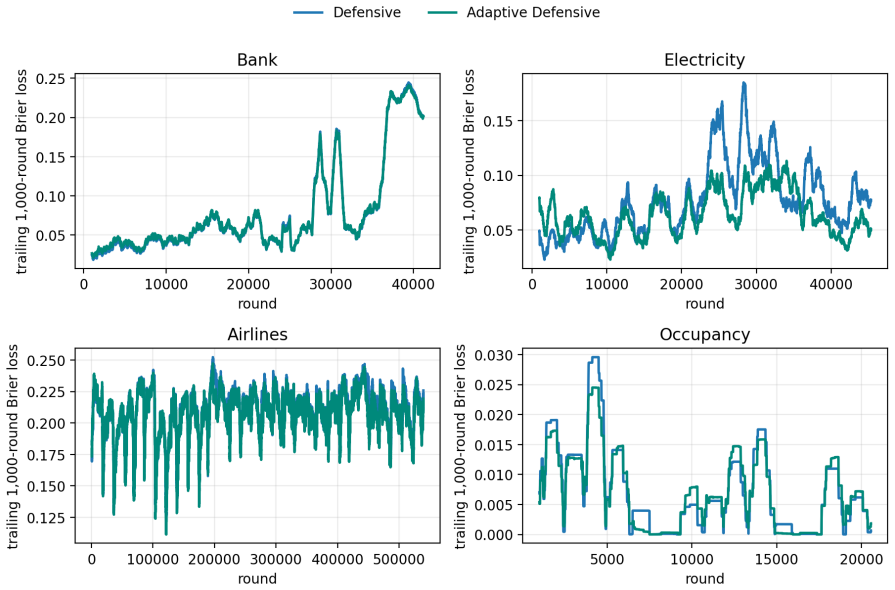
- The algorithm uses one weak-class oracle call plus O(1) arithmetic per round, and in experiments tracks or beats the stronger of the ensemble baselines while being 20-66 times faster per round.
Reading between the lines
- Because the hard-core direction needs only multiaccuracy, any online learner that maintains multiaccuracy could in principle be boosted by the same dual argument; a testable extension would be to replace the Brier root rule with another proper scoring rule.
- The interval hard-core witnesses double as a change-point detector: on a data stream, a persistent smooth low-edge weighting along a trailing interval indicates that the weak class has stopped being informative, without any separate drift-detection subroutine.
- The second-order oracle assumption is doing real work, since a first-order oracle would degrade the sample complexity to 1/(gamma^2 epsilon^2); this suggests that online boosting theory may benefit from building data-dependent-regret oracles explicitly rather than treating O(sqrt(T)) online learners as generic black boxes.
Editorial analysis
A structured set of objections, weighed in public.
Referee Report
Summary. The paper introduces the Defensive Booster, an online probabilistic forecaster for binary (and, by extension, bounded real-valued) outcomes under an adaptive adversary. The algorithm is a black-box reduction from a second-order weak-class oracle (Definition 2.3) together with two scalar adaptive-OGD states. It uses a one-dimensional root rule to enforce two statistical conditions: multiaccuracy with respect to the weak class and self-orthogonality of the forecasts (Theorem 3.3). From these conditions the paper derives an unconditional Brier-score regret bound against the norm-bounded span of the weak class (Theorem 4.1), a hard-core mistake-weighting certificate (Theorem 4.4), and, under the smooth weak-learning condition, a weak-to-strong bound on Brier score and randomized classification error of the form max{rho_0, O(A_H^2/(gamma_0^2 T)), O(B_H/(gamma_0 T))} (Corollary 4.5). It also gives a strongly adaptive interval version (Section 5), separation examples showing the two guarantees are incomparable (Appendix B), and an extensive empirical evaluation on synthetic streams, real binary streams, and chronological regression data, with a released implementation. The claimed contribution is a single one-oracle algorithm that simultaneously obtains online gradient boosting's span guarantee and online weak-to-strong boosting's classification guarantee, at rates matching prior specialized methods.
Significance. If the results hold, the paper is a substantial contribution to online learning and boosting. It unifies two previously separate families of online boosting guarantees in a single simple algorithm, provides the first online boosting theorem derived through the defensive-forecasting / multiaccuracy dual view, and matches the optimal 1/(gamma^2 epsilon) weak-to-strong rate under a clean, explicitly stated oracle model. The proofs are largely self-contained and the main inequalities are checkable: the root sign property, the second-order scalar regret lemma, the multiaccuracy-to-hard-core conversion, and the contrapositive rate argument are all coherent. The paper is also unusually complete on the empirical side: it reports synthetic streams engineered for each guarantee, real-data binary streams, regression extensions, a controlled drift benchmark, runtime comparisons, and code with reproduction commands.
minor comments (3)
- [Abstract and Section 1.1] The abstract's opening statement, 'Given an online learning algorithm for a weak hypothesis class H,' is broader than the formal primitive in Definition 2.3, which requires a second-order no-regret oracle whose regret scales as a_H sqrt(sum_t c_t^2) + b_H. An ordinary first-order O(sqrt(T)) learner would only yield the degraded 1/(gamma_0^2 epsilon^2) rate, as the paper itself notes in Section 2. Please qualify the abstract and the informal theorem statements to say 'given a second-order no-regret online learning algorithm,' so that the advertised scope matches the theorem.
- [Appendix A.3 / Proposition 5.1] The proof of Proposition 5.1 invokes 'the standard guarantee' of a second-order confidence-rated experts algorithm and cites Gaillard et al. (2014) without stating the exact regret bound or the constant C_0. Since the logarithmic factors in Corollary 5.3 depend on this bound, please state the precise inequality being used or provide a short derivation within the appendix.
- [Section 4.3, after Corollary 4.5] The discussion says that the lower bound of Beygelzimer et al. (2015b) shows the 1/(gamma_0^2 epsilon) dependence is unavoidable, and the text does say 'in their model.' Because Definition 2.3 is a stronger oracle than their weak-online-learning model, the lower bound does not apply directly to the present setting; a sentence clarifying that the match is only in the gamma, epsilon rate, not in the exact model, would prevent over-reading.
Circularity Check
No significant circularity: the weak-to-strong guarantee is a genuine contrapositive of the multiaccuracy hard-core certificate, not a restatement of the oracle assumption.
full rationale
The derivation chain is self-contained. Algorithm 1 is a defensive forecaster whose certificate (Theorem 3.3) is proved from the second-order weak-class oracle (Definition 2.3) and scalar adaptive OGD (Lemma 2.5), using only the root-sign property (Lemma 3.2). The Brier/span guarantee (Theorem 4.1) is obtained by substituting the multiaccuracy and self-orthogonality bounds into the signed convexity inequality for squared loss; no fitted comparator or assumed outcome is reused as a conclusion. The hard-core mistake weighting (Theorem 4.4) follows from the identity w_t sigma_t = r_t/2, converting the multiaccuracy bound into an edge bound on the algorithm's own mistake weights. Corollary 4.5 is exactly the contrapositive: if every rho0-smooth reweighting has edge at least gamma0, then the algorithm's weighting cannot be simultaneously smooth and low-edge, and solving the two inequalities gives the max{rho0, O(1/(gamma0^2 T))} rate. The paper explicitly states that its second-order oracle is stronger than the prior weak-online-learning model used in the lower bound it matches ('although our oracle model is stronger', Section 2), so the rate comparison is a conditional claim about a stated primitive rather than an equation-level identity. Self-citations (Noarov--Roth multicalibration work, Kearns et al. self-orthogonality, Collina et al. lower bounds) are used as context or are accompanied by independent proofs and external citations; none carries the load of a main theorem by itself. I find no circular step.
Assumptions & free parameters
assumptions (5)
- domain assumption Adversarial online protocol with arbitrary adaptive sequences.
- domain assumption Second-order weak-class oracle (Definition 2.3).
- domain assumption Symmetric weak class H.
- standard math Scalar adaptive OGD second-order regret (Lemma 2.5).
- standard math Existing second-order confidence-rated experts bounds (Gaillard et al. 2014).
Cite this review
Pith. "Pith review of Defensive Boosting for Online Probabilistic Forecasting." pith.science (2026). https://pith.science/paper/FNWIGLP3
@misc{pith2026260813554,
  author       = {Pith},
  title        = {Pith review of: Defensive Boosting for Online Probabilistic Forecasting},
  year         = {2026},
  howpublished = {\url{https://pith.science/paper/FNWIGLP3}},
  note         = {Machine review of arXiv:2608.13554}
}
abstract
We study online probabilistic forecasting of binary outcomes chosen by an adaptive adversary. Given an online learning algorithm for a weak hypothesis class $H$, we would like to efficiently obtain two incomparable guarantees that existing online boosting techniques provide separately. Online gradient boosting competes in Brier score with the best predictor induced by the span of $H$ on every sequence, but promises nothing when the span does not contain an accurate predictor. Online weak-to-strong boosting drives classification error to zero under a weak-learning condition, but promises little when that condition fails. We give a simple defensive forecasting algorithm, the Defensive Booster, that obtains both guarantees. On every adaptive sequence, its Brier score is competitive with the best prediction induced by the span of $H$ at the same rate as online gradient boosting; simultaneously, whenever the realized transcript satisfies the smooth weak-learning condition, its Brier score and randomized classification error satisfy the same rate guarantee as online classification boosting. This is achieved by operationalizing the "dual view" of boosting: When the algorithm's randomized classification error is persistently high, its mistake weights form a smooth reweighting on which every weak hypothesis has low edge, yielding an ex-post hard-core certificate that the weak-learning condition fails. We also develop a strongly adaptive variant, which satisfies both guarantees on every time interval. The Defensive Booster is very efficient: it accesses just one weak-class learner, whereas the prior online boosting methods we compare against maintain large weak-learner ensembles. Experiments on synthetic and real data streams demonstrate its strong predictive performance (sometimes substantially improving over all prior baselines) coupled with orders-of-magnitude faster runtime.
Figures


Figures from the paper (11 more)




Reference graph
Works this paper leans on
-
[1]
Proceedings of the 36th Annual IEEE Symposium on Foundations of Computer Science , pages =
Impagliazzo, Russell , title =. Proceedings of the 36th Annual IEEE Symposium on Foundations of Computer Science , pages =. 1995 , publisher =. doi:10.1109/SFCS.1995.492584 , url =
arXiv 1995
-
[2]
Advances in Neural Information Processing Systems , volume =
Bastani, Osbert and Gupta, Varun and Jung, Christopher and Noarov, Georgy and Ramalingam, Ramya and Roth, Aaron , title =. Advances in Neural Information Processing Systems , volume =. 2022 , editor =. doi:10.52202/068431-2129 , url =
-
[3]
arXiv preprint arXiv:2506.11848 , year =
Perdomo, Juan Carlos and Recht, Benjamin , title =. arXiv preprint arXiv:2506.11848 , year =. 2506.11848 , archivePrefix =
-
[4]
Proceedings of the 42nd International Conference on Machine Learning , pages =
Noarov, Georgy and Ramalingam, Ramya and Roth, Aaron and Xie, Stephan , title =. Proceedings of the 42nd International Conference on Machine Learning , pages =. 2025 , editor =
work page 2025
-
[5]
A Pseudorandom Generator from Any One-Way Function , journal =
H. A Pseudorandom Generator from Any One-Way Function , journal =. 1999 , doi =
work page 1999
-
[6]
Annals of Mathematics , volume =
Green, Ben and Tao, Terence , title =. Annals of Mathematics , volume =. 2008 , doi =
work page 2008
-
[7]
Electronic Colloquium on Computational Complexity , note =
Reingold, Omer and Trevisan, Luca and Tulsiani, Madhur and Vadhan, Salil , title =. Electronic Colloquium on Computational Complexity , note =. 2008 , url =
work page 2008
- [8]
Show all 73 references
-
[9]
2008 , eprint =
Reingold, Omer and Trevisan, Luca and Tulsiani, Madhur and Vadhan, Salil , title =. 2008 , eprint =
2008
-
[10]
, title =
Freund, Yoav and Schapire, Robert E. , title =. Journal of Computer and System Sciences , volume =. 1997 , doi =
1997
-
[11]
and Frean, Marcus R
Mason, Llew and Baxter, Jonathan and Bartlett, Peter L. and Frean, Marcus R. , title =. Advances in Neural Information Processing Systems 12 , pages =. 1999 , url =
1999
-
[12]
, title =
Mukherjee, Indraneel and Rudin, Cynthia and Schapire, Robert E. , title =. Journal of Machine Learning Research , volume =. 2013 , url =
2013
-
[13]
, title =
Niculescu-Mizil, Alexandru and Caruana, Richard A. , title =. Proceedings of the Twenty-First Conference on Uncertainty in Artificial Intelligence , pages =. 2005 , eprint =
2005
-
[14]
Proceedings of Innovations in Computer Science , pages =
Feldman, Vitaly , title =. Proceedings of Innovations in Computer Science , pages =. 2010 , eprint =
2010
-
[15]
Proceedings of the 32nd International Conference on Machine Learning , pages =
Beygelzimer, Alina and Kale, Satyen and Luo, Haipeng , title =. Proceedings of the 32nd International Conference on Machine Learning , pages =. 2015 , editor =
2015
-
[16]
Advances in Neural Information Processing Systems 28 , pages =
Beygelzimer, Alina and Hazan, Elad and Kale, Satyen and Luo, Haipeng , title =. Advances in Neural Information Processing Systems 28 , pages =. 2015 , url =
2015
-
[17]
Proceedings of the 20th International Conference on Artificial Intelligence and Statistics , pages =
Hu, Hanzhang and Sun, Wen and Venkatraman, Arun and Hebert, Martial and Bagnell, Andrew , title =. Proceedings of the 20th International Conference on Artificial Intelligence and Statistics , pages =. 2017 , editor =
2017
-
[18]
Advances in Neural Information Processing Systems 33 , pages =
Brukhim, Nataly and Chen, Xinyi and Hazan, Elad and Moran, Shay , title =. Advances in Neural Information Processing Systems 33 , pages =. 2020 , url =
2020
-
[19]
Advances in Neural Information Processing Systems , volume =
Ghai, Udaya and Singh, Karan , title =. Advances in Neural Information Processing Systems , volume =. 2024 , editor =. doi:10.52202/079017-3190 , eprint =
2024 doi
-
[20]
Revisiting Agnostic Boosting , booktitle =
da Cunha, Arthur and M. Revisiting Agnostic Boosting , booktitle =. 2025 , editor =. 2503.09384 , archivePrefix =
2025
-
[21]
Sample-Near-Optimal Agnostic Boosting with Improved Running Time , booktitle =
da Cunha, Arthur and H. Sample-Near-Optimal Agnostic Boosting with Improved Running Time , booktitle =. 2026 , editor =. 2601.11265 , archivePrefix =
2026
-
[22]
Multicalibration: Calibration for the (Computationally-Identifiable) Masses , booktitle =
H. Multicalibration: Calibration for the (Computationally-Identifiable) Masses , booktitle =. 2018 , url =
2018
-
[23]
and Ghorbani, Amirata and Zou, James , title =
Kim, Michael P. and Ghorbani, Amirata and Zou, James , title =. Proceedings of the 2019 AAAI/ACM Conference on AI, Ethics, and Society , pages =. 2019 , publisher =. doi:10.1145/3306618.3314287 , url =
2019
-
[24]
and Reingold, Omer and Rothblum, Guy N
Dwork, Cynthia and Kim, Michael P. and Reingold, Omer and Rothblum, Guy N. and Yona, Gal , title =. Proceedings of the 53rd Annual ACM SIGACT Symposium on Theory of Computing , pages =. 2021 , publisher =. doi:10.1145/3406325.3451064 , url =
2021
-
[25]
and Roth, Aaron , title =
Gupta, Varun and Jung, Christopher and Noarov, Georgy and Pai, Mallesh M. and Roth, Aaron , title =. 13th Innovations in Theoretical Computer Science Conference , volume =. 2022 , doi =
2022
-
[26]
13th Innovations in Theoretical Computer Science Conference , volume =
Gopalan, Parikshit and Kalai, Adam Tauman and Reingold, Omer and Sharan, Vatsal and Wieder, Udi , title =. 13th Innovations in Theoretical Computer Science Conference , volume =. 2022 , doi =
2022
-
[27]
and Reingold, Omer and Wieder, Udi , title =
Gopalan, Parikshit and Hu, Lunjia and Kim, Michael P. and Reingold, Omer and Wieder, Udi , title =. 14th Innovations in Theoretical Computer Science Conference , volume =. 2023 , doi =
2023
-
[28]
and Reingold, Omer , title =
Gopalan, Parikshit and Kim, Michael P. and Reingold, Omer , title =. Advances in Neural Information Processing Systems , volume =
-
[29]
Proceedings of the 40th International Conference on Machine Learning , pages =
Globus-Harris, Ira and Harrison, Declan and Kearns, Michael and Roth, Aaron and Sorrell, Jessica , title =. Proceedings of the 40th International Conference on Machine Learning , pages =. 2023 , url =
2023
-
[30]
Proceedings of the 40th International Conference on Machine Learning , pages =
Noarov, Georgy and Roth, Aaron , title =. Proceedings of the 40th International Conference on Machine Learning , pages =. 2023 , editor =
2023
-
[31]
Complexity-Theoretic Implications of Multicalibration , booktitle =
Casacuberta, S. Complexity-Theoretic Implications of Multicalibration , booktitle =. 2024 , publisher =. doi:10.1145/3618260.3649748 , url =
2024
-
[32]
Proceedings of the 2024 Annual ACM-SIAM Symposium on Discrete Algorithms , pages =
Garg, Sumegha and Jung, Christopher and Reingold, Omer and Roth, Aaron , title =. Proceedings of the 2024 Annual ACM-SIAM Symposium on Discrete Algorithms , pages =. 2024 , doi =
2024
-
[33]
arXiv preprint arXiv:2505.20885 , year =
Luo, Haipeng and Senapati, Spandan and Sharan, Vatsal , title =. arXiv preprint arXiv:2505.20885 , year =. 2505.20885 , archivePrefix =
-
[34]
How Global Calibration Strengthens Multiaccuracy , booktitle =
Casacuberta, S. How Global Calibration Strengthens Multiaccuracy , booktitle =. 2025 , publisher =. doi:10.1109/FOCS63196.2025.00063 , url =
2025
-
[35]
arXiv preprint arXiv:2507.09683 , year =
Kearns, Michael and Roth, Aaron and Ryu, Emily , title =. arXiv preprint arXiv:2507.09683 , year =. 2507.09683 , archivePrefix =
-
[36]
Proceedings of the 53rd Annual ACM SIGACT Symposium on Theory of Computing , pages =
Qiao, Mingda and Valiant, Gregory , title =. Proceedings of the 53rd Annual ACM SIGACT Symposium on Theory of Computing , pages =. 2021 , doi =
2021
-
[37]
Proceedings of the 57th Annual ACM Symposium on Theory of Computing , pages =
Dagan, Yuval and Daskalakis, Constantinos and Fishelson, Maxwell and Golowich, Noah and Kleinberg, Robert and Okoroafor, Princewill , title =. Proceedings of the 57th Annual ACM Symposium on Theory of Computing , pages =. 2025 , doi =
2025
-
[38]
Proceedings of the 42nd International Conference on Machine Learning , pages =
Ghuge, Rohan and Muthukumar, Vidya and Singla, Sahil , title =. Proceedings of the 42nd International Conference on Machine Learning , pages =. 2025 , url =
2025
-
[39]
Proceedings of Thirty Ninth Conference on Learning Theory , pages =
Hu, Lunjia and Luo, Haipeng and Senapati, Spandan and Sharan, Vatsal , title =. Proceedings of Thirty Ninth Conference on Learning Theory , pages =. 2026 , editor =
2026
-
[40]
arXiv preprint arXiv:2601.05245 , year =
Collina, Natalie and Lu, Jiuyao and Noarov, Georgy and Roth, Aaron , title =. arXiv preprint arXiv:2601.05245 , year =. 2601.05245 , archivePrefix =
-
[41]
arXiv preprint arXiv:2605.09273 , year =
Huang, Zhiming and Morgenstern, Jamie and Roth, Aaron and Zhang, Claire Jie , title =. arXiv preprint arXiv:2605.09273 , year =. 2605.09273 , archivePrefix =
-
[42]
arXiv preprint arXiv:2604.19592 , year =
Farina, Gabriele and Perdomo, Juan Carlos , title =. arXiv preprint arXiv:2604.19592 , year =. 2604.19592 , archivePrefix =
-
[43]
Proceedings of the Tenth International Workshop on Artificial Intelligence and Statistics , pages =
Vovk, Vladimir and Takemura, Akimichi and Shafer, Glenn , title =. Proceedings of the Tenth International Workshop on Artificial Intelligence and Statistics , pages =. 2005 , editor =
2005
-
[44]
2007 , month = aug, eprint =
Vovk, Vladimir , title =. 2007 , month = aug, eprint =
2007
-
[45]
arXiv preprint cs/0506007 , year =
Vovk, Vladimir and Nouretdinov, Ilia and Takemura, Akimichi and Shafer, Glenn , title =. arXiv preprint cs/0506007 , year =. cs/0506007 , archivePrefix =
-
[46]
2003 , url =
Zinkevich, Martin , title =. 2003 , url =
2003
-
[47]
and Williamson, Robert C
Kivinen, Jyrki and Smola, Alexander J. and Williamson, Robert C. , title =. IEEE Transactions on Signal Processing , volume =. 2004 , doi =
2004
-
[48]
, title =
Savage, Leonard J. , title =. Journal of the American Statistical Association , volume =. 1971 , doi =
1971
-
[49]
, title =
Gneiting, Tilmann and Raftery, Adrian E. , title =. Journal of the American Statistical Association , volume =. 2007 , doi =
2007
-
[50]
Proceedings of the Eighth International Workshop on Artificial Intelligence and Statistics , pages =
Online Bagging and Boosting , author =. Proceedings of the Eighth International Workshop on Artificial Intelligence and Statistics , pages =. 2001 , editor =
2001
-
[51]
Proceedings of the 29th International Conference on Machine Learning , pages =
An Online Boosting Algorithm with Theoretical Justifications , author =. Proceedings of the 29th International Conference on Machine Learning , pages =. 2012 , editor =
2012
-
[52]
Proceedings of the 32nd International Conference on Machine Learning , pages =
Optimal and Adaptive Algorithms for Online Boosting , author =. Proceedings of the 32nd International Conference on Machine Learning , pages =. 2015 , editor =
2015
-
[53]
Proceedings of the 38th International Conference on Machine Learning , pages =
Boosting for Online Convex Optimization , author =. Proceedings of the 38th International Conference on Machine Learning , pages =. 2021 , editor =
2021
-
[54]
Information and Computation , volume =
Boosting a Weak Learning Algorithm by Majority , author =. Information and Computation , volume =. 1995 , doi =
1995
-
[55]
Journal of Machine Learning Research , volume =
Smooth Boosting and Learning with Malicious Noise , author =. Journal of Machine Learning Research , volume =. 2003 , url =
2003
-
[56]
Journal of Machine Learning Research , volume =
Optimally-Smooth Adaptive Boosting and Application to Agnostic Learning , author =. Journal of Machine Learning Research , volume =. 2003 , url =
2003
-
[57]
Machine Learning , volume =
Boosting and Hard-Core Set Construction , author =. Machine Learning , volume =. 2003 , doi =
2003
-
[58]
Proceedings of the Twentieth Annual ACM-SIAM Symposium on Discrete Algorithms , pages =
The Uniform Hardcore Lemma via Approximate Bregman Projections , author =. Proceedings of the Twentieth Annual ACM-SIAM Symposium on Discrete Algorithms , pages =. 2009 , publisher =. doi:10.1137/1.9781611973068.129 , url =
2009 doi
-
[59]
Algorithmic Learning Theory, 16th International Conference, ALT 2005 , series =
Defensive Forecasting for Linear Protocols , author =. Algorithmic Learning Theory, 16th International Conference, ALT 2005 , series =. 2005 , doi =
2005
-
[60]
Machine Learning , volume =
Improved Second-Order Bounds for Prediction with Expert Advice , author =. Machine Learning , volume =. 2007 , doi =
2007
-
[61]
Theoretical Computer Science , volume =
Scale-Free Online Learning , author =. Theoretical Computer Science , volume =. 2018 , doi =
2018
- [62]
-
[63]
Massive Online Analysis Datasets , year =
-
[64]
1999 , url =
Harries, Michael , title =. 1999 , url =
1999
-
[65]
and Feldheim, V
Candanedo, Luis M. and Feldheim, V. Accurate Occupancy Detection of an Office Room from Light, Temperature, Humidity and. Energy and Buildings , volume =. 2016 , doi =
2016
-
[66]
2017 , howpublished =
Candanedo, Luis , title =. 2017 , howpublished =. doi:10.24432/C5VC8G , url =
2017 doi
-
[67]
2013 , howpublished =
Fanaee-T, Hadi , title =. 2013 , howpublished =. doi:10.24432/C5W894 , url =
2013 doi
-
[68]
2019 , howpublished =
Hogue, John , title =. 2019 , howpublished =. doi:10.24432/C5X60B , url =
2019 doi
-
[69]
, title =
Freund, Yoav and Schapire, Robert E. , title =. Proceedings of the Ninth Annual Conference on Computational Learning Theory , pages =. 1996 , publisher =. doi:10.1145/238061.238163 , url =
1996
-
[70]
Proceedings of the 32nd International Conference on Machine Learning , pages =
Daniely, Amit and Gonen, Alon and Shalev-Shwartz, Shai , title =. Proceedings of the 32nd International Conference on Machine Learning , pages =. 2015 , editor =
2015
-
[71]
Proceedings of the 27th Conference on Learning Theory , pages =
Gaillard, Pierre and Stoltz, Gilles and van Erven, Tim , title =. Proceedings of the 27th Conference on Learning Theory , pages =. 2014 , editor =
2014
-
[72]
Proceedings of the 37th International Conference on Machine Learning , pages =
Cutkosky, Ashok , title =. Proceedings of the 37th International Conference on Machine Learning , pages =. 2020 , editor =
2020
-
[73]
Souza, Vinicius M. A. and dos Reis, Denis M. and Maletzke, Andr. Challenges in Benchmarking Stream Learning Algorithms with Real-world Data , journal =. 2020 , doi =
2020
Reviewed August 14, 2026 · model on record in the stance chip above.
Discussion (0). Continue with ORCID to comment.