SchwarMAX: a GPU-friendly Schwarzschild orbit-superposition modelling framework
Pith reviewed 2026-07-02 18:03 UTC · model grok-4.3
The pith
SchwarMAX recovers barred galaxy density profiles and pattern speeds accurately using GPU-accelerated Schwarzschild modeling.
A machine-rendered reading of the paper's core claim, the machinery that carries it, and where it could break.
Core claim
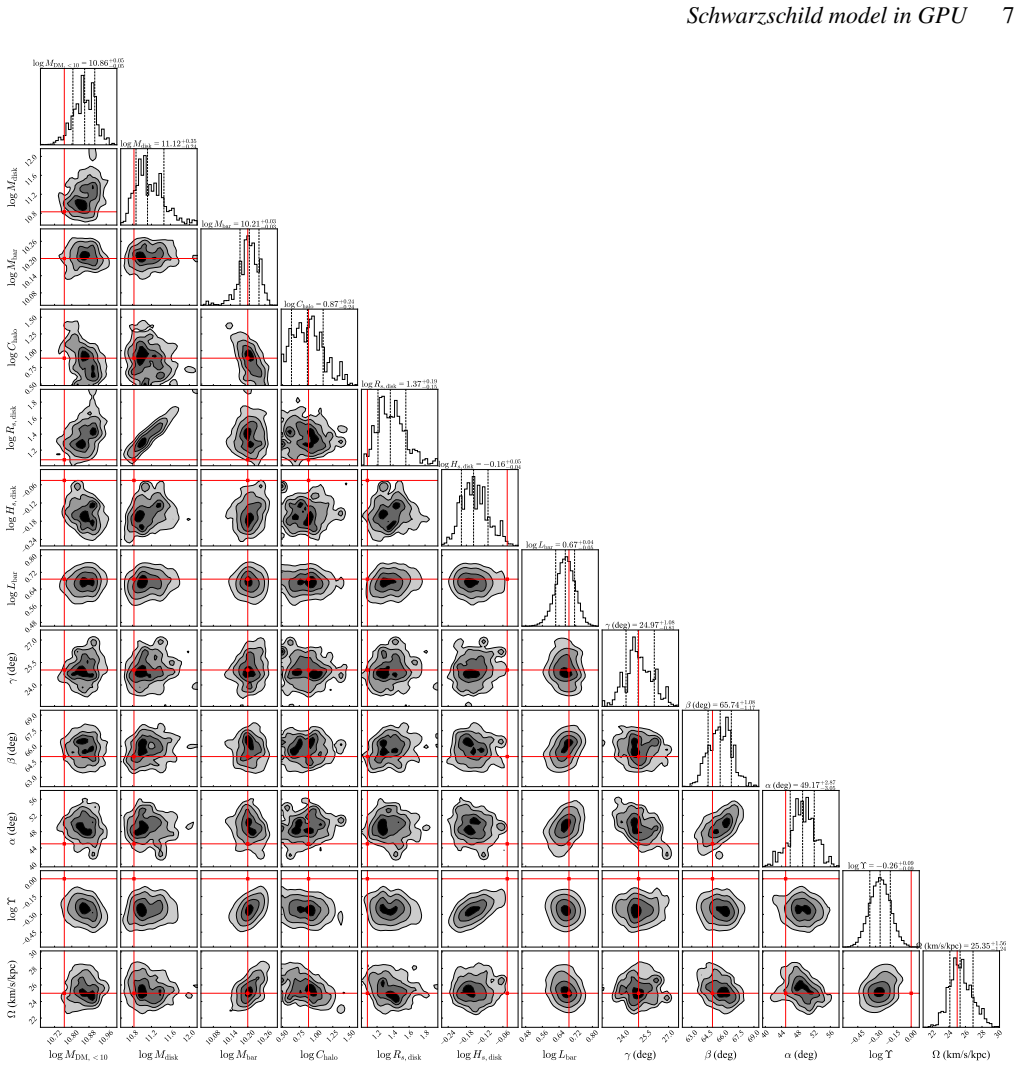
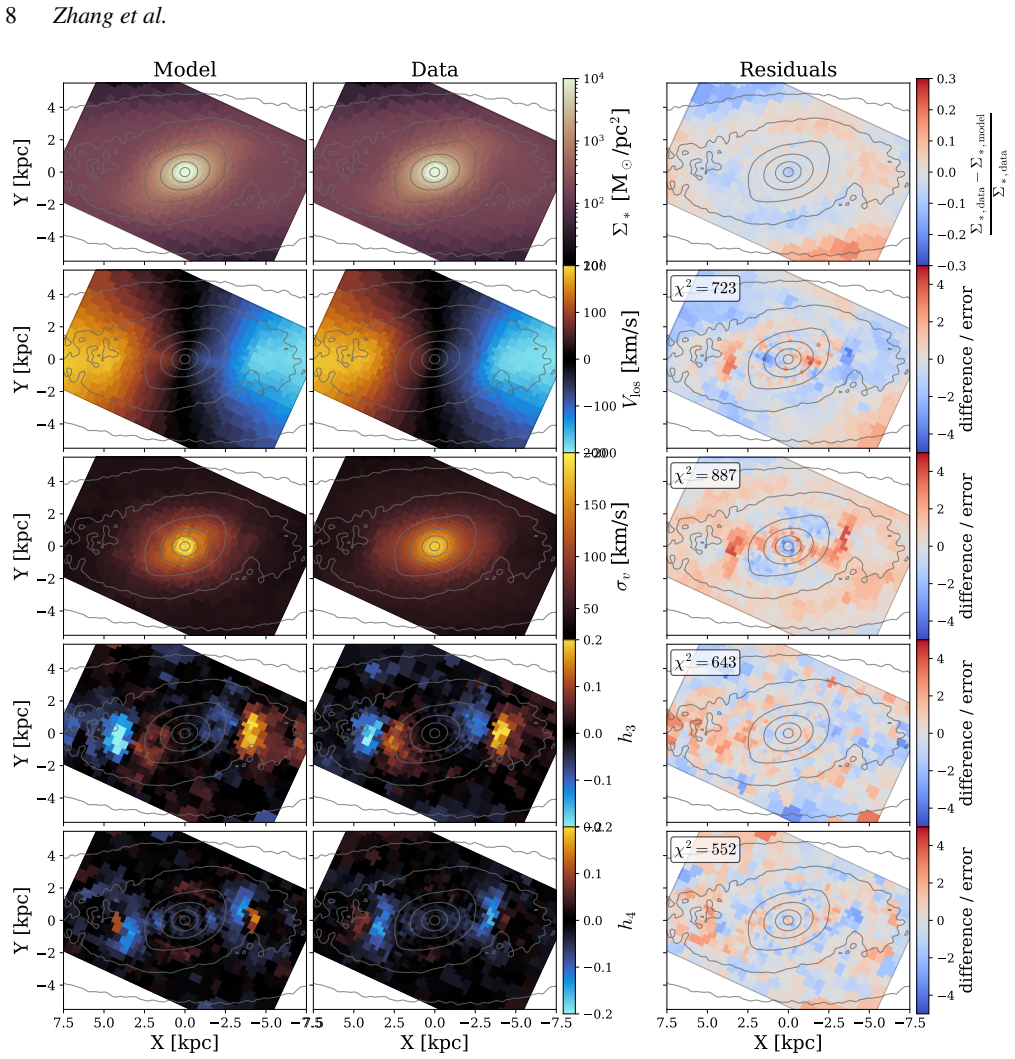
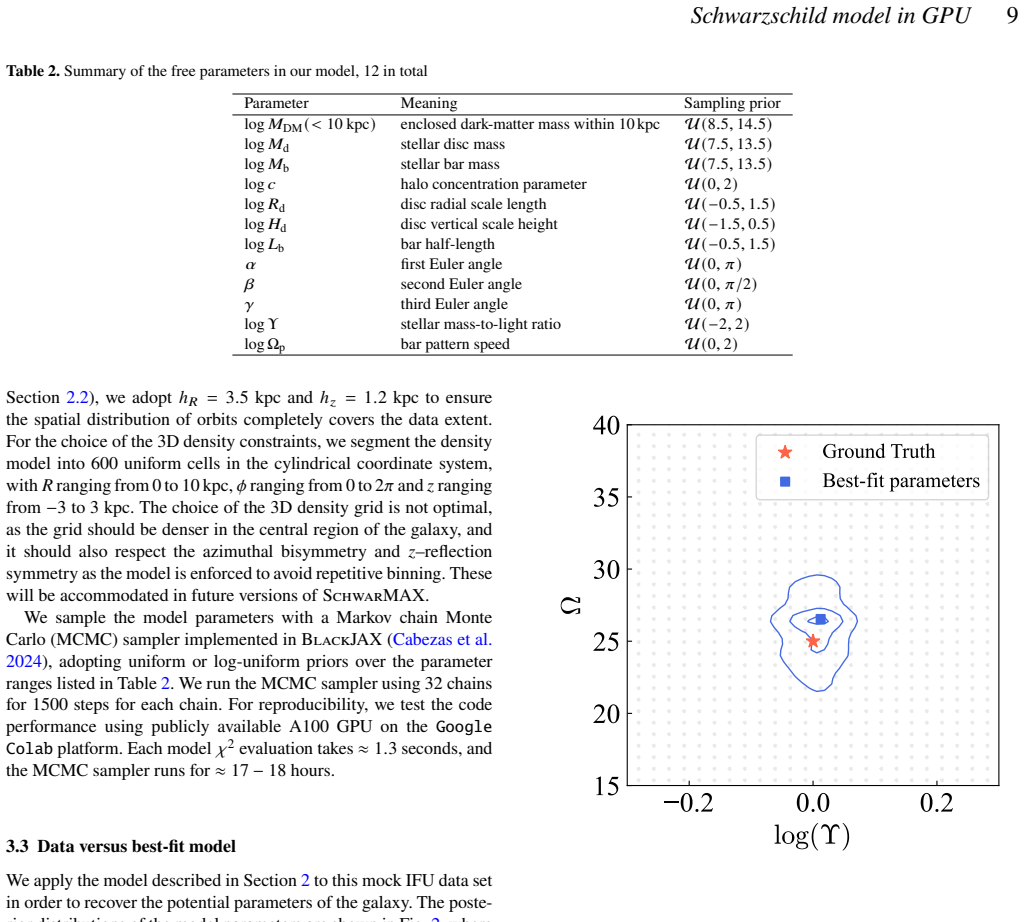
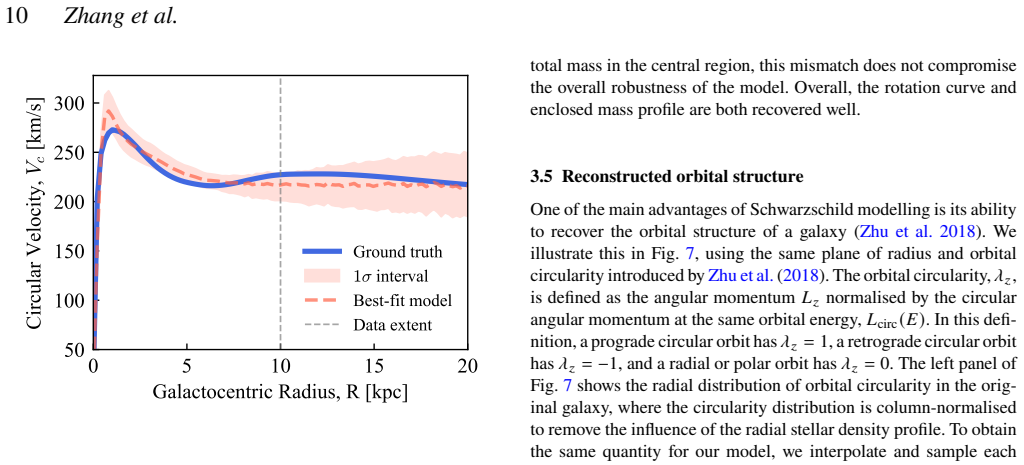
SchwarMAX implements the Schwarzschild orbit-superposition method directly on GPU hardware so that entire model constructions finish in about one second, which in turn permits Markov Chain Monte Carlo sampling over twelve parameters that jointly describe the disc, bar, and dark-matter halo; when the resulting models are fitted to mock IFU observations generated from an N-body barred galaxy, both the three-dimensional density profiles and the bar pattern speed are recovered with good accuracy.
What carries the argument
The GPU-native Schwarzschild orbit-superposition engine that assembles and evaluates large orbit libraries fast enough for high-dimensional MCMC sampling.
If this is right
- Density profiles of both the stellar disc and the dark-matter halo can be constrained simultaneously from photometric and kinematic data.
- Bar pattern speeds can be measured directly from line-of-sight velocity fields without assuming a particular functional form for the potential.
- The method remains accurate for galaxies viewed at a wide range of inclination angles.
- The same framework can be applied to elliptical galaxies and dwarf galaxies with only minor code changes.
Where Pith is reading between the lines
- The one-second model time opens the possibility of fitting hundreds of galaxies from large IFU surveys in a single run.
- Because the orbit library is built on the GPU, adding triaxial or time-dependent potentials becomes computationally feasible.
- Direct comparison of SchwarMAX results with Jeans or made-to-measure models on the same mock data would quantify method-to-method systematics.
Load-bearing premise
The N-body simulated barred galaxy that supplied the mock observations is representative enough of real galaxies for the recovery tests to demonstrate reliability on actual data.
What would settle it
Applying the code to real IFU observations of a barred galaxy whose bar pattern speed has been measured independently by gas kinematics or other methods and finding that the recovered speed or density profiles disagree beyond the reported uncertainties.
Figures


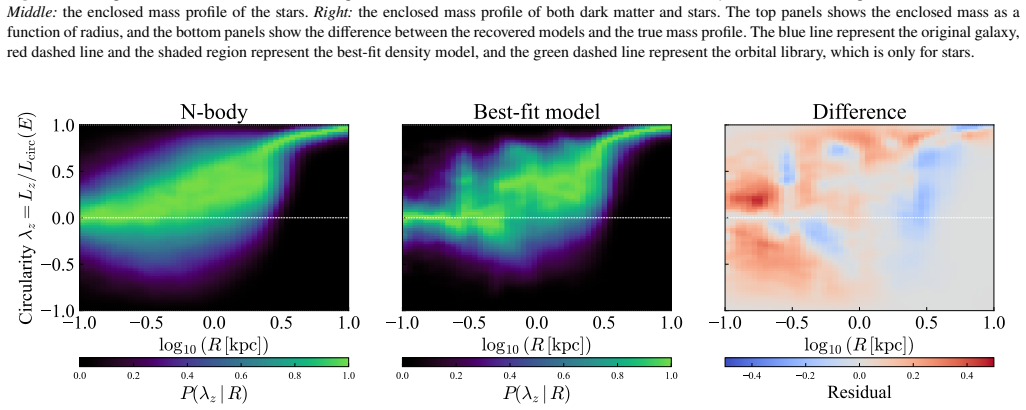


read the original abstract
The Schwarzschild orbit-superposition method is a highly flexible dynamical modelling tool. It constrains the mass distribution of a galaxy using line-of-sight velocity and photometric observations. However, constructing such a dynamical model of a galaxy is computationally expensive. We present SchwarMAX, a new publicly available GPU implementation of the Schwarzschild orbit-superposition method. The GPU-native code is significantly faster than other implementations, with entire model construction taking around a second on GPU A100. Using SchwarMAX, we can explore the distributions of both baryonic and dark matter in a galaxy across a high-dimensional parameter space. We demonstrate its performance using mock integrated-field spectroscopic unit data generated from an N-body simulated barred galaxy. We explore the 12-dimensional space of disc, bar and halo parameters using Markov Chain Monte Carlo. The density profiles and the bar pattern speed of the galaxy are recovered with good accuracy. We show that the code can be applied to barred galaxies across a wide range of inclination angles and can be easily extended to other stellar systems, such as elliptical and dwarf galaxies.
Editorial analysis
A structured set of objections, weighed in public.
Referee Report
Summary. The paper presents SchwarMAX, a publicly available GPU-native implementation of the Schwarzschild orbit-superposition dynamical modeling method. It claims that entire model construction takes around one second on an A100 GPU, enabling MCMC exploration of a 12-dimensional parameter space (disc, bar, and halo parameters) on mock IFU data generated from an N-body simulated barred galaxy. The central result is that the input density profiles and bar pattern speed are recovered with good accuracy, with additional claims of applicability across a wide range of inclinations and easy extensibility to elliptical and dwarf galaxies.
Significance. If the performance and recovery claims hold under full technical scrutiny, the work provides a practical advance by accelerating Schwarzschild modeling enough to support high-dimensional parameter searches for barred galaxies. The public release and GPU focus are strengths that could improve reproducibility and accessibility for the community.
minor comments (2)
- The abstract states recovery 'with good accuracy' but provides no quantitative metrics, error bars, or comparison to other codes; these details would be needed in the results section to support the claim.
- No information is given on orbit library construction, weight-solving algorithm, or MCMC convergence diagnostics, which are central to validating the implementation.
Simulated Author's Rebuttal
We thank the referee for their summary of the manuscript and for highlighting the potential practical advance offered by a fast, publicly available GPU-native Schwarzschild code. We note that the recommendation is listed as uncertain pending technical scrutiny of the performance and recovery claims. No specific major comments were provided in the report, so we have no point-by-point responses to individual referee points at this stage. We remain available to address any technical questions that may arise during further review.
Circularity Check
No significant circularity; computational implementation with external mock-data validation
full rationale
The manuscript introduces SchwarMAX, a GPU-native Schwarzschild orbit-superposition code, and validates it by recovering input parameters (density profiles, bar pattern speed) from mock IFU data generated by an independent N-body simulation. No equations, orbit-weight solutions, or MCMC steps are shown to reduce to the fitted quantities by construction. The work contains no load-bearing self-citations, uniqueness theorems, or ansatzes imported from prior author papers; the recovery test uses externally generated mock data rather than self-generated inputs. This is a standard code-validation exercise whose central claim remains independent of its own outputs.
Axiom & Free-Parameter Ledger
axioms (1)
- domain assumption The Schwarzschild orbit-superposition method is a valid approach for constraining galaxy mass distributions from line-of-sight velocities and photometry.
Reference graph
Works this paper leans on
-
[1]
The Structure of Cold Dark Matter Halos
The Structure of Cold Dark Matter Halos. , keywords =. doi:10.1086/177173 , archivePrefix =. astro-ph/9508025 , primaryClass =
work page internal anchor Pith review Pith/arXiv arXiv doi:10.1086/177173
-
[2]
, year = 1979, month = aug, volume =
A numerical model for a triaxial stellar system in dynamical equilibrium. , year = 1979, month = aug, volume =. doi:10.1086/157282 , adsurl =
-
[3]
AGAMA: Action-based galaxy modelling architecture
AGAMA: action-based galaxy modelling architecture. , keywords =. doi:10.1093/mnras/sty2672 , archivePrefix =. 1802.08239 , primaryClass =
work page internal anchor Pith review Pith/arXiv arXiv doi:10.1093/mnras/sty2672
-
[4]
Three-Dimensional Models for the Distribution of Mass in Galaxies. , keywords =. doi:10.1093/pasj/27.4.533 , adsurl =
-
[5]
A family of potential-density pairs for galactic bars. , keywords =. doi:10.1093/mnras/stac3124 , archivePrefix =. 2210.14853 , primaryClass =
-
[6]
Analytical Potentials for Barred Galaxies. , keywords =. doi:10.1086/171764 , adsurl =
-
[7]
Recovering the pattern speeds of edge-on barred galaxies via an orbit-superposition method. , keywords =. doi:10.1051/0004-6361/202555378 , archivePrefix =. 2505.02917 , primaryClass =
-
[8]
Schwarzschild modelling of barred s0 galaxy NGC 4371. , keywords =. doi:10.1093/mnras/stae2109 , archivePrefix =. 2310.00497 , primaryClass =
-
[9]
Orbit-superposition Dynamical Modeling of Barred Galaxies. , keywords =. doi:10.3847/1538-4357/ac9df6 , archivePrefix =. 2210.14218 , primaryClass =
-
[10]
, year = 2015, month = jan, volume =
Overview of the SDSS-IV MaNGA Survey: Mapping nearby Galaxies at Apache Point Observatory. , year = 2015, month = jan, volume =. doi:10.1088/0004-637X/798/1/7 , adsurl =
work page internal anchor Pith review doi:10.1088/0004-637x/798/1/7 2015
-
[11]
Made-to-measure modeling of observed galaxy dynamics
Made-to-measure modelling of observed galaxy dynamics. , keywords =. doi:10.1093/mnras/stx2402 , archivePrefix =. 1704.03884 , primaryClass =
work page internal anchor Pith review Pith/arXiv arXiv doi:10.1093/mnras/stx2402
-
[12]
, year = 2019, month = jan, volume =
Time Inference with MUSE in Extragalactic Rings (TIMER): properties of the survey and high-level data products. , year = 2019, month = jan, volume =. doi:10.1093/mnras/sty2666 , adsurl =
-
[13]
Thirty systems with space-based light curves
Chaotic mixing and the secular evolution of triaxial cuspy galaxy models built with Schwarzschild's method. , keywords =. doi:10.1111/j.1365-2966.2011.19965.x , archivePrefix =. 1201.0667 , primaryClass =
-
[14]
Applying Schwarzschild's orbit superposition method to barred or non-barred disc galaxies
Applying Schwarzschild's orbit superposition method to barred or non-barred disc galaxies. , keywords =. doi:10.1093/mnras/stv805 , archivePrefix =. 1505.03148 , primaryClass =
work page internal anchor Pith review Pith/arXiv arXiv doi:10.1093/mnras/stv805
-
[15]
A New Implementation of the Schwarzchild Method for Constructing Observationally Driven Dynamical Models of Galaxies of All Morphological Types. , keywords =. doi:10.3847/1538-4357/ab5fe0 , archivePrefix =. 1912.04288 , primaryClass =
-
[16]
Recovery of the internal orbital structure of galaxies. , keywords =. doi:10.1111/j.1365-2966.2008.12873.x , archivePrefix =. 0712.0309 , primaryClass =
-
[17]
Triaxial orbit based galaxy models with an application to the (apparent) decoupled core galaxy NGC 4365. , keywords =. doi:10.1111/j.1365-2966.2008.12874.x , archivePrefix =. 0712.0113 , primaryClass =
-
[18]
DYNAMITE: Dynamics, Age and Metallicity Indicators Tracing Evolution
-
[19]
Deprojection and stellar dynamical modelling of boxy/peanut bars in edge-on discs. , keywords =. doi:10.1093/mnras/stae802 , archivePrefix =. 2309.11557 , primaryClass =
-
[20]
, year = 1993, month = nov, volume =
Line-of-sight velocity profiles in spherical galaxies: breaking the degeneracy between anisotropy and mass. , year = 1993, month = nov, volume =. doi:10.1093/mnras/265.1.213 , adsurl =
-
[21]
A New Method for the Identification of Non-Gaussian Line Profiles in Elliptical Galaxies. , keywords =. doi:10.1086/172534 , adsurl =
-
[22]
Dynamical Modeling of Velocity Profiles: The Dark Halo Around the Elliptical Galaxy NGC2434
Dynamical Modeling of Velocity Profiles: The Dark Halo around the Elliptical Galaxy NGC 2434. , keywords =. doi:10.1086/304733 , archivePrefix =. astro-ph/9702126 , primaryClass =
work page internal anchor Pith review Pith/arXiv arXiv doi:10.1086/304733
-
[23]
doi:10.1046/j.1365-8711.2003.06653.x , eprint =
Adaptive spatial binning of integral-field spectroscopic data using Voronoi tessellations. , keywords =. doi:10.1046/j.1365-8711.2003.06541.x , archivePrefix =. astro-ph/0302262 , primaryClass =
-
[24]
Application to the central region of the Sombrero Galaxy (NGC 4594)
The multi-gaussian expansion method: a tool for building realistic photometric and kinematical models of stellar systems II. Application to the central region of the Sombrero Galaxy (NGC 4594). , keywords =
-
[25]
The Effect of Spatial Gradients in Stellar Mass-to-Light Ratio on Black Hole Mass Measurements
The Effect of Spatial Gradients in Stellar Mass-to-light Ratio on Black Hole Mass Measurements. , keywords =. doi:10.1088/2041-8205/768/1/L21 , archivePrefix =. 1303.4393 , primaryClass =
work page internal anchor Pith review Pith/arXiv arXiv doi:10.1088/2041-8205/768/1/l21 2041
-
[26]
The dependence of bar frequency on galaxy mass, colour, and gas content - and angular resolution - in the local universe. , keywords =. doi:10.1093/mnras/stx3117 , archivePrefix =. 1711.04867 , primaryClass =
work page internal anchor Pith review Pith/arXiv arXiv doi:10.1093/mnras/stx3117
-
[27]
Constraining black hole masses from stellar kinematics by summing over all possible distribution functions. , keywords =. doi:10.1111/j.1365-2966.2006.11054.x , archivePrefix =. astro-ph/0609238 , primaryClass =
-
[28]
A novel approach to optimize the regularization and evaluation of dynamical models using a model selection framework. , keywords =. doi:10.1093/mnras/stab1092 , archivePrefix =. 2104.10168 , primaryClass =
-
[29]
The stellar orbit distribution in present-day galaxies inferred from the CALIFA survey
The stellar orbit distribution in present-day galaxies inferred from the CALIFA survey. Nature Astronomy , keywords =. doi:10.1038/s41550-017-0348-1 , archivePrefix =. 1711.06728 , primaryClass =
work page internal anchor Pith review Pith/arXiv arXiv doi:10.1038/s41550-017-0348-1
-
[30]
Alberto Cabezas and Adrien Corenflos and Junpeng Lao and Rémi Louf , year=. BlackJAX: Composable. 2402.10797 , archivePrefix=
-
[31]
, keywords =
The 3D dynamics of barred galaxies. , keywords =
-
[32]
A general method for constructing spherical galaxy models. , keywords =. doi:10.1086/162572 , adsurl =
-
[33]
Axisymmetric Three-Integral Models for Galaxies
Axisymmetric Three-Integral Models for Galaxies. , keywords =. doi:10.1086/313264 , archivePrefix =. astro-ph/9902034 , primaryClass =
work page internal anchor Pith review Pith/arXiv arXiv doi:10.1086/313264
-
[34]
Low-velocity streams in the solar neighbourhood caused by the Galactic bar. , keywords =. doi:10.1111/j.1365-2966.2010.17060.x , archivePrefix =. 0909.3516 , primaryClass =
-
[35]
Black Hole Mass Estimates from Reverberation Mapping and from Spatially Resolved Kinematics
Black Hole Mass Estimates from Reverberation Mapping and from Spatially Resolved Kinematics. , keywords =. doi:10.1086/318174 , archivePrefix =. astro-ph/0007123 , primaryClass =
work page internal anchor Pith review Pith/arXiv arXiv doi:10.1086/318174
-
[36]
Axisymmetric Dynamical Models of the Central Regions of Galaxies
Axisymmetric Dynamical Models of the Central Regions of Galaxies. , keywords =. doi:10.1086/345081 , archivePrefix =. astro-ph/0209483 , primaryClass =
work page internal anchor Pith review Pith/arXiv arXiv doi:10.1086/345081
-
[37]
The SINFONI Black Hole Survey: The Black Hole Fundamental Plane Revisited and the Paths of (Co)evolution of Supermassive Black Holes and Bulges. , keywords =. doi:10.3847/0004-637X/818/1/47 , archivePrefix =. 1601.00974 , primaryClass =
work page internal anchor Pith review Pith/arXiv arXiv doi:10.3847/0004-637x/818/1/47
-
[38]
Difficulties with Recovering The Masses of Supermassive Black Holes from Stellar Kinematical Data
Difficulties with Recovering the Masses of Supermassive Black Holes from Stellar Kinematical Data. , keywords =. doi:10.1086/380896 , archivePrefix =. astro-ph/0210379 , primaryClass =
work page internal anchor Pith review Pith/arXiv arXiv doi:10.1086/380896
-
[39]
The SAURON project - IV. The mass-to-light ratio, the virial mass estimator and the Fundamental Plane of elliptical and lenticular galaxies. , keywords =. doi:10.1111/j.1365-2966.2005.09981.x , archivePrefix =. astro-ph/0505042 , primaryClass =
-
[40]
Dynamical modelling of luminous and dark matter in 17 Coma early-type galaxies. , keywords =. doi:10.1111/j.1365-2966.2007.12434.x , archivePrefix =. 0709.0691 , primaryClass =
-
[41]
Improved Evidence for a Black Hole in M32 from HST/FOS Spectra. II. Axisymmetric Dynamical Models. , keywords =. doi:10.1086/305147 , archivePrefix =. astro-ph/9705081 , primaryClass =
work page internal anchor Pith review Pith/arXiv arXiv doi:10.1086/305147
-
[42]
Dynamical Friction and the Distribution of Dark Matter in Barred Galaxies
Dynamical Friction and the Distribution of Dark Matter in Barred Galaxies. , keywords =. doi:10.1086/311118 , archivePrefix =. astro-ph/9710039 , primaryClass =
work page internal anchor Pith review Pith/arXiv arXiv doi:10.1086/311118
-
[43]
doi:10.1046/j.1365-8711.2003.06653.x , eprint =
What determines the strength and the slowdown rate of bars?. , keywords =. doi:10.1046/j.1365-8711.2003.06473.x , archivePrefix =. astro-ph/0302519 , primaryClass =
-
[44]
, keywords =
A kinematic method for measuring the pattern speed of barred galaxies. , keywords =
-
[45]
A Self-Consistent Dynamical Model for the COBE Detected Galactic Bar
A steady-state dynamical model for the COBE-detected Galactic bar. , keywords =. doi:10.1093/mnras/283.1.149 , archivePrefix =. astro-ph/9512064 , primaryClass =
work page internal anchor Pith review Pith/arXiv arXiv doi:10.1093/mnras/283.1.149
-
[46]
A Schwarzschild model of the Galactic bar with initial density from N-body simulations
A Schwarzschild model of the Galactic bar with initial density from N-body simulations. , keywords =. doi:10.1093/mnras/stt1537 , archivePrefix =. 1308.3132 , primaryClass =
work page internal anchor Pith review Pith/arXiv arXiv doi:10.1093/mnras/stt1537
-
[47]
Dynamical modelling of the galactic bulge and bar: the Milky Way's pattern speed, stellar and dark matter mass distribution. , keywords =. doi:10.1093/mnras/stw2819 , archivePrefix =. 1608.07954 , primaryClass =
work page internal anchor Pith review Pith/arXiv arXiv doi:10.1093/mnras/stw2819
-
[48]
Deprojection of external barred galaxies from photometry. , keywords =. doi:10.1093/mnras/stab3002 , archivePrefix =. 2110.06955 , primaryClass =
-
[49]
SDSS-IV MaNGA: Internal mass distributions and orbital structures of early-type galaxies and their dependence on environment. , keywords =. doi:10.1093/mnras/stz3072 , archivePrefix =. 1911.00777 , primaryClass =
-
[50]
A barred Milky Way surrogate from an N-body simulation. arXiv e-prints , keywords =. doi:10.48550/arXiv.2111.05466 , archivePrefix =. 2111.05466 , primaryClass =
-
[51]
PowerBin: fast adaptive data binning with Centroidal Power Diagrams , year =
Cappellari, Michele , journal =. PowerBin: fast adaptive data binning with Centroidal Power Diagrams , year =. doi:10.1093/mnras/staf1726 , url =
-
[52]
The pattern speed of the Milky Way bar/bulge from VIRAC and Gaia. , keywords =. doi:10.1093/mnras/stac603 , archivePrefix =. 2107.10875 , primaryClass =
-
[53]
Summary of the content and survey properties
Gaia Data Release 3. Summary of the content and survey properties. , keywords =. doi:10.1051/0004-6361/202243940 , archivePrefix =. 2208.00211 , primaryClass =
-
[54]
VISTA Variables in the Via Lactea (VVV): The public ESO near-IR variability survey of the Milky Way
VISTA Variables in the Via Lactea (VVV): The public ESO near-IR variability survey of the Milky Way. , keywords =. doi:10.1016/j.newast.2009.12.002 , archivePrefix =. 0912.1056 , primaryClass =
work page internal anchor Pith review Pith/arXiv arXiv doi:10.1016/j.newast.2009.12.002 2009
-
[55]
The Far Side of the Galactic Bar/Bulge Revealed through Semi-regular Variables. , keywords =. doi:10.3847/1538-3881/ad01bf , archivePrefix =. 2305.19319 , primaryClass =
-
[56]
Age demographics of the Milky Way disc and bulge. , keywords =. doi:10.1093/mnras/stz3617 , archivePrefix =. 1912.02816 , primaryClass =
-
[57]
Kinematics and dynamics of the Galactic bar revealed by Gaia long-period variables. , keywords =. doi:10.1093/mnras/stae2023 , archivePrefix =. 2406.06678 , primaryClass =
-
[58]
Deciphering the Milky Way disc formation time encrypted in the bar chrono-kinematics. , keywords =. doi:10.1093/mnras/stae2546 , archivePrefix =. 2408.16815 , primaryClass =
-
[59]
Rediscovering the Milky Way with an orbit superposition approach and APOGEE data: I. Method validation. , keywords =. doi:10.1051/0004-6361/202453304 , archivePrefix =. 2411.15062 , primaryClass =
-
[60]
Chrono-chemo-kinematics of the disc
Rediscovering the Milky Way with an orbit superposition approach and APOGEE data: II. Chrono-chemo-kinematics of the disc. , keywords =. doi:10.1051/0004-6361/202453305 , archivePrefix =. 2411.16866 , primaryClass =
-
[61]
CALIFA, the Calar Alto Legacy Integral Field Area survey. I. Survey presentation. , keywords =. doi:10.1051/0004-6361/201117353 , archivePrefix =. 1111.0962 , primaryClass =
work page internal anchor Pith review Pith/arXiv arXiv doi:10.1051/0004-6361/201117353
-
[62]
The Orbital Structure of Triaxial Galaxies with Figure Rotation
The Orbital Structure of Triaxial Galaxies with Figure Rotation. , keywords =. doi:10.1088/0004-637X/728/2/128 , archivePrefix =. 1008.2753 , primaryClass =
work page internal anchor Pith review Pith/arXiv arXiv doi:10.1088/0004-637x/728/2/128
-
[63]
Testing the Tremaine-Weinberg Method Applied to Integral-field Spectroscopic Data Using a Simulated Barred Galaxy. , keywords =. doi:10.3847/1538-4357/ab3f34 , archivePrefix =. 1908.10524 , primaryClass =
-
[64]
Mapping stationary axisymmetric phase-space distribution functions by orbit libraries. , keywords =. doi:10.1111/j.1365-2966.2004.08072.x , archivePrefix =. astro-ph/0406014 , primaryClass =
-
[65]
Non-parametric triaxial deprojection of elliptical galaxies. , keywords =. doi:10.1093/mnras/staa1703 , archivePrefix =. 2006.05971 , primaryClass =
-
[66]
SMART: a new implementation of Schwarzschild's Orbit Superposition technique for triaxial galaxies and its application to an N-body merger simulation. , keywords =. doi:10.1093/mnras/staa3014 , archivePrefix =. 2009.08979 , primaryClass =
-
[67]
Testing the robustness of DYNAMITE triaxial Schwarzschild modelling: The effects of correcting the orbit mirroring. , keywords =. doi:10.1051/0004-6361/202243926 , archivePrefix =. 2205.04165 , primaryClass =
-
[68]
Triaxial Orbit-based Dynamical Modeling of Galaxies with Supermassive Black Holes and an Application to Massive Elliptical Galaxy NGC 1453. , keywords =. doi:10.3847/1538-4357/ac3e68 , archivePrefix =. 2111.06904 , primaryClass =
-
[69]
Dynamical Stellar Mass-to-light Ratio Gradients: Evidence for Very Centrally Concentrated IMF Variations in ETGs?. , keywords =. doi:10.3847/1538-4357/acfe09 , archivePrefix =. 2309.15911 , primaryClass =
-
[70]
1989 , doi =
Applied Mathematics Letters , volume =. 1989 , doi =
1989
-
[71]
Triaxial Galaxies with Cusps. , year = 1996, month = mar, volume =. doi:10.1086/176957 , archivePrefix =. astro-ph/9511021 , primaryClass =
work page internal anchor Pith review Pith/arXiv arXiv doi:10.1086/176957 1996
-
[72]
Orbital structure in barred galaxies. , keywords =. doi:10.1111/j.1365-2966.2007.12263.x , adsurl =
-
[73]
Thirty systems with space-based light curves
Regular and chaotic orbits in barred galaxies - I. Applying the SALI/GALI method to explore their distribution in several models. , keywords =. doi:10.1111/j.1365-2966.2011.18734.x , archivePrefix =. 1102.1157 , primaryClass =
-
[74]
Dynamical modelling of stars and gas in NGC 2974: determination of mass-to-light ratio, inclination and orbital structure using the Schwarzschild method. , keywords =. doi:10.1111/j.1365-2966.2005.08715.x , archivePrefix =. astro-ph/0412186 , primaryClass =
discussion (0)
Sign in with ORCID, Apple, or X to comment. Anyone can read and Pith papers without signing in.