Affine ANEC selects the closed FRW branch for geodesically complete cosmology
Pith reviewed 2026-05-20 09:03 UTC · model grok-4.3
The pith
Non-static flat and open FRW models cannot be both null geodesically complete and ANEC-satisfying, while closed models can with ordinary matter.
A machine-rendered reading of the paper's core claim, the machinery that carries it, and where it could break.
Core claim
Within the regular classes of FRW spacetimes, non-static flat or open models cannot be both null geodesically complete and ANEC-satisfying when the affinely parameterized ANEC is evaluated along radial null geodesics; bounded oscillatory or cyclic cases still accumulate a negative bulk term to minus infinity. The sign obstruction is absent for closed geometry because the positive curvature term enters the affine ANEC identity with the opposite sign and can support nonsingular, geodesically complete cosmologies with ordinary NEC-respecting matter, as shown by explicit quadratic and cubic-root scalar-field reconstructions.
What carries the argument
The affinely parameterized averaged null energy condition evaluated along radial null geodesics, in which the spatial curvature term changes sign between open/flat and closed geometries.
If this is right
- Closed FRW spacetimes admit nonsingular eternal evolution with NEC-respecting scalar fields.
- Any non-static ANEC-satisfying flat or open model must be null incomplete.
- Cyclic flat or open models accumulate infinite negative ANEC and cannot evade the obstruction.
- Positive curvature biases scalar-field reconstructions toward an effective phantom equation of state at the percent level under current bounds.
Where Pith is reading between the lines
- The result suggests that any attempt to embed flat or open FRW into a larger geodesically complete spacetime will require either ANEC violation or additional degrees of freedom outside the regular classes.
- Reconstructions that appear to require phantom matter in flat models may become ordinary when a small positive curvature is restored.
- The same curvature-sign mechanism could be tested in numerical simulations of inhomogeneous cosmologies or in loop-quantum-gravity effective equations that modify the ANEC integral.
Load-bearing premise
The obstruction for flat and open models holds only inside the regular classes of FRW spacetimes when the affinely parameterized ANEC is computed along radial null geodesics.
What would settle it
An explicit non-static flat FRW metric that remains null geodesically complete, yields a non-negative value for the affine ANEC integral along every radial null geodesic, and is supported by matter obeying the null energy condition would falsify the claim.
Figures

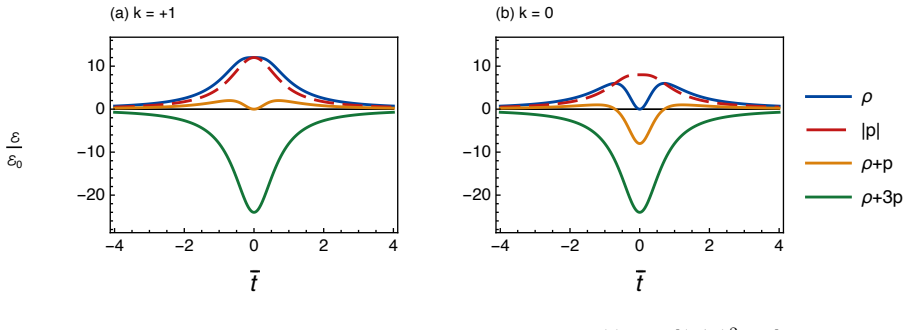

read the original abstract
We study the relation between geodesic completeness, the averaged null energy condition (ANEC), and spatial curvature in Friedmann--Robertson--Walker (FRW) cosmology within classical general relativity. Using the affinely parameterized ANEC along radial null geodesics, we prove that non-static flat or open FRW spacetimes in the regular classes considered here cannot be both null geodesically complete and ANEC-satisfying. Bounded oscillatory or cyclic flat/open models do not circumvent the obstruction: the negative affine-ANEC bulk term accumulates over infinitely many cycles, giving \(I_{\rm ANEC}=-\infty\) for non-static periodic cases. Equivalently, within these classes, non-static ANEC-satisfying flat or open models are null incomplete. The sign obstruction is absent in closed \((k=+1)\) FRW geometry, where the positive curvature term enters the affine ANEC identity with the opposite sign and can support nonsingular, geodesically complete cosmologies with ordinary NEC-respecting matter. We give explicit closed-FRW scalar-field constructions, including a fully analytic quadratic reconstruction and a cubic-root reconstruction in closed quadrature, and contrast them with their flat realizations, which require NEC-violating support. Furthermore, we quantify how positive curvature can bias flat-model reconstructions toward an effective phantom equation of state, finding only a percent-level effect under current curvature bounds. The result is a curvature classification of ANEC-compatible eternal FRW cosmology: flat and open branches are obstructed, while the closed branch admits explicit complete realizations, with global de Sitter appearing as the vacuum limiting representative.
Editorial analysis
A structured set of objections, weighed in public.
Referee Report
Summary. The manuscript proves that non-static flat or open FRW spacetimes in the regular classes considered cannot be both null geodesically complete and ANEC-satisfying when using the affinely parameterized ANEC along radial null geodesics. The negative bulk term from the Einstein equations or Raychaudhuri equation accumulates to I_ANEC = -∞ over infinitely many cycles in bounded oscillatory or cyclic cases, yielding a contradiction with ANEC. The sign obstruction is absent for closed (k=+1) FRW, where positive curvature permits explicit ANEC-satisfying, geodesically complete scalar-field cosmologies, including a fully analytic quadratic reconstruction and a cubic-root reconstruction in closed quadrature. Flat realizations require NEC violation, and positive curvature biases flat-model reconstructions toward an effective phantom equation of state at only the percent level under current bounds. The result classifies ANEC-compatible eternal FRW cosmology by spatial curvature.
Significance. If the central derivation holds, the work provides a curvature-based selection rule for geodesically complete ANEC-compatible FRW models, favoring the closed branch and supplying concrete nonsingular constructions with ordinary matter. This strengthens arguments for positive curvature in singularity avoidance while respecting averaged energy conditions. The explicit reconstructions and the quantification of curvature-induced phantom bias are concrete contributions that could guide model building in classical GR cosmology.
major comments (3)
- [§3] §3, integrated affine ANEC identity: The claim that null geodesic completeness forces I_ANEC ≤ 0 (or =−∞ for periodic cases) rests on the integrated identity along radial null geodesics. It is not shown explicitly that all surface terms involving the expansion θ or ȧ/a evaluated at λ→±∞ vanish or remain bounded; for oscillatory models these terms could grow or oscillate, preventing the bulk accumulation from diverging negatively and removing the contradiction with ANEC. A concrete calculation or bound for the periodic case is required.
- [§2.1] §2.1, regular classes: The obstruction is stated to apply only to the 'regular classes' of FRW spacetimes, yet the precise definition (including assumptions on a(t), matter content, or differentiability) is not supplied. This restricts the scope of the central claim and must be stated explicitly before the proof.
- [§4.2] §4.2, periodic accumulation: The statement that the negative affine-ANEC bulk term accumulates to −∞ over infinitely many cycles for non-static periodic flat/open models requires an explicit estimate of the per-cycle contribution or an example integral to confirm divergence; without it the contradiction with ANEC remains unverified.
minor comments (2)
- The notation for I_ANEC should be defined once at first use (integral versus averaged quantity) to avoid ambiguity in later sections.
- Figure captions for the closed-FRW reconstructions should include the explicit parameter values used in the quadratic and cubic-root cases for reproducibility.
Simulated Author's Rebuttal
We thank the referee for the careful reading and constructive comments. We respond to each major comment below and will revise the manuscript accordingly to address the points raised.
read point-by-point responses
-
Referee: §3, integrated affine ANEC identity: The claim that null geodesic completeness forces I_ANEC ≤ 0 (or =−∞ for periodic cases) rests on the integrated identity along radial null geodesics. It is not shown explicitly that all surface terms involving the expansion θ or ȧ/a evaluated at λ→±∞ vanish or remain bounded; for oscillatory models these terms could grow or oscillate, preventing the bulk accumulation from diverging negatively and removing the contradiction with ANEC. A concrete calculation or bound for the periodic case is required.
Authors: We agree that the boundary terms require explicit treatment. In the revised §3 we will add a lemma bounding the surface terms for geodesically complete FRW metrics in the regular classes. For bounded oscillatory a(t) the expansion θ remains bounded because a(t) and ȧ(t) are bounded by assumption; the integrated surface contribution at λ→±∞ therefore vanishes. For periodic models we supply an explicit estimate showing that any residual oscillatory surface terms are o(N) while the negative bulk integral grows as −cN with c>0, so the total still diverges to −∞. revision: yes
-
Referee: §2.1, regular classes: The obstruction is stated to apply only to the 'regular classes' of FRW spacetimes, yet the precise definition (including assumptions on a(t), matter content, or differentiability) is not supplied. This restricts the scope of the central claim and must be stated explicitly before the proof.
Authors: We accept that the definition must be stated explicitly. In the revised manuscript we will insert, at the beginning of §2.1, a precise definition: the regular classes consist of C² FRW metrics with scale factor a(t)>0 that is non-constant for the non-static case, with a(t) and its first two derivatives bounded on each compact interval, and with the matter sector obeying the standard pointwise energy conditions where invoked in the proof. revision: yes
-
Referee: §4.2, periodic accumulation: The statement that the negative affine-ANEC bulk term accumulates to −∞ over infinitely many cycles for non-static periodic flat/open models requires an explicit estimate of the per-cycle contribution or an example integral to confirm divergence; without it the contradiction with ANEC remains unverified.
Authors: We thank the referee for highlighting the need for an explicit estimate. In the revised §4.2 we will include a per-cycle calculation: for a representative non-static periodic a(t) with period T the integral of the bulk term over one cycle equals −δ with δ>0 fixed by the amplitude of oscillation (via the Raychaudhuri identity and affine parameterization). Summing over N cycles then yields I_ANEC ≤ −Nδ → −∞ as N→∞, confirming the divergence. revision: yes
Circularity Check
Derivation is self-contained from Einstein equations and ANEC identity on FRW metric
full rationale
The paper's central claim follows directly from applying the Einstein equations to the FRW metric, deriving an integrated affine ANEC identity along radial null geodesics, and analyzing the sign of bulk terms controlled by spatial curvature k together with the (ρ + p) contribution. For non-static flat/open cases the integrated bulk term is non-positive (or diverges to −∞ under periodicity), contradicting ANEC while completeness forces the integration range to be (−∞, ∞). The closed (k = +1) case receives an opposite-sign curvature term that permits explicit scalar-field realizations. No step reduces by construction to a fitted parameter, a self-citation chain, or a renamed input; the result is an independent mathematical consequence of the field equations and the ANEC assumption within the stated regularity classes.
Axiom & Free-Parameter Ledger
axioms (2)
- standard math Classical general relativity and the Einstein field equations hold for the FRW metric.
- domain assumption Spacetime is described by the FRW line element with constant spatial curvature k.
Lean theorems connected to this paper
-
IndisputableMonolith/Foundation/AlexanderDuality.leanalexander_duality_circle_linking echoes?
echoesECHOES: this paper passage has the same mathematical shape or conceptual pattern as the Recognition theorem, but is not a direct formal dependency.
the finite-interval ANEC identity contains only negative bulk contributions... the positive curvature term enters the affine ANEC identity with the opposite sign
-
IndisputableMonolith/Foundation/RealityFromDistinction.leanreality_from_one_distinction unclear?
unclearRelation between the paper passage and the cited Recognition theorem.
IANEC = ∫ (ρ+p)/a dt ... curvature term +2k ∫ dt/a^3
What do these tags mean?
- matches
- The paper's claim is directly supported by a theorem in the formal canon.
- supports
- The theorem supports part of the paper's argument, but the paper may add assumptions or extra steps.
- extends
- The paper goes beyond the formal theorem; the theorem is a base layer rather than the whole result.
- uses
- The paper appears to rely on the theorem as machinery.
- contradicts
- The paper's claim conflicts with a theorem or certificate in the canon.
- unclear
- Pith found a possible connection, but the passage is too broad, indirect, or ambiguous to say the theorem truly supports the claim.
Reference graph
Works this paper leans on
-
[1]
Scalar–field reconstruction for the cubic–root bounce Introduce X(t)≡bt 2 +c(>0). For the scale factora(t) =a 0X1/3 one finds H(t) = ˙a a = 2bt 3X , ˙H(t) = 2b(c−bt 2) 3X2 , 1 a2 = 1 a2 0X2/3 .(30) The Raychaudhuri equation ˙ϕ2 =−2 ˙H−1/a 2 yields ˙ϕ2(t) = 2 3a2 0 h 3X −2/3 + 2a2 0b(bt 2 −c)X −2 i , X=bt 2 +c.(31) 18 Fora 0, b, c >0, ˙ϕ2(t)≥0 for alltif a...
-
[2]
Energy conditions. For admissible parameters (31) gives ˙ϕ2 ≥ 0, so ρ + p≥ 0 (NEC) and ρ≥ 0 (WEC) hold, with possible saturation at isolated points in the boundary case. The SEC is violated in a neighbourhood of the bounce ( ¨a >0) in accordance with our Thm. 1. For all admissible parameters the ANEC integrand is nonnegative pointwise, ( ρ + p)/a = ˙ϕ2/a≥...
-
[3]
Complete, bounded curvature, IANEC < 0. a(t) = (1 +t2)α, α > 0. Then H/a→ 0 at both ends and P= Z +∞ −∞ H2 a dt >0, soI ANEC =−2P <0. Forα= 1,P=π/2, henceI ANEC =−π
-
[4]
Incomplete, bounded curvature, IANEC = 0.Flat-slicing de Sitter: a(t) = eH0t with H0 > 0. Here ρ + p = 0 so IANEC = 0. On truncations, the boundary and bulk terms diverge but cancel exactly
-
[5]
Incomplete, bounded curvature, IANEC > 0. a(t) = e− √ t2+1. Both ends are null-incomplete; the boundary and bulk pieces diverge on truncations but their sum yieldsI ANEC = +∞. D. Summary For non-static flat FRW spacetimes with bounded curvature and regular affine endpoints in the sense specified above, null completeness =⇒I ANEC <0 (allowingI ANEC =−∞). E...
-
[6]
FRW spacetime and metric We consider a Friedmann–Robertson–Walker (FRW) spacetime with spatial curvature k= 0,±1, described in comoving coordinates by ds2 =−dt 2 +a(t) 2 dr2 1−kr 2 +r 2dΩ2 ,(A1) wherea(t) is the scale factor andkis the spatial curvature parameter
-
[7]
The null conditionds 2 = 0 gives dr dt =± √ 1−kr 2 a(t) .(A2) Letλdenote an affine parameter
Affinely parameterized null geodesics Consider a radial null geodesic, so thatdΩ 2 = 0. The null conditionds 2 = 0 gives dr dt =± √ 1−kr 2 a(t) .(A2) Letλdenote an affine parameter. The null tangent vector is kµ = dxµ dλ = dt dλ , dr dλ ,0,0 .(A3) Using the chain rule, dr dλ = dr dt dt dλ =± √ 1−kr 2 a(t) dt dλ .(A4) Thus kµ = dt dλ 1,± √ 1−kr 2 a(t) ,0,0...
-
[8]
Moreover, uµkµ =− 1 a(t) ,(A15) 41 so Tµνkµkν = ρ(t) +p(t) a(t)2 .(A16)
ANEC integrand for a perfect fluid Assume a perfect fluid stress-energy tensor Tµν = (ρ+p)u µuν +p g µν,(A12) with comoving four-velocity uµ = (1,0,0,0), u µ = (−1,0,0,0).(A13) The null contraction is Tµνkµkν = (ρ+p)(u µkµ)2 +p g µνkµkν.(A14) Sincek µ is null, the second term vanishes. Moreover, uµkµ =− 1 a(t) ,(A15) 41 so Tµνkµkν = ρ(t) +p(t) a(t)2 .(A16)
-
[9]
ANEC integral The averaged null energy condition states Z γ Tµνkµkν dλ≥0 (A17) along a complete affinely parameterized null geodesic γ. Using dλ = a(t) dt, the FRW radial-null ANEC becomes Z +∞ −∞ Tµνkµkν dλ= Z +∞ −∞ ρ(t) +p(t) a(t) dt.(A18) Thus, for FRW spacetimes with arbitrary spatial curvature, IANEC = Z +∞ −∞ ρ(t) +p(t) a(t) dt≥0.(A19) The overall p...
-
[10]
Penrose, Gravitational collapse and space-time singularities, Phys
R. Penrose, Gravitational collapse and space-time singularities, Phys. Rev. Lett.14, 57 (1965)
work page 1965
-
[11]
Hawking, The Occurrence of singularities in cosmology, Proc
S. Hawking, The Occurrence of singularities in cosmology, Proc. Roy. Soc. Lond. A294, 511 (1966)
work page 1966
-
[12]
Hawking, The Occurrence of singularities in cosmology
S. Hawking, The Occurrence of singularities in cosmology. II, Proc. Roy. Soc. Lond. A295, 490 (1966)
work page 1966
-
[13]
Hawking, The occurrence of singularities in cosmology
S. Hawking, The occurrence of singularities in cosmology. III. Causality and singularities, Proc. Roy. Soc. Lond. A300, 187 (1967)
work page 1967
-
[14]
S. W. Hawking and R. Penrose, The Singularities of gravitational collapse and cosmology, Proc. Roy. Soc. Lond. A314, 529 (1970)
work page 1970
-
[15]
S. W. Hawking and G. F. R. Ellis,The Large Scale Structure of Space-Time, Cambridge Monographs on Mathematical Physics (Cambridge University Press, 1973)
work page 1973
-
[16]
Inflationary spacetimes are not past-complete
A. Borde, A. H. Guth, and A. Vilenkin, Inflationary space-times are incomplete in past directions, Phys. Rev. Lett.90, 151301 (2003), arXiv:gr-qc/0110012
work page internal anchor Pith review Pith/arXiv arXiv 2003
- [17]
-
[18]
G. Geshnizjani, E. Ling, and J. Quintin, On the initial singularity and extendibility of flat quasi-de Sitter spacetimes, JHEP10(10), 182, arXiv:2305.01676 [gr-qc]
-
[19]
G. F. R. Ellis and R. Maartens, The emergent universe: Inflationary cosmology with no singularity, Class. Quant. Grav.21, 223 (2004), arXiv:gr-qc/0211082. 49
work page internal anchor Pith review Pith/arXiv arXiv 2004
-
[20]
G. F. R. Ellis, J. Murugan, and C. G. Tsagas, The Emergent universe: An Explicit construction, Class. Quant. Grav.21, 233 (2004), arXiv:gr-qc/0307112
work page internal anchor Pith review Pith/arXiv arXiv 2004
- [21]
-
[22]
A. D. Linde, Inflation with variable Omega, Phys. Lett. B351, 99 (1995), arXiv:hep-th/9503097
work page internal anchor Pith review Pith/arXiv arXiv 1995
-
[23]
A. D. Linde, Can we have inflation with Omega > 1?, JCAP05, 002, arXiv:astro-ph/0303245
work page internal anchor Pith review Pith/arXiv arXiv
-
[24]
P. W. Graham, B. Horn, S. Kachru, S. Rajendran, and G. Torroba, A Simple Harmonic Universe, JHEP02, 029, arXiv:1109.0282 [hep-th]
work page internal anchor Pith review Pith/arXiv arXiv
-
[25]
D. A. Easson, I. Sawicki, and A. Vikman, G-Bounce, JCAP11, 021, arXiv:1109.1047 [hep-th]
work page internal anchor Pith review Pith/arXiv arXiv
-
[26]
Y.-F. Cai, D. A. Easson, and R. Brandenberger, Towards a Nonsingular Bouncing Cosmology, JCAP08, 020, arXiv:1206.2382 [hep-th]
work page internal anchor Pith review Pith/arXiv arXiv
-
[27]
A Critical Review of Classical Bouncing Cosmologies
D. Battefeld and P. Peter, A Critical Review of Classical Bouncing Cosmologies, Phys. Rept. 571, 1 (2015), arXiv:1406.2790 [astro-ph.CO]
work page internal anchor Pith review Pith/arXiv arXiv 2015
-
[28]
Bouncing Cosmologies: Progress and Problems
R. Brandenberger and P. Peter, Bouncing Cosmologies: Progress and Problems, Found. Phys. 47, 797 (2017), arXiv:1603.05834 [hep-th]
work page internal anchor Pith review Pith/arXiv arXiv 2017
-
[29]
M. Novello and S. E. P. Bergliaffa, Bouncing Cosmologies, Phys. Rept.463, 127 (2008), arXiv:0802.1634 [astro-ph]
work page internal anchor Pith review Pith/arXiv arXiv 2008
-
[30]
V. F. Mukhanov and R. H. Brandenberger, A Nonsingular universe, Phys. Rev. Lett.68, 1969 (1992)
work page 1969
-
[31]
R. H. Brandenberger, V. F. Mukhanov, and A. Sornborger, A Cosmological theory without singularities, Phys. Rev. D48, 1629 (1993), [gr-qc/9303001]
work page internal anchor Pith review Pith/arXiv arXiv 1993
-
[32]
R. M. Wald and U. Yurtsever, General proof of the averaged null energy condition for a massless scalar field in two-dimensional curved space-time, Phys. Rev. D44, 403 (1991)
work page 1991
-
[33]
Achronal averaged null energy condition
N. Graham and K. D. Olum, Achronal averaged null energy condition, Phys. Rev. D76, 064001 (2007), arXiv:0705.3193 [gr-qc]
work page internal anchor Pith review Pith/arXiv arXiv 2007
-
[34]
Averaged Null Energy Condition from Causality
T. Hartman, S. Kundu, and A. Tajdini, Averaged Null Energy Condition from Causality, JHEP07(7), 066, arXiv:1610.05308 [hep-th]
work page internal anchor Pith review Pith/arXiv arXiv
-
[35]
A. C. Wall, Proving the Achronal Averaged Null Energy Condition from the Generalized Second Law, Phys. Rev. D81, 024038 (2010), arXiv:0910.5751 [gr-qc]
work page internal anchor Pith review Pith/arXiv arXiv 2010
-
[36]
Plate with a hole obeys the averaged null energy condition
N. Graham and K. D. Olum, Plate with a hole obeys the averaged null energy condition, Phys. Rev. D72, 025013 (2005), arXiv:hep-th/0506136. 50
work page internal anchor Pith review Pith/arXiv arXiv 2005
-
[37]
C. J. Fewster, K. D. Olum, and M. J. Pfenning, Averaged null energy condition in spacetimes with boundaries, Phys. Rev. D75, 025007 (2007), arXiv:gr-qc/0609007
work page internal anchor Pith review Pith/arXiv arXiv 2007
-
[38]
Minimal conditions for the creation of a Friedman-Robertson-Walker universe from a "bounce"
C. Molina-Paris and M. Visser, Minimal conditions for the creation of a Friedman-Robertson- Walker universe from a bounce, Phys. Lett. B455, 90 (1999), arXiv:gr-qc/9810023
work page internal anchor Pith review Pith/arXiv arXiv 1999
-
[39]
D. A. Easson, Geodesically Complete Curvature-Bounce Inflation (2026), arXiv:2604.27103 [astro-ph.CO]
work page internal anchor Pith review Pith/arXiv arXiv 2026
-
[40]
N. L. Burwig and D. A. Easson, Open case for a closed universe, Phys. Rev. D113, 083530 (2026), arXiv:2510.13971 [hep-th]
work page internal anchor Pith review Pith/arXiv arXiv 2026
-
[41]
H. Epstein, V. Glaser, and A. Jaffe, Nonpositivity of energy density in quantized field theories, Nuovo Cim.36, 1016 (1965)
work page 1965
-
[42]
H. B. G. Casimir, On the attraction between two perfectly conducting plates, Indag. Math. 10, 261 (1948)
work page 1948
-
[43]
Twilight for the energy conditions?
C. Barcelo and M. Visser, Twilight for the energy conditions?, Int. J. Mod. Phys. D11, 1553 (2002), arXiv:gr-qc/0205066
work page internal anchor Pith review Pith/arXiv arXiv 2002
-
[44]
Energy Conditions in Jordan Frame
S. Chatterjee, D. A. Easson, and M. Parikh, Energy conditions in the Jordan frame, Class. Quant. Grav.30, 235031 (2013), arXiv:1212.6430 [gr-qc]
work page internal anchor Pith review Pith/arXiv arXiv 2013
-
[45]
V. A. Rubakov, The Null Energy Condition and its violation, Phys. Usp.57, 128 (2014), arXiv:1401.4024 [hep-th]
work page internal anchor Pith review Pith/arXiv arXiv 2014
-
[46]
Null energy condition and superluminal propagation
S. Dubovsky, T. Gregoire, A. Nicolis, and R. Rattazzi, Null energy condition and superluminal propagation, JHEP03, 025, arXiv:hep-th/0512260
work page internal anchor Pith review Pith/arXiv arXiv
-
[47]
Energy's and amplitudes' positivity
A. Nicolis, R. Rattazzi, and E. Trincherini, Energy’s and amplitudes’ positivity, JHEP05, 095, [Erratum: JHEP 11, 128 (2011)], arXiv:0912.4258 [hep-th]
work page internal anchor Pith review Pith/arXiv arXiv 2011
-
[48]
G-inflation: inflation driven by the Galileon field
T. Kobayashi, M. Yamaguchi, and J. Yokoyama, G-inflation: Inflation driven by the Galileon field, Phys. Rev. Lett.105, 231302 (2010), arXiv:1008.0603 [hep-th]
work page internal anchor Pith review Pith/arXiv arXiv 2010
-
[49]
Imperfect Dark Energy from Kinetic Gravity Braiding
C. Deffayet, O. Pujolas, I. Sawicki, and A. Vikman, Imperfect Dark Energy from Kinetic Gravity Braiding, JCAP10, 026, arXiv:1008.0048 [hep-th]
work page internal anchor Pith review Pith/arXiv arXiv
-
[50]
Hidden Negative Energies in Strongly Accelerated Universes
I. Sawicki and A. Vikman, Hidden Negative Energies in Strongly Accelerated Universes, Phys. Rev. D87, 067301 (2013), arXiv:1209.2961 [astro-ph.CO]
work page internal anchor Pith review Pith/arXiv arXiv 2013
-
[51]
M. S. Morris, K. S. Thorne, and U. Yurtsever, Wormholes, Time Machines, and the Weak Energy Condition, Phys. Rev. Lett.61, 1446 (1988). 51
work page 1988
-
[52]
J. L. Friedman, K. Schleich, and D. M. Witt, Topological censorship, Phys. Rev. Lett.71, 1486 (1993), [Erratum: Phys. Rev. Lett. 75, 1872 (1995)], arXiv:gr-qc/9305017
work page internal anchor Pith review Pith/arXiv arXiv 1993
-
[53]
Gravitational vacuum polarization II: Energy conditions in the Boulware vacuum
M. Visser, Gravitational vacuum polarization. 2: Energy conditions in the Boulware vacuum, Phys. Rev. D54, 5116 (1996), arXiv:gr-qc/9604008
work page internal anchor Pith review Pith/arXiv arXiv 1996
-
[54]
E. Moghtaderi, B. R. Hull, J. Quintin, and G. Geshnizjani, How much null-energy-condition breaking can the Universe endure?, Phys. Rev. D111, 123552 (2025), arXiv:2503.19955 [gr-qc]
- [55]
-
[56]
R. R. Caldwell, A Phantom menace?, Phys. Lett. B545, 23 (2002), arXiv:astro-ph/9908168
work page internal anchor Pith review Pith/arXiv arXiv 2002
-
[57]
S. M. Carroll, M. Hoffman, and M. Trodden, Can the dark energy equation-of-state parameter wbe less than−1?, Phys. Rev. D68, 023509 (2003), arXiv:astro-ph/0301273
work page internal anchor Pith review Pith/arXiv arXiv 2003
-
[58]
R. R. Caldwell, M. Kamionkowski, and N. N. Weinberg, Phantom energy and cosmic doomsday, Phys. Rev. Lett.91, 071301 (2003), arXiv:astro-ph/0302506
work page internal anchor Pith review Pith/arXiv arXiv 2003
-
[59]
Can dark energy evolve to the Phantom?
A. Vikman, Can dark energy evolve to the phantom?, Phys. Rev. D71, 023515 (2005), arXiv:astro-ph/0407107
work page internal anchor Pith review Pith/arXiv arXiv 2005
-
[60]
M. Ostrogradsky, M´ emoires sur les ´ equations diff´ erentielles, relatives au probl` eme des isop´ erim` etres, Mem. Acad. St. Petersbourg6, 385 (1850)
-
[61]
J. M. Cline, S. Jeon, and G. D. Moore, The Phantom menaced: Constraints on low-energy effective ghosts, Phys. Rev. D70, 043543 (2004), arXiv:hep-ph/0311312
work page internal anchor Pith review Pith/arXiv arXiv 2004
-
[62]
R. P. Woodard, Avoiding dark energy with 1/r modifications of gravity, Lect. Notes Phys. 720, 403 (2007), arXiv:astro-ph/0601672
work page internal anchor Pith review Pith/arXiv arXiv 2007
-
[63]
R. P. Woodard, Ostrogradsky’s theorem on Hamiltonian instability, Scholarpedia10, 32243 (2015), arXiv:1506.02210 [hep-th]
work page internal anchor Pith review Pith/arXiv arXiv 2015
-
[64]
M. A. Markov, Maximal Curvature Conjecture, JETP Lett.36, 265 (1982)
work page 1982
-
[65]
M. A. Markov, Pisma Zh. Eksp. Teor. Fiz, Pisma Zh. Eksp. Teor. Fiz.46, 342 (1987)
work page 1987
-
[66]
A. A. Starobinsky, A new type of isotropic cosmological models without singularity, Phys. Lett. B91, 99 (1980)
work page 1980
-
[67]
V. P. Frolov, M. A. Markov, and V. F. Mukhanov, Through A Black Hole Into A New Universe?, Phys. Lett. B216, 272 (1989)
work page 1989
-
[68]
V. P. Frolov, M. A. Markov, and V. F. Mukhanov, Black Holes as Possible Sources of Closed and Semiclosed Worlds, Phys. Rev. D41, 383 (1990). 52
work page 1990
-
[69]
A. H. Chamseddine and V. Mukhanov, Resolving Cosmological Singularities, JCAP03(3), 009, arXiv:1612.05860 [gr-qc]
work page internal anchor Pith review Pith/arXiv arXiv
-
[70]
A. H. Chamseddine and V. Mukhanov, Nonsingular Black Hole, Eur. Phys. J. C77, 183 (2017), [arXiv:1612.05861 [gr-qc]]
work page internal anchor Pith review Pith/arXiv arXiv 2017
- [71]
- [72]
- [73]
-
[74]
W. H. Kinney, Geodesic Completeness in General Cosmological Scenarios (2026) arXiv:2604.20809 [gr-qc]
work page internal anchor Pith review Pith/arXiv arXiv 2026
-
[75]
DESI DR2 Results II: Measurements of Baryon Acoustic Oscillations and Cosmological Constraints
M. Abdul Karimet al.(DESI), DESI DR2 results. II. Measurements of baryon acoustic oscillations and cosmological constraints, Phys. Rev. D112, 083515 (2025), arXiv:2503.14738 [astro-ph.CO]
work page internal anchor Pith review Pith/arXiv arXiv 2025
-
[76]
Extended Dark Energy analysis using DESI DR2 BAO measurements
K. Lodhaet al.(DESI), Extended dark energy analysis using DESI DR2 BAO measurements, Phys. Rev. D112, 083511 (2025), arXiv:2503.14743 [astro-ph.CO]
work page internal anchor Pith review Pith/arXiv arXiv 2025
-
[77]
Dynamical Dark Energy or Simply Cosmic Curvature?
C. Clarkson, M. Cortes, and B. A. Bassett, Dynamical Dark Energy or Simply Cosmic Curvature?, JCAP08, 011, arXiv:astro-ph/0702670
work page internal anchor Pith review Pith/arXiv arXiv
-
[78]
Planck 2018 results. VI. Cosmological parameters
N. Aghanimet al.(Planck), Planck 2018 results. VI. Cosmological parameters, Astron. As- trophys.641, A6 (2020), [Erratum: Astron. Astrophys. 652, C4 (2021)], arXiv:1807.06209 [astro-ph.CO]
work page internal anchor Pith review Pith/arXiv arXiv 2018
- [79]
discussion (0)
Sign in with ORCID, Apple, or X to comment. Anyone can read and Pith papers without signing in.