REVIEW 5 major objections 6 minor 3 references
CueTip: An Interactive and Explainable Physics-aware Pool Assistant
T0 review · 5 major / 6 minor · reviewed 2026-08-10 · deepseek-v4-flash
Pith's one-line read CueTip couples a language model to a physics simulator and expert rules, and keeps the agent's win rate while explaining every shot.
desk verdict Worth refereeing, but the reliability claim rests on a rule set that is never shown and a surrogate that is never validated. read the letter →
The pith
A machine-rendered reading of the paper's core claim, the machinery that carries it, and where it could break.
The reading
What carries the argument
The load-bearing object is the neural surrogate $\tilde{\pi}$, a six-layer MLP that maps a vector of 29 expert-rule evaluations $r_i(x,\theta)$ to a discretized distribution over expected win rate, trained on Monte Carlo rollouts of the underlying agent with execution noise. It is flanked by two abstractions: an event-trace representation $f_e$ that converts simulator output into ordered strings like ball-ball-<id>-<id>, and the rule book $R$ of 29 natural-language heuristics paired with hand-implemented evaluators $r_i$. The recommender uses an LLM with chain-of-thought prompting to propose event sequences; the tuner maximizes $\mathbb{E}[\tilde{p}]+v_s+v_d$ (expected surrogate value plus strategy and difficulty scores) via simulated annealing; and the explainer receives the computed rule values as part of its context so that its prose refers to measured quantities rather than the LLM's guesses about physics.
What would settle it
Train the surrogate with the same pipeline but with a rule vector that has been deliberately corrupted (e.g., one rule's evaluations randomly permuted across states); if CueTip's win rate and explanation relevance remain unchanged, the rules are not actually carrying the information the paper attributes to them. A cleaner test would be to hold out a set of table layouts and check whether the surrogate's win-rate predictions degrade when the rules are computed for those layouts versus in-distribution ones.
Extended reading notes
Core claim
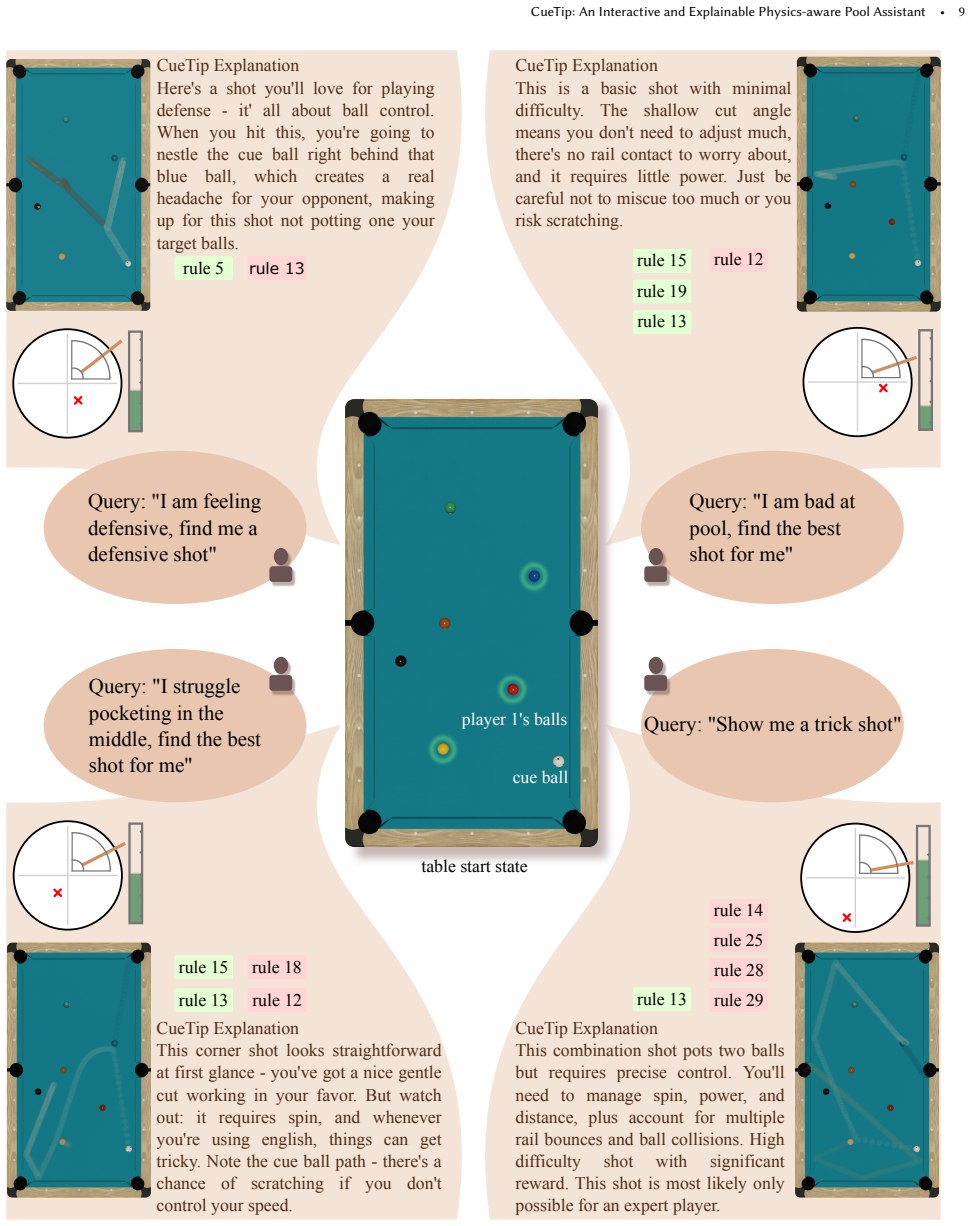
The central claim is that a modular pipeline—an LLM that proposes shot event sequences, a tuner that optimizes those proposals against a neural surrogate of a pool agent, and an explainer that grounds its text in a fixed set of domain-expert rule evaluations—yields a coach for a three-ball pool variant that maintains or improves the win rate of the agent it wraps. The paper demonstrates this for two underlying agents, a tournament-winning PoolMaster-style agent and a simple greedy agent, and it shows that the assistant's explanations receive higher human quality ratings than a baseline LLM that lacks access to the computed rule evaluations. The reliability experiment additionally shows that when the LLM is given the rule-evaluation vector r, its Likert-scale estimates of each rule's applicability match the reference evaluations far more closely than without it, with the effect strongest for the largest model tested.
Load-bearing premise
The whole system rests on the 29 hand-implemented rule-evaluation functions r_i being both accurate enough to serve as ground truth and complete enough that the neural surrogate can predict expected win rate without ever seeing the raw table state or shot parameters.
Editorial extensions
If this is right
- If the central claim holds, natural-language coaching can be added to any rule-following physical agent without a costly LLM fine-tuning step, since the simulator and rule evaluators supply the physical grounding.
- The neural-surrogate design makes the assistant reconfigurable: swapping the underlying agent only requires retraining the small MLP on new state–shot pairs, not redesigning the interface or explanation mechanism.
- Grounded explanations appear to scale with model size: larger LLMs agree more closely with the computed rule evaluations, suggesting that explanation faithfulness is partly a function of the model's ability to follow structured context.
- The reported win-rate results imply that the interactivity gain does not necessarily cost competence, and in the PoolMaster case the surrogate-based tuning outperformed its own training baseline on win rate.
Reading between the lines
- A natural next experiment would be to test how explanation quality and win rate degrade when the rule set is intentionally misspecified, or when the assistant faces table layouts outside its training distribution.
- The same surrogate-plus-event-trace recipe could be lifted to other physics domains—robotics, billiards variants, or simulated manipulation—where a simulator and a small set of hand-coded heuristics exist, though the paper only demonstrates pool.
- If the reliability result generalizes, explanation-generation systems should treat numeric evaluations as first-class context rather than only natural-language rule descriptions; the reported gap between with-r and without-r conditions quantifies that benefit.
Editorial analysis
A structured set of objections, weighed in public.
Referee Report
Summary. The paper presents CueTip, an interactive and explainable pool-coaching assistant for a simplified variant of pool (3Pool). The system combines an off-the-shelf language model (LM) with an instrumented physics simulator that emits natural-language event traces, a set of 29 hand-implemented expert rules used to evaluate shots, a neural surrogate that maps rule-evaluation vectors to expected win-rate distributions, and a three-stage pipeline (recommender, tuner, explainer). The authors claim that CueTip provides contextual, physics-aware assistance and reliable explanations grounded in expert rules while maintaining (and sometimes improving) the win rate of the underlying agent. Experiments include qualitative query examples, pairwise win-rate comparisons among six agent variants, a likelihood-alignment experiment comparing LM rule-relevance estimates to ground-truth rule evaluations, and a user study with 100 participants.
Significance. If the central claims hold, CueTip would be a useful demonstration that a modular combination of an LM, a physics simulator, and expert-rule evaluations can yield an interactive coaching agent whose explanations are grounded rather than hallucinated. The paper's strengths are its clear modular architecture, its use of an instrumented simulator to produce interpretable event traces, the decision to train a small MLP surrogate to decouple the assistant from the underlying agent, and the inclusion of a user study with self-reported expertise levels. The authors also state an intention to release the 3Pool environment and implementation, which would be valuable to the community. However, the load-bearing validation of the reliability experiment and of the surrogate's predictive accuracy is currently insufficient, and the win-rate evidence for the key 'maintaining strength' claim is statistically weak.
major comments (5)
- [Section 4.2.2 and Appendix C (Listing 4)] The reliability experiment is close to tautological in the 'With r_r' condition. The prompt contains the ground-truth rule evaluations r_r (as percentages) together with an explicit, rule-by-rule conversion table from percentages to Likert bins (Appendix C, Listing 4). An LM that can read and transcribe will reproduce the reference Likert labels with near-zero error. The low distance between the LM output and the reference therefore measures instruction-following and numeric transcription, not the LM's ability to assess rule relevance from physical or contextual information. The abstract's claim that 'the explanations generated by CueTip are physically-aware and grounded in the expert rules and are therefore more reliable' is not established by this experiment. The authors should redesign the experimental condition so that the LM must predict rule relevance from the state, shot parameters, and event trace without being handed the reference evaluations; the existing 'Without r_r' condition could serve as the experimental condition, and a stronger baseline should be added.
- [Section 3.3 and Algorithm 1] The neural surrogate π~ maps a 29-dimensional rule-evaluation vector r to a distribution over expected win rate, and the tuner in Section 3.2 maximizes E[π~(r)] + strategy score + difficulty score. This objective is valid only if r is an approximately sufficient statistic for win rate and if π~ is accurate on the rule vectors the tuner actually explores. Algorithm 1 trains π~ only on r vectors of agent-selected shots (θ = π(x)), whereas at inference the tuner evaluates r for recommender-proposed and iteratively optimized shots, which may lie outside that distribution. The paper reports no held-out accuracy, no calibration of the predicted win-rate distributions against Monte Carlo estimates, no sensitivity analysis of the choice of n bins, and no ablation that isolates surrogate error from agent strength. The authors should add a validation section reporting held-out loss, a comparison of π~ predictions to Monte Carlo win-rate estimates on the tuner's search distribution, and an analysis of where the tuner's optimized r vectors lie relative to the training distribution.
- [Table 1 and Section 5.2.1] The key comparison for the claim that CueTip maintains strength is Πpm versus πpm, reported as a 59% win rate with standard deviation 4.9% over 100 games. The corresponding 95% confidence interval (approximately [49.4%, 68.6%]) includes 50%, so the data do not provide strong evidence that Πpm is at least as strong as πpm; they are also consistent with a small advantage or with parity. The paper should report confidence intervals or Bayesian posterior intervals for the pairwise comparisons, and ideally increase the number of games or justify the sample size. In addition, the agent ablation in Section 6, which compares neural tuners to LM-based tuners, conflates surrogate quality with the recommender and prompt design; the caption and surrounding text should separate these contributors.
- [Section 2.2 and Appendix A] The paper states that the 29 rule-evaluation functions r_i are 'listed in Appendix A within supplemental material,' but the main text and the arXiv version's Appendix A contain only the natural-language descriptions R_i, not the actual mathematical or algorithmic implementations of r_i. Since r_i serves as ground truth for the reliability experiment, as the input to the neural surrogate, and as the basis of the explanations, the paper is not reproducible without those definitions. The authors should either include the implementations of r_i in an appendix or a clearly linked code repository, and should state which of the 13 value rules and 16 difficulty rules depend only on the state x and which depend on the shot θ, since some rule descriptions (e.g., 'Ball Groupings') are state-dependent while the rule evaluations are defined as r_i(x, θ).
- [Section 6, 'Limitations'] The authors acknowledge in the Limitations paragraph that 'potential inconsistency between R_i and the implementation of r_i could introduce inaccuracies in rule evaluation.' This is a correct and important caveat, but it is not merely a minor limitation: because the r_i functions are never defined in the paper and are used as ground truth for both the reliability experiment and the surrogate, this concession directly undercuts the reliability claim if the implementations are unavailable for inspection. The authors should treat this as a primary validation requirement rather than a closing caveat.
minor comments (6)
- [Throughout] There are several typos and minor errors: 'seperated' (Section 4.2.3), 'performas' (Section 5.2.1), 'similarily' (Section 2.1), 'simulated shot image' (Figure 1 caption), and 'i.e. heuristics' (Section 1). The paper would benefit from a careful proofread.
- [Section 4.2.2] The Likert-scale diagram in Section 4.2.2 (the line showing bin boundaries 0 through 6) is visually confusing as typeset; it would be clearer as a table with explicit intervals for each bin label, particularly because the 'moderate' bin has width 0.25 while the others have width 0.125.
- [Figure 3] The figure caption and legend use 'With rr' and 'Without rr' but do not define the bar colors beyond the text; adding explicit labels such as 'With r_r (orange)' and 'Without r_r (blue)' would improve readability.
- [Section 3.1] The event-based representation is described as lossy because it ignores geometry and dynamics attributes such as velocity and spin. The paper should clarify whether the recommender's simulated annealing optimization has access to the full state and shot parameters in addition to the event trace, since the loss term λ(|L_k| + ||θ_k||) suggests both are used.
- [Section 3.4] The definitions of w_o and w_d as binary classification vectors over rules are clear, but the paper does not state how the values of w_o and w_d were obtained (e.g., whether they were assigned by the authors or derived from the expert rules). This is worth a sentence of explanation for reproducibility.
- [Section 4.2.1] The hyperparameter description says 'For neural-based agents (π~, Π), we set the number of candidate shots K = 3 and use N = 300 simulated annealing steps,' but Section 4.1 states that the qualitative experiments use '5 candidate shots and 300 optimization steps.' The paper should reconcile these two settings or explain why they differ.
Circularity Check
The 'With r_r' reliability experiment reduces to a deterministic relabeling of the ground-truth rule values supplied in the prompt, making the central explanation-reliability claim partly circular; the surrogate's sufficiency is unvalidated but not itself circular.
-
self definitional
[Section 4.2.2 and Appendix C, Listing 4 (Relevance to Expert Rules Prompt, 'With r_r' condition)]
"Section 4.2.2: 'Our experiment constructs C_re from (x_r, theta_r, r_r) (as done by the explainer described in Sec. 3.2) and uses this to augment a skeleton test prompt P_t."
The reference labels s_r are defined by binning r_r on the Likert scale described in Section 4.2.2. In the 'With r_r' condition the prompt supplies r_r itself and an explicit percentage-to-bin conversion table, so the LM's output is a deterministic relabeling of its input. Agreement with ground truth therefore measures instruction-following, not the LM's ability to infer rule relevance from the physical state and shot. Because the explainer also receives r_r when generating explanations, the reliability claim is validated against the same values that produced the explanations; the loop closes by construction. The 'Without r_r' control only shows that withholding the answer degrades performance, which is expected.
full rationale
Most of CueTip's pipeline is not circular: the win-rate comparisons in Table 1 are external game simulations against genuine agents, the surrogate is trained on Monte Carlo win-rate histograms, and the user study provides independent (though subjective) evidence. The circular step is the reliability validation in Section 4.2.2/5.2.2. The 'With r_r' condition feeds the ground-truth rule-evaluation vector into the prompt and then asks the LM to output Likert categories; Listing 4 gives a deterministic conversion from each percentage X to a bin, so the low measured distance is a tautology. The paper's conclusion that 'r_r plays a vital role in grounding the explanations' is true by construction, since the explainer is given r_r as context, but it does not establish that the explanations are physically reliable. The paper's own Limitations concede that 'potential inconsistency between R_i and the implementation of r_i could introduce inaccuracies in rule evaluation,' and no external benchmark validates the 29 rule implementations as correct physics. The surrogate's sufficiency and out-of-distribution accuracy are asserted without held-out calibration, which is a correctness risk rather than a circularity. Overall, one central predictive claim reduces by construction, while the rest of the system is evaluated externally, giving a partial circularity score of 6.
Assumptions & free parameters
free parameters (8)
- Rule evaluation functions r_i (i=1 to 29) =
Unspecified; hand-implemented from Alciatore's textbook heuristics
- Strategy classification vectors w_o, w_d =
Unspecified binary vectors in {0,1}^29
- Difficulty entropy thresholds =
Low [0,0.4), medium [0.4,0.8), high [0.8, ...)
- Execution noise standard deviation sigma =
Not reported
- Win-rate histogram bins n =
Not reported
- Recommender regularization weight lambda =
Not reported
- MLP architecture and training hyperparameters =
6 layers x 256 ReLU, dropout 0.25, lr 0.005, 25 epochs, batch 128
- Likert bin boundaries =
All bins 0.125 wide except moderate [0.375,0.625)
assumptions (5)
- domain assumption The PoolTool physics simulator accurately models the dynamics of 3Pool (collisions, cushions, spin, friction).
- ad hoc to paper The 29 expert rules, as implemented by the authors, correctly capture shot value and difficulty in 3Pool.
- ad hoc to paper The rule evaluation vector r is a sufficient statistic for expected win rate.
- domain assumption Simulated annealing finds sufficiently good shots within 300 steps.
- domain assumption The off-the-shelf LM produces useful event sequences and explanations when given structured context.
invented entities (1)
-
3Pool environment
Cite this review
Pith. "Pith review of CueTip: An Interactive and Explainable Physics-aware Pool Assistant." pith.science (2026). https://pith.science/paper/2ENGNMJX
@misc{pith2026250118291,
  author       = {Pith},
  title        = {Pith review of: CueTip: An Interactive and Explainable Physics-aware Pool Assistant},
  year         = {2026},
  howpublished = {\url{https://pith.science/paper/2ENGNMJX}},
  note         = {Machine review of arXiv:2501.18291}
}
read the original abstract
We present an interactive and explainable automated coaching assistant called CueTip for a variant of pool/billiards. CueTip's novelty lies in its combination of three features: a natural-language interface, an ability to perform contextual, physics-aware reasoning, and that its explanations are rooted in a set of predetermined guidelines developed by domain experts. We instrument a physics simulator so that it generates event traces in natural language alongside traditional state traces. Event traces lend themselves to interpretation by language models, which serve as the interface to our assistant. We design and train a neural adaptor that decouples tactical choices made by CueTip from its interactivity and explainability allowing it to be reconfigured to mimic any pool playing agent. Our experiments show that CueTip enables contextual query-based assistance and explanations while maintaining the strength of the agent in terms of win rate (improving it in some situations). The explanations generated by CueTip are physically-aware and grounded in the expert rules and are therefore more reliable.
Figures


Figures from the paper (10 more)



Reference graph
Works this paper leans on
-
[1993]
Artificial Intelligence 61, 2 (1993), 209–261
DENDRAL: A case study of the first expert system for scientific hypothesis formation. Artificial Intelligence 61, 2 (1993), 209–261. https://doi.org/10.1016/ 0004-3702(93)90068-M Ruibo Liu, Jason Wei, Shixiang Shane Gu, Te-Yen Wu, Soroush Vosoughi, Claire Cui, Denny Zhou, and Andrew M. Dai. 2022. Mind’s Eye: Grounded Language Model Reasoning through Simul...
arXiv 1993
-
[2019]
Toward Human-like Billiard AI Bot Based on Backward Induction and Machine Learning. 2019 IEEE Symposium Series on Computational Intelligence (SSCI) (2019), 924–932. https://api.semanticscholar.org/CorpusID:211243863 Miles Turpin, Julian Michael, Ethan Perez, and Samuel Bowman. 2024. Language models don’t always say what they think: unfaithful explanations...
arXiv 2019
-
[2023]
A Foundation LAnguage-Image model of the Retina (FLAIR): Encoding expert knowledge in text supervision. Medical image analysis 99 (2023), 103357. https://api.semanticscholar.org/CorpusID:260899927 Kevin Smith, Lingjie Mei, Shunyu Yao, Jiajun Wu, Elizabeth Spelke, Josh Tenenbaum, and Tomer Ullman. 2019. Modeling expectation violation in intuitive physics ,...
Reviewed August 10, 2026 · model on record in the stance chip above.
Discussion (0). Continue with ORCID to comment.