Sub-kpc scale gas density histograms of the nearby barred spiral galaxy M83: Multi-component molecular gas structure reflecting the galactic environment
Pith reviewed 2026-05-20 17:25 UTC · model grok-4.3
The pith
Molecular gas in M83 consists of two log-normal components, with the denser one tied more closely to star formation.
A machine-rendered reading of the paper's core claim, the machinery that carries it, and where it could break.
Core claim
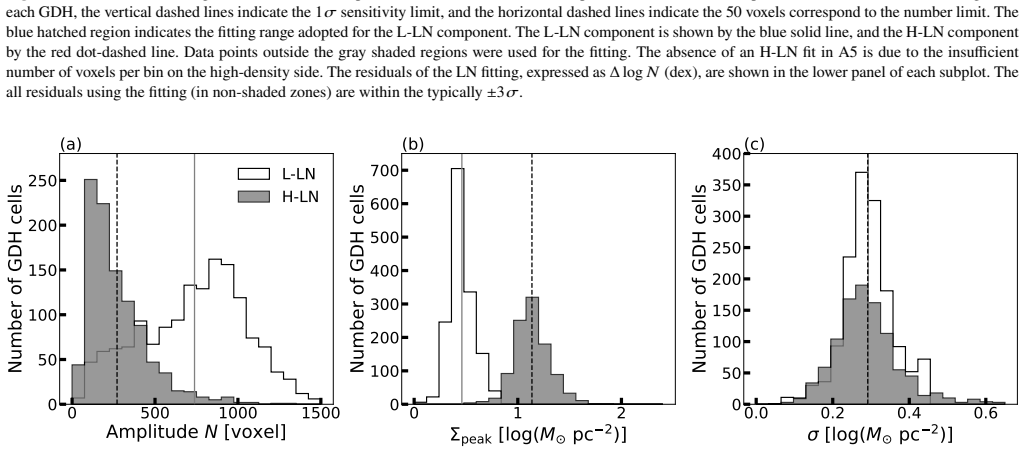
Gas density histograms in 550 pc cells across M83 are well described by one or two log-normal components. The lower-density component has mass that is relatively uniform across the disk, while the higher-density component is highly structured and traces spiral arms. The higher-density component shows a tight, nearly linear correlation with star formation rate surface density, whereas the lower-density component correlates only weakly and exhibits a steep Kennicutt-Schmidt relation with surface-density saturation. These observations demonstrate that the molecular interstellar medium in M83 comprises multiple components whose relative contributions are regulated by galactic environment, with a
What carries the argument
Gas density histogram (GDH) constructed in 550 pc by 550 pc by 100 km/s cells and decomposed into lower log-normal (L-LN) and higher log-normal (H-LN) components that separate spatially extended and arm-tracing molecular gas.
Where Pith is reading between the lines
- The separation into two components may explain why star formation efficiency appears to vary with galactic environment even when total molecular gas is measured.
- Similar two-component structure observed in the Milky Way could be the local counterpart of the L-LN and H-LN populations seen here.
- If the pattern holds, CO-based star formation relations may need to be reinterpreted as mixtures of the two components rather than a single phase.
Load-bearing premise
That the log-normal fits to the gas density histograms in 550-pc cells correspond to physically distinct gas phases rather than serving only as a convenient statistical description.
What would settle it
High-resolution maps that show whether the two fitted components remain separable at scales much smaller than 550 pc or whether their velocity or excitation properties differ in a way that matches distinct physical phases.
Figures




read the original abstract
We investigate the sub-kiloparsec (sub-kpc) molecular ISM structure and its relation to the galactic environment and star formation in the barred spiral galaxy M83 (NGC 5236). We employ the gas density histogram (GDH), which quantifies molecular gas surface density within $550~\mathrm{pc}\times550~\mathrm{pc}\times100~\mathrm{km~s^{-1}}$ cells. The GDHs are well described by one or two log-normal components, corresponding to the lower and higher-surface-density molecular components, referred to as L-LN and H-LN, respectively. The L-LN mass ($M_{\rm L}$) is relatively uniform across the disk, whereas the H-LN mass ($M_{\rm H}$) is highly structured and traces spiral arms. The fractional contribution of the H-LN component ($f^{\prime}_{\rm H}$) shows coherent structures across the disk and is enhanced along spiral arms, consistent with our previous Milky Way results. Moreover, while the L-LN correlates only weakly with star formation rate surface density ($\Sigma_{\rm SFR}$) and shows a steep Kennicutt-Schmidt (KS) relation with surface-density saturation reminiscent of atomic gas, the H-LN exhibits a tighter, nearly linear correlation similar to the conventional molecular KS relation. These results provide direct evidence that the molecular gas in M83 consists of multiple components. Star formation is more closely linked to the H-LN component, whereas the L-LN component appears to represent a more spatially extended molecular gas. Overall, our results suggest that galactic environments control the relative contribution of the two LN components, and that enhanced H-LN contribution is associated with elevated star formation activity.
Editorial analysis
A structured set of objections, weighed in public.
Referee Report
Summary. The manuscript analyzes sub-kpc molecular gas structure in M83 via gas density histograms (GDHs) constructed in 550 pc × 550 pc × 100 km s⁻¹ cells. These GDHs are fitted with one or two log-normal components (L-LN and H-LN); M_H is found to trace spiral arms while M_L is more uniform, f'_H is enhanced along arms, and only the H-LN component shows a tight, near-linear correlation with Σ_SFR (in contrast to the steeper, saturating relation for L-LN). The central claim is that galactic environment controls the relative contributions of these two components and that star formation is preferentially linked to the H-LN phase, providing direct evidence for multi-component molecular gas.
Significance. If the physical interpretation of the L-LN/H-LN decomposition holds, the work supplies spatially resolved evidence that molecular gas in an external barred spiral consists of multiple components whose relative importance is modulated by galactic environment, extending prior Milky Way results and offering a potential explanation for variations in the resolved Kennicutt-Schmidt relation. The use of new observational data from M83 with direct comparison to Milky Way findings is a clear strength.
major comments (2)
- [§3] §3 (GDH construction and fitting): The claim that the observed histograms are 'well described' by one or two log-normal components and that these correspond to physically distinct phases is load-bearing for the multi-component interpretation, yet no quantitative goodness-of-fit statistics, model-selection criteria (e.g., AIC/BIC), or explicit comparisons to alternatives (single log-normal with environment-dependent width/mean, or log-normal plus power-law tail) are reported. Without such tests the decomposition risks being a convenient parametrization rather than secured evidence for distinct regimes.
- [§4.2–4.3] §4.2–4.3 (KS relations and component correlations): The reported distinction that H-LN exhibits a tighter, nearly linear KS relation while L-LN shows a steep relation with saturation is central to linking star formation to the H-LN component, but the text does not provide fit parameters with uncertainties, Spearman rank coefficients, or robustness checks against the fixed 550 pc cell size that averages over multiple clouds; this weakens the inference that the two components reflect separate physical regimes controlled by environment.
minor comments (2)
- Notation for the fractional H-LN contribution is introduced as f'_H but appears inconsistently in subsequent text and figure labels; a single, clearly defined symbol should be used throughout.
- Figure captions for the GDH examples and spatial maps should explicitly state the exact cell dimensions, velocity integration range, and any masking or completeness thresholds applied to the ALMA data.
Simulated Author's Rebuttal
We are grateful to the referee for providing detailed and insightful comments on our manuscript. These comments have helped us identify areas where the presentation and analysis can be strengthened. Below, we respond to each major comment in turn.
read point-by-point responses
-
Referee: [§3] §3 (GDH construction and fitting): The claim that the observed histograms are 'well described' by one or two log-normal components and that these correspond to physically distinct phases is load-bearing for the multi-component interpretation, yet no quantitative goodness-of-fit statistics, model-selection criteria (e.g., AIC/BIC), or explicit comparisons to alternatives (single log-normal with environment-dependent width/mean, or log-normal plus power-law tail) are reported. Without such tests the decomposition risks being a convenient parametrization rather than secured evidence for distinct regimes.
Authors: We thank the referee for highlighting the importance of quantitative model selection. In the current manuscript, the choice of one or two log-normal components was based on visual assessment of the histograms and the physical motivation from our prior Milky Way study, where similar decompositions were used. However, we recognize that formal statistics would provide stronger support. In the revised manuscript, we will include AIC and BIC values comparing the single and double log-normal models for a selection of cells across different environments. We will also briefly compare to a log-normal plus power-law model and explain why the two log-normal components are preferred in this context, particularly in arm regions where the high-density component is evident. revision: yes
-
Referee: [§4.2–4.3] §4.2–4.3 (KS relations and component correlations): The reported distinction that H-LN exhibits a tighter, nearly linear KS relation while L-LN shows a steep relation with saturation is central to linking star formation to the H-LN component, but the text does not provide fit parameters with uncertainties, Spearman rank coefficients, or robustness checks against the fixed 550 pc cell size that averages over multiple clouds; this weakens the inference that the two components reflect separate physical regimes controlled by environment.
Authors: We agree that the quantitative characterization of the KS relations is important for the robustness of our conclusions. The manuscript currently describes the relations in qualitative terms, but we will update it to include the results of linear fits in log-log space, providing the slopes, intercepts, and their uncertainties for both the L-LN and H-LN components. Additionally, we will report the Spearman rank correlation coefficients to quantify the strength of the correlations. Regarding the cell size, the 550 pc × 550 pc scale was chosen to match the typical size of giant molecular clouds and to enable direct comparison with Milky Way analyses; we will add a discussion of the potential effects of averaging and note that future higher-resolution observations could further test this. revision: yes
Circularity Check
Minor self-citation to prior Milky Way GDH analysis; central M83 claims rest on new observations and fits rather than reducing to inputs by construction.
full rationale
The paper fits one- or two-component log-normals to observed GDHs in 550 pc cells from M83 data, separates M_L and M_H, and reports their differing spatial distributions and KS relations with Σ_SFR. These steps are data-driven and not equivalent to the inputs by definition. The sole self-reference is the statement that f'_H structures are 'consistent with our previous Milky Way results,' which is comparative rather than load-bearing for the M83 conclusions. No fitted parameter is relabeled as a prediction, no uniqueness theorem is invoked from self-work, and no ansatz is smuggled via citation. The interpretive step that L-LN and H-LN represent distinct phases is an assumption, not a circular derivation.
Axiom & Free-Parameter Ledger
free parameters (1)
- log-normal parameters for L-LN and H-LN
axioms (1)
- domain assumption Molecular gas surface density distributions within sub-kpc cells can be modeled as one or two log-normal components
Reference graph
Works this paper leans on
-
[1]
On the Density Distribution in Star-forming Interstellar Clouds
On the Density Distribution in Star-forming Interstellar Clouds. , keywords =. doi:10.1088/2041-8205/727/1/L20 , archivePrefix =. 1007.2950 , primaryClass =
work page internal anchor Pith review Pith/arXiv arXiv doi:10.1088/2041-8205/727/1/l20 2041
-
[2]
The Density Probability Distribution in Compressible Isothermal Turbulence: Solenoidal versus Compressive Forcing. , keywords =. doi:10.1086/595280 , archivePrefix =. 0808.0605 , primaryClass =
work page internal anchor Pith review Pith/arXiv arXiv doi:10.1086/595280
-
[3]
Supersonic Turbulence in the Interstellar Medium: Stellar Extinction Determinations as Probes of the Structure and Dynamics of Dark Clouds. , keywords =. doi:10.1086/303482 , archivePrefix =. astro-ph/9603061 , primaryClass =
work page internal anchor Pith review Pith/arXiv arXiv doi:10.1086/303482
-
[4]
Filaments and ridges in Vela C revealed by Herschel: from low-mass to high-mass star-forming sites
Filaments and ridges in Vela C revealed by Herschel: from low-mass to high-mass star-forming sites. , keywords =. doi:10.1051/0004-6361/201117315 , archivePrefix =. 1108.0941 , primaryClass =
work page internal anchor Pith review Pith/arXiv arXiv doi:10.1051/0004-6361/201117315
-
[5]
Ionization compression impact on dense gas distribution and star formation. Probability density functions around H II regions as seen by Herschel. , keywords =. doi:10.1051/0004-6361/201322700 , archivePrefix =. 1401.7333 , primaryClass =
work page internal anchor Pith review Pith/arXiv arXiv doi:10.1051/0004-6361/201322700
-
[6]
The HI-to-H _ 2 transition in the Draco cloud. , keywords =. doi:10.1051/0004-6361/202555308 , archivePrefix =. 2507.06131 , primaryClass =
-
[7]
Short-term dynamical evolution of grand-design spirals in barred galaxies
Short-term dynamical evolution of grand-design spirals in barred galaxies. , keywords =. doi:10.1093/mnras/stv2220 , archivePrefix =. 1509.07239 , primaryClass =
work page internal anchor Pith review Pith/arXiv arXiv doi:10.1093/mnras/stv2220
-
[8]
Azimuthal offsets in spiral arms of nearby galaxies. , keywords =. doi:10.1051/0004-6361/202556175 , archivePrefix =. 2509.01668 , primaryClass =
-
[9]
The life cycle of giant molecular clouds in simulated Milky Way-mass galaxies. , keywords =. doi:10.1051/0004-6361/202554126 , archivePrefix =. 2502.12256 , primaryClass =
-
[10]
Cloud properties across spatial scales in simulations of the interstellar medium. , keywords =. doi:10.1051/0004-6361/202348983 , archivePrefix =. 2403.00512 , primaryClass =
-
[11]
Determining Star Formation Timescale and Pattern Speed in Nearby Spiral Galaxies
Determining Star Formation Timescale and Pattern Speed in Nearby Spiral Galaxies. , keywords =. doi:10.1088/0004-637X/697/2/1870 , archivePrefix =. 0904.3121 , primaryClass =
work page internal anchor Pith review Pith/arXiv arXiv doi:10.1088/0004-637x/697/2/1870
-
[12]
Offsets between H and CO Arms of a Spiral Galaxy, NGC 4254: A New Method for Determining the Pattern Speed of Spiral Galaxies. , keywords =. doi:10.1093/pasj/56.6.L45 , archivePrefix =. astro-ph/0410469 , primaryClass =
work page internal anchor Pith review Pith/arXiv arXiv doi:10.1093/pasj/56.6.l45
-
[13]
A Molecular Star Formation Law in the Atomic Gas Dominated Regime in Nearby Galaxies
A Molecular Star Formation Law in the Atomic-gas-dominated Regime in Nearby Galaxies. , keywords =. doi:10.1088/0004-6256/142/2/37 , archivePrefix =. 1105.4605 , primaryClass =
work page internal anchor Pith review Pith/arXiv arXiv doi:10.1088/0004-6256/142/2/37
-
[14]
Whole-disk Sampling of Molecular Clouds in M83. , keywords =. doi:10.3847/1538-4357/ad8228 , archivePrefix =. 2410.05424 , primaryClass =
-
[15]
ACA CO(J = 2-1) mapping of the nearest spiral galaxy M 33. II. Exploring the evolution of giant molecular clouds. , keywords =. doi:10.1093/pasj/psae073 , archivePrefix =. 2407.17018 , primaryClass =
-
[16]
Gas and stellar spiral arms and their offsets in the grand-design spiral galaxy M51
Gas and stellar spiral arms and their offsets in the grand-design spiral galaxy M51. , keywords =. doi:10.1093/mnras/stw2710 , archivePrefix =. 1610.06642 , primaryClass =
work page internal anchor Pith review Pith/arXiv arXiv doi:10.1093/mnras/stw2710
-
[17]
CASA, the Common Astronomy Software Applications for Radio Astronomy
CASA, the Common Astronomy Software Applications for Radio Astronomy. , keywords =. doi:10.1088/1538-3873/ac9642 , archivePrefix =. 2210.02276 , primaryClass =
work page internal anchor Pith review Pith/arXiv arXiv doi:10.1088/1538-3873/ac9642
-
[18]
Breakdown of Kennicutt-Schmidt Law at GMC Scales in M33
Breakdown of Kennicutt-Schmidt Law at Giant Molecular Cloud Scales in M33. , keywords =. doi:10.1088/2041-8205/722/2/L127 , archivePrefix =. 1009.1971 , primaryClass =
work page internal anchor Pith review Pith/arXiv arXiv doi:10.1088/2041-8205/722/2/l127 2041
-
[19]
Kennicutt-Schmidt relation variety and star-forming cloud fraction
Kennicutt-Schmidt Relation Variety and Star-forming Cloud Fraction. , keywords =. doi:10.3847/1538-4357/aa6115 , archivePrefix =. 1702.04820 , primaryClass =
work page internal anchor Pith review Pith/arXiv arXiv doi:10.3847/1538-4357/aa6115
-
[20]
The ALMOND survey: molecular cloud properties and gas density tracers across 25 nearby spiral galaxies with ALMA. , keywords =. doi:10.1093/mnras/stad424 , archivePrefix =. 2302.03042 , primaryClass =
-
[21]
The CO-to-H _ 2 conversion factor of Galactic giant molecular clouds using CO isotopologues: high-resolution X _ CO maps. , keywords =. doi:10.1093/mnras/stad3648 , archivePrefix =. 2311.13760 , primaryClass =
-
[22]
The CO-to-H _ 2 Conversion Factor in the Barred Spiral Galaxy M83. , keywords =. doi:10.3847/1538-4357/ad40a0 , archivePrefix =. 2404.14503 , primaryClass =
-
[23]
DustPedia: Multiwavelength photometry and imagery of 875 nearby galaxies in 42 ultraviolet-microwave bands. , keywords =. doi:10.1051/0004-6361/201731419 , archivePrefix =. 1708.05335 , primaryClass =
work page internal anchor Pith review Pith/arXiv arXiv doi:10.1051/0004-6361/201731419
-
[24]
DustPedia - A Definitive Study of Cosmic Dust in the Local Universe
DustPedia: A Definitive Study of Cosmic Dust in the Local Universe. , keywords =. doi:10.1088/1538-3873/129/974/044102 , archivePrefix =. 1609.06138 , primaryClass =
work page internal anchor Pith review Pith/arXiv arXiv doi:10.1088/1538-3873/129/974/044102
-
[25]
, year = 1972, month = may, volume =
Galactic Shocks in an Interstellar Medium with Two Stable Phases. , year = 1972, month = may, volume =. doi:10.1086/151444 , adsurl =
-
[26]
, year = 1969, month = oct, volume =
Large-Scale Shock Formation in Spiral Galaxies and its Implications on Star Formation. , year = 1969, month = oct, volume =. doi:10.1086/150177 , adsurl =
-
[27]
EMPIRE: The IRAM 30 m Dense Gas Survey of Nearby Galaxies. , keywords =. doi:10.3847/1538-4357/ab2b95 , archivePrefix =. 1906.08779 , primaryClass =
-
[28]
ALMA FACTS. II. Large Scale Variations in the ^ 12 CO(J = 2 1) to ^ 12 CO(J = 1 0) Line Ratio in Nearby Galaxies. , keywords =. doi:10.3847/1538-4357/ada6b5 , archivePrefix =. 2505.08912 , primaryClass =
-
[29]
CO Excitation and its Connection to Star Formation at 200 pc in NGC 1365. , keywords =. doi:10.3847/1538-4357/ac8050 , archivePrefix =. 2207.05910 , primaryClass =
-
[30]
Dynamically Driven Evolution of Molecular Gas in the Barred Spiral Galaxy M83 Traced by CO J = 2 1/1 0 Line Ratio Variations. , keywords =. doi:10.3847/1538-4357/add1dc , adsurl =
-
[31]
The Wide-field Infrared Survey Explorer (WISE): Mission Description and Initial On-orbit Performance
The Wide-field Infrared Survey Explorer (WISE): Mission Description and Initial On-orbit Performance. , keywords =. doi:10.1088/0004-6256/140/6/1868 , archivePrefix =. 1008.0031 , primaryClass =
work page internal anchor Pith review Pith/arXiv arXiv doi:10.1088/0004-6256/140/6/1868
-
[32]
The Galaxy Evolution Explorer: A Space Ultraviolet Survey Mission
The Galaxy Evolution Explorer: A Space Ultraviolet Survey Mission. , keywords =. doi:10.1086/426387 , archivePrefix =. astro-ph/0411302 , primaryClass =
work page internal anchor Pith review Pith/arXiv arXiv doi:10.1086/426387
-
[33]
A z = 0 Multiwavelength Galaxy Synthesis. I. A WISE and GALEX Atlas of Local Galaxies. , keywords =. doi:10.3847/1538-4365/ab3925 , archivePrefix =. 1910.13470 , primaryClass =
-
[34]
Interpreting the sub-linear Kennicutt-Schmidt relationship: The case for diffuse molecular gas
Interpreting the sub-linear Kennicutt-Schmidt relationship: the case for diffuse molecular gas. , keywords =. doi:10.1093/mnras/stu919 , archivePrefix =. 1404.5964 , primaryClass =
work page internal anchor Pith review Pith/arXiv arXiv doi:10.1093/mnras/stu919
-
[35]
Neutral Atomic and Molecular Clouds and Star Formation in the Outer Carina Arm. , keywords =. doi:10.3847/1538-4357/acebda , archivePrefix =. 2308.01577 , primaryClass =
-
[36]
New Horizons from Multi-Wavelength Sky Surveys , year = 1998, editor =
SKYVIEW:The Multi-Wavelength Sky on the Internet. New Horizons from Multi-Wavelength Sky Surveys , year = 1998, editor =
work page 1998
-
[37]
Measuring 60 pc-scale Star Formation Rate of the Nearby Seyfert Galaxy NGC 1068 with ALMA, HST, VLT/MUSE, and VLA. , keywords =. doi:10.3847/1538-4357/ad6312 , archivePrefix =. 2407.15931 , primaryClass =
-
[38]
The density structure of supersonic self-gravitating turbulence. , keywords =. doi:10.1093/mnras/stab1914 , archivePrefix =. 2107.00725 , primaryClass =
-
[39]
Molecular Gas Density Measured with H$_2$CO and CS toward a Spiral Arm of M51
Molecular Gas Density Measured with H _ 2 CO and CS toward a Spiral Arm of M51. , keywords =. doi:10.3847/1538-4357/ab24d3 , archivePrefix =. 1905.11087 , primaryClass =
work page internal anchor Pith review Pith/arXiv arXiv doi:10.3847/1538-4357/ab24d3 1905
-
[40]
Millimeter-Wave Line Ratios and Sub-beam Volume Density Distributions
Millimeter-wave Line Ratios and Sub-beam Volume Density Distributions. , keywords =. doi:10.3847/1538-4357/835/2/217 , archivePrefix =. 1611.09864 , primaryClass =
work page internal anchor Pith review Pith/arXiv arXiv doi:10.3847/1538-4357/835/2/217
-
[41]
Dynamically Driven Evolution of the Interstellar Medium in M51
Dynamically Driven Evolution of the Interstellar Medium in M51. , keywords =. doi:10.1088/0004-637X/700/2/L132 , archivePrefix =. 0907.1656 , primaryClass =
work page internal anchor Pith review Pith/arXiv arXiv doi:10.1088/0004-637x/700/2/l132
-
[42]
Molecular Gas Evolution across a Spiral Arm in M 51
Molecular Gas Evolution Across a Spiral Arm in M51. , keywords =. doi:10.1088/0004-637X/726/2/85 , archivePrefix =. 1011.3889 , primaryClass =
work page internal anchor Pith review Pith/arXiv arXiv doi:10.1088/0004-637x/726/2/85
-
[43]
An Out-of-Plane CO (J = 2-1) Survey of the Milky Way. II. Physical Conditions of Molecular Gas. , keywords =. doi:10.1086/304479 , adsurl =
-
[44]
Systematic Variations of CO J = 2-1/1-0 Ratio and Their Implications in The Nearby Barred Spiral Galaxy M83. , keywords =. doi:10.3847/2041-8213/ab70b7 , archivePrefix =. 2001.11043 , primaryClass =
-
[45]
New constraints on the ^ 12 CO(2-1)/(1-0) line ratio across nearby disc galaxies. , keywords =. doi:10.1093/mnras/stab859 , archivePrefix =. 2103.10442 , primaryClass =
-
[46]
, year = 1959, month = mar, volume =
The Rate of Star Formation. , year = 1959, month = mar, volume =. doi:10.1086/146614 , adsurl =
-
[47]
The Global Schmidt Law in Star Forming Galaxies
The Global Schmidt Law in Star-forming Galaxies. , keywords =. doi:10.1086/305588 , archivePrefix =. astro-ph/9712213 , primaryClass =
work page internal anchor Pith review Pith/arXiv arXiv doi:10.1086/305588
-
[48]
THINGS: The HI Nearby Galaxy Survey
THINGS: The H I Nearby Galaxy Survey. , keywords =. doi:10.1088/0004-6256/136/6/2563 , archivePrefix =. 0810.2125 , primaryClass =
work page internal anchor Pith review Pith/arXiv arXiv doi:10.1088/0004-6256/136/6/2563
-
[49]
The impact of H II regions on giant molecular cloud properties in nearby galaxies sampled by PHANGS ALMA and MUSE. , keywords =. doi:10.1051/0004-6361/202244520 , archivePrefix =. 2305.03650 , primaryClass =
-
[50]
The Milky Way in Molecular Clouds: A New Complete CO Survey
The Milky Way in Molecular Clouds: A New Complete CO Survey. , keywords =. doi:10.1086/318388 , archivePrefix =. astro-ph/0009217 , primaryClass =
work page internal anchor Pith review Pith/arXiv arXiv doi:10.1086/318388
-
[51]
Dependence of Molecular Cloud Samples on Angular Resolution, Sensitivity, and Algorithms. , keywords =. doi:10.3847/1538-3881/ac77ea , archivePrefix =. 2206.05436 , primaryClass =
-
[52]
PHANGS: constraining star formation time-scales using the spatial correlations of star clusters and giant molecular clouds. , keywords =. doi:10.1093/mnras/stac2559 , archivePrefix =. 2209.02872 , primaryClass =
-
[53]
CO(2-1)/CO(1-0) Line Ratio on a 100 Parsec Scale in the Nearby Barred Galaxy NGC 1300. , keywords =. doi:10.3847/1538-4357/ac4505 , archivePrefix =. 2112.11470 , primaryClass =
-
[54]
The gas morphology of nearby star-forming galaxies. , keywords =. doi:10.1051/0004-6361/202346318 , archivePrefix =. 2305.17172 , primaryClass =
-
[55]
PHANGS-ALMA: Arcsecond CO(2-1) Imaging of Nearby Star-forming Galaxies. , keywords =. doi:10.3847/1538-4365/ac17f3 , archivePrefix =. 2104.07739 , primaryClass =
-
[56]
Bar-driven Transport of Molecular Gas to Galactic Centers and Its Consequences
Bar-driven Transport of Molecular Gas to Galactic Centers and Its Consequences. , keywords =. doi:10.1086/307910 , archivePrefix =. astro-ph/9906454 , primaryClass =
work page internal anchor Pith review Pith/arXiv arXiv doi:10.1086/307910
-
[57]
Stellar structures, molecular gas, and star formation across the PHANGS sample of nearby galaxies. , keywords =. doi:10.1051/0004-6361/202140695 , archivePrefix =. 2109.04491 , primaryClass =
-
[58]
Dense molecular gas properties on 100 pc scales across the disc of NGC 3627. , keywords =. doi:10.1093/mnras/stab1776 , archivePrefix =. 2106.09742 , primaryClass =
-
[59]
Spatially Extended and High-Velocity Dispersion Molecular Component in Spiral Galaxies: Single-Dish Versus Interferometric Observations. , keywords =. doi:10.1088/0004-6256/149/2/76 , archivePrefix =. 1501.05646 , primaryClass =
work page internal anchor Pith review Pith/arXiv arXiv doi:10.1088/0004-6256/149/2/76
-
[60]
Density probability distribution functions of diffuse gas in the Milky Way. , keywords =. doi:10.1111/j.1745-3933.2008.00526.x , archivePrefix =. 0806.4316 , primaryClass =
-
[61]
Gaseous Galaxy Halos. , keywords =. doi:10.1146/annurev-astro-081811-125612 , archivePrefix =. 1207.4837 , primaryClass =
work page internal anchor Pith review Pith/arXiv arXiv doi:10.1146/annurev-astro-081811-125612
-
[62]
The Plateau de Bure + 30 m Arcsecond Whirlpool Survey Reveals a Thick Disk of Diffuse Molecular Gas in the M51 Galaxy. , keywords =. doi:10.1088/0004-637X/779/1/43 , archivePrefix =. 1304.1396 , primaryClass =
work page internal anchor Pith review Pith/arXiv arXiv doi:10.1088/0004-637x/779/1/43
-
[63]
Distribution and kinematics of ^ 26 Al in the Galactic disc. , keywords =. doi:10.1093/mnras/staa2125 , archivePrefix =. 2006.03057 , primaryClass =
-
[64]
Formation and evolution of the local interstellar environment: combined constraints from nucleosynthetic and X-ray data. , keywords =. doi:10.1093/mnras/staa2778 , archivePrefix =. 2007.12180 , primaryClass =
-
[65]
Fast cloud-cloud collisions in a strongly barred galaxy: suppression of massive star formation. , keywords =. doi:10.1093/mnras/staa840 , archivePrefix =. 2003.12074 , primaryClass =
-
[66]
Properties of giant molecular clouds in the strongly barred galaxy NGC 1300. , keywords =. doi:10.1093/mnras/staa556 , archivePrefix =. 2002.08977 , primaryClass =
-
[67]
CO Multi-line Imaging of Nearby Galaxies (COMING). IX. ^ 12 CO(J = 2-1)/ ^ 12 CO(J = 1-0) line ratio on kiloparsec scales. , keywords =. doi:10.1093/pasj/psaa119 , archivePrefix =. 2012.08523 , primaryClass =
-
[68]
CO Multi-line Imaging of Nearby Galaxies (COMING). III. Dynamical effect on molecular gas density and star formation in the barred spiral galaxy NGC 4303. , keywords =. doi:10.1093/pasj/psz022 , archivePrefix =. 1902.04587 , primaryClass =
-
[69]
Dynamics of Galaxies and Their Molecular Cloud Distributions , year = 1991, editor =
The Molecular Bar and Arm of the Barred-Spiral Galaxy M83. Dynamics of Galaxies and Their Molecular Cloud Distributions , year = 1991, editor =
work page 1991
-
[70]
The Star Formation Rate and Dense Molecular Gas in Galaxies
The Star Formation Rate and Dense Molecular Gas in Galaxies. , keywords =. doi:10.1086/382999 , archivePrefix =. astro-ph/0310339 , primaryClass =
work page internal anchor Pith review Pith/arXiv arXiv doi:10.1086/382999
-
[71]
Diffuse and Gravitationally Stable Molecular Gas in the Post-Starburst Galaxy NGC 5195
Diffuse and Gravitationally Stable Molecular Gas in the Post-Starburst Galaxy NGC 5195. , keywords =. doi:10.1093/pasj/54.4.541 , archivePrefix =. astro-ph/0206400 , primaryClass =
work page internal anchor Pith review Pith/arXiv arXiv doi:10.1093/pasj/54.4.541
-
[72]
Nobeyama Millimeter Array Observations of the Nuclear Starburst of M 83: A GMA Scale Correlation between Dense Gas Fraction and Star Formation Efficiency. , keywords =. doi:10.1093/pasj/61.2.163 , archivePrefix =. 0811.1431 , primaryClass =
work page internal anchor Pith review Pith/arXiv arXiv doi:10.1093/pasj/61.2.163
-
[73]
Density structure of the interstellar medium and the star formation rate in galactic disks
Density Structure of the Interstellar Medium and the Star Formation Rate in Galactic Disks. , keywords =. doi:10.1086/513002 , archivePrefix =. astro-ph/0701595 , primaryClass =
work page internal anchor Pith review Pith/arXiv arXiv doi:10.1086/513002
-
[74]
Gas velocity patterns in simulated galaxies: Observational diagnostics of spiral structure theories
Gas velocity patterns in simulated galaxies: observational diagnostics of spiral structure theories. , keywords =. doi:10.1093/mnras/stw987 , archivePrefix =. 1604.06879 , primaryClass =
work page internal anchor Pith review Pith/arXiv arXiv doi:10.1093/mnras/stw987
-
[75]
Interplay between Stellar Spirals and the ISM in Galactic Disks
Interplay between Stellar Spirals and the Interstellar Medium in Galactic Disks. , keywords =. doi:10.1088/0004-637X/735/1/1 , archivePrefix =. 1104.1287 , primaryClass =
work page internal anchor Pith review Pith/arXiv arXiv doi:10.1088/0004-637x/735/1/1
-
[76]
The Dense Gas Mass Fraction and the Relationship to Star Formation in M51. , keywords =. doi:10.3847/1538-4357/ac67ea , archivePrefix =. 2204.09613 , primaryClass =
-
[77]
Evidence for Dense Gas Formation via Spiral Shock Associated with Density Waves?
Giant Molecular Association in Spiral Arms of M 31: I. Evidence for Dense Gas Formation via Spiral Shock Associated with Density Waves?. , keywords =. doi:10.1093/pasj/59.1.33 , adsurl =
-
[78]
The JCMT Gould Belt Survey: radiative heating by OB stars. , keywords =. doi:10.1093/mnras/stab1354 , archivePrefix =. 2105.03353 , primaryClass =
-
[79]
The Formation and Destruction of Molecular Clouds and Galactic Star Formation
The formation and destruction of molecular clouds and galactic star formation. An origin for the cloud mass function and star formation efficiency. , keywords =. doi:10.1051/0004-6361/201425584 , archivePrefix =. 1505.04696 , primaryClass =
work page internal anchor Pith review Pith/arXiv arXiv doi:10.1051/0004-6361/201425584
-
[80]
Wide-field ^ 12 CO (J = 1-0) imaging of the nearby barred galaxy M 83 with NMA and Nobeyema 45 m telescope: Mole cular gas kinematics and star formation along the bar. , keywords =. doi:10.1093/pasj/psu006 , archivePrefix =. 1405.2991 , primaryClass =
work page internal anchor Pith review Pith/arXiv arXiv doi:10.1093/pasj/psu006
discussion (0)
Sign in with ORCID, Apple, or X to comment. Anyone can read and Pith papers without signing in.