REVIEW 4 major objections 5 minor 143 references
Manager: Aggregating Insights from Unimodal Experts in Two-Tower VLMs and MLLMs
T0 review · 4 major / 5 minor · reviewed 2026-08-07 · deepseek-v4-flash
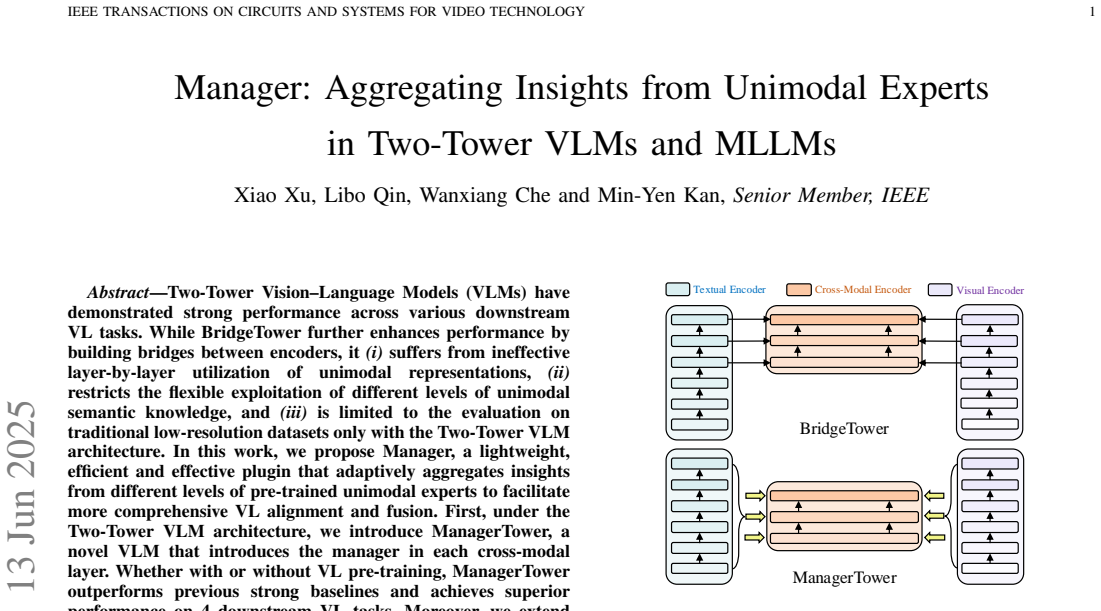
Pith's one-line read A lightweight manager that aggregates multi-layer unimodal representations improves two-tower vision-language models and multimodal LLMs at near-zero added cost.
desk verdict Useful drop-in plugin paper with honest limitations, but the 20-dataset MLLM claim needs the removed datasets and variance estimates before it can be taken at face value. read the letter →
The pith
A machine-rendered reading of the paper's core claim, the machinery that carries it, and where it could break.
The reading
What carries the argument
The central object is the manager, a lightweight aggregation layer inserted into each cross-modal layer (or, at intervals, into the LLM of an MLLM). Its main form, AAUM, computes per-token aggregation weights $W_A=\mathrm{softmax}(\mathrm{LN}(C^V_{\ell-1})W_M+\epsilon)$ and produces $\tilde{C}^V_\ell=\sum_{i=1}^{6}W_{A,i}\odot\mathrm{LN}(V_{i+6})+W_C\odot\mathrm{LN}(C^V_{\ell-1})$, so each token in each sample can draw differently on the top $N=6$ unimodal layer representations plus the previous cross-modal layer state. In the MLLM setting the paper uses an optimized SAUM variant with zero-initialized weights, no LayerNorm and no softmax, to avoid disturbing the pre-trained LLM early in training. This mechanism decouples the number of unimodal layers exploited from the number of cross-modal layers, and the authors use attention entropy and head-diversity measurements to attribute the gains to more diverse visual attention.
What would settle it
Run the four-baseline comparison on all datasets in the original LLaVA-OV zero-shot suite with no datasets removed and report per-dataset deltas; if the +Grid+Manager advantage over +Grid shrinks to zero or becomes negative once the excluded datasets are included, the 20-dataset averaging claim collapses.
Extended reading notes
Core claim
On the paper's own terms, the discovery is that layers of a pre-trained unimodal encoder can be treated as experts, and a small trainable manager that learns to combine their outputs—token-by-token in ManagerTower, with simpler static weights in LLaVA-OV-Manager—supplies exactly the level of semantic detail each cross-modal layer needs. This repairs what the authors identify as BridgeTower's flaw: fixed one-to-one bridges force layer-by-layer reuse of unimodal representations and tether the number of bridges to the number of cross-modal layers. With managers, ManagerTower reaches 79.15% on VQAv2 test-std and 86.56% IR@1 on Flickr30K using the same 4M pre-training data as BridgeTower, and LLaVA-OV-Manager improves the zero-shot average on 20 datasets from 50.61% to 51.67% without grids and from 53.87% to 55.21% with grids, with 0.08M extra parameters. The paper further argues that the manager's multi-layer aggregation (depth) and the multi-grid algorithm (width) are orthogonal ways to add visual detail, and that their synergy counters the semantic ambiguity caused by cutting images into grids.
Load-bearing premise
The paper's claim of consistent gains on 20 datasets assumes that the datasets it kept after removing 'few some downstream datasets' are representative of the full evaluation suite, so if the removals systematically dropped cases where managers helped least, the reported averages overstate the general result.
Editorial extensions
If this is right
- ManagerTower with half the cross-modal layers ($L_C=3$) can beat BridgeTower with $L_C=6$, so the same data and backbones yield better results with less cross-modal depth.
- Adding managers to LLaVA-OV is cheap: about 0.08M parameters, roughly 2% more FLOPs, and 3–4% more training or inference time, while adding about one absolute point without grids and 1.44 points with grids on the 20-dataset average.
- The top half of the visual encoder carries most of the benefit; including all layers hurts, so practitioners can select a fixed layer range and reuse it across architectures.
- The manager and the multi-grid algorithm are complementary: managers help most where grid splitting cuts objects and creates ambiguity, such as instance location and counting on SEED-Bench and artistic or handwriting text recognition on OCRBench.
- Because the manager works with different visual and textual backbones and with both two-tower and MLLM architectures, the same recipe transfers across model families without retraining the unimodal encoders.
Reading between the lines
- If the depth/width decomposition is the right explanation, managers should also stack with other width-style plugins—different tile sizes, high-resolution encoders, or multi-scale crops—rather than only with LLaVA-OV's specific multi-grid scheme; that is testable with the same four-baseline recipe.
- The 20-dataset average should be re-computed on the full original LLaVA-OV evaluation suite; Appendix C-E says the authors removed 'few some downstream datasets' for efficiency and robustness, and the robustness of the central claim depends on whether those omitted datasets also benefit from the manager.
- The attention-entropy mechanism suggests managers might help in other settings where vision tokens are ambiguous, such as small objects or heavily cropped inputs, even without grid tiling; a controlled experiment varying input resolution while holding architecture fixed could test this.
- AAUM's failure to beat SAUM in the causal LLM setting hints that a bidirectional or causally compatible query might unlock more of the manager's potential in MLLMs, a direction the paper itself raises as future work.
Editorial analysis
A structured set of objections, weighed in public.
Referee Report
Summary. The paper proposes Manager, a lightweight module that aggregates representations from multiple layers of pretrained unimodal encoders and injects them into cross-modal or LLM layers. In the two-tower VLM setting, ManagerTower replaces BridgeTower's one-hot layer-wise bridges with learned static (SAUM) or adaptive (AAUM) managers, reporting gains on VQAv2, SNLI-VE, NLVR2, and Flickr30K under matched pretraining and finetuning. In the MLLM setting, LLaVA-OV-Manager injects visual managers into LLaVA-OneVision, with or without the multi-grid algorithm, and reports zero-shot gains on 20 datasets, together with attention-diversity analyses and case studies.
Significance. If the empirical claims are sound, the Manager plugin is a useful, architecture-agnostic contribution: it is lightweight, compatible with different encoders and cross-modal depths, and the paper provides a fairly extensive set of controlled comparisons, ablations, and computational-budget measurements. The ManagerTower results on four downstream tasks are internally consistent and appear to be a credible extension of BridgeTower. The MLLM extension is ambitious and the depth/width synergy viewpoint with the multi-grid algorithm is interesting. However, the headline 20-dataset claim is currently not auditable because the paper does not disclose which datasets were removed from the original LLaVA-OV evaluation suite, and several aggregate numbers in the MLLM section are internally inconsistent. These issues must be resolved before the central claims can be credited.
major comments (4)
- [Appendix C-E] The sentence "we remove few some downstream datasets for better efficiency and robustness" does not identify which datasets were removed, how many, or the decision rule. Since the central claim is a significant improvement on the 20 reported datasets, the evaluation suite must be a fixed, pre-specified set; otherwise the reported averages in Table IV and Figure 8 could reflect post-hoc selection. Please report the full set of datasets evaluated, the removed datasets, and the results on all of them, or justify that the removals were independent of performance.
- [Tables XI-XIII] The aggregate numbers in the MLLM section are internally inconsistent. For the Baseline row in Table XII, the six listed General values (VQAv2 73.90, OKVQA 37.18, GQA 57.66, MMVet 21.40, SEED-Bench 61.50, RealWorldQA 50.98) average to 50.44, yet Table XII reports 48.71 and Table XI reports 48.72. The Table XI overall scores (50.54/51.50) also conflict with Table IV (50.61/51.67) for the same claimed 20-dataset averages. Please recompute and reconcile all aggregate tables, or explicitly state the averaging procedure and any excluded datasets.
- [Section V-C, Table IV] The text states "55.21−51.67 = 1.44" and uses this to claim the synergy gain over the manager-only baseline. The arithmetic is incorrect: 55.21−51.67 = 3.54, and the manager-over-grid gain is 55.21−53.87 = 1.34, not 1.44. This error directly affects the claim that the manager and multi-grid algorithm provide an additional 1.44% synergy. Please correct the computation and the corresponding claim.
- [Section V-C and Tables IV, XII] The term "significantly" is used throughout, but no confidence intervals, standard deviations, or significance tests are reported. This is especially important because some per-dataset deltas are tiny (e.g., InfoVQA +0.01, OKVQA +0.10 in Table XII) and the headline gains of +1.06/+1.44 are averages over 20 datasets. Please provide multiple runs or at least a paired significance analysis for the main comparisons, and temper the word "significantly" accordingly.
minor comments (5)
- [Appendix A-A] The phrase "The casual nature of the representation" should be "causal nature", and "casual attention" should be "causal attention" in the same paragraph.
- [Appendix C-E] The phrase "remove few some downstream datasets" is ungrammatical; it should read "remove a few downstream datasets" or "remove some downstream datasets".
- [Figures 23-25 and Figure 7] The x-axis label is inconsistent across figures: "Unimodal Expert Index", "Uni-Modal Layer Index", and "Uni-Modal Expert Index" are used interchangeably. Please unify the terminology.
- [Section V-D2, Figure 10] The caption states the ablation is on 9 datasets, but the figure reports only an overall average score. Please list the 9 datasets or cite the table containing them, for reproducibility.
- [Appendix C-F, Table X] The table lists "2407 and 2409" for MM-LiveBench, but the text and Table XIII refer to "July" and "Sep". Please align these labels and verify the dates.
Circularity Check
No significant circularity; the architecture is evaluated on held-out benchmarks, with minor self-citation only.
full rationale
The paper's central claims are empirical: ManagerTower and LLaVA-OV-Manager are compared against strong baselines on fixed downstream benchmarks. The manager equations (Eq. 4-14) define a new aggregation mechanism, and no fitted parameter is renamed as a prediction. Hyperparameters such as N=6 and injection times are tuned through ablations (Fig. 6, Fig. 10), while the headline results are reported on held-out evaluation sets. The paper cites its own conference version [1] and BridgeTower [7], a prior work by the same first author, but these are published baselines and extensions, not invoked as uniqueness theorems or as substitutes for the experiments. The undisclosed removal of 'few some downstream datasets' in Appendix C-E is a legitimate transparency and selection-bias concern, but it does not make any reported number equivalent by construction to an input; that issue belongs to correctness risk, not circularity. Overall, the derivation chain is self-contained: the manager's design is motivated by external layer-aggregation work, and its effectiveness is measured directly on benchmarks.
Assumptions & free parameters
free parameters (3)
- Number of top unimodal layers used (N) =
6 (default, tuned on VQAv2/Flickr30K)
- Manager injection times in MLLM =
6 with interval 4
- Zero-init with multiplicative jitter in MLLM SAUM =
zero init, epsilon ~ U(0.98,1.02)
assumptions (3)
- domain assumption Pretrained unimodal encoders (CLIP-ViT, RoBERTa, SigLIP) encode hierarchical semantic knowledge across layers.
- domain assumption Injecting aggregated multi-layer visual features into a pretrained LLM does not catastrophically disrupt its learned representations.
- ad hoc to paper The selected 20 downstream datasets, after unspecified removals, are a representative sample of multimodal capabilities.
invented entities (1)
-
Manager module (SAM/SAUM/AAUM)
independent evidence
Cite this review
Pith. "Pith review of Manager: Aggregating Insights from Unimodal Experts in Two-Tower VLMs and MLLMs." pith.science (2026). https://pith.science/paper/2I2GSVDK
@misc{pith2026250611515,
  author       = {Pith},
  title        = {Pith review of: Manager: Aggregating Insights from Unimodal Experts in Two-Tower VLMs and MLLMs},
  year         = {2026},
  howpublished = {\url{https://pith.science/paper/2I2GSVDK}},
  note         = {Machine review of arXiv:2506.11515}
}
read the original abstract
Two-Tower Vision--Language Models (VLMs) have demonstrated strong performance across various downstream VL tasks. While BridgeTower further enhances performance by building bridges between encoders, it \textit{(i)} suffers from ineffective layer-by-layer utilization of unimodal representations, \textit{(ii)} restricts the flexible exploitation of different levels of unimodal semantic knowledge, and \textit{(iii)} is limited to the evaluation on traditional low-resolution datasets only with the Two-Tower VLM architecture. In this work, we propose Manager, a lightweight, efficient and effective plugin that adaptively aggregates insights from different levels of pre-trained unimodal experts to facilitate more comprehensive VL alignment and fusion. First, under the Two-Tower VLM architecture, we introduce ManagerTower, a novel VLM that introduces the manager in each cross-modal layer. Whether with or without VL pre-training, ManagerTower outperforms previous strong baselines and achieves superior performance on 4 downstream VL tasks. Moreover, we extend our exploration to the latest Multimodal Large Language Model (MLLM) architecture. We demonstrate that LLaVA-OV-Manager significantly boosts the zero-shot performance of LLaVA-OV across different categories of capabilities, images, and resolutions on 20 downstream datasets, whether the multi-grid algorithm is enabled or not. In-depth analysis reveals that both our manager and the multi-grid algorithm can be viewed as a plugin that improves the visual representation by capturing more diverse visual details from two orthogonal perspectives (depth and width). Their synergy can mitigate the semantic ambiguity caused by the multi-grid algorithm and further improve performance. Code and models are available at https://github.com/LooperXX/ManagerTower.
Figures


Figures from the paper (21 more)


Reference graph
Works this paper leans on
-
[1]
ManagerTower: Aggregating the insights of uni-modal experts for vision-language representation learning,
X. Xu, B. Li, C. Wu, S.-Y . Tseng, A. Bhiwandiwalla, S. Rosenman, V . Lal, W. Che, and N. Duan, “ManagerTower: Aggregating the insights of uni-modal experts for vision-language representation learning,” in Proc. of ACL, 2023, pp. 14 507–14 525
2023
-
[2]
Making the V in VQA matter: Elevating the role of image understanding in visual question answering,
Y . Goyal, T. Khot, D. Summers-Stay, D. Batra, and D. Parikh, “Making the V in VQA matter: Elevating the role of image understanding in visual question answering,” inProc. of CVPR, 2017, pp. 6325–6334
2017
-
[3]
Visual entailment: A novel task for fine-grained image understanding,
N. Xie, F. Lai, D. Doran, and A. Kadav, “Visual entailment: A novel task for fine-grained image understanding,”ArXiv preprint, vol. abs/1901.06706, 2019
arXiv 1901
-
[4]
A corpus for reasoning about natural language grounded in photographs,
A. Suhr, S. Zhou, A. Zhang, I. Zhang, H. Bai, and Y . Artzi, “A corpus for reasoning about natural language grounded in photographs,” in Proc. of ACL, 2019, pp. 6418–6428
2019
-
[5]
From image descriptions to visual denotations: New similarity metrics for semantic inference over event descriptions,
P. Young, A. Lai, M. Hodosh, and J. Hockenmaier, “From image descriptions to visual denotations: New similarity metrics for semantic inference over event descriptions,”Transactions of the Association for Computational Linguistics, vol. 2, pp. 67–78, 2014
2014
-
[6]
An empirical study of training end-to-end vision-and-language transformers,
Z. Dou, Y . Xu, Z. Gan, J. Wang, S. Wang, L. Wang, C. Zhu, P. Zhang, L. Yuan, N. Peng, Z. Liu, and M. Zeng, “An empirical study of training end-to-end vision-and-language transformers,” inProc. of CVPR, 2022, pp. 18 145–18 155
2022
-
[7]
Bridgetower: Building bridges between encoders in vision-language representation learning,
X. Xu, C. Wu, S. Rosenman, V . Lal, W. Che, and N. Duan, “Bridgetower: Building bridges between encoders in vision-language representation learning,” inProc. of AAAI, 2023, pp. 10 637–10 647
2023
-
[8]
Learning transferable visual models from natural language supervi- sion,
A. Radford, J. W. Kim, C. Hallacy, A. Ramesh, G. Goh, S. Agarwal, G. Sastry, A. Askell, P. Mishkin, J. Clark, G. Krueger, and I. Sutskever, “Learning transferable visual models from natural language supervi- sion,” inProc. of ICML, vol. 139, 2021, pp. 8748–8763
2021
Show all 143 references
-
[9]
Roberta: A robustly optimized bert pretraining approach,
Y . Liu, M. Ott, N. Goyal, J. Du, M. Joshi, D. Chen, O. Levy, M. Lewis, L. Zettlemoyer, and V . Stoyanov, “Roberta: A robustly optimized bert pretraining approach,”ArXiv preprint, vol. abs/1907.11692, 2019
1907 arXiv
-
[10]
Learning deep transformer models for machine translation,
Q. Wang, B. Li, T. Xiao, J. Zhu, C. Li, D. F. Wong, and L. S. Chao, “Learning deep transformer models for machine translation,” inProc. of ACL, 2019, pp. 1810–1822
2019
-
[11]
Llava-onevision: Easy visual task transfer,
B. Li, Y . Zhang, D. Guo, R. Zhang, F. Li, H. Zhang, K. Zhang, Y . Li, Z. Liu, and C. Li, “Llava-onevision: Easy visual task transfer,”ArXiv preprint, vol. abs/2408.03326, 2024
2024 arXiv
-
[12]
Llava- next: Improved reasoning, ocr, and world knowledge,
H. Liu, C. Li, Y . Li, B. Li, Y . Zhang, S. Shen, and Y . J. Lee, “Llava- next: Improved reasoning, ocr, and world knowledge,” 2024
2024
-
[13]
How much can CLIP benefit vision-and-language tasks?
S. Shen, L. H. Li, H. Tan, M. Bansal, A. Rohrbach, K. Chang, Z. Yao, and K. Keutzer, “How much can CLIP benefit vision-and-language tasks?” inProc. of ICLR, 2022
2022
-
[14]
UNIMO-2: End-to-end unified vision-language grounded learning,
W. Li, C. Gao, G. Niu, X. Xiao, H. Liu, J. Liu, H. Wu, and H. Wang, “UNIMO-2: End-to-end unified vision-language grounded learning,” in Proc. of ACL Findings, 2022, pp. 3187–3201
2022
-
[15]
Neural machine translation of rare words with subword units,
R. Sennrich, B. Haddow, and A. Birch, “Neural machine translation of rare words with subword units,” inProc. of ACL, 2016, pp. 1715–1725
2016
-
[16]
Language models are unsupervised multitask learners,
A. Radford, J. Wu, R. Child, D. Luan, D. Amodei, I. Sutskeveret al., “Language models are unsupervised multitask learners,”OpenAI blog, 2019
2019
-
[17]
Attention is all you need,
A. Vaswani, N. Shazeer, N. Parmar, J. Uszkoreit, L. Jones, A. N. Gomez, L. Kaiser, and I. Polosukhin, “Attention is all you need,” in Proc. of NeurIPS, 2017, pp. 5998–6008
2017
-
[18]
Vilbert: Pretraining task- agnostic visiolinguistic representations for vision-and-language tasks,
J. Lu, D. Batra, D. Parikh, and S. Lee, “Vilbert: Pretraining task- agnostic visiolinguistic representations for vision-and-language tasks,” inProc. of NeurIPS, 2019, pp. 13–23
2019
-
[19]
Multi-layer representation fusion for neural machine translation,
Q. Wang, F. Li, T. Xiao, Y . Li, Y . Li, and J. Zhu, “Multi-layer representation fusion for neural machine translation,” inProc. of COLING, 2018, pp. 3015–3026
2018
-
[20]
Multiscale collaborative deep models for neural machine translation,
X. Wei, H. Yu, Y . Hu, Y . Zhang, R. Weng, and W. Luo, “Multiscale collaborative deep models for neural machine translation,” inProc. of ACL, 2020, pp. 414–426
2020
-
[21]
Layer normalization,
J. L. Ba, J. R. Kiros, and G. E. Hinton, “Layer normalization,”ArXiv preprint, vol. abs/1607.06450, 2016
2016 arXiv
-
[22]
Switch transformers: Scaling to trillion parameter models with simple and efficient sparsity,
W. Fedus, B. Zoph, and N. Shazeer, “Switch transformers: Scaling to trillion parameter models with simple and efficient sparsity,”Journal of Machine Learning Research, vol. 23, pp. 1–39, 2022
2022
-
[23]
Decoupled weight decay regularization,
I. Loshchilov and F. Hutter, “Decoupled weight decay regularization,” inProc. of ICLR, 2019
2019
-
[24]
Vilt: Vision-and-language transformer without convolution or region supervision,
W. Kim, B. Son, and I. Kim, “Vilt: Vision-and-language transformer without convolution or region supervision,” inProc. of ICML, vol. 139, 2021, pp. 5583–5594
2021
-
[25]
Uniter: Universal image-text representation learning,
Y .-C. Chen, L. Li, L. Yu, A. El Kholy, F. Ahmed, Z. Gan, Y . Cheng, and J. Liu, “Uniter: Universal image-text representation learning,” in Proc. of ECCV, 2020
2020
-
[26]
UNIMO: Towards unified-modal understanding and generation via cross-modal contrastive learning,
W. Li, C. Gao, G. Niu, X. Xiao, H. Liu, J. Liu, H. Wu, and H. Wang, “UNIMO: Towards unified-modal understanding and generation via cross-modal contrastive learning,” inProc. of ACL, 2021, pp. 2592– 2607
2021
-
[27]
Align before fuse: Vision and language representation learning with momentum distillation,
J. Li, R. R. Selvaraju, A. Gotmare, S. R. Joty, C. Xiong, and S. C. Hoi, “Align before fuse: Vision and language representation learning with momentum distillation,” inProc. of NeurIPS, 2021, pp. 9694–9705
2021
-
[28]
Vlmo: Unified vision-language pre- training with mixture-of-modality-experts,
H. Bao, W. Wang, L. Dong, Q. Liu, O. K. Mohammed, K. Aggarwal, S. Som, S. Piao, and F. Wei, “Vlmo: Unified vision-language pre- training with mixture-of-modality-experts,” inProc. of NeurIPS, 2022
2022
-
[29]
Simvlm: Simple visual language model pretraining with weak supervision,
Z. Wang, J. Yu, A. W. Yu, Z. Dai, Y . Tsvetkov, and Y . Cao, “Simvlm: Simple visual language model pretraining with weak supervision,” in Proc. of ICLR, 2022
2022
-
[30]
BLIP: bootstrapping language-image pre-training for unified vision-language understanding and generation,
J. Li, D. Li, C. Xiong, and S. C. H. Hoi, “BLIP: bootstrapping language-image pre-training for unified vision-language understanding and generation,” inProc. of ICML, vol. 162, 2022, pp. 12 888–12 900
2022
-
[31]
Conceptual captions: A cleaned, hypernymed, image alt-text dataset for automatic image captioning,
P. Sharma, N. Ding, S. Goodman, and R. Soricut, “Conceptual captions: A cleaned, hypernymed, image alt-text dataset for automatic image captioning,” inProc. of ACL, 2018, pp. 2556–2565
2018
-
[32]
Im2text: Describing images using 1 million captioned photographs,
V . Ordonez, G. Kulkarni, and T. L. Berg, “Im2text: Describing images using 1 million captioned photographs,” inProc. of NeurIPS, 2011, pp. 1143–1151
2011
-
[33]
Microsoft coco captions: Data collection and evaluation server,
X. Chen, H. Fang, T.-Y . Lin, R. Vedantam, S. Gupta, P. Doll ´ar, and C. L. Zitnick, “Microsoft coco captions: Data collection and evaluation server,”ArXiv preprint, vol. abs/1504.00325, 2015
2015 arXiv
-
[34]
Visual genome: Connect- ing language and vision using crowdsourced dense image annotations,
R. Krishna, Y . Zhu, O. Groth, J. Johnson, K. Hata, J. Kravitz, S. Chen, Y . Kalantidis, L.-J. Li, D. A. Shammaet al., “Visual genome: Connect- ing language and vision using crowdsourced dense image annotations,” International journal of computer vision, 2017
2017
-
[35]
Improved baselines with visual instruction tuning,
H. Liu, C. Li, Y . Li, and Y . J. Lee, “Improved baselines with visual instruction tuning,” inProc. of CVPR, 2024, pp. 26 296–26 306
2024
-
[36]
Monkey: Image resolution and text label are important things for large multi-modal models,
Z. Li, B. Yang, Q. Liu, Z. Ma, S. Zhang, J. Yang, Y . Sun, Y . Liu, and X. Bai, “Monkey: Image resolution and text label are important things for large multi-modal models,” inProc. of CVPR, 2024, pp. 26 763–26 773
2024
-
[37]
Docvqa: A dataset for vqa on document images,
M. Mathew, D. Karatzas, and C. Jawahar, “Docvqa: A dataset for vqa on document images,” inProceedings of the IEEE/CVF winter conference on applications of computer vision, 2021, pp. 2200–2209
2021
-
[38]
Ocrbench: On the hidden mystery of ocr in large multimodal models,
Y . Liu, Z. Li, M. Huang, B. Yang, W. Yu, C. Li, X. Yin, C. lin Liu, L. Jin, and X. Bai, “Ocrbench: On the hidden mystery of ocr in large multimodal models,”ArXiv preprint, vol. abs/2305.07895, 2023
2023 arXiv
-
[39]
Sigmoid loss for language image pre-training,
X. Zhai, B. Mustafa, A. Kolesnikov, and L. Beyer, “Sigmoid loss for language image pre-training,” inProc. of ICCV, 2023, pp. 11 941– 11 952
2023
-
[40]
Qwen2 technical report,
A. Yang, B. Yang, B. Hui, B. Zheng, B. Yu, C. Zhou, C. Li, C. Li, D. Liu, F. Huanget al., “Qwen2 technical report,”ArXiv preprint, vol. abs/2407.10671, 2024
2024 arXiv
-
[41]
Exploring plain vision transformer backbones for object detection,
Y . Li, H. Mao, R. Girshick, and K. He, “Exploring plain vision transformer backbones for object detection,”ArXiv preprint, vol. abs/2203.16527, 2022
2022 arXiv
-
[42]
Llama-adapter: Efficient fine-tuning of language models with zero-init attention,
R. Zhang, J. Han, C. Liu, P. Gao, A. Zhou, X. Hu, S. Yan, P. Lu, H. Li, and Y . Qiao, “Llama-adapter: Efficient fine-tuning of language models with zero-init attention,”ArXiv preprint, vol. abs/2303.16199, 2023
2023 arXiv
-
[43]
OK-VQA: A visual question answering benchmark requiring external knowledge,
K. Marino, M. Rastegari, A. Farhadi, and R. Mottaghi, “OK-VQA: A visual question answering benchmark requiring external knowledge,” inProc. of CVPR, 2019, pp. 3195–3204
2019
-
[44]
GQA: A new dataset for real-world visual reasoning and compositional question answering,
D. A. Hudson and C. D. Manning, “GQA: A new dataset for real-world visual reasoning and compositional question answering,” inProc. of CVPR, 2019, pp. 6700–6709
2019
-
[45]
MM-vet: Evaluating large multimodal models for integrated capabilities,
W. Yu, Z. Yang, L. Li, J. Wang, K. Lin, Z. Liu, X. Wang, and L. Wang, “MM-vet: Evaluating large multimodal models for integrated capabilities,” inProc. of ICML, 2024
2024
-
[46]
Seed-bench: Benchmarking multimodal llms with generative comprehension,
B. Li, R. Wang, G. Wang, Y . Ge, Y . Ge, and Y . Shan, “Seed-bench: Benchmarking multimodal llms with generative comprehension,”ArXiv preprint, vol. abs/2307.16125, 2023
2023 arXiv
-
[47]
Grok-1.5 vision preview
x.ai, “Grok-1.5 vision preview.” 2019
2019
-
[48]
Towards VQA models that can read,
A. Singh, V . Natarajan, M. Shah, Y . Jiang, X. Chen, D. Batra, D. Parikh, and M. Rohrbach, “Towards VQA models that can read,” inProc. of CVPR, 2019, pp. 8317–8326
2019
-
[49]
ChartQA: A benchmark for question answering about charts with visual and logical reasoning,
A. Masry, X. L. Do, J. Q. Tan, S. Joty, and E. Hoque, “ChartQA: A benchmark for question answering about charts with visual and logical reasoning,” inProc. of ACL Findings, 2022, pp. 2263–2279
2022
-
[50]
Infographicvqa,
M. Mathew, V . Bagal, R. Tito, D. Karatzas, E. Valveny, and C. Jawahar, “Infographicvqa,” inProceedings of the IEEE/CVF Winter Conference on Applications of Computer Vision, 2022, pp. 1697–1706. IEEE TRANSACTIONS ON CIRCUITS AND SYSTEMS FOR VIDEO TECHNOLOGY 29
2022
-
[51]
A diagram is worth a dozen images,
A. Kembhavi, M. Salvato, E. Kolve, M. Seo, H. Hajishirzi, and A. Farhadi, “A diagram is worth a dozen images,” inProc. of ECCV, 2016, pp. 235–251
2016
-
[52]
Learn to explain: Multimodal reasoning via thought chains for science question answering,
P. Lu, S. Mishra, T. Xia, L. Qiu, K. Chang, S. Zhu, O. Tafjord, P. Clark, and A. Kalyan, “Learn to explain: Multimodal reasoning via thought chains for science question answering,” inProc. of NeurIPS, 2022
2022
-
[53]
Mmmu: A massive multi-discipline multimodal understanding and reasoning benchmark for expert agi,
X. Yue, Y . Ni, K. Zhang, T. Zheng, R. Liu, G. Zhang, S. Stevens, D. Jiang, W. Ren, Y . Sun, C. Wei, B. Yu, R. Yuan, R. Sun, M. Yin, B. Zheng, Z. Yang, Y . Liu, W. Huang, H. Sun, Y . Su, and W. Chen, “Mmmu: A massive multi-discipline multimodal understanding and reasoning benc...
2024
-
[54]
Mathvista: Evaluating mathematical reasoning of foundation models in visual contexts,
P. Lu, H. Bansal, T. Xia, J. Liu, C. Li, H. Hajishirzi, H. Cheng, K.-W. Chang, M. Galley, and J. Gao, “Mathvista: Evaluating mathematical reasoning of foundation models in visual contexts,” inProc. of ICLR, 2024
2024
-
[55]
Llava-next: What else influences visual instruction tuning beyond data?
B. Li, H. Zhang, K. Zhang, D. Guo, Y . Zhang, R. Zhang, F. Li, Z. Liu, and C. Li, “Llava-next: What else influences visual instruction tuning beyond data?” 2024
2024
-
[56]
Lmms-eval: Reality check on the evaluation of large multimodal models,
K. Zhang, B. Li, P. Zhang, F. Pu, J. A. Cahyono, K. Hu, S. Liu, Y . Zhang, J. Yang, C. Liet al., “Lmms-eval: Reality check on the evaluation of large multimodal models,”ArXiv preprint, vol. abs/2407.12772, 2024
2024 arXiv
-
[57]
Visual instruction tuning,
H. Liu, C. Li, Q. Wu, and Y . J. Lee, “Visual instruction tuning,” in Proc. of NeurIPS, 2023
2023
-
[58]
An image is worth 16x16 words: Transformers for image recognition at scale,
A. Dosovitskiy, L. Beyer, A. Kolesnikov, D. Weissenborn, X. Zhai, T. Unterthiner, M. Dehghani, M. Minderer, G. Heigold, S. Gelly, J. Uszkoreit, and N. Houlsby, “An image is worth 16x16 words: Transformers for image recognition at scale,” inProc. of ICLR, 2021
2021
-
[59]
Mini-monkey: Alleviating the semantic sawtooth effect for lightweight mllms via complementary image pyramid,
M. Huang, Y . Liu, D. Liang, L. Jin, and X. Bai, “Mini-monkey: Alleviating the semantic sawtooth effect for lightweight mllms via complementary image pyramid,”ArXiv preprint, vol. abs/2408.02034, 2024
2024 arXiv
-
[60]
Neural machine translation by jointly learning to align and translate,
D. Bahdanau, K. Cho, and Y . Bengio, “Neural machine translation by jointly learning to align and translate,” inProc. of ICLR, 2015
2015
-
[61]
Revealing the dark secrets of masked image modeling,
Z. Xie, Z. Geng, J. Hu, Z. Zhang, H. Hu, and Y . Cao, “Revealing the dark secrets of masked image modeling,” inProc. of CVPR, 2023, pp. 14 475–14 485
2023
-
[62]
On information and sufficiency,
S. Kullback and R. A. Leibler, “On information and sufficiency,”The annals of mathematical statistics, vol. 22, pp. 79–86, 1951
1951
-
[63]
VL-BERT: pre-training of generic visual-linguistic representations,
W. Su, X. Zhu, Y . Cao, B. Li, L. Lu, F. Wei, and J. Dai, “VL-BERT: pre-training of generic visual-linguistic representations,” inProc. of ICLR, 2020
2020
-
[64]
Unicoder-vl: A universal encoder for vision and language by cross-modal pre-training,
G. Li, N. Duan, Y . Fang, M. Gong, and D. Jiang, “Unicoder-vl: A universal encoder for vision and language by cross-modal pre-training,” inProc. of AAAI, 2020, pp. 11 336–11 344
2020
-
[65]
Oscar: Object-semantics aligned pre-training for vision-language tasks,
X. Li, X. Yin, C. Li, P. Zhang, X. Hu, L. Zhang, L. Wang, H. Hu, L. Dong, F. Weiet al., “Oscar: Object-semantics aligned pre-training for vision-language tasks,” inProc. of ECCV, 2020
2020
-
[66]
Unifying architectures, tasks, and modalities through a simple sequence-to-sequence learning framework,
P. Wang, A. Yang, R. Men, J. Lin, S. Bai, Z. Li, J. Ma, C. Zhou, J. Zhou, and H. Yang, “Unifying architectures, tasks, and modalities through a simple sequence-to-sequence learning framework,”ArXiv preprint, vol. abs/2202.03052, 2022
2022 arXiv
-
[67]
Image as a foreign language: Beit pretraining for all vision and vision-language tasks,
W. Wang, H. Bao, L. Dong, J. Bjorck, Z. Peng, Q. Liu, K. Aggarwal, O. K. Mohammed, S. Singhal, S. Somet al., “Image as a foreign language: Beit pretraining for all vision and vision-language tasks,” ArXiv preprint, vol. abs/2208.10442, 2022
2022 arXiv
-
[68]
Coca: Contrastive captioners are image-text foundation mod- els,
J. Yu, Z. Wang, V . Vasudevan, L. Yeung, M. Seyedhosseini, and Y . Wu, “Coca: Contrastive captioners are image-text foundation mod- els,”ArXiv preprint, vol. abs/2205.01917, 2022
2022 arXiv
-
[69]
Exploring vision-language foundation model for novel object captioning,
J. Luo, Y . Li, Y . Pan, T. Yao, J. Feng, H. Chao, and T. Mei, “Exploring vision-language foundation model for novel object captioning,”IEEE Trans. Circuits Syst. Video Technol., pp. 1–1, 2024
2024
-
[70]
Unsupervised domain adaption harnessing vision-language pre-training,
W. Zhou and Z. Zhou, “Unsupervised domain adaption harnessing vision-language pre-training,”IEEE Trans. Circuits Syst. Video Tech- nol., vol. 34, pp. 8201–8214, 2024
2024
-
[71]
Do vision transformers see like convolutional neural networks?
M. Raghu, T. Unterthiner, S. Kornblith, C. Zhang, and A. Dosovitskiy, “Do vision transformers see like convolutional neural networks?” in Proc. of NeurIPS, 2021, pp. 12 116–12 128
2021
-
[72]
Intriguing properties of vision transformers,
M. Naseer, K. Ranasinghe, S. Khan, M. Hayat, F. S. Khan, and M. Yang, “Intriguing properties of vision transformers,” inProc. of NeurIPS, 2021, pp. 23 296–23 308
2021
-
[73]
Dissecting contextual word embeddings: Architecture and representation,
M. E. Peters, M. Neumann, L. Zettlemoyer, and W.-t. Yih, “Dissecting contextual word embeddings: Architecture and representation,” inProc. of EMNLP, 2018, pp. 1499–1509
2018
-
[74]
Linguistic knowledge and transferability of contextual representa- tions,
N. F. Liu, M. Gardner, Y . Belinkov, M. E. Peters, and N. A. Smith, “Linguistic knowledge and transferability of contextual representa- tions,” inProc. of NAACL, 2019, pp. 1073–1094
2019
-
[75]
What does BERT learn about the structure of language?
G. Jawahar, B. Sagot, and D. Seddah, “What does BERT learn about the structure of language?” inProc. of ACL, 2019, pp. 3651–3657
2019
-
[76]
BERT: Pre- training of deep bidirectional transformers for language understanding,
J. Devlin, M.-W. Chang, K. Lee, and K. Toutanova, “BERT: Pre- training of deep bidirectional transformers for language understanding,” inProc. of NAACL, 2019, pp. 4171–4186
2019
-
[77]
Feature pyramid networks for object detection,
T. Lin, P. Doll ´ar, R. B. Girshick, K. He, B. Hariharan, and S. J. Belongie, “Feature pyramid networks for object detection,” inProc. of CVPR, 2017, pp. 936–944
2017
-
[78]
Densely connected convolutional networks,
G. Huang, Z. Liu, L. van der Maaten, and K. Q. Weinberger, “Densely connected convolutional networks,” inProc. of CVPR, 2017, pp. 2261– 2269
2017
-
[79]
Deep layer aggregation,
F. Yu, D. Wang, E. Shelhamer, and T. Darrell, “Deep layer aggregation,” inProc. of CVPR, 2018, pp. 2403–2412
2018
-
[80]
Segformer: Simple and efficient design for semantic segmentation with transformers,
E. Xie, W. Wang, Z. Yu, A. Anandkumar, J. M. Alvarez, and P. Luo, “Segformer: Simple and efficient design for semantic segmentation with transformers,” inProc. of NeurIPS, 2021, pp. 12 077–12 090
2021
-
[81]
Clsr: Cross-layer interaction pyramid super-resolution network,
D. Huang, X. Zhu, X. Li, and H. Zeng, “Clsr: Cross-layer interaction pyramid super-resolution network,”IEEE Trans. Circuits Syst. Video Technol., vol. 33, pp. 6273–6287, 2023
2023
-
[82]
Attention-based layer fusion and token masking for weakly supervised semantic segmentation,
Y . Zhang and X. Zhu, “Attention-based layer fusion and token masking for weakly supervised semantic segmentation,”IEEE Trans. Circuits Syst. Video Technol., vol. 34, pp. 7912–7921, 2024
2024
-
[83]
Artificial- spiking hierarchical networks for vision-language representation learn- ing,
Y . Chen, S. Zhang, Y . Sun, J. Yang, W. Liang, and H. Wang, “Artificial- spiking hierarchical networks for vision-language representation learn- ing,”IEEE Trans. Circuits Syst. Video Technol., pp. 1–1, 2024
2024
-
[84]
Deep contextualized word representations,
M. E. Peters, M. Neumann, M. Iyyer, M. Gardner, C. Clark, K. Lee, and L. Zettlemoyer, “Deep contextualized word representations,” inProc. of NAACL, 2018, pp. 2227–2237
2018
-
[85]
Coarse-to-fine vision-language pre-training with fusion in the backbone,
Z. Dou, A. Kamath, Z. Gan, P. Zhang, J. Wang, L. Li, Z. Liu, C. Liu, Y . LeCun, N. Peng, J. Gao, and L. Wang, “Coarse-to-fine vision-language pre-training with fusion in the backbone,” inProc. of NeurIPS, 2022
2022
-
[86]
Dense connector for mllms,
H. Yao, W. Wu, T. Yang, Y . Song, M. Zhang, H. Feng, Y . Sun, Z. Li, W. Ouyang, and J. Wang, “Dense connector for mllms,”ArXiv preprint, vol. abs/2405.13800, 2024
2024 arXiv
-
[87]
Tokenpacker: Efficient visual projector for multimodal llm,
W. Li, Y . Yuan, J. Liu, D. Tang, S. Wang, J. Qin, J. Zhu, and L. Zhang, “Tokenpacker: Efficient visual projector for multimodal llm,”ArXiv preprint, vol. abs/2407.02392, 2024
2024 arXiv
-
[88]
Language models are few-shot learners,
T. B. Brown, B. Mann, N. Ryder, M. Subbiah, J. Kaplan, P. Dhari- wal, A. Neelakantan, P. Shyam, G. Sastry, A. Askell, S. Agarwal, A. Herbert-V oss, G. Krueger, T. Henighan, R. Child, A. Ramesh, D. M. Ziegler, J. Wu, C. Winter, C. Hesse, M. Chen, E. Sigler, M. Litwin, S. Gray, ...
2020
-
[89]
Llama 2: Open foundation and fine-tuned chat models,
H. Touvron, L. Martin, K. Stone, P. Albert, A. Almahairi, Y . Babaei, N. Bashlykov, S. Batra, P. Bhargava, S. Bhosaleet al., “Llama 2: Open foundation and fine-tuned chat models,”ArXiv preprint, vol. abs/2307.09288, 2023
2023 arXiv
-
[90]
Large language models meet nlp: A survey,
L. Qin, Q. Chen, X. Feng, Y . Wu, Y . Zhang, Y . Li, M. Li, W. Che, and P. S. Yu, “Large language models meet nlp: A survey,”ArXiv preprint, vol. abs/2405.12819, 2024
2024 arXiv
-
[91]
BLIP-2: bootstrapping language-image pre-training with frozen image encoders and large language models,
J. Li, D. Li, S. Savarese, and S. C. H. Hoi, “BLIP-2: bootstrapping language-image pre-training with frozen image encoders and large language models,” inProc. of ICML, vol. 202, 2023, pp. 19 730–19 742
2023
-
[92]
Introducing our multimodal models,
R. Bavishi, E. Elsen, C. Hawthorne, M. Nye, A. Odena, A. Somani, and S. Tas ¸ırlar, “Introducing our multimodal models,” 2023
2023
-
[93]
Mini-gemini: Mining the potential of multi-modality vision language models,
Y . Li, Y . Zhang, C. Wang, Z. Zhong, Y . Chen, R. Chu, S. Liu, and J. Jia, “Mini-gemini: Mining the potential of multi-modality vision language models,”ArXiv preprint, vol. abs/2403.18814, 2024
2024 arXiv
-
[94]
Qwen2-vl: Enhancing vision-language model’s perception of the world at any resolution,
P. Wang, S. Bai, S. Tan, S. Wang, Z. Fan, J. Bai, K. Chen, X. Liu, J. Wang, W. Geet al., “Qwen2-vl: Enhancing vision-language model’s perception of the world at any resolution,”ArXiv preprint, vol. abs/2409.12191, 2024
2024 arXiv
-
[95]
Oryx mllm: On- demand spatial-temporal understanding at arbitrary resolution,
Z. Liu, Y . Dong, Z. Liu, W. Hu, J. Lu, and Y . Rao, “Oryx mllm: On- demand spatial-temporal understanding at arbitrary resolution,”ArXiv preprint, vol. abs/2409.12961, 2024
2024 arXiv
-
[96]
Sphinx: The joint mixing of weights, tasks, and visual embeddings for multi-modal large language models,
Z. Lin, C. Liu, R. Zhang, P. Gao, L. Qiu, H. Xiao, H. Qiu, C. Lin, W. Shao, K. Chenet al., “Sphinx: The joint mixing of weights, tasks, and visual embeddings for multi-modal large language models,”ArXiv preprint, vol. abs/2311.07575, 2023
2023 arXiv
-
[97]
When do we not need larger vision models?
B. Shi, Z. Wu, M. Mao, X. Wang, and T. Darrell, “When do we not need larger vision models?” inProc. of ECCV, 2025, pp. 444–462
2025
-
[98]
Textmonkey: An ocr-free large multimodal model for understanding document,
Y . Liu, B. Yang, Q. Liu, Z. Li, Z. Ma, S. Zhang, and X. Bai, “Textmonkey: An ocr-free large multimodal model for understanding document,”ArXiv preprint, vol. abs/2403.04473, 2024. IEEE TRANSACTIONS ON CIRCUITS AND SYSTEMS FOR VIDEO TECHNOLOGY 30
2024 arXiv
-
[99]
Honeybee: Locality-enhanced projector for multimodal llm,
J. Cha, W. Kang, J. Mun, and B. Roh, “Honeybee: Locality-enhanced projector for multimodal llm,” inProc. of CVPR, 2024, pp. 13 817– 13 827
2024
-
[100]
Unified language model pre-training for natural language understanding and generation,
L. Dong, N. Yang, W. Wang, F. Wei, X. Liu, Y . Wang, J. Gao, M. Zhou, and H. Hon, “Unified language model pre-training for natural language understanding and generation,” inProc. of NeurIPS, 2019, pp. 13 042– 13 054
2019
-
[101]
Language models are general-purpose interfaces,
Y . Hao, H. Song, L. Dong, S. Huang, Z. Chi, W. Wang, S. Ma, and F. Wei, “Language models are general-purpose interfaces,”ArXiv preprint, vol. abs/2206.06336, 2022
2022 arXiv
-
[102]
Prismer: A vision-language model with multi-task experts,
S. Liu, L. Fan, E. Johns, Z. Yu, C. Xiao, and A. Anandkumar, “Prismer: A vision-language model with multi-task experts,”Transactions on Machine Learning Research, 2024
2024
-
[103]
Flamingo: a visual language model for few-shot learning,
J. Alayrac, J. Donahue, P. Luc, A. Miech, I. Barr, Y . Hasson, K. Lenc, A. Mensch, K. Millican, M. Reynolds, R. Ring, E. Rutherford, S. Cabi, T. Han, Z. Gong, S. Samangooei, M. Monteiro, J. L. Menick, S. Borgeaud, A. Brock, A. Nematzadeh, S. Sharifzadeh, M. Binkowski, R. Barre...
2022
-
[104]
Cogvlm: Visual expert for pretrained language models,
W. Wang, Q. Lv, W. Yu, W. Hong, J. Qi, Y . Wang, J. Ji, Z. Yang, L. Zhao, X. Songet al., “Cogvlm: Visual expert for pretrained language models,”ArXiv preprint, vol. abs/2311.03079, 2023
2023 arXiv
-
[105]
MMICL: Empowering vision-language model with multi-modal in-context learning,
H. Zhao, Z. Cai, S. Si, X. Ma, K. An, L. Chen, Z. Liu, S. Wang, W. Han, and B. Chang, “MMICL: Empowering vision-language model with multi-modal in-context learning,” inProc. of ICLR, 2024
2024
-
[106]
What factors affect multi-modal in-context learning? an in-depth exploration,
L. Qin, Q. Chen, H. Fei, Z. Chen, M. Li, and W. Che, “What factors affect multi-modal in-context learning? an in-depth exploration,”ArXiv preprint, vol. abs/2410.20482, 2024
2024 arXiv
-
[107]
Mul- timodal chain-of-thought reasoning in language models,
Z. Zhang, A. Zhang, M. Li, hai zhao, G. Karypis, and A. Smola, “Mul- timodal chain-of-thought reasoning in language models,”Transactions on Machine Learning Research, 2024
2024
-
[108]
M 3CoT: A novel benchmark for multi-domain multi-step multi-modal chain-of- thought,
Q. Chen, L. Qin, J. Zhang, Z. Chen, X. Xu, and W. Che, “M 3CoT: A novel benchmark for multi-domain multi-step multi-modal chain-of- thought,” inProc. of ACL, 2024, pp. 8199–8221
2024
-
[109]
Multi-grained vision language pre- training: Aligning texts with visual concepts,
Y . Zeng, X. Zhang, and H. Li, “Multi-grained vision language pre- training: Aligning texts with visual concepts,” inProc. of ICML, vol. 162, 2022, pp. 25 994–26 009
2022
-
[110]
Exploring multi-grained concept annotations for multimodal large language mod- els,
X. Xu, T. Niu, Y . Xie, L. Qin, W. Che, and M.-Y . Kan, “Exploring multi-grained concept annotations for multimodal large language mod- els,”ArXiv preprint, vol. abs/2412.05939, 2024
2024 arXiv
-
[111]
Eagle: Exploring the design space for multimodal llms with mixture of encoders,
M. Shi, F. Liu, S. Wang, S. Liao, S. Radhakrishnan, D.-A. Huang, H. Yin, K. Sapra, Y . Yacoob, H. Shiet al., “Eagle: Exploring the design space for multimodal llms with mixture of encoders,”ArXiv preprint, vol. abs/2408.15998, 2024
2024 arXiv
-
[112]
Cambrian-1: A fully open, vision-centric exploration of multimodal LLMs,
S. Tong, E. L. B. II, P. Wu, S. Woo, A. J. IYER, S. C. Akula, S. Yang, J. Yang, M. Middepogu, Z. Wang, X. Pan, R. Fergus, Y . LeCun, and S. Xie, “Cambrian-1: A fully open, vision-centric exploration of multimodal LLMs,” inProc. of NeurIPS, 2024
2024
-
[113]
DINOv2: Learning robust visual features without supervision,
M. Oquab, T. Darcet, T. Moutakanni, H. V . V o, M. Szafraniec, V . Khalidov, P. Fernandez, D. HAZIZA, F. Massa, A. El-Nouby, M. Assran, N. Ballas, W. Galuba, R. Howes, P.-Y . Huang, S.-W. Li, I. Misra, M. Rabbat, V . Sharma, G. Synnaeve, H. Xu, H. Jegou, J. Mairal, P. Labatut,...
2024
-
[114]
Nvlm: Open frontier-class multimodal llms,
W. Dai, N. Lee, B. Wang, Z. Yang, Z. Liu, J. Barker, T. Rintamaki, M. Shoeybi, B. Catanzaro, and W. Ping, “Nvlm: Open frontier-class multimodal llms,”ArXiv preprint, vol. abs/2409.11402, 2024
2024 arXiv
-
[115]
Expanding performance boundaries of open- source multimodal models with model, data, and test-time scaling,
Z. Chen, W. Wang, Y . Cao, Y . Liu, Z. Gao, E. Cui, J. Zhu, S. Ye, H. Tian, Z. Liuet al., “Expanding performance boundaries of open- source multimodal models with model, data, and test-time scaling,” ArXiv preprint, vol. abs/2412.05271, 2024
2024 arXiv
-
[116]
Deepseek-vl2: Mixture-of-experts vision- language models for advanced multimodal understanding,
Z. Wu, X. Chen, Z. Pan, X. Liu, W. Liu, D. Dai, H. Gao, Y . Ma, C. Wu, B. Wang, Z. Xie, Y . Wu, K. Hu, J. Wang, Y . Sun, Y . Li, Y . Piao, K. Guan, A. Liu, X. Xie, Y . You, K. Dong, X. Yu, H. Zhang, L. Zhao, Y . Wang, and C. Ruan, “Deepseek-vl2: Mixture-of-experts vision- lang...
2024
-
[117]
Hires-llava: Restoring fragmentation input in high-resolution large vision-language models,
R. Huang, X. Ding, C. Wang, J. Han, Y . Liu, H. Zhao, H. Xu, L. Hou, W. Zhang, and X. Liang, “Hires-llava: Restoring fragmentation input in high-resolution large vision-language models,”ArXiv preprint, vol. abs/2407.08706, 2024
2024
-
[118]
Scaling up visual and vision-language representation learning with noisy text supervision,
C. Jia, Y . Yang, Y . Xia, Y . Chen, Z. Parekh, H. Pham, Q. V . Le, Y . Sung, Z. Li, and T. Duerig, “Scaling up visual and vision-language representation learning with noisy text supervision,” inProc. of ICML, vol. 139, 2021, pp. 4904–4916
2021
-
[119]
Visual- bert: Asimple and performant baseline for vision and language,
L. H. Li, M. Yatskar, D. Yin, C.-J. Hsieh, and K.-W. Chang, “Visual- bert: Asimple and performant baseline for vision and language,”ArXiv preprint, vol. abs/1908.03557, 2019
1908 arXiv
-
[120]
Unified vision-language pre-training for image captioning and VQA,
L. Zhou, H. Palangi, L. Zhang, H. Hu, J. J. Corso, and J. Gao, “Unified vision-language pre-training for image captioning and VQA,” inProc. of AAAI, 2020, pp. 13 041–13 049
2020
-
[121]
Vinvl: Revisiting visual representations in vision-language models,
P. Zhang, X. Li, X. Hu, J. Yang, L. Zhang, L. Wang, Y . Choi, and J. Gao, “Vinvl: Revisiting visual representations in vision-language models,” inProc. of CVPR, 2021, pp. 5579–5588
2021
-
[122]
Unifying vision-and-language tasks via text generation,
J. Cho, J. Lei, H. Tan, and M. Bansal, “Unifying vision-and-language tasks via text generation,” inProc. of ICML, vol. 139, 2021, pp. 1931– 1942
2021
-
[123]
Pixel-bert: Aligning image pixels with text by deep multi-modal transformers,
Z. Huang, Z. Zeng, B. Liu, D. Fu, and J. Fu, “Pixel-bert: Aligning image pixels with text by deep multi-modal transformers,”ArXiv preprint, vol. abs/2004.00849, 2020
2004 arXiv
-
[124]
Seeing out of the box: End-to-end pre-training for vision-language representation learning,
Z. Huang, Z. Zeng, Y . Huang, B. Liu, D. Fu, and J. Fu, “Seeing out of the box: End-to-end pre-training for vision-language representation learning,” inProc. of CVPR, 2021, pp. 12 976–12 985
2021
-
[125]
KD- VLP: Improving end-to-end vision-and-language pretraining with ob- ject knowledge distillation,
Y . Liu, C. Wu, S.-Y . Tseng, V . Lal, X. He, and N. Duan, “KD- VLP: Improving end-to-end vision-and-language pretraining with ob- ject knowledge distillation,” inProc. of ACL Findings, 2022, pp. 1589– 1600
2022
-
[126]
Xgpt: Cross-modal generative pre-training for image captioning,
Q. Xia, H. Huang, N. Duan, D. Zhang, L. Ji, Z. Sui, E. Cui, T. Bharti, and M. Zhou, “Xgpt: Cross-modal generative pre-training for image captioning,” inProc. of NLPCC, 2021
2021
-
[127]
M3P: learning universal representations via multitask multilingual multimodal pre-training,
M. Ni, H. Huang, L. Su, E. Cui, T. Bharti, L. Wang, D. Zhang, and N. Duan, “M3P: learning universal representations via multitask multilingual multimodal pre-training,” inProc. of CVPR, 2021, pp. 3977–3986
2021
-
[128]
Pali: A jointly-scaled multilingual language-image model,
X. Chen, X. Wang, S. Changpinyo, A. J. Piergiovanni, P. Padlewski, D. Salz, S. Goodman, A. Grycner, B. Mustafa, L. Beyer, A. Kolesnikov, J. Puigcerver, N. Ding, K. Rong, H. Akbari, G. Mishra, L. Xue, A. V . Thapliyal, J. Bradbury, and W. Kuo, “Pali: A jointly-scaled multilingu...
2023
-
[129]
Git: A generative image-to-text transformer for vision and language,
J. Wang, Z. Yang, X. Hu, L. Li, K. Lin, Z. Gan, Z. Liu, C. Liu, and L. Wang, “Git: A generative image-to-text transformer for vision and language,”ArXiv preprint, vol. abs/2205.14100, 2022
2022 arXiv
-
[130]
Faster R-CNN: towards real-time object detection with region proposal networks,
S. Ren, K. He, R. B. Girshick, and J. Sun, “Faster R-CNN: towards real-time object detection with region proposal networks,” inProc. of NeurIPS, 2015, pp. 91–99
2015
-
[131]
Deep residual learning for image recognition,
K. He, X. Zhang, S. Ren, and J. Sun, “Deep residual learning for image recognition,” inProc. of CVPR, 2016, pp. 770–778
2016
-
[132]
Distilled dual-encoder model for vision-language understanding,
Z. Wang, W. Wang, H. Zhu, M. Liu, B. Qin, and F. Wei, “Distilled dual-encoder model for vision-language understanding,” inProc. of EMNLP, 2022, pp. 8901–8913
2022
-
[133]
LXMERT: Learning cross-modality encoder representations from transformers,
H. Tan and M. Bansal, “LXMERT: Learning cross-modality encoder representations from transformers,” inProc. of EMNLP, 2019, pp. 5100–5111
2019
-
[134]
MDETR - modulated detection for end-to-end multi-modal under- standing,
A. Kamath, M. Singh, Y . LeCun, G. Synnaeve, I. Misra, and N. Carion, “MDETR - modulated detection for end-to-end multi-modal under- standing,” inProc. of ICCV, 2021, pp. 1760–1770
2021
-
[135]
Attention bottlenecks for multimodal fusion,
A. Nagrani, S. Yang, A. Arnab, A. Jansen, C. Schmid, and C. Sun, “Attention bottlenecks for multimodal fusion,” inProc. of NeurIPS, 2021, pp. 14 200–14 213
2021
-
[136]
mPLUG: Effective and efficient vision-language learning by cross-modal skip- connections,
C. Li, H. Xu, J. Tian, W. Wang, M. Yan, B. Bi, J. Ye, H. Chen, G. Xu, Z. Cao, J. Zhang, S. Huang, F. Huang, J. Zhou, and L. Si, “mPLUG: Effective and efficient vision-language learning by cross-modal skip- connections,” inProc. of EMNLP, 2022, pp. 7241–7259
2022
-
[137]
A survey of vision-language pre-trained models,
Y . Du, Z. Liu, J. Li, and W. X. Zhao, “A survey of vision-language pre-trained models,” inProc. of IJCAI, 2022, pp. 5436–5443
2022
-
[138]
Decoupling the role of data, attention, and losses in multimodal transformers,
L. A. Hendricks, J. Mellor, R. Schneider, J.-B. Alayrac, and A. Ne- matzadeh, “Decoupling the role of data, attention, and losses in multimodal transformers,”Transactions of the Association for Com- putational Linguistics, vol. 9, pp. 570–585, 2021
2021
-
[139]
Large-scale adversarial training for vision-and-language representation learning,
Z. Gan, Y . Chen, L. Li, C. Zhu, Y . Cheng, and J. Liu, “Large-scale adversarial training for vision-and-language representation learning,” in Proc. of NeurIPS, 2020
2020
-
[140]
Deep visual-semantic alignments for generating image descriptions,
A. Karpathy and F. Li, “Deep visual-semantic alignments for generating image descriptions,” inProc. of CVPR, 2015, pp. 3128–3137
2015
-
[141]
Tips and tricks for visual question answering: Learnings from the 2017 challenge,
D. Teney, P. Anderson, X. He, and A. van den Hengel, “Tips and tricks for visual question answering: Learnings from the 2017 challenge,” in Proc. of CVPR, 2018, pp. 4223–4232
2017
-
[142]
Randaugment: Practical automated data augmentation with a reduced search space,
E. D. Cubuk, B. Zoph, J. Shlens, and Q. Le, “Randaugment: Practical automated data augmentation with a reduced search space,” inProc. of NeurIPS, 2020. IEEE TRANSACTIONS ON CIRCUITS AND SYSTEMS FOR VIDEO TECHNOLOGY 31
2020
-
[143]
Mm1. 5: Methods, analysis & insights from multimodal llm fine-tuning,
H. Zhang, M. Gao, Z. Gan, P. Dufter, N. Wenzel, F. Huang, D. Shah, X. Du, B. Zhang, Y . Liet al., “Mm1. 5: Methods, analysis & insights from multimodal llm fine-tuning,”ArXiv preprint, vol. abs/2409.20566, 2024. Xiao Xureceived the B.S. degree from North- eastern University, S...
2024 arXiv
Reviewed August 7, 2026 · model on record in the stance chip above.
Discussion (0). Sign in to comment.