Semi-global symplectic invariant of the champagne bottle
Pith reviewed 2026-05-22 02:30 UTC · model grok-4.3
The pith
The champagne bottle Hamiltonian yields an explicit semi-global symplectic invariant near its focus-focus singularity.
A machine-rendered reading of the paper's core claim, the machinery that carries it, and where it could break.
Core claim
For the champagne bottle Hamiltonian the Birkhoff normal form is calculated near the focus-focus singularity, the nontrivial action is identified, and the semi-global symplectic invariant is obtained as the function that encodes the symplectic geometry in a punctured neighborhood of the singularity.
What carries the argument
The Birkhoff normal form near the focus-focus point, which supplies the nontrivial action that remains well-defined despite the monodromy.
If this is right
- The explicit invariant distinguishes the champagne bottle from other integrable systems sharing the same local singularity type.
- Local dynamics near the equilibrium can be described without requiring global action coordinates.
- The comparison with the spherical pendulum invariant highlights system-specific features of the monodromy.
- The same normal-form procedure applies to other members of the class of integrable systems with non-trivial monodromy.
Where Pith is reading between the lines
- The method could be used to construct a table of semi-global invariants for other known integrable Hamiltonians with focus-focus points.
- The explicit form opens the possibility of studying semiclassical approximations or quantization conditions that respect the monodromy.
- Small perturbations of the potential could be tested to see how the invariant changes and whether it remains stable under deformation.
Load-bearing premise
The champagne bottle system is completely integrable, so that a semi-global symplectic invariant near the focus-focus singularity is well-defined once the Birkhoff normal form is known.
What would settle it
An independent calculation of the action variable near the focus-focus equilibrium that produces a different functional dependence for the invariant would falsify the result.
Figures

read the original abstract
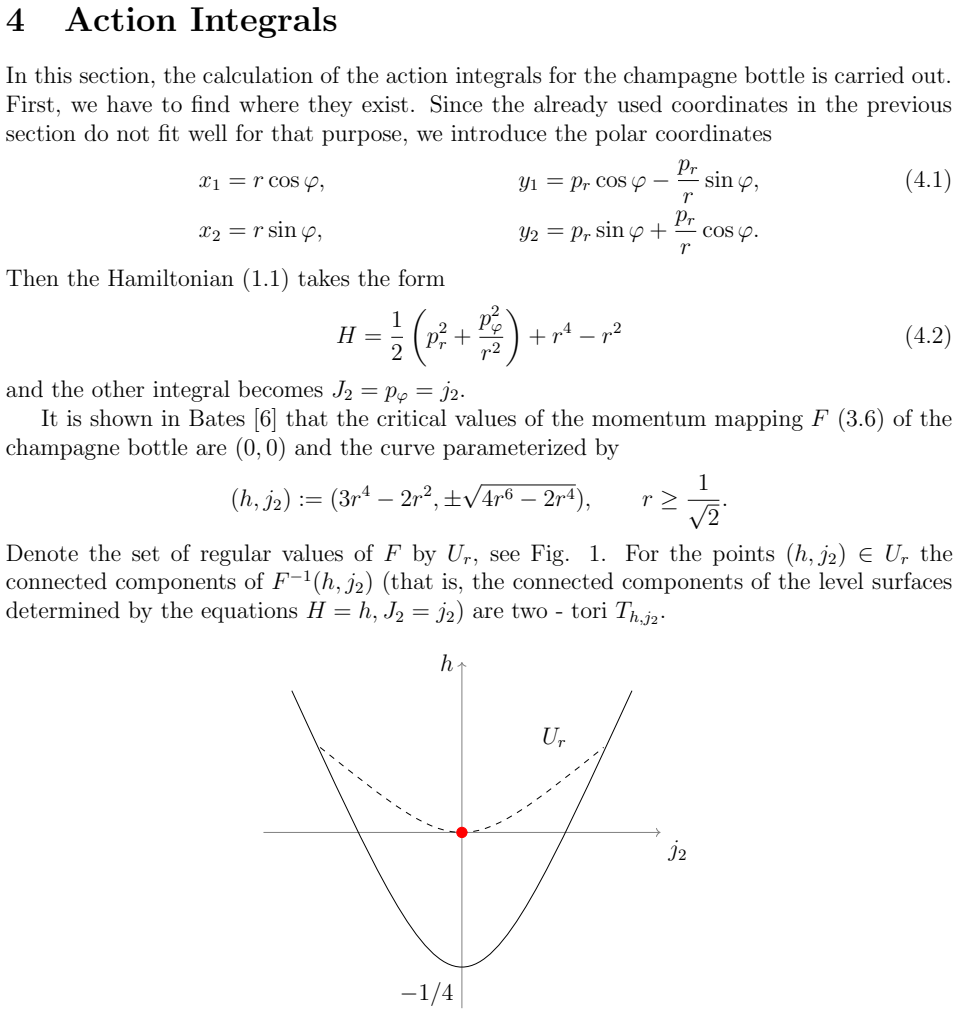
We study a two degrees of freedom Hamiltonian system describing the motion of a particle in a potential field of the form of $S^1$ symmetric double well, namely $V = - (x_1^2 + x_2^2) + (x_1^2 + x_2^2)^2$, known also as a champagne bottle potential. This system is completely integrable. The champagne bottle is the simplest member of a class of integrable systems that have no global action variables due to a non-trivial monodromy, Bates (1991). Beyond that, the geometric and dynamical properties of the system near the equilibrium are of primary interest. We calculate the Birkhoff normal form and the nontrivial action near the focus-focus singularity and obtain the semi-global symplectic invariant near focus-focus point, which is introduced by V\~{u} Ng\d{o}c (2003). Examples of such calculations are still few. We compare our result with the semi-global symplectic invariant of the spherical pendulum, calculated by Dullin (2013).
Editorial analysis
A structured set of objections, weighed in public.
Referee Report
Summary. The manuscript investigates the two-degree-of-freedom champagne bottle Hamiltonian with potential V = -(x₁² + x₂²) + (x₁² + x₂²)². The system is completely integrable but possesses non-trivial monodromy, precluding global action variables. The authors compute the Birkhoff normal form near the focus-focus equilibrium at the origin, extract the associated nontrivial action, and obtain the semi-global symplectic invariant in the sense of Vũ Ngọc (2003). The result is compared with the corresponding invariant for the spherical pendulum computed by Dullin (2013).
Significance. If the explicit calculation is correct, the work supplies a concrete additional example of a semi-global symplectic invariant for a focus-focus singularity in an integrable system with monodromy. The champagne bottle is a standard, simple model in this class, and the direct comparison with the spherical pendulum case supplies a useful external consistency check. Such explicit computations remain scarce and can serve as benchmarks for further theoretical developments.
minor comments (2)
- The abstract states that the Birkhoff normal form and semi-global invariant are obtained but supplies neither the leading coefficients nor the explicit functional form of the invariant; including these would allow immediate assessment of the result.
- A brief, self-contained recap of the Vũ Ngọc construction (including the role of the nontrivial action) in the introduction or a dedicated preliminary section would improve accessibility for readers outside the immediate subfield.
Simulated Author's Rebuttal
We thank the referee for their positive assessment of our manuscript and for recommending minor revision. The referee's summary accurately reflects the content and goals of the work, including the computation of the Birkhoff normal form near the focus-focus equilibrium and the extraction of the semi-global symplectic invariant for the champagne bottle system, along with the comparison to the spherical pendulum.
Circularity Check
No significant circularity; concrete calculation follows external framework
full rationale
The paper performs an explicit computation of the Birkhoff normal form and the associated semi-global symplectic invariant for the champagne-bottle Hamiltonian near its focus-focus equilibrium. This follows the construction introduced in the external reference Vũ Ngọc (2003) and uses the known integrability and monodromy properties established independently in Bates (1991). The result is compared against the independent calculation for the spherical pendulum in Dullin (2013). No self-citations appear in the load-bearing steps, no parameters are fitted to a subset and then relabeled as predictions, and no ansatz or uniqueness claim is smuggled in via prior work by the same author. The derivation is therefore self-contained against external benchmarks and does not reduce to its own inputs by construction.
Axiom & Free-Parameter Ledger
axioms (1)
- domain assumption The champagne bottle system is completely integrable.
Lean theorems connected to this paper
-
IndisputableMonolith/Foundation/AlexanderDuality.leanalexander_duality_circle_linking unclear?
unclearRelation between the paper passage and the cited Recognition theorem.
We calculate the Birkhoff normal form and the nontrivial action near the focus-focus singularity and obtain the semi-global symplectic invariant near focus-focus point, which is introduced by Vũ Ngọc (2003).
What do these tags mean?
- matches
- The paper's claim is directly supported by a theorem in the formal canon.
- supports
- The theorem supports part of the paper's argument, but the paper may add assumptions or extra steps.
- extends
- The paper goes beyond the formal theorem; the theorem is a base layer rather than the whole result.
- uses
- The paper appears to rely on the theorem as machinery.
- contradicts
- The paper's claim conflicts with a theorem or certificate in the canon.
- unclear
- Pith found a possible connection, but the passage is too broad, indirect, or ambiguous to say the theorem truly supports the claim.
Reference graph
Works this paper leans on
-
[1]
R. Abraham, J. E. Marsden, Foundations of Mechanics, Benjamin, Reading, 1978
work page 1978
- [2]
-
[3]
Alonso, On the symplectic invariants of semitoric systems, PhD Thesis, University of Antwerp, 2019
J. Alonso, On the symplectic invariants of semitoric systems, PhD Thesis, University of Antwerp, 2019
work page 2019
-
[4]
V. I. Arnold, Mathematical methods of Classical Mechanics, Springer, Berlin, 1978
work page 1978
-
[5]
O. Babelon and B. Dou¸ cot. Higher index focus-focus singularities in the Jaynes- Cummings-Gaudin model: symplectic invariants and monodromy. J. Geom. Phys.,87, 3—29, 2015
work page 2015
-
[6]
Bates, Monodromy in the champagne bottle, J
L. Bates, Monodromy in the champagne bottle, J. Appl. Math. Phys. (ZAMP),42, 837–847, 1991
work page 1991
- [7]
-
[8]
A. V. Bolsinov, A. T. Fomenko, Integrable Hamiltonian systems: geometry, topology, classification, Chapman & Hall, 2004
work page 2004
-
[9]
A. V. Bolsinov, A. A. Oshemkov, Singularities in integrable Hamiltonian systems, Topo- logical methods in the theory of integrable systems, Cambridge Sci. Publ., 1-67, 2006
work page 2006
-
[10]
P. Byrd, M. Friedman, Handbook of elliptic integrals for engineers and physicists, Springer, Berlin, 1954
work page 1954
-
[11]
Cayley, An Elementary Treatise on Elliptic Functions, Second Ed, Dover, New York, 1961
A. Cayley, An Elementary Treatise on Elliptic Functions, Second Ed, Dover, New York, 1961
work page 1961
-
[12]
M. S. Child, Quantum States in a champagne bottle, J. Phys. A.,31(2), 657–670, 1998
work page 1998
-
[13]
Deprit, Canonical transformation depending on small parameter, Celest
A. Deprit, Canonical transformation depending on small parameter, Celest. Mech.72, 173–179, 1969
work page 1969
- [14]
-
[15]
Dullin, San V˜ u Ngo.c, Vanishing twist near focus-focus points, Nonlinearity17, 1777–1785, 2004
H.R. Dullin, San V˜ u Ngo.c, Vanishing twist near focus-focus points, Nonlinearity17, 1777–1785, 2004
work page 2004
- [16]
-
[17]
Dullin, Semi-global symplectic invariants of the spherical pendulum, J
H.R. Dullin, Semi-global symplectic invariants of the spherical pendulum, J. Differential Equations,254, 2942–2963, 2013
work page 2013
-
[18]
J. J. Duistermaat, On global action-angle coordinates, Comm. Pure and Appl. Math. 33, 687–706, 1980
work page 1980
-
[19]
L. H. Eliasson, Hamiltonian systems with Poisson commuting integrals, PhD Thesis, University of Stockholm, 1984
work page 1984
-
[20]
Gaeta, Poincar´ e normal and renormalized forms, Acta Appl
G. Gaeta, Poincar´ e normal and renormalized forms, Acta Appl. Math.,70(1-3), 113–131, 2002
work page 2002
-
[21]
Georgiev, Perturbations in a champagne bottle, Ann
G. Georgiev, Perturbations in a champagne bottle, Ann. de l’Universite de Sofia ”St. Kliment Ohridski”, Faculte de Math´ ematiques et Informatique, Livre 1- Math´ ematiques et Mecanique, Tome89, 141–157, 1995
work page 1995
-
[22]
Horozov, Perturbations of the spherical pendulum and Abelian integrals, J
E. Horozov, Perturbations of the spherical pendulum and Abelian integrals, J. Reine Angew. Math.408, 114—135, 1990
work page 1990
-
[23]
Horozov, On the isoenergetical nondegeneracy of the spherical pendulum, Phys
E. Horozov, On the isoenergetical nondegeneracy of the spherical pendulum, Phys. Lett. A173(3), 279—283, 1993
work page 1993
-
[24]
Ito, Convergence of Birkhoff normal forms for integrable systems, Comment
H. Ito, Convergence of Birkhoff normal forms for integrable systems, Comment. Math. Helv.64(3), 412–461, 1989
work page 1989
- [25]
-
[26]
San V˜ u Ngo.c, On semi-global invariants for focus-focus singularities, Topology42(2), 365–380, 2003
work page 2003
- [27]
-
[28]
B. Rink, A Cantor set of tori with monodromy near a focus-focus singularity, Nonlinearity 17, 347–356, 2004
work page 2004
-
[29]
Williamson, On the algebraic problem concerning the normal forms of linear dynamical systems, Amer
J. Williamson, On the algebraic problem concerning the normal forms of linear dynamical systems, Amer. J. Math.58(1), 141–163, 1936
work page 1936
-
[30]
N. T. Zung, A topological classification of integrable hamiltonian systems. In R. Brouzet (Ed.), S´ eminaire Gaston Darboux de g´ eometrie et topologie diff´ erentielle, pages 43—54. Universit´ e Montpellier II, 1994-1995
work page 1994
-
[31]
N. T. Zung, Kolmogorov condition for integrable systems with focus-focus singularities, Phys. Lett. A,215, 40–44, 1996. 20
work page 1996
-
[32]
N. T. Zung, A note on focus-focus singularities, Diff. Geometry and its Aplications,7, 123–130, 1997. 21
work page 1997
discussion (0)
Sign in with ORCID, Apple, or X to comment. Anyone can read and Pith papers without signing in.