A Uniformly High-Accuracy PML-BIE Method for Scattering by Periodic Arrays of Obstacles: The 2D Case
Pith reviewed 2026-06-27 19:49 UTC · model grok-4.3
The pith
A PML boundary integral method with finite-mode correction solves periodic scattering problems accurately near Rayleigh-Wood anomalies.
A machine-rendered reading of the paper's core claim, the machinery that carries it, and where it could break.
Core claim
The central claim is that combining the perfectly matched layer truncation with a finite-mode correction yields a boundary integral formulation whose truncated operators converge exponentially and uniformly in frequency, including at and near Rayleigh-Wood anomalies, without introducing new instabilities.
What carries the argument
The finite-mode correction added to the PML-truncated boundary integral operators, which restores exponential convergence independently of frequency.
If this is right
- The PML-truncated operators converge exponentially for any fixed PML parameters once the finite-mode correction is included.
- The method requires no retuning of PML parameters when frequency varies across anomalies.
- The formulation uses only the free-space Green's function and avoids lattice sums or quasi-periodic kernels.
- Several numerical examples confirm high accuracy and robustness for both dielectric and perfectly conducting obstacles.
Where Pith is reading between the lines
- The same correction idea could be tested on three-dimensional periodic structures where similar anomalies occur.
- Because the correction is frequency-independent, the method may allow efficient sweeping over frequency bands without recomputing the correction at each step.
- If the correction generalizes, it might also improve windowed Green function approaches that currently require mode corrections at anomalies.
Load-bearing premise
The finite-mode correction can be chosen once, independently of frequency, so that it restores exponential convergence uniformly near Rayleigh-Wood anomalies without new instabilities or parameter retuning.
What would settle it
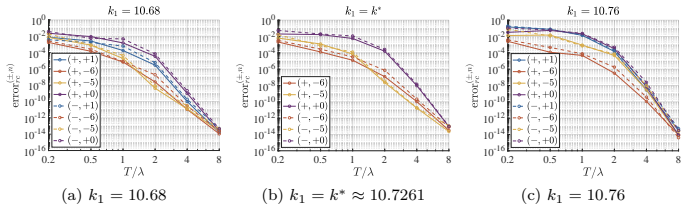
Numerical tests on a periodic array at a sequence of frequencies crossing a Rayleigh-Wood anomaly that show the error failing to decrease exponentially with PML thickness when the correction is applied.
Figures
read the original abstract
This paper presents a novel frequency-robust perfectly matched layer (PML) boundary integral equation (BIE) method for solving two-dimensional electromagnetic scattering problems involving periodic arrays of obstacles. In periodic scattering problems, standard BIE formulations based on the quasi-periodic Green's function require the evaluation of lattice sums or challenging Sommerfeld-type integrals, which diverge at Rayleigh--Wood (RW) anomalies. An alternative is to use BIE formulations based on the Helmholtz free-space Green's function, but these are defined on unbounded unit-cell boundaries and therefore require suitable truncation strategies, such as the Windowed Green Function (WGF) method. Although such approaches avoid the use of expensive quasi-periodic Green's functions, they also suffer from breakdowns at RW anomalies unless an appropriate mode correction is incorporated. Similarly, the direct application of PML-BIE techniques to periodic structures experiences comparable difficulties near RW anomalies due to the destruction of exponential convergence near RW anomalies for fixed PML parameters. To overcome this challenge, we propose a modified PML-BIE method that combines the PML technique with a finite-mode correction, ensuring both high accuracy and robustness at and around RW-anomalies. Convergence of the PML-truncated boundary integral operators is proved and several numerical examples are presented to validate the efficiency and performance of the proposed method.
Editorial analysis
A structured set of objections, weighed in public.
Referee Report
Summary. The paper proposes a modified PML-BIE formulation for 2D scattering by periodic arrays that augments standard PML truncation of the free-space Green's function with a finite-mode correction. The central claims are that this correction restores uniform exponential convergence of the truncated operators near Rayleigh-Wood anomalies without frequency-dependent retuning, that convergence of the resulting operators is proved, and that numerical tests confirm high accuracy and robustness.
Significance. A frequency-independent finite-mode correction that provably restores uniform exponential PML convergence would be a meaningful technical advance for periodic scattering, removing the need for case-by-case parameter adjustment that affects both WGF and standard PML approaches. The existence of a convergence proof and the presentation of numerical validation are positive features if the uniformity statement holds.
major comments (2)
- [§3] §3 (finite-mode correction): the explicit construction of the correction term is not shown to be independent of the wave number k. The claim that a single, fixed set of modes restores exponential decay uniformly in a neighborhood of RW anomalies requires a demonstration that neither the mode selection nor the correction amplitudes depend on proximity to the anomaly or on k.
- [Theorem 4.2] Theorem 4.2 (uniform convergence): the proof of exponential decay of the PML truncation error assumes the correction operator is fixed, yet the load-bearing step—how the propagating-mode projection remains valid and stable without retuning when the incident frequency crosses an RW anomaly—is not supplied with sufficient detail to confirm the uniformity statement.
minor comments (2)
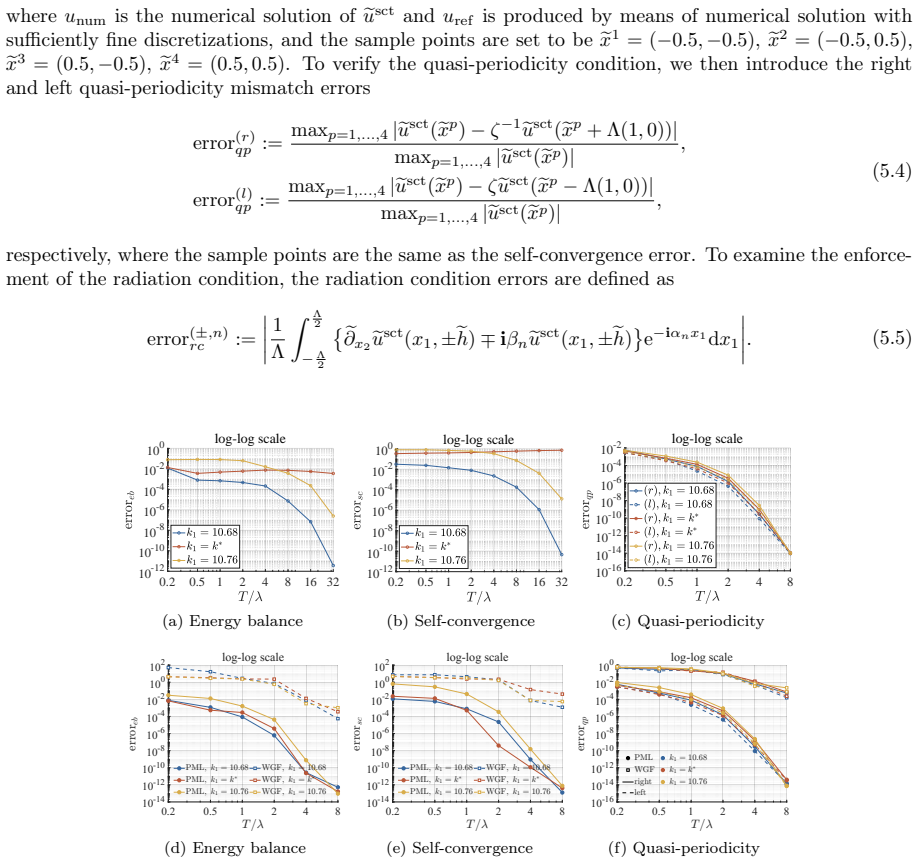
- [Numerical examples] The numerical examples section should report the precise distances to the nearest RW anomaly and the fixed PML parameters used across all tests to allow direct assessment of the uniformity claim.
- [Notation] Notation for the PML absorption profile and the number of retained modes should be introduced once and used consistently; current usage mixes symbols across sections.
Simulated Author's Rebuttal
We thank the referee for the careful reading and constructive comments. The points raised highlight opportunities to strengthen the exposition of the finite-mode correction's frequency independence and the details supporting uniform convergence. We address each major comment below and will revise the manuscript accordingly.
read point-by-point responses
-
Referee: [§3] §3 (finite-mode correction): the explicit construction of the correction term is not shown to be independent of the wave number k. The claim that a single, fixed set of modes restores exponential decay uniformly in a neighborhood of RW anomalies requires a demonstration that neither the mode selection nor the correction amplitudes depend on proximity to the anomaly or on k.
Authors: The finite-mode correction in §3 is constructed by subtracting the contributions of the propagating plane-wave modes (determined by the lattice vectors and incidence angle) from the free-space kernel before PML truncation. For any fixed interval between consecutive RW anomalies the set of propagating modes is constant, so both the mode selection and the form of the correction operator remain fixed; only the numerical amplitudes of those modes are obtained from the BIE solve itself and therefore vary continuously with k. Within a neighborhood of a given anomaly the same fixed set is used, and the PML parameters are never retuned. We will add an explicit remark and a short lemma in the revised §3 making this independence manifest. revision: yes
-
Referee: [Theorem 4.2] Theorem 4.2 (uniform convergence): the proof of exponential decay of the PML truncation error assumes the correction operator is fixed, yet the load-bearing step—how the propagating-mode projection remains valid and stable without retuning when the incident frequency crosses an RW anomaly—is not supplied with sufficient detail to confirm the uniformity statement.
Authors: Theorem 4.2 proves exponential decay of the truncated operators once the correction is applied, with the correction operator treated as fixed on each side of an anomaly. The projection onto propagating modes is stable because the number of such modes is locally constant and the associated Fourier coefficients remain bounded as k approaches the anomaly from either side (the singularity is removable by the correction). We agree that the manuscript would benefit from an expanded paragraph immediately after the statement of Theorem 4.2 that spells out this local constancy and the uniform bound on the projection operator. This addition will be included in the revision. revision: yes
Circularity Check
No significant circularity; derivation self-contained via new correction term and operator convergence proof.
full rationale
The paper introduces a modified PML-BIE formulation that augments standard PML truncation with an explicit finite-mode correction to restore uniform exponential convergence near RW anomalies. The abstract states that convergence of the PML-truncated operators is proved, and the correction is presented as an added term chosen independently of frequency. No equations or steps in the provided text reduce a claimed prediction or uniqueness result to a fitted parameter, self-citation chain, or definitional tautology. The central construction is a combination of existing PML and BIE operators plus the correction, with the proof serving as independent verification rather than a renaming or self-referential fit. This satisfies the default expectation of a non-circular derivation.
Axiom & Free-Parameter Ledger
free parameters (2)
- PML absorption parameters
- Number of modes in correction
axioms (1)
- standard math Standard analytic properties of the Helmholtz free-space Green's function and PML truncation operators permit exponential convergence after mode correction.
Reference graph
Works this paper leans on
-
[1]
Maxwell's equations in periodic structures , author =
-
[2]
A. G. Fernandez-Lado , school =. Wave-
-
[3]
J. A. Monro, Jr. , PUBLISHER =. A
-
[4]
22 of Topics in Current Physics , author=
Electromagnetic Theory of Gratings, Vol. 22 of Topics in Current Physics , author=
-
[5]
F. W. J. Olver and D. W. Lozier and R. F. Boisvert and C. W. Clark , publisher =
-
[6]
A treatise on the theory of Bessel functions , author=
-
[7]
Arens and K
T. Arens and K. Sandfort and S. Schmitt and A. Lechleiter , year =. Analysing. IMA J. Appl. Math. , pages =
-
[8]
Bao and W
G. Bao and W. Lu and T. Yin and L. Zhang , year=. A highly accurate. SIAM J. Sci. Comput. , pages=
-
[9]
A perfectly matched layer for the absorption of electromagnetic waves , author =. J. Comput. Phys. , pages =. 1994 , volume =
1994
-
[10]
O. P. Bruno and B. Delourme , year =. Rapidly convergent two-dimensional quasi-periodic. J. Comput. Phys. , pages =
-
[11]
O. P. Bruno and A. G. Fernandez-Lado , year =. Rapidly convergent quasi-periodic. Proc. A. , pages =
-
[12]
O. P. Bruno and A. G. Fernandez-Lado , year=. On the evaluation of quasi-periodic. J. Comput. Phys. , pages =
-
[13]
Efficient high-order evaluation of scattering by periodic surfaces: deep gratings, high frequencies, and glancing incidences , author=. J. Opt. Soc. Am. A , pages=. 2009 , volume=
2009
-
[14]
Efficient high-order evaluation of scattering by periodic surfaces: vector-parametric gratings and geometric singularities , author=. Wave. Random. Complex. , pages=. 2010 , volume=
2010
-
[15]
O. P. Bruno and S. P. Shipman and C. Turc and S. Venakides , year =. Superalgebraically convergent smoothly windowed lattice sums for doubly periodic. Proc. A. , pages =
-
[16]
O. P. Bruno and S. P. Shipman and C. Turc and S. Venakides , year =. Three-dimensional quasi-periodic shifted. Proc. A. , pages =
-
[17]
Capolino and D
F. Capolino and D. R. Wilton and W. A. Johnson , year =. Efficient computation of the 3. J. Comput. Phys. , pages =
-
[18]
An adaptive finite element method with perfectly matched absorbing layers for the wave scattering by periodic structures , author =. SIAM J. Numer. Anal. , pages =. 2003 , volume =
2003
-
[19]
Convergence of the uniaxial perfectly matched layer method for time-harmonic scattering problems in two-layered media , author =. SIAM J. Numer. Anal. , pages =. 2010 , volume =
2010
-
[20]
Chen and W
Z. Chen and W. Zheng , year =. SIAM J. Numer. Anal. , pages =
-
[21]
Scattering in flatland: Efficient representations via wave atoms , author=. Found. Comput. Math. , pages=. 2010 , volume=
2010
-
[22]
Gao and W
Y. Gao and W. Lu , year =. Wave scattering in layered orthotropic media. SIAM J. Sci. Comput. , pages =
-
[23]
Lassas and E
M. Lassas and E. Somersalo , year =. Analysis of the. Proc. Roy. Soc. Edinburgh Sect. A , pages =
-
[24]
C. M. Linton , year =. The. J. Engrg. Math. , pages =
-
[25]
C. M. Linton , year =. Lattice sums for the. SIAM Rev. , pages =
-
[26]
Perfectly matched layer boundary integral equation method for wave scattering in a layered medium , author =. SIAM J. Appl. Math. , pages =. 2018 , volume =
2018
-
[27]
Lu and K
W. Lu and K. Shen and R. Zhang , year =. A boundary integral equation method for wave scattering in periodic structures via the. J. Comput. Phys. , pages =
-
[28]
A highly accurate perfectly-matched-layer boundary integral equation solver for acoustic layered-medium problems , author =. SIAM J. Sci. Comput. , pages =. 2023 , volume =
2023
-
[29]
Perfectly matched layer method for the wave scattering problem by a step-like surface , author =. SIAM J. Numer. Anal. , pages =. 2025 , volume =
2025
-
[30]
A complex-scaled boundary integral equation for time-harmonic water waves , author =. SIAM J. Appl. Math. , pages =. 2024 , volume =
2024
-
[31]
Rayleigh , year=
L. Rayleigh , year=. Note on the remarkable case of diffraction spectra described by. The London, Edinburgh, and Dublin Philosophical Magazine and Journal of Science , pages=
-
[32]
Strauszer-Caussade and L
T. Strauszer-Caussade and L. M. Faria and A. Fernandez-Lado and C. P\'erez-Arancibia , year =. Windowed. Stud. Appl. Math. , pages =
-
[33]
The London, Edinburgh, and Dublin Philosophical Magazine and Journal of Science , pages=
On a remarkable case of uneven distribution of light in a diffraction grating spectrum , author=. The London, Edinburgh, and Dublin Philosophical Magazine and Journal of Science , pages=. 1902 , volume=
1902
-
[34]
Yu and G
X. Yu and G. Hu and W. Lu and A. Rathsfeld , year =. P. SIAM J. Numer. Anal. , pages =
-
[35]
2018 , publisher=
Diffraction gratings and applications , author=. 2018 , publisher=
2018
-
[36]
2018 , publisher=
Light propagation in periodic media: differential theory and design , author=. 2018 , publisher=
2018
-
[37]
Phononic crystals , author=
-
[38]
J. D. Joannopoulos and S. G. Johnson and J. N. Winn and R. D. Meade , publisher=. Photonic crystals:
-
[39]
Wu and Y
Y. Wu and Y. Y. Lu , year =. Analyzing diffraction gratings by a boundary integral equation. J. Opt. Soc. Am. A , pages =
-
[40]
BIT Numer
A new integral representation for quasi-periodic scattering problems in two dimensions , author =. BIT Numer. Math. , pages =. 2011 , volume =
2011
-
[41]
Numerical solution of diffraction problems: a method of variation of boundaries , author =. J. Opt. Soc. Am. A , pages =. 1993 , volume =
1993
-
[42]
A fast direct solver for quasi-periodic scattering problems , author =. J. Comput. Phys. , pages =. 2013 , volume =
2013
-
[43]
Wu and Y
Y. Wu and Y. Y. Lu , year =. Boundary integral equation. J. Opt. Soc. Am. A , pages =
-
[44]
High order integral equation method for diffraction gratings , author =. J. Opt. Soc. Am. A , pages =. 2012 , volume =
2012
-
[45]
Robust fast direct integral equation solver for quasi-periodic scattering problems with a large number of layers , author =. Opt. Express , pages =. 2015 , volume =
2015
-
[46]
Robust fast direct integral equation solver for three-dimensional doubly periodic scattering problems with a large number of layers , author =. J. Comput. Phys. , pages =. 2023 , volume =
2023
-
[47]
A fast and robust solver for the scattering from a layered periodic structure containing multi-particle inclusions , author =. J. Comput. Phys. , pages =. 2015 , volume =
2015
discussion (0)
Sign in with ORCID, Apple, or X to comment. Anyone can read and Pith papers without signing in.