REVIEW 2 major objections 5 minor 47 references
Lights, Camera, Carbon: Architectural Scaling Laws for Video Generation Energy Consumption
T0 review · 2 major / 5 minor · reviewed 2026-07-11 · grok-4.5
Pith's one-line read Video diffusion energy follows architectural scaling laws of quadratic self-attention and linear feed-forward costs, predictable from resolution and duration without model weights.
desk verdict Solid open-model energy scaling for T2V with tight MAPE and real ablation checks; proprietary Wh numbers are order-of-magnitude only. read the letter →
The pith
A machine-rendered reading of the paper's core claim, the machinery that carries it, and where it could break.
The reading
What carries the argument
The bidirectional energy framework: a unified non-negative least-squares fit of E = N₁·T²·S·B + (optional VAE/stage attention terms) + M·T·S·B + G·B that isolates quadratic attention from linear FFN/VAE costs; fit quality is the diagnostic that the assumed architecture is correct.
What would settle it
Force a wrong architecture into the fit (drop the quadratic attention term or the FFN term) on a held-out open-model configuration; if MAPE stays near 3% instead of collapsing, the claim that fit quality validates architecture fails. For closed models, measure actual rack power during API runs; systematic deviation from ~0.9·TDP would falsify the reported Wh ranges.
Extended reading notes
Core claim
Each video diffusion model’s energy profile obeys theoretically derived scaling laws that decompose into quadratic self-attention and linear feed-forward and VAE terms whose coefficients reflect true architectural complexity. Fitted on open models, the decomposition achieves below 3% MAPE across six architectures and three GPU configurations; accuracy itself validates the architectural assumptions, enabling both forward energy prediction from generation parameters and backward recovery of scaling behavior from inference times without weights or model size.
Load-bearing premise
Video generation is treated as predominantly compute-bound with power stuck near thermal design power, so energy equals time and time is fully determined by the architectural complexity of the generation parameters.
Editorial extensions
If this is right
- Sustainability benchmarks for T2V systems can be produced from resolution, duration, and steps without disclosing weights or FLOPs.
- Parameter count is neither necessary nor sufficient for energy estimates; architectural design choices dominate cost.
- Multi-GPU inference cuts latency but does not cut total energy and can raise it through communication overhead.
- Joint audio-video overhead is driven mainly by extra classifier-free-guidance forward passes, not by audio token terms themselves.
- API-only commercial models can be energy-ranked from observed latency under near-TDP power assumptions, revealing order-of-magnitude differences.
Reading between the lines
- Platforms or auditors could treat the fitted quadratic and linear coefficients as a lightweight public architectural fingerprint for energy transparency without requiring weight release.
- The same quadratic-linear decomposition is a natural candidate for image-to-video, upscaling, and other iterative generative pipelines that remain compute-bound.
- At the adoption volumes already cited for short-video platforms, the household-scale electricity equivalents imply material grid and carbon planning needs beyond text-focused AI impact studies.
- Architectural ablations that remove attention terms could serve as a pre-training diagnostic for energy-quality trade-offs during model design.
Editorial analysis
A structured set of objections, weighed in public.
Referee Report
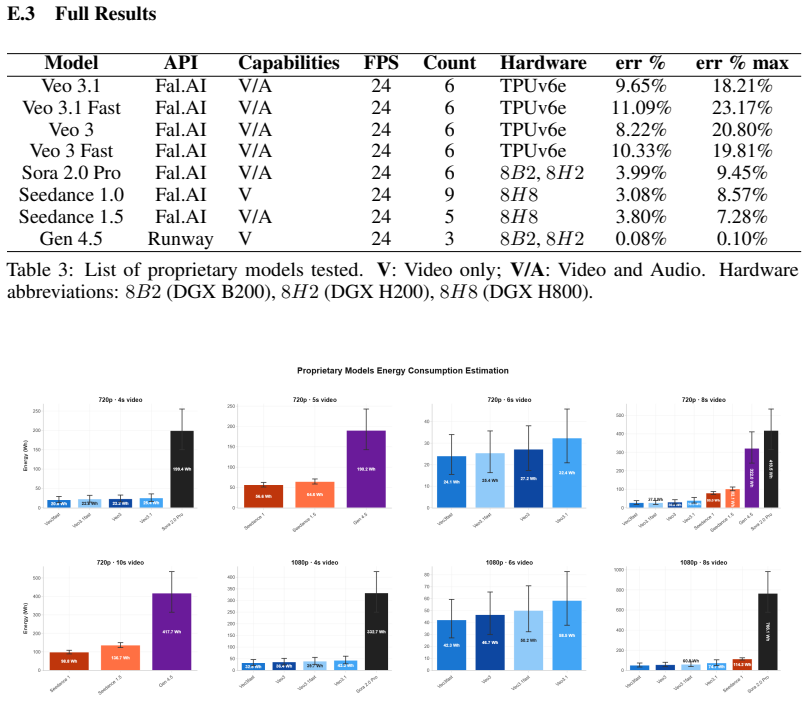
Summary. The paper derives and validates architectural scaling laws for energy consumption of text-to-video (and T2VA) diffusion models. From first principles (self-attention O(T^{2}), FFN/VAE O(T), batch/step linearity) it obtains a bidirectional framework: forward, energy is predicted from resolution, duration, steps, and batch size without weights or model size; backward, fit quality on observed times diagnoses architectural assumptions. Open-model validation on six models (8.3B–27B) and three GPU setups (H200, B200, 8×H200) yields MAPE below 3% (Table 2, Fig. 3), with term-ablation collapses (Sec. 4.3) and leave-one-out CV supporting the claims. Properties 1–6 formalize compute-bound near-TDP behavior, architecture-over-parameter-count, linear batch scaling, and multi-GPU latency-vs-energy trade-offs. A case study extends the framework to eight proprietary APIs via min-of-3 latencies and Monte-Carlo power assumptions (Sec. 4.4, App. E).
Significance. If the open-model results hold, the work supplies a practical, architecture-grounded, and largely black-box-compatible method for sustainability benchmarking of video generation—an area whose energy cost is orders of magnitude above text or image generation and is still sparsely measured. Strengths include phase-level pyNVML instrumentation, theoretically motivated functional forms fitted by NNLS, explicit ablation of architectural terms, and cross-validation that keeps MAPE near in-sample values. The proprietary estimates, while more speculative, illustrate how the same laws can be applied when only API latencies are available, which is the regime most users actually face. The contribution is therefore both empirical (tight open-model fits) and methodological (a reusable bidirectional template).
major comments (2)
- Sec. 4.4 and Appendix E: the proprietary energy ranges rest on E ≈ P·t with P ~ N(0.9·TDP, (0.05·TDP)²), assumed multi-accelerator nodes (TPU v6e / DGX H800 / H200 / B200), and min-of-3 API latencies treated as true generation time. These assumptions are not independently verifiable and can shift absolute Wh by factors of ~2 without affecting open-model MAPE. The manuscript already flags the uncertainty, but the abstract and Fig. 1 present the closed-model numbers with comparable visual weight to the measured open-model results. Either (a) move the proprietary estimates to a clearly labeled exploratory appendix with wider sensitivity bands, or (b) add an explicit sensitivity table showing how the reported ranges change under plausible alternative power fractions and single- vs multi-GPU deployments.
- Sec. 3.1–3.2 and Eq. (1): high collinearity between the linear FFN and VAE-convolution terms forces them to be merged into a single M coefficient; the paper itself notes this limitation. Because the central claim is that coefficients “directly reflect the underlying architectural complexity,” the inability to disentangle phase-level contributions weakens the architectural-interpretation claim for the linear term. Expanding the design matrix (more independent variation of resolution vs. frame count, or explicit phase-separated energy when tiling is not required) would strengthen identification; at minimum, the text should quantify the condition number of the design matrix and report coefficient standard errors more prominently for every model, not only selected rows of Table 2.
minor comments (5)
- Notation: T is defined as (H×W×F)/1000 for numerical stability, yet later expressions still write T^{2}; a brief remark that all coefficients absorb the 10^{-6} factor would avoid reader confusion.
- Fig. 1 caption and main text: “estimated proprietary-model energy” should be qualified as “Monte-Carlo estimates under assumed hardware” so the figure is not read as measured data.
- Property 5 claims multi-GPU is “not an energy [optimization]”; the 8H2 vs H2 comparisons show a modest energy penalty, but the text could note that communication overhead may be architecture- and framework-dependent (xDiT, etc.).
- Table 1 lists “Count” without defining it; a footnote clarifying that it is the number of measured configurations would help.
- References [38] and [44] cite 2026 dates that appear future-dated relative to the arXiv stamp; verify publication years.
Circularity Check
Open-model scaling laws are non-circular first-principles fits with independent ablation/CV checks; only mild fitted-input reuse appears in proprietary energy estimates.
-
fitted input called prediction
[Sec. 4.4 and Appendix E (proprietary case study)]
"by fitting the full scaling law formula to observed inference times, we aim to recover the architectural scaling behavior of each model, enabling energy prediction across arbitrary unseen configurations based on predictive accuracy reflecting architectural validity (Property 6). ... Energy is estimated by modeling power draw as P∼N(0.9·TDP,(0.05·TDP)2) ... Running 10,000 Monte Carlo simulations per model yields a weighted energy distribution"
Coefficients are fit directly to the same min-of-3 API latencies that later become the time component of E≈P·t; absolute energy ranges are then produced by multiplying those fitted times by an assumed near-TDP power distribution under assumed hardware. For configurations inside the fit set this is largely a re-expression of the fitted times rather than an independent prediction of energy. The open-model core (Table 2, Fig. 3) does not share this reduction.
full rationale
The core claim is not circular. Section 2.1 and 3.1 derive the functional form (quadratic self-attention O(T^{2}), linear FFN/VAE O(T), batch/step linearity) from standard transformer/VAE complexity before any energy data are used; coefficients N1, M, N2, G are free non-negative parameters fit by NNLS to measured energy (Eqs. 1–2, Table 2). Leave-one-out CV MAPE stays close to in-sample MAPE, and architectural ablation (removing N2 or M) collapses accuracy (Sec. 4.3), which is a genuine falsification check rather than a tautology. Property 1 (near-TDP power) is independently measured, so E ≈ P·t is an empirical observation, not a definition. The only mild circularity is in the proprietary case study (Sec. 4.4 / App. E): the same form is re-fit to min-of-3 API latencies, then multiplied by an assumed P ~ N(0.9·TDP, …) under assumed multi-accelerator hardware; absolute Wh ranges are therefore partly forced by those inputs. That is a secondary application already flagged by the authors as carrying extra uncertainty, not the load-bearing open-model result. Score 2 reflects one non-central fitted-input step; the derivation chain for Properties 1–6 and Table 2/Fig. 3 is self-contained against external benchmarks.
Assumptions & free parameters
free parameters (7)
- N1 (denoising self-attention coefficient)
- M (linear FFN + VAE convolution coefficient)
- N2 (VAE mid-block or second-stage attention coefficient)
- G (per-video overhead)
- ΔM, ΔG (audio/CFG overhead deltas for LTX-2 T2VA)
- Power model P ~ N(0.9·TDP, (0.05·TDP)²)
- Hardware deployment assignments (TPU v6e / 8H8 / 8H2 / 8B2)
assumptions (4)
- domain assumption Video diffusion denoising is predominantly compute-bound, so average power stays near TDP and Energy ≈ P × t with P roughly constant.
- standard math Self-attention scales as O(T²), FFN and causal 3D convolutions as O(T), cross-attention absorbed into linear terms when L_text is padded constant.
- domain assumption Videos in a batch are independent, so energy scales linearly with batch size B and steps S.
- ad hoc to paper API min-of-3 latency approximates true generation time; fixed S is absorbed into coefficients; multi-accelerator near-TDP deployment is used for closed models.
invented entities (1)
-
Bidirectional architectural energy framework (forward prediction + backward architecture recovery via fit quality)
Cite this review
Pith. "Pith review of Lights, Camera, Carbon: Architectural Scaling Laws for Video Generation Energy Consumption." pith.science (2026). https://pith.science/paper/2JQV5DBO
@misc{pith2026260704553,
  author       = {Pith},
  title        = {Pith review of: Lights, Camera, Carbon: Architectural Scaling Laws for Video Generation Energy Consumption},
  year         = {2026},
  howpublished = {\url{https://pith.science/paper/2JQV5DBO}},
  note         = {Machine review of arXiv:2607.04553}
}
read the original abstract
We present a bidirectional framework for estimating the energy consumption of text-to-video (T2V) and text-to-video-audio (T2VA) models from architectural first principles and observable generation parameters such as resolution and duration, requiring no access to weights, model size, or implementation details. Forward, it predicts energy from generation parameters and architectural principles; backward, it recovers architectural scaling behavior from observed inference times, with accuracy serving as a criterion for architectural validity. Building on the established compute-bound nature of video diffusion models, we demonstrate that each model's energy profile obeys theoretically derived scaling laws, decomposing into quadratic and linear terms whose coefficients directly reflect the underlying architectural complexity. Validated across six open-source models spanning 8.3B-27B parameters and three GPU configurations, this decomposition achieves below 3% MAPE across all architectures. This approach offers a standardized, empirically and theoretically grounded framework for sustainability benchmarking across T2V models and architectures.
Figures


Figures from the paper (2 more)

Reference graph
Works this paper leans on
-
[1]
GPT-4 technical report, 2024
OpenAI. GPT-4 technical report, 2024
2024
-
[2]
Conditional variational autoencoder with adversar- ial learning for end-to-end text-to-speech
Jaehyeon Kim, Jungil Kong, and Juhee Son. Conditional variational autoencoder with adversar- ial learning for end-to-end text-to-speech. InInternational conference on machine learning, pages 5530–5540. PMLR, 2021
2021
-
[3]
High- resolution image synthesis with latent diffusion models
Robin Rombach, Andreas Blattmann, Dominik Lorenz, Patrick Esser, and Björn Ommer. High- resolution image synthesis with latent diffusion models. InProceedings of the IEEE/CVF conference on computer vision and pattern recognition, pages 10684–10695, 2022
2022
-
[4]
The ai gambit: leveraging artificial intelligence to combat climate change—opportunities, challenges, and recommendations.Ai & Society, 38(1):283–307, 2023
Josh Cowls, Andreas Tsamados, Mariarosaria Taddeo, and Luciano Floridi. The ai gambit: leveraging artificial intelligence to combat climate change—opportunities, challenges, and recommendations.Ai & Society, 38(1):283–307, 2023
2023
-
[5]
Energy and policy considerations for deep learning in nlp
Emma Strubell, Ananya Ganesh, and Andrew McCallum. Energy and policy considerations for deep learning in nlp. InProceedings of the 57th annual meeting of the association for computational linguistics, pages 3645–3650, 2019
2019
-
[6]
Alexandra Sasha Luccioni, Sylvain Viguier, and Anne-Laure Ligozat. Estimating the carbon footprint of BLOOM, a 176b parameter language model.arXiv preprint arXiv:2211.02001, 2022
arXiv 2022
-
[7]
Jared Fernandez, Clara Na, Vashisth Tiwari, Yonatan Bisk, Sasha Luccioni, and Emma Strubell. Energy considerations of large language model inference and efficiency optimizations.arXiv preprint arXiv:2504.17674, 2025
arXiv 2025
-
[8]
Evaluating the environmental impact of language models with life cycle assessment
Jared Fernandez, Clara Na, Yonatan Bisk, and Emma Strubell. Evaluating the environmental impact of language models with life cycle assessment
Show all 47 references
-
[9]
Holistically evaluating the environmental impact of creating language models.arXiv preprint arXiv:2503.05804, 2025
Jacob Morrison, Clara Na, Jared Fernandez, Tim Dettmers, Emma Strubell, and Jesse Dodge. Holistically evaluating the environmental impact of creating language models.arXiv preprint arXiv:2503.05804, 2025
2025 arXiv
-
[10]
Benchmarking energy efficiency of large language models using vllm
K Pronk and Q Zhao. Benchmarking energy efficiency of large language models using vllm. arXiv preprint arXiv:2509.08867, 2025
2025 arXiv
-
[11]
How hungry is ai? benchmarking energy, water, and carbon footprint of llm inference
Nidhal Jegham, Marwan Abdelatti, Chan Young Koh, Lassad Elmoubarki, and Abdeltawab Hendawi. How hungry is ai? benchmarking energy, water, and carbon footprint of llm inference. arXiv preprint arXiv:2505.09598, 2025
2025
-
[12]
Power hungry processing: Watts driving the cost of ai deployment? InThe 2024 ACM Conference on Fairness Accountability and Transparency, FAccT ’24, page 85–99
Sasha Luccioni, Yacine Jernite, and Emma Strubell. Power hungry processing: Watts driving the cost of ai deployment? InThe 2024 ACM Conference on Fairness Accountability and Transparency, FAccT ’24, page 85–99. ACM, June 2024
2024
-
[13]
Talk is cheap, energy is not: Towards a green, context-aware metrics framework for automatic speech recognition
Maria Ulan, Erik Johannes Husom, and Jeriek Van den Abeele. Talk is cheap, energy is not: Towards a green, context-aware metrics framework for automatic speech recognition. InJoint European Conference on Machine Learning and Knowledge Discovery in Databases, pages 36–54. Sprin...
2025
-
[14]
Carbon in motion: Characterizing open-sora on the sustainability of generative ai for video generation.ACM SIGENERGY Energy Informatics Review, 4(5):160–165, 2024
Baolin Li, Yankai Jiang, and Devesh Tiwari. Carbon in motion: Characterizing open-sora on the sustainability of generative ai for video generation.ACM SIGENERGY Energy Informatics Review, 4(5):160–165, 2024
2024
-
[15]
Video killed the energy budget: Characterizing the latency and power regimes of open text-to-video models.arXiv preprint arXiv:2509.19222, 2025
Julien Delavande, Regis Pierrard, and Sasha Luccioni. Video killed the energy budget: Characterizing the latency and power regimes of open text-to-video models.arXiv preprint arXiv:2509.19222, 2025
2025
-
[16]
Hunyuanvideo: A systematic framework for large video generative models.arXiv preprint arXiv:2412.03603, 2024
Weijie Kong, Qi Tian, Zijian Zhang, Rox Min, Zuozhuo Dai, Jin Zhou, Jiangfeng Xiong, Xin Li, Bo Wu, Jianwei Zhang, et al. Hunyuanvideo: A systematic framework for large video generative models.arXiv preprint arXiv:2412.03603, 2024. 11
2024 arXiv
-
[17]
Mind the memory gap: Unveiling gpu bottlenecks in large-batch llm inference
Pol G Recasens, Ferran Agullo, Yue Zhu, Chen Wang, Eun Kyung Lee, Olivier Tardieu, Jordi Torres, and Josep Ll Berral. Mind the memory gap: Unveiling gpu bottlenecks in large-batch llm inference. In2025 IEEE 18th International Conference on Cloud Computing (CLOUD), pages 277–28...
2025
-
[18]
Eliminating vae for fast and high-resolution generative detail restoration.arXiv preprint arXiv:2602.10630, 2026
Yan Wang, Shijie Zhao, Junlin Li, and Li Zhang. Eliminating vae for fast and high-resolution generative detail restoration.arXiv preprint arXiv:2602.10630, 2026
2026
-
[19]
Ltx-2: Efficient joint audio-visual foundation model.arXiv preprint arXiv:2601.03233, 2026
Yoav HaCohen, Benny Brazowski, Nisan Chiprut, Yaki Bitterman, Andrew Kvochko, Avishai Berkowitz, Daniel Shalem, Daphna Lifschitz, Dudu Moshe, Eitan Porat, et al. Ltx-2: Efficient joint audio-visual foundation model.arXiv preprint arXiv:2601.03233, 2026
2026 arXiv
-
[20]
Artificial analysis.https://artificialanalysis.ai, 2026
Artificial Analysis. Artificial analysis.https://artificialanalysis.ai, 2026
2026
-
[21]
Hunyuanvideo
Tencent. Hunyuanvideo. https://huggingface.co/tencent/HunyuanVideo, 2025
2025
-
[22]
Hunyuanvideo-1.5
Tencent. Hunyuanvideo-1.5. https://huggingface.co/tencent/HunyuanVideo-1.5, 2025
2025
-
[23]
Lightricks. Ltx-2. https://huggingface.co/Lightricks/LTX-2/tree/main, 2025
2025
-
[24]
Wan-AI. Wan 2.2. https://huggingface.co/Wan-AI/Wan2.2-T2V-A14B/, 2025
2025
-
[25]
Wan-AI. Wan 2.1. https://huggingface.co/Wan-AI/Wan2.1-T2V-14B, 2025
2025
-
[26]
Energyusecalculator, 2026
EnergyUseCalculator. Energyusecalculator, 2026
2026
-
[27]
Measuring the environmental impact of delivering ai at google scale.arXiv preprint arXiv:2508.15734, 2025
Cooper Elsworth, Keguo Huang, David Patterson, Ian Schneider, Robert Sedivy, Savannah Goodman, Ben Townsend, Parthasarathy Ranganathan, Jeff Dean, Amin Vahdat, et al. Measuring the environmental impact of delivering ai at google scale.arXiv preprint arXiv:2508.15734, 2025
2025 arXiv
-
[28]
Google’s ai filmmaker program, flow, helped creators make 100 million videos, 2025
Andrew Gebhart. Google’s ai filmmaker program, flow, helped creators make 100 million videos, 2025
2025
-
[29]
Energy Information Administration
U.S. Energy Information Administration. How much electricity does an american home use?, 2024
2024
-
[30]
Electricity maps
Electricity Maps. Electricity maps. https://app.electricitymaps.com/, 2024
2024
-
[31]
Greenhouse gas emissions from a typi- cal passenger vehicle
United States Environmental Protection Agency. Greenhouse gas emissions from a typi- cal passenger vehicle. https://www.epa.gov/greenvehicles/greenhouse-gas-emissions-typical- passenger-vehicle
-
[32]
Fish-speech: Leveraging large language models for advanced multilingual text-to-speech synthesis.arXiv preprint arXiv:2411.01156, 2024
Shijia Liao, Yuxuan Wang, Tianyu Li, Yifan Cheng, Ruoyi Zhang, Rongzhi Zhou, and Yijin Xing. Fish-speech: Leveraging large language models for advanced multilingual text-to-speech synthesis.arXiv preprint arXiv:2411.01156, 2024
2024 arXiv
-
[33]
V oxtral-4b-tts-2603
Mistral AI. V oxtral-4b-tts-2603. https://huggingface.co/mistralai/ Voxtral-4B-TTS-2603, 2025
2025
-
[34]
Video generation models as world simulators
OpenAI. Video generation models as world simulators. https://openai.com/index/ video-generation-models-as-world-simulators/, February 15 2024
2024
-
[35]
Veo: a text-to-video generation system
Google DeepMind. Veo: a text-to-video generation system. https://storage.googleapis. com/deepmind-media/veo/Veo-3-Tech-Report.pdf, 2025
2025
-
[36]
Life-cycle emissions of ai hardware: A cradle-to-grave approach and generational trends.arXiv preprint arXiv:2502.01671, 2025
Ian Schneider, Hui Xu, Stephan Benecke, David Patterson, Keguo Huang, Parthasarathy Ran- ganathan, and Cooper Elsworth. Life-cycle emissions of ai hardware: A cradle-to-grave approach and generational trends.arXiv preprint arXiv:2502.01671, 2025
2025 arXiv
-
[37]
The real reason openai shut sora down is a warning to every ai startup
Victor Tangermann. The real reason openai shut sora down is a warning to every ai startup. Futurism, April 4 2026. 12
2026
-
[38]
Here’s how much cash OpenAI is burning on AI video app Sora
Rashi Shrivastava. Here’s how much cash OpenAI is burning on AI video app Sora. What it means.F orbes, Nov 2025
2025
-
[39]
Meta unveils new ai video feed vibes, 2025
Reuters. Meta unveils new ai video feed vibes, 2025
2025
-
[40]
Openai launches sora social media app for ai-generated videos, raising ’ai slop’ and copyright worries, 2025
The Associated Press. Openai launches sora social media app for ai-generated videos, raising ’ai slop’ and copyright worries, 2025
2025
-
[41]
This 27-year-old’s tiktok-like ai app makes playful, creative short videos from just a few words—it’s built for gen z, 2025
Sharon Goldman. This 27-year-old’s tiktok-like ai app makes playful, creative short videos from just a few words—it’s built for gen z, 2025
2025
-
[42]
Coca-cola’s new ai holiday ad is a sloppy eyesore, 2025
Jess Weatherbed. Coca-cola’s new ai holiday ad is a sloppy eyesore, 2025
2025
-
[43]
Nvidia has not yet sold its H200 AI chips to China, Lutnick says
Reuters. Nvidia has not yet sold its H200 AI chips to China, Lutnick says. https://www.reuters.com/technology/ nvidia-has-not-yet-sold-its-h200-ai-chips-china-lutnick-says-2026-04-22/ , April 22 2026
2026
-
[44]
Frontier video foundation model: Veo
Emergent Mind. Frontier video foundation model: Veo. https://www.emergentmind.com/ topics/frontier-video-foundation-model-veo, 2026
2026
-
[45]
Seedance 1.0: Exploring the boundaries of video generation models.arXiv preprint arXiv:2506.09113, 2025
Yu Gao, Haoyuan Guo, Tuyen Hoang, Weilin Huang, Lu Jiang, Fangyuan Kong, Huixia Li, Jiashi Li, Liang Li, Xiaojie Li, et al. Seedance 1.0: Exploring the boundaries of video generation models.arXiv preprint arXiv:2506.09113, 2025
2025 arXiv
-
[46]
Seedance 1.5 pro api – 1080p cinematic video with native audio
EvoLink AI. Seedance 1.5 pro api – 1080p cinematic video with native audio. https: //www.evolink.ai/models/seedance-1.5-pro, 2026
2026
-
[47]
Kling 3.0 pro vs
fal.ai. Kling 3.0 pro vs. sora 2 pro: What’s the difference? https://fal.ai/blog/ kling-3-pro-vs-sora-2-pro-difference, April 2026. 13 Supplementary Materials A Packages & Libraries •Python == 3.12 •torch == 2.10.0 •torchao == 0.16.0 •xDiT == 0.4.5(Cloned from GitHub) •diffuse...
2026
Reviewed July 11, 2026 · model on record in the stance chip above.
Discussion (0). Sign in to comment.