MISO Downlink with Fluid Antenna Multiple Access
Pith reviewed 2026-05-25 03:09 UTC · model grok-4.3
The pith
The signal-to-interference ratio at each fluid antenna port follows a Beta-prime distribution in MISO downlink systems using MRT or ZF precoding.
A machine-rendered reading of the paper's core claim, the machinery that carries it, and where it could break.
Core claim
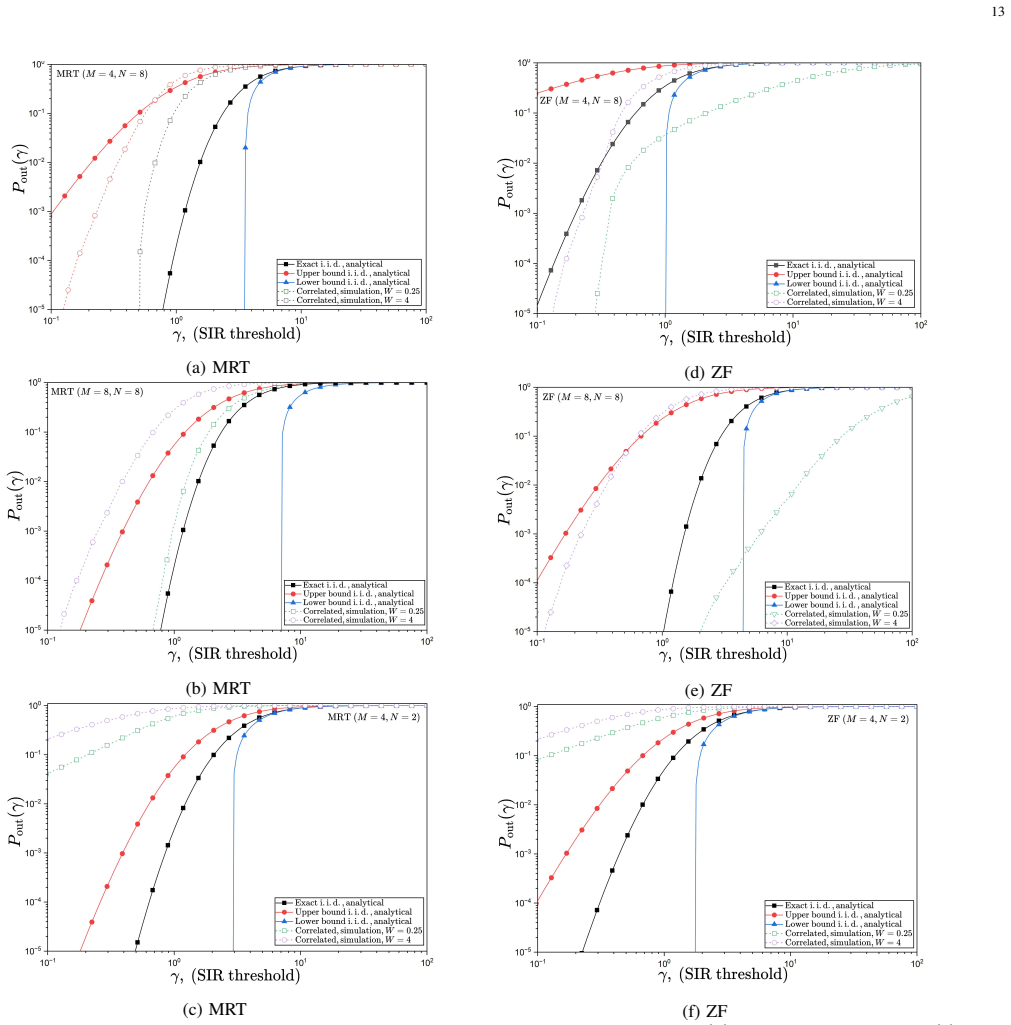
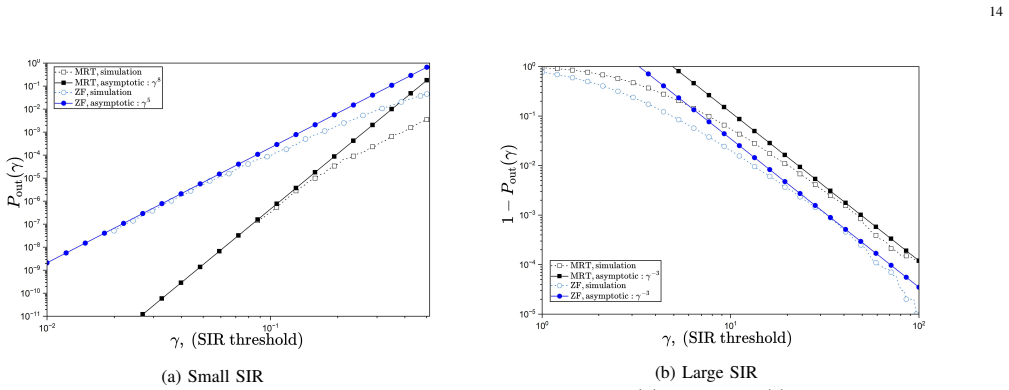
The per-port SIR follows a Beta-prime distribution with parameters (M_eff, L), where M_eff equals M under MRT and M-U+1 under ZF. This yields closed-form finite-sum CDFs for both precoders, the first analytical characterization of cross-port SIR correlation, and outage probability bounds that tightly bracket exact performance and become exact when ports are fully correlated or independent. Asymptotic results further give the diversity orders and tail behavior under each precoding scheme.
What carries the argument
The Beta-prime distribution of per-port SIR, which encodes the combined effect of linear precoding, port selection, and spatial correlation among fluid antenna elements.
If this is right
- MRT produces weaker cross-port SIR correlation and larger selection gains than ZF when the base station has many spatial degrees of freedom.
- The finite-sum CDF expressions allow outage probability to be computed directly for any port configuration without Monte Carlo simulation.
- The outage bounds become exact at the two extremes of full port correlation and complete independence.
- Asymptotic diversity orders and tail decay rates are available separately for MRT and ZF.
- The correlation model supplies explicit rules for choosing the number and spacing of fluid antenna ports.
Where Pith is reading between the lines
- Designers could use the closed-form correlation expression to decide port spacing that trades off diversity against implementation complexity.
- The same SIR distribution approach might be applied to other selection-based antenna systems that operate under spatial correlation.
- If the Beta-prime model remains accurate under measured propagation conditions, the outage bounds could be used for real-time link adaptation.
- Extending the analysis to nonlinear precoding would likely change the effective number of degrees of freedom M_eff.
Load-bearing premise
The framework assumes a specific spatial correlation model among the fluid antenna ports together with Rayleigh fading and linear precoding.
What would settle it
Empirical measurement of the distribution of SIR values across multiple fluid antenna ports in a real MISO downlink setup, followed by a statistical test against the predicted Beta-prime parameters for the chosen precoder.
Figures


read the original abstract
Fluid antenna multiple access (FAMA) enables each user to rapidly switch among several closely spaced ports and select the strongest received signal. Although this mechanism offers micro-scale spatial diversity, its behavior in multiuser downlink systems with spatial correlation and linear precoding is not well understood. This paper develops a unified analytical framework for the multiple-input single-output (MISO) downlink with FAMA users served via maximum ratio transmission (MRT) or zero-forcing (ZF). We show that the per-port signal-to-interference ratio (SIR) follows a Beta-prime distribution with parameters \((M_{\mathrm{eff}},L)\), where \(M_{\mathrm{eff}}=M\) under MRT and \(M_{\mathrm{eff}}=M-U+1\) under ZF, and derive closed-form finite-sum cumulative distribution functions (CDFs) for both cases. We further provide the first analytical characterization of cross-port SIR correlation. \textcolor{black}{Furthermore, we derive rigorous outage probability bounds that tightly bracket the exact performance and become exact in the limiting cases of fully correlated and independent ports.} Asymptotic analyses reveal the fundamental diversity orders and tail behavior for each precoder. Numerical results confirm the accuracy of the SIR distributions, correlation model, and outage bounds, and show that MRT achieves weaker port correlation and larger selection gains than ZF when the base station (BS) has ample spatial degrees of freedom. The framework offers explicit guidelines for port configuration and precoder selection in practical FAMA systems.
Editorial analysis
A structured set of objections, weighed in public.
Referee Report
Summary. The manuscript develops a unified analytical framework for the MISO downlink with fluid antenna multiple access (FAMA), where each user selects the strongest port among closely spaced ports. It shows that the per-port SIR follows a Beta-prime distribution with parameters (M_eff, L), where M_eff = M for MRT and M_eff = M-U+1 for ZF; derives closed-form finite-sum CDFs; provides the first analytical characterization of cross-port SIR correlation; and obtains rigorous outage probability bounds that are tight and become exact for fully correlated and independent ports. Asymptotic diversity orders and tail behavior are analyzed, with numerical results validating the expressions and comparing MRT versus ZF performance.
Significance. If the results hold, the work supplies the first closed-form analytical treatment of FAMA in multiuser MISO downlink under linear precoding, including novel cross-port SIR correlation results and outage bounds that are exact at the correlation extremes. The explicit guidelines for port configuration and precoder selection, together with the finite-sum CDFs and standard Beta-prime marginals, constitute a reproducible contribution that facilitates further analysis in fluid-antenna systems.
minor comments (2)
- [Abstract, §II] Abstract and §II (system model): the specific spatial correlation function among fluid-antenna ports (e.g., the form of the port correlation matrix) should be stated explicitly, even though the marginal SIR distribution is independent of it; this would remove the verification gap for the cross-port correlation characterization.
- [§IV] §IV (outage bounds): confirm that the bounding technique remains rigorous when the port correlation model is non-trivial; the current statement that bounds become exact at the extremes is clear, but an intermediate-correlation example would strengthen the claim.
Simulated Author's Rebuttal
We thank the referee for the positive evaluation, accurate summary of our contributions, and recommendation of minor revision. No specific major comments were provided in the report.
Circularity Check
No significant circularity identified
full rationale
The paper derives that per-port SIR follows Beta-prime(M_eff, L) directly from the standard ratio of independent Gamma random variables under Rayleigh fading and linear precoding (MRT/ZF), with M_eff = M or M-U+1. Closed-form CDFs, cross-port correlation, and outage bounds are obtained from this marginal distribution and its known properties without any fitted parameters, self-definitional loops, or load-bearing self-citations that reduce the target quantities to the inputs by construction. The framework remains self-contained against external benchmarks of classical MISO analysis.
Axiom & Free-Parameter Ledger
axioms (2)
- domain assumption Per-port SIR follows Beta-prime distribution with parameters (M_eff, L)
- domain assumption Spatial correlation exists among fluid-antenna ports
Reference graph
Works this paper leans on
-
[1]
Capacity of multi-antenna gaussian channels,
E. Telatar, “Capacity of multi-antenna gaussian channels,”Europ. Trans. on Telecom., vol. 10, no. 6, pp. 585–595, 1999
work page 1999
-
[2]
Goldsmith,Wireless communications
A. Goldsmith,Wireless communications. Cambridge University Press, 2005
work page 2005
-
[3]
On the achievable throughput of a multiantenna gaussian broadcast channel,
G. Caire and S. Shamai, “On the achievable throughput of a multiantenna gaussian broadcast channel,”IEEE Trans. Inf. Th., vol. 49, no. 7, pp. 1691–1706, 2003
work page 2003
-
[4]
MIMO broadcast channels with finite-rate feedback,
N. Jindal, “MIMO broadcast channels with finite-rate feedback,”IEEE Trans. on Inform. Theory, vol. 52, no. 11, pp. 5045–5060, 2006
work page 2006
-
[5]
S. J. Kar, A. Chakrabarty, and B. Sarkar, “Fluid antennas,” inIEEE Middle East Conference on Antennas and Propagation (MECAP 2010). IEEE, pp. 1–6
work page 2010
-
[6]
Y . Kosta and S. Kosta, “Liquid antenna systems,” inIEEE Antennas and Propagation Society Symposium, 2004., vol. 3. IEEE, pp. 2392–2395
work page 2004
-
[7]
Liquid metal antennas: Materials, fabrication and applications,
K. N. Parachaet al., “Liquid metal antennas: Materials, fabrication and applications,”Sensors, vol. 20, no. 1, p. 177, 2019
work page 2019
-
[8]
Liquid antennas: Past, present and future,
Y . Huanget al., “Liquid antennas: Past, present and future,”IEEE Open J. Ant. Prop., vol. 2, pp. 473–487, 2021
work page 2021
-
[9]
J. Zhuet al., “Index modulation for fluid antenna-assisted MIMO communications: System design and performance analysis,”IEEE Trans. Wireless Commun., vol. 23, no. 8, pp. 9701–9713, 2024
work page 2024
-
[10]
Fluid antenna empowered index modulation for RIS-aided mmWave transmissions,
——, “Fluid antenna empowered index modulation for RIS-aided mmWave transmissions,”IEEE Trans. Wireless Commun., 2024
work page 2024
-
[11]
Fluid antenna index modulation for MIMO systems: Ro- bust transmission and low-complexity detection,
X. Guoet al., “Fluid antenna index modulation for MIMO systems: Ro- bust transmission and low-complexity detection,”IEEE Trans. Commun., 2025
work page 2025
-
[12]
Fluid antenna multiple access,
K.-K. Wong and K.-F. Tong, “Fluid antenna multiple access,”IEEE Trans. Wireless Commun., vol. 21, no. 7, pp. 4801–4815, 2021
work page 2021
-
[13]
Slow fluid antenna multiple access,
K.-K. Wonget al., “Slow fluid antenna multiple access,”IEEE Trans. Commun., vol. 71, no. 5, pp. 2831–2846, 2023
work page 2023
-
[14]
Fast fluid antenna multiple access enabling massive connectivity,
——, “Fast fluid antenna multiple access enabling massive connectivity,” IEEE Commun. Let., vol. 27, no. 2, pp. 711–715, 2023
work page 2023
-
[15]
Downlink OFDM-FAMA in 5G-NR systems,
H. Honget al., “Downlink OFDM-FAMA in 5G-NR systems,”IEEE Trans. Wir. Commun., pp. 1–1, 2025
work page 2025
-
[16]
Opportunistic fluid antenna multiple access,
K.-K. Wonget al., “Opportunistic fluid antenna multiple access,”IEEE Trans. Wireless Commun., vol. 22, no. 11, pp. 7819–7833, 2023
work page 2023
-
[17]
X. Linet al., “Fluid antenna multiple access assisted integrated data and energy transfer: Outage and multiplexing gain analysis,”IEEE Trans. Wireless Commun., vol. 24, no. 9, pp. 7777–7793, 2025
work page 2025
-
[18]
Coded caching enabled fluid antenna multiple access for interference-free connectivity,
H. Zhao and D. Slock, “Coded caching enabled fluid antenna multiple access for interference-free connectivity,”IEEE Trans. Wireless Commun., vol. 25, pp. 6301–6316, 2026
work page 2026
-
[19]
On fundamental limits of slow-fluid antenna multiple access for unsourced random access,
Z. Zhanget al., “On fundamental limits of slow-fluid antenna multiple access for unsourced random access,”IEEE Wireless Commun. Let., vol. 14, no. 11, pp. 3455–3459, 2025
work page 2025
-
[20]
Fluid antenna system enhancing orthogonal and non-orthogonal multiple access,
W. K. Newet al., “Fluid antenna system enhancing orthogonal and non-orthogonal multiple access,”IEEE Commun. Let., vol. 28, no. 1, pp. 218–222, 2024
work page 2024
- [21]
-
[22]
Papoulis,Random variables and stochastic processes
A. Papoulis,Random variables and stochastic processes. McGraw Hill, 1965
work page 1965
-
[23]
M. K. Simon and M.-S. Alouini,Digital communication over fading channels. John Wiley & Sons, 2004
work page 2004
-
[24]
M. Abramowitz and I. A. Stegun,Handbook of mathematical functions: with formulas, graphs, and mathematical tables. Courier Corporation, 1964, no. 55
work page 1964
discussion (0)
Sign in with ORCID, Apple, or X to comment. Anyone can read and Pith papers without signing in.