Quantum-geometric shift of quasiequilibrium: Origin of nonreciprocal current driven by quantum-metric dipole
Pith reviewed 2026-07-03 06:55 UTC · model grok-4.3
The pith
A quantum correction to the electron distribution from wave-packet spreading under bias produces nonreciprocal current set by the quantum-metric dipole.
A machine-rendered reading of the paper's core claim, the machinery that carries it, and where it could break.
Core claim
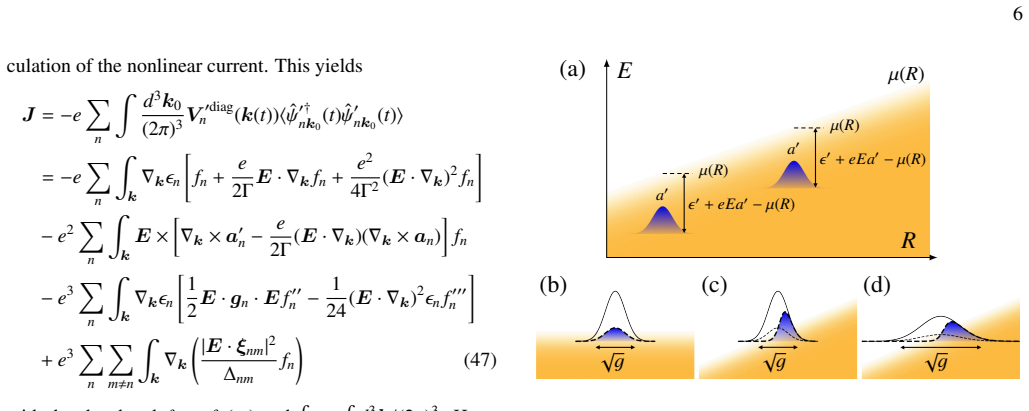
Applying the adiabatic perturbation theory combined with nonequilibrium Green functions, the work finds a longitudinal nonreciprocal current governed by the quantum-metric dipole. The essential ingredient is a quantum correction to the distribution function absent from semiclassical treatments. This correction is traced to the finite spread of an electron wave packet during relaxation under a bias field, identifying the shifted quasiequilibrium as the physical origin of quantum-metric nonreciprocal transport.
What carries the argument
Shifted quasiequilibrium arising from the finite spatial spread of the electron wave packet under a DC bias, obtained via the adiabatic-basis Hamiltonian.
If this is right
- The nonreciprocal current appears already at linear order in the relaxation time and is longitudinal.
- Semiclassical Boltzmann approaches miss the effect because they lack the quantum correction to the distribution function.
- The same adiabatic formulation yields equivalent Hamiltonians in velocity and length gauges, allowing direct comparison of results.
- The mechanism operates in the DC limit without requiring an AC-field zero-frequency extrapolation.
Where Pith is reading between the lines
- Materials with large quantum metric but small Berry curvature could still exhibit measurable nonreciprocity if the distribution-shift channel dominates.
- The same wave-packet-spread correction may appear in other nonlinear responses such as second-harmonic generation or photogalvanic effects.
- Numerical simulations that retain the spatial extent of wave packets during scattering should reproduce the nonreciprocal term even without explicit geometric-phase tracking.
Load-bearing premise
The adiabatic ansatz can be used to treat a DC electric field directly in the velocity gauge and produces a Hamiltonian of the same form as in the length gauge.
What would settle it
A calculation or measurement showing that the nonreciprocal current disappears when the quantum-metric dipole is set to zero while all other geometric quantities remain finite.
Figures

read the original abstract
We study nonlinear DC electric transport of quantum-metric origin by combining adiabatic perturbation theory with the nonequilibrium Green function approach. The adiabatic ansatz provides a basis for directly treating a DC electric field in the velocity gauge, rather than introducing it as the zero-frequency limit of an AC field. The resulting adiabatic-basis Hamiltonian takes the same form as in the length gauge, enabling a systematic comparison across different formulations. Applying this fully quantum formulation, we find a longitudinal nonreciprocal current governed by the quantum-metric dipole. The essential ingredient is a quantum correction to the distribution function that is absent in semiclassical treatments. We trace this correction to the finite spread of an electron wave packet during relaxation under a bias field, thereby identifying shifted quasiequilibrium as the physical origin of quantum-metric nonreciprocal transport.
Editorial analysis
A structured set of objections, weighed in public.
Referee Report
Summary. The manuscript develops a quantum formulation of nonlinear DC transport by combining adiabatic perturbation theory with the nonequilibrium Green's function (NEGF) method. It asserts that an adiabatic ansatz permits direct inclusion of a constant DC electric field in the velocity gauge, producing a Hamiltonian identical in form to the length-gauge case. This framework yields a longitudinal nonreciprocal current controlled by the quantum-metric dipole. The key element is a quantum correction to the nonequilibrium distribution function, absent from semiclassical treatments, which the authors trace to the finite spatial spread of electron wave packets during relaxation under bias; the resulting picture is termed a 'shifted quasiequilibrium.'
Significance. If the derivation is shown to be gauge-consistent and independent of the specific relaxation model, the work supplies a concrete physical mechanism (wave-packet spreading under bias) for quantum-metric dipole effects in nonreciprocal transport. This interpretation goes beyond semiclassical Boltzmann approaches and could inform both theory and experiment on geometric contributions to nonlinear conductivity in topological and flat-band materials.
major comments (2)
- [Theory section on adiabatic ansatz and velocity gauge] The adiabatic ansatz (theory section describing the velocity-gauge treatment of a time-independent DC field): the claim that this ansatz directly reproduces the distribution-function correction without taking the zero-frequency limit of an AC field is load-bearing for the central identification of 'shifted quasiequilibrium' as the origin. For a strictly constant field the adiabatic condition is not obviously satisfied in the same manner as for slowly ramped or AC fields; an explicit check that the lesser Green's function and resulting current remain unchanged under this choice (and match the AC limit) is required.
- [Section deriving the distribution correction and semiclassical comparison] Comparison to semiclassical limit (likely §4 or the discussion of the distribution correction): the manuscript states the quantum correction is absent in semiclassics, yet the precise manner in which the wave-packet spread enters the NEGF lesser component versus the semiclassical Boltzmann collision integral is not shown in sufficient detail to confirm the correction survives all gauge choices and relaxation models.
minor comments (1)
- [Throughout] Notation for the quantum-metric dipole and the shifted distribution should be defined once with an explicit equation number before being used in the current expression.
Simulated Author's Rebuttal
We thank the referee for the constructive report and the positive assessment of the work's potential significance. We address the two major comments point by point below, providing clarifications and committing to revisions that strengthen the manuscript without altering its central claims.
read point-by-point responses
-
Referee: [Theory section on adiabatic ansatz and velocity gauge] The adiabatic ansatz (theory section describing the velocity-gauge treatment of a time-independent DC field): the claim that this ansatz directly reproduces the distribution-function correction without taking the zero-frequency limit of an AC field is load-bearing for the central identification of 'shifted quasiequilibrium' as the origin. For a strictly constant field the adiabatic condition is not obviously satisfied in the same manner as for slowly ramped or AC fields; an explicit check that the lesser Green's function and resulting current remain unchanged under this choice (and match the AC limit) is required.
Authors: We agree that an explicit verification would reinforce the load-bearing claim. The adiabatic ansatz is motivated by the fact that a constant DC field can be incorporated via a time-dependent vector potential whose time derivative is constant, allowing the same perturbative expansion as in the AC case. In the revised manuscript we will add a dedicated appendix or subsection that computes the lesser Green's function under the direct DC adiabatic ansatz and demonstrates its equivalence (to leading order in the field) with the zero-frequency limit of the AC treatment, confirming that both the distribution correction and the longitudinal nonreciprocal current are unchanged. revision: yes
-
Referee: [Section deriving the distribution correction and semiclassical comparison] Comparison to semiclassical limit (likely §4 or the discussion of the distribution correction): the manuscript states the quantum correction is absent in semiclassics, yet the precise manner in which the wave-packet spread enters the NEGF lesser component versus the semiclassical Boltzmann collision integral is not shown in sufficient detail to confirm the correction survives all gauge choices and relaxation models.
Authors: We accept that the current presentation leaves the microscopic origin of the wave-packet-spread correction insufficiently contrasted with the semiclassical collision integral. The NEGF lesser component encodes the finite spatial extent of the wave packet through the off-diagonal elements of the adiabatic-basis density matrix, an effect absent from the local Boltzmann equation. In the revision we will expand the relevant section (and add a short supplementary note) with an explicit side-by-side expansion: we show how the first-order correction to the lesser function arises from the commutator structure in the Dyson equation under the adiabatic ansatz, why the corresponding term vanishes upon taking the semiclassical limit (ħ→0 while keeping the relaxation time fixed), and why the resulting nonreciprocal current remains gauge-independent for the relaxation models considered. revision: yes
Circularity Check
No significant circularity; derivation remains self-contained
full rationale
The paper derives the quantum correction to the distribution function by combining adiabatic perturbation theory with the NEGF formalism, then interprets the result as arising from finite wave-packet spread under bias. No step reduces by construction to a fitted parameter renamed as a prediction, nor does any central claim rest on a self-citation chain whose content is unverified outside the present work. The adiabatic ansatz is introduced as a methodological choice enabling direct DC treatment, but the resulting current expression and its physical tracing are not shown to be equivalent to the inputs by definition. The derivation therefore retains independent content relative to its assumptions.
Axiom & Free-Parameter Ledger
Reference graph
Works this paper leans on
-
[1]
D. Xiao, M.-C. Chang, and Q. Niu, Berry phase effects on elec- tronic properties, Rev. Mod. Phys.82, 1959 (2010)
work page 1959
-
[2]
N. Nagaosa, J. Sinova, S. Onoda, A. H. MacDonald, and N. P. Ong, Anomalous Hall effect, Rev. Mod. Phys.82, 1539 (2010)
work page 2010
-
[3]
M. Z. Hasan and C. L. Kane, Colloquium: Topological insula- tors, Rev. Mod. Phys.82, 3045 (2010)
work page 2010
-
[4]
X.-L. Qi and S.-C. Zhang, Topological insulators and supercon- ductors, Rev. Mod. Phys.83, 1057 (2011)
work page 2011
-
[5]
R. D. King-Smith and D. Vanderbilt, Theory of polarization of crystalline solids, Phys. Rev. B47, 1651(R) (1993)
work page 1993
-
[6]
Resta, Macroscopic polarization in crystalline dielectrics: the geometric phase approach, Rev
R. Resta, Macroscopic polarization in crystalline dielectrics: the geometric phase approach, Rev. Mod. Phys.66, 899 (1994)
work page 1994
-
[7]
M. V . Berry, Quantal phase factors accompanying adiabatic changes, Proc. R. Soc. London A392, 45 (1984)
work page 1984
-
[8]
Y . Tokura and N. Nagaosa, Nonreciprocal responses from non- centrosymmetric quantum materials, Nat. Commun.9, 3740 (2018)
work page 2018
-
[9]
T. Morimoto, S. Kitamura, and N. Nagaosa, Geometric As- pects of Nonlinear and Nonequilibrium Phenomena, J. Phys. Soc. Jpn.92, 072001 (2023)
work page 2023
-
[10]
N. Nagaosa and Y . Yanase, Nonreciprocal Transport and Op- tical Phenomena in Quantum Materials, Annu. Rev. Condens. 14 Matter Phys.15, 63 (2024)
work page 2024
-
[11]
M. Su ´arez-Rodr´ıguez, F. de Juan, I. Souza, M. Gobbi, F. Casanova, and L. E. Hueso, Nonlinear transport in non- centrosymmetric systems, Nat. Mater.24, 1005 (2025)
work page 2025
-
[12]
J. E. Sipe and A. I. Shkrebtii, Second-order optical response in semiconductors, Phys. Rev. B61, 5337 (2000)
work page 2000
-
[13]
T. Morimoto and N. Nagaosa, Topological nature of nonlinear optical effects in solids, Sci. Adv.2, e1501524 (2016)
work page 2016
-
[14]
C. Aversa and J. E. Sipe, Nonlinear optical susceptibilities of semiconductors: Results with a length-gauge analysis, Phys. Rev. B52, 14636 (1995)
work page 1995
-
[15]
S. Ghimire and D. A. Reis, High-harmonic generation from solids, Nat. Phys.15, 10 (2019)
work page 2019
-
[16]
I. Sodemann and L. Fu, Quantum Nonlinear Hall Effect Induced by Berry Curvature Dipole in Time-Reversal Invariant Materi- als, Phys. Rev. Lett.115, 216806 (2015)
work page 2015
-
[17]
Q. Ma, S.-Y . Xu, H. Shen, D. MacNeill, V . Fatemi, T.-R. Chang, A. M. Mier Valdivia, S. Wu, Z. Du, C.-H. Hsu, S. Fang, Q. D. Gibson, K. Watanabe, T. Taniguchi, R. J. Cava, E. Kaxiras, H.- Z. Lu, H. Lin, L. Fu, N. Gedik, and P. Jarillo-Herrero, Observa- tion of the nonlinear Hall effect under time-reversal-symmetric conditions, Nature565, 337 (2019)
work page 2019
-
[18]
K. Kang, T. Li, E. Sohn, J. Shan, and K. F. Mak, Nonlinear anomalous Hall effect in few-layer WTe2, Nat. Mater.18, 324 (2019)
work page 2019
-
[19]
G. L. J. A. Rikken, J. F ¨olling, and P. Wyder, Electrical Magne- tochiral Anisotropy, Phys. Rev. Lett.87, 236602 (2001)
work page 2001
-
[20]
R. Wakatsuki, Y . Saito, S. Hoshino, Y . M. Itahashi, T. Ideue, M. Ezawa, Y . Iwasa, and N. Nagaosa, Nonreciprocal charge transport in noncentrosymmetric superconductors, Sci. Adv.3, e1602390 (2017)
work page 2017
-
[21]
T. Morimoto and N. Nagaosa, Nonreciprocal current from elec- tron interactions in noncentrosymmetric crystals: roles of time reversal symmetry and dissipation, Sci. Rep.8, 2973 (2018)
work page 2018
-
[22]
S. Kitamura, N. Nagaosa, and T. Morimoto, Nonreciprocal Lan- dau–Zener tunneling, Commun. Phys.3, 63 (2020)
work page 2020
-
[23]
J. P. Provost and G. Vallee, Riemannian structure on manifolds of quantum states, Commun. Math. Phys.76, 289 (1980)
work page 1980
- [24]
-
[25]
J. Yu, B. A. Bernevig, R. Queiroz, E. Rossi, P. T¨orm¨a, and B.-J. Yang, Quantum geometry in quantum materials, npj Quantum Materials10, 101 (2025)
work page 2025
-
[26]
N. Marzari and D. Vanderbilt, Maximally localized generalized Wannier functions for composite energy bands, Phys. Rev. B 56, 12847 (1997)
work page 1997
-
[27]
S. Peotta and P. T¨orm¨a, Superfluidity in topologically nontrivial flat bands, Nat. Commun.6, 8944 (2015)
work page 2015
- [28]
-
[29]
Roy, Band geometry of fractional topological insulators, Phys
R. Roy, Band geometry of fractional topological insulators, Phys. Rev. B90, 165139 (2014)
work page 2014
-
[30]
T. S. Jackson, G. M ¨oller, and R. Roy, Geometric stability of topological lattice phases, Nat. Commun.6, 8629 (2015)
work page 2015
-
[31]
Y . Onishi and L. Fu, Fundamental bound on topological gap, Phys. Rev. X14, 011052 (2024)
work page 2024
-
[32]
Y . Onishi and L. Fu, Topological Bound on the Structure Factor, Phys. Rev. Lett.133, 206602 (2024)
work page 2024
-
[33]
Y . Gao, S. A. Yang, and Q. Niu, Field Induced Positional Shift of Bloch Electrons and Its Dynamical Implications, Phys. Rev. Lett.112, 166601 (2014)
work page 2014
-
[34]
H. Watanabe and Y . Yanase, Nonlinear electric transport in odd- parity magnetic multipole systems: Application to Mn-based compounds, Phys. Rev. Res.2, 043081 (2020)
work page 2020
-
[35]
R. Oiwa and H. Kusunose, Systematic Analysis Method for Nonlinear Response Tensors, J. Phys. Soc. Jpn.91, 014701 (2022)
work page 2022
-
[36]
Y . Michishita and N. Nagaosa, Dissipation and geometry in nonlinear quantum transports of multiband electronic systems, Phys. Rev. B106, 125114 (2022)
work page 2022
-
[37]
K. Das, S. Lahiri, R. B. Atencia, D. Culcer, and A. Agarwal, In- trinsic nonlinear conductivities induced by the quantum metric, Phys. Rev. B108, L201405 (2023)
work page 2023
-
[38]
Y . Wang, Z. Zhang, Z.-G. Zhu, and G. Su, Intrinsic nonlinear Ohmic current, Phys. Rev. B109, 085419 (2024)
work page 2024
- [39]
-
[40]
C. Xiao, J. Cao, Q. Niu, and S. A. Yang, Proper Definition of In- trinsic Nonlinear Current, Phys. Rev. Lett.135, 256306 (2025)
work page 2025
- [41]
-
[42]
Absence of Quantum-Metric-Induced Intrinsic Longitudinal Response
P. Tang, Absence of Quantum-Metric-Induced Intrinsic Longi- tudinal Response, arXiv:2605.02750 [cond-mat.mes-hall]
work page internal anchor Pith review Pith/arXiv arXiv
- [43]
- [44]
-
[45]
T. Anan, S. Kitamura, and T. Morimoto, Nonreciprocal cur- rent induced by dissipation in time-reversal symmetric systems, arXiv:2604.04520 [cond-mat.mes-hall]
work page internal anchor Pith review Pith/arXiv arXiv
-
[46]
G. Rigolin, G. Ortiz, and V . H. Ponce, Beyond the quantum adiabatic approximation: Adiabatic perturbation theory, Phys. Rev. A78, 052508 (2008)
work page 2008
-
[47]
C. D. Grandi and A. Polkovnikov, Adiabatic Perturbation The- ory: From Landau–Zener Problem to Quenching Through a Quantum Critical Point, inQuantum Quenching, Annealing and Computation(Springer Berlin Heidelberg, 2010) pp. 75–114
work page 2010
-
[48]
S. Kitamura, N. Nagaosa, and T. Morimoto, Current response of nonequilibrium steady states in the Landau-Zener problem: Nonequilibrium Green’s function approach, Phys. Rev. B102, 245141 (2020)
work page 2020
-
[49]
B ¨uttiker, Four-Terminal Phase-Coherent Conductance, Phys
M. B ¨uttiker, Four-Terminal Phase-Coherent Conductance, Phys. Rev. Lett.57, 1761 (1986)
work page 1986
- [50]
- [51]
- [52]
-
[53]
D. J. Passos, G. B. Ventura, J. M. V . P. Lopes, J. M. B. L. d. Santos, and N. M. R. Peres, Nonlinear optical responses of crys- talline systems: Results from a velocity gauge analysis, Phys. Rev. B97, 235446 (2018)
work page 2018
-
[54]
G. B. Ventura, D. J. Passos, J. M. B. Lopes dos Santos, J. M. Viana Parente Lopes, and N. M. R. Peres, Gauge covariances and nonlinear optical responses, Phys. Rev. B96, 035431 (2017)
work page 2017
discussion (0)
Sign in with ORCID, Apple, or X to comment. Anyone can read and Pith papers without signing in.