Quantum-Enhanced Single-Parameter Phase Estimation with Adaptive NOON States
Pith reviewed 2026-05-21 00:29 UTC · model grok-4.3
The pith
Optimizing NOON-state circuit parameters yields up to 1598 percent higher classical Fisher information for five-photon phase estimation.
A machine-rendered reading of the paper's core claim, the machinery that carries it, and where it could break.
Core claim
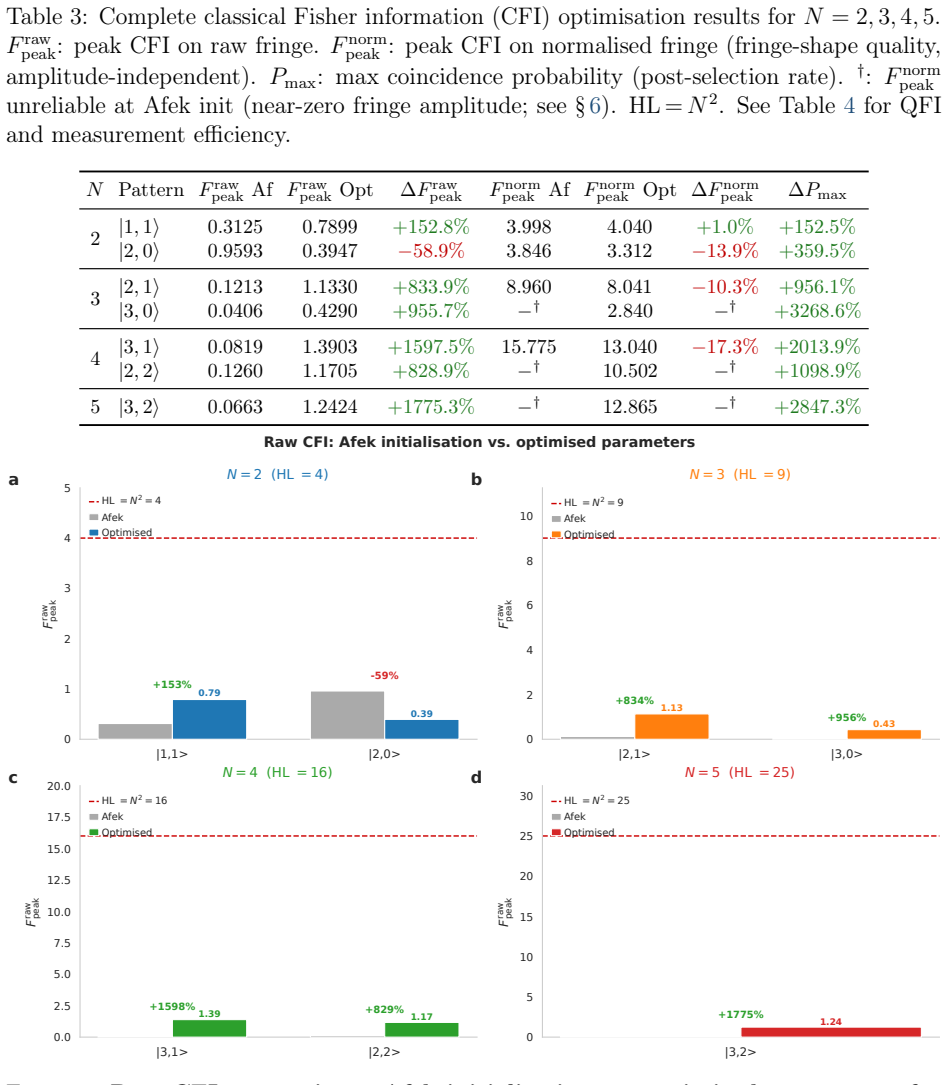
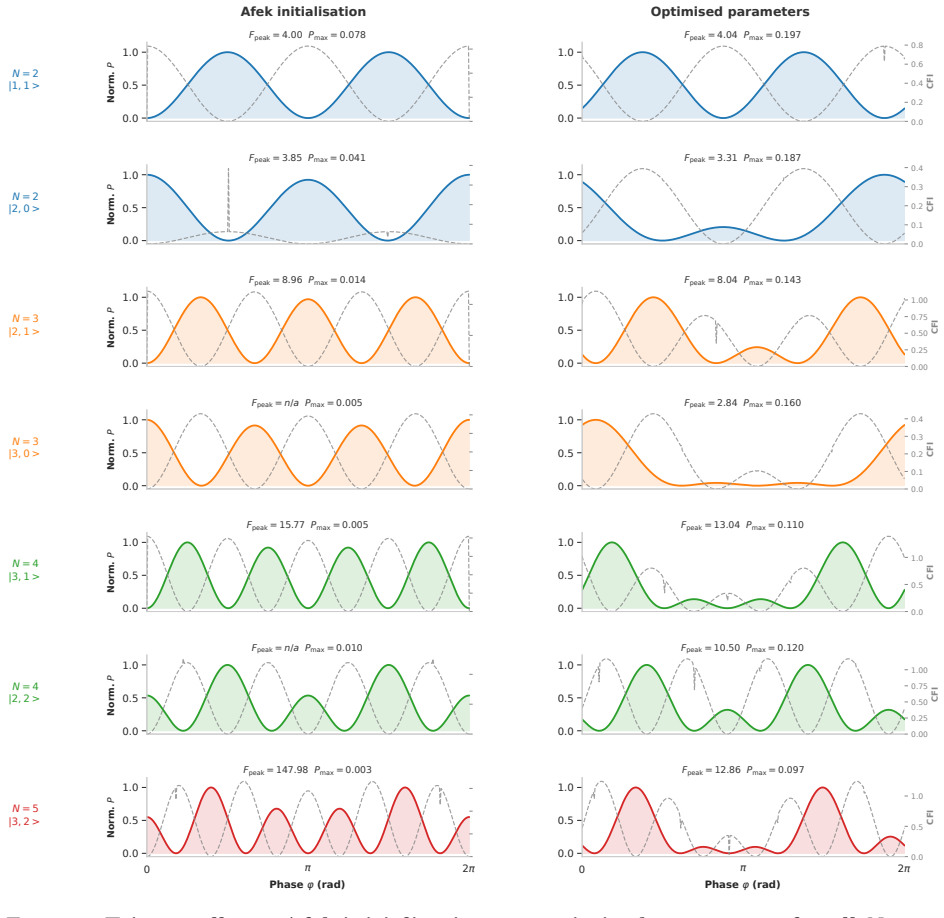
An end-to-end differentiable quantum-optical framework learns optimal circuit parameters by maximising the classical Fisher information across all coincidence channels for photon numbers N=2 to 5. Starting from reproductions of prior experimental coincidence fringes, gradient descent on eight trainable parameters produces raw CFI gains of +153 percent at N=2 up to +1775 percent at N=5, together with post-selection rate gains up to +3269 percent. These translate to an 8-fold to 133-fold increase in useful measurement events per pulse. Quantum Fisher information calculations show the optimised state reaches 82 percent of the Heisenberg limit at N=2 and improves from 36 percent to 58 percent at
What carries the argument
A differentiable quantum-optical simulator that applies gradient descent to eight circuit parameters in order to maximise the summed classical Fisher information obtained from all photon coincidence detection channels.
If this is right
- Raw classical Fisher information rises by +153 percent at N=2 and by as much as +1775 percent at N=5.
- Post-selection rates increase by up to +3269 percent, producing 8 times to 133 times more useful measurement events per pulse.
- The quantum Fisher information of the optimised probe reaches 82 percent of the Heisenberg limit at N=2 and 58 percent at N=5.
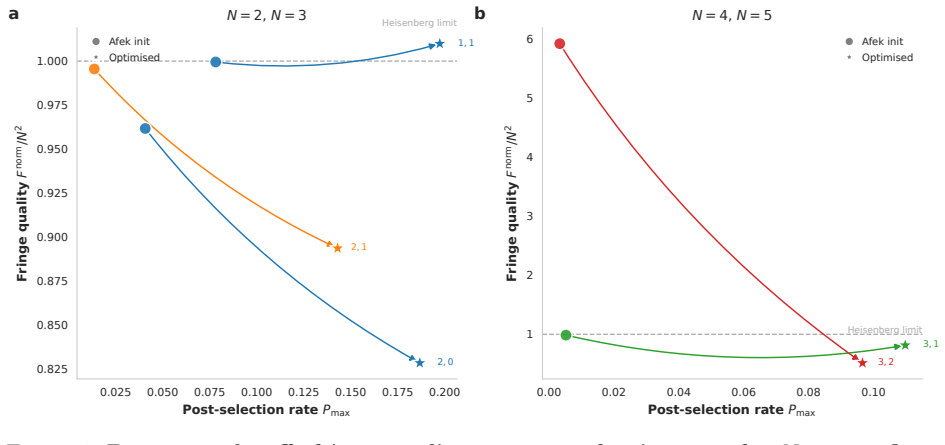
- An inter-channel performance trade-off is pronounced at N=2 but becomes weaker at higher photon numbers.
Where Pith is reading between the lines
- The same gradient-based search could be applied to other entangled resources such as squeezed states or different measurement bases to seek comparable gains.
- The weakening trade-off at larger N suggests that adaptive parameter tuning becomes increasingly valuable as photon number grows.
- Experimental teams could now test the N=5 parameters in the lab to determine whether the predicted event-rate multiplication appears in real hardware.
Load-bearing premise
The simulation accurately captures every optical loss, mode mismatch, and detector imperfection that would appear when the same circuit is built and operated in a laboratory.
What would settle it
Construct the circuit with the numerically optimised parameters for N=5, run the phase-estimation experiment, and measure whether the observed classical Fisher information or phase uncertainty matches the simulated improvement over the earlier Afek et al. working point.
Figures





read the original abstract
Quantum metrology promises phase sensitivity surpassing the shot-noise limit by exploiting entanglement and photon-number correlations. NOON states-maximally path-entangled $N$-photon superpositions $(|N,0\rangle + |0,N\rangle)/\sqrt{2}$ -achieve the Heisenberg limit $1/N$ for single-parameter estimation, as demonstrated experimentally by Afek et al. (2010) using hybrid coherent-plus-squeezed light up to $N=5$. We present an end-to-end differentiable quantum-optical framework-implemented in Strawberry Fields (Killoran et al., 2019) with a TensorFlow backend -that learns optimal circuit parameters by maximising the classical Fisher information (CFI) across all coincidence channels for $N=2,3,4,5$. Starting from proper numerical reproductions of the Afek et al. coincidence fringes, verified by FFT analysis and parity measurements, we apply gradient descent (Adam) to the eight trainable circuit parameters. Raw CFI improvements grow dramatically with photon number: $+153\%$ ($N=2$), $+834\%$ to $+956\%$ ($N=3$), $+829\%$ to $+1598\%$ ($N=4$), and $+1775\%$ ($N=5$), alongside post-selection rate improvements of $+153\%$ to $+3269\%$, and an $8\times$ to $133\times$ improvement in useful measurement events per pulse across $N=2$-$5$. A fundamental inter-channel trade-off is identified at $N=2$ but weakens at higher $N$ where the Afek initialisation is further from optimal. These results provide numerically rigorous benchmarks for adaptive single-parameter quantum sensing and demonstrate that the Afek working point is significantly suboptimal at $N\geq 3$. QFI calculations confirm that the optimised probe reaches $82\%$ of the Heisenberg limit at $N=2$ and improves from $36\%$ to $58\%$ at $N=5$, while useful measurement events per pulse improve by $8\times$ to $133\times$ across all $N$, making quantum-enhanced sensing at $N\geq 3$ experimentally practical.
Editorial analysis
A structured set of objections, weighed in public.
Referee Report
Summary. The manuscript presents an end-to-end differentiable quantum-optical simulation framework implemented in Strawberry Fields with a TensorFlow backend. It reproduces Afek et al. (2010) coincidence fringes for NOON-state phase estimation at N=2–5, then uses Adam gradient descent on eight trainable circuit parameters to maximize the classical Fisher information across coincidence channels, reporting large CFI gains (+153% to +1775%), post-selection improvements, and 8×–133× increases in useful events per pulse. QFI calculations show the optimized probe reaching 82% of the Heisenberg limit at N=2 and improving from 36% to 58% at N=5, concluding that the Afek working point is suboptimal for N≥3 and that quantum-enhanced sensing becomes experimentally practical at higher N.
Significance. If the simulation model is faithful, the work supplies concrete numerical benchmarks demonstrating that adaptive optimization can substantially outperform the original Afek et al. configuration, particularly at N≥3. The differentiable-circuit approach and explicit identification of an inter-channel trade-off at N=2 constitute a useful methodological contribution for guiding future experimental designs in quantum metrology.
major comments (2)
- [Abstract and simulation framework] Abstract and § on simulation framework: the headline claim that the optimized parameters render quantum-enhanced sensing at N≥3 'experimentally practical' rests on the assumption that the Strawberry Fields/TensorFlow model captures all relevant imperfections (losses, mode mismatch, detector effects). No sensitivity analysis to additional unmodeled noise sources such as phase diffusion or timing jitter is provided; without it the reported 8×–133× gains in useful events and the QFI percentages may not survive hardware translation.
- [QFI calculations] QFI calculations (mentioned in Abstract): the reported improvement from 36% to 58% of the Heisenberg limit at N=5 is load-bearing for the significance claim, yet the manuscript does not specify whether these QFI values are computed from the full multi-channel optimized state or under idealized assumptions that ignore the post-selection and coincidence filtering used in the CFI optimization.
minor comments (2)
- [Methods] The precise definition of 'useful measurement events per pulse' and how it is extracted from the simulated coincidence channels should be stated explicitly in the main text rather than left implicit.
- [Results] The FFT and parity verification of the reproduced Afek fringes would be strengthened by inclusion of quantitative error metrics or uncertainty bands on the plotted data.
Simulated Author's Rebuttal
We thank the referee for the constructive feedback. The comments highlight important distinctions between simulation results and experimental translation, as well as the need for clarity on our QFI calculations. We respond to each major comment below and will incorporate clarifications and a limitations discussion in the revised manuscript.
read point-by-point responses
-
Referee: [Abstract and simulation framework] Abstract and § on simulation framework: the headline claim that the optimized parameters render quantum-enhanced sensing at N≥3 'experimentally practical' rests on the assumption that the Strawberry Fields/TensorFlow model captures all relevant imperfections (losses, mode mismatch, detector effects). No sensitivity analysis to additional unmodeled noise sources such as phase diffusion or timing jitter is provided; without it the reported 8×–133× gains in useful events and the QFI percentages may not survive hardware translation.
Authors: We agree that the Strawberry Fields model used here incorporates only the imperfections already present in the Afek et al. (2010) reproduction (losses, mode mismatch, detector effects) and does not include additional sources such as phase diffusion or timing jitter. The reported CFI gains, event-rate improvements, and QFI percentages are therefore simulation-specific. We will revise the abstract and simulation-framework section to explicitly state the model assumptions, add a dedicated limitations paragraph discussing how unmodeled noise could degrade performance, and provide a qualitative sensitivity estimate for phase diffusion. This will moderate the phrasing around “experimentally practical” while preserving the core result that the Afek working point is suboptimal. revision: yes
-
Referee: [QFI calculations] QFI calculations (mentioned in Abstract): the reported improvement from 36% to 58% of the Heisenberg limit at N=5 is load-bearing for the significance claim, yet the manuscript does not specify whether these QFI values are computed from the full multi-channel optimized state or under idealized assumptions that ignore the post-selection and coincidence filtering used in the CFI optimization.
Authors: The QFI values are obtained from the full density operator of the optimized probe state prior to any post-selection or coincidence filtering; they therefore represent the ultimate quantum limit for that state. The CFI optimization, by contrast, is performed only on the post-selected coincidence channels. We will add an explicit statement in the methods section (and a clarifying sentence in the abstract) that distinguishes the two quantities, together with the numerical procedure used to evaluate the QFI (symmetric logarithmic derivative on the full state). This removes the ambiguity noted by the referee. revision: yes
Circularity Check
No circularity: explicit CFI optimization yields independent gains
full rationale
The paper numerically reproduces Afek et al. coincidence fringes, then applies Adam gradient descent on eight circuit parameters to maximize multi-channel classical Fisher information inside a Strawberry Fields/TensorFlow model. Reported CFI gains (+153% to +1775%), post-selection improvements, useful-event multipliers (8×–133×), and QFI reaching 82% of the Heisenberg limit at N=2 (or 58% at N=5) are direct numerical outputs of this optimization together with a separate QFI evaluation on the resulting probe state. These quantities are defined independently of the final performance numbers; the optimization does not rename or tautologically reproduce its own inputs. The simulation framework is cited from external prior work (Killoran et al., 2019) with no load-bearing self-citation chain. The derivation chain is therefore a standard computational parameter search and remains self-contained against external benchmarks.
Axiom & Free-Parameter Ledger
free parameters (1)
- eight trainable circuit parameters
axioms (1)
- domain assumption Strawberry Fields with TensorFlow backend faithfully models the linear-optical circuit, photon-number-resolving detectors, and loss channels for N-photon NOON states.
Forward citations
Cited by 2 Pith papers
-
OAM-Induced Lattice Rotation Reveals a Fractional Optimum in Fault-Tolerant GKP Quantum Sensing
Fractional OAM charge ℓ=1.5 optimizes twisted GKP lattices, cutting error probability by 23.9× versus square lattices at fixed Fisher information.
-
OAM-Induced Lattice Rotation Reveals a Fractional Optimum in Fault-Tolerant GKP Quantum Sensing
Fractional OAM charge ℓ=1.5 induces an optimal 67.5° GKP lattice rotation that reduces error rate 23.9× with <0.2% loss in Fisher information and yields 41% higher metrological capacity.
Reference graph
Works this paper leans on
-
[1]
Afek, I., Ambar, O., & Silberberg, Y. High-NOON states by mixing quantum and classical light.Science328, 879–881 (2010).doi:10.1126/science.1188172
-
[2]
Caves, C. M. Quantum-mechanical noise in an interferometer.Physi- cal Review D23, 1693–1708 (1981). doi:10.1103/PhysRevD.23.1693 21
-
[3]
Killoran, N. et al. Strawberry Fields: A software platform for photonic quan- tum computing.Quantum3, 129 (2019). doi:10.22331/q-2019-03-11-129
-
[4]
Bergholm, V. et al. PennyLane: Automatic differentiation of hy- brid quantum-classical computa- tions.arXiv:1811.04968(2018). doi:10.48550/arXiv.1811.04968
work page internal anchor Pith review Pith/arXiv arXiv doi:10.48550/arxiv.1811.04968 2018
-
[5]
Giovannetti, V., Lloyd, S., & Maccone, L. Advances in quantum metrology. Nature Photonics5, 222–229 (2011). doi:10.1038/nphoton.2011.35
-
[6]
Giovannetti, V., Lloyd, S., & Mac- cone, L. Quantum metrology.Physi- cal Review Letters96, 010401 (2006). doi:10.1103/PhysRevLett.96.010401
-
[7]
Dowling, J. P. Quantum opti- cal metrology—the lowdown on high-N00N states.Contempo- rary Physics49, 125–143 (2008). doi:10.1080/00107510802091298
-
[8]
Lee, H., Kok, P., & Dowling, J. P. A quantum Rosetta Stone for interferometry.Journal of Mod- ern Optics49, 2325–2338 (2002). doi:10.1080/09500340210123173
-
[9]
Physical Review Letters85, 2733–2736 (2000).doi:10.1103/PhysRevLett.85.2733
Boto, A.N.etal.Quantuminterferomet- ric optical lithography: exploiting en- tanglement to beat the diffraction limit. Physical Review Letters85, 2733–2736 (2000).doi:10.1103/PhysRevLett.85.2733
-
[10]
Xiang, G. Y., Higgins, B. L., Berry, D. W., Wiseman, H. M., & Pryde, G. J. Entanglement-enhanced measure- ment of a completely unknown opti- cal phase.Nature Photonics5, 43–47 (2011).doi:10.1038/nphoton.2010.268
-
[11]
Knill, E., Laflamme, R., & Milburn, G. J. A scheme for efficient quantum computation with linear optics.Nature 409, 46–52 (2001).doi:10.1038/35051009
-
[12]
Gerry, C. C. & Hach, E. E. Genera- tion of NOON states via cross-Kerr in- teraction and homodyne measurement. Physical Review A82, 063804 (2010). doi:10.1103/PhysRevA.82.063804
-
[13]
Mitarai, K., Negoro, M., Kitagawa, M., & Fujii, K. Quantum circuit learning. Physical Review A98, 032309 (2018). doi:10.1103/PhysRevA.98.032309
-
[14]
V., Schulte, M., Hammerer, K., & Zoller, P
Kaubruegger, R., Vasilyev, D. V., Schulte, M., Hammerer, K., & Zoller, P. Quantum variational op- timisation of Ramsey interferom- etry and atomic clocks.Physical Review Letters123, 260505 (2019). doi:10.1103/PhysRevLett.123.260505
-
[15]
Hentschel, A. & Sanders, B. C. Machine learning for precise quan- tum measurement.Physical Re- view Letters104, 063603 (2010). doi:10.1103/PhysRevLett.104.063603
-
[16]
Lumino, A. et al. Experimen- tal phase estimation enhanced by machine learning.Physical Re- view Applied10, 044033 (2018). doi:10.1103/PhysRevApplied.10.044033
-
[17]
Niu, M. Y., Boixo, S., Smelyanskiy, V. N., & Neven, H. Universal quan- tum control through deep reinforcement learning.npj Quantum Information5, 33 (2019).doi:10.1038/s41534-019-0141-3
-
[18]
Demkowicz-Dobrzański, R., Górecki, W., & Gutˇ a, M. Multi-parameter quantum metrology.Advances in Physics69, 345–435 (2020). doi:10.1080/00018732.2021.1896786 22
-
[19]
Hong, C. K., Ou, Z. Y., & Mandel, L. Measurement of subpicosecond time in- tervals between two photons by interfer- ence.Physical Review Letters59, 2044 (1987).doi:10.1103/PhysRevLett.59.2044
-
[20]
Paris, M. G. A. Quantum estimation for quantumtechnology.International Jour- nal of Quantum Information7, 125–137 (2009).doi:10.1142/S0219749909004839
-
[21]
W.Quantum Detection and Estimation Theory
Helstrom, C. W.Quantum Detection and Estimation Theory. Academic Press, New York (1976).doi:10.1016/S0065- 2539(08)60258-1
-
[22]
Braunstein, S. L. & Caves, C. M. Statistical distance and the geome- try of quantum states.Physical Re- view Letters72, 3439–3443 (1994). doi:10.1103/PhysRevLett.72.3439
-
[23]
Kingma, D. P. & Ba, J. Adam: A method for stochastic opti- mization.arXiv:1412.6980(2014). doi:10.48550/arXiv.1412.6980
work page internal anchor Pith review Pith/arXiv arXiv doi:10.48550/arxiv.1412.6980 2014
-
[24]
Physical Review 40(5), 749–759 (1932)
Wigner, E. On the quantum correc- tion for thermodynamic equilibrium. Physical Review40, 749–760 (1932). doi:10.1103/PhysRev.40.749
-
[25]
Kenfack, A. & Życzkowski, K. Negativ- ity of the Wigner function as an indi- cator of non-classicality.Journal of Op- tics B: Quantum and Semiclassical Op- tics6, 396–404 (2004).doi:10.1088/1464- 4266/6/10/003
-
[26]
Cahill, K. E. & Glauber, R. J. Density operators and quasiprobability distribu- tions.Physical Review177, 1882–1902 (1969).doi:10.1103/PhysRev.177.1882
-
[27]
Bradshaw, M., Assad, S. M., & Lam, P. K. A tight Cramér-Rao bound for joint parameter estimation with a pure two-mode squeezed probe.Physics Letters A382, 1213–1219 (2018). doi:10.1016/j.physleta.2018.02.011
-
[28]
Olivares, S. & Paris, M. G. A. Bayesian estimation in homodyne interferometry. Journal of Physics B: Atomic, Molecular and Optical Physics42, 055506 (2009). doi:10.1088/0953-4075/42/5/055506
-
[29]
Bayesian quantum multiphase estimation algorithm.Physical Re- view Applied16, 014035 (2021)
Gebhart, V., Smerzi, A., & Pezè, L. Bayesian quantum multiphase estimation algorithm.Physical Re- view Applied16, 014035 (2021). doi:10.1103/PhysRevApplied.16.014035
-
[30]
F., Kok, P., & Dunning- ham, J
Knott, P., Proctor, T., Hayes, A., Ralph, J. F., Kok, P., & Dunning- ham, J. Local versus global strate- gies in multiparameter estimation.Phys- ical Review A94, 062312 (2016). doi:10.1103/PhysRevA.94.062312
-
[31]
Proctor, T. J., Knott, P. A., & Dunning- ham, J. A. Multiparameter estimation in networked quantum sensors.Physi- cal Review Letters120, 080501 (2018). doi:10.1103/PhysRevLett.120.080501 23
discussion (0)
Sign in with ORCID, Apple, or X to comment. Anyone can read and Pith papers without signing in.