On the quasi-continuum approximation of some localized patterns in the FPUT lattice
Pith reviewed 2026-06-26 18:46 UTC · model grok-4.3
The pith
A modified KdV equation derived from the FPUT lattice supports rogue waves, solitons and breathers that approximate the discrete dynamics.
A machine-rendered reading of the paper's core claim, the machinery that carries it, and where it could break.
Core claim
From the FPUT lattice we derive a modified KdV equation that admits exact rational solutions for rogue-wave profiles as well as solitons and breathers superimposed on both homogeneous and periodic elliptic-function traveling-wave backgrounds. Numerical time-stepping of the lattice with initial data taken from these continuum solutions shows that the modified KdV reduction approximates the localized wave structures of the FPUT lattice with good accuracy.
What carries the argument
The modified KdV equation obtained via quasi-continuum approximation of the FPUT lattice, whose exact localized-wave solutions are used to initialize and benchmark the discrete evolution.
Load-bearing premise
The quasi-continuum limit leading to the modified KdV equation remains valid for the localized patterns under study, so that higher-order discrete effects can be neglected without destroying the agreement between the continuum solutions and the lattice evolution.
What would settle it
A direct numerical run in which the L2 difference between the FPUT lattice solution and the corresponding modified-KdV solution, started from identical initial data, grows beyond a fixed threshold within a fixed time interval.
Figures


read the original abstract
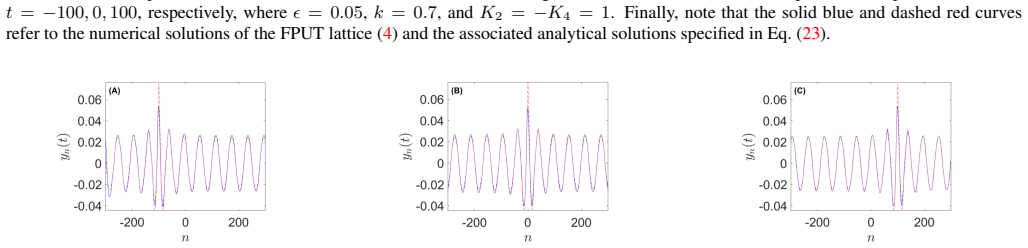
In the present work, we present a number of localized wave patterns that are theoretically analyzed and numerically illustrated to be observable within the widely applicable paradigm of the FPUT lattice. In particular, we derive a modified KdV equation from the FPUT lattice, which admits a variety of localized waves including these exact rational solutions representing rogue-wave profiles, solitons and breathers on the top of not only homogeneous, but also periodic elliptic function traveling-wave background. We utilize these exact solutions of the modified KdV reduction to construct consistent initial conditions for the FPUT lattice and perform time stepping of the latter. Relevant comparisons between these numerical solutions of the FPUT lattice and their associated analytical counterparts have been conducted to demonstrate good performance of the derived modified KdV reduction in approximating distinct localized wave structures from the FPUT lattice. This approach paves the way for importing a number of quasi-continuum waveforms to the FPUT lattice and the potential associated physical experiments, including recent ones in mechanical metamaterials.
Editorial analysis
A structured set of objections, weighed in public.
Referee Report
Summary. The paper derives a modified KdV (mKdV) equation from the FPUT lattice via quasi-continuum approximation. It obtains exact rational solutions of this mKdV (rogue waves, solitons, breathers) on both homogeneous and elliptic periodic traveling-wave backgrounds, uses these as initial data for the discrete FPUT system, and reports numerical comparisons indicating good agreement between the lattice evolution and the continuum profiles.
Significance. If the numerical agreement is robust and quantified, the work would demonstrate that the quasi-continuum reduction remains useful even for algebraically localized structures on nontrivial backgrounds, enabling transfer of known mKdV solutions to discrete lattices and supporting applications in mechanical metamaterials.
major comments (2)
- [Abstract] The central claim rests on numerical agreement between mKdV initial data evolved in the lattice and the continuum profiles, yet the abstract supplies no error metrics (e.g., L2 or L-infinity norms), time intervals of validity, or quantitative thresholds for 'good performance'. This omission makes it impossible to judge whether the observed agreement substantiates the reduction's validity or is merely visual.
- The quasi-continuum derivation assumes slow spatial variation and small amplitudes, but the rational rogue-wave and breather solutions on elliptic backgrounds possess algebraically decaying tails whose higher derivatives introduce wavenumbers comparable to the lattice cutoff. No analysis or diagnostic is provided to confirm that higher-order discrete corrections remain perturbative for these profiles.
Simulated Author's Rebuttal
We thank the referee for the constructive report and the recommendation for major revision. The comments correctly identify the need for quantitative error measures and further justification of the approximation's range of validity. We address each point below and will revise the manuscript to incorporate the suggested improvements.
read point-by-point responses
-
Referee: [Abstract] The central claim rests on numerical agreement between mKdV initial data evolved in the lattice and the continuum profiles, yet the abstract supplies no error metrics (e.g., L2 or L-infinity norms), time intervals of validity, or quantitative thresholds for 'good performance'. This omission makes it impossible to judge whether the observed agreement substantiates the reduction's validity or is merely visual.
Authors: We agree that the abstract would be strengthened by quantitative indicators. In the revised manuscript we will update the abstract to report L2 and L-infinity error norms between the FPUT lattice evolution and the mKdV profiles, specify the time intervals over which these norms remain below explicit thresholds (e.g., relative L2 error < 0.05), and define the criteria used to characterize 'good performance'. revision: yes
-
Referee: The quasi-continuum derivation assumes slow spatial variation and small amplitudes, but the rational rogue-wave and breather solutions on elliptic backgrounds possess algebraically decaying tails whose higher derivatives introduce wavenumbers comparable to the lattice cutoff. No analysis or diagnostic is provided to confirm that higher-order discrete corrections remain perturbative for these profiles.
Authors: This observation is accurate: the algebraic tails do introduce high-wavenumber content that formally challenges the slow-variation assumption. Because the amplitude of these tails is small, the absolute contribution of the neglected terms remains limited, as suggested by the observed numerical agreement. In the revision we will add a dedicated paragraph discussing this limitation together with a diagnostic plot that evaluates the magnitude of the leading omitted terms in the quasi-continuum expansion for the specific parameter values employed. A rigorous a-priori error bound for algebraically localized solutions lies outside the present scope. revision: partial
Circularity Check
No significant circularity in mKdV derivation and lattice validation
full rationale
The paper performs a standard quasi-continuum expansion to obtain the modified KdV equation from the FPUT lattice, derives exact solutions of that continuum model, seeds the discrete system with those solutions, and performs direct numerical time-stepping comparisons. This workflow constitutes an independent check of the reduction's accuracy rather than any self-definitional loop, fitted-input prediction, or load-bearing self-citation. No equations or steps in the provided text reduce the central claim to its own inputs by construction.
Axiom & Free-Parameter Ledger
axioms (1)
- domain assumption The FPUT lattice admits a quasi-continuum limit that yields a modified KdV equation under appropriate scaling assumptions for slowly varying localized waves.
Reference graph
Works this paper leans on
-
[1]
Ablowitz, B
M. Ablowitz, B. Prinari, and A. Trubatch.Discrete and Con- tinuous Nonlinear Schr ¨odinger Systems. Cambridge University Press, Cambridge, 2004
2004
-
[2]
M. J. Ablowitz.Nonlinear dispersive waves: Asymptotic anal- ysis and solitons. Cambridge University Press, sep 2011
2011
-
[3]
M. J. Ablowitz and H. Segur.Solitons and the inverse scattering transform. SIAM, 1981
1981
-
[4]
discussion & debate: Rogue waves – towards a uni- fying concept?
N. Akhmediev and E. Pelinovsky. Editorial – introductory re- marks on “discussion & debate: Rogue waves – towards a uni- fying concept?”.European Physical Journal Special Topics, 185:1–4, 2010
2010
-
[5]
Ankiewicz and N
A. Ankiewicz and N. Akhmediev. Rogue wave-type solutions of the mKdV equation and their relation to known NLSE rogue wave solutions.Nonlinear Dynamics, 91(3):1931–1938, 2018
1931
-
[6]
Ankiewicz, M
A. Ankiewicz, M. Bokaeeyan, and N. Akhmediev. Shallow- water rogue waves: An approach based on complex solutions of the Korteweg–de Vries equation.Phys. Rev. E, 99:050201(R), May 2019
2019
-
[7]
Bailung, S
H. Bailung, S. Sharma, and Y . Nakamura. Observation of pere- grine solitons in a multicomponent plasma with negative ions. Physical Review Letters, 107(25):255005, 2011
2011
-
[8]
Bilman, L
D. Bilman, L. Ling, and P. D. Miller. Extreme superposition: Rogue waves of infinite order and the painlev ´e-iii hierarchy. Duke Mathematical Journal, 169(4), Mar. 2020
2020
-
[9]
Carretero-Gonz ´alez, D
R. Carretero-Gonz ´alez, D. Frantzeskakis, P. Kevrekidis, and R. Gonz´alez.Nonlinear Waves and Hamiltonian Systems: From One to Many Degrees of Freedom, from Discrete to Continuum. Oxford University Press, 2024
2024
-
[10]
Chabchoub, N
A. Chabchoub, N. Hoffmann, and N. Akhmediev. Rogue wave observation in a water wave tank.Physical Review Letters, 106(20):204502, 2011
2011
-
[11]
Chabchoub, N
A. Chabchoub, N. Hoffmann, M. Onorato, and N. Akhmediev. Super rogue waves: observation of a higher-order breather in water waves.Physical Review X, 2(1):011015, 2012
2012
-
[12]
E. G. Charalampidis, J. Lee, P. G. Kevrekidis, and C. Chong. Phononic rogue waves.Phys. Rev. E, 98:032903, Sep 2018
2018
-
[13]
Chen and D
J. Chen and D. E. Pelinovsky. Rogue periodic waves of the modified KdV equation.Nonlinearity, 31(5):1955–1980, 2018
1955
-
[14]
Clarke, R
S. Clarke, R. Grimshaw, P. Miller, E. Pelinovsky, and T. Tal- ipova. On the generation of solitons and breathers in the modi- fied Korteweg–de Vries equation.Chaos: An Interdisciplinary Journal of Nonlinear Science, 10(2):383–392, 2000
2000
-
[15]
J. M. Dudley, F. Dias, M. Erkintalo, and G. Genty. Instabil- ities, breathers and rogue waves in optics.Nature Photonics, 8(10):755–764, 2014
2014
-
[16]
El and M
G. El and M. Hoefer. Dispersive shock waves and modulation theory.Physica D: Nonlinear Phenomena, 333:11–65, 2016
2016
-
[17]
G. A. El, M. A. Hoefer, and M. Shearer. Dispersive and diffusive-dispersive shock waves for nonconvex conservation laws.SIAM Review, 59(1):3–61, 2017
2017
-
[18]
Friesecke and A
G. Friesecke and A. Mikikits-Leitner. Cnoidal waves on Fermi– Pasta–Ulam lattices.J. Dyn. Diff. Equ., 27(3):627–652, 2015
2015
-
[19]
Friesecke and R
G. Friesecke and R. L. Pego. Solitary waves on Fermi–Pasta– Ulam lattices: II. Qualitative properites, renormalization and continuum limit.Nonlinearity, 12:1601, 1999
1999
-
[20]
Friesecke and R
G. Friesecke and R. L. Pego. Solitary waves on Fermi–Pasta– Ulam lattices: I. Linear implies nonlinear stability.Nonlinear- ity, 15:1343, 2002
2002
-
[21]
Friesecke and R
G. Friesecke and R. L. Pego. Solitary waves on Fermi–Pasta– Ulam lattices: III. Howland-type Floquet theory.Nonlinearity, 17:207, 2004
2004
-
[22]
Friesecke and R
G. Friesecke and R. L. Pego. Solitary waves on Fermi–Pasta– Ulam lattices: IV. Proof of stability at low energy.Nonlinearity, 17:229, 2004
2004
-
[23]
Gallavotti.The Fermi–Pasta–Ulam Problem: A Status Re- port
G. Gallavotti.The Fermi–Pasta–Ulam Problem: A Status Re- port. Springer-Verlag, Berlin, Germany, 2008. 9
2008
-
[24]
J. S. He, H. R. Zhang, L. H. Wang, K. Porsezian, and A. S. Fokas. Generating mechanism for higher-order rogue waves. Physical Review E, 87(5), May 2013
2013
-
[25]
Hristov and D
N. Hristov and D. E. Pelinovsky. Justification of the KP-II approximation in dynamics of two-dimensional FPU systems. Zeitschrift f ¨ur angewandte Mathematik und Physik, 73(5):213, 2022
2022
-
[26]
P. G. Kevrekidis.The Discrete Nonlinear Schr ¨odinger Equa- tion. Springer Berlin Heidelberg, 2009
2009
-
[27]
Kharif, E
C. Kharif, E. Pelinovsky, and A. Slunyaev.Rogue Waves in the Ocean. Advances in Geophysical and Environmental Mechan- ics and Mathematics. Springer Berlin, Heidelberg, 2009
2009
-
[28]
Kibler, J
B. Kibler, J. Fatome, C. Finot, G. Millot, F. Dias, G. Genty, N. Akhmediev, and J. M. Dudley. The peregrine soliton in non- linear fibre optics.Nature Physics, 6(10):790–795, 2010
2010
-
[29]
V . I. Kruglov and H. Triki. Breather and interacting soliton and periodic waves for modified KdV equation.arXiv preprint arXiv:2110.14102, 2021
arXiv 2021
-
[30]
V . B. Matveev and M. A. Salle.Darboux Transformations and Solitons. Springer Series in Nonlinear Dynamics. Springer- Verlag, 1991
1991
-
[31]
Miyazawa, C
Y . Miyazawa, C. Chong, P. G. Kevrekidis, and J. Yang. Rogue and solitary waves in coupled phononic crystals.Phys. Rev. E, 105:034202, Mar 2022
2022
-
[32]
Miyazawa, C
Y . Miyazawa, C. Chong, P. G. Kevrekidis, and J. Yang. Forma- tion of mechanical rogue waves, 2026
2026
-
[33]
Mucalica and D
A. Mucalica and D. E. Pelinovsky. Solitons on the rarefaction wave background via the Darboux transformation.Proceedings of the Royal Society A: Mathematical, Physical and Engineer- ing Sciences, 478(2267), 2022
2022
-
[34]
Mucalica and D
A. Mucalica and D. E. Pelinovsky. Dark breathers on a snoidal wave background in the defocusing mKdV equation.Letters in Mathematical Physics, 114(4):100, 2024
2024
-
[35]
A. C. Newell.Solitons in mathematics and physics. SIAM, 1985
1985
-
[36]
Onorato, S
M. Onorato, S. Resitori, and F. Baronio, editors.Rogue and Shock Waves in Nonlinear Dispersive Media. Lecture Notes in Physics. Springer, Cham, 2016
2016
-
[37]
D. H. Peregrine. Water waves, nonlinear Schr¨odinger equations and their solutions.The ANZIAM Journal, 25(1):16–43, 1983
1983
-
[38]
D. R. Solli, C. Ropers, P. Koonath, and B. Jalali. Optical rogue waves.Nature, 450(7172):1054–1057, 2007
2007
-
[39]
Suleimanov
B. Suleimanov. Effect of a small dispersion on self-focusing in a spatially one-dimensional case.JETP Letters, 106(6):400– 405, 2017
2017
-
[40]
Vainchtein
A. Vainchtein. Solitary waves in fpu-type lattices.Physica D: Nonlinear Phenomena, 434:133252, 2022
2022
-
[41]
Wen and Z
X.-Y . Wen and Z. Yan. Higher-order rational solitons and rogue-like wave solutions of the (2 + 1)-dimensional nonlin- ear fluid mechanics equations.Communications in Nonlinear Science and Numerical Simulation, 43:311–329, Feb. 2017
2017
-
[42]
Z. Xu, H. Chen, and Z. Dai. Rogue wave for the (2+1)- dimensional Kadomtsev–Petviashvili equation.Applied Math- ematics Letters, 37:34–38, 2014
2014
-
[43]
S. Yang, G. Biondini, C. Chong, and P. G. Kevrekidis. A reg- ularized continuum model for travelling waves and dispersive shocks of the granular chain.Journal of Nonlinear Waves, 1:e2, 2025
2025
-
[44]
Zhang, Y
X. Zhang, Y . Chen, and X. Tang. Rogue wave and a pair of resonance stripe solitons to KP equation.Computers and Math- ematics with Applications, 76(8):1938–1949, 2018
1938
discussion (0)
Sign in with ORCID, Apple, or X to comment. Anyone can read and Pith papers without signing in.