Deft Scheduling of Dynamic Cloud Workflows with Varying Deadlines via Mixture-of-Experts
Pith reviewed 2026-06-28 17:27 UTC · model grok-4.3
The pith
DEFT uses a mixture-of-experts deep reinforcement learning architecture to schedule dynamic cloud workflows by routing each decision to the expert matched to the current deadline tightness.
A machine-rendered reading of the paper's core claim, the machinery that carries it, and where it could break.
Core claim
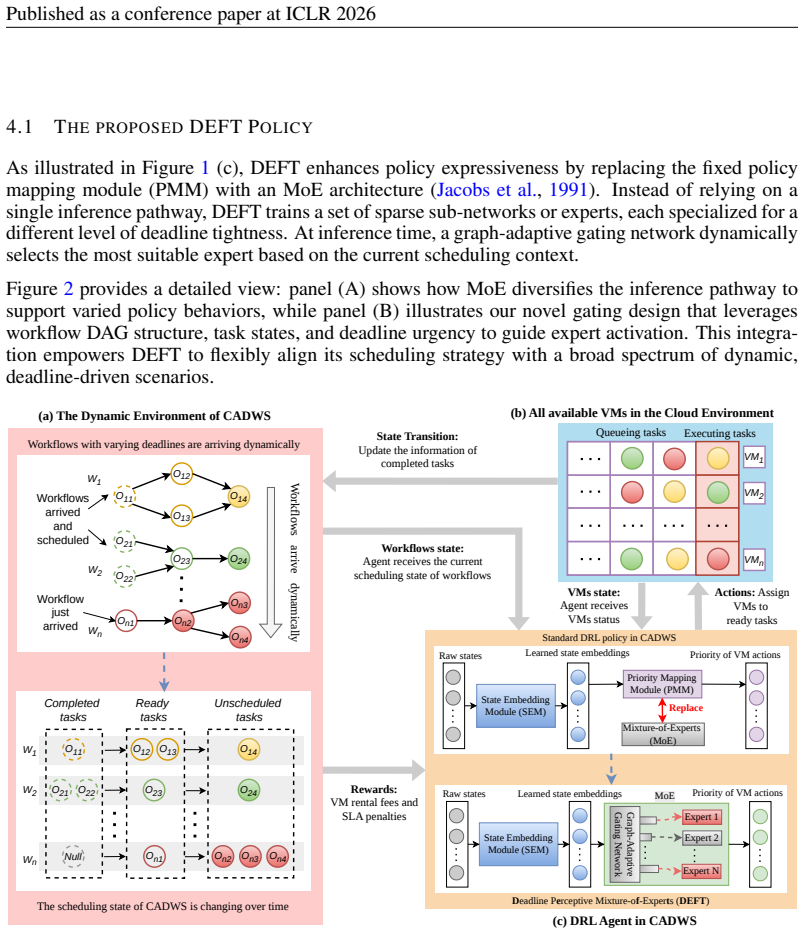
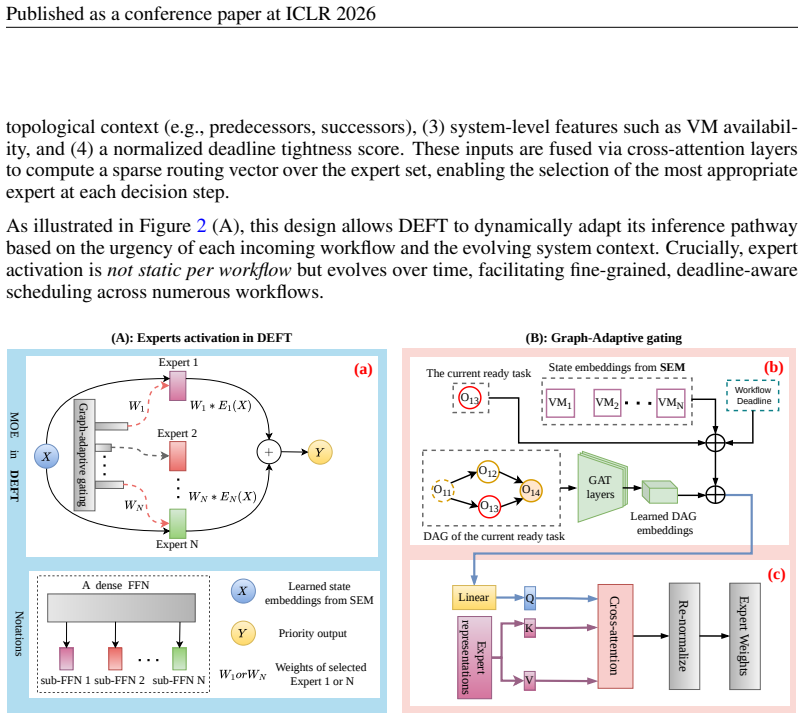
DEFT is the first Mixture-of-Experts architecture for dynamic cloud workflow scheduling. Each expert is trained for a different level of deadline tightness. A graph-adaptive gating mechanism encodes workflow DAGs, task states, and VM conditions with cross-attention to activate the appropriate expert in a fine-grained, deadline-sensitive way. This routing allows DEFT to meet a broad spectrum of deadline requirements that no single expert can achieve while reducing execution cost and deadline violations on dynamic benchmarks.
What carries the argument
Mixture-of-experts policy with a graph-adaptive gating network that uses cross-attention over workflow DAGs, task states, and virtual-machine conditions to select the deadline-specific expert.
If this is right
- DEFT meets a wider range of deadline tightness levels than any individual expert model.
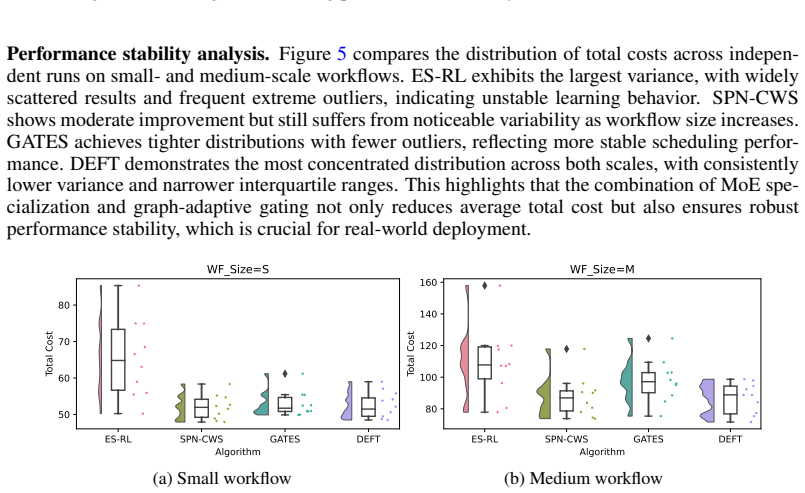
- Execution cost and deadline violation rates drop compared with existing single-path DRL schedulers on the same dynamic benchmarks.
- The architecture adapts decisions to continuously arriving workflows and changing virtual-machine availability without retraining the entire policy.
- Cross-attention in the gate produces deadline-sensitive routing that single models cannot replicate.
Where Pith is reading between the lines
- The same gating idea could be tested on other multi-objective resource problems where different cost-time trade-offs matter.
- If the experts are made interpretable, operators could inspect which expert is active for a given deadline class.
- Production use would require checking whether the gating overhead remains acceptable under high arrival rates not present in the benchmark traces.
Load-bearing premise
The gating network can correctly identify which expert matches the current deadline tightness from the workflow graph and resource state in real time.
What would settle it
Run the trained gating network on held-out workflow traces and measure whether its expert selections produce measurably lower deadline violations than a single-model baseline; if the selections show no correlation with deadline tightness or yield no gain, the central claim does not hold.
Figures


read the original abstract
Workflow scheduling in cloud computing demands the intelligent allocation of dynamically arriving, graph-structured workflows with varying deadlines onto ever-changing virtual machine resources. However, existing deep reinforcement learning (DRL) schedulers remain limited by rigid, single-path inference architectures that struggle to handle diverse scheduling scenarios. We introduce $\textbf{DEFT}$ ($\textbf{D}$eadline-p$\textbf{E}$rceptive Mixture-o$\textbf{F}$-Exper$\textbf{t}$s), an innovative DRL policy architecture that leverages a specialized mixture of experts, each trained to manage different levels of deadline tightness. To our knowledge, DEFT is the first to introduce and validate a Mixture-of-Experts architecture for dynamic cloud workflow scheduling. By adaptively routing decisions through the most appropriate experts, DEFT is capable of meeting a broad spectrum of deadline requirements that no single expert can achieve. Central to DEFT is a $\textbf{graph-adaptive}$ gating mechanism that encodes workflow DAGs, task states, and VM conditions, using cross-attention to guide expert activation in a fine-grained, deadline-sensitive manner. Experiments on dynamic cloud workflow benchmarks demonstrate that DEFT significantly reduces execution cost and deadline violations, outperforming multiple state-of-the-art DRL baselines.
Editorial analysis
A structured set of objections, weighed in public.
Referee Report
Summary. The paper introduces DEFT, a DRL policy using a Mixture-of-Experts architecture for scheduling dynamically arriving graph-structured workflows onto changing VM resources. Experts are specialized for different deadline tightness levels; a graph-adaptive gating network with cross-attention encodes DAG structure, task states, and VM conditions to route decisions. The authors claim this is the first MoE application to the domain and that experiments on dynamic benchmarks show reduced execution cost and deadline violations relative to multiple SOTA DRL baselines.
Significance. If the empirical results hold, the work would be significant for demonstrating that MoE routing can address a wider range of deadline constraints than single-path DRL policies in cloud scheduling. The graph-adaptive gating mechanism offers a concrete way to incorporate workflow structure into expert selection.
major comments (1)
- [Abstract] Abstract: the central claim that DEFT 'significantly reduces execution cost and deadline violations' and outperforms baselines rests entirely on qualitative statements; no quantitative metrics, tables, figures, baseline descriptions, or ablation results are supplied, rendering the empirical contribution impossible to evaluate.
minor comments (1)
- [Abstract] Abstract: the acronym DEFT is expanded on first use but the expanded form is not repeated for clarity in the subsequent sentence.
Simulated Author's Rebuttal
We thank the referee for the detailed review. We agree that the abstract should be strengthened with quantitative metrics to better support the empirical claims, and we will revise accordingly in the next version.
read point-by-point responses
-
Referee: [Abstract] Abstract: the central claim that DEFT 'significantly reduces execution cost and deadline violations' and outperforms baselines rests entirely on qualitative statements; no quantitative metrics, tables, figures, baseline descriptions, or ablation results are supplied, rendering the empirical contribution impossible to evaluate.
Authors: We acknowledge the validity of this observation. While the full manuscript contains quantitative results (including tables with cost and violation metrics, baseline comparisons, and ablations), the abstract relies on qualitative phrasing. We will revise the abstract to incorporate specific quantitative highlights from the experiments, such as average percentage reductions in execution cost and deadline violations relative to the SOTA DRL baselines, along with a concise description of the evaluation setup. revision: yes
Circularity Check
No significant circularity
full rationale
The abstract and available text contain no equations, derivations, fitted parameters presented as predictions, or self-citations invoked as load-bearing uniqueness theorems. The central claim is an empirical demonstration that a graph-adaptive MoE gating mechanism reduces cost and deadline violations on benchmarks; this is an external validation step rather than a reduction of any result to its own inputs by construction. No load-bearing step reduces to a self-definition, renamed known result, or ansatz smuggled via prior work by the same authors.
Axiom & Free-Parameter Ledger
axioms (1)
- domain assumption Deep reinforcement learning policies can be trained to optimize workflow scheduling objectives in dynamic cloud environments.
invented entities (1)
-
DEFT (Deadline-perceptive Mixture-of-Experts) architecture
no independent evidence
Reference graph
Works this paper leans on
-
[1]
Shield: Multi-task multi-distribution vehicle routing solver with sparsity and hierarchy
Yong Liang Goh, Zhiguang Cao, Yining Ma, Jianan Zhou, Mohammad Haroon Dupty, and Wee Sun Lee. Shield: Multi-task multi-distribution vehicle routing solver with sparsity and hierarchy. arXiv preprint arXiv:2506.08424,
-
[2]
Cost-aware dynamic multi-workflow scheduling in cloud data center using evolutionary reinforcement learning
11 Published as a conference paper at ICLR 2026 Victoria Huang, Chen Wang, Hui Ma, Gang Chen, and Kameron Christopher. Cost-aware dynamic multi-workflow scheduling in cloud data center using evolutionary reinforcement learning. In International Conference on Service-Oriented Computing, pp. 449–464. Springer,
2026
-
[3]
Evolution Strategies as a Scalable Alternative to Reinforcement Learning
Tim Salimans, Jonathan Ho, Xi Chen, Szymon Sidor, and Ilya Sutskever. Evolution strategies as a scalable alternative to reinforcement learning.arXiv preprint arXiv:1703.03864,
work page internal anchor Pith review Pith/arXiv arXiv
-
[4]
Outrageously Large Neural Networks: The Sparsely-Gated Mixture-of-Experts Layer
Noam Shazeer, Azalia Mirhoseini, Krzysztof Maziarz, Andy Davis, Quoc Le, Geoffrey Hinton, and Jeff Dean. Outrageously large neural networks: The sparsely-gated mixture-of-experts layer. arXiv preprint arXiv:1701.06538,
work page internal anchor Pith review Pith/arXiv arXiv
-
[5]
Petar Veliˇckovi´c, Guillem Cucurull, Arantxa Casanova, Adriana Romero, Pietro Lio, and Yoshua Bengio. Graph attention networks.arXiv preprint arXiv:1710.10903,
work page internal anchor Pith review Pith/arXiv arXiv
-
[6]
Learning to dispatch for job shop scheduling via deep reinforcement learning.Advances in neural information processing systems, 33:1621–1632,
12 Published as a conference paper at ICLR 2026 Cong Zhang, Wen Song, Zhiguang Cao, Jie Zhang, Puay Siew Tan, and Xu Chi. Learning to dispatch for job shop scheduling via deep reinforcement learning.Advances in neural information processing systems, 33:1621–1632,
2026
-
[7]
Guangyao Zhou, Wenhong Tian, Rajkumar Buyya, Ruini Xue, and Liang Song. Deep reinforce- ment learning-based methods for resource scheduling in cloud computing: A review and future directions.Artificial Intelligence Review, 57(5):124, 2024a. Jianan Zhou, Zhiguang Cao, Yaoxin Wu, Wen Song, Yining Ma, Jie Zhang, and Chi Xu. Mv- moe: Multi-task vehicle routin...
-
[8]
Each directed edge(Oni, Onj)∈ C Wi indicates that taskO ni must finish before taskO nj can begin
A.1 WORKFLOW MODEL A workflowW i ∈ Wis represented by a directed acyclic graph (DAG)W i = (O Wi ,C Wi), where OWi is the set of tasks andCWi is the set of precedence edges. Each directed edge(Oni, Onj)∈ C Wi indicates that taskO ni must finish before taskO nj can begin. A task becomes aready task, denoted byO n∗, once all its predecessors have completed. ...
2026
-
[9]
to train each expert under a different workflow urgency to learn specific knowledge under this deadline scenario. OpenAI ES is a population-based optimization technique known for its robustness against hyperparameter sensitivity, insensitivity to the design of reward signals, and suitability for parallel implementation, making it particularly effective fo...
2017
-
[10]
D TRAINING OF GRAPH-ADAPTIVE GATING NETWORK Let{ϕ k}K k=1 be the pre-trained MLP experts obtained in Appendix C, whereKdenotes the number of experts. During the second-stage training, we jointly optimize the graph-adaptive gating network with parametersθ g, the State Embedding Module (SEM) with parametersθ s, and all pre-trained experts{ϕ k}K k=1. We pack...
2026
-
[11]
Scale” indicates the workflow scale/size. “Card
17 Published as a conference paper at ICLR 2026 Table 4: The configuration of VM instances. VM Type vCPU/Memory (GB) Cost ($/hour) m5.large2/8 0.096 m5.xlarge4/16 0.192 m5.2xlarge8/32 0.384 m5.4xlarge16/64 0.768 m5.8xlarge32/128 1.536 m5.12xlarge48/192 2.304 Table 5: Workflow patterns and sizes. Scale CyberShake Montage Inspiral/SIPHT Small 30 25 30 Mediu...
2026
-
[12]
Activating only the highest-scoring expert preserves the specialization encoded in each expert policy and avoids the noise introduced by averaging multiple experts’ outputs. Increas- ingkgenerally weakens this specialization signal and yields diminishing or negative performance, especially when the expert pool already contains overlapping behaviors, as in...
2026
discussion (0)
Sign in with ORCID, Apple, or X to comment. Anyone can read and Pith papers without signing in.