WIMP-like Dark Matter Without Thermalization At Freeze-Out
Pith reviewed 2026-05-20 03:56 UTC · model grok-4.3
The pith
Dark matter in hidden sectors can reach the observed relic density with extremely weak Standard Model couplings by decoupling early but sharing similar temperatures at freeze-out.
A machine-rendered reading of the paper's core claim, the machinery that carries it, and where it could break.
Core claim
In hidden-sector models the dark matter and Standard Model sectors decouple at T ≫ m_X and subsequently evolve with separate thermal histories, yet the sectors maintain similar temperatures during freeze-out, producing the observed relic density for annihilation cross sections of order 10^{-26} cm³/s.
What carries the argument
Hidden-sector models with early decoupling at T ≫ m_X but temperature alignment at freeze-out.
If this is right
- The coupling between the Standard Model and hidden sectors can be extremely small.
- Direct detection and collider signals can lie far below foreseeable sensitivities.
- The observed relic density arises from the usual thermal mechanism despite the lack of late-time thermalization.
- Comparable annihilation cross sections emerge naturally without fine-tuning the inter-sector interaction strength.
Where Pith is reading between the lines
- This framework suggests that null results in current experiments may reflect early decoupling rather than the absence of dark matter interactions.
- Cosmological probes of early-universe entropy injection or temperature ratios could test the required alignment of sector temperatures.
- The mechanism opens parameter space for hidden-sector particles that interact too weakly for near-term detection but still satisfy the relic-density constraint.
Load-bearing premise
The decoupled sectors naturally reach similar temperatures at freeze-out through unspecified initial conditions or entropy production.
What would settle it
Continued non-observation of dark matter signals in direct detection experiments down to cross sections orders of magnitude below 10^{-26} cm³/s while the relic density is confirmed by cosmology would support the scenario; detection of a signal at standard WIMP strength would challenge it.
Figures

read the original abstract
In the standard thermal relic scenario, dark matter remains in chemical equilibrium with the Standard Model radiation bath until freeze-out occurs at $T \sim m_X/20$, where $m_X$ is the dark matter mass. In this familiar class of models, the observed relic density is obtained for annihilation cross sections of order $\sigma v \sim 10^{-26}$ cm$^3$/s. We show that comparable cross sections can naturally be realized in hidden-sector models in which the dark matter and Standard Model sectors decouple at a very high temperature, $T \gg m_X$, and subsequently evolve with separate thermal histories. Despite this decoupling, the two sectors have similar temperatures during freeze-out, leading to the usual thermal relic abundance. As a consequence, the coupling between the Standard Model and hidden sectors can be extremely small, potentially placing direct detection and collider signals far below foreseeable sensitivities.
Editorial analysis
A structured set of objections, weighed in public.
Referee Report
Summary. The manuscript proposes a hidden-sector dark matter scenario in which the dark matter and Standard Model sectors decouple at T ≫ m_X and thereafter follow independent thermal histories, yet maintain comparable temperatures at the freeze-out epoch T ∼ m_X/20. This temperature alignment is asserted to occur naturally, permitting the standard thermal relic density for annihilation cross sections σv ∼ 10^{-26} cm³/s while allowing the inter-sector coupling to be extremely small.
Significance. If the temperature alignment can be shown to arise generically from the dynamics rather than from tuned initial conditions, the result would meaningfully enlarge the viable parameter space for WIMP-like dark matter by decoupling the relic-density requirement from the strength of direct-detection and collider signals. The approach highlights the role of separate entropy and temperature evolution in multi-sector models.
major comments (1)
- [Abstract] The central claim that the two sectors maintain similar temperatures at freeze-out after decoupling at T ≫ m_X is presented as natural in the abstract, yet the manuscript provides neither the coupled Boltzmann equations for the two temperatures nor any scan over initial temperature ratios or reheating scenarios that would establish the alignment as generic rather than dependent on specific initial conditions. This assumption is load-bearing for the assertion that comparable cross sections are 'naturally realized.'
Simulated Author's Rebuttal
We thank the referee for the constructive comments and the opportunity to clarify aspects of our hidden-sector dark matter scenario. We address the major comment regarding the naturalness of the temperature alignment below.
read point-by-point responses
-
Referee: [Abstract] The central claim that the two sectors maintain similar temperatures at freeze-out after decoupling at T ≫ m_X is presented as natural in the abstract, yet the manuscript provides neither the coupled Boltzmann equations for the two temperatures nor any scan over initial temperature ratios or reheating scenarios that would establish the alignment as generic rather than dependent on specific initial conditions. This assumption is load-bearing for the assertion that comparable cross sections are 'naturally realized.'
Authors: We agree that the manuscript would benefit from a more explicit demonstration that the temperature alignment arises generically. After decoupling, each sector conserves its own comoving entropy, so the temperature ratio evolves according to the respective effective degrees of freedom and any subsequent entropy injections. To strengthen this point, we will add the explicit coupled equations governing the temperature evolution of the two sectors and include a scan over initial temperature ratios at decoupling together with representative reheating scenarios. These additions will show that comparable temperatures at T ∼ m_X/20 are achieved across a broad range of initial conditions without fine-tuning, thereby supporting the claim that standard thermal relic densities are naturally realized for WIMP-like cross sections. revision: yes
Circularity Check
No significant circularity; central claim is a model-construction statement with independent content.
full rationale
The paper constructs hidden-sector scenarios in which the dark matter and SM sectors decouple early but maintain comparable temperatures at freeze-out, yielding the standard thermal relic density for WIMP-like cross sections. This is presented as a possible dynamical outcome rather than a derivation that reduces to its inputs by construction. No equations redefine a fitted quantity as a prediction, no self-citation chain bears the load of a uniqueness theorem, and no ansatz is smuggled in. The relic abundance calculation follows the usual Boltzmann equation once the temperature ratio is specified by the model, without tautological reduction. The temperature alignment is asserted to arise naturally in the constructed examples, but this is a statement about model viability rather than a self-referential loop.
Axiom & Free-Parameter Ledger
axioms (2)
- standard math Standard thermal history of the universe and Boltzmann equations govern relic density
- domain assumption Hidden sector maintains its own thermal bath after early decoupling
Lean theorems connected to this paper
-
IndisputableMonolith/Cost/FunctionalEquation.leanwashburn_uniqueness_aczel unclear?
unclearRelation between the paper passage and the cited Recognition theorem.
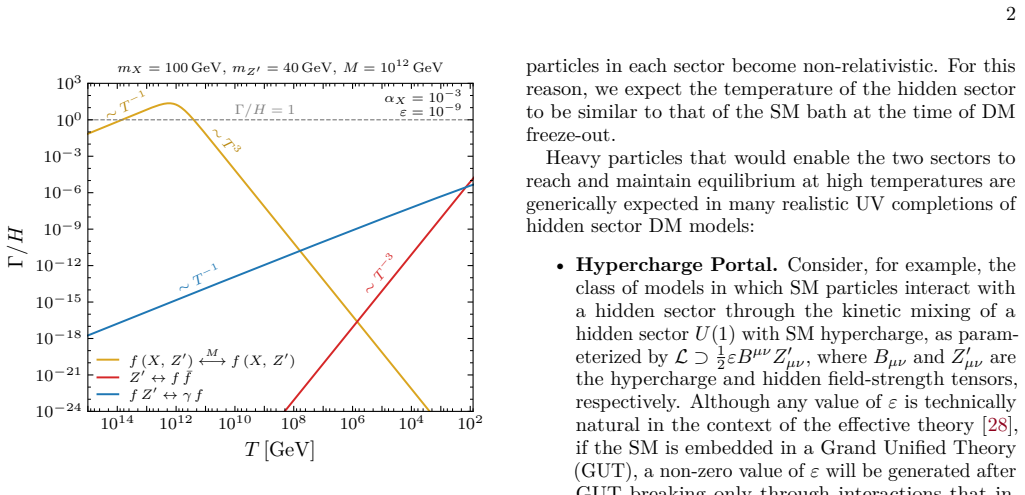
the ratio Γ/H for several processes... scattering processes mediated by a very heavy (M=10^12 GeV) state
What do these tags mean?
- matches
- The paper's claim is directly supported by a theorem in the formal canon.
- supports
- The theorem supports part of the paper's argument, but the paper may add assumptions or extra steps.
- extends
- The paper goes beyond the formal theorem; the theorem is a base layer rather than the whole result.
- uses
- The paper appears to rely on the theorem as machinery.
- contradicts
- The paper's claim conflicts with a theorem or certificate in the canon.
- unclear
- Pith found a possible connection, but the passage is too broad, indirect, or ambiguous to say the theorem truly supports the claim.
Reference graph
Works this paper leans on
-
[1]
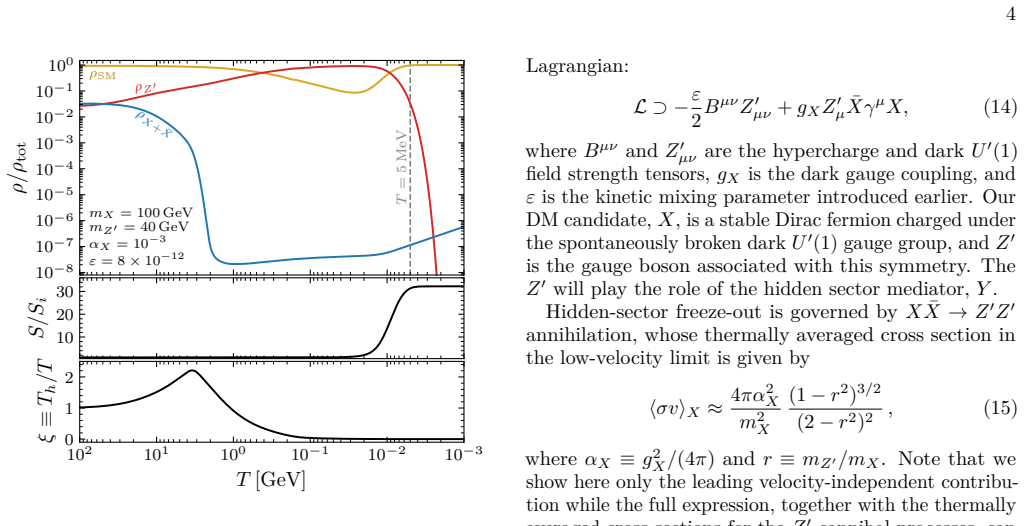
Secluded Evolution.First, the hidden sector undergoes internal chemical freeze-out. The hidden- to-SM temperature ratio,ξ, evolves through entropy conservation in each sector, possibly modified by a transient cannibal phase once the mediator be- comes non-relativistic [ 14], but remains of order unity throughout. Since Γ Y ≪Hduring this entire epoch, the ...
-
[2]
Entropy T ransfer.In the second stage, the frozen- out mediator population, redshifting as matter, comes to dominate the total energy density before decaying into SM particles. These decays inject en- tropy into the visible sector, diluting all pre-existing comoving abundances by a factor of [13, 14] Sf Si = ρY (τY )3/4 T(τY )3 ,(13) where Si,f are the SM...
-
[3]
G. Bertone and D. Hooper, Rev. Mod. Phys.90, 045002 (2018), arXiv:1605.04909 [astro-ph.CO]
work page internal anchor Pith review Pith/arXiv arXiv 2018
-
[4]
Dark Matter Search Results from 4.2 Tonne-Years of Exposure of the LUX-ZEPLIN (LZ) Experiment
J. Aalbers et al. (LZ), Phys. Rev. Lett.135, 011802 (2025), arXiv:2410.17036 [hep-ex]
work page internal anchor Pith review Pith/arXiv arXiv 2025
-
[5]
E. Aprile et al. (XENON), Phys. Rev. Lett.131, 041003 (2023), arXiv:2303.14729 [hep-ex]
-
[6]
Dark Matter Search Results from the Complete Exposure of the PICO-60 C$_3$F$_8$ Bubble Chamber
C. Amole et al. (PICO), Phys. Rev. D100, 022001 (2019), arXiv:1902.04031 [astro-ph.CO]
work page internal anchor Pith review Pith/arXiv arXiv 2019
-
[7]
M. Aaboud et al. (ATLAS), JHEP01, 126 (2018), arXiv:1711.03301 [hep-ex]
work page internal anchor Pith review Pith/arXiv arXiv 2018
-
[8]
A. M. Sirunyan et al. (CMS), JHEP08, 130 (2018), arXiv:1806.00843 [hep-ex]
work page internal anchor Pith review Pith/arXiv arXiv 2018
- [9]
- [10]
-
[11]
S. Chatrchyan et al. (CMS), JHEP09, 094 (2012), arXiv:1206.5663 [hep-ex]
work page internal anchor Pith review Pith/arXiv arXiv 2012
-
[12]
G. Aad et al. (ATLAS), Phys. Lett. B705, 294 (2011), arXiv:1106.5327 [hep-ex]
work page internal anchor Pith review Pith/arXiv arXiv 2011
-
[13]
M. Pospelov, A. Ritz, and M. B. Voloshin, Phys. Lett. B 662, 53 (2008), arXiv:0711.4866 [hep-ph]
work page internal anchor Pith review Pith/arXiv arXiv 2008
-
[14]
N. Arkani-Hamed, D. P. Finkbeiner, T. R. Slatyer, and N. Weiner, Phys. Rev. D79, 015014 (2009), arXiv:0810.0713 [hep-ph]
work page internal anchor Pith review Pith/arXiv arXiv 2009
-
[15]
Thermal Dark Matter From A Highly Decoupled Sector
A. Berlin, D. Hooper, and G. Krnjaic, Phys. Rev. D94, 095019 (2016), arXiv:1609.02555 [hep-ph]
work page internal anchor Pith review Pith/arXiv arXiv 2016
-
[16]
PeV-Scale Dark Matter as a Thermal Relic of a Decoupled Sector
A. Berlin, D. Hooper, and G. Krnjaic, Phys. Lett. B760, 106 (2016), arXiv:1602.08490 [hep-ph]
work page internal anchor Pith review Pith/arXiv arXiv 2016
-
[17]
Higgs-field Portal into Hidden Sectors
B. Patt and F. Wilczek, (2006), arXiv:hep-ph/0605188
work page internal anchor Pith review Pith/arXiv arXiv 2006
- [18]
-
[19]
Asymmetric Dark Matter from Leptogenesis
A. Falkowski, J. T. Ruderman, and T. Volansky, JHEP 05, 106 (2011), arXiv:1101.4936 [hep-ph]
work page internal anchor Pith review Pith/arXiv arXiv 2011
-
[20]
J. M. Cline, G. Dupuis, Z. Liu, and W. Xue, JHEP08, 131 (2014), arXiv:1405.7691 [hep-ph]
work page internal anchor Pith review Pith/arXiv arXiv 2014
-
[21]
Sterile Neutrino portal to Dark Matter II: Exact Dark symmetry
M. Escudero, N. Rius, and V. Sanz, Eur. Phys. J. C77, 397 (2017), arXiv:1607.02373 [hep-ph]
work page internal anchor Pith review Pith/arXiv arXiv 2017
-
[22]
Sterile neutrino portal to Dark Matter I: The $U(1)_{B-L}$ case
M. Escudero, N. Rius, and V. Sanz, JHEP02, 045 (2017), arXiv:1606.01258 [hep-ph]
work page internal anchor Pith review Pith/arXiv arXiv 2017
-
[23]
Hidden Sector Dark Matter and the Galactic Center Gamma-Ray Excess: A Closer Look
M. Escudero, S. J. Witte, and D. Hooper, JCAP11, 042 (2017), arXiv:1709.07002 [hep-ph]
work page internal anchor Pith review Pith/arXiv arXiv 2017
-
[24]
J. A. Evans, S. Gori, and J. Shelton, JHEP02, 100 (2018), arXiv:1712.03974 [hep-ph]
work page internal anchor Pith review Pith/arXiv arXiv 2018
- [25]
- [26]
-
[27]
A Comprehensive Study of WIMP Models Explaining the Fermi-LAT Galactic Center Excess
C. Kong and M. Di Mauro, Phys. Rev. D113, 043031 (2026), arXiv:2511.21808 [hep-ph]
work page internal anchor Pith review Pith/arXiv arXiv 2026
-
[28]
J. Koechler and M. Di Mauro, Phys. Rev. D112, 115016 (2025), arXiv:2508.02775 [hep-ph]
-
[29]
Y. Hu, C. Cesarotti, and T. R. Slatyer, (2025), arXiv:2509.08043 [hep-ph]
work page internal anchor Pith review Pith/arXiv arXiv 2025
-
[30]
LHC Signals for a SuperUnified Theory of Dark Matter
N. Arkani-Hamed and N. Weiner, JHEP12, 104 (2008), arXiv:0810.0714 [hep-ph]
work page internal anchor Pith review Pith/arXiv arXiv 2008
- [31]
-
[32]
Vector Dark Matter through a Radiative Higgs Portal
A. DiFranzo, P. J. Fox, and T. M. P. Tait, JHEP04, 135 (2016), arXiv:1512.06853 [hep-ph]
work page internal anchor Pith review Pith/arXiv arXiv 2016
-
[33]
Multi-component Dark Matter through a Radiative Higgs Portal
A. DiFranzo and G. Mohlabeng, JHEP01, 080 (2017), arXiv:1610.07606 [hep-ph]
work page internal anchor Pith review Pith/arXiv arXiv 2017
-
[34]
Virtual signatures of dark sectors in Higgs couplings
A. Voigt and S. Westhoff, JHEP11, 009 (2017), arXiv:1708.01614 [hep-ph]
work page internal anchor Pith review Pith/arXiv arXiv 2017
-
[35]
S. Dittmaier, S. Schuhmacher, and M. Stahlhofen, Eur. Phys. J. C81, 826 (2021), arXiv:2102.12020 [hep-ph]
-
[36]
E. Frangipane, S. Gori, and B. Shakya, JHEP09, 083 (2022), arXiv:2110.10711 [hep-ph]
-
[37]
E. Bertuzzo, T. Sassi, and A. Tesi, JHEP10, 109 (2024), arXiv:2406.14437 [hep-ph]
-
[38]
Supersymmetric Dark Matter and the Reheating Temperature of the Universe
N. Fornengo, A. Riotto, and S. Scopel, Phys. Rev. D67, 023514 (2003), arXiv:hep-ph/0208072
work page internal anchor Pith review Pith/arXiv arXiv 2003
-
[39]
The effect of a late decaying scalar on the neutralino relic density
G. Gelmini, P. Gondolo, A. Soldatenko, and C. E. Yaguna, Phys. Rev. D74, 083514 (2006), arXiv:hep-ph/0605016
work page internal anchor Pith review Pith/arXiv arXiv 2006
-
[40]
G. Kane, K. Sinha, and S. Watson, Int. J. Mod. Phys. D 24, 1530022 (2015), arXiv:1502.07746 [hep-th]
work page internal anchor Pith review Pith/arXiv arXiv 2015
-
[41]
Is the CMB telling us that dark matter is weaker than weakly interacting?
D. Hooper, Phys. Rev. D88, 083519 (2013), arXiv:1307.0826 [hep-ph]
work page internal anchor Pith review Pith/arXiv arXiv 2013
-
[42]
A. V. Patwardhan, G. M. Fuller, C. T. Kishimoto, and A. Kusenko, Phys. Rev. D92, 103509 (2015), arXiv:1507.01977 [astro-ph.CO]
work page internal anchor Pith review Pith/arXiv arXiv 2015
-
[43]
Flooded Dark Matter and S Level Rise
L. Randall, J. Scholtz, and J. Unwin, JHEP03, 011 (2016), arXiv:1509.08477 [hep-ph]
work page internal anchor Pith review Pith/arXiv arXiv 2016
-
[44]
Nonthermal production of dark radiation and dark matter
M. Reece and T. Roxlo, JHEP09, 096 (2016), arXiv:1511.06768 [hep-ph]
work page internal anchor Pith review Pith/arXiv arXiv 2016
-
[45]
D. H. Lyth and E. D. Stewart, Phys. Rev. D53, 1784 (1996), arXiv:hep-ph/9510204
work page internal anchor Pith review Pith/arXiv arXiv 1996
-
[46]
H. Davoudiasl, D. Hooper, and S. D. McDermott, Phys. Rev. Lett.116, 031303 (2016), arXiv:1507.08660 [hep-ph]
work page internal anchor Pith review Pith/arXiv arXiv 2016
-
[47]
Changes in Dark Matter Properties After Freeze-Out
T. Cohen, D. E. Morrissey, and A. Pierce, Phys. Rev. D 78, 111701 (2008), arXiv:0808.3994 [hep-ph]
work page internal anchor Pith review Pith/arXiv arXiv 2008
-
[48]
A little inflation at the cosmological QCD phase transition
T. Boeckel and J. Schaffner-Bielich, Phys. Rev. D85, 103506 (2012), arXiv:1105.0832 [astro-ph.CO]
work page internal anchor Pith review Pith/arXiv arXiv 2012
-
[49]
A little inflation in the early universe at the QCD phase transition
T. Boeckel and J. Schaffner-Bielich, Phys. Rev. Lett.105, 041301 (2010), arXiv:0906.4520 [astro-ph.CO]
work page internal anchor Pith review Pith/arXiv arXiv 2010
-
[50]
S. E. Hong, H.-J. Lee, Y. J. Lee, E. D. Stewart, and H. Zoe, JCAP06, 002 (2015), arXiv:1503.08938 [astro- ph.CO]
work page internal anchor Pith review Pith/arXiv arXiv 2015
-
[51]
E. Aprile et al. (XENON), Phys. Rev. Lett.135, 221003 (2025), arXiv:2502.18005 [hep-ex]
-
[52]
Planck Collaboration, A&A641, A6 (2020), arXiv:1807.06209 [astro-ph.CO]
work page internal anchor Pith review Pith/arXiv arXiv 2020
-
[53]
L. Goodenough and D. Hooper, (2009), arXiv:0910.2998 [hep-ph]
work page internal anchor Pith review Pith/arXiv arXiv 2009
-
[54]
Dark Matter Annihilation in The Galactic Center As Seen by the Fermi Gamma Ray Space Telescope
D. Hooper and L. Goodenough, Phys. Lett. B697, 412 (2011), arXiv:1010.2752 [hep-ph]
work page internal anchor Pith review Pith/arXiv arXiv 2011
-
[55]
On The Origin Of The Gamma Rays From The Galactic Center
D. Hooper and T. Linden, Phys. Rev. D84, 123005 (2011), arXiv:1110.0006 [astro-ph.HE]
work page internal anchor Pith review Pith/arXiv arXiv 2011
-
[56]
K. N. Abazajian and M. Kaplinghat, Phys. Rev. D86, 083511 (2012), [Erratum: Phys.Rev.D 87, 129902 (2013)], arXiv:1207.6047 [astro-ph.HE]
work page internal anchor Pith review Pith/arXiv arXiv 2012
-
[57]
Two Emission Mechanisms in the Fermi Bubbles: A Possible Signal of Annihilating Dark Matter
D. Hooper and T. R. Slatyer, Phys. Dark Univ.2, 118 (2013), arXiv:1302.6589 [astro-ph.HE]
work page internal anchor Pith review Pith/arXiv arXiv 2013
-
[58]
Dark Matter and Pulsar Model Constraints from Galactic Center Fermi-LAT Gamma Ray Observations
C. Gordon and O. Macias, Phys. Rev. D88, 083521 7 (2013), [Erratum: Phys.Rev.D 89, 049901 (2014)], arXiv:1306.5725 [astro-ph.HE]
work page internal anchor Pith review Pith/arXiv arXiv 2013
-
[59]
T. Daylan, D. P. Finkbeiner, D. Hooper, T. Linden, S. K. N. Portillo, N. L. Rodd, and T. R. Slatyer, Phys. Dark Univ.12, 1 (2016), arXiv:1402.6703 [astro-ph.HE]
work page internal anchor Pith review Pith/arXiv arXiv 2016
-
[60]
Background model systematics for the Fermi GeV excess
F. Calore, I. Cholis, and C. Weniger, JCAP03, 038 (2015), arXiv:1409.0042 [astro-ph.CO]
work page internal anchor Pith review Pith/arXiv arXiv 2015
-
[61]
Fermi-LAT Observations of High-Energy Gamma-Ray Emission Toward the Galactic Center
M. Ajello et al. (Fermi-LAT), Astrophys. J.819, 44 (2016), arXiv:1511.02938 [astro-ph.HE]
work page internal anchor Pith review Pith/arXiv arXiv 2016
-
[62]
The Fermi Galactic Center GeV Excess and Implications for Dark Matter
M. Ackermann et al. (Fermi-LAT), Astrophys. J.840, 43 (2017), arXiv:1704.03910 [astro-ph.HE]
work page internal anchor Pith review Pith/arXiv arXiv 2017
-
[63]
I. Cholis, Y.-M. Zhong, S. D. McDermott, and J. P. Surdutovich, Phys. Rev. D105, 103023 (2022), arXiv:2112.09706 [astro-ph.HE]
-
[64]
M. Di Mauro, Phys. Rev. D103, 063029 (2021), arXiv:2101.04694 [astro-ph.HE]
- [65]
-
[66]
New Developments in FeynCalc 9.0
V. Shtabovenko, R. Mertig, and F. Orellana, Comput. Phys. Commun.207, 432 (2016), arXiv:1601.01167 [hep- ph]
work page internal anchor Pith review Pith/arXiv arXiv 2016
-
[67]
FeynCalc 9.3: New features and improvements
V. Shtabovenko, R. Mertig, and F. Orellana, Comput. Phys. Commun.256, 107478 (2020), arXiv:2001.04407 [hep-ph]
work page internal anchor Pith review Pith/arXiv arXiv 2020
-
[68]
V. Shtabovenko, R. Mertig, and F. Orellana, Comput. Phys. Commun.306, 109357 (2025), arXiv:2312.14089 [hep-ph]
-
[69]
HDECAY: a Program for Higgs Boson Decays in the Standard Model and its Supersymmetric Extension
A. Djouadi, J. Kalinowski, and M. Spira, Comput. Phys. Commun.108, 56 (1998), arXiv:hep-ph/9704448
work page internal anchor Pith review Pith/arXiv arXiv 1998
-
[70]
A. Djouadi, J. Kalinowski, M. Muehlleitner, and M. Spira (HDECAY), Comput. Phys. Commun.238, 214 (2019), arXiv:1801.09506 [hep-ph]
work page internal anchor Pith review Pith/arXiv arXiv 2019
-
[71]
M. W. Winkler, Phys. Rev. D99, 015018 (2019), arXiv:1809.01876 [hep-ph]
work page internal anchor Pith review Pith/arXiv arXiv 2019
-
[72]
N. Fernandez, Y. Kahn, and J. Shelton, JHEP07, 044 (2022), arXiv:2111.13709 [hep-ph]
-
[73]
Searching for dilepton resonances below the Z mass at the LHC
I. Hoenig, G. Samach, and D. Tucker-Smith, Phys. Rev. D90, 075016 (2014), arXiv:1408.1075 [hep-ph]
work page internal anchor Pith review Pith/arXiv arXiv 2014
-
[74]
A. Alenezi, C. Cesarotti, S. Gori, and J. Shelton, JHEP 03, 177 (2026), arXiv:2504.00077 [hep-ph]
-
[75]
Revisiting Big-Bang Nucleosynthesis Constraints on Long-Lived Decaying Particles
M. Kawasaki, K. Kohri, T. Moroi, and Y. Takaesu, Phys. Rev. D97, 023502 (2018), arXiv:1709.01211 [hep-ph]
work page internal anchor Pith review Pith/arXiv arXiv 2018
-
[76]
C. D. Carone and H. Murayama, Phys. Rev. Lett.74, 3122 (1995), arXiv:hep-ph/9411256
work page internal anchor Pith review Pith/arXiv arXiv 1995
-
[77]
Baryon and Lepton Number as Local Gauge Symmetries
P. Fileviez Perez and M. B. Wise, Phys. Rev. D82, 011901 (2010), [Erratum: Phys.Rev.D 82, 079901 (2010)], arXiv:1002.1754 [hep-ph]
work page internal anchor Pith review Pith/arXiv arXiv 2010
-
[78]
Gauge Theory for Baryon and Lepton Numbers with Leptoquarks
M. Duerr, P. Fileviez Perez, and M. B. Wise, Phys. Rev. Lett.110, 231801 (2013), arXiv:1304.0576 [hep-ph]. 8 Supplementary Material for WIMP-like Dark Matter Without Thermalization At Freeze-Out Dan Hooper, Gordan Krnjaic, and Gabriele Montefalcone CONTENTS I. Details of the Numerical Implementation 8 A. Boltzmann Equations 8 B. Three-Phase Solver Strateg...
work page internal anchor Pith review Pith/arXiv arXiv 2013
-
[79]
Cross Sections and Rates In this model, the thermally averaged DM annihilation cross section takes the form ⟨σv⟩X ¯X→ϕϕ=a+ 6b xX ,(S39) where the coefficients a and b represent the s-wave and p-wave contributions, respectively, and are given by a= 2 √ 1−r2λ2 sλ2 p πm2 X (r2−2)2,(S40) b= 1 12m 2 Xπ √ 1−r2 (r2−2)4 [ −2(r2−1)3λ4 p + 3(r6−8r4 + 20r2−12)λ2 sλ2...
-
[80]
S1, we show the analogue of Fig
Results In the top panel of Fig. S1, we show the analogue of Fig. 3 in the main text for the case of the Higgs portal, evaluated for λs = λp = 0.05 and for λs = λp = 0.1. The qualitative picture parallels that of the hypercharge portal, with direct detection bounding the relic line from above and BBN from below, leaving a large portion of viable parameter...
discussion (0)
Sign in with ORCID, Apple, or X to comment. Anyone can read and Pith papers without signing in.