Single Spatio-Temporal Mode Bright Twin-Beam Source Across the Near- and Mid-Infrared
Pith reviewed 2026-05-19 15:29 UTC · model grok-4.3
pith:2VGKWM5G Add to your LaTeX paper
What is a Pith Number?\usepackage{pith}
\pithnumber{2VGKWM5G}
Prints a linked pith:2VGKWM5G badge after your title and writes the identifier into PDF metadata. Compiles on arXiv with no extra files. Learn more
The pith
A bright entangled twin-beam source maintains nearly single spatio-temporal mode operation from near- to mid-infrared while directing 95-97 percent of its entanglement resource into occupational degrees of freedom.
A machine-rendered reading of the paper's core claim, the machinery that carries it, and where it could break.
Core claim
The source realizes type-0 parametric down-conversion with a tunable pump pulse duration that sets the temporal gain window relative to the phase-matching bandwidth, yielding a continuously tunable Schmidt number K approximately 1.03 to 1.05 maintained over multiple orders of magnitude in brightness; in the resulting bright few-mode limit the total entanglement resource separates between modal and occupational degrees of freedom, with up to 95-97 percent allocated to the occupational sector.
What carries the argument
The group-delay dispersion of the pump pulse, which controls the temporal gain window relative to the inverse phase-matching bandwidth and thereby sets the Schmidt number of the down-converted fields.
If this is right
- The source supplies a practical platform for quantum-enhanced metrology and nonlinear interferometry that uses the mid-infrared idler while detecting in the near-infrared.
- Molecular vibrational resonances in the 4-micrometer band become accessible for quantum spectroscopic sensing without requiring mid-infrared detectors.
- The clean separation of entanglement into modal and occupational sectors allows the occupational resource to be used efficiently even when the source is operated at high brightness.
- Continuous tuning of the Schmidt number from single-mode to controlled multimode operation provides a testbed for studying how mode structure affects entanglement distribution.
Where Pith is reading between the lines
- The demonstrated separation of entanglement resources could be exploited to optimize photon-number squeezing independently of spatial or temporal mode content in quantum sensing protocols.
- Extending the pump-tuning range might allow the source to be matched to specific molecular absorption lines while preserving near-single-mode character.
- The non-degenerate design suggests that similar architectures could be adapted to other wavelength pairs where one band overlaps with a target resonance and the other enables efficient detection.
Load-bearing premise
The measured g^(2)(0) values and singular-value decomposition of the signal spectral density matrix accurately reflect the true Schmidt number without significant undetected modes, spatial filtering, or calibration errors in the non-degenerate wavelength setup.
What would settle it
An independent measurement of the full spatio-temporal mode occupancy, for example through higher-order correlation functions or direct imaging of the joint spectral amplitude, that returns a Schmidt number substantially larger than 1.05 at the reported brightness levels.
Figures



read the original abstract
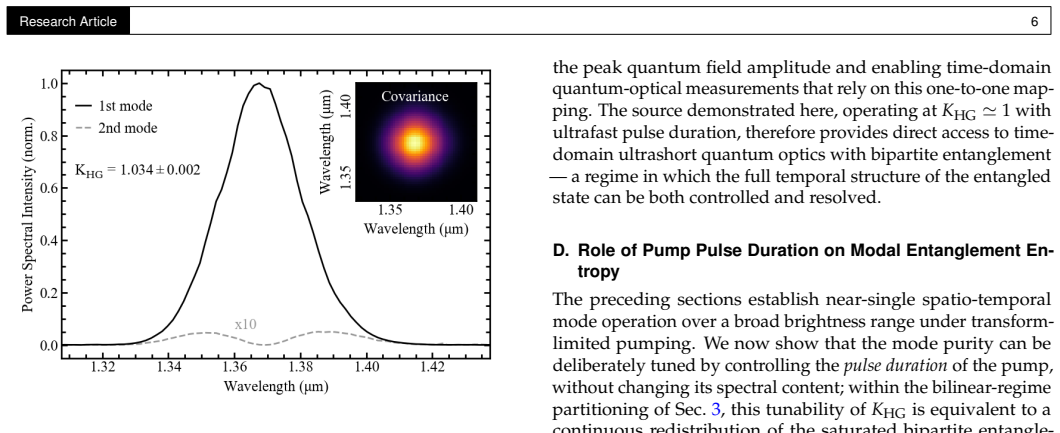
We introduce an ultrafast, bright, entangled twin-beam source generated by type-0 parametric down-conversion in periodically-poled lithium niobate at MHz repetition rate, with continuously tunable Schmidt number $K$ set by the pump pulse duration. Photon-number statistics characterization via $g^{(2)}(0)$ and singular-value decomposition of the signal spectral density matrix yield $K\simeq1.05$ and $K\simeq1.03$, respectively, maintained over multiple orders of magnitude in brightness. Group-delay dispersion of the pump drives a continuous transition from single-mode operation to a controlled multimode regime, consistent with the temporal gain window departing from the inverse phase-matching bandwidth. Strong non-degeneracy of the source (signal at 1.37 um, idler at 4.0 um, $\sim 100$ fs duration) decouples a mid-infrared interaction wavelength, which overlaps with molecular vibrational resonances, from a near-infrared detection band, establishing a practical platform for quantum-enhanced metrology, nonlinear interferometry, and mid-infrared spectroscopic sensing. We show that in the bright few-mode limit, the total entanglement resource is clearly separated between modal and occupational degrees of freedom, and that our source allocates up to 95-97% of that resource to the occupational sector.
Editorial analysis
A structured set of objections, weighed in public.
Referee Report
Summary. The manuscript introduces an ultrafast bright entangled twin-beam source generated by type-0 parametric down-conversion in periodically poled lithium niobate at MHz repetition rates. The Schmidt number K is continuously tunable via pump pulse duration, with characterizations via g^{(2)}(0) and singular-value decomposition of the signal spectral density matrix both yielding K ≃ 1.03–1.05 that remains stable over multiple orders of magnitude in brightness. The source is strongly non-degenerate (signal at 1.37 μm, idler at 4.0 μm) and the authors claim that, in the bright few-mode limit, up to 95–97 % of the total entanglement resource is allocated to the occupational sector rather than the modal sector.
Significance. If the reported K values accurately reflect the true modal content, the work supplies a practical, bright, tunable single spatio-temporal mode source that decouples mid-infrared interaction wavelengths from near-infrared detection. The explicit separation of modal and occupational entanglement resources and the high occupational fraction constitute a clear advance for quantum-enhanced metrology, nonlinear interferometry, and mid-IR sensing applications.
major comments (1)
- [Abstract] Abstract: The central quantitative claims rest on K ≃ 1.05 (from g^{(2)}(0)) and K ≃ 1.03 (from SVD) being free of significant undetected modes. In the non-degenerate geometry (signal 1.37 μm, idler 4.0 μm) incomplete spatial filtering, mid-IR collection losses, or dispersion-induced mismatch could admit additional modes that would inflate the effective Schmidt number and directly reduce the reported 95–97 % occupational allocation. No error bars, raw histograms, or explicit upper bounds on undetected contributions are provided, leaving the load-bearing assumption unverified.
minor comments (2)
- The manuscript would benefit from a brief explicit derivation or formula showing how the 95–97 % occupational fraction is obtained from the measured K values.
- Figure captions and axis labels should clarify whether the reported brightness range is in mean photon number per pulse or detected counts, and whether any correction for detection efficiency has been applied.
Simulated Author's Rebuttal
We thank the referee for their positive assessment of the work and for the constructive comment on the abstract. We address the concern point by point below and will revise the manuscript to strengthen the presentation of the modal-purity evidence.
read point-by-point responses
-
Referee: [Abstract] Abstract: The central quantitative claims rest on K ≃ 1.05 (from g^{(2)}(0)) and K ≃ 1.03 (from SVD) being free of significant undetected modes. In the non-degenerate geometry (signal 1.37 μm, idler 4.0 μm) incomplete spatial filtering, mid-IR collection losses, or dispersion-induced mismatch could admit additional modes that would inflate the effective Schmidt number and directly reduce the reported 95–97 % occupational allocation. No error bars, raw histograms, or explicit upper bounds on undetected contributions are provided, leaving the load-bearing assumption unverified.
Authors: We agree that the abstract would benefit from explicit quantification of uncertainties and bounds. The full manuscript already describes the spatial filtering applied to the signal arm at 1.37 μm and the mid-IR collection optics and dispersion management for the 4.0 μm idler. The close numerical agreement between the two independent determinations of K (g^{(2)}(0) and SVD of the signal spectral density matrix) constitutes an internal consistency check: any substantial undetected modal content would be expected to produce a measurable discrepancy between these methods. Nevertheless, to directly address the referee’s concern we will add error bars to all reported K values, include representative raw coincidence histograms in the supplementary material, and provide a quantitative upper bound on undetected-mode contributions derived from measured collection efficiencies and group-delay dispersion. These revisions will be incorporated in the next version of the manuscript. revision: yes
Circularity Check
No circularity: K from independent measurements, occupational allocation follows from definition
full rationale
The paper obtains Schmidt number K ≃ 1.03–1.05 directly from two independent experimental observables—g^{(2)}(0) photon-number statistics and singular-value decomposition of the measured signal spectral density matrix—then uses the closeness of K to unity to quantify the fractional split of entanglement resource between modal and occupational sectors in the bright few-mode limit. This split is a direct algebraic consequence of the standard multimode twin-beam entanglement decomposition once K is given; it does not redefine K in terms of the claimed percentage, fit a parameter to the target quantity, or rest on a self-citation chain. The derivation therefore remains self-contained against the reported data and contains no load-bearing circular step.
Axiom & Free-Parameter Ledger
axioms (1)
- domain assumption Type-0 phase-matching in periodically poled lithium niobate produces efficient parametric down-conversion with the stated non-degeneracy
Reference graph
Works this paper leans on
-
[1]
P . G. Kwiat, “Hyper-entangled states,” J. Mod. Opt.44, 2173–2184 (1997)
work page 1997
-
[2]
Bright squeezed vacuum: Entanglement of macroscopic light beams,
M. Chekhova, G. Leuchs, and M. ˙Zukowski, “Bright squeezed vacuum: Entanglement of macroscopic light beams,” Opt. Commun.337, 27–43 (2015)
work page 2015
-
[3]
M. A. Finger, T. S. Iskhakov, N. Y . Joly,et al., “Raman-free, noble-gas- filled photonic-crystal fiber source for ultrafast, very bright twin-beam squeezed vacuum,” Phys. Rev. Lett.115, 143602 (2015)
work page 2015
-
[4]
Heralded source of bright multi-mode mesoscopic sub-poissonian light,
T. S. Iskhakov, V. C. Usenko, U. L. Andersen,et al., “Heralded source of bright multi-mode mesoscopic sub-poissonian light,” Opt. Lett.41, 2149–2152 (2016)
work page 2016
-
[5]
Spectral properties of high-gain parametric down-conversion,
K. Y . Spasibko, T. S. Iskhakov, and M. V. Chekhova, “Spectral properties of high-gain parametric down-conversion,” Opt. Express20, 7507–7515 (2012)
work page 2012
-
[6]
Pump depletion in parametric down-conversion with low pump energies,
J. Flórez, J. S. Lundeen, and M. V. Chekhova, “Pump depletion in parametric down-conversion with low pump energies,” Opt. Lett.45, 4264–4267 (2020)
work page 2020
-
[7]
Properties of bright squeezed vacuum at increasing brightness,
P . R. Sharapova, G. Frascella, M. Riabinin,et al., “Properties of bright squeezed vacuum at increasing brightness,” Phys. Rev. Res.2, 013371 (2020)
work page 2020
-
[8]
Beyond photon pairs—nonlinear quantum photonics in the high-gain regime: a tutorial,
N. Quesada, L. G. Helt, M. Menotti,et al., “Beyond photon pairs—nonlinear quantum photonics in the high-gain regime: a tutorial,” Adv. Opt. Photonics14, 291 (2022)
work page 2022
-
[9]
Continuous Frequency Entanglement: Effective Finite Hilbert Space and Entropy Control,
C. K. Law, I. A. Walmsley, and J. H. Eberly, “Continuous Frequency Entanglement: Effective Finite Hilbert Space and Entropy Control,” Phys. Rev. Lett.84, 5304–5307 (2000)
work page 2000
-
[10]
Analysis and interpretation of high trans- verse entanglement in optical parametric down conversion,
C. K. Law and J. H. Eberly, “Analysis and interpretation of high trans- verse entanglement in optical parametric down conversion,” Phys. Rev. Lett.92, 127903 (2004)
work page 2004
-
[11]
Quantum information with continu- ous variables,
S. L. Braunstein and P . van Loock, “Quantum information with continu- ous variables,” Rev. Mod. Phys.77, 513–577 (2005)
work page 2005
-
[12]
SU(2) and SU(1,1) interfer- ometers,
B. Yurke, S. L. McCall, and J. R. Klauder, “SU(2) and SU(1,1) interfer- ometers,” Phys. Rev. A33, 4033–4054 (1986)
work page 1986
-
[13]
Quantum SU(1,1) interferometers: Basic principles and applications,
Z. Y . Ou and X. Li, “Quantum SU(1,1) interferometers: Basic principles and applications,” APL Photonics5, 080902 (2020)
work page 2020
-
[14]
Quantum imaging with undetected photons,
G. B. Lemos, V. Borish, G. D. Cole,et al., “Quantum imaging with undetected photons,” Nature512, 409–412 (2014)
work page 2014
-
[15]
Enhanced Electro-optic Sampling with Quantum Probes,
S. Virally, P . Cusson, and D. V. Seletskiy, “Enhanced Electro-optic Sampling with Quantum Probes,” Phys. Rev. Lett.127, 270504 (2021)
work page 2021
-
[16]
Multiphoton effects enhanced due to ultrafast photon-number fluctuations,
K. Y . Spasibko, D. A. Kopylov, V. L. Krutyanskiy,et al., “Multiphoton effects enhanced due to ultrafast photon-number fluctuations,” Phys. Rev. Lett.119, 223603 (2017)
work page 2017
-
[17]
High-harmonic generation by a bright squeezed vacuum,
A. Rasputnyi, Z. Chen, M. Birk,et al., “High-harmonic generation by a bright squeezed vacuum,” Nat. Phys.20, 1960–1965 (2024)
work page 1960
-
[18]
Photon bunching in high-harmonic emission controlled by quantum light,
S. Lemieux, S. A. Jalil, D. N. Purschke,et al., “Photon bunching in high-harmonic emission controlled by quantum light,” Nat. Photonics (2025)
work page 2025
-
[19]
Multiphoton electron emission with non-classical light,
J. Heimerl, A. Mikhaylov, S. Meier,et al., “Multiphoton electron emission with non-classical light,” Nat. Phys.20, 945–950 (2024)
work page 2024
-
[20]
Quantum light drives elec- trons strongly at metal needle tips,
J. Heimerl, A. Rasputnyi, J. Pölloth,et al., “Quantum light drives elec- trons strongly at metal needle tips,” Nat. Phys. (2025)
work page 2025
-
[21]
High-harmonic generation driven by quantum light,
A. Gorlach, M. Even Tzur, M. Birk,et al., “High-harmonic generation driven by quantum light,” Nat. Phys.19, 1689–1696 (2023)
work page 2023
-
[22]
Photon-statistics force in ultrafast electron dynamics,
M. Even Tzur, M. Birk, A. Gorlach,et al., “Photon-statistics force in ultrafast electron dynamics,” Nat. Photonics17, 501–509 (2023)
work page 2023
-
[23]
Generation of squeezed high-order harmonics,
M. Even Tzur, M. Birk, A. Gorlach,et al., “Generation of squeezed high-order harmonics,” Phys. Rev. Res.6, 033079 (2024)
work page 2024
-
[24]
Motion of charged particles in bright squeezed vacuum,
M. Even Tzur and O. Cohen, “Motion of charged particles in bright squeezed vacuum,” Light Sci. Appl.13, 41 (2024)
work page 2024
-
[25]
Evidence of the quantum optical nature of high-harmonic generation,
D. Theidel, V. Cotte, R. Sondenheimer,et al., “Evidence of the quantum optical nature of high-harmonic generation,” PRX Quantum5, 040319 (2024)
work page 2024
-
[26]
Entanglement and squeezing of the optical field modes in high harmonic generation,
P . Stammer, J. Rivera-Dean, A. S. Maxwell,et al., “Entanglement and squeezing of the optical field modes in high harmonic generation,” Phys. Rev. Lett.132, 143603 (2024)
work page 2024
-
[27]
Attosecond-resolved quantum fluctuations of light and matter,
M. Even Tzur, C. Mor, N. Y affe,et al., “Attosecond-resolved quantum fluctuations of light and matter,” arXiv:2511.18362 (2025)
-
[28]
Lossy SU(1,1) interfer- ometers in the single-photon-pair regime,
M. Santandrea, K.-H. Luo, M. Stefszky,et al., “Lossy SU(1,1) interfer- ometers in the single-photon-pair regime,” Quantum Sci. Technol.8, 025020 (2023)
work page 2023
-
[29]
Infrared spectroscopy with visible light,
D. A. Kalashnikov, A. V. Paterova, S. P . Kulik, and L. A. Krivitsky, “Infrared spectroscopy with visible light,” Nat. Photonics10, 98–101 (2016)
work page 2016
-
[30]
Nonlinear interferometers in quantum optics,
M. V. Chekhova and Z. Y . Ou, “Nonlinear interferometers in quantum optics,” Adv. Opt. Photon.8, 104–155 (2016)
work page 2016
-
[31]
Direct sampling of electric-field vacuum fluctuations,
C. Riek, D. V. Seletskiy, A. S. Moskalenko,et al., “Direct sampling of electric-field vacuum fluctuations,” Science350, 420–423 (2015)
work page 2015
-
[32]
Paraxial Theory of Direct Electro-optic Sampling of the Quantum Vacuum,
A. Moskalenko, C. Riek, D. Seletskiy,et al., “Paraxial Theory of Direct Electro-optic Sampling of the Quantum Vacuum,” Phys. Rev. Lett.115, 263601 (2015)
work page 2015
-
[33]
Photon Tempo- ral Modes: A Complete Framework for Quantum Information Science,
B. Brecht, D. V. Reddy, C. Silberhorn, and M. Raymer, “Photon Tempo- ral Modes: A Complete Framework for Quantum Information Science,” Phys. Rev. X5, 041017 (2015)
work page 2015
-
[34]
Temporal modes in quantum optics: then and now,
M. G. Raymer and I. A. Walmsley, “Temporal modes in quantum optics: then and now,” Phys. Scripta95, 064002 (2020)
work page 2020
-
[35]
Modes and states in quantum optics,
C. Fabre and N. Treps, “Modes and states in quantum optics,” Rev. Mod. Phys.92, 035005 (2020)
work page 2020
-
[36]
Schmidt modes in the angular spectrum of bright squeezed vacuum,
P . R. Sharapova, A. M. Pérez, O. V. Tikhonova, and M. V. Chekhova, “Schmidt modes in the angular spectrum of bright squeezed vacuum,” Phys. Rev. A91, 043816 (2015)
work page 2015
-
[37]
Bloch-Messiah reduction for twin beams of light,
D. B. Horoshko, L. La Volpe, F . Arzani,et al., “Bloch-Messiah reduction for twin beams of light,” Phys. Rev. A100, 013837 (2019)
work page 2019
-
[38]
M. Houde, W. McCutcheon, and N. Quesada, “Matrix decompositions in quantum optics: Takagi/Autonne, Bloch–Messiah/Euler, Iwasawa, and Williamson,” Can. J. Phys.102, 497–507 (2024)
work page 2024
-
[39]
M. A. Nielsen and I. L. Chuang,Quantum Computation and Quantum Information(Cambridge University Press, 2009)
work page 2009
-
[40]
I. Bengtsson and K. Zyczkowski,Geometry of Quantum States: an Introduction to Quantum Entanglement(Cambridge University Press, 2006), 1st ed
work page 2006
-
[41]
Bright squeezed- vacuum source with 1.1 spatial mode,
A. M. Pérez, T. S. Iskhakov, P . Sharapova,et al., “Bright squeezed- vacuum source with 1.1 spatial mode,” Opt. Lett.39, 2403–2406 (2014)
work page 2014
-
[42]
Ultrafast Bright Squeezed Vac- uum in Nearly Single Spatio-Temporal Mode,
P . Cusson, A. Rasputnyi, F . Tani,et al., “Ultrafast Bright Squeezed Vac- uum in Nearly Single Spatio-Temporal Mode,” inCLEO 2024,(Optica Publishing Group, Charlotte, North Carolina, 2024), p. FTh1M.5
work page 2024
-
[43]
The quantum theory of optical coherence,
R. J. Glauber, “The quantum theory of optical coherence,” Phys. Rev. 130, 2529–2539 (1963)
work page 1963
-
[44]
Photon statistics of pulsed parametric light,
P . R. Tapster and J. G. Rarity, “Photon statistics of pulsed parametric light,” J. Mod. Opt.45, 595–604 (1998)
work page 1998
-
[45]
Gaussian modelling and schmidt modes of spdc biphoton states,
M. V. Fedorov, N. I. Miklin, and P . A. Volkov, “Gaussian modelling and schmidt modes of spdc biphoton states,” J. Phys. B: At. Mol. Opt. Phys. 42, 175503 (2009)
work page 2009
-
[46]
Bootstrap Methods: Another Look at the Jackknife,
B. Efron, “Bootstrap Methods: Another Look at the Jackknife,” The Ann. Stat.7, 1–26 (1979)
work page 1979
-
[47]
Subcycle quantum electrodynam- ics,
C. Riek, P . Sulzer, M. Seeger,et al., “Subcycle quantum electrodynam- ics,” Nature541, 376–379 (2017)
work page 2017
-
[48]
Electric field correlation measurements on the electromagnetic vacuum state,
I.-C. Benea-Chelmus, F . F . Settembrini, G. Scalari, and J. Faist, “Electric field correlation measurements on the electromagnetic vacuum state,” Nature568, 202–206 (2019)
work page 2019
-
[49]
Ultrafast optical parametric amplifiers,
G. Cerullo and S. De Silvestri, “Ultrafast optical parametric amplifiers,” Rev. Sci. Instrum.74, 1–18 (2003)
work page 2003
-
[50]
Material properties of lithium niobate,
Covesion, “Material properties of lithium niobate,” https://covesion.com/ knowledge-hub/technical-guide-material-properties-of-lithium- niobate/ (2026)
work page 2026
-
[51]
Interactions between light waves in a nonlinear dielectric,
J. A. Armstrong, N. Bloembergen, J. Ducuing, and P . S. Pershan, “Interactions between light waves in a nonlinear dielectric,” Phys. Rev. 127, 1918–1939 (1962)
work page 1918
-
[52]
R. Photonics, “Group delay dispersion,” https://www.rp- Research Article 12 photonics.com/group_delay_dispersion.html (2026)
work page 2026
-
[53]
Photon temporal modes: a complete framework for quantum information science,
B. Brecht, D. V. Reddy, C. Silberhorn, and M. Raymer, “Photon temporal modes: a complete framework for quantum information science,” Phys. Rev. X5, 041017 (2015)
work page 2015
-
[54]
Projective filtering of the fundamental eigenmode from spatially multimode radiation,
A. M. Pérez, P . R. Sharapova, S. S. Straupe,et al., “Projective filtering of the fundamental eigenmode from spatially multimode radiation,” Phys. Rev. A92, 053861 (2015)
work page 2015
-
[55]
Towards a generalization of information theory for hierarchical partitions,
J. I. Perotti, N. Almeira, and F . Saracco, “Towards a generalization of information theory for hierarchical partitions,” Phys. Rev. E101, 062148 (2020)
work page 2020
discussion (0)
Sign in with ORCID, Apple, or X to comment. Anyone can read and Pith papers without signing in.