Exotic magnetism and persistent spin dynamics in a frustrated Jeff = 1/2 triangular lattice antiferromagnet
Pith reviewed 2026-06-27 02:56 UTC · model grok-4.3
The pith
K3NdTe2O9 shows no long-range order or spin freezing but persistent fluctuating moments down to 50 mK.
A machine-rendered reading of the paper's core claim, the machinery that carries it, and where it could break.
Core claim
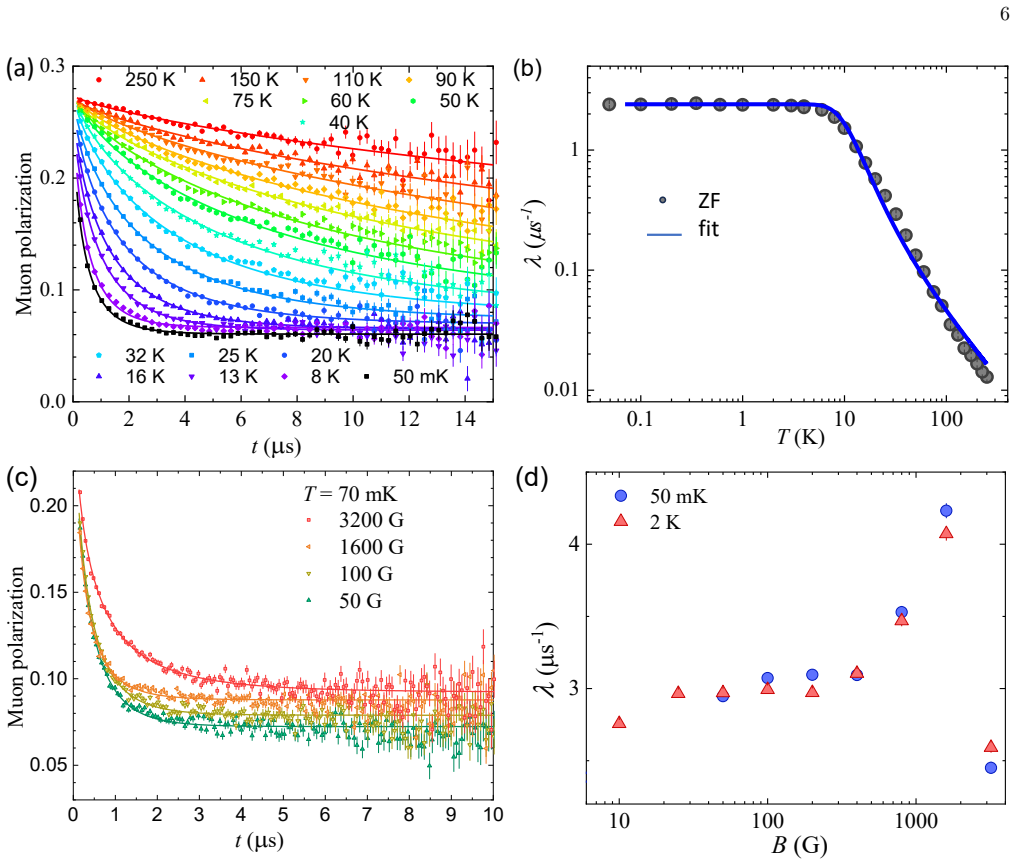
The experiments reveal the realization of a Kramers doublet ground state with Jeff=1/2 moments, well separated from the first excited state, which interact antiferromagnetically with an exchange interaction of ~0.6 K between the Nd3+ moments in the triangular plane. The absence of oscillations and the so-called 1/3 plateau in the zero-field μSR asymmetry down to 50 mK rules out long-range magnetic ordering and spin freezing on the μSR time scale, respectively. The temperature dependence of the zero-field μSR relaxation rate is well described by the Orbach relaxation mechanism, indicating the existence of fluctuating moments in the ground state of this frustrated magnet.
What carries the argument
Zero-field μSR asymmetry and relaxation rate, interpreted through the Orbach mechanism to demonstrate persistent fluctuations of Jeff=1/2 moments on the perfect triangular lattice.
If this is right
- The system realizes exotic magnetism with nontrivial low-energy excitations.
- This new family of rare-earth triangular-lattice antiferromagnets offers a venue for quantum states.
- Persistent spin dynamics occur without conventional ordering or freezing.
- The well-isolated ground state allows study of frustration effects in isolation.
Where Pith is reading between the lines
- The fluctuating moments may correspond to a quantum spin liquid-like state.
- Related compounds could be tuned by chemical substitution while preserving lattice perfection.
- Field-dependent measurements might reveal transitions from the fluctuating regime.
Load-bearing premise
The Nd3+ ions form a structurally perfect triangular lattice with no detectable site disorder.
What would settle it
Observation of oscillations in zero-field μSR asymmetry or a clear departure from the Orbach fit in the relaxation rate below 1 K would indicate ordering or freezing.
Figures
read the original abstract
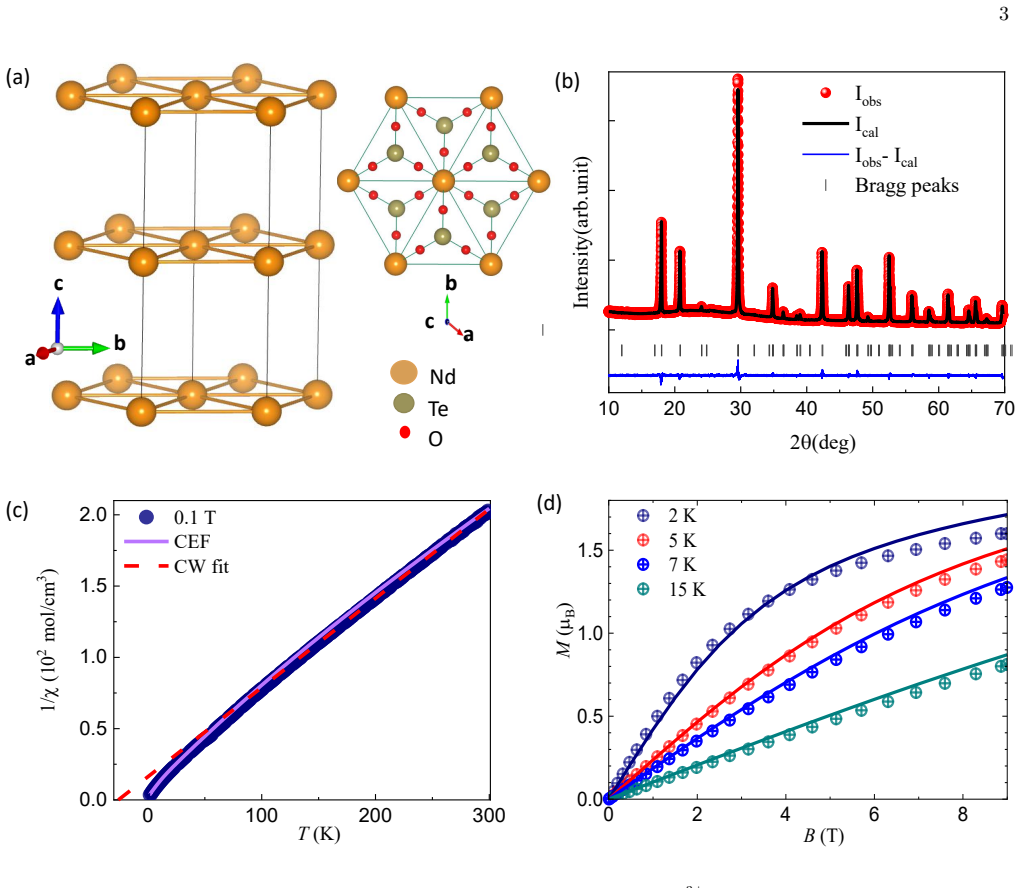
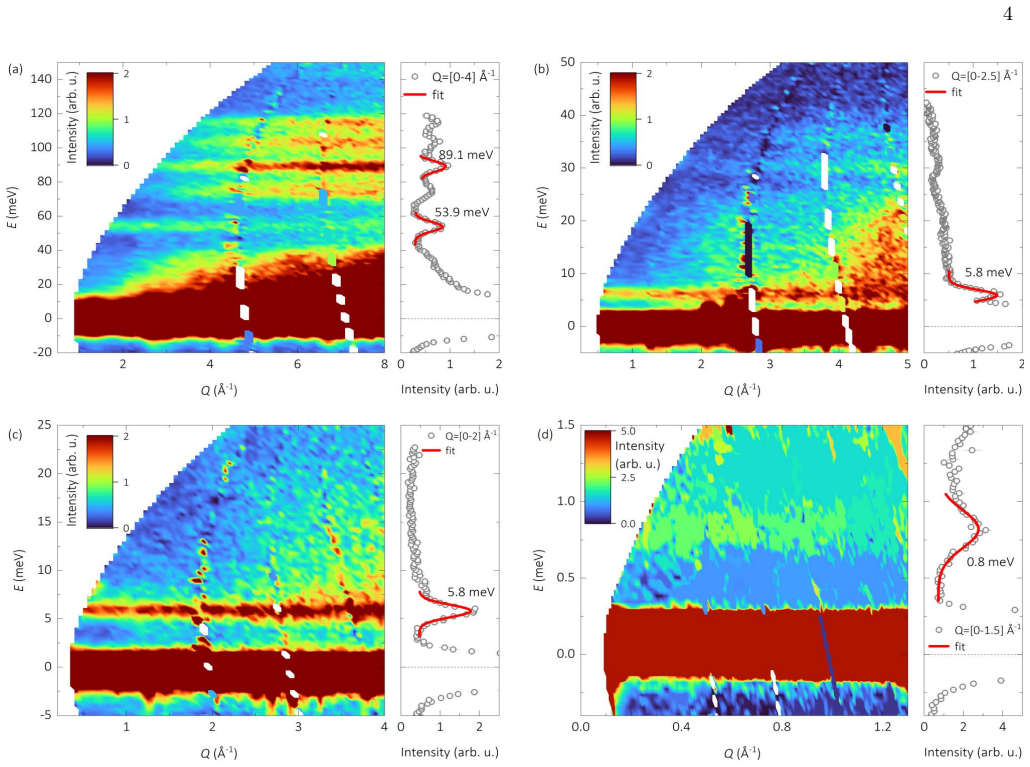
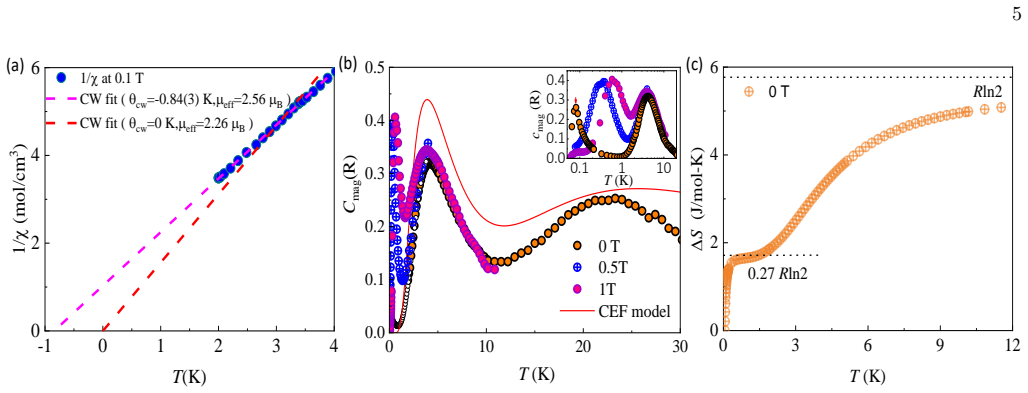
The delicate interplay between competing degrees of freedom, anisotropy, and frustration-induced strong quantum fluctuations in pseudospin-$J_{\rm eff}=1/2$ rare-earth triangular-lattice antiferromagnets offers a promising platform for the experimental realization of exotic states with nontrivial low-energy excitations. Here, we present thermodynamic, inelastic neutron scattering (INS), and muon spin relaxation ($\mu$SR) investigations of the frustrated magnet K$_3$NdTe$_2$O$9$, in which Nd$^{3+}$ ions constitute a structurally perfect triangular lattice with no detectable site disorder. The experiments reveal the realization of a Kramers doublet ground state with $J{\rm eff}=1/2$ moments, well separated from the first excited state, which interact antiferromagnetically with an exchange interaction of $\sim$0.6 K between the Nd$^{3+}$ moments in the triangular plane. The absence of oscillations and the so-called 1/3 plateau in the zero-field $\mu$SR asymmetry down to 50 mK rules out long-range magnetic ordering and spin freezing on the $\mu$SR time scale, respectively. The temperature dependence of the zero-field $\mu$SR relaxation rate is well described by the Orbach relaxation mechanism, indicating the existence of fluctuating moments in the ground state of this frustrated magnet. Our results demonstrate exotic magnetism and persistent spin dynamics down to 50 mK. These observations establish this new family of frustrated rare-earth triangular-lattice antiferromagnets as a promising venue for the experimental realization of nontrivial quantum states with exotic low-energy excitations.
Editorial analysis
A structured set of objections, weighed in public.
Referee Report
Summary. The manuscript reports thermodynamic, inelastic neutron scattering (INS), and muon spin relaxation (μSR) investigations of K₃NdTe₂O₉. It claims that the Nd³⁺ ions form a structurally perfect triangular lattice with no detectable site disorder, realizing a well-isolated Kramers doublet with J_eff = 1/2 moments that interact antiferromagnetically with an exchange of ~0.6 K. Zero-field μSR shows no oscillations and no 1/3 plateau down to 50 mK, ruling out long-range magnetic order and spin freezing on the μSR timescale; the relaxation rate follows an Orbach mechanism, indicating persistent fluctuating moments in the ground state.
Significance. If the structural characterization and μSR interpretations hold, the work identifies a new, clean member of the rare-earth triangular-lattice antiferromagnet family with persistent dynamics down to 50 mK. The combination of thermodynamic, INS, and μSR data, together with explicit support for the absence of site disorder via occupancy and displacement parameters, strengthens the case for using this material to explore exotic low-energy excitations in frustrated magnets.
minor comments (3)
- The value of the exchange interaction (~0.6 K) is stated without specifying the extraction method (Curie-Weiss fit, high-temperature expansion, or INS) or associated uncertainties; add this detail in the thermodynamic or INS section.
- The statement that the temperature dependence of the zero-field μSR relaxation rate is 'well described by the Orbach relaxation mechanism' should include the explicit functional form used, the fitted parameters, and a comparison to alternative models (e.g., Raman or direct processes) to substantiate the preference.
- Figure captions and text should explicitly reference the occupancy and isotropic displacement parameters that support the claim of no detectable site disorder, rather than leaving this as a qualitative statement.
Simulated Author's Rebuttal
We thank the referee for the positive assessment of our work and the recommendation for minor revision. We appreciate the recognition that the combination of thermodynamic, INS, and μSR data, together with the structural characterization, strengthens the case for K₃NdTe₂O₉ as a promising platform for exploring exotic low-energy excitations in frustrated magnets.
Circularity Check
No significant circularity detected
full rationale
This is a purely experimental report on thermodynamic, INS, and μSR measurements of K3NdTe2O9. The key claims (no LRO or spin freezing down to 50 mK, Orbach-type dynamics) rest on direct data inspection (absence of oscillations or 1/3 plateau in asymmetry, temperature dependence of relaxation rate) and standard fitting protocols rather than any derivation chain. No equations, predictions, or uniqueness theorems appear that reduce to fitted inputs or self-citations by construction; the structural perfection assertion is backed by refinement parameters, not asserted circularly.
Axiom & Free-Parameter Ledger
free parameters (1)
- exchange interaction =
~0.6 K
axioms (1)
- domain assumption Nd3+ ions form a structurally perfect triangular lattice with no detectable site disorder
Reference graph
Works this paper leans on
-
[1]
2 and sTable III [51])
with an odd number of electrons andJ= 9/2splits into five Kramers doublets by the CEF (See fig. 2 and sTable III [51]). Figure 3(a) shows the low temperature inverse susceptibility, and the Curie Weiss fit in the temperature range 1.9 K≤T≤ 3.8 K (see SI [25, 51]), indicating that the susceptibil- ity corresponds to the CEF ground-state doublet. The fit yi...
-
[2]
Khatua, B
J. Khatua, B. Sana, A. Zorko, M. Gomilšek, K. Sethu- pathi, M. R. Rao, M. Baenitz, B. Schmidt, and P. Khuntia, Experimental signatures of quantum and topological states in frustrated magnetism, Physics Re- ports1041, 1 (2023)
2023
-
[3]
Balents, Spin liquids in frustrated magnets, nature 464, 199 (2010)
L. Balents, Spin liquids in frustrated magnets, nature 464, 199 (2010)
2010
-
[4]
Lacroix, P
C. Lacroix, P. Mendels, and F. Mila,Introduction to frus- trated magnetism: materials, experiments, theory, Vol. 164 (Springer Science & Business Media, 2011)
2011
-
[5]
S. Yan, D. A. Huse, and S. R. White, Spin-liquid ground state of the s= 1/2 kagome heisenberg antiferromagnet, Science332, 1173 (2011)
2011
-
[6]
Khuntia, M
P. Khuntia, M. Velazquez, Q. Barthélemy, F. Bert, E. Kermarrec, A. Legros, B. Bernu, L. Messio, A. Zorko, and P. Mendels, Gapless ground state in the archetypal quantum kagome antiferromagnet zncu3 (oh) 6cl2, Na- ture Physics16, 469 (2020)
2020
-
[7]
Khuntia, F
P. Khuntia, F. Bert, P. Mendels, B. Koteswararao, A. V. Mahajan, M. Baenitz, F. C. Chou, C. Baines, A. Amato, and Y. Furukawa, Spin liquid state in the 3d frustrated antiferromagnetpbcute 2o6: Nmr and muon spin relax- ation studies, Phys. Rev. Lett.116, 107203 (2016)
2016
-
[8]
Savary and L
L. Savary and L. Balents, Quantum spin liquids: a re- view, Reports on Progress in Physics80, 016502 (2017)
2017
-
[9]
Broholm, R
C. Broholm, R. J. Cava, S. Kivelson, D. Nocera, M. Nor- man, and T. Senthil, Quantum spin liquids, Science367, eaay0668 (2020)
2020
-
[10]
P. W. Anderson, Resonating valence bonds: A new kind of insulator?, Materials Research Bulletin8, 153 (1973)
1973
-
[11]
D. A. Huse and V. Elser, Simple variational wave func- tions for two-dimensional heisenberg spin-½antiferromag- nets, Phys. Rev. Lett.60, 2531 (1988)
1988
-
[12]
Jolicoeur and J
T. Jolicoeur and J. C. Le Guillou, Spin-wave results for the triangular heisenberg antiferromagnet, Phys. Rev. B 40, 2727 (1989)
1989
-
[13]
Bernu, C
B. Bernu, C. Lhuillier, and L. Pierre, Signature of néel order in exact spectra of quantum antiferromagnets on finite lattices, Phys. Rev. Lett.69, 2590 (1992)
1992
-
[14]
Elstner, R
N. Elstner, R. R. P. Singh, and A. P. Young, Finite tem- perature properties of the spin-1/2 heisenberg antiferro- magnet on the triangular lattice, Phys. Rev. Lett.71, 1629 (1993)
1993
-
[15]
S. R. White and A. L. Chernyshev, Neél order in square and triangular lattice heisenberg models, Phys. Rev. Lett.99, 127004 (2007)
2007
-
[16]
Iqbal, W.-J
Y. Iqbal, W.-J. Hu, R. Thomale, D. Poilblanc, and F. Becca, Spin liquid nature in the heisenbergJ1 −J 2 triangular antiferromagnet, Phys. Rev. B93, 144411 (2016)
2016
-
[17]
Zhu and S
Z. Zhu and S. R. White, Spin liquid phase of thes= 1 2 J1 −J 2 heisenberg model on the triangular lattice, Phys. Rev. B92, 041105 (2015)
2015
-
[18]
Hu, S.-S
W.-J. Hu, S.-S. Gong, W. Zhu, and D. N. Sheng, Com- peting spin-liquid states in the spin-1 2 heisenberg model on the triangular lattice, Phys. Rev. B92, 140403 (2015)
2015
-
[19]
Misguich, C
G. Misguich, C. Lhuillier, B. Bernu, and C. Waldtmann, Spin-liquid phase of the multiple-spin exchange hamil- tonian on the triangular lattice, Phys. Rev. B60, 1064 (1999)
1999
-
[20]
Yamamoto, G
D. Yamamoto, G. Marmorini, and I. Danshita, Quantum phase diagram of the triangular-latticexxzmodel in a magnetic field, Phys. Rev. Lett.112, 127203 (2014)
2014
-
[21]
O. I. Motrunich, Variational study of triangular lattice spin-1/2model with ring exchanges and spin liquid state inκ−(ET) 2cu2(CN)3, Phys. Rev. B72, 045105 (2005)
2005
-
[22]
Q. Luo, S. Hu, B. Xi, J. Zhao, and X. Wang, Ground- state phase diagram of an anisotropic spin-1 2 model on the triangular lattice, Phys. Rev. B95, 165110 (2017)
2017
-
[23]
M. D. Kuz’min, Single-ion magnetic anisotropy of rare- earth–transition-metal compounds and its description by means of analytical expressions, Phys. Rev. B51, 8904 (1995)
1995
-
[24]
Skomski and D
R. Skomski and D. Sellmyer, Anisotropy of rare-earth magnets, Journal of Rare Earths27, 675 (2009)
2009
-
[25]
M. Xie, W. Zhuo, Y. Cai, Z. Zhang, and Q. Zhang, Rare- earth chalcogenides: An inspiring playground for explor- ing frustrated magnetism, Chinese Physics Letters41, 117505 (2024)
2024
-
[26]
T. Arh, B. Sana, M. Pregelj, P. Khuntia, Z. Jagličić, M. Le, P. Biswas, P. Manuel, L. Mangin-Thro, A. Ozarowski,et al., The ising triangular-lattice antifer- romagnet neodymium heptatantalate as a quantum spin liquid candidate, Nature Materials21, 416 (2022). 8
2022
-
[27]
Y.-D. Li, X. Wang, and G. Chen, Anisotropic spin model of strong spin-orbit-coupled triangular antiferromagnets, Phys. Rev. B94, 035107 (2016)
2016
-
[28]
Y.-D. Li, X. Wang, and G. Chen, Hidden multipolar or- ders of dipole-octupole doublets on a triangular lattice, Phys. Rev. B94, 201114 (2016)
2016
-
[29]
Z. Zhu, P. A. Maksimov, S. R. White, and A. L. Cherny- shev, Topography of spin liquids on a triangular lattice, Phys. Rev. Lett.120, 207203 (2018)
2018
-
[30]
Iaconis, C
J. Iaconis, C. Liu, G. B. Halász, and L. Balents, Spin Liq- uidversusSpinOrbitCouplingontheTriangularLattice, SciPost Phys.4, 003 (2018)
2018
-
[31]
C. A. Gallegos, S. Jiang, S. R. White, and A. L. Cherny- shev, Phase diagram of the easy-axis triangular-lattice J1−J2 model, Phys. Rev. Lett.134, 196702 (2025)
2025
-
[32]
Melting upon cooling in a quantum magnet
K. Jaksetič, T. Arh, M. Pregelj, M. Gomilšek, M. Dragomir, P. Prelovšek, M. Ulaga, L. Šibav, M. Mal- ovrh, K. Železnikar,et al., Melting upon cooling in a quantum magnet, arXiv preprint arXiv:2605.04611 /10.48550/arXiv.2605.04611 (2026)
work page internal anchor Pith review Pith/arXiv arXiv doi:10.48550/arxiv.2605.04611 2026
-
[33]
T. Dey, A. V. Mahajan, P. Khuntia, M. Baenitz, B. Koteswararao, and F. C. Chou, Spin-liquid behavior inJ eff = 1 2 triangular lattice compound ba3irti2o9, Phys. Rev. B86, 140405 (2012)
2012
-
[34]
Khatua, M
J. Khatua, M. Pregelj, A. Elghandour, Z. Jagličic, R. Klingeler, A. Zorko, and P. Khuntia, Magnetic proper- ties of the triangular-lattice antiferromagnetsba3RB9o18 (r= Yb,Er), Phys. Rev. B106, 104408 (2022)
2022
-
[35]
Khuntia, R
P. Khuntia, R. Kumar, A. V. Mahajan, M. Baenitz, and Y. Furukawa, Spin liquid state in the disordered triangu- lar latticesc 2ga2cuo7 revealed by nmr, Phys. Rev. B93, 140408 (2016)
2016
-
[36]
Khatua, S
J. Khatua, S. Bhattacharya, A. M. Strydom, A. Zorko, J. S. Lord, A. Ozarowski, E. Kermarrec, and P. Khuntia, Magnetic properties and spin dynamics in the spin- orbit drivenJ eff = 1 2 triangular lattice antiferromagnet ba6yb2ti4o17, Phys. Rev. B109, 024427 (2024)
2024
-
[37]
Barik, J
M. Barik, J. Khatua, S. Kim, E. Mun, S. Lee, B. Hitti, G. D. Morris, K.-Y. Choi, and P. Khuntia, Magnetic properties of theJ eff = 1 2 based frustrated triangular lattice antiferromagnetba 4ybrewo12, Phys. Rev. B113, 024434 (2026)
2026
-
[38]
C. Y. Jiang, B. L. Chen, K. W. Chen, J. C. Jiao, Y. Wang, Q. Wu, N. Y. Zhang, M. Y. Zou, P.-C. Ho, O. O. Bernal, D. E. MacLaughlin, and L. Shu, Persistent spin dynamics in the ising triangular-lattice antiferro- magnetba 6nd2ti4o17, Phys. Rev. B111, 155148 (2025)
2025
-
[39]
Kumar, G
S. Kumar, G. Bastien, M. Savinov, P. Proschek, A. Eliáš, K. Załęski, M. Śliwi ńska Bartkowiak, R. H. Colman, and S. Kamba, Crystal field driven magnetoelectricity in the triangular quantum magnetcemgal 11o19, Phys. Rev. B 112, 224431 (2025)
2025
-
[40]
N. Li, A. Rutherford, Y. Y. Wang, H. Liang, Q. J. Li, Z. J. Zhang, H. Wang, W. Xie, H. D. Zhou, and X. F. Sun, Ising-type quantum spin liquid state inprmgal11o19, Phys. Rev. B110, 134401 (2024)
2024
-
[41]
T. Itou, A. Oyamada, S. Maegawa, M. Tamura, and R. Kato, Quantum spin liquid in the spin-1/2triangu- lar antiferromagnetEtme 3Sb[Pd(dmit)2]2, Phys. Rev. B 77, 104413 (2008)
2008
-
[42]
H. A. Kramers, Théorie générale de la rotation paramag- nétique dans les cristaux, Proc. Acad. Amst33(1930)
1930
-
[43]
Orbach, Spin-lattice relaxation in rare-earth salts, Proceedings of the Royal Society of London
R. Orbach, Spin-lattice relaxation in rare-earth salts, Proceedings of the Royal Society of London. Series A. Mathematical and Physical Sciences264, 458 (1961)
1961
-
[44]
W. Liu, Z. Zhang, J. Ji, Y. Liu, J. Li, X. Wang, H. Lei, G. Chen, and Q. Zhang, Rare-earth chalcogenides: A large family of triangular lattice spin liquid candidates, Chinese Physics Letters35, 117501 (2018)
2018
-
[45]
J. Xing, L. D. Sanjeewa, J. Kim, W. R. Meier, A. F. May, Q. Zheng, R. Custelcean, G. R. Stewart, and A. S. Sefat, Synthesis, magnetization, and heat capacity of triangular lattice materialsnaerse 2 andkerse 2, Phys. Rev. Mater. 3, 114413 (2019)
2019
-
[46]
Z. Zhu, B. Pan, L. Nie, J. Ni, Y. Yang, C. Chen, C. Jiang, Y. Huang, E. Cheng, Y. Yu,et al., Fluctuating magnetic droplets immersed in a sea of quantum spin liquid, The Innovation4, 10.1016/j.xinn.2023.100459 (2023)
-
[47]
M. M. Bordelon, E. Kenney, C. Liu, T. Hogan, L. Posthuma, M. Kavand, Y. Lyu, M. Sherwin, N. P. Butch, C. Brown,et al., Field-tunable quantum disor- dered ground state in the triangular-lattice antiferromag- net naybo2, Nature physics15, 1058 (2019)
2019
-
[48]
Sibav, M
L. Sibav, M. Lozinsek, Z. Jaglicic, T. Arh, P. Khuntia, A. Zorko, and M. Dragomir, Optimized flux single- crystal growth of the quantum spin liquid candidate ndta7o19 and other rare-earth heptatantalates, erta7o19 and gdta7o19, Crystal growth & design25, 4646 (2025)
2025
-
[49]
Y. Lv, Y. Wang, Y. Dou, A. Li, J. Tang, O. S. Volkova, A. N. Vasiliev, and H. Lu, Synthesis and characteriza- tions of two-dimensional rare-earth magnetic compounds re2o2cn2 (re= nd, dy, gd) with a frustrated triangular spin–lattice, Crystal Growth & Design25, 2446 (2025)
2025
-
[50]
J. Xing, S. Mu, E. S. Choi, and R. Jin, Candidate spin- liquid ground state in csndse2 with an effective spin- 1/2 triangular lattice, Communications Materials5, 45 (2024)
2024
-
[51]
J. Gaudet, D. Reig-i Plessis, B. Wen, T. J. Hicken, J. A. Krieger, J. P. Embs, H. Luetkens, A. A. Aczel, S. A. Calder, M. B. Stone,et al., Vanishing ordered mo- ment in the frustrated triangular lattice antiferromag- net cundo2, npj Quantum Materials 10.1038/s41535-026- 00854-y (2026)
-
[52]
See the supplemental material for additional experimen- tal details, extended discusions, and supporting figures, Submitted as a part of this manuscript
-
[53]
P. Hall, A. Pidduck, and C. Wright, Inelastic neutron scattering by water adsorbed on silica, Journal of Colloid and Interface Science79, 339 (1981)
1981
-
[54]
Miskowiec, J
A. Miskowiec, J. L. Niedziela, M. C. Kirkegaard, and A. E. Shields, Analysis of water coupling in inelastic neutron spectra of uranyl fluoride, Scientific Reports9, 10476 (2019)
2019
-
[55]
L. Yang, Y. Sun, X. Deng, W. Cao, X. Ma, Y. Xiao, Z. Wang, Z. Hu, X. Hao, Y. Yuan, Z. Qin, W. Luo, Q. Ren, X. Tong, M. Aouane, M. D. Le, Y. Shi, Y. Qi, D. Adroja, and H. Luo, Crystalline electric field excita- tions in the weyl semimetalsrAlSi(r= Ce,Pr,Nd), Phys. Rev. B112, 054439 (2025)
2025
-
[56]
Nakatsuji, Y
S. Nakatsuji, Y. Nambu, H. Tonomura, O. Sakai, S. Jonas, C. Broholm, H. Tsunetsugu, Y. Qiu, and Y. Maeno, Spin disorder on a triangular lattice, science 309, 1697 (2005)
2005
-
[57]
Le Yaouanc and P
A. Le Yaouanc and P. D. De Reotier,Muon spin ro- tation, relaxation, and resonance: applications to con- densed matter, 147 (OUP Oxford, 2011)
2011
discussion (0)
Sign in with ORCID, Apple, or X to comment. Anyone can read and Pith papers without signing in.